- Product Description Description
- Table of Contents TOC
- List of Table & Figure LOT
- Get Free Sample PDF Sample PDF
Market Size, 2025
$426.53 MnMarket Estimate, 2026
$568.14 MnMarket Forecast, 2034
$5,629.77 MnCAGR, 2026–2034
33.2%Executive Summary: Europe Deep Learning Market
- Market Scope: Comprehensive European deep learning industry analysis covering software/services offerings, application domains, end-use verticals, country leadership frameworks, strategic corporate developments, and competitive landscapes.
- Market Valuation: Valued at USD 426.53 million (2025), estimated at USD 568.14 million (2026), and projected to reach USD 5,629.77 million by 2034, registering a strong CAGR of 33.2% (2026–2034).
- Primary Growth Drivers: Stringent EU regulatory frameworks like the AI Act fostering trustworthy AI, public investment in sovereign computing via EuroHPC, precision medicine and sustainable manufacturing integration, and demand for explainable AI. Restraints include fragmented GDPR data governance and specialized AI talent shortages.
Key Market Segment Metrics (2026–2034)
| Category | Leading Segment / Country (Position) | Fastest-Growing Segment |
|---|---|---|
| By Offering | Software segment (dominated with a 52.5% share in 2025) | Services (fastest-growing segment expanding at a CAGR of 28.4% from 2025–2033) |
| By Application | Image recognition (led applications with a 36.2% share in 2025) | Video surveillance and diagnostics (growing at a CAGR of 26.8%) |
| By End-Use Vertical | Healthcare (secured largest end-use share at 29.9% in 2024) | Automotive (predicted to witness highest CAGR of 29.1% from 2025–2033) |
| By Region / Country | Germany (led regional market with a 19.3% share in 2024, followed by UK) | Sweden (anticipated to expand considerably due to sustainability-oriented AI innovation) |
Major Market Players & Market Structure
Market Structure: Highly strategic European deep learning ecosystem driven by foundational research in medical imaging, CUDA exascale model training partnerships with EuroHPC, and energy-conscious business process platforms tracking carbon impact per inference.
Key Companies: NVIDIA Corporation, Google LLC (Alphabet Inc.), Microsoft Corporation, IBM Corporation, Intel Corporation, Amazon Web Services Inc., Meta Platforms Inc., Apple Inc., OpenAI, Siemens AG, SAP SE, Bosch Sensortec GmbH, Qualcomm Incorporated, Hewlett Packard Enterprise, Accenture plc, Capgemini SE, Dassault Systèmes SE, Infosys Limited, Tata Consultancy Services Limited, and Advanced Micro Devices Inc.
Europe Deep Learning Market Size
The Europe Deep Learning Market is projected to grow from USD 426.53 million in 2025 to USD 568.14 million in 2026 and reach USD 5,629.77 million by 2034, registering a CAGR of 33.20% from 2026 to 2034.
Deep learning is a specialized field of machine learning (ML) that uses multi-layered artificial neural networks to automatically learn patterns and features from vast amounts of raw data (such as images, text, or audio), enabling systems to perform complex tasks and make intelligent decisions with minimal human intervention. In Europe, this technology is rapidly transitioning from experimental research to operational deployment across health,thcare manufa, manufacturing, finance, nance, and public services. The regional ecosystem is distinguished by a strong empha,, sis on ethical AI governance, data pr,ivacy and human-centric design principles enshrined in frameworks such as the EU AI Act. According to Eurostat data from the 2025survey, 41.17% of large enterprises in the EU used AI technologies. This marks a notable increase from the previous year. In 2024, 13.5% used AI technologies, an increase of 5.5 percentage points from the year before. Also, in 2023, the share was approximately 8% for all enterprises using AI. The European public sector is increasingly exploring and piloting the use of artificial intelligence in key areas such as medical imaging, climate modeling, and industrial predictive maintenance. In addition, Europe's first exascale machine, JUPITER, located in Germany, was inaugurated in September 2025. It is a highly energy-efficient system (ranking #1 on the Green500 list) and is expected to become fully operational in late 2025/early 2026, marking a significant milestone for European computing capabilities. These developments position deep learning not merely as a technological tool but as a strategic enabler of Europe’s digital sovereignty and green transition objectives.
MARKET DRIVERS
Stringent Regulatory Frameworks Fostering Trustworthy AI Adoption
The European Union's comprehensive regulatory approach establishes clear boundaries for ethical deployment. This framework is, paradoxically, accelerating the growth of theEuropeane deep learning market. The EU AI Act classifies deep European systems used in critical domains s, such as healthcare, recruitment, and l,, aw enforcement, as high-risk,k thereby mandating transparent data governance and human oversight. National market surveillance authorities and the newly established AI Office are preparing for the eventual enforcement of the EU AI Act, which will involve overseeing AI system conformity assessments to ensure fundamental rights safeguards. This regulatory clarity reduces legal uncertainty for enterprises and builds public trust e, enabling broader integration in sensitive sectors. For instance, hospitals in Germany and the Netherlands have deployed deep learning based diagnostic assistants only after obtaining certification under the new Medical Device Regulation, which explicitly incorporates algorithmic accountability. T,, he EU AI Act's risk-based structure is generally anticipated to provide a clear legal framework, which many surveyed European enterprises indicate may enhance their confidence in procuring AI solutions once the rules are fully applicable. Consequently, regulation functions not as a barrier but as a market enabler by standardizing evaluation protocols and encouraging investment in auditable, reproducible models.
Expansion of AI Ready Public and Resea,,rch Computing Infrastructure
The region’s strategic investment in sovereign computing capacity is fuelling the expansion of theEuropean deepp learning market. This expansion is removing a historic barrier to deep learning innovation. The European Union's EuroHPC initiative supports the deployment of multiple advanced supercomputing systems, some of which are optimized for large-scale neural network training. These systems have provided substantial computing time to both academic and industrial AI projects. Individual national programs enhance this effort, with supercomputers in various countries, such as France and Germany, allocating significant capacity to deep learning research and providing access schemes for businesses. A considerable number of small and medium enterprises across the region utilize public artificial intelligenceassistng resources, which assistin managing their model development expenses. Furthermore, the European Open Science Cloud now integrates curate,d dataset,s from healthcare transport and energy sectors,ectors enabling faster model validation without violating GDPR. This coordinated infrastructure eliminates reliance on non-European cloud platforms and supports the development of domain-specific models tailored to European languages,s industrial standards,, rds and societal values.
MARKET RESTRAINTS
Fragmented Data Access and Privacy Constraints Across Jurisdictions
Fragmented data governance and stringent privacy enforcement restrict the growth of the European deep learning market. The restriction is despite the abundant European generation. The General Data Protection Regulation prohibits the indiscriminate collection and processing of personal data, even for AI training,, ng without explicit purpose limitation and data minimization. Cross-border data sharing proposals face challenges due to varied national interpretations of anonymization standards. This impedes the creation of large-scale multimodal datasets essential for robust deep learning models, particularly in medical imaging and behavioural analytics. The implementation of new technologies is sometimes delayed by restrictions on pooling data across different member states. Moreover, the lack of standardized data spaces under the Data Governance Act has slowed the emergence of sectoral data marketplaces. Progress in developing federated data ecosystems is slow, even with dedicated initiatives. These structural barriers increase model development time and cost and disproportionately affect startups lacking legal resources to navigate dis, tinct regulatory environments, thereby slowing down the velocity of data-intensive applications.
Shortage of Specialized AI Talent and Academic Industry Disconnect
The region confronts a major deficit in deep learning expertise that constrains model development, deployment, and maintenance, and negativelEuropeanancts the expansion of the European deep learning market. Academic institutions produce strong theoretical researchers but often lack alignment with industrial needs, such as model optimization for edge devices or MLOps pipelines, and engineering. As per research, a notable observation is that a majority of artificial intelligence master's graduates lack practical experience with prominent, large-scale distributed training frameworks. This gap forces companies to either outsource development or engage in costly upskilling. Moreover, brain drain remains acute. It has been observed that a number of artificial intelligence PhDs trained in Europe choose to relocate to other regions due to factors like compensation and availability of computing resources. National upskilling programs are scaling but cannot yet offset systemic underinvestment in applied AI education. Europe risks becoming reliant on foreign AI tech if it doesn't fix its AI skills shortage, despite leading in regulations.
MARKET OPPORTUNITIES
Integration of Deep Learning into Precision Medicine and Diagnostics
The convergence of deep learning with the continent’s advanced healthcare systems offers a potential opportunity in precision medicine, which is expected to drive the growth of theEuropeane deep learning market. Hospitals across the region are deploying convolutional neural networks to analyze radiological and histopathological images with diagnostic accuracy rivaling human experts. Diagnostic centers across the European Union have implemented certified deep learning tools to assist in detecting lung nodules, screening for diabetic retinopathy, and triaging stroke cases. Specialized medical networks have integrated federated learning protocols to facilitate model training on distributed patient data while keeping sensitive records decentralized. Multicenter clinical validation studies indicate that AI-assisted diagnosis can decrease interpretation time while preserving high levels of sensitivity. Furthermore, the upcoming European Health Data Space will enable secure cross-border access to anonymized imaging datasets, accelerating algorithm validation. This ecosystem of clinical rigor, regulatory approval, and data infrastructure positions Europ,,e to lead in clinically validated deep learning rather than generic pattern recognition.
Deployment of Industrial AI for Sustainable Manufacturing
AI is emerging as a cornerstone of the region’s green industrial transformation by optimizing energy use, material efficiency, and predictive maintenance, which in turn provides fresh prospecEuropean the expansion of the European deep learning market. In the automotive and steel sectors, RS neural networks analyze sensor streams from production lines to minimize waste and emissions in real time. AI-driven process optimization in manufacturing has led to a notable decrease in specific energy consumption. European Union legislation encourages the use of artificial intelligence for monitoring carbon capture and storage systems. Companies have deployed computer vision systems to detect microdefects in steel coils, reducing scrap rates. Numerous manufacturing sites have adopted artificial intelligence programs that connect machine learning to circular supply chain decisions. These applications align economic competitiveness with climate goals, creating a uniquely European value proposition where AI ser,,ves not only productivity but planetary boundaries.
MARKET CHALLENGES
Explainability and Algorithmic Bias in High-Stakes Decision Systems
The opacity of complex neuraHigh-Stakesconflicts with the region’s legal requirements for contestable and explainable automated decisions, which is a persistent challenge in Europe deep learning market. High-risk Act mandates that high-risk systems provide meaningful explanations for their outputs,u,tputs particularly in hiring, credit scoring, and public benefits allocation. However, deep learning models,s especially visi, on and language, ns operate as black boxes, making it difficult to trace causal reasoning. Efforts to retrofit interpretability through techniques like SHAP or LIME often degrade performance or introduce new vulnerabilities. Regulators might limit the use of these technologies in important areas, slowing down their widespread business adoption, unless we create inherently understandable systems or use consistent checking procedures.
Energy Intensity and Environmental Footprint of Model Training
The computational demands of training large deep learning models pose a growing sustainability problem that contradicts the region’s climate commitments and hinders the expansion of the European deep learning market. Developing advanced vision models results in notable carbon dioxide equivalent emissions. Data centers and artificial intelligence clusters are experiencing growth in total electricity consumption. The variable nature of renewable energy sources can present challenges for the consistent power requirements of model training. Regulatory frameworks now mandate that large organizations report the environmental footprint of their digital operations and artificial intelligence development. This regulatory pressure forces firms to either downscale modcarbon-awarely or invest in carbon-aware comp, uting which remains nascent. Startups without access to green data centers face reputational and compliance risks. Europe’s leadership in ethical AI may be compromised by its carbon footprint, unless there are coordinated policies for energy-efficient architectures, model sharing, and carbon budgeting for AI.
REPORT COVERAGE
| REPORT METRIC | DETAILS |
| Market Size Available | 2025 to 2034 |
| Base Year | 2025 |
| Forecast Period | 2026 to 2034 |
| Segments Covered | By Solution, ApplicationType End Useand Region. |
| Various Analyses Covered | Global, Regional and Country-Level Analysis, Segment-Level Analysis, Drivers, Restraints, Opportunities, Challenges; PESTLE Analysis; Porter’s Five Forces Analysis, Competitive Landscape, Analyst Overview of Investment Opportunities |
| Countries Covered | UK, France, Spain, Germany, Italy, Russia, Sweden, Denmark, Switzerland, Netherlands, Turkey, Czech Republic, Rest of Europe |
| Market Leaders Profiled | NVIDIA Corporation, Google LLC (Alphabet Inc.), Microsoft Corporation, IBM Corporation, Intel Corporation, Amazon Web Services, Inc. (AWS), Meta Platforms, Inc. (formerly Facebook, Inc.), Apple Inc., OpenAI, Siemens AG, SAP SE, Bosch Sensortec GmbH, Qualcomm Incorporated, Hewlett Packard Enterprise (HPE), Accenture plc, Capgemini SE, Dassault Systèmes SE, Infosys Limited, Tata Consultancy Services Limited, Advanced Micro Devices, Inc. (AMD) |
SEGMENTAL ANALYSIS
By Solution Insights
The software segment dominated the European deep learning market by holding a 52.5% share in 2025Europe leading position of the software segment is credited to the region’s emphasis on algorithmic innovation withi,,n a regpre-trainednvironment where pre-trained models and development frameworks serve as the primary value layer. Moreover, the proliferation of open source and commercial deep learning libraries tailored to European compliance requirements also drives the growth of this segment. European startups are increasingly integrating specialized modules for interpretability and bias detection into established artificial intelligence frameworks to align with regional regulatory standards. National AI strategies have further incentivized software development. Public funding is being directed toward the development of secure and dependable software stacks for artificial intelligence. A further growth factor is the rise of vertical-specific software platforms that embed deep learning flows without requiring in-house AI expertise. Numerous medical imaging software suiin-houseuring integrated deep learning, have received certification, allowing clinical professionals to utilize artificial intelligence within existing image management environments. Similarly, manufacturing software vendors offer predictive maintenance modules powered by neural networks as standard features in their digital twin platforms. This embedded approach lowers adoption barriers for non-tech enterprises and aligns with Europe’s preference for human-in-the-loop AI rather than fully autonomous systems. The software layer thus acts as the critical enabler that translates hardware power into compliant,t actionable intelligence across regulated sectors.
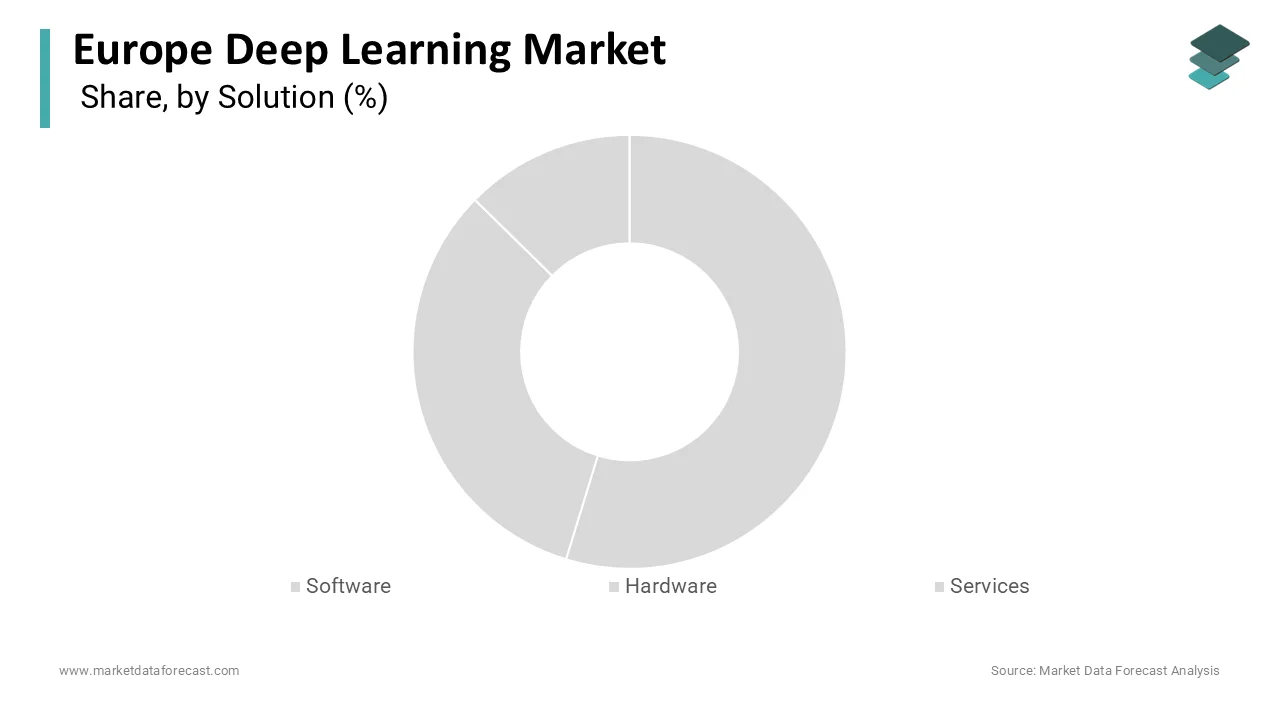
The services segment is on the risfastest-growinged to be the fastest-growing segment in the market by witnessing a CAGR of 28.4% from 2025 to 2033. The rapid acceleration of the services segment is fuelled by the complexity oproduction-grademaintaining production grade deep learning systems in compliance with the continent’s evolving regulatory landscape. In addition, an additional growth enabler is the demand for AI governance and audit services as organizations seek to certify their models under the EU AI Act. According to research, a notable number of consulting firms in the EU now offer algorithmic impact assessments with certifications f,,rom national notified bodies rising. Enterprises require expert support not only in model validation but also in data lineage d,ocumentation continuous monitoring, and human oversight design. A different driver of this segment is the surge in managed MLOps services that ensure model performance stability and security throughout the lifecycle. As per sources, a portion of large European enterprises outsourced model deployment and monitoring to specialized AI service providers due to internal talent shortages. These services include federated learning, rated learning,g orchestration, differential privacy implementationcarbon-awareaware inference sche andg all tailored to European infrastructure and legal norms. Furthermore, national AI hubs in France S, Sweden,weden and the Netherlands have partnered with service integrators to deliver subsidized AI adoption packages for small and medium enterprises. This ecosystem of compliance engineering and operational support transforms deep learning from a one-time project into a sustainable service relationship, enabling scalable, trustworthy adoption across the region.
By Application Insights
The image recognition segment led the European deep learning market by capturing a share of 36.2% inEuropean. The supremacy of the image recognition segment is attributed to the maturity of convolutional neural networks for visual tasks and strong demand from regulated sectors requiring objective diagnostic or inspection capabilities. Apart from these, a further key driver of this segment is the integration of deep learning into medical imaging, where radiologists use AI to detect anomalies with high precision. Regulatory pathways for these tools are now well established under the Medical Device Regulation, creating a predictable market entry route. An additional st,,rengthening factor i,,s industrial quality control,l where vision systems inspect products at high speed and consistency. The European Commission further promotes such adoption through the AI Factories initiative, ve which funded many smart manufacturing demonstrators,strators each featuring image recognition for process optimization. Unlike voice or video, analytics image recognition offers a clear return on investment through reduced waste, improved safety,afety and regulatory compliance without the privacy intricacies of continuous audio or behavioural monitoring,oring making it the most widely accepted deep learning application across European institutions.
The video surveillance and diagnostics segment is expected to exhibit a noteworthy CAGR of 26.8% during the forecast period, owing to the convergence of public safety mandates, data advanced edge computing, and privacy-preserving AI techniques that align with European values. Moreover, the deployment of anonymized behavioral analytics in urban mobility and critical infrastructure also contributes to the expansion of this segment. European cities are increasingly exploring and piloting innovative crowd management systems that use privacy-enhancing technologies, such as on-device processing and anonymization methods, to monitor public spaces effectively while adhering to strict data protection regulations. These systems support both emergency response and climate adaptation by optimizing pedestrian zones. A different growth accelerator of this segment is the use of video diagnostics in industrial predictive maintenance, where continuous visual monitoring of machinery prevents catastrophic failures. The energy industry is increasingly leveraging digitalization and advanced analytics, including machine learning and artificial intelligence, to enhance operational efficiency and maintenance, which helps in reducing the frequency and duration of unplanned outages in power generation facilities across Europe. The technology is also gaining traction in rail infrastructure. Crucially, our European developers are pioneering privacy by design architectures such as federated video analyticswhere raw footage never leaves the premises; only encrypted feature vectors are transmitted. This technical legal alignment enables rapid scalinvideo-basedbased deep learning without compromising fundamental rights.
By End Use Insights
The healthcare segment secured the largest share of 29.9% of the European deep learning market in 2024. The leading position of the healthcare segment is propelled by the region’s a,,dvanced public health systems, strong medical research base, and regulatory frameworks that facilitate clinical AI integration. In addition, the urgent need to address radiologist shortages and diagnostic backlogs is another major driver of this segment. Deep learning based image analysis tools approved under the Medical Device Regulation now assist in prioritizing urgent cases and automating measurement,s thereby improving throughput without compromising accuracy. A further stimulant of this segment is Europe’s command in multicenter clinical AI validation. The European Reference Networks have established standardized protocols for evaluating deep learning models across dozens of hospitals simultaneously. Public-private partnerships like the Innovative Health Initiative (IHI) and its predecessor, the Innovative Medicines Initiative (IMI), are actively involved in advancing the use of artificial intelligence and real-world data in healthcare research across Europe. These initiatives foster collaborative projects that develop foundational methodologies and platforms to improve the efficiency and design of clinical studies, ultimately generating the robust evidence needed to inform regulatory and reimbursement decisions by national health systems. Furthermore, the upcoming EurHealthcross-bordewillll enable secure cross-border access to anonymized imaging data,asets accelerating model training while preserving data sovereignty. This ecosystem of clinical need, regulatory, and collaborative validation solidifies healthcare as the dominant and most trusted end use for deep learning in Europe.
The automotive segment is predicted to witness the highest CAGR of 29.1% from 2025 to 2033. The swift expansion of the automotive segment is fuelled by the continent’s aggressive transitiosoftware-definedfined electric vehicles and advanced driver assistance systems that rely fundamentally on deep learning for perception and decision making. An additional driver is the implementation of General Safety Regulation Ph, ase 2, which mandates from July 2025that all new vehicles sold in the EU include intelligent speed assistance, stance driver drowsiness detection, nd automated emergency braking, aking all powered by convolutional and recurrent neural networks processing data from cameras, radars, ar and lidar. A different growth enablerin-vehicleegment is the rise of in-vehicle AI assistants that understand natural language accents and context to control infotainment climate and navigation systems. Furthermore, European Oonboardnvesting heavily in onboard AI chips to process data locally,lly ensuring low latency and compliance with data localization expectations. The rapid evolution of vehicles into mobile AI platforms means the automotive sector is poised to surpass even the healthcare industry in terms of deep learning intensity, driven by the multitude of sensors, models, and real-time inference demands in each new car.
COUNTRY LEVEL ANALYSIS
United Kingdom Deep Learning Market Analysis
The United Kingdom waEuropeantop performer in the European deep learning market by capturingworld-classare in 2024. Its world-class university research base, strong fintech and healthtech ecosystems, and early adoption of pro-innovation AI regulation have contributed to the growth of the UK market. Public investment supports the AI Acceleration Network, which connects emerging AI companies with public sector data and computational resources. A significant number of deep learning startups operate across major UK cities, with many receiving certification for applications in health and financial services. Deep learning tools are being increasingly deployed within the health system to aid in critical screening and detectio,,n processes. Despite Brexit,t the UK maintains strong technical alignment with EU standards through participation in Horizon Europe and the Global Partnership on AI, enabling continued collaboration and market access.
Germany Deep Learning Market Analysis
Germany was the next prominent player in tEuropeanope deep learning market and accounted for a 19.3% share in 2024. The demand for deep learning in the German market stems from its industrial AI leadership and engineering-driven AI adoption. The country’s deep learning ecosystem is anchored in the manufacturing of automotive and machinery sectors, where AI enhances precision and efficiency. Numerous manufacturing facilities are adopting advanced computational systems for anticipating equipment maintenance needs and managing product excellence. Research organizations are creating specialized tools for inspecting assembly joints and categorizing energy storage components that are subsequently made available to small and medium enterprises. Frameworks for testing regulations have cleared several high-risk automated solutions, including self-operating transport units and software for clinical assessments, to streamline the adoption of verified technologies. This is the fusion of industrial rigor, academic excellence, nd regulatory pragmatism that solidifies Germany’s position as Europe’s AI engineering powerhouse.
France Deep Learning Market Analysis
France continues Europeanana major European country in the European deep learning market due to strong momentum in sovereign AI infrastructure and public sector deployment. The country has prioritized digital sovereignty by investing in an AI champion and computing capacity. A prominent national computing resource has provided extensive processing power to numerous advanced machine learning initiatives, covering both linguistic research and environmental modeling. Government funding strategies are allocating substantial financial resources towards artificial intelligence, with particular emphasis on applications within the healthcare and national security domains. A number of nationally recognized projects involving advanced computational systems for environmental forecasting, legal document examination, and defense-related image analysis have been initiated. Startups have gained global recognition while maintaining Eurste-ledstate-leda governance. This state-led ecosystem positions France as a strategic node in Europe’s quest for technological autonomy.
Netherlands Deep Learning Market Analysis
The Netherlands holds a noteworthy position in the European deep learning market by serving as a hub for AI ethics research and cross-border data innovation. The country’s deep learning market thrives on its dense network of universities,s tech ccompanies and international institutions. Partnerships between various sectors are supporting machine learning initiatives that emphasize ethical applications in food production, supply chain management, and clinical care. Clinical settings are testing decentralized learning frameworks that allow collaborative model improvement while maintaining the confidentiality of sensitive individual records. National researchers are contributing a notable portion of regional academic work focused on making automated systems more transparent and understandable. The presence of the European Medicines Agency and the European Data Protection Board in Amsterdam further attractscompliance-focusedd AI developers. This unique b, lend of technical excellence,ellence regulatory proximity, and collaborative culture makes the Netherlands a laboratory for trustworthy AI at scale.
Sweden Deep Learning Market Analysis
Sweden is anticipated to expand considerably in the European deep learning market from 2025 to 2033 and is recognized for its sustainability-oriented AI innovation. The country leverages its clean energy grid and digital public infrastructure to develop low-carbon AI solutions. A significant portion of newly fundlow-carbonogy ventures is prioritizing environmental applications, such as machine learning for tracking forest resources, managing power grids, and monitoring material reuse. Academic institutions have introduced specialized advanced degree programs focused on sustainable computing to train professionals in improving the operational efficiency of automated models. National industrial testing environments are facilitating the validation of energy-efficient computational systems within diverse commercial settings to reduce the power required for processing data. The Swedish Data Protection Authority also issued the EU’s first guidelines on carbon impact disclosure for AI services, aligning environmental and digital policy. This commitment to planetary boundaries within AI development distinguishes Sweden as a leader in sustainable deep learning.
COMPETITIVE LANDSCAPE
Competition in the European deep learning market is defined by a tension between global technological leadership and regional regulatory sovereignty. Multinational, cutting-edge, aand cutting-edgeresearch but must adapt to Europe’s unique emphashuman-centricent, reliable, trustworthy A. In contrasEuropean startups and industrial software providers compete through domain expertise, risk compliance readiness, and the local data ecosystems. The market is not won by model size alone but by the ability to demonstrate conformity with the EU AI Act data protection rules and environmental standards. Academic institutions act as critical spin-off bridges with many spin-offs commercializing ethically designed architectures. Public procurement increasingly favors vendors with auditable development processes and CE marking for AI systems. This environmhigh-integrityfragmented yet high-integrity competitive landscape where trust, trust transp,arency and contextual relevance outweigh raw performance metrics. As a result, differentiation hinges on responsible deployment rather than algorithmic novelty alone.
KEY MARKET PLAYERS
Some of the companies that are playing a dominating role some europe deep learning market include
- NVIDIA Corporation
- Google LLC (Alphabet Inc.)
- Microsoft Corporation
- IBM Corporation
- Intel Corporation
- Amazon Web Services, Inc. (AWS)
- Facebook, Inc. (Meta Platforms, Inc.)
- Apple Inc.
- OpenAI
- Siemens AG
- SAP SE
- Bosch Sensortec GmbH
- Qualcomm Incorporated
- Hewlett Packard Enterprise (HPE)
- Accenture plc
- Capgemini SE
- Dassault Systèmes SE
- Infosys Limited
- Tata Consultancy Services Limited
- Advanced Micro Devices, Inc. (AMD)
TOP LEADING PLAYERS IN THE MARKET
- Google DeepMind, headquartered in London, Europeanpivotal force in the European deep learning market through its foundational research and deployment of ethically aligned AI systems. The company contributes globally by advancing neural architecture search, reinforcement learning, reinforcementlearningl, ng and multimodal models while maintaining strong ties to European academic institutions such as University College London and the open-sourced society. It also open sourcedprivacy-preservingrving federated learning toolkit for medical imaging, enabling hospitals across the EU to train models without centralizing sensitive data. These initiatives reinforce its commitment to responsible innovation within Europe’s regulatory framework.
- NVIDIA Corporation maintains a robust presence in Europe by providing the hardware and software infrastructure essential for deep learning development and deployment. Its CUDA platform and AI Enterprise software suite arewidely adoptedd by European research labs, automotivOEMsst,s and healthcare providers. It also partnered with CERN and the European High Performance Computing Joint Undertaking to optimize large model training on EuroHPC exascale systems. Through developer education programs and certification pathways, NVIDIA empowers European engineers to build efficient,t scalable deep learning applications aligned with regional compute sovereignty goals.
- SAP SE, the German enterprise software leader, embeds deep learning into its business process platforms to serve industrial and public sector clients across Europe. The company’s AI Core and JouleCopilot leverage transformer models trained on enterpr,ise data to automate finance logistics and human resources workflows. It also integrated energy consumption metrics into its AI deployment ppipelinee enabling customers to track carbon impact per inference. Byanchoring deep learning in trusted business systems, SAP enables European organizations to adopt AI with operational rigor governanc,e and contextual relevance.
TOP STRATEGIES USED BY THE KEY MARKET PARTICIPANTS
Key players in the European deep learning market are actively aligning their offerings with the EU AI Act by embedding explainability bias detection and human oversight into their platforms. They are investing in sovereign AI infrastructure through partnerships with national supercomputing centers and participation in EuroHPC initiatives to reduce reliance on nonon-Europeanloud providers. Companies are increasingly offerinvertical-specificic solutions in healthcare manufacturing and vertical-specifichat integrate seamlessly with existing regulatory and operational workflows. Collaborations with universities, research institutes, and notified bodies accelerate the validation and certification of high-risk, isk AI systems. Additionally, firms are prioritizing energy efficiency bydeveloping energy-efficientt architectural modelscarbon-aware inference scheduling, and transparent environmental impact reporting to meet Europe’s sustainability mandates.
MARKET SEGMENTATION
This research report on the europe deep learning market is segmented and sub-segmented Europeanhe following categories.
By Solution
- Software
- Hardware
- Services
By Application
- Imag.e Recognition
- Video Surveillance & Diagnostics
- Speech Recognition
- Natural Language Processing
- Predictive Analytics
- Others
By End Use
- Healthcare
- Automotive
- Manufacturing
- Banking, Financial Services, and Insurance (BFSI)
- Retail & E-commerce
- Government & Defense
- Others
By Country
- United Kingdom
- Germany
- France
- Netherlands
- Sweden
- Rest of Europe