- Product Description Description
- Table of Contents TOC
- List of Table & Figure LOT
- Get Free Sample PDF Sample PDF
Market Size, 2025
$695.31 MnMarket Estimate, 2026
$723.61 MnMarket Forecast, 2034
$995.65 MnCAGR, 2026–2034
4.07%Executive Summary: Europe Diesel Gensets Market
- Market Scope: Comprehensive European diesel generator sets market analysis covering power capacity ratings, end-user application segments, national market leadership shares, weather-related power reliability catalysts, and industrial gigafactory power benchmarks.
- Market Valuation: Valued at USD 695.31 million (2025), rising to USD 723.61 million (2026), and projected to reach approximately USD 996.65 million by 2034, registering a CAGR of 4.07% (2026–2034).
- Primary Growth Drivers: Escalating backup-power requirements driven by a 37% increase in weather-related power disruptions across Europe between 2020 and 2025, alongside mission-critical demands from more than 45 gigafactories and advanced wafer fabs under construction across Germany, France, and Poland (each requiring 10–50 MW of uninterrupted power during grid instability).
Key Market Segment Metrics (2026–2034)
| Category | Leading Segment (2025 Position) | Fastest-Growing Segment |
|---|---|---|
| By Power Capacity | 75–350 KVA gensets (dominated with a 58.7% market share in 2025) | Above-350 KVA segment (identified as the fastest-growing category at a 6.8% CAGR) |
| By End User | Industrial applications (held 62.7% of the market in 2025, encompassing manufacturing, data centers, and heavy utilities) | Commercial applications (projected to grow at a robust 7.2% CAGR) |
| By Operation / Application Type | Standby and emergency backup power systems | Mission-continuous industrial microgrids and renewable-hybrid backup configurations |
| By Country / Region | Germany (led with 24.4% of the European market in 2025, followed by the United Kingdom at 18.6%; Germany, France, the UK, Italy, and Spain collectively account for over 60% of total demand) | Central and Eastern European industrial hubs expanding advanced manufacturing facilities |
Major Market Players & Market Structure
Market Structure: Highly competitive European backup power and heavy machinery landscape featuring global engine manufacturers and power-generation system integrators competing intensely on strict EU Stage V emissions compliance, digital remote monitoring, predictive maintenance capabilities, extensive service-network expansion, and hybrid integration with solar and battery storage technologies.
Key Companies: Caterpillar Inc., Mitsubishi Heavy Industries Engine & Turbocharger Ltd, F G Wilson, Cummins Inc., Yanmar Holdings Co. Ltd, Generac Power Systems, Kohler Co., and Doosan Corporation.
Europe Diesel Gensets Market Size
The diesel gensets market size was valued at USD 695.31 million in 2025 and is anticipated to reach a valuation of USD 723.61 million in 2026 and USD 996.65 million by 2034, growing at a CAGR of 4.07%, from 2026 to 2034.
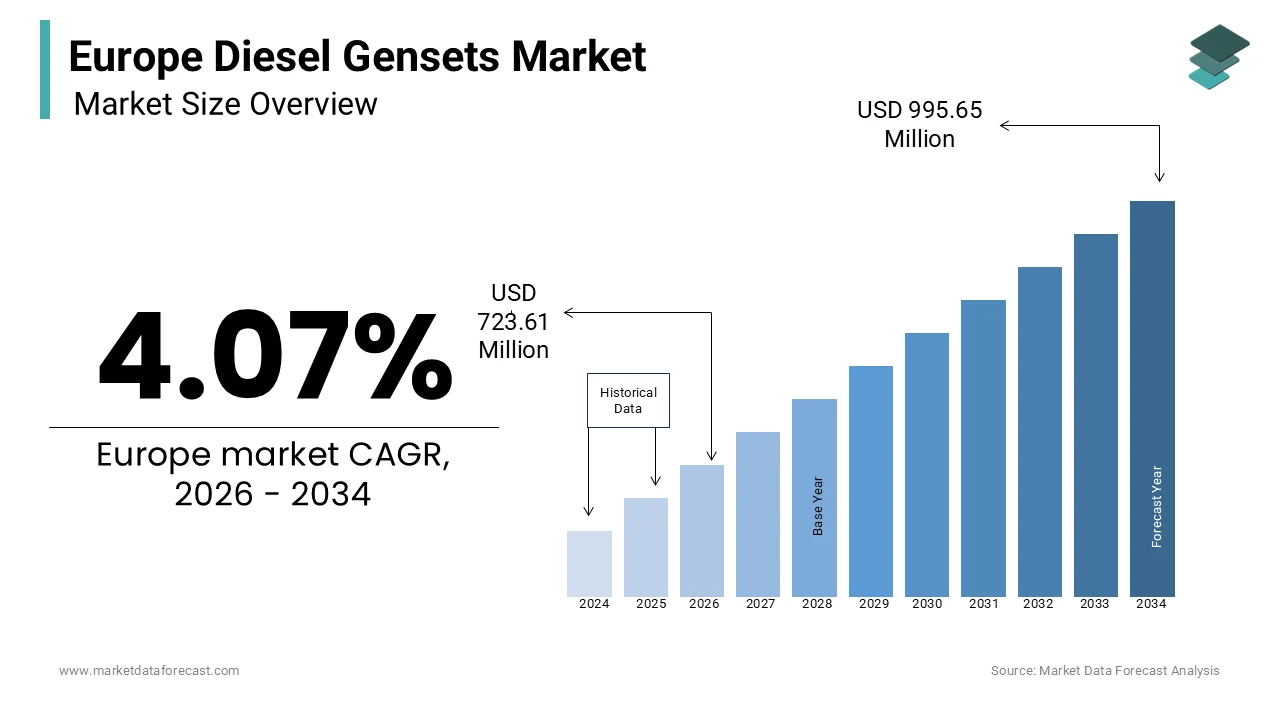
Diesel gensets, or diesel-powered generator sets, are integrated systems comprising a diesel engine and an alternator that produce electrical power during grid outages or in off-grid settings. In Europe, these units serve as critical backup power sources for hospitals, data centers, telecommunications infrastructure, and industrial facilities where uninterrupted electricity is non-negotiable. Despite the region’s progressive decarbonization agenda, diesel gensets remain operationally indispensable due to their reliability, high power density, and rapid start-up capability. The European Union recorded a major grid disturbance event, which emphasizes persistent vulnerabilities in power supply continuity. Apart from these, extreme weather events linked to climate change have increased in frequency. The European Environment Agency reports that weather-related power disruptions rose by 37 percent between 2020 and 2025. Diesel gensets currently fulfil this role across critical sectors, particularly in regions with aging grid infrastructure or limited access to natural gas pipelines, maintaining their relevance even as regulatory pressures mount.
MARKET DRIVERS
Critical Infrastructure Reliability Mandates Sustain Diesel Genset Demand
The non-negotiable requirement for uninterrupted power in Europe’s critical infrastructure sectors continues to drive the Europe diesel gensets market. Hospitals, data centers, and emergency response facilities operate under stringent regulatory uptime standards that leave no room for outage risk. According to sources, a portion of Tier III and Tier IV data centers in Europe rely on diesel gensets as their primary backup power source due to their ability to deliver full load within a few seconds of grid failure. Data center electricity consumption reached notable terawatt hours and is projected to rise by 2030, driven by AI and cloud computing, which amplifies backup power needs. These operational imperatives create a structural demand floor for diesel gensets that transcends energy transition narratives, particularly in Southern and Eastern Europe, where grid resilience remains comparatively low.
Industrial Operations in Remote and Grid-Constrained Areas Depend on Diesel Power
Industrial facilities located in remote or under-electrified regions continue to propel the expansion of the Europe diesel gensets market. Many industrial zones across Central, Eastern, and Southern Europe continue to experience inadequate grid infrastructure, which constrains energy reliability and limits the adoption of low-carbon power solutions. Moreover, the high cost of extending high-voltage transmission lines in these regions presents a major barrier to electrification, encouraging reliance on decentralized or temporary energy alternatives. As per sources, large construction and infrastructure projects across Europe frequently employ temporary diesel-based power systems to sustain long-term operations, reflecting delayed progress toward full electrification at project sites. This geographic and operational necessity ensures sustained diesel genset deployment even as urban centers transition to cleaner alternatives.
MARKET RESTRAINTS
Stringent EU Emission Regulations Increase Operational and Compliance Costs
The European Union’s tightening air quality and climate regulations hinder the growth of the Europe diesel gensets market. This imposes significant compliance burdens on diesel genset operators, raising both capital and operational expenses. According to research, the latest phase of the EU’s emission regulations for non-road mobile machinery requires significant reductions in particulate matter and nitrogen oxide emissions from new diesel generators, marking a major advancement in air quality standards. Achieving these limits requires costly after-treatment systems such as diesel particulate filters and selective catalytic reduction units, which increase genset manufacturing costs. These regulatory headwinds disincentivize new investments and accelerate retirement schedules p,, particularly among small and medium enterprises with limited compliance budgets.
Rising Diesel Fuel Prices and Supply Volatility Undermine Economic Viability
Volatile and elevated fuel prices driven by geopolitical instability and decarbonization policies also restrain the expansion of the Europe diesel gensets market. The wholesale price of diesel in the EU surged. This surge stems from the EU’s phase out of Russian crude imports following the 2022 invasion of Ukraine and the imposition of a carbon levy on fossil fuels under the revised EU Emissions Trading System. These cost and supply uncertainties make long-term operational planning difficult and reduce the total cost of ownership advantage that diesel once held over alternatives like natural gas or battery storage, especially in applications with low runtime requirements.
MARKET OPPORTUNITIES
Hybridization with Renewables and Storage Creates Transitional Value
Its integration into hybrid power systems that combine solar, wind, or battery storage allows extending their operational relevance while reducing emissions and fuel consumption, which bolsters the growth of the Europe diesel gensets market. Across Southern Europe, agricultural and tourism facilities are increasingly adopting solar diesel hybrids to cut operating costs and comply with local air quality rules. Countries are witnessing he rapid deployment of hybrid microgrid systems that combine solar power and battery storage to enhance energy resilience and reduce reliance on diesel generation. These systems reduce diesel runtime while maintaining grid independence. This transitional model allows asset owners to preserve existing capital investments while meeting decarbonization targets, offering a pragmatic bridge toward full electrification or hydrogen readiness.
Defense and Emergency Response Sectors Prioritize Fuel Security and Mobility
The defense and civil protection sectors in the region continue to view diesel gensets as irreplaceable due to their logistical compatibility, fuel availability, and field deployability, which is setting new prospects for the expansion of the Europe diesel gensets market. NATO’s Standardization Agreement 4429 designates diesel as the primary fuel for military ground operations, ensuring interoperability across allied forces. National emergency protocols mandate municipal stockpiles of mobile diesel generators capable of powering shelters, water pumps, and communication hubs. This institutional reliance on diesel for mission-critical mobility ensures continued procurement despite environmental pressures.
MARKET CHALLENGES
Phase Down of Fossil Fuel Subsidies and Tax Incentives
The systematic withdrawal of fiscal support for diesel and other fossil fuels in the region is eroding the economic foundation of genset operations, which challenges the growth of the Europe diesel gensets market. Many European Union member states have begun phasing out tax exemptions for non-transport diesel use, reflecting wider fiscal alignment with the region’s carbon reduction objectives. As per sources, France has introduced higher taxation on diesel consumption as part of its broader policy to integrate carbon budgeting principles into national energy and fiscal planning. These fiscal and financial disincentives accelerate capital reallocation toward alternative technologies, particularly in applications where runtime is low and replacement is feasible.
Technological Obsolescence Risk from Rapid Battery Storage Advancements
The accelerating performance gains and cost declines in battery energy storage systems are slowing down the expansion of the Europe diesel gensets market. Moreover, European building codes increasingly penalize on-site fossil emissions in new commercial constructions, pushing developers toward all-electric designs. For applications like retail banking branches and telecom towers, which historically relied on small diesel gensets, runtime needs rarely exceed two hours, making them prime candidates for battery substitution. This rapid technological displacement compresses the viable window for diesel genset investment, particularly in Western Europe, where grid reliability is high and environmental compliance costs are steep.
REPORT COVERAGE
| REPORT METRIC | DETAILS |
| Market Size Available | 2025 to 2034 |
| Base Year | 2025 |
| Forecast Period | 2026 to 2034 |
| CAGR | 4.07% |
| Segments Covered | By Capacity, End-User, And Region |
| Various Analyses Covered | Global, Regional & Country Level Analysis, Segment-Level Analysis, DROC, PESTLE Analysis, Porter’s Five Forces Analysis, Competitive Landscape, Analyst Overview on Investment Opportunities |
| Regions Covered | UK, France, Spain, Germany, Italy, Russia, Sweden. |
| Market Leaders Profiled | Caterpillar Inc., Mitsubishi Heavy Industries Engine & Turbocharger Ltd, F G Wilson, Cummins Inc., Yanmar Holdings Co. Ltd, Generac Power Systems, Kohler Co., Doosan Corporation |
SEGMENTAL ANALYSIS
By Capacity Insights
The 75 to 350 KVA capacity segment dominated the Europe diesel gensets market and accounted for a 58.7% share in 2025. The dominance of the 75 to 350 KVA capacity segment is driven by its optimal balance of power output, mobility, and compliance suitability for mid-scale critical applications. The segment serves a broad cross section of commercial facilities, including medium-sized hospitals, retail complexes, data centers, and municipal water treatment plants that require reliable backup. The prevalence of such infrastructure across Europe’s secondary cities and industrial zones further fuels the growth of this segment. The modular nature of this capacity class also allows for N+1 redundancy without excessive capital outlay, aligning with operational risk management protocols. Regulatory frameworks further favor this segment.

The above 350 KVA segment is anticipated to witness the fastest CAGR of 6.8% from 2025 to 2033 due to increasing power demands in heavy industry and large-scale infrastructure projects that require multi-megawatt backup or primary generation. A different driver of this segment is the resurgence of domestic manufacturing under the EU’s Critical Raw Materials Act, which mandates onshoring of battery and semiconductor production. The European Commission reports that over 45 gigafactories and advanced wafer fabs are under construction across Germany, France, and Poland, each requiring 10 to 50 megawatts of uninterruptible power during grid instability events. A different growth factor is the expansion of mining and mineral processing in the Nordic and Balkan regions. These macro industrial shifts create sustained demand for high-capacity diesel power despite decarbonization pressures.
By End User Insights
The industrial user segment held a 62.7% share of the Europe diesel gensets market in 2025. The prominence of the industrial end-user segment is because of the sector’s non-negotiable need for continuous power to prevent production losses, safety hazards, and equipment damage. Industries such as chemicals, metals, food processing, and pharmaceuticals operate processes. Furthermore, industrial facilities often operate in regions with constrained grid capacity. In Eastern Europe, where grid reliability lags, industrial users in Romania and Bulgaria report average annual outage durations. This operational reality, combined with stringent process safety standards under the EU’s Seveso III Directive, ensures diesel gensets remain embedded in industrial energy architecture across the continent.
The commercial end-user segment is likely to experience the fastest CAGR of 7.2% over the forecast period, owing to the proliferation of digital infrastructure and rising regulatory mandates for business continuity. The rapid expansion of edge data centers, small facilities located near population centers to support 5G and AI applications, has created new demand. Moreover, EU building codes are evolving to require backup power for essential services in large commercial complexes. The policy-driven and technology-enabled demands are transforming the commercial sector into the most dynamic growth corridor for diesel gensets.
COUNTRY LEVEL ANALYSIS
Germany Diesel Gensets Market Analysis
Germany was the largest country in the European diesel gensets market and accounted for a 24.4% share in 2025. Factors such as its dense industrial base and stringent operational continuity requirements are propelling the prominence of Germany. The country hosts thousands of manufacturing facilities classified as energy-intensive under EU regulations, each mandated to maintain backup power under the Federal Immission Control Act. According to research, recent grid instability incidents in Germany have underscored the dependence of industrial regions on reliable on-site power generation to maintain operational continuity during supply disruptions. The presence of global genset manufacturers like MTU and Siemens Energy further consolidates Germany’s position as both a consumption and innovation hub for high-reliability power solutions.
United Kingdom Diesel Gensets Market Analysis.
The United Kingdom followed closely in the Europe diesel gensets market by occupying 18.6% of the regional market in 2025. Its concentration of digital and financial infrastructure requiring ultra-high uptime fuels the demand for diesel gensets in the UK. London is Europe’s largest data center hub with multiple facilities housing a portion of the continent’s server capacity. The UK’s temperate climate and frequent localized flooding further elevate backup needs. This confluence of digital economy demands and climate vulnerability sustains robust diesel genset demand despite the UK’s net-zero ambitions.
France Diesel Gensets Market Analysis..
France is another key region in the European diesel gensets market, with unique grid dynamics and regulatory mandates. According to research, although France relies heavily on nuclear power for its electricity supply, periodic reactor maintenance has led to temporary capacity constraints during peak demand periods, highlighting the importance of resilient backup power systems. This intermittency from a traditionally stable source has heightened institutional reliance on backup generation. As per sources, industrial facilities in France are required under national environmental and safety regulations to maintain emergency power infrastructure, ensuring uninterrupted operations during grid disruptions. These policy and operational factors create a resilient demand base that offsets national decarbonization pressure, particularly in healthcare and manufacturing sectors.
Italy Diesel Generators Market Analysis.
Italy experienced consistent growth in the Europe diesel gensets market due to persistent grid reliability issues and a vast network of small and medium enterprises. According to research, southern regions of Italy continue to experience frequent localized power outages due to aging grid infrastructure and underinvestment, making energy reliability a key national concern. As per sources, regional assessments consistently rank southern Italy among the most grid-vulnerable areas in the European Union, emphasizing the need for modernization and capacity upgrades. These structural and geographic factors ensure sustained diesel genset adoption across commercial and industrial segments despite national efforts to promote renewable microgrids.
Turkey Diesel Generators Market Analysis.
Turkey is expected to be the most lucrative region in the Europe diesel gensets market over the forecast pperperiodingto its serving as a dynamic growth frontier due to rapid industrialization and infrastructural gaps. A transcontinental geography does not prevent Turkey from being a major player in the European energy equipment market, where its demand profile strongly aligns with EU industrial trends. Moreover, industrial electricity consumption gr, ew driven by automotive electronics and textile exports. However, the national grid faces chronic congestion. The government encourages generation as a mitigation measure, which indirectly supports diesel genset uptake. Besides, Turkey’s strategic location as a logistics hub between Europe and Asia has spurred warehouse and data center construction. Companies operate multi-megawatt diesel plants at their manufacturing sites to ensure production continuity. This blend of economic expansion and energy infrastructure lag positions Turkey as a critical and growing node in the broader European diesel gensets ecosystem.
COMPETITIVE LANDSCAPE
Competition in the Europe diesel gensets market is characterized by a mix of global engineering giants and regional specialists vying for dominance across industrial, commercial, and critical infrastructure segments. The market is mature yet dynamic, with incumbents leveraging brand reputation, service reach, and compliance expertise to defend positions against cost-focused entrants from Asia. Differentiation occurs through emission control sophistication, digital capabilities, noise performance,e, and integration readiness with hybrid systems. While price remains a factor in low runtime applications, total cost of ownership and uptime reliability dominate procurement decisions in data centers, hospitals, and manufacturing. Regulatory complexity under EU Stage V and national permitting rules creates significant entry barriers, favoring established players with local certification experience. Despite long-term pressure from battery storage, the persistent need for multi-hour and multi-megawatt backup ensures diesel gensets retain strategic relevance. Competitive intensity is highest in the 75 to 350 KVA segment, where brand perception and service responsiveness determine customer loyalty across Western and Central Europe.
KEY MARKET PLAYERS
A few of the market players in the Europe diesel gensets market include
- Caterpillar Inc.
- Mitsubishi Heavy Industries Engine & Turbocharger Ltd
- F G Wilson
- Cummins Inc.
- Yanmar Holdings Co. Ltd
- Generac Power Systems
- Kohler Co.
- Doosan Corporation
Top Players In The Market
- Caterpillar Inc. is a global leader in power systems with a strong presence in the Europe diesel gensets market through its Cat brand. The company supplies a comprehensive range of diesel generator sets from 10 KVA to over 4 megawatts, tailored for industrial, commercial, and critical infrastructure applications across the continent. Caterpillar emphasizes compliance with EU Stage V emission standards and integrates digital monitoring via its Cat Connect platform for remote diagnostics and predictive maintenance. In 202,4, the company expanded its service network in Eastern Europe, establishing new parts distribution centers in Poland and Romania to enhance after-sales support. These initiatives reinforce Caterpillar’s reputation for reliability and rapid response, which are critical for mission-critical throughout.
- Cummins Inc. is a major player in the European diesel gensets market, offering robust, fuel-efficient generator sets under its Cummins Power Generation brand. The company has localized its manufacturing and engineering in the Netherlands and the UK to meet regional performance and regulatory requirements, including stringent noise and emission limits. Cummins actively supports hybrid power solutions by developing control systems that seamlessly integrate diesel gensets with battery storage and renewable sources. This focus on digital infrastructure and regulatory alignment strengthens its competitive positioning in high-value segments across the region.
- Kohler Co has significantly expanded its footprint in the Europe diesel gensets market through its Kohler Power division, which delivers premium backup power solutions for healthcare, e-finance,ce, and industrial sectors. The company differentiates itself through quiet operation, advanced paralleling capabilities, and compact design suited for urban installations. Kohler’s European engineering center in Italy focuses on adapting products to Mediterranean climate conditions and local grid codes. The firm also strengthened its dealer network in Spain and Greece to support growing demand in Southern Europe, driven by grid instability and tourism infrastructure needs.
Top Strategies Used By The Key Market Participants
Key players in the Europe diesel gensets market focus on regulatory compliance, product localization, digital integration, strategic service network expansion, and hybrid system development to maintain competitiveness. Companies invest heavily in meeting EU Stage V emission standards through advanced after-treatment and engine redesign. They tailor products to regional grid codes, noise ordinances, and climate conditions to ensure seamless installation. Digital platforms for remote monitoring, predictive maintenance, and load management are now standard offerings, enhancing customer value. Service networks are being expanded in Eastern and Southern Europe to address growing demand and reduce response times. Furthermore, manufacturers are developing control architectures that allow diesel gensets to operate in hybrid configurations with solar and batteries, enabling transitional decarbonization while preserving reliability.
MARKET SEGMENTATION
This research report on the Europe diesel gensets market is segmented and sub-segmented into the following categories.
By Capacity Type
- Below 75 kVA
- 75-350 kVA
- Above 350 kVA
By End User Type
- Residential
- Commercial
- Industrial
By Country
- UK
- France
- Spain
- Germany
- Italy
- Russia
- Sweden
- Denmark
- Switzerland
- Netherlands
- Turkey
- Czech Republic
- Rest of Europe