- Product Description Description
- Table of Contents TOC
- List of Table & Figure LOT
- Get Free Sample PDF Sample PDF
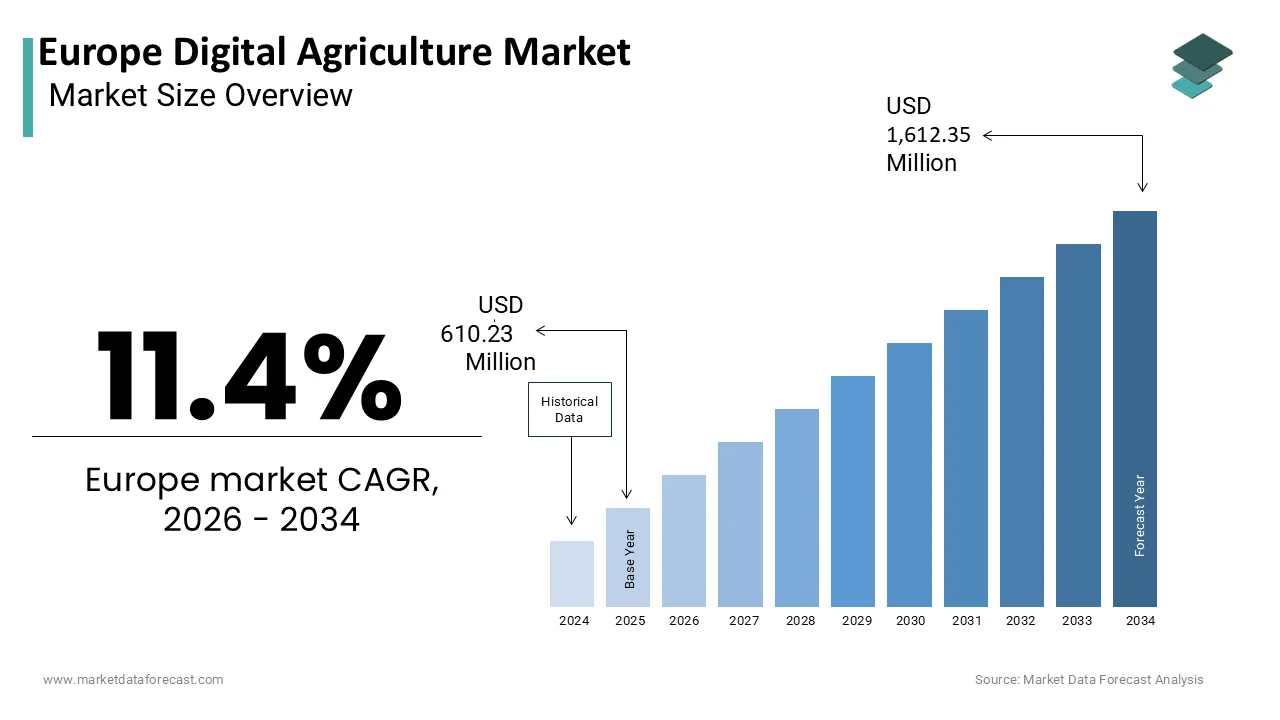
Market Size, 2025
$610.23 MnMarket Estimate, 2026
$679.79 MnMarket Forecast, 2034
$1,612.35 MnCAGR, 2026–2034
11.4%Europe Digital Agriculture Market Size
The Europe Digital Agriculture Market was valued at USD 610.23 million in 2025, is estimated to reach USD 679.79 million in 2026, and is projected to reach USD 1,612.35 million by 2034, growing at a CAGR of 11.4% from 2026 to 2034.
Digital agriculture encompasses the integration of advanced technologies such as the Internet of Things, artificial intelligence, big data analytics, and robotics into farming practices to enhance productivity, sustainability, and resource efficiency. This sector transforms traditional agricultural operations by enabling precise monitoring of crop health, soil conditions, and livestock welfare through connected devices and software platforms. The region is at the forefront of this transformation due to strong regulatory support and a high concentration of technology providers. According to Eurostat, the utilized agricultural area in the European Union amounted to 161 million hectares in 2023, providing a vast landscape for the deployment of digital solutions. Furthermore, as per the European Commission, 33% of farms in the EU used internet connected devices for agricultural purposes in 2023, indicating a growing acceptance of smart farming technologies. The Common Agricultural Policy emphasizes the importance of digital tools in achieving environmental goals, encouraging farmers to adopt precision agriculture techniques. According to the Food and Agriculture Organization of the United Nations, the average age of farm managers in Europe is 57 years, highlighting the need for user friendly digital interfaces to attract younger generations to the sector. The integration of satellite imagery and drone technology allows for real time data collection, facilitating informed decision making. This technological shift is crucial for addressing challenges such as climate change, labor shortages, and food security, positioning digital agriculture as a key driver of modernization in the European agrifood system.
MARKET DRIVERS
Stringent Environmental Regulations and Sustainability Mandates Drive Adoption
Strict environmental regulations and sustainability mandates imposed by European authorities is fuelling the adoption of digital agriculture technologies, which is compelling farmers to optimize resource usage and reduce ecological footprints and propelling the European digital agriculture market growth. The European Green Deal and the Farm to Fork Strategy aim to reduce the use of chemical pesticides by 50% and fertilizers by 20% by 2030, which is creating an urgent need for precise application methods. As per the European Environment Agency, agriculture accounts for approximately 10% of the European Union’s greenhouse gas emissions, prompting regulatory pressure to implement low carbon farming practices. Digital tools such as variable rate technology and precision spraying systems enable farmers to apply inputs only where and when needed, significantly reducing waste and environmental impact. According to the Joint Research Centre of the European Commission, precision agriculture can reduce nitrogen fertilizer use by up to 15% while maintaining crop yields, aligning with regulatory targets. The Nitrates Directive further restricts fertilizer application in vulnerable zones, necessitating detailed monitoring and reporting capabilities provided by digital platforms. Farmers who adopt these technologies can comply with regulations more efficiently and avoid penalties, while also accessing green subsidies and incentives. The European Investment Bank supports sustainable agriculture projects through dedicated financing instruments, encouraging investment in digital solutions. This regulatory framework transforms compliance from a burden into a strategic advantage, driving widespread adoption of digital agriculture technologies across the continent to meet ambitious environmental goals.
Labor Shortages and Aging Farmer Population Necessitate Automation
The persistent labor shortages and the aging demographic of the European farming population significantly propel the demand for digital agriculture solutions, particularly automation and robotics. According to Eurostat, the average age of farm managers in the European Union is 57 years, with only 12% under the age of 40, indicating a looming succession crisis and workforce deficit. This demographic trend reduces the availability of manual labor for tasks such as planting, weeding, and harvesting, creating a critical need for automated alternatives. According to the European Agricultural Machinery Industry Association, the sales of autonomous tractors and robotic harvesters have increased by 20% annually in recent years, reflecting the shift towards mechanized solutions. Digital platforms enable remote monitoring and control of farm operations, allowing fewer workers to manage larger areas efficiently. As per data from Eurostat, agricultural labor input in the EU has decreased by 18% over the past decade, making automation a cost effective solution for maintaining profitability. Robotics equipped with computer vision and artificial intelligence can perform repetitive tasks with greater precision and consistency than human labor, addressing both quantity and quality concerns. Furthermore, digital tools simplify complex management processes, making farming more accessible to younger, tech savvy individuals who may lack traditional farming experience. This technological compensation for labor scarcity ensures operational continuity and enhances productivity, driving the rapid integration of digital agriculture technologies in response to demographic and economic pressures.
MARKET RESTRAINTS
High Initial Investment Costs and Limited Access to Capital
Substantial initial investment costs associated with acquiring digital agriculture hardware and software is a significant restraint to the regional market growth, particularly for small and medium sized farms that operate on thin margins. The deployment of sensors, drones, autonomous machinery, and data management platforms requires considerable upfront capital, which many farmers cannot afford without external financing. As per the European Investment Bank, access to finance remains a challenge for 15% of agricultural businesses in the European Union, limiting their ability to invest in modern technologies. The return on investment for digital solutions can be slow and uncertain, discouraging risk averse farmers from adopting new systems. According to a report by the European Parliament, 60% of farmers cite high costs as the primary barrier to digitalization. Additionally, the rapid pace of technological obsolescence means that equipment may become outdated quickly, further increasing long term costs. The lack of standardized pricing and transparent value propositions makes it difficult for farmers to assess the financial viability of different solutions. Government subsidies and grants are often complex to access and insufficient to cover the full cost of implementation. This financial barrier creates a digital divide between large agribusinesses that can afford advanced technologies and smaller farms that struggle to compete. Consequently, the high entry cost restricts the widespread adoption of digital agriculture, limiting market penetration and slowing the overall modernization of the European agricultural sector.
Fragmented Land Ownership and Small Farm Sizes Limit Scalability
The fragmented nature of land ownership and the prevalence of small farm sizes in Europe significantly hinder the expansion of the European digital agriculture market. Unlike regions with large contiguous fields, European agriculture is characterized by numerous small plots owned by different individuals, complicating the deployment of large scale automated machinery and uniform data collection. As per Eurostat, the average size of agricultural holdings in the European Union is 17 hectares, with significant variations across member states, which is making it challenging to achieve economies of scale. According to the European Parliament’s Committee on Agriculture and Rural Development, fragmented land structures increase the complexity of implementing precision agriculture technologies, as each plot may require customized settings and calibration. Small farms often lack the volume of data necessary to train effective artificial intelligence models, reducing the accuracy and utility of predictive analytics. The logistical challenges of moving equipment between scattered plots also increase operational costs and reduce efficiency. Furthermore, the diversity of crops and farming practices across small holdings requires flexible and adaptable solutions, which are often more expensive and complex to develop. This structural fragmentation limits the appeal of standardized digital products, forcing vendors to create niche solutions that may not be commercially viable. Consequently, the disjointed landscape of European agriculture restrains the broad adoption of digital technologies, as the benefits are diluted across small, disparate units rather than concentrated in large, efficient operations.
MARKET OPPORTUNITIES
Integration of Artificial Intelligence for Predictive Analytics and Decision Support
The integration of artificial intelligence into digital agriculture platforms presents a lucrative opportunity for the European digital agriculture market. AI algorithms can analyze vast amounts of data from satellites, drones, and ground sensors to predict crop yields, detect diseases early, and recommend precise intervention strategies. As per the European Commission, AI driven predictive models can improve crop yield accuracy by up to 20%, allowing farmers to plan harvests and logistics more effectively. The ability to forecast weather impacts and pest outbreaks enables proactive management, reducing losses and input costs. According to a study by Wageningen University, AI powered decision support systems have reduced pesticide use by 30% in pilot projects, demonstrating significant environmental and economic benefits. The European Commission’s Horizon Europe program funds research into AI applications for agriculture, fostering innovation and collaboration between tech companies and research institutions. Machine learning models can also optimize irrigation schedules based on real time soil moisture and weather forecasts, conserving water resources. The growing availability of open data sources and cloud computing infrastructure supports the development of sophisticated AI tools that are accessible to farmers. By providing actionable insights and automating complex analyses, AI enhances the value proposition of digital agriculture solutions, driving adoption and creating new revenue streams for technology providers in the European market.
Expansion of Precision Livestock Farming Technologies
The expansion of precision livestock farming technologies offers significant opportunities for the Europe digital agriculture market and addressing the need for improved animal welfare, health monitoring, and productivity. Sensors and wearable devices can track vital signs, activity levels, and feeding behavior of livestock in real time, enabling early detection of diseases and optimizing breeding cycles. According to the European Commission, precision livestock farming can reduce antibiotic use by 25% by enabling targeted treatment rather than herd wide administration, aligning with regulatory goals to combat antimicrobial resistance. The European Food Safety Authority emphasizes the importance of monitoring animal health to ensure food safety and quality, driving demand for advanced tracking solutions. As per research published in the Journal of Dairy Science, farms using precision livestock technologies report a 10% increase in milk production and a 15% reduction in labor costs. The integration of these systems with farm management software provides comprehensive insights into herd performance, facilitating data driven decision making. The European Union’s Animal Health Law encourages the use of digital tools for disease surveillance and control, creating a supportive regulatory environment. Furthermore, consumer demand for ethically produced meat and dairy products incentivizes farmers to adopt transparency enhancing technologies. By improving animal welfare and operational efficiency, precision livestock farming technologies unlock new value propositions, driving growth and innovation in the European digital agriculture sector.
MARKET CHALLENGES
Data Privacy Concerns and Lack of Standardization
Data privacy concerns and the lack of standardization in data formats and protocols are primarily challenging the Europe digital agriculture market growth, which is hindering trust and interoperability among stakeholders. Farmers are increasingly wary of sharing sensitive operational data with technology providers due to fears of misuse, commercial exploitation, or unauthorized access. As per the European Data Protection Supervisor, the General Data Protection Regulation applies to agricultural data, but ambiguity regarding data ownership and rights creates uncertainty for users. According to a survey by COPA-COGECA, 55% of farmers hesitate to adopt digital tools due to concerns about data security and privacy. The absence of universal standards for data exchange prevents seamless integration between different hardware and software platforms, leading to data silos and reduced functionality. The European Commission has initiated efforts to establish common data spaces for agriculture, but progress has been slow and fragmented. Without standardized protocols, farmers face vendor lock in, limiting their ability to switch providers or combine best in class solutions. This lack of interoperability increases costs and complexity, discouraging adoption. Furthermore, the varying legal interpretations of data rights across member states complicate cross border data flows and collaborations. Addressing these issues requires robust legal frameworks, transparent data governance policies, and industry wide cooperation to establish common standards. Until these challenges are resolved, data privacy and standardization issues will continue to impede the full potential of digital agriculture in Europe.
Limited Digital Literacy and Technical Skills among Farmers
Limited digital literacy and technical skills among the farming community is further challenging the digital agriculture market growth in Europe. Many farmers, particularly older generations, lack the necessary knowledge and confidence to operate complex digital tools and interpret data insights effectively. As per the European Commission, only 54% of adults in rural areas possess basic digital skills, compared to 64% in urban areas, highlighting a significant skills gap. According to the European Network for Rural Development, training programs for digital agriculture are often insufficient or inaccessible, leaving farmers without adequate support. The complexity of user interfaces and the need for continuous software updates further exacerbate the learning curve, leading to frustration and abandonment of technologies. The European Agricultural Advisory Services note that there is a shortage of qualified advisors who can guide farmers through the digital transition, limiting the dissemination of best practices. Without proper training and support, farmers may fail to realize the benefits of digital tools, resulting in poor return on investment and negative perceptions. Bridging this skills gap requires comprehensive education initiatives, user friendly design, and ongoing technical assistance. Until digital literacy improves, the effective utilization of advanced agriculture technologies will remain limited, constraining market growth and preventing the sector from fully leveraging the potential of digital innovation.
REPORT COVERAGE
| REPORT METRIC | DETAILS |
| Market Size Available | 2025 to 2034 |
| Base Year | 2025 |
| Forecast Period | 2026 to 2034 |
| Segments Covered | By Application, Technology, Component, and Region. |
| Various Analyses Covered | Global, Regional and Country-Level Analysis, Segment-Level Analysis, Drivers, Restraints, Opportunities, Challenges; PESTLE Analysis; Porter’s Five Forces Analysis, Competitive Landscape, Analyst Overview of Investment Opportunities |
| Countries Covered | UK, France, Spain, Germany, Italy, Russia, Sweden, Denmark, Switzerland, Netherlands, Turkey, Czech Republic, Rest of Europe |
| Market Leaders Profiled | Deere & Company, AGCO Corporation, Kubota Corporation, Syngenta Crop Protection AG, Corteva Agriscience, BASF SE, Bayer AG, Trimble Inc., Topcon Corporation, Raven Industries, Inc., IBM Corporation, Microsoft Corporation |
SEGMENTAL ANALYSIS
By Application Insights
The precision farming and farm management segment led the market by application and accounted for 41.6% of the European market share in 2025. The dominance of precision farming and farm management segment in the European market is primarily driven by stringent European Union regulations mandating the reduction of chemical inputs and the promotion of sustainable agricultural practices. The Farm to Fork Strategy aims to reduce the use of chemical pesticides by 50% and fertilizers by 20% by 2030, which is compelling farmers to adopt precise application technologies. According to the Joint Research Centre of the European Commission, precision farming techniques can reduce nitrogen fertilizer usage by up to 15% while maintaining or even improving crop yields. This efficiency is critical for farmers to comply with the Nitrates Directive and avoid penalties associated with excessive runoff. Variable rate technology allows for the site specific application of inputs based on real time soil data, minimizing waste and environmental impact. According to Eurostat, the utilization of precision agriculture tools has increased by 25% among large farms in the EU since 2020, reflecting a rapid adaptation to regulatory demands. The ability to document input usage digitally also simplifies compliance reporting for subsidies under the Common Agricultural Policy. Consequently, the imperative to balance productivity with environmental stewardship solidifies the leadership of precision farming solutions, as they provide the necessary technological framework for sustainable intensification in European agriculture.
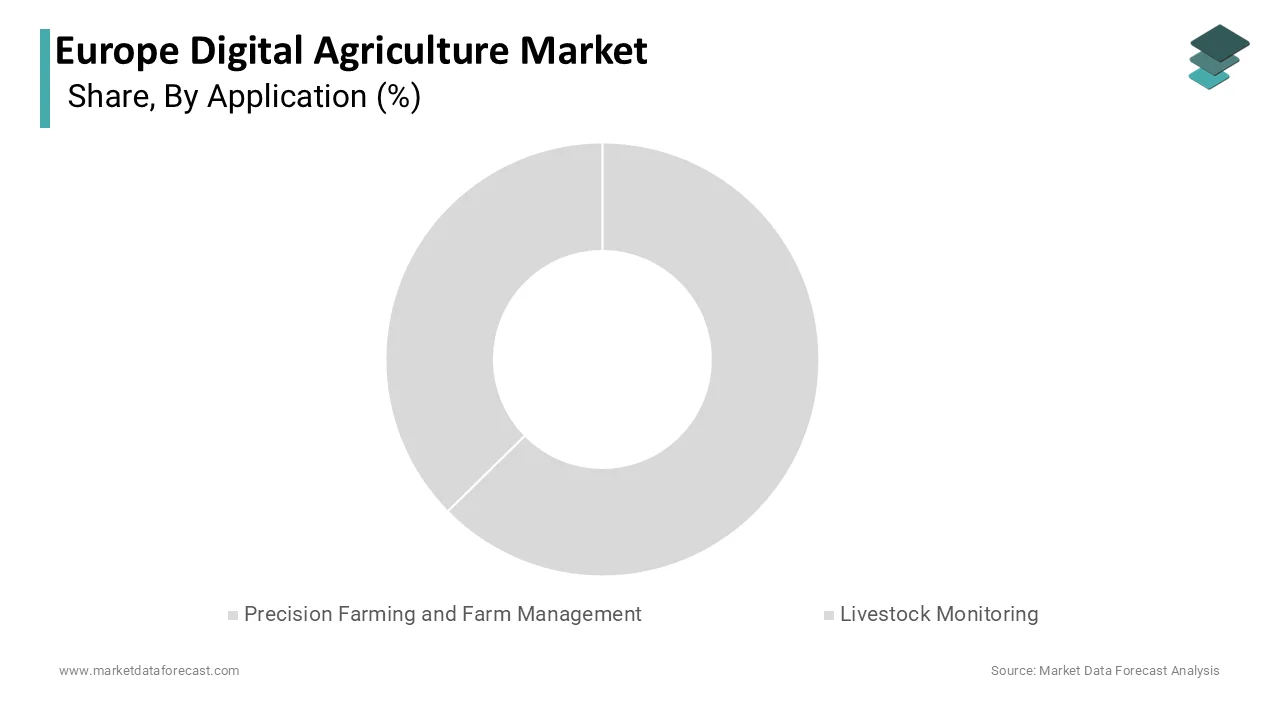
On the other hand, the livestock monitoring segment is estimated to record a promising CAGR of 15.8% over the forecast period in the European market owing to the increasing regulatory focus on animal welfare and the need for early disease detection. The European Union has implemented stricter standards for livestock housing and care that require farmers to monitor animal health and behavior more closely. As per research highlights from the European Commission, early detection of diseases such as mastitis in dairy cows can reduce treatment costs by 40% and improve milk quality. Wearable sensors and smart collars track vital signs, activity levels, and feeding patterns, providing real time alerts for potential health issues. According to the European Commission, the adoption of precision livestock farming technologies can reduce antibiotic usage by 25% by enabling targeted treatments rather than herd wide administration. This aligns with the EU’s strategy to combat antimicrobial resistance, a major public health concern. Furthermore, consumers are increasingly demanding transparency regarding animal welfare, prompting retailers to source from farms that utilize advanced monitoring systems. The European Commission’s Animal Health Law emphasizes the importance of digital tools for disease surveillance and control, creating a supportive regulatory environment. By improving animal health outcomes and meeting consumer expectations, livestock monitoring solutions are experiencing rapid adoption across dairy, beef, and poultry sectors in Europe.
By Technology Insights
The Internet of Things (IoT) segment led the market by accounting for 34.3% of the European market share in 2025. The growth of the IoT segment in the European market is attributed to the widespread availability of connectivity infrastructure and the fundamental role of IoT sensors in collecting real time data from fields and livestock. IoT devices, including soil moisture sensors, weather stations, and wearable animal tags, form the backbone of digital agriculture systems by providing the raw data necessary for analytics and decision making. As per the European Telecommunications Standards Institute, the deployment of Low Power Wide Area Networks such as LoRaWAN and NB IoT has expanded significantly in rural areas, enabling reliable connectivity for agricultural sensors. According to the European Commission, 33% of farms in the EU utilized internet connected devices for agricultural purposes in 2023, reflecting the high penetration of IoT technology. The ability to monitor environmental conditions continuously allows farmers to respond promptly to changes in weather, soil status, and crop health. The European Commission’s Digital Decade targets aim to ensure full coverage of 5G networks in populated areas by 2030, which will further enhance IoT capabilities in agriculture. The scalability and relatively low cost of IoT sensors make them accessible to a wide range of farm sizes. By enabling precise and timely interventions, IoT technology improves resource efficiency and productivity, solidifying its position as the dominant technology segment in the European digital agriculture market.
On the other side, the AI segment is predicted to register a promising CAGR of 19.4% over the forecast period in the European market due to the rising demand for predictive analytics and advanced decision support systems in agriculture. AI algorithms can process vast amounts of data from satellites, drones, and IoT sensors to predict crop yields, detect diseases, and optimize planting schedules. As per the European Commission, AI driven predictive models can improve yield accuracy by up to 20%, allowing farmers to plan logistics and marketing strategies more effectively. The ability to forecast weather impacts and pest outbreaks enables proactive management, reducing losses and input costs. According to a study by Wageningen University, AI powered decision support systems have reduced pesticide use by 30% in pilot projects by identifying specific areas requiring treatment. The European Commission’s Horizon Europe program funds extensive research into AI applications for agriculture, fostering innovation and collaboration between tech companies and research institutions. Machine learning models can also optimize irrigation schedules based on real time soil moisture and weather forecasts, conserving water resources. The growing availability of open data sources and cloud computing infrastructure supports the development of sophisticated AI tools that are accessible to farmers. By providing actionable insights and automating complex analyses, AI enhances the value proposition of digital agriculture solutions, driving rapid adoption and market growth.
By Component Insights
The hardware segment accounted for the major share of 44.7% of the European market in 2025. The dominance of hardware segment in the European market is primarily driven by the fundamental need for physical devices such as sensors, drones, autonomous tractors, and smart irrigation systems to collect data and execute actions in the field. Without robust hardware infrastructure, digital agriculture solutions cannot function, making it the primary entry point for farmers adopting these technologies. As per the European Agricultural Machinery Industry Association, the sales of smart agricultural machinery and sensors have grown steadily, supported by government subsidies for modernization. The high initial cost of hardware contributes to its larger market share compared to software and services. According to Eurostat, investments in agricultural machinery and equipment constitute the largest portion of gross fixed capital formation in the sector. The durability and longevity of hardware assets also mean that they represent a significant capital expenditure for farmers. The European Investment Bank notes that financing for agricultural hardware remains a priority for many rural development programs. Furthermore, the integration of advanced technologies such as GPS and IoT modules into traditional machinery increases the value and complexity of hardware products. As farmers upgrade their fleets to include precision capabilities, the demand for sophisticated hardware continues to rise, sustaining its leading position in the market.
However, the software segment is growing exponentially and is estimated to record a CAGR of 18.4% over the forecast period in the European digital agriculture market owing to the growing demand for data analytics, farm management platforms, and cloud based services. As the volume of data generated by IoT devices and machinery grows, farmers require sophisticated software to process, visualize, and interpret this information. According to the European Commission, the adoption of cloud based farm management software has increased significantly in recent years, enabling real time access to data from any location. Software solutions provide actionable insights that optimize decision making, leading to improved productivity and profitability. According to a survey by COPA-COGECA, 65% of digital agriculture users consider software usability and analytical capabilities as key factors in their satisfaction. The shift towards subscription based software models lowers upfront costs and ensures continuous updates and support. The European Cloud Partnership promotes the development of secure and interoperable data spaces, facilitating the integration of various software applications. Furthermore, the integration of artificial intelligence and machine learning into software platforms enhances their predictive capabilities, adding significant value. By transforming raw data into strategic intelligence, software becomes the brain of digital agriculture operations, driving its rapid growth and increasing importance in the market.
COUNTRY LEVEL ANALYSIS
Germany Digital Agriculture Market Analysis
Germany accounted for the leading share of 23.9% of the European digital agriculture market in 2025. The dominance of Germany in the European market is majorly driven by its strong manufacturing base, advanced technological infrastructure, and supportive government policies. The country is a leader in the production of agricultural machinery and precision farming technologies, with companies like Bosch and Claas pioneering innovative solutions. As per the German Federal Ministry of Food and Agriculture, the Digital Strategy for Agriculture and Rural Areas aims to enhance the competitiveness and sustainability of the sector through digitalization. According to the German Agricultural Society, over 50% of large farms in Germany use precision farming techniques such as GPS guidance and variable rate application. The presence of renowned research institutions and universities fosters innovation and collaboration between industry and academia. The country’s robust internet infrastructure supports the deployment of IoT and cloud based solutions in rural areas. Government subsidies for digital investments further accelerate adoption among small and medium sized farms. The strong focus on Industry 4.0 principles extends to agriculture, promoting automation and data exchange. This combination of industrial strength, policy support, and technological readiness positions Germany as the dominant market for digital agriculture in Europe, setting benchmarks for innovation and efficiency.
France Digital Agriculture Market Analysis
France occupied a significant position in the Europe digital agriculture market in 2025 due to its large agricultural sector and strong commitment to sustainable farming practices. The French government’s France 2030 investment plan includes substantial funding for agritech innovation and digital transformation. As per the French Ministry of Agriculture, the Ecophyto plan aims to reduce pesticide use through the adoption of precision agriculture technologies. According to Arvalis, the French agricultural institute, the use of decision support tools for crop protection has increased by 35% in recent years. The country has a vibrant startup ecosystem focused on agritech, supported by incubators and venture capital. The presence of major cooperatives facilitates the dissemination of digital tools among smallholder farmers. France’s diverse agricultural landscape, ranging from cereals to vineyards, drives demand for specialized digital solutions. The National Institute for Agricultural Research collaborates with private sector partners to develop and validate new technologies. Regulatory pressure to meet environmental goals further incentivizes the adoption of digital monitoring and precision application systems. This dynamic environment of policy support, innovation, and practical application sustains France’s prominent role in the European digital agriculture landscape.
United Kingdom Digital Agriculture Market Analysis
The United Kingdom is anticipated to account for a notable share of the Europe digital agriculture market during the forecast period owing to a strong agritech sector, advanced research capabilities, and a focus on productivity enhancement. Post Brexit agricultural policies emphasize sustainable land management and technological innovation, encouraging farmers to adopt digital tools. As per the UK Department for Environment Food and Rural Affairs, the Farming Innovation Programme provides grants for the development and adoption of new technologies. According to the UK Government, the UK is home to a growing agritech sector, leading in areas such as robotics, sensors, and data analytics. The country’s strong university network, including institutions like Harper Adams University, supports research and development in digital agriculture. The prevalence of large scale arable farms facilitates the adoption of precision farming technologies. The UK government’s push for net zero emissions drives the uptake of carbon tracking and sustainable farming software. Furthermore, the strong financial sector supports investment in agritech startups. The combination of innovative enterprises, supportive policy, and research excellence positions the UK as a key player in the European digital agriculture market, fostering continuous advancement and adoption.
Netherlands Digital Agriculture Market Analysis
The Netherlands accounts for a considerable share of the Europe digital agriculture market due to its high tech greenhouse sector, intensive farming practices, and leadership in agritech innovation. Despite its small size, the Netherlands is the second largest exporter of agricultural products globally, relying heavily on digital technologies for efficiency and sustainability. As per the Dutch Ministry of Agriculture Nature and Food Quality, the Mission Driven Innovation Cooperation focuses on circular and climate neutral agriculture through digital solutions. According to Wageningen University and Research, the adoption of sensor based climate control and precision irrigation in greenhouses exceeds 80%. The country is a hub for agritech startups and multinational companies developing advanced solutions for livestock monitoring, crop management, and supply chain optimization. The dense population and limited land area drive the need for high productivity per square meter, which digital tools enable. Strong collaboration between government, industry, and knowledge institutions creates a conducive ecosystem for innovation. The Netherlands’ expertise in water management and sustainable farming practices is exported globally, reinforcing its market position. This concentration of expertise and intensive application of technology makes the Netherlands a pivotal market for digital agriculture in Europe.
Italy Digital Agriculture Market Analysis
Italy is expected to exhibit a healthy CAGR in the European digital agriculture market during the forecast period. Factors such as the diverse agricultural production, strong wine and olive oil sectors, and increasing adoption of precision technologies are propelling the French market expansion. The Italian National Recovery and Resilience Plan includes significant investments for the digitalization of the agricultural sector, aiming to improve competitiveness and sustainability. As per the Italian Ministry of Agricultural Food and Forestry Policies, the number of farms using precision agriculture tools has grown by 20% in recent years. According to Confagricoltura, the main association of agricultural entrepreneurs, digital solutions are increasingly used for irrigation management and crop monitoring.
COMPETITIVE LANDSCAPE
The competition in the Europe digital agriculture market is intense and characterized by the presence of established agricultural machinery manufacturers agrochemical giants and innovative technology startups. Major players leverage their extensive distribution networks and brand recognition to dominate the landscape while niche firms compete on specialized algorithms and user friendly interfaces. The market exhibits high barriers to entry due to the need for significant investment in research and development and compliance with strict data privacy regulations. Companies differentiate themselves through technological superiority ease of integration and proven agronomic value. Strategic alliances between hardware providers and software developers are common as they seek to offer seamless end to end solutions. The rapid pace of technological advancement requires continuous innovation to stay ahead of competitors. Pricing pressure from cost conscious farmers influences competitive dynamics prompting firms to demonstrate clear return on investment through efficiency gains. The emphasis on sustainability and regulatory compliance has become a key differentiator with companies competing to offer eco friendly options. Intellectual property protections encourage innovation but also lead to legal disputes over proprietary algorithms. Market participants must navigate complex regulatory landscapes varying across different European countries. This dynamic environment drives consolidation as larger entities acquire smaller innovators to enhance their portfolios. Ultimately the focus remains on empowering farmers with actionable insights to improve productivity and sustainability.
KEY MARKET PLAYERS
Some of the companies that are playing a dominating role in the global Europe Digital Agriculture Market include
- Deere & Company
- AGCO Corporation
- Kubota Corporation
- Syngenta Crop Protection AG
- Corteva Agriscience
- BASF SE
- Bayer AG
- Trimble Inc.
- Topcon Corporation
- Raven Industries, Inc.
- IBM Corporation
- Microsoft Corporation
TOP LEADING PLAYERS IN THE MARKET
- Bayer AG is a global leader in the Europe digital agriculture market through its Crop Science division and the xarvio digital farming platform. The company integrates advanced data analytics with agronomic expertise to provide farmers with precise field monitoring and decision support tools. Bayer recently expanded its xarvio Field Manager capabilities by incorporating artificial intelligence for improved disease prediction and weed detection. This enhancement allows users to optimize input application and reduce environmental impact significantly. The company actively collaborates with agricultural machinery manufacturers to ensure seamless data exchange between equipment and software platforms. Bayer continues to invest in research and development to refine its digital offerings and address specific regional crop needs. By focusing on sustainable intensification and regulatory compliance Bayer strengthens its position as a trusted partner for European farmers seeking efficient and eco friendly solutions. These strategic initiatives reinforce its commitment to driving digital transformation in modern agriculture across the continent.
- Deere and Company maintains a strong presence in the Europe digital agriculture market by leveraging its extensive portfolio of connected machinery and precision agriculture technologies. The company offers integrated solutions such as John Deere Operations Center which enables farmers to manage data from planting to harvest efficiently. Deere recently enhanced its autonomous capabilities by launching new self driving tractor models equipped with advanced sensors and machine learning algorithms. These innovations help address labor shortages and improve operational efficiency for large scale farms. The company also focuses on interoperability by partnering with third party software providers to create an open ecosystem for agricultural data. Deere invests heavily in sustainability initiatives aiming to reduce carbon emissions through optimized field operations. By combining hardware excellence with digital intelligence Deere empowers farmers to make data driven decisions that enhance productivity and profitability. These efforts solidify its reputation as a key enabler of smart farming practices in Europe.
- CNH Industrial N.V. is a prominent player in the Europe digital agriculture market known for its Case IH and New Holland brands and their digital farming solutions. The company provides comprehensive telematics and precision agriculture tools that help farmers monitor equipment performance and optimize field operations. CNH Industrial recently launched its AFS Connect platform update which features improved user interface and enhanced data analytics capabilities. This upgrade facilitates better integration with farm management software and supports real time decision making. The company actively promotes sustainable farming practices by offering solutions that minimize soil compaction and fuel consumption. CNH Industrial also engages in strategic partnerships with technology firms to develop innovative applications for crop monitoring and yield prediction. By focusing on customer centric innovation and operational efficiency CNH Industrial strengthens its market position. Its commitment to advancing digital agriculture helps European farmers achieve higher productivity while adhering to strict environmental regulations.
TOP STRATEGIES USED BY KEY MARKET PARTICIPANTS
Key players in the Europe digital agriculture market primarily focus on developing integrated ecosystems that combine hardware software and services to provide holistic farm management solutions. Companies invest heavily in research and development to enhance artificial intelligence and machine learning capabilities for predictive analytics and automation. Strategic partnerships with agricultural machinery manufacturers and technology startups enable firms to expand their product portfolios and improve interoperability. Emphasis on sustainability drives the creation of tools that help farmers reduce chemical inputs and optimize resource usage in compliance with European regulations. User experience improvement is a critical strategy with firms designing intuitive interfaces to facilitate adoption among farmers with varying levels of digital literacy. Expansion into niche markets such as viticulture and organic farming allows companies to tailor solutions for specific crop requirements. Data security and privacy protection are prioritized to build trust and ensure compliance with general data protection regulations. These multifaceted strategies enable market participants to maintain competitive advantages and drive widespread adoption of digital technologies in European agriculture.
MARKET SEGMENTATION
This research report on the europe digital agriculture market is segmented and sub-segmented into the following categories
By Application
- Precision Farming and Farm Management
- Livestock Monitoring
By Technology
- Internet of Things (IoT)
- Artificial Intelligence (AI)
By Component
- Hardware
- Software
By Country
- Germany
- France
- United Kingdom
- Netherlands
- Italy
- Rest of Europe