- Product Description Description
- Table of Contents TOC
- List of Table & Figure LOT
- Get Free Sample PDF Sample PDF
Market Size, 2025
$2.85 BnMarket Estimate, 2026
$3.96 BnMarket Forecast, 2034
$55.22 BnCAGR, 2026–2034
39.01%Executive Summary: Europe Digital Signature Market
- Market Scope: European market analysis covering deployment modes, enterprise classifications, end-use sectors, country-level regional leadership, and digital identity framework metrics.
- Market Valuation: Valued at USD 2.85 billion (2025), estimated at USD 3.96 billion (2026), and projected to reach USD 55.22 billion by 2034, growing at a robust CAGR of 39.01% (2026–2034).
- Primary Growth Drivers: Strict eIDAS compliance mandates, enterprise digital transformation, shift toward remote transactions, national digital identity integration, and high adoption across regulated industries. Key adoption indicators show ~14 EU Member States notifying national eID schemes as of 2023, and Estonia's e-Residency program onboarding >100,000 e-residents who created over 20,000 companies.
Key Market Segment Metrics (2026–2034)
| Category | Leading Segment (2025 Position) | Fastest-Growing Segment |
|---|---|---|
| By Deployment Mode | As-a-Service (substantial leading market share) | Software / Apps (18.7% CAGR) |
| By Enterprise Type | Businesses and Enterprises (led market share in 2025) | Government Entities (21.3% CAGR) |
| By End Use | BFSI (29.5% market share) | Cross-Border Trade (22.9% CAGR) |
| By Region / Country | Germany (24.2% share; France second at 18.3%) | The Netherlands (expanding via legal-tech innovation and privacy-focused infrastructure) |
Major Market Players & Market Structure
Market Structure: Highly competitive digital trust ecosystem centering on strict eIDAS regulatory compliance, qualified trust services, seamless digital identity integration, rigorous data sovereignty, high-grade cryptographic security, and enterprise cross-platform interoperability.
Key Companies: PXL Vision AG, D-Trust GmbH, Skribble, Tinexta, Yousign, Alohi, CM.com, EDICOM, Autenti, Swisscom Trust Services, Signicat, GlobalSign, OneSpan, and Entrust Corporation.
Europe Digital Signature Market Size
The Europe digital signature market size was valued at USD 2.85 billion in 2025 and is projected to reach USD 55.22 billion by 2034 from USD 3.96 billion in 2026, growing at a CAGR of 39.01%.
Digital signature refers to the technologies and services that enable the creation, verification, and management of legally binding electronic signatures across public and private sectors. These solutions leverage cryptographic protocols and identity validation mechanisms to ensure document integrity non non-repudiation, and compliance with regional regulatory frameworks. Europe has emerged as a global benchmark for digital trust due to the early adoption of the eIDAS Regulation, which established a unified legal foundation for electronic identification and trust services across all member states. According to research, a share of public administrations in the EU offer core services online with digital signatures serving as the primary authentication method for citizen and business interactions. As per sources, the majority of businesses across the European Union now consistently use electronic methods to communicate with government agencies, indicating strong institutional integration. Furthermore, access to digital services across national borders within the EU has significantly expanded, largely as a result of shared agreements foreseeing electronic signatures. These structural and policy-driven factors position digital signatures not as optional tools but as essential infrastructure for Europe’s digital single market and administrative modernisation.
MARKET DRIVERS
Mandatory Compliance with eIDAS and National Digital Governance Frameworks
The binding legal framework established by the European Union’s eIDAS Regulation serves as a key booster for the growth of the European digital signature market. The eIDAS regulation established a standardised legal foundation for electronic trust services across the EU, with qualified electronic signatures achieving legal parity with traditional handwritten signatures. According to studies, all EU member states have fully implemented the eIDAS framework into their national legal systems and public service operations, which ensures broad applicability. Enterprise and sector-specific adoption is accelerating, driven by government mandates and regulatory requirements. Similarly, Specific sectors, including government procurement, real estate, banking, and data protection compliance, are increasingly relying on qualified electronic signatures for legally binding transactions and agreements. This regulatory ecosystem transforms digital signatures from discretionary efficiency tools into mandatory compliance instruments across legal, finance,, e-healthcare, and public administration domains.
Acceleration of Remote Work and Digital Transaction Volumes
The structural shift toward remote and hybrid work models has dramatically increased the volume and urgency of digitally signed agreements across regional businesses, which contributes to the expansion of the European digital signature market. According to sources, a portion of EU enterprises maintained hybrid work arrangements in 2023, up from those in 2019. This transition necessitated secure, scalable methods for executing employment contracts, vendor agreements and internal approvals without physical presence. Healthcare providers similarly embraced the technology. This surge in transactional demand across sectors has cemented digital signatures as critical operational infrastructure in Europe’spost-pandemicc digital economy.
MARKET RESTRAINTS
Fragmented National Interpretations of eIDAS Implementation
Divergent national implementations create legal and technical uncertainty that restrains the growth of the European digital signature market. According to research, several member states maintain national requirements for electronic identification and trust services that conflict with or go beyond baseline European Union provisions. For example, Italy mandates additional technical protocols for qualified electronic signatures in public procurement. Similarly, Poland requires digital signatures for certain transactions to be issued by only domestic providers. As per research, member states apply inconsistent data retention rules for signature audit logs, which vary in duration. These discrepancies undermine the principle of mutual recognition and force organisations to maintain multiple signature workflows. Such fragmentation erodes trust in the single digital market and inhibits full market potential.
Persistent User Scepticism and Low Digital Literacy in Certain Demographics
Lingering public scepticism and insufficient digital literacy, particularly among older populations and small enterprises, continue to hinder the expansion of the European digital signature market. Confidence in using advanced digital services, such as electronic signatures, is low among individuals aged 55 to 74 in the EU, as per studies. A wider gap in digital signature use exists in Southern and Eastern Europe, where few micro-enterprises use them due to concerns about complexity and security. Cultural preference for handwritten signatures remains strong in legal and notarial contexts. Also, A strong cultural preference for handwritten signatures persists in legal and notarial contexts, even where digital alternatives are legally permitted. Trust deficits are amplified by high-profile cyber incidents, including a rise in phishing attacks targeting digital certificate credentials. The absence of targeted digital inclusion initiatives and standardised user education means that behavioural and perceptual barriers will continue to constrain adoption in key segments.
MARKET OPPORTUNITIES
Integration with National Digital Identity Schemes
Its convergence with sovereign digital identity systems generates a potential opportunity for the growth of the European digital signature market. This paves the way for seamless and secure authentication in the region. As of 2023, approximately 14 EU Member States had notified at least one national eID scheme under the original eIDAS regulation, which allowed some citizens to use their government-issued credentials to access online services, though cross-border access was limited. As per sources, as of 2023, the Estonian e-Residency program had attracted over 100,000 e-residents who have founded more than 20,000 companies, enabling them to sign legally binding business contracts using their state-backed digital ID. Similarly, Germany's AusweisApp (AusweisApp2) software integrates with various service providers and can be used to authenticate via the national ID card for qualified remote signatures, removing the need for a physical card reader. This integration eliminates redundant verification steps, reduces fraud risk, and creates a unified user experience, positioning digital signatures as the natural extension of Europe’s trusted identity infrastructure.
Expansion into Regulated Sectors with High Compliance Demands
Emerging adoption in highly regulated sectors, such as clinical trials, energy, and aviation, offers substantial growth prospects for the expansion of the European digital signature market. European Union authorities increasingly require secure digital signatures for official documentation in highly regulated sectors. The European Medicines Agency mandates qualified electronic signatures for clinical trial master files, while the European Union Aviation Safety Agency accepts digitally signed aircraft maintenance records. ACER requires digital signatures for energy capacity booking confirmations, and qualified signatures are used in carbon credit trading under the EU ETS. These sectors demand high assurance solutions with long-term validation and cryptographic durability, creating premium opportunities for providers offering compliant next-generation signature platforms.
MARKET CHALLENGES
Interoperability Gaps Between Legacy Systems and Modern Signature Platforms
The lack of seamless integration between modern qualified signature services and legacy enterprise and public sector IT infrastructures degrades the growth of the European digital signature market. According to research, most public administrations utilise older document management systems incompatible with modern eIDAS signature protocols. Many hospitals cannot process qualified electronic signatures in patient records due to outdated software, while financial institutions need expensive custom adapters to connect existing core banking systems with modern digital trust services. These integration barriers increase deployment time and total cost of ownership, deterring adoption, particularly among small public bodies and SMEs. Organisations also face high integration costs when adding digital signature capabilities to legacy IT. The promise of frictionless digital signing will remain unrealised across significant portions of the European economy until standardised APIs and middleware solutions become widespread.
Evolving Cybersecurity Threats Targeting Signature Credentials
The increasing sophistication of cyber threats specifically targeting digital signature credentials poses a persistent operational and reputational challenge, which hurts the European digital signature market. Phishing attacks targeting digital certificates rose in 2023, with attackers aiming to steal private keys or intercept one-time passwords, as per sources. Attackers have successfully compromised signature certificates to forge documents. In addition, stolen qualified certificates facilitate high-value fraud due to their legal presumption of authenticity. Furthermore, the rise of AI-generated deepfake voice and video authentication creates new spoofing risks for remote signing processes that rely on biometric verification. As per research, advanced persistent threat groups increasingly incorporate digital certificate theft into their attack chains. These developments necessitate continuous investment in post-quantum cryptography hardware security modules and behavioural anomaly detection, capabilities not yet universally deployed across the European trust service ecosystem.
REPORT COVERAGE
| REPORT METRIC | DETAILS |
| Market Size Available | 2025 to 2034 |
| Base Year | 2025 |
| Forecast Period | 2026 to 2034 |
| CAGR | 39.01% |
| Segments Covered | By Deployment Mode, Enterprise Type, End Use, and Region |
| Various Analyses Covered | Global, Regional, & Country Level Analysis; Segment-Level Analysis; DROC, PESTLE Analysis; Porter’s Five Forces Analysis; Competitive Landscape; Analyst Overview of Investment Opportunities |
| Regions Covered | UK, France, Spain, Germany, Italy, Russia, Sweden, Denmark, Switzerland, Netherlands, Turkey, and the Czech Republic |
| Market Leaders Profiled | PXL Vision AG (Switzerland), D-Trust GmbH (Germany), Skribble (Switzerland), Tinexta (Italy), Yousign (France), Alohi (Switzerland), CM.com (Netherlands), EDICOM (Spain), Autenti (Poland), Spoof GmbH (Austria), Swisscom Ltd. (Swisscom Trust Services) (Switzerland), Nortal (Estonia), Signicat (Norway), GlobalSign (Belgium), Safelayer Secure Communications (Spain), Cybernetica AS (Estonia), Box, Inc. (U.S.), OneSpan Inc. (U.S.), Citrix Systems Inc. (U.S.), and Entrust Corporation (U.S.) |
SEGMENTAL ANALYSIS
By Deployment Mode InsightsThe service deploymentt segment dominated the European digital signature market by capturing a substantial share in 2025. The dominance of the as-a-Service segment is driven by the operational agility, scalability, and regulatory compliance advantages offered by cloud-based signature platforms. European enterprises, particularly中小 enterprisprioritisetize solutions that eliminate theneedr for on-premises infrastructure maintenance and cryptographic key management. According to the European Commission, many digital public services now integrate with cloud-based trust service providers for real-time validation and audit trail generation. Besides, the General Data Protection Regulation has accelerated adoption as leading European providers offer data residency guarantees with EU-based datacentres certified under ISO 27001 and eIDAS. Many qualified trust service providers (QTSPs) operate in secure cloud environments, and that cloud deployment enables seamless updates and threat monitoring. This alignment with Europe’s digital sovereignty, data protection and service delivery imperatives solidifies the As a Service model as the default deployment choice.
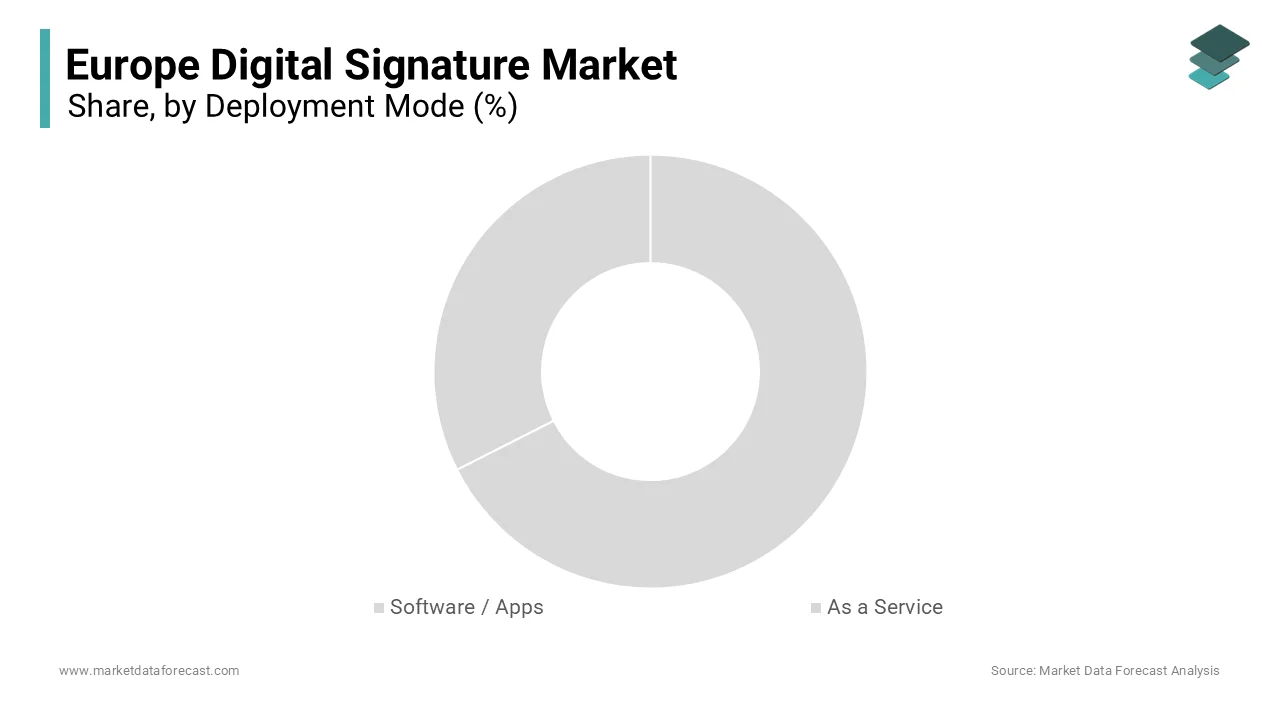
The software/apps deployment segment is estimated to register the fastest CAGR of 18.7% from 2026 to 2034. The swift expansion of the software/apps deployment segment is propelled by rising demand for offline-capable e-signing solutions in high-security and regulated environments where internet connectivity poses compliance or operational risks. According to research, clinical trials in Eastern Europe, even in remote areas with unreliable internet, require methods for legally valid signatures on source documents. In response, providers have developed standalone desktop and mobile applications that generate qualified signatures using embedded secure elements or local smart cards. This niche but critical demand for sovereign disconnected signing capabilities is fueling rapid innovation and adoption in the Software/Apps segment.
By Enterprise Type Insights
In 2025, the businesses and enterprises segment held the leading share of the European digital signature market. The prominence of the businesses and enterprises segment is attributed to regulatory mandates,tes digital transformation initiatives across-borderder operational needs. As per sources, Financial institutions in the European Union significantly increased their implementation of digital signatures for client onboarding and transaction approvals to meet specific regulatory requirements. The manufacturing sector, led by major automobile associations, standardised the use of digital signing for supplier compliance certificates across its member companies. Logistics firms adopt an enterprise-wide platformto mitigatee the risks of lading and customs declarations, reducing shipment clearance time by several hours. Furthermore, the European Commission actively supported the broad digitisation efforts of small and medium enterprises, including providing grants that encourage digital signature adoption. Enterprises remain the primary engine of market growth, driving deployment through compliance and efficiency, even as millions of SMEs across the EU face pressure to modernise their documentation workflows.
The government entities segment is anticipated to witness the fastest CAGR of 21.3% during the forecast period,d owing to the EU’s Digital Decade Policy Programme, which mandates that all member states achieve 10per cent digitisation of key public services by 2030 with digital signatures as a core enabler. In addition, Germany processed a large number of digitally signed tenders. France generally requires qualified electronic signatures for e-administration matters like public procurement contracts and tax documents. The European Court of Justice reinforced this trend. Apart from these, national eGovernment strategies such as Estonia’s X-Road and Spain’s Cl@ve integrate digital signatures into citizen identity frameworks, enabling seamless access to numerous public services. The public sector is emerging as the most dynamic growth vector in the European signature ecosystem, driven by governments transitioning from service providers to digital platforms.
By End Use Insights
The BFSI segment led the European digital signature market by occupying a 29.5% share in 2025. The supremacy of the BFSI segment is because to stringent regulatory requirements and high transaction volumes involving legally binding documentation. Insurance firms have similarly adopted the technology. The rise of open banking has further accelerated adoption as third-party providers must digitally sign consent agreements with account holders under PSD2. This confluence of compliance, operationalscalee and risk mitigation makes BFSI the most mature and volume-used segment in Europe.
The cross-border trade segment is likely to experience the fastest CAGR of 22.9% from 2025 to 2030. The rapid expansion of the cross-border trade segment is fuelled by the EU’s push for paperless trade under the Digital Single Market strategy and the mutual recognition of qualified electronic signatures across all 27 member states. The EU Customs Declaration Service has moved away from physical documents to process import and export declarations digitally. Trade between EU and EFTA countries has benefited from digital signatures, which have made customs clearance more efficient. The EU’s Digital Trade Platform initiative allows small and medium-sized businesses to securely sign and exchange legal documents across different jurisdictions. The use of digital signatures in international transactions has increased among EU exporters. This segment is becoming the frontline of Europe’s digital trade sovereignty as global supply chains prioritise speed and compliance.
REGIONAL ANALYSIS
Germany Market Analysis
Germany was the top performer in the European digital signature market and accounted for a 24.2% share in 2025. The demand for digital signatures in Germany is attributed to its strict regulatory enforcement and advanced industrial digitisation. The Federal Ministry of Justice mandated qualified electronic signatures for notarised contracts in commercial law as of 2022. Industrial adoption is equally robust, with the German Association of Automotive Industries requiring digital signatures for all supplier quality certifications and delivery confirmations. Deutsche Bank and Commerzbank leathe d the financial sector implementation. Germany also hosts some of Europe’s qualified trust service providers accredited under the EU’s Root Certification Authority framework. This combination of legal mandate, enterprises, scale and trust infrastructure establishes Germany as Europe’s most mature compliance-driven digital signature market.
France Market Analysis
France was the second-largest player in the European digital signature market by accounting for an 18.3% share in 2025. The growth of France in the regional market is propelled by an automated digital identity strategy and legal sector transformation. The French Digital Republic Act of 2016 granted qualified electronic signatures full equivalence to handwritten ones in all civil and commercial proceedings. France also mandates digital signatures for all inter-ministerial communications. France has used its strong state coordination and high citizen digital ID penetration to build a top-down adoption model, accelerating market penetration across public and private domains.
Estonia Market Analysis
Estonia is a lucrative country in the European digital signature market, despite its small population, due to its globally recognised digital infrastructure and cross-border leadership. Most Estonian residents use national ID cards and Mobile ID for daily activities, a trend driven by legal frameworks and a commitment to digital services. Digital signatures are legally equivalent to handwritten signatures across the European Union, making electronic transactions secure and legally binding. Nearly all public services require digital authentication and signatures, integrating digital identity into everyday life for citizens and e-residents. Estonia also leads EU cross-border initiatives such as the Digital Europe Programme’s Trusted Digital Identity pilot. This first-mover advantage and deep integration into national digital DNA make Estonia a disproportionately influential high-intensity market in Europe.
Sweden Market Analysis
Sweden expanded gradually in the European digital signature market, with its healthcare digitisation and sustainable public procurement policies. The Swedish Environmental Protection Agency further requires digital signing of carbon offset agreements under its national climate framework. Private sector adoption is strong in banking. Swedbank and SEB are processing millions of digitally signed customer agreements annually. Sweden’s BankID system, one of Europe’s most trusted identity solutions, supports seamless signature authentication across sectors. This focus on health sustainability and trusted identity creates a cohesive ecosystem where digital signatures are embedded in both social welfare and environmental governance.
Netherlands Market Analysis
The Netherlands is predicted to grow in the European digital signature market between 2026 and 2034 due to its role as a European logistics gateway and legal tech innovation centre. The Dutch Chamber of Commerce requires digital signatures for all company registrations and annual filings. Legal tech startups have pioneered blockchain-anchored signature platforms compliant with eIDAS and GDPR. The Dutch Data Protection Authority actively certifies signature providers under strict privacy by design principles. This blend of trade efficiency, modernisation,y legamodernisationon and privacy leadership positions the Netherlands as a high-value niche market where digital signatures enable both economic velocity and regulatory trust.
COMPETITIVE LANDSCAPE
KEY MARKET PLAYERS
Some of the notable key players in the European digital signature market are
- PXL Vision AG (Switzerland)
- D-Trust GmbH (Germany)
- Skribble (Switzerland)
- Tinexta (Italy)
- Yousign (France)
- Alohi (Switzerland)
- CM.com (Netherlands)
- EDICOM (Spain)
- Autenti (Poland)
- Spoof GmbH (Austria)
- Swisscom Ltd. (Swisscom Trust Services) (Switzerland)
- Nortal (Estonia)
- Signicat (Norway)
- GlobalSign (Belgium)
- Safelayer Secure Communications (Spain)
- Cybernetica AS (Estonia)
- Box, Inc. (U.S.)
- OneSpan Inc. (U.S.)
- Citrix Systems Inc. (U.S.)
- Entrust Corporation (U.S.)
TOP STRATEGIES USED BY THE KEY MARKET PLAYERS
Key players in the European digital signature market employ a range of strategic initiatives to reinforce compliance, competitiveness, and scalability. Achieving and maintaining Qualified Trust Service Provider status under eIDAS is fundamental to offering legally binding signatures across the EU. Companies invest heavily in EU-based datacentres and residency frameworks to comply with GDPR and build customer trust. Strategic integrations with national digital identity systems such as BankID and FranceConnect enhance user authentication and adoption. Partnerships with enterprise software vendors like SA, P Microso, ft and Salesforce embed signature functionality into core business workflows. Continuous innovation in cryptographic ssecuritypost-quantum readiness, hardware-backed key storage, and addressing evolving cyber threats. Additionally, firms actively participate in European standardisation bodies to shape future regulatory and technical requirements, ts long-term market alignment and leadership.
COMPETITION OVERVIEW
The European digital signature market features intense competition among global technology leaders, specialised trust service providers and region-compliance-focused vendors. Competition is defined less by price and more by legal validity, ty data sovereignty, regulatory alig, and integration depth with existing enterprise and public sector systems. The eIDAS framework creates a high barrier to entry, as only Qualified Trust Service Providers can offer the highest assurance signatures with cross-border legal equivalence. This regulatory framework favours established players with proven cryptographic infrastructure and audit capabilities. However, niche providers thrive by catering to specific sectors such as legal, healthcare or logistics with tailored workflows and localised identity integrations. National digital identity schemes further shape the landscape by favouring vendors that interoperate government-issued credentials. Innovatiocentresrs on auditability, ty long-term validation and user experience rather than core signing functionality.
TOP PLAYERS IN THE MARKET
- DocuSigInc.nc is a globally recognised leader in the European digital signature market offering IDAS-compliant solutions tailored for regulated industries including finance, health,nce healthe and public administration. The company has strengthened its European footprint by obtaining Qualified Trust Service Provider status under the EU framework, enabling its platform to issue legally binding qualified electronic signatures. The company also partnered with national digital identity schemes such as Sweden’s BankID and France’s FranceConnect to enable seamless citizen authentication. These initiatives reinforce DocuSign’s position as a trusted enabler of secure digital transactions across Europe while supporting its global mission to digitise agreement processes worldwide.
- AdoInc.Inc plays a pivotal role in the European digital signature market through its Adobe Acrobat Sign platform, which integrates deeply with widely used document workflows across legal and enterprise sectors. Adobe holds Qualified Trust Service Provider accreditation in the EU, allowing its solutions to generate signatures with the highest legal validity under eIDAS. The company has enhanced its European compliance posture by establishing data centres in Ireland and the Netherlands to ensure full GDPR adherence. Embedding digital signing directly into common productivity tools allows Adobe to accelerate adoption and support the global standardisation of secure electronic agreements.
- GlobalSign Ltd is a foundational trust infrastructure provider in the European digital signature mark, et operating as a Qualified Trust Service Provider with roots in cryptographic certificate issuance. The company supplies the backend validation and timestamping services that power digital signature platforms across financhealthcare e re and government sectors in Europe. It also launched a cloud-based Qualified Signature Creation Device compliant with ETSI standards to support mobile and remote signing. A strong focus on PKI infrastructure, interoperability, and compliance allows GlobalSign to enable seamless cross-border legal validity and contribute significantly to the global trust ecosystem that underpins all secure digital transactions.
MARKET SEGMENTATION
This research report on the European digital signature market has been segmented and sub-segmented based on categories.
By Deployment Mode
- Software / Apps
- As a Service
By Enterprise Type
- Businesses / Enterprises
- Government Entities
By End Use
- Legal Services
- BFSI
- Healthcare
- Real Estate
- Education
- Manufacturing
- Cross-Border Trade
- Others
By Country
- UK
- France
- Spain
- Germany
- Italy
- Russia
- Sweden
- Denmark
- Switzerland
- Netherlands
- Turkey
- Czech Republic
- Rest of Europe