- Product Description Description
- Table of Contents TOC
- List of Table & Figure LOT
- Get Free Sample PDF Sample PDF
Market Size, 2025
$55.56 MnMarket Estimate, 2026
$89.72 MnMarket Forecast, 2034
$4152.25 MnCAGR, 2026–2034
61.5%Executive Summary: Europe Direct Air Capture Market
- Market Scope: Comprehensive regional analysis of the European direct air capture (DAC) market covering technology segments, carbon storage corridors, regulatory frameworks (Fit for 55), and green tech public funding programs.
- Market Valuation: Valued at USD 55.56 million (2025), estimated at USD 89.72 million (2026), and projected to reach USD 4,152.25 million by 2034, registering a remarkable CAGR of 61.5% (2026–2034).
- Primary Growth Drivers: EU legally binding climate neutrality targets under the Fit for 55 package, rising carbon prices within the EU ETS, and carbon removal certification frameworks. Key opportunities are boosted by industrial waste heat integration, electrochemical sorbents, and permanent mineralization storage.
Key Market Segment Metrics (2026–2034)
| Category | Leading Segment (2025 Position) | Fastest-Growing Segment |
|---|---|---|
| By Technology Type | Liquid-Based Direct Air Capture (L-DAC) (dominated with a 62.7% share in 2025) | Electrochemical DAC (E-DAC) (projected to witness the fastest CAGR of 41.3% due to redox-active sorbents) |
| By Storage & Integration | Basaltic Mineralization Storage & Industrial Heat Integration | Integrated Storage Corridors (e.g., Porthos and Athos linking to North Sea depleted fields) |
| By Region / Country | Switzerland (led regionally with a 28.5% share in 2025) & Iceland (22.7% share) | Germany & Netherlands (rapidly scaling demonstration sites and North Sea transport corridors) |
Major Market Players & Market Structure
Market Structure: Highly specialized and rapidly advancing European climate tech and carbon removal landscape featuring pioneering engineering firms, strategic industrial partnerships, and public-backed infrastructure deployment.
Key Companies: Climeworks AG, Carbon Engineering Limited, Global Thermostat, Heirloom, Soletair Power Oy, CarbonCapture Inc., Verdox Inc., AspiraDAC, CO₂Rail Company, Prometheus Fuels Inc., Twelve, AirCapture LLC, Svante Technologies Inc., Storegga Limited, Arca Climate Technologies, and Drax Group plc.
Europe Direct Air Capture Market Size
The europe direct air capture (DAC) market was valued at USD 55.56 million in 2025, is expected to have a 61.5% CAGR from 2026 to 2034, and be worth USD 4152.25 million by 2034 from USD 89.72 million in 2026.

Direct air capture (DAC) denotes a class of engineered systems that selectively remove carbon dioxide from ambient air through chemical sorption processes, enabling either permanent geological storage or utilization in synthetic fuels and materials. In Europe, DAC is increasingly positioned not as a substitute for emissions reduction but as an essential complement within the continent’s legally mandated net-zero trajectory. The European Climate Law enshrines a binding target of climate neutrality by 2050, with an intermediate reduction of 55 percent below 1990 levels by 2030. As of 2025, the European Union emitted notable metric tons of CO₂, with a significant share arising from sectors resistant to conventional decarbonization. The International Energy Agency underscores that carbon dioxide removal will be indispensable for neutralizing residual emissions, particularly in industry and aviation. Europe currently hosts operational DAC facilities in Iceland (Orca and Mammoth by Climeworks), Norway (Northern Lights partnership), and Finland and Denmark (Soletair Power pilot), signaling early but tangible market formation.
MARKET DRIVERS
Ambitious Climate Policy Frameworks Cause DAC Deployment
The region’s legally binding and multi-layered climate governance structure provides a robust foundation that drives the growth of the European direct air capture market. The Fit for 55 legislative package, central to the European Green Deal, establishes a clear decarbonization runway that cannot be fulfilled through abatement alone. The revision of the EU Emissions Trading System (EU ETS) has driven carbon prices to historically high levels. The price first exceeded 100 euros per metric ton in February 2023, and the annual average price was approximately €83 per metric ton in 2023. In 2025, prices generally fell, averaging around €65-€78 per metric ton due to factors such as lower power emissions and an increase in renewable energy use. This price signal enhances the economic rationale for high-cost carbon removal solutions. Apart from these, the 2023 Net Zero Industry Act explicitly designates DAC as a strategic net zero technology, which prioritizes it for fast-tracked permitting and state aid compatibility. These coordinated policy levers collectively reduce investment uncertainty and accelerate the transition from pilot to commercial scale.
Industrial Decarbonization Imperatives Drive Dac Integration
Hard-to-abate industrial sectors in the region generate emissions that are chemically inherent to production processes, and these propel the expansion of the European direct air capture market. The cement, steel, and chemical industries collectively account for a portion of the EU’s CO₂ output. For instance, cement production releases notable kilograms of CO₂ per metric ton due to limestone calcination, a reaction that cannot be electrified. In addition, major industrial players are actively exploring DAC integration. Heidelberg Materials has partnered with Climeworks for CO₂ offtake, while ArcelorMittal is evaluating DAC feasibility at its Ghent site. This industrial pull is transforming DAC from a theoretical solution into an operational necessity for sectoral net zero compliance.
MARKET RESTRAINTS
Prohibitive Energy Requirements Impede Scalability
The energy intensity of current DAC technologies imposes a fundamental constraint on their scalability, which restricts the growth of the European direct air capture market. Solvent-based DAC systems require low-grade thermal energy and electricity for per metric ton of CO₂ captured. Diverting clean power to DAC competes directly with electrification priorities in transport and buildings. Moreover, the intermittent nature of wind and solar undermines the continuous high-temperature heat supply needed for solvent regeneration. Solid sorbent systems offer lower thermal demands but remain largely at the pilot scale. DAC will only see limited implementation in Europe because of the region's constrained clean energy supply, unless breakthroughs in energy efficiency or zero-carbon energy coupling are achieved.
Immature CO₂ Transportation and Storage Infrastructure Limits Viability
The absence of a comprehensive and interconnected CO₂ transport and storage network impedes the expansion of the European direct air capture market. As of 2025, there are active commercial storage sites in Europe (primarily Sleipner and Snøhvit in Norway, and another in Hungary), but the Porthos project in the Netherlands is still under construction and is expected to become operational by 2026. This stands in stark contrast to the European Commission's 2025 Industrial Carbon Management Strategy (which is informed by the EEA's analysis) estimates that approximately 250 million tonnes of CO₂ will need permanent storage annually by 2040 to achieve climate neutrality by 2050. The target for 2050 is a total capture of 450 MtCO₂ per annum across the EU and UK combined. Pipeline infrastructure is equally underdeveloped. A lack of assured permanent storage hinders DAC developers from securing long-term offtake agreements or attracting project finance, which effectively creates a systemic impediment to market expansion despite the technology being ready.
MARKET OPPORTUNITIES
Emergence of High Integrity Carbon Removal Markets Creates Revenue Pathways
The institutionalization of credible carbon removal verification systems in the region is forging new commercial channels that open new opportunities for the growth of the European direct air capture market. The EU’s Carbon Removal Certification Framework, enacted in 2025, establishes rigorous criteria for permanence, additionality, and environmental integrity, enabling the issuance of tradable removal certificates. This regulatory clarity has spurred corporate procurement. Major buyers have contracted with Climeworks for multiyear DAC offtake. Looking ahead, the EU’s Climate Transition Benchmark is expected to require institutional investors to incorporate high-quality removals into decarbonization strategies, broadening demand beyond voluntary markets. This shift transforms DAC from a public subsidy-dependent technology into a commercially viable asset class.
Strategic Public Funding Accelerates Technology Demonstration and Learning
Targeted public investment is de-risking first-of-a-kind DAC deployment and accelerating technological learning in the region, which offers major opportunities for the expansion of the European direct air capture market. National programs complement this support. The investments have already reduced DAC levelized costs through engineering standardization and supply chain maturation. Horizon Europe research grants are further advancing next-generation materials, such as electro swing adsorption systems, which could cut energy use. This coordinated public backing not only bridges the commercialization gap but also positions European firms as global DAC technology exporters.
MARKET CHALLENGES
Technological Immaturity Constrains Cost Competitiveness and Performance
DAC remains an early-stage technology plagued by performance uncertainty, high costs, and limited operational history, and this is among the key challenges for the European direct air capture market. Performance also varies significantly with ambient conditions. Solid sorbent systems, for example, exhibit reduced CO₂ uptake in high humidity, which prevails across much of Western Europe. Scaling from pilot to industrial capacity introduces engineering risks related to heat integration, automation, and material degradation over time. Unlike mature clean energy technologies, DAC lacks standardized modular designs, leading to high customization costs and extended construction timelines. The market's slow diffusion stems directly from low project bankability and investor confidence, which will persist until providers ensure consistent, multi-term performance globally and scale up their manufacturing operations.
Public Acceptance and Social License Remain Uncertain
Low public awareness, ethical concerns, and localized opposition also constrain the expansion of the European direct air capture market. This affects the social and political acceptance of DAC in the region. Environmental NGOs such as Greenpeace have criticized DAC as a moral hazard that could delay fossil fuel phaseout, a narrative that influences local policymakers. Besides, CO₂ pipeline proposals often encounter community resistance despite scientific consensus on safe transport. Gaining social license for DAC projects is challenging unless there is inclusive engagement connecting them to just transition principles and local co-benefits. Projects lacking local support and understanding risk rejection as an undemocratic expert dictates, a major and unpredictable impediment to their deployment.
REPORT COVERAGE
| REPORT METRIC | DETAILS |
| Market Size Available | 2025 to 2034 |
| Base Year | 2025 |
| Forecast Period | 2026 to 2034 |
| Segments Covered | By Technology and Region. |
| Various Analyses Covered | Global, Regional, and Country-Level Analysis, Segment-Level Analysis, Drivers, Restraints, Opportunities, Challenges; PESTLE Analysis; Porter’s Five Forces Analysis, Competitive Landscape, Analyst Overview of Investment Opportunities |
| Countries Covered | UK, France, Spain, Germany, Italy, Russia, Sweden, Denmark, Switzerland, Netherlands, Turkey, Czech Republic, and the Rest of Europe. |
| Market Leaders Profiled | Climeworks AG, Carbon Engineering Ltd., Global Thermostat LLC, Heirloom Carbon Technologies, Carbyon B.V., Carbon Collect Limited, Skytree BV, Mission Zero Technologies Ltd., Verdox Inc., Soletair Power Oy, AspiraDAC, CO₂Rail Company, Prometheus Fuels Inc., Twelve (Benefit Corporation), AirCapture LLC, CarbonCapture Inc., Svante Technologies Inc., Storegga Limited, Arca Climate Technologies, and Drax Group plc. |
SEGMENTAL ANALYSIS
By Technology Insights
In 2025, the liquid-based direct air capture (L DAC) segment led the European direct air capture market by capturing a 62.7% share. The dominance of the liquid-based direct air capture (L DAC) segment is because of the technological maturity and scalability trajectory of liquid solvent systems, particularly those commercialized by early movers like Climeworks in partnership with Carbfix in Iceland and other European pilot sites. L DAC systems utilize hydroxide solutions that react exothermically with atmospheric CO₂, which enables high capture capacities per unit volume. The alignment of L DAC with existing industrial heat infrastructure also drives the growth of this segment. Many European chemical and cement plants produce low-grade waste heat between 80 and 120 degrees Celsius, which can be repurposed for solvent regeneration. This synergy with incumbent industrial ecosystems accelerates L DAC adoption over less integrated alternatives.
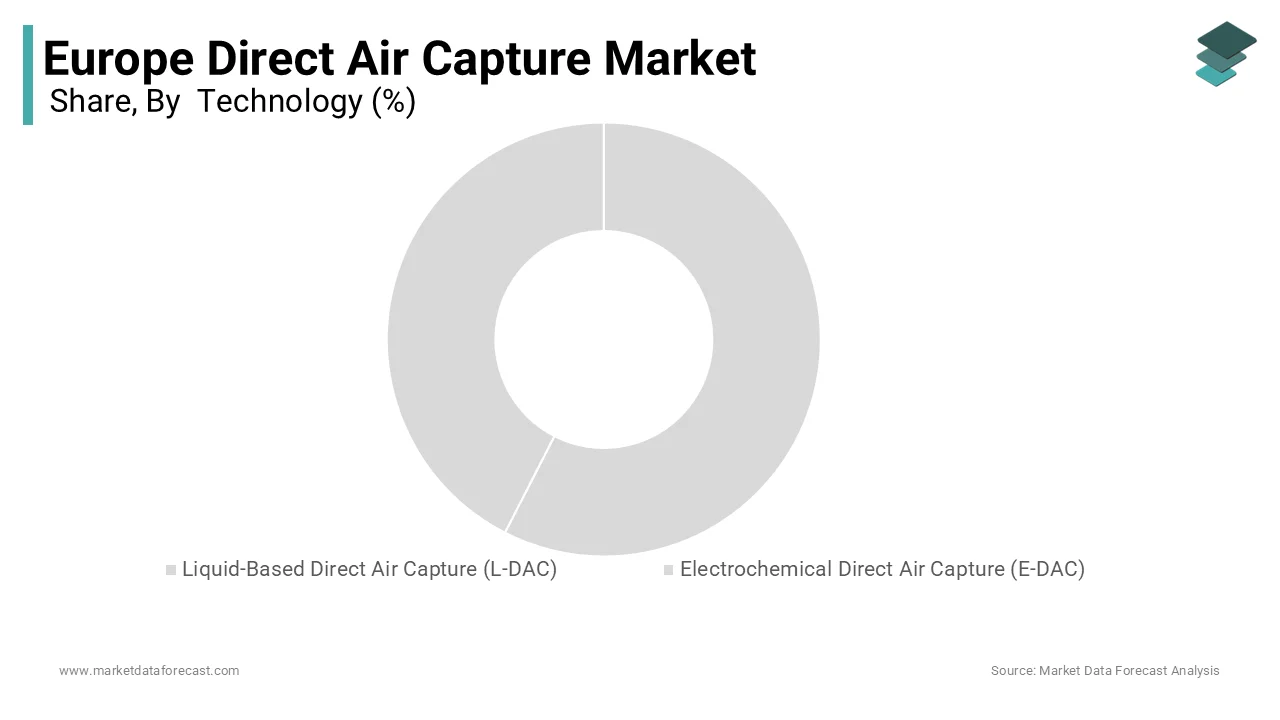
The Electrochemical DAC (E DAC) segment is likely to experience the fastest CAGR of 41.3% from 2025 to 2033. The rapid growth of the Electrochemical DAC (E DAC) segment is fuelled by breakthroughs in redox-active sorbents and membrane electrode assemblies that eliminate the need for high-temperature thermal regeneration. The compatibility of E DAC with intermittent renewable electricity further propels the growth of this segment. Unlike thermal-based systems, E DAC can operate efficiently using variable solar or wind power, aligning with Europe’s grid decarbonization trajectory. E DAC units developed by startups have demonstrated low energy consumption per metric ton of CO₂ in lab-scale trials. A further driver is targeted public funding. The modular and water-efficient nature of E DAC also makes it suitable for urban and coastal settings, broadening its applicability beyond remote industrial zones.
COUNTRY LEVEL ANALYSIS
Switzerland Direct Air Capture Market Analysis
Switzerland dominated the European direct air capture market and accounted for a 28.5% share in 2025. The prominence of Switzerland is primarily driven by technology commercialization and innovation, and its role as the birthplace and operational base of Climeworks, the world’s first commercial DAC company. The country’s DAC leadership is underpinned by a supportive innovation ecosystem and stringent climate accountability mechanisms. Switzerland has introduced new climate legislation requiring a portion of national emission reductions to be achieved through carbon dioxide removal by establishing one of the first domestic offtake frameworks in Europe. The Swiss government is investing substantially in advancing carbon removal technologies, with funding directed toward large-scale demonstration projects and regional pilot hubs focused on direct air capture innovation. This confluence of policy certainty, public investment, and scientific excellence positions Switzerland as Europe’s DAC innovation nucleus.
Iceland Direct Air Capture Market Analysis
Iceland was the second-largest player in the European direct air capture market and occupied a 22.7% share in 2025. Its strategic function as a CO₂ storage hub contributed to its growth in this market. The island nation hosts the world’s first and largest operational DAC plants, Climeworks’ Orca and Mammoth facilities, which inject captured CO₂ into basaltic rock formations via the Carbfix process, achieving mineralization in under two years. This capability stems from Iceland’s unique geology. The Icelandic government has designated seven CO₂ storage zones by streamlining permitting for international DAC operators.
Germany Direct Air Capture Market Analysis
Germany is among the key players in the European DAC market. The country’s DAC strategy is tightly coupled with its industrial decarbonization agenda, particularly in the chemicals and steel sectors. It is advancing its national carbon management agenda through significant public investment aimed at scaling direct air capture (DAC) technologies, including multiple large-scale demonstration sites connected to major industrial players. As per sources, high-emission industrial hubs are being prioritized for carbon capture deployment, particularly to address process-related emissions that remain difficult to abate through conventional measures like electrification. DAC has been identified within Germany’s national climate strategy as a critical solution for offsetting residual industrial emissions, with long-term capacity goals set to support national decarbonization targets.
Netherlands Direct Air Capture Market Analysis
The Netherlands is moving ahead steadfastly in the European direct air capture market due to its integrated port ecosystems and cross-border carbon transport networks. The Port of Rotterdam Authority has integrated DAC into its Porthos and Athos carbon capture and storage corridors, which connect to depleted North Sea gas fields capable of storing large metric tons of CO₂. The Netherlands also benefits from its central location in the North Sea Basin. This infrastructure advantage, combined with proactive policy design, positions the Netherlands as a DAC logistics and offtake nexus.
Norway Direct Air Capture Market Analysis
Norway is predicted to see notable growth in the European direct air capture market over the forecast owing to its world-leading regulatory framework for CO₂ storage and long-term public investment. According to research, Norway’s updated carbon storage legislation has established one of the most advanced regulatory frameworks in Europe by shifting long-term storage liability to the state, thereby creating a more favorable environment for private sector investment in direct air capture (DAC) projects. As per sources, the Northern Lights initiative, led by major energy companies, is positioning Norway as a central hub for cross-border carbon storage by facilitating agreements with DAC operators from multiple European countries. The country possesses substantial underground storage capacity in the North Sea, offering long-term potential for secure carbon sequestration and regional emissions management.
COMPETITIVE LANDSCAPE
Competition in the European direct air capture market is characterized by a small but rapidly evolving cohort of technology developers competing on engineering efficiency, integration models, and policy influence rather than price. The market features a mix of European-born innovators and US-based firms establishing European operations to access funding and regulatory support. Differentiation arises through technological approaches, such as liquid solvents, solid sorbents, or electrochemical systems, and deployment strategy, including centralized industrial hubs versus decentralized urban units. Strategic alliances with energy companies, industrial clusters, and storage operators are critical for operational viability. While commercial-scale deployment remains limited, competition is intensifying around intellectual property, first-mover credibility, and access to verified carbon offtake agreements. The absence of standardized performance metrics and the high cost of demonstration projects create significant entry barriers, reinforcing the incumbency advantage of early entrants who have secured public grants and pilot sites across Iceland, Switzerland, the Netherlands, and Norway.
KEY MARKET PLAYERS
Some of the companies that are playing a dominating role in the global Europe direct air capture market include
- Climeworks AG
- Carbon Engineering Ltd.
- Global Thermostat LLC
- Heirloom Carbon Technologies
- Carbyon B.V.
- Carbon Collect Limited
- Skytree BV
- Mission Zero Technologies Ltd.
- Verdox Inc.
- Soletair Power Oy
- AspiraDAC
- CO₂Rail Company
- Prometheus Fuels Inc.
- 12 (Twelve Benefit Corporation)
- AirCapture LLC
- CarbonCapture Inc.
- Svante Technologies Inc.
- Storegga Limited
- Arca Climate Technologies
- Drax Group plc
TOP LEADING PLAYERS IN THE MARKET
- Climeworks is a Swiss-based pioneer in direct air capture technology and a central figure in Europe’s carbon removal landscape. The company operates the world’s first commercial DAC plants, Orca and Mammoth, in Iceland in partnership with Carbfi,x, leveraging basaltic mineralization for permanent CO₂ storage. In 202,4, Climeworks inaugurated its third-generation DAC module, featuring a 30 percent reduction in energy consumption compared to prior models. The firm has secure long-term carbon removal agreements with corporations, including Microsoft, Lufthansa, and Boston Consulting Gr, reinforcing its role in shaping high-integrity removal markets across Europe and globally.
- Heirloom is a US-headquartered company with significant operational expansion into Western Europe through strategic partnerships and pilot deployments. The company’s innovation centers on accelerated mineralization using natural limestone processed into calcium oxide, which captures CO₂ from ambient air within days rather than millennia. In early 202,5, Heirloom launched its first European demonstration site in the Netherlands, co-funded by the European Innovation Council. The project integrates with local cement plants to recycle regenerated material, creating a circular industrial loop that aligns with EU circular economy directives.
- Soletair Power is a Finnish technology developer specializing in modular and building-integrated DAC solutions that utilize low-temperature waste heat and solar energy. The company has installed pilot units at commercial buildings in Helsinki, Stockholm, and Amsterdam, demonstrating decentralized carbon removal within urban environments. On November 20,24, Soletair Power partnered with Schneider Electric to embed its DAC modules into smart building energy management systems. This integration enables real-time optimization of capture cycles based on grid carbon intensity and electricity pricing, enhancing both efficiency and grid compatibility across European cities.
TOP STRATEGIES USED BY THE KEY MARKET PARTICIPANTS
Key players in the European direct air capture market employ a combination of strategic partnerships, public funding, acquisition, standardization, a nd policy engagement to strengthen their positions. Companies actively collaborate with industrial emitters, port authorities, ties, and energy providerco-locateocate DAC units with waste heat sources or storage infrastructure. They pursue non-dilutive grants from the EU Innovation Fund Horizon Europe and national green tech programs to de-risk capital expenditure. Several firms are investing in modular standardized designs to reduce manufacturing costs and accelerate deployment timelines. Simultaneously, they engage with regulators to shape carbon removal certification methodologies and advocate for inclusion in national decarbonization strategies, ensuring long-term market viability through policy alignment and revenue certainty.
MARKET SEGMENTATION
This research report on the European direct air capture market is segmented and sub-segmented into the following categories.
By Technology
- Liquid-Based Direct Air Capture (L-DAC)
- Electrochemical Direct Air Capture (E-DAC)
- Others
By Country
- Switzerland
- Iceland
- Germany
- Netherlands
- Norway
- Rest of Europe