- Product Description Description
- Table of Contents TOC
- List of Table & Figure LOT
- Get Free Sample PDF Sample PDF
Market Size, 2025
$5.48 BnMarket Estimate, 2026
$5.72 BnMarket Forecast, 2034
$8.02 BnCAGR, 2026–2034
4.32%Europe Dried Fruits Market Report Summary
The Europe dried fruits market was valued at USD 5.48 billion in 2025 and is estimated to reach USD 5.72 billion in 2026, further projected to reach USD 8.02 billion by 2034, growing at a CAGR of 4.32% during the forecast period. Market growth is driven by increasing consumer preference for healthy snack alternatives, rising demand for plant based and clean label products, and growing awareness of the nutritional benefits of dried fruits. Expanding use of dried fruits in bakery, confectionery, breakfast cereals, and dairy products is further supporting market expansion. In addition, the trend toward convenient and long shelf life food products is strengthening demand across retail and foodservice channels in Europe.
Key Market Trends
- Growing consumer demand for natural, preservative free, and organic dried fruit products across European markets.
- Rising popularity of raisins due to their versatility in bakery, snacks, and traditional food applications.
- Increasing incorporation of dried fruits in functional foods and energy bars driven by health conscious consumers.
- Expansion of private label offerings and premium packaging formats in supermarkets and hypermarkets.
- Strong import and trade networks supporting year round availability of diverse dried fruit varieties.
Segmental Insights
- Based on type, the raisins segment accounted for 35.5% of the Europe dried fruits market share in 2025. The segment’s leadership is attributed to widespread consumption, affordability, and extensive application across bakery and snack industries.
- Based on form, the whole dried fruits segment held 61.4% of the European market share in 2025. The dominance of this segment is supported by consumer preference for minimally processed products and their use in direct snacking and culinary applications.
Regional Insights
- Germany accounted for 19.4% of the Europe dried fruits market share in 2025, making it the leading country in the region. The country’s dominance is supported by high health awareness, strong retail distribution networks, and significant demand for organic and natural food products.
- Other major European countries continue to witness steady growth due to expanding plant based diets and healthy snacking trends.
Competitive Landscape
The Europe dried fruits market is moderately competitive with the presence of global suppliers and specialized regional processors. Companies are focusing on quality sourcing, organic certification, innovative packaging, and strategic partnerships to strengthen their market position. Key players operating in the Europe dried fruits market include Sunbeam Foods Pty Ltd., Traina Foods, Kiantama Oy, Dole Food Company, Sun Maid Growers of California, Bergin Fruit and Nut Company Inc., Red River Foods Incorporated, and Lion Raisins Inc.
Europe Dried Fruits Market Size
The Europe dried fruits market size was valued at USD 5.48 billion in 2025 and is projected to reach USD 8.02 billion by 2034 from USD 5.72 billion in 2026, growing at a CAGR of 4.32%.
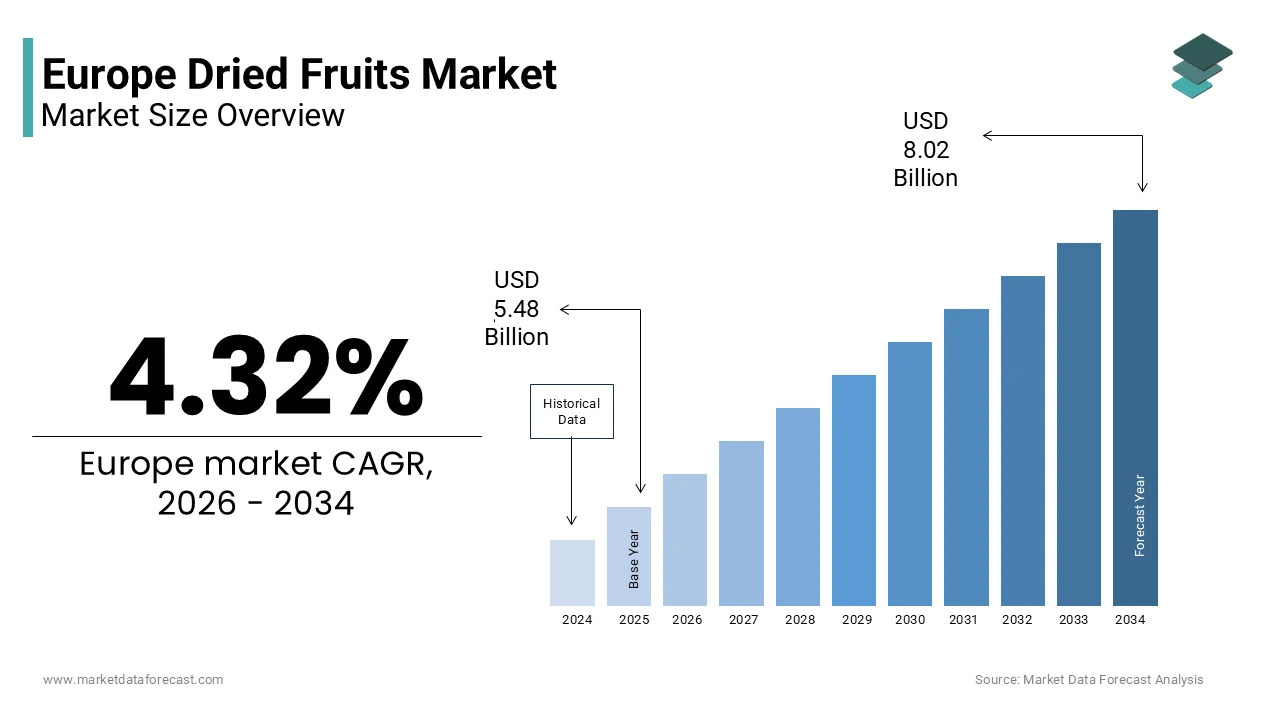
Dried fruit encompasses a diverse range of naturally or mechanically dehydrated fruits including raisins, apricots, figs, dates, prunes, and cranberries and consumed as snacks, baking ingredients, or functional food components. In 2025, this sector is defined not by volume alone but by its alignment with health consciousness, clean label trends, and sustainable sourcing expectations. Unlike commodity markets, European dried fruit demand is heavily influenced by nutritional awareness and culinary tradition, with Mediterranean countries maintaining centuries old consumption patterns while Northern Europe adopts dried fruits as sugar alternatives in plant-based diets. According to Eurostat, many EU households purchased dried fruit in 2024, reflecting broad demographic penetration. The European Food Safety Authority recognizes dried fruits as significant sources of dietary fiber, potassium, and antioxidants, reinforcing their role in public health narratives. Furthermore, as per the European Commission, most dried fruit sold in the EU must comply with strict maximum residue levels for pesticides and mycotoxins, ensuring high safety standards. This confluence of wellness orientation, regulatory rigor, and cultural integration positions the dried fruit market as a resilient and evolving segment within Europe’s broader healthy snacking ecosystem.
MARKET DRIVERS
Rising Health Consciousness and Demand for Natural Snacking Alternatives
European consumers are increasingly replacing ultra processed snacks with nutrient dense, minimally processed alternatives, which is driving sustained demand for dried fruits across age groups and propelling the growth of the European dried fruit market. As per the European Commission’s Special Eurobarometer on Healthy Eating, many EU citizens actively seek foods with no added sugar, positioning unsweetened dried fruits as ideal substitutes in both home and on the go consumption. Raisins, dates, and apricots are particularly favored for their natural sweetness and fiber content. According to the European Food Information Council, prunes are recognized for their fiber contribution. Retailers have responded by expanding organic and no additive dried fruit sections, as per FiBL reports. School lunch programs in Scandinavia now include dried fruit packs as standard, while fitness communities promote date energy balls as clean fuel. This shift is not fleeting, it reflects a structural realignment toward whole food nutrition, making dried fruits a staple rather than a niche product in Europe’s evolving dietary landscape.
Integration of Dried Fruits into Traditional and Modern Culinary Practices
Dried fruits maintain deep roots in European gastronomy while simultaneously adapting to contemporary food innovation, which is ensuring consistent demand across retail and food service channels and is further boosting the expansion of the European dried fruit market. In Southern Europe, raisins and figs are indispensable in festive breads like Italian panettone and Spanish ensaimada, with seasonal production spikes aligning with holiday calendars. According to the Italian Confectionery Association, sultanas are widely used in panettone. Meanwhile, Northern European chefs leverage dried fruits for umami depth, Swedish meatballs often include rehydrated prunes, and German sauerbraten recipes call for raisins in the braising liquid. Modern applications extend to plant based dairy alternatives, oat milk yogurt brands in Denmark now incorporate chopped dates for natural sweetness. The baking industry relies heavily on dried fruits for texture and moisture retention, as per the British Baking Federation. This dual identity as both heritage ingredient and functional modern component grants dried fruits enduring relevance beyond passing health fads.
MARKET RESTRAINTS
Stringent EU Regulations on Pesticide Residues and Mycotoxin Contamination
The Europe dried fruit market faces significant compliance hurdles due to rigorous food safety standards that restrict permissible levels of chemical and biological contaminants. The European Commission enforces some of the world’s strictest maximum residue limits for pesticides, with dried vine fruits like raisins subject to numerous compound thresholds. More critically, mycotoxins, particularly aflatoxin B1, pose a persistent challenge, the EU mandates strict limits for ready to eat dried fruits. According to the European Food Safety Authority, non-compliance rates for imported dried figs and apricots have been reported, triggering rejections at EU borders. These standards necessitate costly pre shipment testing, cold chain logistics to inhibit mold growth, and supplier certification programs that small exporters struggle to afford. While protective of consumer health, these regulations fragment supply chains, increase costs, and disproportionately impact producers from developing regions, forcing European importers to consolidate sourcing and invest heavily in verification infrastructure just to maintain market access.
Volatility in Global Supply Due to Climate and Geopolitical Instability
Europe’s dried fruit market remains vulnerable to production shocks in key origin countries, where climate extremes and political unrest disrupt supply consistency and pricing. According to the Turkish Statistical Institute, Turkey, the world’s largest dried fig and apricot producer, has faced challenges due to late spring frosts. Similarly, California, a major source of raisins, has experienced prolonged drought reducing grape yields, as per the USDA. Geopolitical tensions further complicate trade, sanctions and logistical bottlenecks have limited access to Iranian dates and Syrian pistachios, traditional favourites in Eastern Europe. These disruptions trigger price spikes and force manufacturers to reformulate products or ration allocations. Unlike fresh produce, dried fruits have longer shelf lives but cannot be easily substituted without altering taste or texture. This dependency on climatically fragile and politically sensitive regions creates systemic risk that no amount of inventory buffering can fully mitigate, which is undermining planning certainty for processors and retailers alike.
MARKET OPPORTUNITIES
Expansion into Functional Food and Nutraceutical Applications
Leveraging the natural bioactive compounds in dried fruits for functional food and wellness products is a promising opportunity in the European dried fruit market. As per studies from the University of East Anglia, prunes are clinically recognized for bone health support. Dates contain high levels of polyphenols and potassium, making them ideal for sports nutrition bars, while dried cranberries are rich in proanthocyanidins that support urinary tract health. According to the European Nutraceutical Association, functional snack launches featuring dried fruits have been increasing, particularly in Germany and Sweden. Companies like Valio and Alpro now incorporate prune powder into fortified dairy alternatives, and pharmacy chains stock date-based iron supplements. The EU’s pending health claim approvals for specific dried fruits could unlock further potential. By transitioning from simple snacks to evidence backed wellness ingredients, dried fruits gain access to higher margin, science driven segments aligned with Europe’s preventive health agenda.
Adoption of Sustainable and Ethical Sourcing Certifications
Growing consumer demand for transparency is driving the adoption of sustainability certifications that enhance brand trust and secure premium shelf placement across Europe, which is another notable opportunity in the European dried fruit market. As per FiBL, Fairtrade, Organic, and Rainforest Alliance labels are now widely present on dried fruit SKUs in Western European supermarkets. Retailers like Edeka and Carrefour mandate ethical sourcing for private label lines, requiring proof of fair wages, water stewardship, and biodiversity protection from suppliers. In response, cooperatives in Turkey and Greece have adopted regenerative agriculture practices, using cover crops and reduced tillage to improve soil health in apricot orchards. Blockchain traceability pilots, such as those by Dutch importer Tradin Organic, allow consumers to scan QR codes and view farm location, harvest date, and carbon footprint. The EU Deforestation Regulation further accelerates this trend by requiring geolocation data for all agricultural imports by 2025. These initiatives transform dried fruits from anonymous commodities into story rich, ethically verified products, aligning with Europe’s values driven consumption model and opening avenues for differentiation in a crowded marketplace.
MARKET CHALLENGES
Dependence on Seasonal Harvests and Limited Domestic Production
Europe’s dried fruit market is structurally constrained by minimal local cultivation and reliance on distant, seasonally bound harvests that limit supply flexibility. As per Eurostat, the EU imports large volumes of dried fruit annually, with lead times often exceeding several months for bulk shipments. This dependency creates inflexibility, retailers cannot quickly adjust assortments in response to trends, and shortages cannot be mitigated through local sourcing. Climate change exacerbates the issue, rising temperatures in Mediterranean regions threaten traditional olive and fig groves, while water scarcity in California jeopardizes future raisin output. Unlike frozen or canned goods, dried fruits require specific sun drying or controlled dehydration conditions that cannot be replicated year round in temperate Europe. Without investment in vertical farming or alternative drying technologies, the market will remain tethered to external harvest cycles, vulnerable to delays, quality variance, and geopolitical trade barriers that undermine resilience.
Labor Shortages in Post Harvest Processing and Quality Sorting
A critical yet overlooked challenge confronting the Europe dried fruit market is the scarcity of skilled labor for manual grading, pitting, and packaging, tasks still largely resistant to full automation due to product variability. Dried fruits require visual inspection for color uniformity, moisture content, and defect removal. As per the European Labour Authority, processing facilities in Spain and Greece have reported significant vacancy rates for seasonal workers, driven by rural depopulation and competition from tourism sectors offering better wages. Aging workforces compound the problem, average sorter age exceeds 52 in many Mediterranean plants. While optical sorters exist, they struggle with irregular shapes like figs or sticky dates, necessitating human oversight. Delays in sorting increase spoilage risk and reduce throughput during peak import seasons. Without mechanization breakthroughs or immigration policy reforms to ensure reliable labor flows, Europe’s ability to maintain consistent quality and timely distribution of dried fruits will remain compromised, affecting both retailer satisfaction and consumer experience.
REPORT COVERAGE
| REPORT METRIC | DETAILS |
| Market Size Available | 2025 to 2034 |
| Base Year | 2025 |
| Forecast Period | 2026 to 2034 |
| CAGR | 4.32% |
| Segments Covered | By Type, Form, End User, and Region |
| Various Analyses Covered | Global, Regional, & Country Level Analysis; Segment-Level Analysis; DROC, PESTLE Analysis; Porter’s Five Forces Analysis; Competitive Landscape; Analyst Overview of Investment Opportunities |
| Regions Covered | UK, France, Spain, Germany, Italy, Russia, Sweden, Denmark, Switzerland, Netherlands, Turkey, and the Czech Republic |
| Market Leaders Profiled | Sunbeam Foods Pty Ltd., Traina Foods, Kiantama Oy, Dole Food Company, Sun-Maid Growers of California, Bergin Fruit and Nut Company Inc., Red River Foods Incorporated, and Lion Raisins Inc |
SEGMENTAL ANALYSIS
By Type Insights
The raisins segment led the market by capturing 35.5% of the regional market share by type in 2025. The dominance of raisins segment in the European dried fruit market is attributed to their versatility across culinary applications, long shelf life, and deep integration into both traditional and modern European diets. As per Eurostat, raisins are imported into the EU primarily from Turkey, the United States, and Chile. Raisins are indispensable in baking, used in British scones, German stollen, and Italian panettone. According to the Italian Confectionery Association, raisins are widely used in panettone. Retail demand remains robust due to their natural sweetness and fiber content. As per Eurostat, many EU households purchased raisins in 2024, often as a child friendly snack or cereal additive. The food service sector further amplifies usage in salads, rice dishes, and desserts across Mediterranean restaurants. Unlike more perishable dried fruits, raisins benefit from standardized grading and consistent global supply chains, which is ensuring year-round availability. Their neutral flavor profile and functional properties such as moisture retention in baked goods make them irreplaceable in industrial formulations, securing their position as the backbone of Europe’s dried fruit consumption.
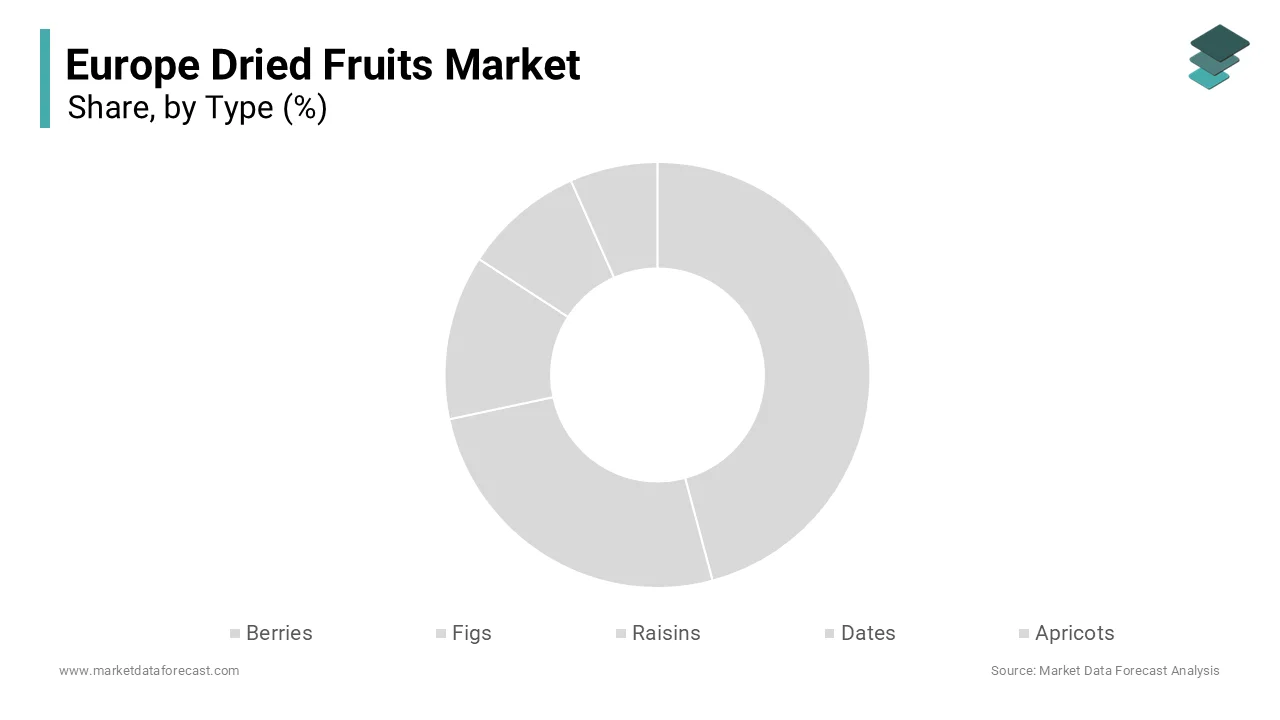
The dates segment is a promising segment and is estimated to record a CAGR of 10.6% over the forecast period. The rising demand for natural sweeteners, plant-based nutrition, and energy dense snacks among health-conscious consumers is primarily driving the growth of the dates segment in the European market. As per the European Food Information Council, dates are recognized for their natural sugar content, making them a popular alternative to refined sugar in clean label products. Sales of date paste as a baking ingredient have been increasing, driven by vegan and gluten free trends. The Middle Eastern diaspora also contributes significantly. As per the Pew Research Center, the Muslim population in Europe increases demand during Ramadan and festive occasions. Retailers respond with premium Medjool date displays in organic sections, often priced higher than conventional varieties. Additionally, sports nutrition brands incorporate chopped dates into energy bars for sustained glycemic release. As consumers seek whole food alternatives to artificial additives, dates transition from ethnic specialty to mainstream superfood, propelling their rapid adoption across culinary, wellness, and confectionery domains.
By Form Insights
The whole dried fruits segment led the market by accounting for 61.4% of the regional market share in 2025. The leading position of whole dried fruits segment in the European market can be credited to the strong consumer preference for minimally processed, recognizable ingredients that align with clean label and whole food movements. As per the European Commission’s Food Safety Directorate, many EU shoppers actively avoid products with artificial additives, driving demand for intact fruits like whole apricots, figs, and raisins. Retailers reinforce this trend by dedicating prominent shelf space to bulk bins and transparent packaging that showcase product quality. Whole forms are also essential in traditional cooking, Italian households use whole dried figs in rustic desserts, while Spanish recipes call for whole prunes in meat stews. The food service industry relies on whole fruits for visual appeal in salads, cheese boards, and breakfast buffets. Unlike powders or granulates, whole dried fruits require no reconstitution or processing, preserving fiber integrity and sensory authenticity. This combination of nutritional transparency, culinary versatility, and cultural familiarity ensures whole dried fruits remain the default choice for European consumers seeking natural, unadulterated snacking options.
The powder form segment is a prominent segment and is estimated to register a CAGR of 11.4% over the forecast period. The integration of dried fruit powders into functional foods, beverages and nutraceuticals where convenience, solubility, and consistent dosing are critical, which is one of the key factors propelling the powder form segment in the European market. Date powder, rich in potassium and natural sugars, is increasingly used as a clean label sweetener in plant based yogurts and protein shakes. As per Alpro, date powder usage across European product lines has been increasing. Prune powder features in bone health supplements due to its boron and polyphenol content, while raspberry powder adds color and antioxidants to bakery glazes without moisture interference. According to the European Nutraceutical Association, dried fruit powders have been incorporated into many new product launches, particularly in Germany and the Netherlands. Advances in freeze drying and micronization have improved solubility and flavor retention, overcoming past limitations. As manufacturers seek natural alternatives to synthetic additives, fruit powders offer scalable, shelf stable, and nutrient dense solutions, positioning them at the forefront of Europe’s functional food innovation wave.
REGIONAL ANALYSIS
Germany Dried Fruit Market Analysis
Germany dominated the dried fruit market in Europe in 2025 by holding 19.4% of the European market share. The dominating position of Germany in the European market can be credited to its role as Europe’s most populous nation and a leader in health-oriented consumption. The country’s market status is defined by strong demand for organic and functional dried fruits, supported by a well-developed retail infrastructure and high disposable income. As per the German Federal Ministry of Food and Agriculture, organic dried fruit sales have been increasing, with raisins and apricots leading purchases. Germans consume dried fruits primarily as breakfast additions and fitness snacks. Major retailers like Edeka and Rewe enforce strict sustainability criteria, requiring Fairtrade or Rainforest Alliance certification for private label lines. The food industry also drives demand, bakeries use raisins yearly for traditional holiday breads. Berlin and Munich have emerged as hubs for plant-based startups incorporating date paste and prune powder into innovative products. This blend of health consciousness, regulatory rigor, and culinary tradition ensures Germany remains the continent’s most influential dried fruit market.
United Kingdom Dried Fruit Market Analysis
The United Kingdom had the second biggest share of the European dried fruit market in 2025. The growth of the UK in the European market is attributed to its multicultural palate and strong snacking culture. The country’s market status reflects historical trade links with Commonwealth nations and a diverse population that embraces global dried fruit varieties from Pakistani dates to South African dried mango. As per the British Nutrition Foundation, many UK households purchase dried fruit weekly, often as lunchbox staples or baking ingredients. Traditional uses persist, raisins and currants are consumed annually in Christmas puddings and scones. Health trends also drive innovation, sales of no sugar added dried berries have been increasing. Retailers like Tesco and Sainsbury’s offer extensive ethnic dried fruit aisles alongside organic selections. Post Brexit, the UK has aligned its import standards with EU mycotoxin limits, ensuring consistent quality. This fusion of heritage, diversity, and wellness orientation makes the UK a dynamic and high-volume dried fruit market with broad consumer appeal.
France Dried Fruit Market Analysis
France is expected to exhibit a promising CAGR in the European dried fruit market during the forecast period. The French market is characterized by gourmet appreciation and Mediterranean dietary patterns. The country’s market status blends artisanal tradition with modern health awareness, particularly in southern regions where dried figs, apricots, and prunes feature in regional cuisine. As per FranceAgriMer, French households consume dried fruits with peak demand during winter holidays for use in cakes and compotes. Parisian patisseries increasingly incorporate date paste as a natural sweetener in vegan pastries, reflecting broader clean label shifts. The government supports quality through origin labeling, “Figue de Solliès” holds Protected Geographical Indication status, ensuring premium positioning. Organic dried fruit sales have been rising, led by raisins and apricots. Supermarkets like Carrefour highlight ethical sourcing, partnering with Turkish cooperatives for traceable supply chains. This balance of gastronomic heritage, regulatory distinction, and ethical consumption sustains France’s influential role in Europe’s premium dried fruit segment.
Italy Dried Fruit Market Analysis
Italy is projected to grow at a healthy CAGR in the European dried fruit market during the forecast period. The integral role of Italy in confectionery, seasonal baking traditions and the massive annual production of panettone and pandoro that collectively consume raisins and candied citrus peel sourced as dried fruit base are propelling the Italian market growth. As per the Italian Confectionery Association, December accounts for a significant portion of yearly dried fruit sales, highlighting seasonal intensity. Beyond holidays, dried figs and prunes are staples in rural diets, often paired with cheeses and cured meats. Northern Italy leads in organic adoption, with many dried fruit purchases carrying certified labels. Urban centers like Milan and Rome see rising demand for date energy balls and dried berry mixes among fitness communities. The government promotes Mediterranean diet principles, reinforcing dried fruits as part of a balanced lifestyle. This unique fusion of industrial scale, cultural ritual, and nutritional awareness ensures Italy remains a resilient and cyclical dried fruit market.
Turkey Dried Fruit Market Analysis
Turkey is anticipated to record a noteworthy share of the European dried fruit market over the forecast period. Turkey is notable not as a consumer but as a strategic producer and exporter deeply integrated into European supply chains. The country’s market status reflects its dominance in global dried fruit production. As per the Turkish Statistical Institute, Turkey supplies a large share of the world’s dried figs and apricots. Domestic consumption is modest, but Turkey’s influence is exerted through exports, with much of its dried fruit output shipped to EU countries, particularly Germany, France, and the Netherlands. Aegean region cooperatives adhere to EU pesticide and mycotoxin standards, enabling seamless market access. Recent investments in solar drying and optical sorting have improved quality consistency. The EU-Turkey Customs Union facilitates tariff free trade, reinforcing dependency. Though not a top consumer, Turkey’s role as Europe’s primary source of premium dried figs and apricots makes it an indispensable pillar of the regional market’s supply security and quality benchmark.
COMPETITIVE LANDSCAPE
Competition in the Europe dried fruit market is characterized by a dual dynamic: large integrated processors compete on scale, traceability, and regulatory compliance, while regional and organic specialists differentiate through ethical sourcing, terroir identity, and product innovation. Unlike commoditized agricultural markets, success here hinges on storytelling by proving origin, farming practices, and social impact to discerning consumers. Retailers exert significant influence, mandating certifications and sustainability proof points that reshape supply chains. The market is further segmented by form and function; traditional whole fruits dominate volume, but powders and blends drive growth in functional foods. Climate vulnerability in key origin countries adds volatility, rewarding companies with diversified sourcing and robust verification systems. Ultimately, the most resilient players harmonize industrial efficiency with transparent, values-based narratives, which is transforming dried fruits from simple snacks into trusted components of Europe’s health and sustainability agenda.
KEY MARKET PLAYERS
Some of the notable key players in the Europe dried fruit market are
- Sunbeam Foods Pty Ltd.
- Traina Foods
- Kiantama Oy
- Dole Food Company
- Sun Maid Growers of California
- Bergin Fruit and Nut Company Inc.
- Red River Foods Incorporated
- Lion Raisins Inc.
Top Players in the Market
- Sunval International B V is a leading European dried fruit processor and distributor headquartered in the Netherlands, specializing in raisins, apricots, figs, and dates for retail, food service, and industrial clients across the continent. The company sources directly from growers in Turkey, the United States, and South America, ensuring traceability and quality control from harvest to packaging. Sunval has strengthened its market position by investing in advanced optical sorting technology and solar drying facilities that reduce energy consumption while meeting strict EU mycotoxin standards. It also launched a certified organic and Fairtrade product line in 2024, responding to retailer demand for ethical sourcing. These initiatives reinforce Sunval’s reputation as a reliable, sustainable, and innovation driven partner in Europe’s evolving dried fruit supply chain.
- Tradin Organic Agriculture B V is a pioneer in organic dried fruit sourcing and distribution, operating globally with a strong foothold in Germany, France, and Scandinavia. The company works directly with over 50,000 smallholder farmers across Turkey, Iran, and Chile, providing training in regenerative agriculture and fair pricing mechanisms. Tradin has enhanced its European presence by implementing blockchain enabled traceability that allows customers to verify farm origin, harvest date, and carbon footprint via QR codes. In 2024, it expanded its date and prune powder production for the functional food sector, aligning with clean label trends. By combining ethical sourcing with digital transparency, Tradin sets a benchmark for sustainable dried fruit commerce in a values driven market.
- Borges Agricultural & Industrial Nuts S A, based in Spain, is a major player in the Europe dried fruit market with an integrated value chain spanning cultivation, processing, and branded retail distribution. While renowned for nuts, Borges has significantly expanded its dried fruit portfolio including organic raisins, apricots, and Mediterranean figs and under its premium private label and own brand lines. The company leverages its extensive Iberian orchard network to ensure freshness and quality control. In recent years, Borges strengthened its position by launching ready to eat snack packs featuring dried fruits blended with nuts, targeting health-conscious urban consumers. It also achieved full compliance with the EU Deforestation Regulation through GPS mapped supplier registries. These actions demonstrate Borges’s agility in blending tradition with modern consumer demands.
Top Strategies Used by the Key Market Participants
Key players in the Europe dried fruit market prioritize direct sourcing from certified farms to ensure traceability and compliance with stringent EU pesticide and mycotoxin regulations. They invest in advanced optical sorting and solar drying technologies to enhance quality while reducing environmental impact. Companies expand into value added formats such as powders, granulates, and ready to eat snack blends to capture higher margins and meet convenience driven demand. Strategic adoption of blockchain and QR code traceability systems builds consumer trust and satisfies retailer sustainability mandates. Additionally, firms actively pursue organic and Fairtrade certifications to differentiate products and align with Europe’s clean label and ethical consumption ethos.
MARKET SEGMENTATION
This research report on the European dried fruit market has been segmented and sub-segmented based on categories.
By Type
- Berries
- Figs
- Raisins
- Dates
- Apricots
By Form
- Whole Dried Fruits
- Nature
- Powder
- Slices
- Granulate Conventional
- Organic
By End User
- Food Processing Industry
- Food Service Provider
- Individual
By Country
- UK
- France
- Spain
- Germany
- Italy
- Russia
- Sweden
- Denmark
- Switzerland
- Netherlands
- Turkey
- Czech Republic
- Rest of Europe