- Product Description Description
- Table of Contents TOC
- List of Table & Figure LOT
- Get Free Sample PDF Sample PDF
Market Size, 2025
$604.20 MnMarket Estimate, 2026
$641.64 MnMarket Forecast, 2034
$1,037.59 MnCAGR, 2026–2034
6.19%Europe Dumper Market Report Summary
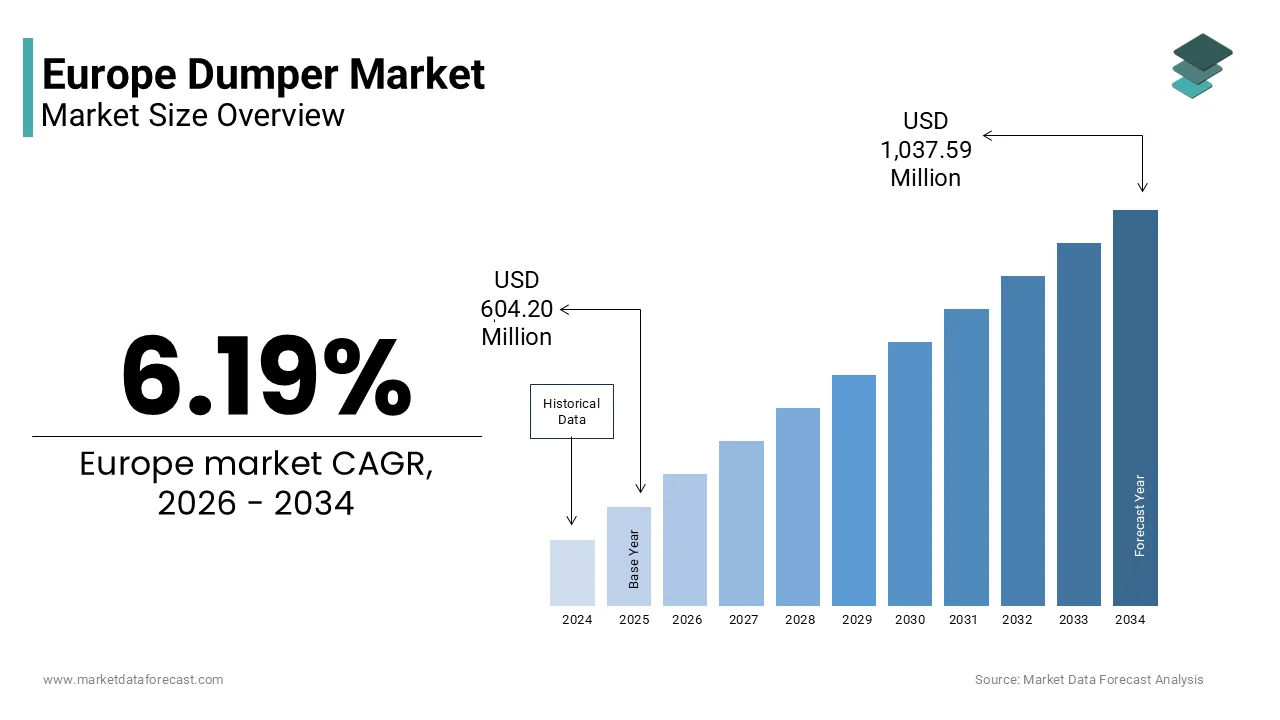
The Europe dumper market was valued at USD 604.20 million in 2025 and is estimated to reach USD 641.64 million in 2026, further projected to reach USD 1,037.59 million by 2034, growing at a CAGR of 6.19% during the forecast period. Market growth is supported by expanding infrastructure development, increasing construction and mining activities, and rising demand for efficient material handling equipment across industrial sectors. The need for enhanced site productivity, reduced manual handling, and improved operational safety is driving the adoption of advanced dumpers. Technological advancements such as improved load capacity, fuel efficient engines, and automation integration are further strengthening market expansion across Europe.
Key Market Trends
- Rising demand for high capacity dumpers in construction, mining, and large scale industrial applications to improve operational efficiency.
- Increasing adoption of stationary drum dumpers in manufacturing and processing industries due to their stability and high load handling capabilities.
- Growing focus on safety compliance and workplace ergonomics, encouraging modernization of material handling equipment.
- Integration of telematics, fuel efficient engines, and hybrid technologies to reduce operational costs and environmental impact.
- Expansion of infrastructure renovation and urban development projects across major European economies.
Segmental Insights
- Based on type, the stationary drum dumpers segment accounted for 62.3% of the Europe dumper market share in 2025. The segment’s dominance is attributed to its robust structure, higher load stability, and suitability for continuous industrial material handling operations.
- Based on application, the chemicals segment led the Europe dumper market with a 38.7% share in 2025. Growth in this segment is driven by increasing demand for safe and efficient handling of bulk materials, drums, and hazardous substances within chemical manufacturing facilities.
Regional Insights
- Germany dominated the Europe dumper market in 2025 by accounting for 23.8% of the regional market share. The country’s leadership is supported by strong construction activity, advanced industrial infrastructure, and a well established manufacturing base.
- Other Western European countries are also witnessing steady growth due to infrastructure modernization and industrial automation initiatives.
Competitive Landscape
The Europe dumper market is characterized by strong competition among global construction equipment manufacturers and regional suppliers. Companies are focusing on product innovation, enhanced load capacity, fuel efficiency improvements, and strategic partnerships to expand their market presence. Key players operating in the Europe dumper market include Caterpillar Inc., Komatsu Ltd., Wacker Neuson, Volvo Construction Equipment, Hitachi Construction Machinery Co. Ltd., Liebherr Group, Deere and Company, Terex Corporation, Doosan Infracore, J C Bamford Excavators Ltd. JCB, SANY Group, XCMG Group, Bell Equipment Ltd., ADT, Rokbak Volvo Group, AUSA, Kubota Corporation, Manitou Group, Yanmar Holdings Co. Ltd., Astec Industries Inc., and Epiroc AB.
 Download Free Sample Report
Europe Dumper Market Size
The Europe dumper market size was valued at USD 604.20 million in 2025 and is projected to reach USD 1,037.59 million by 2034 from USD 641.64 million in 2026, growing at a CAGR of 6.19%.
Dumpers refer to rugged off highway vehicles designed for transporting and unloading loose materials such as soil, gravel, sand, and demolition debris across construction, mining, quarrying, and infrastructure sites. These machines, ranging from compact 1 ton site dumpers to heavy duty 30 ton articulated haulers, are engineered for high torque, all terrain mobility, and operator safety in demanding environments. The Europe dumper market is shaped by stringent safety regulations, emission standards under EU Stage V, and the cyclical nature of civil engineering activity. As per studies, large-scale European transit and infrastructure initiatives continue to serve as primary catalysts for the civil engineering sector, sustaining a consistent requirement for specialized earthmoving and material transport machinery across the continent. According to research, increasingly stringent European emission regulations for mobile industrial machinery have led to the standard integration of advanced exhaust after-treatment technologies to significantly reduce the environmental impact of heavy-duty transport equipment. Furthermore, the European Commission’s Construction 2030 Roadmap mandates that all new construction sites implement accident prevention protocols, influencing dumper design with features like rear view cameras, rollover protection structures, and proximity sensors. This regulatory and operational framework defines the modern European dumper as a high compliance, productivity focused asset essential to the continent’s built environment.
MARKET DRIVERS
Surge in Public Infrastructure Investment Under EU Recovery and Resilience Plans
European governments are executing unprecedented public works programs funded by national budgets and EU recovery funds, which drives the growth of the Europe dumber market. This directly stimulates demand for construction dumpers. According to research, Major European Union recovery funds are being channeled into large-scale mobility and energy networks, providing a sustained catalyst for civil engineering and specialized material transport operations across the member states. Long-term strategic rail planning in Germany is driving a comprehensive overhaul of the national track network, necessitating large-scale logistical coordination and earthmoving capacity to meet future transit targets. Similarly, French national investment strategies are prioritizing the transformation of the transport sector and industrial landscape, indirectly stimulating demand for site development and specialized construction machinery in key economic hubs. Large-scale infrastructure hubs in Central Europe represent some of the most significant earthmoving challenges in the region, requiring substantial fleets of specialized hauling equipment to manage complex terrain preparation. Public works and civil engineering projects have grown in importance within the European construction market, capturing a larger share of total investment as governments prioritize modernizing aging infrastructure and energy networks. This state led investment cycle creates stable, long term demand for durable, high capacity dumpers that can operate in confined urban zones or remote rural corridors.
Modernization of Aging Construction Equipment Fleets Across Western Europe
A significant wave of fleet replacement is underway as contractors retire pre Stage V dumpers, which also contributes to the expansion of the Europe dumper market. These machines fail to meet current emission and safety standards. According to multiple sources, a significant portion of the European construction machinery fleet is undergoing a modernization cycle as older units are replaced with newer models featuring improved emission controls and integrated digital monitoring systems. Urban environmental regulations and the expansion of restricted emission zones are prompting rental providers to accelerate the procurement of low-emission machinery to maintain access to major metropolitan construction projects. New models offer not only cleaner combustion but also telematics for fuel monitoring, geofencing, and maintenance alerts, features increasingly demanded by large contractors. Public infrastructure projects in Northern Europe are increasingly setting high safety benchmarks, leading to the broader integration of advanced driver assistance systems and collision avoidance technology in heavy transport equipment. This regulatory push, combined with rising fuel costs that penalize inefficient engines, accelerates retirement of legacy units. As a result, even in mature markets with flat construction growth, equipment turnover remains robust, sustaining demand for next generation dumpers.
MARKET RESTRAINTS
Stringent EU Stage V Emission Regulations Increasing Acquisition and Operational Costs
The enforcement of EU Stage V standards has significantly raised the price and complexity of new dumpers, which is among the main restraints to the Europe dumper market. This has constrained purchases, especially among small contractors and rental firms. Modern emission standards for industrial machinery necessitate the integration of sophisticated exhaust filtration and chemical treatment systems to drastically reduce the output of harmful pollutants. The adoption of advanced emission-control technology has influenced the initial investment required for heavy machinery and introduced new operational requirements for exhaust system upkeep. Small-scale construction firms in Southern Europe are facing financial hurdles in fleet modernization as the reduction of government incentives coincides with higher costs for technologically advanced machinery. Additionally, the transition to newer engine generations requires strict adherence to specific fuel and fluid quality standards, which alters the long-term cost profile of machine operation and maintenance. Supply chain stabilization has improved the availability of compliant heavy machinery, allowing construction firms to better align equipment procurement with project timelines after years of significant delays. These financial and logistical barriers disproportionately affect SMEs, slowing market penetration despite strong underlying demand.
Persistent Shortage of Skilled Operators and Certified Technicians
A critical shortage of trained machine operators and service technicians capable of handling modern, electronically controlled equipment impedes the growth of the Europe dumper market. The European construction industry is navigating an escalating skills crisis that threatens long-term productivity, with specialized technical roles and heavy equipment operators increasingly difficult to recruit as the existing workforce ages. Vocational training pipelines have weakened, fewer share of EU technical schools offer courses on telematics, emission systems, or advanced hydraulics found in current dumpers. Spanish construction firms are facing operational hurdles as a lack of qualified personnel across various trades complicates the execution of projects funded by European recovery initiatives. Similarly, service bottlenecks are acute. The transition to advanced emission-standard machinery has heightened the need for highly trained technicians, leading to longer maintenance cycles as rental providers adapt their service capabilities to new technical requirements. This skills gap not only reduces equipment utilization but also increases accident risks, as inexperienced operators struggle with complex control systems. Without urgent investment in reskilling and standardized certification, the market’s ability to deploy new technology will remain hampered. The market cannot efficiently adopt these advancements without these initiatives.
MARKET OPPORTUNITIES
Integration of Telematics and Fleet Management Platforms for Productivity Optimization
Modern dumpers are increasingly equipped with embedded telematics enabling real-time monitoring of location, fuel consumption, engine hours, and maintenance needs, which is creating new service and efficiency opportunities for the Europe dumper market. Construction companies across Europe are increasingly prioritizing the integration of digital fleet management solutions to harmonize data across diverse machine brands and improve operational oversight. The adoption of advanced telematics and site-wide digital services is enabling fleet managers to identify operational inefficiencies and proactively address maintenance needs, resulting in improved machine utilization and fuel efficiency. Similarly, Caterpillar’s VisionLink platform allows contractors to optimize dumper routes on large sites, cutting fuel use. Municipalities are also leveraging this data, Oslo’s city council mandates telematics on all dumpers used in public works to verify working hours and emissions compliance. In an era of tightening construction margins, digital technology turns passive assets into smart productivity hubs, generating new recurring revenue through data analytics and software subscriptions.
Expansion of Compact and Zero Tail Swing Dumpers for Urban and Confined Site Applications
The rise of urban infill construction, brownfield redevelopment, and interior renovation projects is enabling demand for specialized machinery, which provides fresh prospects for the Europe dumper market. Specifically, these projects require compact, highly maneuverable dumpers that can operate in tight spaces without damaging their surroundings. Increasing urban density across European metropolitan areas has led to a rise in construction activity within confined spaces, driving demand for compact machinery capable of navigating restricted environments. Leading manufacturers of compact construction equipment are experiencing sustained demand for smaller-capacity machines, as contractors in Northern and Western Europe prioritize high-maneuverability and low-emission solutions for inner-city infrastructure projects. These machines feature electric power steering, narrow profiles under 900 millimeters, and load capacities up to 1,500 kilograms, ideal for basement work, historic district renovations, and indoor demolition. Additionally, noise restrictions in cities like Vienna and Copenhagen favor electric or hybrid compact dumpers that operate below 70 decibels. Increasing urban density and a focus on heritage conservation are driving demand for agile, low-impact dumpers, expanding their use into facility maintenance and specialized logistics.
MARKET CHALLENGES
Supply Chain Volatility for Critical Components Like Hydraulic Pumps and Electronic Control Units
Unstable high-precision component supply chains are increasingly hindering modern dumper production and the growth of the Europe dumper market. These include items such as variable displacement hydraulic pumps, electronic control modules, and aftertreatment sensors. Geopolitical tensions and semiconductor shortages have constrained access to microcontrollers used in engine management and telematics systems. Supply chain stabilization has led to a gradual reduction in the procurement windows for electronic components compared to previous years of extreme scarcity, although lead times for specialized industrial controllers remain higher than historical averages. Similarly, Global trade dynamics and resource availability continue to influence the production of high-performance hydraulic components, prompting manufacturers to optimize their sourcing strategies to maintain consistent delivery schedules. Small manufacturers like Aebi Schmidt and Kramer lack the purchasing power to secure priority allocations, forcing project deferrals. German machinery manufacturers are navigating a complex economic environment where rising input costs and shifting market demand have necessitated adjustments to production volumes and delivery timelines. European strategic autonomy in the production of essential off-highway machinery parts is required to shield the market from global disruptions that threaten lead times and brand integrity.
Accelerated Policy Shift Toward Electrification in Municipal and Public Sector Procurement
Public sector tenders across the region are rapidly excluding diesel-powered dumpers in favour of electric alternatives, which challenges the expansion of the Europe dumper market. Consequently, a historically stable demand segment is shrinking. Updated European sustainability guidelines are increasingly pushing public authorities to prioritize zero-emission machinery in their tenders, favoring equipment that eliminates local exhaust pollutants during urban infrastructure development. The city of Amsterdam is progressively tightening access for internal combustion vehicles in its central zones, leading to a market shift where electric construction machinery is increasingly required for municipal contracts. Similarly, Swedish public procurement strategies are evolving to place a heavy emphasis on decarbonization, requiring contractors to provide clear plans for reducing fossil fuel reliance in their machinery fleets. Even national infrastructure programs are shifting. The French government continues to offer significant financial support for the transition to electric mobility, with a primary focus on decarbonizing the broader transport fleet while encouraging the adoption of cleaner industrial vehicles. This policy pivot reduces long term visibility for diesel OEMs and discourages R&D investment, as public contracts once provided predictable volume. Without adaptation, the market risks becoming confined to private industrial niches with limited growth potential.
REPORT COVERAGE
| REPORT METRIC | DETAILS |
| Market Size Available | 2025 to 2034 |
| Base Year | 2025 |
| Forecast Period | 2026 to 2034 |
| CAGR | 6.19% |
| Segments Covered | By Type, Category, Material, Power Source, Application, and Region |
| Various Analyses Covered | Global, Regional, & Country Level Analysis; Segment-Level Analysis; DROC, PESTLE Analysis; Porter’s Five Forces Analysis; Competitive Landscape; Analyst Overview of Investment Opportunities |
| Regions Covered | UK, France, Spain, Germany, Italy, Russia, Sweden, Denmark, Switzerland, Netherlands, Turkey, and the Czech Republic |
| Market Leaders Profiled | Caterpillar Inc., Komatsu Ltd., Volvo Construction Equipment, Hitachi Construction Machinery Co. Ltd., Liebherr Group, Deere & Company, Terex Corporation, Doosan Infracore, J C Bamford Excavators Ltd. (JCB), SANY Group, XCMG Group, Bell Equipment Ltd., ADT, Rokbak (Volvo Group), AUSA, Kubota Corporation, Manitou Group, Yanmar Holdings Co. Ltd., Astec Industries Inc., Epiroc AB |
SEGMENTAL ANALYSIS
By Type Insights
The stationary drum dumpers segment held the majority share of 62.3% of the the Europe drum dumper market in 2025. The supremacy of the segment is driven by their integration into fixed production lines in chemical, pharmaceutical, and food processing facilities where safety, hygiene, and process consistency are paramount. These units are permanently mounted, often with integrated dust containment, explosion proofing, and automated clamping systems that comply with ATEX and EU Machinery Directive requirements. According to sources, the extensive network of chemical manufacturing facilities throughout the European Union relies on specialized container-handling solutions to maintain high safety standards and prevent the accidental release of hazardous materials during the transfer of bulk substances. Pharmaceutical producers in Germany are progressively modernizing their material transfer protocols and equipment to align with more rigorous European standards for sterile manufacturing and contamination control. Similarly, France’s ANSES agency mandates that all food ingredient handling in facilities producing allergen sensitive products use contained dumping systems to avoid airborne dispersion. The reliability, regulatory compliance, and ergonomic benefits of stationary units, especially in high volume, repetitive operations, ensure their dominance in controlled industrial environments.
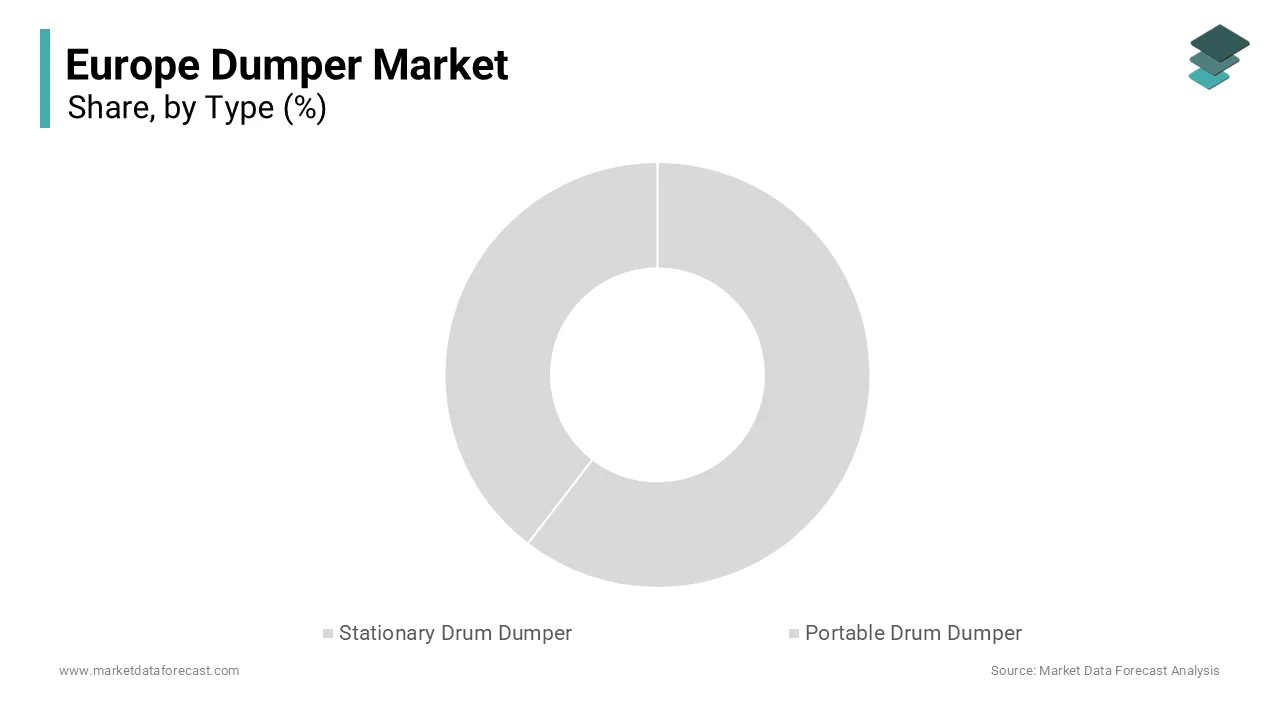
The portable drum dumpers segment is on the rise and is expected to be the fastest growing segment in the market by witnessing a CAGR of 7.4% from 2026 to 2034 due to the rise of flexible manufacturing, multi product facilities, and maintenance operations that require mobile, adaptable material handling solutions. Unlike stationary units, portable dumpers can be wheeled between production lines, warehouses, and cleaning stations, making them ideal for SMEs and pilot plants with limited capital budgets. Small and medium-sized food producers are increasingly utilizing versatile and mobile material handling equipment to maintain operational flexibility and accommodate varied production requirements without extensive infrastructure modifications. In the chemical sector, maintenance teams use battery powered portable dumpers to safely empty residual solvents from drums during equipment servicing, reducing manual lifting injuries. The implementation of mechanized lifting solutions is a key factor in reducing physical strain on workers, contributing to a lower incidence of workplace injuries related to the manual movement of heavy loads. The adoption of lean and modular production methods is driving up demand for flexible, budget-friendly dumping systems in various industrial sectors.
By Application Insights
The chemicals segment led the Europe dumper market and captured a 38.7% share in 2025. The leading position of the segment is attributed to stringent safety regulations governing the handling of hazardous, reactive, and fine particulate substances. Chemical manufacturers routinely transfer catalysts, pigments, resins, and additives from drums into reactors or mixers, requiring contained, spark free dumping systems to prevent explosions, inhalation risks, and environmental release. The rigorous classification of chemical substances under European regulatory frameworks is a primary driver for the implementation of advanced containment and handling technologies designed to mitigate risks during the transfer of sensitive materials. German occupational safety regulations prioritize technical containment strategies for high-risk substances, encouraging the use of specialized, explosion-proof equipment to ensure worker protection in hazardous processing environments. Similarly, large-scale chemical manufacturing hubs utilize a vast array of container-handling systems that meet stringent international safety and hygiene standards to maintain the integrity of specialized industrial fluids. The sector’s zero tolerance for contamination and regulatory non compliance ensures consistent, high value demand for specialized dumping equipment across Western and Central Europe.
The pharmaceutical application segment is expected to exhibit a noteworthy CAGR of 8.9% during the forecast period owing to intensifying aseptic processing requirements and the expansion of biologics manufacturing. Modern drug production demands complete containment during raw material charging to prevent microbial ingress and cross contamination between batches. While the total number of new medicine approvals in Europe remains high, the specialized sector for advanced therapies continues to grow at a measured pace, necessitating highly controlled manufacturing environments to manage complex and sensitive biological materials. Ireland remains a global hub for pharmaceutical manufacturing, with regulatory bodies emphasizing rigorous contamination control and modern containment strategies in new production facilities to align with evolving European safety standards. Similarly, Germany’s PIC/S guidelines require real time particle monitoring during drum emptying, a feature now standard in next generation dumpers from companies like Matcon and Flexicon. The shift toward continuous manufacturing and smaller batch sizes further favors flexible, cleanable dumpers that support rapid changeover. Europe’s push for sovereign pharmaceutical manufacturing is driving accelerated demand for high-integrity, compliant drum handling systems.
REGIONAL ANALYSIS
Germany Dumper Market Analysis
Germany dominated the Europe Dumper Market and accounted for a 23.8% share in 2025. The dominance of the German market is driven by its massive infrastructure renewal agenda and robust mining sector. The market status is defined by a strong preference for high capacity articulated dumpers and rigid off highway trucks that meet stringent European emission standards while delivering superior fuel efficiency. A primary driving factor is the extensive network of road and rail construction projects initiated to modernize transport links and support the energy transition. Significant and sustained public funding for national transportation networks in Germany is driving a long-term requirement for heavy-duty earthmoving and construction machinery to support large-scale rail and road modernization. A further critical driver is the domestic aggregates and mining industry which requires durable dumpers for extracting limestone, gravel, and coal to supply the construction and steel sectors. The German Mining Federation reports that domestic production of mineral resources remains vital, necessitating a fleet of reliable heavy duty vehicles that can operate in challenging quarry environments. Furthermore, the push toward electrification in construction machinery is gaining traction, with manufacturers introducing battery electric dumpers to reduce noise and emissions on urban job sites. The Federal Ministry for Economic Affairs and Climate Action supports this shift through subsidies for low emission commercial vehicles. The convergence of large scale public works, active resource extraction, and a regulatory push for green technology ensures Germany maintains its leadership position as the largest and most advanced dumper market in the region.
United Kingdom Dumper Market Analysis
The United Kingdom was the second largest country in the Europe dumper market and captured a share of 17.1% in 2025. The supremacy of the UK market is supported by a dynamic mix of major civil engineering projects and a mature equipment rental ecosystem. The market status here is characterized by high utilization rates of articulated dumpers due to the often wet and uneven ground conditions typical of British construction sites which require superior traction and flexibility. A key driving factor is the government's National Infrastructure Strategy which outlines billions in spending on housing developments, flood defense systems, and railway upgrades like the HS2 project. A different major driver is the well established plant hire industry which allows contractors to access the latest dumper models without significant capital expenditure. Data from the Equipment Hire Association indicates that the rental sector accounts for a substantial portion of dumper deployments, driven by the need for cost effective and flexible fleet management. Additionally, the decommissioning of old industrial sites and land reclamation projects for renewable energy farms require extensive earthmoving activities. The Health and Safety Executive enforces rigorous safety standards that favor modern dumpers equipped with advanced rollover protection and telemetry systems. The combination of strategic infrastructure investment, a dominant rental culture, and strict safety compliance secures the UK's status as a vital and high value market for dumper technologies.
France Dumper Market Analysis
France occupies a noteworthy position in the Europe Dumper Market by leveraging its ambitious nuclear energy program and extensive public works initiatives to drive demand. The market status in this region is marked by a balanced adoption of both rigid and articulated dumpers tailored for large scale quarrying and complex urban construction environments. A major driving factor is the national strategy to expand nuclear power capacity and maintain existing reactors, which involves massive earthmoving operations for site preparation and cooling system infrastructure. An additional significant driver is the Grand Paris Express project, one of the largest transport infrastructure developments in Europe, which requires thousands of dumper loads of excavated material to be moved daily for tunnel and station construction. Statistics from the French Ministry of Transport show the sheer scale of this undertaking, sustaining high demand for mid to large size dumpers. Furthermore, the road maintenance sector continuously invests in resurfacing and widening highways, utilizing smaller dumpers for localized repairs. The presence of leading domestic manufacturers who design equipment specifically for European regulatory and operational needs further strengthens the supply chain. The synergy between energy security projects, mega urban transport schemes, and steady road maintenance sustains France's strong standing as a key market for diverse dumper applications.
Italy Dumper Market Analysis
Italy grew steadily in the Europe dumper market due to a unique demand profile driven by seismic reconstruction efforts and a vibrant tunneling industry. The market status is defined by the necessity for compact and highly maneuverable dumpers that can operate in the narrow and rugged terrains typical of the Italian peninsula and its islands. A primary driving factor is the ongoing reconstruction and reinforcement of infrastructure in regions affected by earthquakes, which requires precise earthmoving equipment to clear debris and prepare foundations for resilient new structures. As per sources, public spending on disaster recovery and seismic retrofitting remains a consistent budget item, driving steady sales of versatile articulated dumpers. A further crucial driver is the extensive tunneling and underground construction sector, particularly for high speed rail links and mountain bypasses, where dumpers are essential for mucking out excavated rock and soil. The country hosts some of the most complex underground projects in the world, necessitating robust equipment capable of withstanding harsh subterranean conditions. Additionally, the marble and stone quarrying industry in regions like Carrara relies heavily on specialized heavy-duty dumpers to transport massive blocks of stone from quarries to processing plants. The blend of disaster recovery needs, advanced underground engineering, and prestigious stone extraction creates a distinctive market dynamic where durability and agility are paramount, ensuring Italy remains a vital player in the European landscape.
Spain Dumper Market Analysis
Spain is likely to expand in the Europe dumper market from 2026 to 2034 owing to a booming renewable energy construction sector and a recovering residential building market. The market status in Spain is marked by a rapid increase in demand for dumpers used in the installation of large scale solar farms and wind parks across the sun rich southern and central regions. A key driving factor is the aggressive national energy transition plan which aims to install gigawatts of new renewable capacity, requiring extensive site preparation, trenching for cables, and foundation work for turbines and panels. Spain continues to maintain a substantial pipeline of renewable energy projects, supporting a consistent requirement for heavy earthmoving and specialized site preparation equipment in rural regions designated for solar infrastructure. One more reason for growth here is the resurgence of the housing and tourism infrastructure sectors, where coastal developments and hotel renovations drive activity in excavation and groundwork. The National Statistics Institute of Spain records a consistent rise in housing starts and building permits, directly correlating with higher dumper utilization rates. Furthermore, the mining sector for lithium and other critical minerals needed for the green economy is expanding, opening new frontiers for heavy duty hauling equipment. The government's support for sustainable construction practices also encourages the adoption of newer, more efficient dumper models. The convergence of renewable energy expansion, construction recovery, and strategic mining development creates a dynamic environment for dumper adoption, securing Spain's position as a key growth market in the region.
COMPETITIVE LANDSCAPE
The Europe dumper market features a competitive landscape shaped by regulatory compliance, application specialization, and regional strength rather than price alone. Global leaders like Wacker Neuson and Takeuchi dominate through engineering excellence, while niche players such as Aebi Schmidt thrive in municipal and multi purpose segments. Competition centers on meeting EU Stage V emissions, ensuring operator safety, and offering digital connectivity for fleet optimization. While Chinese manufacturers provide lower cost alternatives, they struggle with certification and service coverage in Western Europe. The market sees moderate consolidation as telematics and electrification become essential—vendors without digital or zero emission offerings lose relevance. Regional preferences persist: Germany favors high tech compact dumpers, Nordic countries prioritize cold climate resilience, and Southern Europe focuses on cost effective rental models. New entrants face high barriers due to type approval processes and the need for localized support. However, opportunities exist in urban electrification and fleet modernization. Overall, success depends on transforming dumpers from mechanical assets into intelligent, compliant solutions for Europe’s evolving construction and infrastructure needs.
KEY MARKET PLAYERS
Some of the notable key players in the Europe dumper market are
- Caterpillar Inc.
- Komatsu Ltd.
- Wacker Neuson
- Volvo Construction Equipment
- Hitachi Construction Machinery Co. Ltd.
- Liebherr Group
- Deere & Company
- Terex Corporation
- Doosan Infracore
- J C Bamford Excavators Ltd. JCB
- SANY Group
- XCMG Group
- Bell Equipment Ltd.
- ADT
- Rokbak Volvo Group
- AUSA
- Kubota Corporation
- Manitou Group
- Yanmar Holdings Co. Ltd.
- Astec Industries Inc.
- Epiroc AB
Top Players in the Market
- Wacker Neuson is a leading European manufacturer of compact construction equipment, with a strong presence in the dumper market through its range of articulated and rigid frame dumpers from 1 to 10 tons. Headquartered in Germany, the company contributes globally by pioneering zero tail swing and electric dumper technologies tailored for urban and confined site applications. In Europe, Wacker Neuson supplies municipal contractors, rental companies, and infrastructure developers with Stage V compliant machines featuring advanced telematics and ergonomic cabs. It also expanded its digital fleet management platform across Western Europe, enabling real time monitoring of fuel efficiency and maintenance needs, reinforcing its leadership in sustainable, intelligent material handling.
- Takeuchi, though Japanese headquartered, holds a significant position in the Europe dumper market through its robust compact and mid size dumpers known for durability and all terrain performance. The company’s global influence stems from its innovation in hydrostatic drive systems and operator safety features, which align with EU machinery directives. In Europe, Takeuchi focuses on rental fleets and specialized contractors in mining, forestry, and alpine construction where reliability in extreme conditions is critical. The company also strengthened its dealer network in Scandinavia and Eastern Europe to support rapid parts delivery and service, deepening its foothold in high demand regional markets.
- Aebi Schmidt is a Swiss based engineering group specializing in niche off road vehicles, including high mobility dumpers for municipal, agricultural, and industrial applications. The company plays a unique role in the global market by integrating versatility, many of its dumpers convert into spreaders or snow blowers, making them ideal for multi seasonal public works. In Europe, Aebi Schmidt serves thousands of municipalities with compact, highly maneuverable dumpers that comply with strict noise and emission limits in historic city centers. It also partnered with German engineering institutes to develop autonomous navigation for winter service dumpers, positioning itself at the intersection of sustainability and smart municipal infrastructure.
Top Strategies Used by the Key Market Participants
Key players in the Europe dumper market prioritize compliance with EU Stage V emission standards by integrating advanced aftertreatment systems and offering electric alternatives for urban zones. They invest in telematics and fleet management platforms to provide real time monitoring of location fuel consumption and maintenance alerts. Companies expand service and dealer networks in Eastern and Northern Europe to ensure rapid parts availability and technical support. Strategic development of compact zero tail swing and electric dumpers addresses urban construction and municipal noise restrictions. Emphasis on operator safety through rollover protection structures proximity sensors and ergonomic cabs meets EU Machinery Directive requirements. These strategies collectively balance regulatory adherence operational efficiency and market diversification in a cyclical industry.
MARKET SEGMENTATION
This research report on the European dumper market has been segmented and sub-segmented based on categories.
By Type
- Stationary Drum Dumper
- Portable Drum Dumper
By Category
- Stationary
- Mobile
- Forklift
By Material
- Steel
- Fiber
- Plastic
By Power Source
- Hydraulic
- Electric
- Pneumatic
- Manual
By Application
- Food
- Chemicals
- Pharmaceutical
- Industrial
- Oil and Gas Industry
- Others
By Country
- UK
- France
- Spain
- Germany
- Italy
- Russia
- Sweden
- Denmark
- Switzerland
- Netherlands
- Turkey
- Czech Republic
- Rest of Europe