- Product Description Description
- Table of Contents TOC
- List of Table & Figure LOT
- Get Free Sample PDF Sample PDF
Market Size, 2025
$648.85 MnMarket Estimate, 2026
$695.26 MnMarket Forecast, 2034
$1,207.96 MnCAGR, 2026–2034
7.15%Europe Echocardiography Market Report Summary
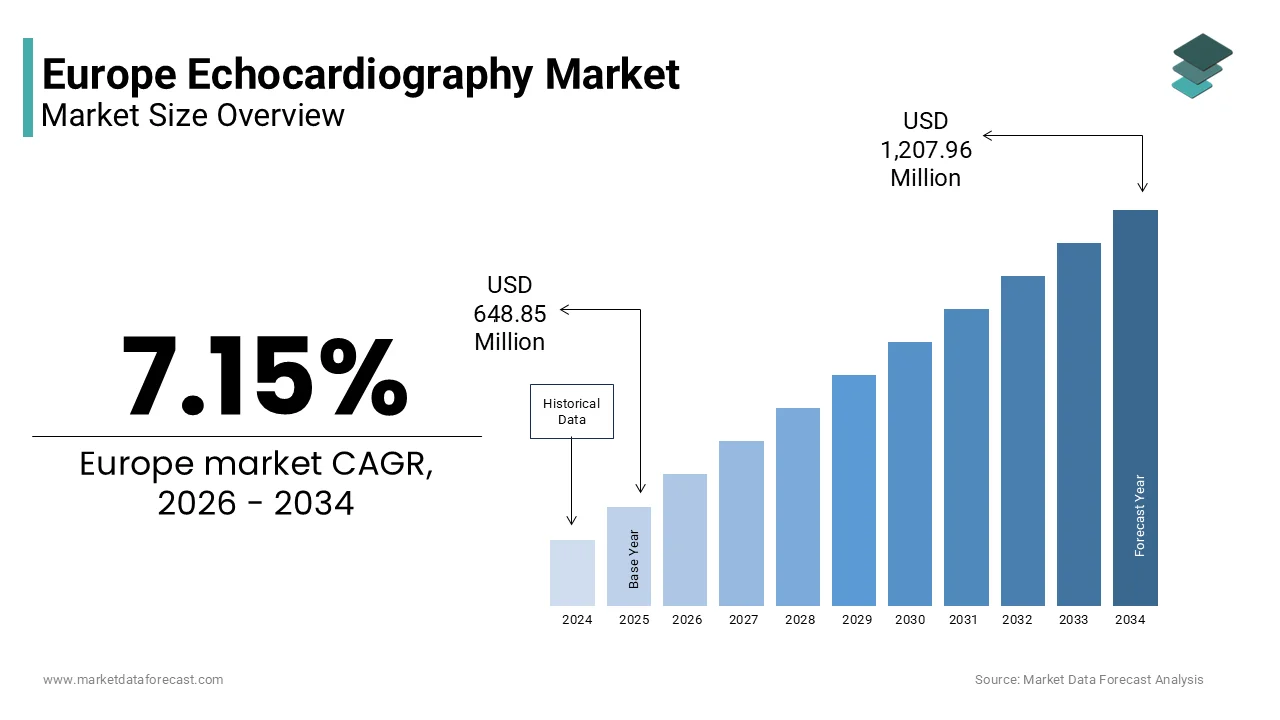
The Europe echocardiography market was valued at USD 648.85 million in 2025 and is estimated to reach USD 695.26 million in 2026, further projected to reach USD 1,207.96 million by 2034, growing at a CAGR of 7.15% during the forecast period. Market growth is driven by the rising prevalence of cardiovascular diseases, increasing aging population, and growing demand for non invasive cardiac diagnostic procedures. Technological advancements in ultrasound imaging, expanding adoption of portable and point of care systems, and integration of artificial intelligence in cardiac imaging analysis are further accelerating market expansion across Europe. In addition, increasing healthcare expenditure and improved reimbursement frameworks are supporting broader access to advanced echocardiography systems.
Key Market Trends
- Growing demand for advanced cardiac imaging solutions to support early diagnosis and monitoring of heart diseases.
- Rising adoption of portable and compact echocardiography systems for point of care diagnostics.
- Increasing integration of artificial intelligence and automation features to enhance diagnostic accuracy and workflow efficiency.
- Expansion of hospital infrastructure and cardiac specialty centers across major European economies.
- Continuous innovation in 3D and 4D imaging technologies improving visualization of cardiac structures.
Segmental Insights
- Based on device type, the cart based segment held a significant share of the Europe echocardiography market in 2024. The segment’s dominance is attributed to high image quality, advanced functionality, and widespread deployment in hospital settings.
- Based on test type, the transthoracic echocardiography segment accounted for a prominent share of the Europe echocardiography market in 2024. Its leadership is driven by its non invasive nature, cost effectiveness, and routine use in cardiac evaluation.
- Based on technology, the two dimensional echocardiography segment held a prominent share of the market due to its established clinical utility, accessibility, and cost efficiency in cardiac diagnostics.
- Based on end user, the hospitals and ambulatory surgical centers segment accounted for a significant share of the Europe echocardiography market in 2024. Growth in this segment is supported by high patient inflow, availability of advanced imaging equipment, and specialized cardiology departments.
Regional Insights
- Germany accounted for 24.1% of the Europe echocardiography market share in 2024, making it the largest contributor in the region. The country’s leadership is supported by advanced healthcare infrastructure, high cardiovascular disease prevalence, strong reimbursement policies, and widespread adoption of innovative medical imaging technologies.
- Other Western European countries such as France, the United Kingdom, and Italy also contribute significantly to regional market growth.
Competitive Landscape
The Europe echocardiography market is highly competitive with the presence of leading global medical imaging companies. Market participants are focusing on technological innovation, AI integration, product portfolio expansion, and strategic collaborations to strengthen their competitive position. Key players operating in the Europe echocardiography market include GE Healthcare, Philips Healthcare, Siemens Healthineers, Canon Medical Systems, Esaote, Mindray, Samsung Medison, Fujifilm SonoSite, Hitachi Healthcare, Chison Medical Imaging, and Aloka under Hitachi.
Europe Echocardiography Market Size
The Europe echocardiography market size was valued at USD 648.85 million in 2025 and is projected to reach USD 1,207.96 million by 2034 from USD 695.26 million in 2026, growing at a CAGR of 7.15%.
The echocardiography is the deployment and utilization of ultrasound based diagnostic technologies specifically designed to assess cardiac structure function and hemodynamics, across clinical settings in the European region. This includes modalities such as transthoracic echocardiography (TTE), transesophageal echocardiography (TEE), stress echocardiography, and advanced techniques like three dimensional (3D) and strain imaging. As per the European Association of Cardiovascular Imaging, over 25 million echocardiograms are performed annually in the European Union, making it the most frequently used non-invasive cardiac imaging tool. The technology is integral to diagnosing conditions including heart failure valvular disease cardiomyopathies and congenital defects. According to Eurostat, cardiovascular diseases remain the leading cause of death in Europe, accounting for 36% of all fatalities in 2024, thereby sustaining consistent clinical demand for accurate and accessible cardiac diagnostics. Equipment ranges from high end cart-based systems in tertiary hospitals to portable and handheld devices increasingly adopted in emergency departments primary care and ambulatory settings, thereby reflecting a broader trend toward point of care cardiovascular assessment.
MARKET DRIVERS
Escalating Burden of Cardiovascular Diseases Drives Diagnostic Demand
The cardiovascular diseases continue to impose a profound epidemiological and economic burden, which is directly fueling the need for reliable and repeatable cardiac imaging. According to the European Heart Network, more than 120 million people in the EU live with some form of cardiovascular condition as of 2025, with heart failure alone affecting over 15 million individuals. The prevalence of atrial fibrillation, where a key indication for echocardiographic screening has risen by 22% since 2015 due to aging populations and improved detection, as documented in the 2024 Atlas of Cardiology published by the European Society of Cardiology. National health strategies in Germany, France, and Italy, now mandate echocardiography as a first line diagnostic for suspected systolic dysfunction under updated heart failure guidelines. Furthermore, post myocardial infarction protocols routinely require serial echocardiograms to monitor left ventricular ejection fraction, ensuring timely intervention. This clinical indispensability, reinforced by evidence-based pathways, ensures sustained procedural volumes regardless of cost containment pressures, anchoring echocardiography as a non-discretionary component of cardiovascular care delivery.
Integration of Echocardiography into Heart Failure and Valve Disease Management Pathways
The echocardiography has evolved from a diagnostic adjunct to a central pillar in structured management programs for chronic cardiac conditions is additionally fuelling the growth of Europe echocardiography market. The 2023 European Society of Cardiology guidelines for heart failure explicitly designate echocardiography as essential for initial classification distinguishing between reduced mid-range and preserved ejection fraction and for guiding therapy selection, including eligibility for devices like CRT or SGLT2 inhibitors. Similarly, in valvular heart disease, echocardiography determines severity timing of intervention and post procedural surveillance, with transesophageal echo being mandatory during transcatheter aortic valve implantation (TAVI) procedures. According to data from the European Registry of TAVI, over 180000 such interventions were performed in Europe in 2024, each requiring multiple echo assessments. National registries in Sweden and the Netherlands, now link echo findings to electronic health records to trigger automatic referrals to specialized clinics, institutionalizing its role in care coordination. This embeddedness within standardized clinical workflows ensures recurrent utilization and justifies investment in advanced imaging capabilities even in resource constrained settings.
MARKET RESTRAINTS
Stringent Regulatory and Reimbursement Constraints Limit Technology Adoption
The uptake of advanced echocardiography systems faces significant headwinds from fragmented reimbursement policies and rigorous regulatory oversight, which is restraining the growth of Europe echocardiography market. Under the EU Medical Device Regulation (MDR) 2017/745, new echo platforms must undergo extensive clinical evaluation and conformity assessment, often delaying market entry by 12 to 18 months compared to pre MDR timelines as observed by the European Coordination Committee of the Radiological Electromedical and Healthcare IT Industry. Moreover, national reimbursement bodies apply divergent criteria, while Germany’s G-BA reimburses 3D echo for mitral valve assessment, Spain’s National Health System restricts coverage to basic 2D studies outside university hospitals. A 2024 survey by the European Association of Cardiovascular Imaging found that cardiology departments in Southern and Eastern Europe deferred purchases of strain imaging capable systems due to lack of separate billing codes. These inconsistencies create financial uncertainty for providers and disincentivize adoption of innovations that could improve diagnostic precision and patient outcomes.
Shortage of Trained Sonographers and Interpretation Expertise Constrains Utilization
The effective deployment of echocardiography with a persistent deficit of qualified personnel capable of acquiring high quality images and interpreting complex datasets is also hampering the growth of Europe echocardiography market. According to the European Association of Cardiovascular Imaging, there is a shortfall of approximately 12000 certified cardiac sonographers across the EU, with ratios as low as one technician per 250000 residents in countries like Romania and Bulgaria. Even in advanced healthcare systems, interpretation bottlenecks exist, a 2024 study in the European Heart Journal revealed that only 41% of general cardiologists in community hospitals feel confident performing advanced techniques like speckle tracking strain analysis. Training programs remain inconsistent, with no harmonized EU certification framework, leading to variability in image quality and diagnostic accuracy. Consequently, many institutions operate below capacity despite equipment availability, and wait times for non-urgent studies exceed eight weeks in several member states as reported by the OECD Health at a Glance 2024, undermining timely diagnosis and treatment initiation.
MARKET OPPORTUNITIES
Expansion of Point of Care and Handheld Echocardiography in Primary and Emergency Settings
The proliferation of compact and handheld echocardiography devices to extend cardiac diagnostics beyond traditional echo labs is creating new opportunities for the growth of Europe echocardiography market. These devices, weighing under 500 grams and costing a fraction of cart-based systems, enable rapid assessment of cardiac function in ambulances emergency rooms and general practitioner offices. According to the European Society of Emergency Medicine, over 3000 handheld units were deployed across European emergency departments in 2024 to triage patients with dyspnea or suspected pulmonary embolism, thereby reducing time to diagnosis by 40%. In Sweden, a national pilot integrated handheld echo into primary care for monitoring heart failure patients by cutting hospital readmissions by 22% over six months. Regulatory advancements under the EU MDR now classify certain handheld devices as Class IIa rather than Class III, accelerating approval. With artificial intelligence powered auto measurement features, these tools democratize access to cardiac insights in rural and underserved regions where specialist access is limited.
Adoption of Artificial Intelligence for Automated Analysis and Workflow Enhancement
Artificial intelligence is unlocking new value in echocardiography by automating time intensive tasks and standardizing measurements across operator skill levels. The adoption of artificial intelligence for automated analysis and workflow enhancement is greatly influencing the growth of Europe echocardiology market. AI algorithms can now auto trace endocardial borders calculate ejection fraction and detect wall motion abnormalities with accuracy comparable to expert readers, as validated in a multicenter trial published in The Lancet Digital Health in early 2025. Companies like Philips and GE Healthcare have embedded these tools into their European echo platforms by reducing exam analysis time from 15 minutes to under 3 minutes. The UK’s National Institute for Health and Care Research funded a 2024 implementation study showing AI assisted echo reporting increased department throughput by 35% without compromising diagnostic quality. Furthermore, AI enables predictive analytics by identifying subtle patterns indicative of early amyloidosis or chemotherapy induced cardiotoxicity before symptoms manifest. As the EU AI Act establishes clear pathways for medical device integration, these technologies are poised to alleviate workforce shortages and elevate diagnostic consistency across diverse care environments.
MARKET CHALLENGES
High Cost of Advanced Systems and Budgetary Pressures on Public Health Systems
The acquisition and maintenance of high-end echocardiography systems represent a substantial capital outlay that strains public healthcare budgets already under fiscal pressure. The high cost of advanced systems and budgetary pressures on public health systems is likely to limit the growth of Europe echocardiology market. In an environment, where the average annual medical imaging budget per hospital in Southern Europe hovers around 800000 euros, replacing aging fleets becomes a multi-year planning exercise. Many institutions resort to extending the lifespan of legacy equipment beyond recommended limits by compromising image quality and limiting access to advanced applications like contrast or strain imaging. Competitive tendering processes further compress margins for vendors, discouraging innovation investment. Without dedicated funding streams or public private partnerships, the gap between technological potential and real world deployment will persist in lower income member states.
Interoperability and Data Integration Challenges in Fragmented Health IT Ecosystems
The systems often operate in digital silos due to poor interoperability with hospital information systems and electronic health records is acting as a barrier for the growth of Europe echocardiography market. A 2024 audit by the European Federation of Radiology found that only echo labs in the EU achieve seamless integration with PACS and EHR platforms using standardized protocols like DICOM and HL7. This forces manual data entry increasing administrative burden and risk of transcription errors. In cross border care scenarios, such as a German patient receiving follow up in Austria image transfer remains cumbersome due to incompatible archiving formats. The lack of unified data standards also impedes large scale research and registry participation. Although the EU’s Digital Europe Programme promotes health data spaces, implementation lags due to national sovereignty concerns and legacy IT infrastructure. Until echo platforms natively support federated data exchange and cloud-based analytics, the full potential of longitudinal cardiac monitoring and population health insights will remain unrealized.
REPORT COVERAGE
| REPORT METRIC | DETAILS |
| Market Size Available | 2025 to 2034 |
| Base Year | 2025 |
| Forecast Period | 2026 to 2034 |
| CAGR | 7.15% |
| Segments Covered | By Device Type, Test Type, Technology, End User, and Region |
| Various Analyses Covered | Global, Regional, & Country Level Analysis; Segment-Level Analysis; DROC, PESTLE Analysis; Porter’s Five Forces Analysis; Competitive Landscape; Analyst Overview of Investment Opportunities |
| Regions Covered | UK, France, Spain, Germany, Italy, Russia, Sweden, Denmark, Switzerland, Netherlands, Turkey, and the Czech Republic |
| Market Leaders Profiled | GE Healthcare, Philips Healthcare, Siemens Healthineers, Canon Medical Systems, Esaote, Mindray, Samsung Medison, Fujifilm SonoSite, Hitachi Healthcare, Chison Medical Imaging, and Aloka under Hitachi |
SEGMENTAL ANALYSIS
By Device Type Insights
The cart based segment was the largest by holding a significant share of the Europe echocardiography market in 2024 from their comprehensive imaging capabilities including high resolution 3D, 4D Doppler and strain analysis, which are essential for complex diagnostic and interventional guidance in tertiary care. Over 95% of transesophageal and stress echocardiography procedures across EU hospitals rely on cart-based platforms due to superior probe variety image stability and integration with hemodynamic monitoring systems. National cardiology guidelines in Germany France and the Netherlands, explicitly recommend cart-based systems for heart failure valve disease and congenital heart assessments. Furthermore, public procurement frameworks in countries like Sweden and Italy prioritize durability and multi-modality functionality attributes inherent to cart based designs over portability due to their institutional entrenchment despite higher acquisition costs.

The handheld echocardiography devices segment is esteemed to witness a fastest CAGR of 16.8% during the forecast period with their deployment in point of care settings where rapid triage is important. In 2024, the UK’s National Health Service rolled out 1200 handheld units, across emergency departments and ambulance services to assess undifferentiated dyspnea by reducing time to cardiac diagnosis by 45%. Similarly, Denmark integrated handheld echo into primary care under its “HeartSafe General Practice” initiative by enabling GPs to detect left ventricular dysfunction during routine visits. Advances in AI powered auto measurement have mitigated operator dependency, with devices from Butterfly iQ and Philips now offering ejection fraction estimates validated against expert readings.
By Test Type Insights
The transthoracic segment was accounted in holding a prominent share of the Europe echocardiography market in 2024 with its non-invasive nature wide clinical applicability and inclusion as a first line diagnostic in nearly all cardiovascular guidelines. TTE is routinely used to evaluate heart failure valvular disease cardiomyopathies and pericardial effusions without requiring sedation or specialized personnel. According to Eurostat, over 20 million TTEs were conducted in the EU in 2024 alone reflecting its role in both acute and chronic care pathways. National health systems reimburse TTE universally often with same day turnaround, unlike more specialized tests. Training curricula for cardiologists and internal medicine residents across Europe mandate TTE competency ensuring consistent operator availability. Its low complication rate and repeatability further cement its status as the cornerstone of cardiac imaging.
The transesophageal echocardiography segment is attributed to grow at a fastest CAGR of 9.3% throughout the forecast period owing to the exponential rise in structural heart interventions particularly transcatheter aortic valve implantation (TAVI) and left atrial appendage occlusion. In 2024, over 190000 TAVI procedures were performed in Europe as per the European Registry of TAVI each requiring intraoperative TEE for device guidance and post deployment assessment. Additionally, TEE is indispensable in diagnosing endocarditis and guiding ablation for atrial fibrillation conditions with rising incidence due to aging populations. The adoption of 3D TEE probes has enhanced spatial resolution enabling real time visualization of complex anatomy. Hospitals in Germany, France, and Switzerland, now mandate TEE certification for interventional cardiologists and anesthesiologists further institutionalizing its use beyond traditional echo labs.
By Technology Insights
The two-dimensional echocardiography segment held a prominent share of the Europe echocardiography market. Its prevalence is rooted in universal compatibility with existing equipment standardized measurement protocols and established diagnostic criteria embedded in clinical guidelines. The Simpson’s biplane method for ejection fraction, where a 2D technique is still the reference standard in heart failure trials and regulatory submissions. Over 90% of community hospitals and diagnostic centers operate 2D capable systems due to lower cost and simpler training requirements. Furthermore, reimbursement codes across EU member states are primarily structured around 2D parameters such as chamber dimensions wall thickness and valve motion. Even advanced platforms default to 2D for initial screening before escalating to 3D or Doppler by ensuring its continued procedural dominance despite technological evolution.
The three and four-dimensional segment is expected to grow at a fastest CAGR of 12.1% in coming years with its superior accuracy in quantifying complex cardiac structures such as mitral valve geometry and right ventricular volumes areas, where 2D imaging suffers from geometric assumptions. The 2023 ESC/EACTS valve guidelines, now recommend 3D echo for preoperative planning in all mitral and tricuspid interventions. In congenital heart disease centers, across the Netherlands and Sweden 3D datasets are used to create printed heart models for surgical simulation. Real time 4D color Doppler enables dynamic visualization of regurgitant jets improving severity grading. Vendors like GE Healthcare and Siemens Healthineers have reduced 3D acquisition times to under 10 seconds minimizing breath hold dependency and expanding usability in frail patients.
By End User Insights
The hospitals and ASCs segment was accounted in holding a prominent share of Europe echocardiography market share in 2024 owing to the centralized nature of cardiac diagnostics where advanced imaging is tightly integrated into inpatient workflows emergency triage and perioperative care. Over 95% of TEE and stress echo studies occur within hospital settings due to sedation requirements and immediate access to resuscitation equipment. University hospitals in Germany France and Italy serve as national referral centers performing over 50000 complex echo studies annually. Public funding mechanisms prioritize capital investment in hospital radiology and cardiology departments ensuring continuous equipment renewal. Moreover, hospitals benefit from economies of scale in maintenance contracts and staff training, making them the natural hub for high volume high complexity echocardiography.
The independent diagnostic centers segment is likely to grow with an anticipated to grow at a fastest CAGR of 10.7% throughout the forecast period owing to the healthcare system efforts to decongest hospitals and reduce wait times for non-urgent studies. In Spain and Italy, over 30% of outpatient TTEs are now performed in accredited private imaging centers reimbursed under national health insurance schemes. These centers leverage lean staffing models and extended hours to offer same week appointments by addressing the average 6 week wait time in public hospitals as documented by OECD Health at a Glance 2024. Partnerships with cardiology group practices enable seamless referral loops while cloud based PACS allow remote interpretation by hospital consultants. Their agility in adopting handheld and AI enhanced platforms further accelerates throughput and cost efficiency.
REGIONAL ANALYSIS
Germany Echocardiography Market Analysis
Germany was the largest contributor of the Europe echocardiography market by holding 24.1% of share in 2024 with the defined by technological procedures, high procedural volumes and robust public healthcare infrastructure. Over 4.2 million echocardiograms are performed annually in the country with near universal access through statutory health insurance. Germany hosts major imaging manufacturers including Siemens Healthineers whose Erlangen facility develops next generation echo platforms for global distribution. The 2024 National Cardiology Quality Initiative mandates standardized echo reporting across all hospitals enhancing data interoperability. Additionally, Germany leads in structural heart interventions with over 45000 TAVI procedures in 2024 requiring advanced TEE guidance thereby driving demand for high end systems.
United Kingdom Echocardiography Market Analysis
The United Kingdom was positioned second by occupying 17.3% of the Europe echocardiography market share in 2024 with the centralized procurement and innovation adoption through the National Health Service. In 2024, NHS England allocated 45 million pounds to deploy handheld echo devices across 120 acute trusts, as part of its Cardiovascular Recovery Plan. The British Society of Echocardiography certifies over 3000 sonographers annually ensuring workforce readiness. The UK maintains alignment with EU MDR standards facilitating device approvals. The integration of echo into heart failure virtual wards, where remote monitoring reduces readmissions has created new utilization patterns distinct from continental models.
France Echocardiography Market Analysis
France echocardiography market growth is likely to grow with a fastest CAGR during the forecasf period with the strong emphasis on academic excellence and equitable access. The dense network of university hospitals that perform over 2.8 million echo studies yearly is also prompting new opportunities for the growth of Europe echocardiography market. The Haute Autorite de Sante mandates echocardiography for all suspected heart failure cases ensuring consistent clinical demand. France leads in research with institutions like Hopital Bichat pioneering AI assisted strain imaging protocols. Public procurement groups such as UNIH bundle purchases across regions to secure favorable pricing while maintaining quality. The recent expansion of echo training for emergency physicians has broadened utilization beyond cardiology departments.
Italy Echocardiography Market Analysis
Italy echocardiography market growth is driven by the regional disparities and growing private sector involvement. Lombardy and Emilia Romagna host advanced centers performing over 500000 studies annually, while southern regions face sonographer shortages. However, accredited private diagnostic networks like Gruppo San Donato have expanded echo services nationwide offering faster appointments. The Italian Ministry of Health’s 2024 National Cardiovascular Plan includes funding for echo lab modernization in underserved areas aiming to reduce diagnostic delays.
Spain Echocardiography Market Analysis
Spain echocardiography market growth is driven by the blend of public provision and private innovation. Over 2.1 million echocardiograms were conducted in 2024 with 35% performed in private imaging centers reimbursed under regional health contracts, as per the Spanish Society of Cardiology. Spain pioneered tele echocardiography programs connecting rural clinics with urban specialists using cloud platforms. The Andalusian Health Service’s 2024 pilot reduced echo wait times from 10 weeks to 10 days through centralized scheduling. Additionally, Spanish hospitals are among the most active in transcatheter valve trials requiring advanced 3D TEE capabilities driving technology refresh cycles.
COMPETITIVE LANDSCAPE
The Europe echocardiography market is characterized by intense rivalry among three dominant multinational imaging companies GE Healthcare Philips and Siemens Healthineers, alongside niche players like Canon Medical and Samsung Medison. Competition centers not on price but on technological differentiation clinical validation and ecosystem integration. The leaders compete through continuous innovation in 3D 4D and AI enhanced quantification while ensuring compliance with the stringent EU Medical Device Regulation. Hospitals increasingly demand end to end solutions that combine hardware software and services rather than standalone devices. This has spurred vendors to bundle cloud storage remote diagnostics and predictive maintenance into subscription models. Regional variations in reimbursement clinical practice and workforce availability further fragment the landscape requiring localized go to market strategies.
KEY MARKET PLAYERS
Some of the notable key players in the Europe echocardiography market are
- GE Healthcare
- Philips Healthcare
- Siemens Healthineers
- Canon Medical Systems
- Esaote
- Mindray
- Samsung Medison
- Fujifilm SonoSite
- Hitachi Healthcare
- Chison Medical Imaging
- Aloka under Hitachi
Top Players in the Market
- GE Healthcare is a global leader in cardiovascular imaging with deep integration across the Europe echocardiography market through its advanced ultrasound platforms and clinical decision support tools. The company contributes significantly to global standards in cardiac diagnostics by pioneering technologies, such as AutoEF and 4D strain imaging. In Europe GE maintains strong partnerships with academic medical centers and national health systems, particularly in Germany the UK and France. Recently it launched its Venue Go handheld echo device tailored for European emergency and primary care settings and enhanced its Vivid E95 platform with AI driven workflow automation compliant with EU MDR requirements to accelerate clinical adoption and improve diagnostic consistency across diverse healthcare environments.
- Philips Healthcare holds a prominent position in the Europe echocardiography market by emphasizing integrated cardiology solutions that combine imaging informatics and telehealth capabilities. Its EPIQ and Affiniti series are widely deployed in hospitals across the Netherlands Sweden and Italy for both routine and complex cardiac assessments. Globally Philips drives innovation in 3D transesophageal echocardiography and interoperable data ecosystems. To strengthen its European footprint Philips recently introduced its Lumify handheld system with cloud-based reporting features and expanded its Cardiology Informatics Suite to enable seamless echo data exchange within national electronic health record frameworks aligning with the EU’s digital health strategy and enhancing point of care utility.
- Siemens Healthineers leverages its German engineering heritage to deliver high precision echocardiography systems that dominate tertiary care settings across Europe. The company’s ACUSON family of ultrasound devices is renowned for superior image quality and advanced quantification tools used in structural heart disease and heart failure management. Siemens contributes to global clinical guidelines through collaborative research with European cardiology societies. In recent developments it upgraded its ACUSON Sequoia platform with BioAcoustic AI technology that auto optimizes image acquisition and launched a dedicated training academy in Erlangen to certify sonographers on advanced echo techniques thereby addressing workforce shortages and reinforcing long term customer loyalty.
Top Strategies Used by the Key Market Participants
Key players in the Europe echocardiography market are prioritizing artificial intelligence integration to automate measurements reduce operator dependency and standardize reporting across skill levels. They are expanding their portfolios to include handheld and portable devices tailored for emergency primary care and ambulatory settings to capture new points of care. Strategic collaborations with national health systems and cardiology societies help align product development with clinical guidelines and reimbursement pathways. Companies are also investing in comprehensive training and certification programs to address sonographer shortages and ensure optimal system utilization. Additionally, they are enhancing interoperability with hospital information systems through cloud-based platforms and adherence to EU digital health standards to support seamless data flow and tele echocardiography initiatives.
MARKET SEGMENTATION
This research report on the European echocardiography market has been segmented and sub-segmented based on categories.
By Device Type
- Cart Based
- Handheld
By Test Type
- Transthoracic Echocardiography
- Transesophageal Echocardiography
- Stress Echocardiography
- Others
By Technology
- 2D
- 3D & 4D
- Doppler Imaging
By End User
- Hospitals & ASCs
- Diagnostic Centers
- Others
By Country
- UK
- France
- Spain
- Germany
- Italy
- Russia
- Sweden
- Denmark
- Switzerland
- Netherlands
- Turkey
- Czech Republic
- Rest of Europe