- Product Description Description
- Table of Contents TOC
- List of Table & Figure LOT
- Get Free Sample PDF Sample PDF
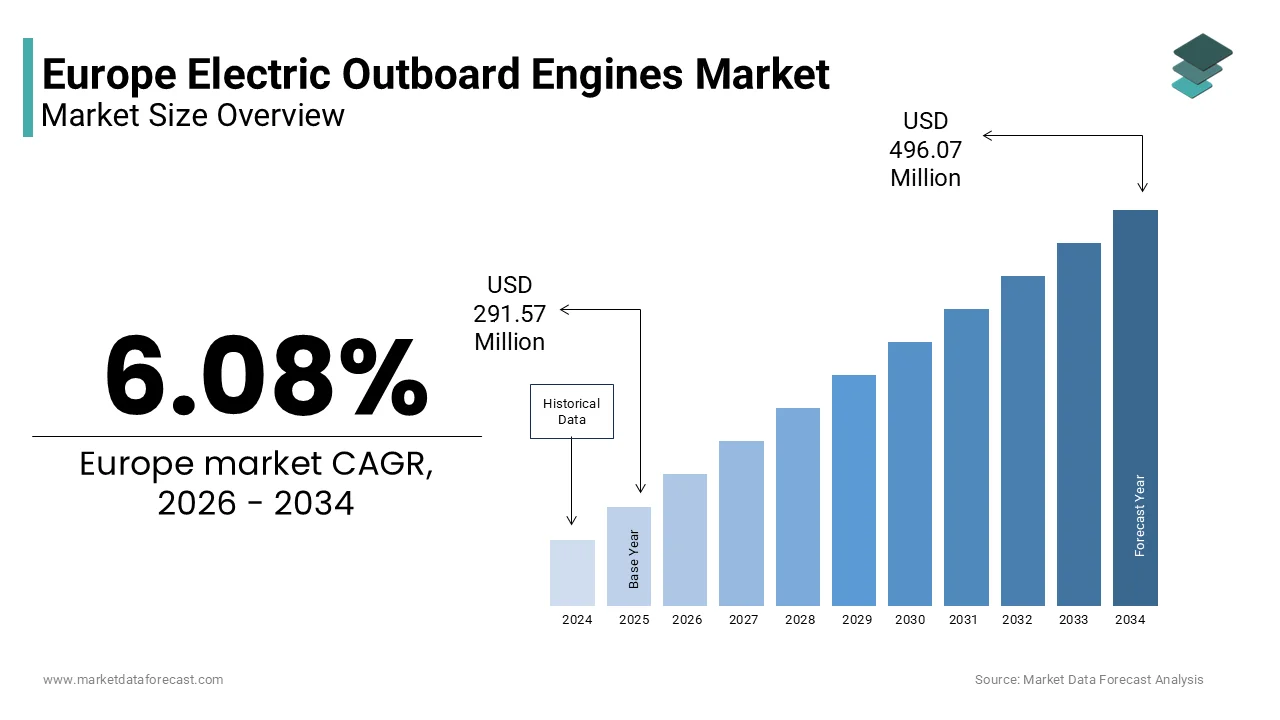
Market Size, 2025
$291.57 MnMarket Estimate, 2026
$309.31 MnMarket Forecast, 2034
$496.07 MnCAGR, 2026–2034
6.08%Europe Electric Outboard Engines Market Report Summary
The Europe electric outboard engines market was valued at USD 291.57 million in 2025 and is estimated to reach USD 309.31 million in 2026, further projected to reach USD 496.07 million by 2034, growing at a CAGR of 6.08% during the forecast period. Market growth is driven by rising environmental regulations on marine emissions, increasing adoption of sustainable boating solutions, and growing demand for quiet and low maintenance propulsion systems. Expanding recreational boating activities, technological advancements in battery efficiency, and integration of lightweight electric propulsion systems are further accelerating market expansion across Europe. In addition, supportive government policies promoting clean marine transportation are strengthening long term market development.
Key Market Trends
- Increasing demand for low power electric outboard engines for leisure boating and small vessel applications.
- Rising adoption of slow speed propulsion systems designed for inland waterways and eco sensitive marine zones.
- Growing consumer preference for recreational boating supported by electric propulsion’s low noise and zero emission benefits.
- Expansion of indirect sales channels including distributors, marine equipment dealers, and online platforms.
- Technological advancements in lithium ion battery systems enhancing range, charging efficiency, and durability.
Segmental Insights
- Based on power, the below 25 kW segment dominated the Europe electric outboard engines market in 2025. The segment’s leadership is attributed to strong demand from small boats, fishing vessels, and recreational crafts requiring compact and efficient propulsion systems.
- Based on speed, the below 5 mph segment accounted for 60.1% of the Europe electric outboard engines market share in 2025. This dominance is supported by widespread use in inland waterways, lakes, and regulated marine zones where speed restrictions and environmental compliance are critical.
- Based on application, the recreational segment held a significant share of the European electric outboard engines market in 2025. Growth in this segment is driven by increasing participation in leisure boating, water sports, and eco tourism activities.
- Based on distribution channel, the indirect sales segment was the largest in the European electric outboard engines market in 2025. The segment’s dominance is attributed to strong dealer networks, marine equipment retailers, and third party distributors facilitating broader product reach.
Regional Insights
- Germany accounted for 25.7% of the Europe electric outboard engines market share in 2025, making it the leading country in the region. The country’s dominance is supported by strong recreational boating culture, advanced marine technology ecosystem, and increasing emphasis on sustainable mobility solutions.
- Other Northern and Western European countries are also witnessing steady adoption due to strict environmental regulations and growing eco conscious consumer base.
Competitive Landscape
The Europe electric outboard engines market is moderately competitive with the presence of specialized marine propulsion manufacturers and emerging electric mobility innovators. Companies are focusing on battery technology improvements, lightweight motor design, distribution network expansion, and product customization to strengthen their market position. Key players operating in the Europe electric outboard engines market include Torqeedo GmbH, EPROPULSION, Combi Outboards, Evoy, Aquawatt, E TECH, Parsun Power, Aquamot GmbH, Bellmarine Transfluid North Europe B.V., E’dyn, Electro Mobile Scandinavia AB, HURACAN S.R.L., and Kräutler Elektromaschinen GmbH.
Europe Electric Outboard Engines Market Size
The Europe electric outboard engines market size was valued at USD 291.57 million in 2025 and is projected to reach USD 496.07 million by 2034 from USD 309.31 million in 2026, growing at a CAGR of 6.08%.
Electric outboard engines are compact, emission-free propulsion systems designed for small to medium-sized watercraft, including recreational boats, fishing vessels, and commercial dinghies. These engines are gaining traction as an eco-friendly alternative to traditional gasoline-powered outboards, aligning with stringent EU regulations aimed at reducing greenhouse gas emissions and combating water pollution.
The market growth is fueled by increasing consumer awareness about climate change, coupled with advancements in battery technology that enhance performance and efficiency. The European Environment Agency highlights that while 80% of marine pollution originates from land, maritime transport-linked activities impact approximately 27% of Europe's near-shore seabed, prompting regional governments to offer incentives for cleaner alternatives like electric outboards. Additionally, countries such as Norway, Sweden, and Germany are leading adopters due to their robust infrastructure for electric vehicles and renewable energy integration. Multiple studies shows that internal combustion engines still dominated with an 86.62% share of the European recreational boating market in 2025. However, electric propulsion is a rapidly growing trend, with online listings for electric boats increasing in 2021 and continuing to rise. The demand for sustainable leisure and commercial boating is rising. Consequently, the electric outboard engines market is poised to play a pivotal role. This market shift will help transform Europe’s marine industry into a greener and more sustainable ecosystem.
MARKET DRIVERS
Stringent Environmental Regulations and Emission Reduction Goals
Stringent environmental regulations and emission reduction goals are significant drivers propelling the Europe electric outboard engines market. European environmental data indicates that while land-based activities cause most coastal pollution, maritime transport contributes significantly to specific pollution types, driving stricter regional regulations. These regulations mandate a shift toward cleaner propulsion systems, with Norway and Sweden leading by offering subsidies for electric marine technologies. Besides, current assessments show that most European Union member states have not yet implemented comprehensive, legally binding incentives to phase out fossil fuel-powered vessels in protected waters. This regulatory push has accelerated the adoption of electric outboard engines, particularly among commercial operators and recreational boaters. Many countries now aim to achieve full carbon neutrality by 2050. As a result, the demand for zero-emission marine solutions is expected to grow significantly. This trend solidifies electric outboards as a key enabler of sustainable boating practices across Europe.
Advancements in Battery Technology and Energy Efficiency
Advancements in battery technology and energy efficiency are pivotal in propelling the Europe electric outboard engines market. Lithium-ion battery technology has experienced sustained improvements in energy density, resulting in enhanced capacity over the past decade. This progress has significantly enhanced the performance and range of electric outboards, addressing previous limitations such as limited runtime and slower speeds. Furthermore, the cost of lithium-ion batteries has fallen dramatically since 2010 due to manufacturing scale and technology improvements. Consequently, electric motors have become more affordable. The European Union is experiencing rapid expansion in public charging infrastructure to support electrification, with significant investment aimed at increasing accessibility. These technological advancements are critical in meeting consumer expectations for reliable, high-performance, and eco-friendly marine propulsion systems.
MARKET RESTRAINTS
Limited Charging Infrastructure
The inadequate charging infrastructure poses a significant barrier to the adoption of these engines and is one major restraint in the European electric outboard engines market. According to the European Alternative Fuels Observatory, the number of public charging points in Europe has grown significantly, though distribution remains uneven across the region. This lack of infrastructure creates range anxiety among boaters who fear being stranded without access to power sources on waterways. Furthermore, European infrastructure data indicates that shore-side electricity supply for maritime vessels is limited, suggesting early-stage electrification in that sector. Such gaps discourage potential buyers from transitioning to electric outboard engines despite their environmental benefits. Expanding this infrastructure requires substantial investment, making it a slow and challenging process.
High Upfront Costs
The high upfront cost of these engines compared to traditional gasoline-powered alternatives is further hindering the expansion of the Europe electric outboard engines market. Primary research and industry analyses indicate that the initial purchase price of electric marine propulsion systems is significantly higher than that of traditional combustion engines, which often discourages buyers who prioritize upfront costs. For instance, when comparing similar power outputs, electric outboard motors typically command a higher retail price than gasoline-powered models, primarily due to the integrated battery technology and specialized electric drive components. Operational savings exist due to lower maintenance and fuel expenses. However, many buyers prioritize immediate affordability. Maritime industry associations have noted that existing government support measures and tax advantages are often not robust enough to bridge the affordability gap for recreational boaters and small-scale operators looking to transition to electric systems. This cost barrier slows down the transition to sustainable marine technologies.
MARKET OPPORTUNITIES
Stringent Emission Regulations Driving Demand
Stringent emission regulations imposed by the European Union are set to fuel significant growth in the European electric outboard engines market. The European Environment Agency identifies maritime transport as a major contributor to EU transportation emissions, driving stricter regulations under the European Green Deal. Besides, the EU has established a legally binding goal for a significant reduction in net greenhouse gas emissions by 2030, compared to 1990 levels. These regulations are pushing boat manufacturers and operators to adopt cleaner alternatives like electric outboard engines. Reports indicate that financial support for zero-emission technologies is increasing to foster a transition to a climate-neutral economy. This regulatory push creates a favorable environment for electric outboard engine manufacturers to expand their market share while aligning with sustainability goals.
Growing Demand for Sustainable Tourism
The rising trend of sustainable tourism in the region offers another major opportunity for the Europe electric outboard engines market. The European Travel Commission highlights a rising consumer preference for nature-based and sustainable tourism, with travelers increasingly seeking low-impact recreational experiences. Electric outboard engines, which produce zero emissions and minimal noise pollution, align perfectly with this demand. Data from the EU Blue Economy report shows that coastal and inland water tourism contributes tens of billions in annual gross value added to the European economy, representing a significant portion of the tourism sector's total economic output. Additionally, the International Maritime Organization emphasizes that quieter and cleaner vessels enhance the experience of nature tourism, attracting environmentally conscious travelers. This shift toward sustainable tourism provides a strong impetus for manufacturers to develop advanced electric outboard solutions tailored to recreational boating needs.
MARKET CHALLENGE
Limited Battery Technology and Performance
The limitation of current battery technology affects performance and usability, which are among the major challenges to the Europe electric outboard engines market. Electric outboard engines are generally designed for shorter, low-speed trips, with operational range significantly dictated by battery size, boat speed, and loading conditions. This range is insufficient for long-distance boating or commercial applications. Additionally, battery charging times remain a concern. Marine battery recharge times vary widely depending on the charging infrastructure power and battery capacity, ranging from rapid charging in some professional, high-voltage systems to longer, standard charging times. These limitations hinder adoption among professional users who require extended operational hours. Furthermore, advances in battery technology, focusing on increased energy density, have shown consistent annual improvements, rather than exponential growth, as the technology matures.
High Initial Investment Costs
The high initial investment required for electric outboard engines acts as a barrier for many consumers and for the European electric outboard engines market. Electric outboard engines generally have higher upfront purchase costs compared to equivalent gasoline engines, with price premiums driven by battery technology and specialized components. For small-scale boat owners and recreational users, this upfront cost is often prohibitive despite potential long-term savings in fuel and maintenance. The adoption of premium-priced sustainable marine technology in Europe is largely dependent on the availability of financial incentives, as many boaters are hesitant to pay high upfront costs for green alternatives. While some EU countries offer subsidies, the European Commission notes that these incentives vary widely across regions, leaving many buyers without adequate support. This disparity slows down the broader adoption of electric outboard engines in the market.
REPORT COVERAGE
| REPORT METRIC | DETAILS |
| Market Size Available | 2025 to 2034 |
| Base Year | 2025 |
| Forecast Period | 2026 to 2034 |
| CAGR | 6.08% |
| Segments Covered | By Power, Speed, Application, Distribution Channel, and Region |
| Various Analyses Covered | Global, Regional, & Country Level Analysis; Segment-Level Analysis; DROC, PESTLE Analysis; Porter’s Five Forces Analysis; Competitive Landscape; Analyst Overview of Investment Opportunities |
| Regions Covered | UK, France, Spain, Germany, Italy, Russia, Sweden, Denmark, Switzerland, Netherlands, Turkey, and the Czech Republic |
| Market Leaders Profiled | Torqeedo GmbH, EPROPULSION, Combi Outboards, Evoy, Aquawatt, E-TECH, Parsun Power, Aquamot GmbH, Bellmarine – Transfluid North Europe B.V., E’dyn, Electro-Mobile Scandinavia Ab, HURACAN S.R.L., and Kräutler Elektromaschinen GmbH. |
SEGMENTAL ANALYSIS
By Power Insights
The "Below 25 kW" segment dominated the European electric outboard engines market and held a substantial share in 2025. The dominance of the segment is driven by its alignment with recreational boating, which accounts for a significant share of Europe's boating activities. Engines in this range are affordable for small boat owners. Their importance lies in supporting sustainable tourism. The ETC reports that travellers are becoming more conscious of sustainability and are increasingly interested in off-the-beaten-path locations to manage tourism flow. These engines also meet emission targets under the European Green Deal, making them vital for reducing maritime pollution.
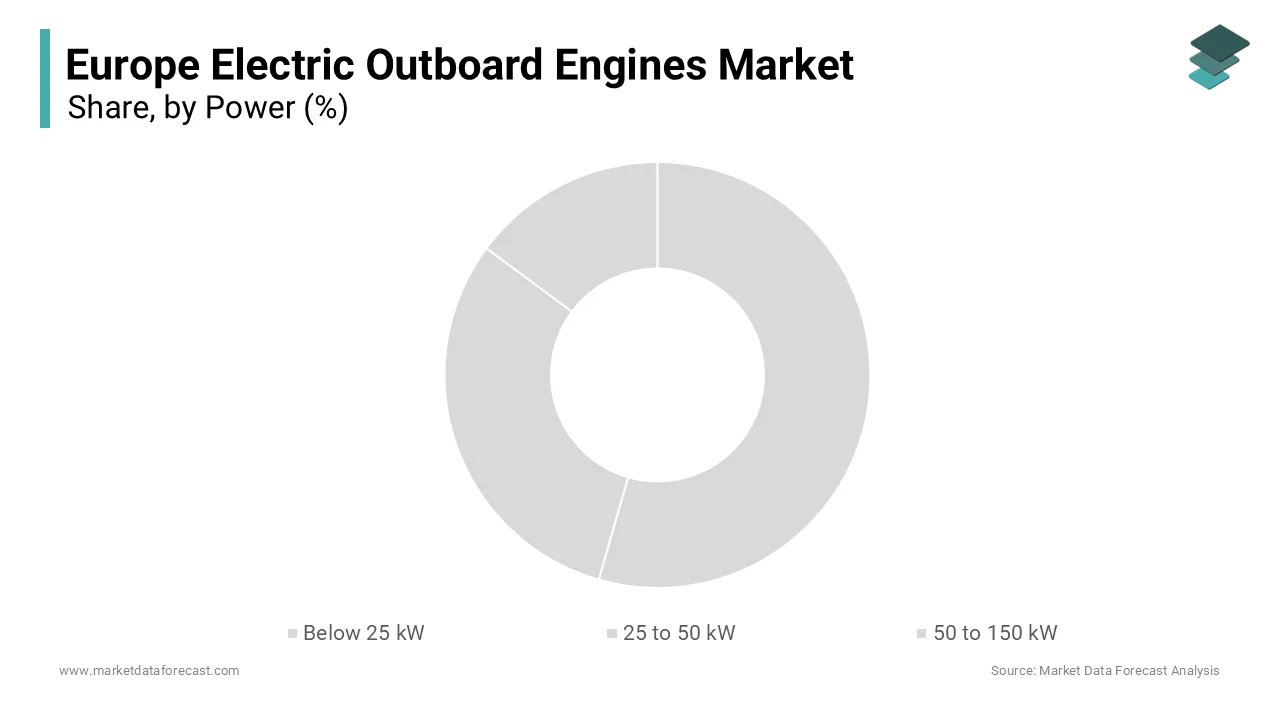
The "25–50 kW" segment is predicted to witness the highest CAGR of 12.5% from 2026 to 2034 due to increasing demand for mid-sized electric engines in water taxis and small commercial vessels, supported by EU subsidies for sustainable marine technologies. The International Maritime Organization highlights that this segment bridges the gap between recreational and commercial use, addressing the need for higher thrust without excessive costs. The European Green Deal, specifically through the "Fit for 55" legislative package, focuses on significantly lowering the greenhouse gas intensity of marine fuels and encouraging the adoption of cleaner technologies to align the shipping industry with broader, ambitious net-zero emissions targets by 2050, despite continued reliance on conventional fuels in the short term.
By Speed Insights
The "Below 5 mph" segment captured the majority share of 60.1% of the Europe electric board engines market in 2025. The supremacy of the segment is attributed to its dominance in leisure and eco-friendly applications. This speed range is ideal for calm water activities like fishing, lake cruising, and nature tours, which account for a significant sgarw of recreational boating in Europe. These engines are energy-efficient, extending battery life notably compared to higher-speed models. Their importance lies in supporting sustainable tourism, with an annual rise in demand for low-impact boating. By reducing noise and emissions, this segment aligns with the EU’s goal of cutting maritime pollution under the European Green Deal.
The "Above 15 mph" segment is estimated to register the fastest CAGR of 18.3% during the forecast period owing to advancements in motor and battery technology, enabling high-speed electric outboards to deliver thrilling experiences for recreational users and meet commercial needs for faster transport. The International Maritime Organization’s 2023 Strategy sets out a roadmap for significant, long-term, total greenhouse gas reduction, driven by the adoption of low- and zero-carbon fuels in the shipping industry. Furthermore, the adoption of alternative, low-emission fuels is considered critical for meeting future European Green Deal targets, with industry goals focusing on scaling their usage to meet strict decarbonization requirements.
By Application Insights
The "Recreational" segment led the European electric outboard engines market and occupied a significant share in 2025. The prominence of the segment is credited to the rising demand for eco-friendly leisure boating. Eurostat data indicates that government expenditure on recreation, culture, and religion represents a significant and stable portion of public spending, with private enterprises in the sector generating substantial value added to the EU economy. Electric outboards are preferred for their quiet operation and zero emissions, making them ideal for lakes and inland waterways. The European Travel Commission reports that travellers are increasingly seeking sustainable and off-season options, with a growing preference for quieter destinations, which helps to spread tourism demand and mitigate overtourism in popular areas. Affordable pricing and suitability for small boats also make these engines accessible to hobbyists. This segment’s importance lies in reducing maritime pollution while aligning with the EU’s Green Deal targets for emission reductions.
The "Commercial" segment is anticipated to witness the fastest CAGR of 14.7% over the forecast period. This rapid growth is fueled by stricter emission regulations under the European Green Deal and increasing urban mobility needs. International maritime authorities are emphasizing a comprehensive transition to low- and zero-emission technologies to achieve decarbonization goals, with electrified, emission-free propulsion being a recognized alternative to conventional marine engines. Currently representing a portion of the market, this segment is critical for applications like water taxis and small ferries. Eurostat notes cities such as Amsterdam and Venice are investing heavily in electric water transport, driving adoption. Its importance lies in promoting sustainable marine transport while supporting Europe’s climate goals and enhancing operational efficiency in commercial sectors.
By Distribution Channel Insights
The "Indirect Sales" segment was the largest segment in the European electric outboard engines market and occupied a noteworthy share in 2025 because of established distribution networks, including marine dealers and online platforms, which provide consumers with accessibility and post-purchase support. EU maritime regulatory frameworks prioritize mandatory safety standards, Type-Approvals, and manufacturer accountability for equipment compliance, focusing on direct conformity rather than specific indirect channel strategies. Additionally, e-commerce growth has boosted this segment, with marine retailers reporting an annual rise in online sales. Its importance lies in enabling widespread market penetration, catering to diverse customers, from recreational users to small businesses, while aligning with EU goals of promoting sustainable marine technologies through accessible channels.
The "Direct Sales" segment is likely to experience the fastest CAGR of 16.2% from 2026 to 2034. The swift expansion of the segment is propelled by manufacturers leveraging direct-to-consumer strategies, such as branded online stores and exclusive showrooms, to offer personalized solutions and reduce intermediary costs. Direct sales foster stronger customer relationships, appealing to eco-conscious buyers seeking transparency. While currently accounting for a portion of the market, its importance lies in allowing manufacturers to capture higher margins and build brand loyalty. This trend supports innovation and aligns with the EU’s push for sustainable products, ensuring long-term competitiveness in the evolving electric outboard market.
REGIONAL ANALYSIS
Germany Electric Outboard Engines Market Analysis
Germany was the top performer in the European electric outboard engines market and accounted for a 25.7% share in 2025. The dominance of the German market is driven by the country’s robust infrastructure for renewable energy and electric mobility, supported by government incentives like subsidies for eco-friendly marine technologies. Germany is a leading European nation in the deployment of electric vehicle charging infrastructure, which supports a growing environment for electric mobility, including on the water. Additionally, Germany’s strong manufacturing base and focus on sustainability align with the European Green Deal, driving demand. The German maritime sector is heavily investing in sustainable technologies, with inland tourism and recreational boating driving the adoption of electric engines and securing Germany's role as a leader in innovative marine solutions.
France Electric Outboard Engines Market Analysis
France was the second-largest country in the Europe and captured a 18.5% share in 2025. The growth of the French market is fuelled by its booming sustainable tourism industry, particularly along the Mediterranean and Atlantic coasts. European tourism bodies report a growing demand for sustainable boating, driving increased interest in electric propulsion across the continent. France’s stringent emission regulations under the EU Green Deal also encourage adoption, with financial incentives such as tax breaks for low-emission vessels. The French Maritime Cluster highlights significant investment growth in clean technologies for both commercial and recreational maritime sectors. This combination of policy support and tourism growth solidifies France’s position as a key player in the electric outboard engines market.
Sweden Electric Outboard Engines Market Analysis
Sweden is another major player in the Europe electric outboard engines market due to its commitment to sustainability, with ambitious goals to achieve net-zero emissions by 2045. Sweden's vast archipelagos and inland waterways encourage the use of eco-friendly electric outboard motors for leisure boating. Sweden is expanding its network of marine charging stations, which is helping to alleviate concerns regarding the operating range of electric boats. Additionally, Swedish manufacturers are global leaders in green technology, fostering innovation. This focus on sustainability and technological advancement ensures Sweden remains a pioneer in adopting electric outboard engines across both recreational and commercial sectors.
KEY MARKET PLAYERS
Some of the notable key players in the Europe electric outboard engines market are
- Torqeedo GmbH
- EPROPULSION
- Combi Outboards
- Evoy
- Aquawatt
- E-TECH
- Parsun Power
- Aquamot GmbH
- Bellmarine, Transfluid North Europe B.V.
- E’dyn
- Electro-Mobile Scandinavia AB
- HURACAN S.R.L.
- Kräutler Elektromaschinen GmbH
MARKET SEGMENTATION
This research report on the European electric outboard engines market has been segmented and sub-segmented based on categories.
By Power
- Below 25 kW
- 25 to 50 kW
- 50 to 150 kW
By Speed
- Below 5 mph
- 5 to 10 mph
- 10 to 15 mph
- Above 15 mph
By Application
- Commercial
- Recreational
- Military
By Distribution Channel
- Direct Sales
- Indirect Sales
By Country
- UK
- France
- Spain
- Germany
- Italy
- Russia
- Sweden
- Denmark
- Switzerland
- Netherlands
- Turkey
- Czech Republic
- Rest of Europe