Europe Electric Scooters Market Size, Share, Growth, Trends And Forecasts Report, Segmented By Battery, Voltage, And Region (The UK, France, Spain, Germany, Italy, Russia, Sweden, Denmark, Switzerland, Netherlands, Turkey, Czech Republic and Rest of Europe), Industry Analysis From 2026 to 2034
Market Size, 2025
$6.76 BnMarket Estimate, 2026
$7.56 BnMarket Forecast, 2034
$18.46 BnCAGR, 2026–2034
11.81%Europe Electric Scooters Market Report Summary
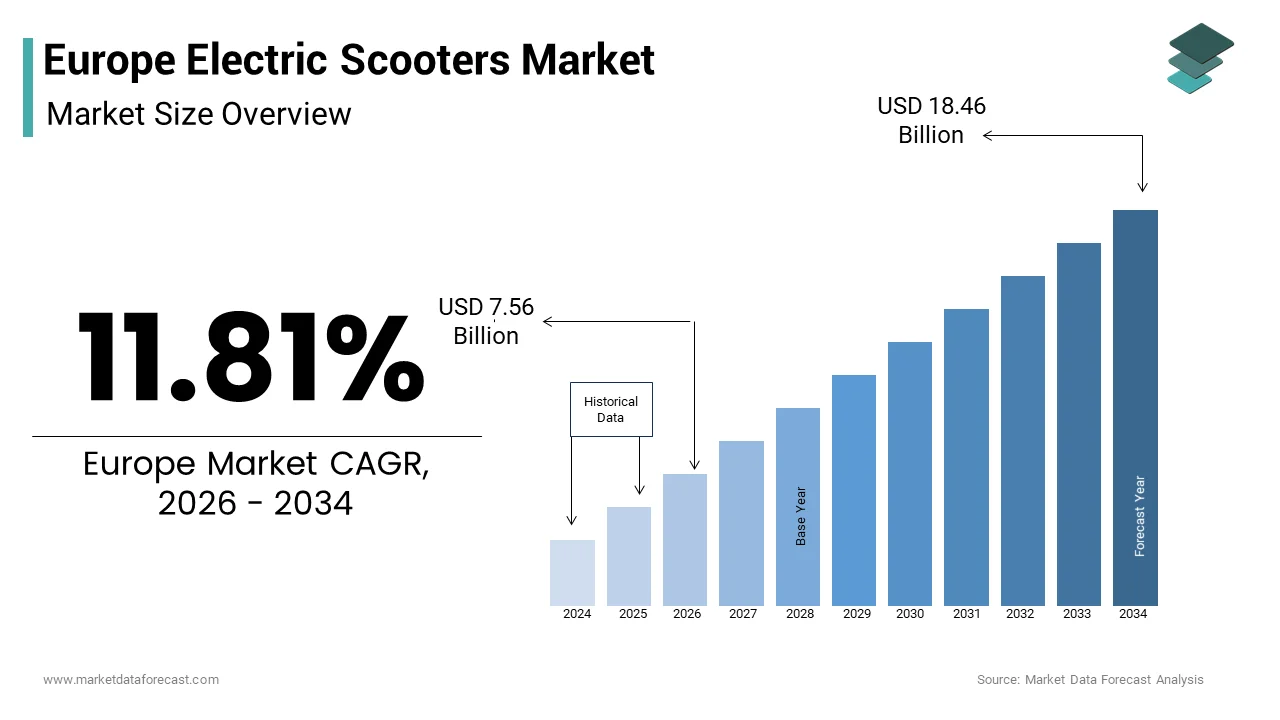
The Europe electric scooter market was valued at USD 6.76 billion in 2025, is estimated to reach USD 7.56 billion in 2026, and is projected to expand to USD 18.46 billion by 2034, registering a robust CAGR of 11.81% during the forecast period from 2026 to 2034. The growth of the European electric scooters market is driven by rapid urbanization, rising fuel costs, and increasing demand for sustainable and cost-efficient urban mobility solutions. Supportive government policies promoting electric vehicles, expansion of charging infrastructure, and growing adoption of shared mobility services are further accelerating market growth. In addition, advancements in battery technology and increasing consumer preference for compact, low-emission transportation are strengthening demand across major European cities.
Key Market Trends
Rising adoption of electric scooters for last-mile connectivity and short-distance urban commuting. Increasing preference for lithium-ion batteries due to their high energy density, longer lifespan, and faster charging capabilities. Growing demand for higher-voltage scooters offering improved performance, speed, and riding range. Expansion of shared e-scooter services and micro-mobility platforms across metropolitan areas. Strong focus on smart features, connectivity, and enhanced safety standards in electric scooter design.
Segmental Insights
- Based on battery type, the lithium-ion batteries segment dominated the Europe electric scooters market in 2025, accounting for 42.35% of the market share. The segment’s leadership is attributed to superior efficiency, lightweight design, and declining battery costs, making lithium-ion technology the preferred choice for both personal and shared electric scooters.
- Based on voltage, the 48 to 59 volt segment held a significant share of the market in 2025, capturing 34.3% of the Europe electric scooters market share. This segment benefits from offering an optimal balance between performance, range, and affordability, making it suitable for urban commuting and commercial fleet applications.
Regional Insights
- The Europe electric scooter market is witnessing strong growth across key economies, driven by urban mobility reforms and sustainability goals.
- Germany emerged as the largest market in 2025, accounting for 19.2% of the regional share, supported by advanced infrastructure, high EV adoption rates, and favorable regulatory frameworks.
- France followed with a 16.8% share, driven by extensive deployment of shared e-scooter services and urban mobility initiatives.
- The United Kingdom is expected to present significant growth opportunities in the coming years due to evolving regulations and rising consumer acceptance.
- Italy is projected to grow steadily, supported by high urban density, tourism-driven short-distance travel, and progressive municipal policies in cities such as Rome, Milan, and Florence.
- Spain is also expected to witness steady growth, driven by increasing urban electrification and micro-mobility adoption.
Competitive Landscape
The Europe electriscooter market is competitive, with the presence of global manufacturers and regional mobility innovators. Leading players are focusing on expanding product portfolios, enhancing battery performance, and strengthening distribution networks across Europe. Prominent companies operating in the market include Yadea Technology Group Co., Ltd, Zhejiang Luyuan Electric Vehicle Co., Ltd, Niu Technologies, Mahindra GenZe, Hero Electric, Vmoto Limited, Amper Vehicles, Govecs Group, BMW Motorrad International, and Gogoro Inc.
Europe Electric Scooters Market Size
The Europe electric scooter market size was valued at USD 6.76 billion in 2025 and is anticipated to reach a valuation of USD 7.56 billion in 2026 and USD 18.46 billion by 2034, growing at a CAGR of 11.81% during the forecast period from 2026 to 2034.
Current Introduction to the Europe Electric Scooters Market
The electric scooters are battery-powered personal mobility devices designed for short-distance urban travel and integrated into both private ownership and shared micro mobility ecosystems across the European continent. These vehicles typically feature compact designs, lithium-ion battery systems, and digital connectivity enabling real-time tracking and user management. City-specific data further illustrates relevance, where Paris recorded over 15 million electric scooter trips in 2022, according to the city’s mobility observatory, demonstrating entrenched usage even before formal regulatory frameworks matured.
MARKET DRIVERS
Expansion of Micromobility Infrastructure Stimulates Consumer Adoption
The European cities are systematically redesigning urban spaces to prioritize non-motorized and low-emission transport, directly fostering electric scooter integration. The expansion of micromobility infrastructure stimulates consumer adoption is bolstering the growth of Europe's electric scooter market. Dedicated micro mobility lanes, protected parking zones, and multimodal transit hubs are increasingly common in metropolitan planning. This investment translates into tangible changes on the ground. Moreover, interoperability with public transit enhances utility. In Barcelona, over 40% of electric scooter trips in 2023 began or ended within 300 meters of a metro or bus stop, according to the city’s transport authority, indicating successful multimodal synergy.
Policy-Driven Electrification Mandates Create Favorable Regulatory Tailwinds
Stringent air quality directives and national electrification roadmaps have positioned electric scooters as a compliant mobility alternative within Europe’s broader green transition. This factor is additionally elevating the growth of the Europe electric scooter market. The European Green Deal, which aims for climate neutrality by 2050, explicitly promotes zero-emission urban transport modes. Additionally, the European Commission’s Clean Vehicles Directive requires public authorities to ensure that light-duty vehicle procurements meet zero or low-emission criteria by 2025, indirectly encouraging complementary micro-mobility adoption. France’s Loi d’Orientation des Mobilités mandates that cities with populations over 100,000 develop sustainable urban mobility plans, with Lyon introducing scooter speed limits and geofencing as part of its 2023 update. Furthermore, congestion pricing schemes amplify cost incentives. Transport for London recorded that the Ultra Low Emission Zone generated 185 million pounds in revenue during 2022 by signaling strong disincentives for internal combustion vehicles.
MARKET RESTRAINTS
Inconsistent Regulatory Frameworks Across Jurisdictions Hamper Market Scalability
The fragmented legal landscape that varies significantly between and even within countries, complicating operational scalability for both manufacturers and operators, is restraining factor for the Europe electric scooters market. While the European Committee for Standardization issued EN 17128 in 2018 to define safety requirements for personal light electric vehicles, national implementation remains uneven. In Germany, electric scooters are permitted on bike lanes with a maximum speed of 20 kilometers per hour, whereas in the United Kingdom, private electric scooters remain illegal on public roads, with only government-sanctioned rental trials allowed in select cities, as per research. A 2023 survey by the European Micromobility Association revealed that some operators consider regulatory inconsistency the top obstacle to expansion. Furthermore, local municipalities often impose additional constraints; Brussels banned overnight parking of scooters in 2022, while Milan introduced mandatory helmet use for riders under 18 in 2023. The absence of harmonized rules also deters long-term investment, as companies cannot guarantee operational continuity across markets.
Safety Concerns and Accident Data Undermine Public and Institutional Confidence
Persistent safety issues linked to electric scooter usage continue to challenge public perception, and policy support is significantly declining the growth othe f the Europe electric scooter market. Emergency departments in major cities report rising injury incidents, raising alarms among health and transport authorities. These statistics fuel opposition from civic groups and influence municipal decisions. In 2023, Oxford City Council suspended all shared scooter operations following a spike in sidewalk collisions, which is citing inadequate rider training and pavement clutter. The root causes are multifaceted: lack of helmet use, sidewalk riding, and poor vehicle maintenance. Such behavioral and design gaps erode trust in the safety of micro mobility systems.
MARKET OPPORTUNITIES
Integration with Mobility as a Service Platforms Unlocks New Usage Models
The emergence of electric scooters with digital mobility, as a Service ecosystem, seamless urban travel is creating new opportunities for the growth of the Europe electric scooters market. Unlike standalone ownership, integration into MaaS platforms enables users to plan, book, and pay for multimodal journeys, including scooters, buses, trains, and bikes, through a single interface. This interoperability increases convenience and reduces friction in trip chaining. In these systems, electric scooters serve as first and last-mile connectors. Moreover, public-private partnerships are accelerating integration. The European Commission’s Horizon Europe program funded the MaaS4EU project to standardize data exchange protocols across transport modes, facilitating smoother scooter inclusion. Operators benefit from increased visibility and user acquisition, while cities gain granular mobility data to optimize infrastructure.
Advancements in Battery Technology and Swapping Infrastructure Enhance Operational Viability
Innovations in battery chemistry and alternative energy replenishment models are addressing core limitations of range anxiety and charging inefficiency, which is also expanding the growth of the Europe electric scooter market. Solid-state and lithium-iron-phosphate batteries now offer higher energy density and longer lifespans. The battery swapping networks are emerging as a scalable solution for shared fleets. In Paris, the startup Vostok launched a network of 200 swapping stations in 2023, reducing vehicle downtime compared to plug-in charging. Similar initiatives are gaining traction in Berlin and Lisbon under the EEU-funded SWAP4BATTERY consortium, which reported in late 2023. These systems also mitigate urban clutter from charging cables and extend battery lifecycle through centralized management. For private users, modular battery designs allow home charging without moving the entire scooter.
MARKET CHALLENGES
Vandalism and Theft Result in Significant Fleet Losses and Operational Disruptions
The shared electric scooter operators face persistent threats from vandalism and theft, which undermine service reliability and inflate operational costs. The vandalism and theft result in significant fleet losses and operational disruptions, which also hinder the growth of the Europe electric scooters market. In Marseille, Lime recorded the loss of over 300 scooters in the first half of 2023 alone, attributing most incidents to overnight thefts and deliberate immersion in water, as disclosed in its city performance review. Moreover, damaged units often block sidewalks or bike lanes, triggering public complaints and regulatory penalties. While geofencing and reinforced hardware help, they cannot fully prevent human-driven interference.
Limited Cold Weather Performance Constrains Year-Round Usability in Northern Europe
The operational efficiency of electric scooters declines significantly in low-temperature environments, restricting consistent usage across Northern and Central European countries during winter months. The limited cold weather performance constrains year-round usability in Northern Europe, and also degrades the growth of the Europe electric scooters market. Lithium-ion batteries, which power most scooters, experience reduced chemical reactivity below 10 degrees Celsius, leading to diminished range and power output. Real-world data corroborates this; in Stockholm, shared scooter trips decreased between November 2022 and February 2023 compared to summer peaks, as per the city’s transport administration. Cold also affects tire traction and braking efficiency, increasing accident risks. Although some manufacturers are developing thermal battery management systems, widespread adoption remains limited due to cost and weight penalties.
REPORT COVERAGE
| REPORT METRIC | DETAILS |
| Market Size Available | 2025 to 2034 |
| Base Year | 2025 |
| Forecast Period | 2026 to 2034 |
| CAGR | 11.81% |
| Segments Covered | By Battery, Voltage, By Country |
| Various Analyses Covered | Global, Regional & Country Level Analysis; Segment-Level Analysis, DROC, PESTLE Analysis, Porter’s Five Forces Analysis, Competitive Landscape, Analyst Overview of Investment Opportunities |
| Regions Covered | UK, France, Spain, Germany, Italy, Russia, Sweden, Denmark, Switzerland, Netherlands, Turkey, Czech Republic & Rest of Europe |
| Market Leaders Profiled | Yadea Technology Group Co., Ltd (China), Zhejiang Luyuan Electric Vehicle Co., Ltd (China), Niu Technologies (China), Mahendra GenZe (U.S.), Hero Electric (India), Vmoto Limited (Australia), Amper Vehicles (India), Govecs Group (Germany), BMW Motorrad International (Germany), Gogoro Inc. (Taiwan) |
SEGMENTAL ANALYSIS
By Battery Insights
Thlithium-ionon battery segment was the largest by holding 42.35% of the Europe electric scooters market share in 2025 due to superior energy density, longer lifespan, and declining costs. As per the European Association for Storage of Energy, over 90% of new electric scooters sold in Europe in 2025 were equipped with lithium-ion battery systems, reflecting a near-total shift away from legacy technologies. This dominance is primarily driven by evolving consumer expectations for performance and range, as well as regulatory alignment with sustainable battery standards under the EU Battery Regulation adopted in 2023. Shared mobility operators, which account for a significant portion of fleet procurement, prioritize Li ion units for their reliability and lower total cost of ownership. These performance and economic advantages have rendered lead acid technology functionally obsolete in new scooter production across Europe.
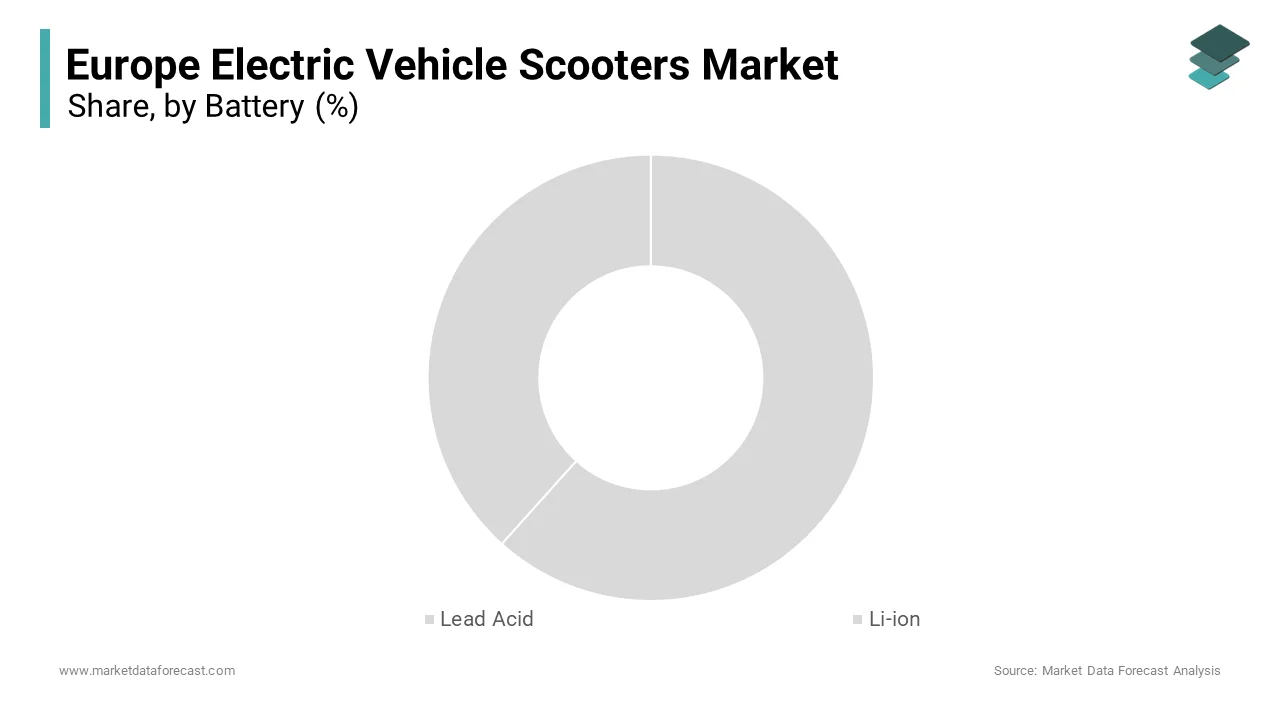
The lithium-ion battery segment is projected to grow at the fastest CAGR of 14.3% throughout the forecast period due to continuous innovation in cell chemistry and manufacturing scale. The shift toward lithium iron phosphate cells, which offer enhanced thermal stability and reduced cobalt dependency, has broadened adoption among safety-conscious European cities. In 2025, new Li ion scooters in Germany and the Netherlands utilized LFP variants, according to the German Electrical and Electronic Manufacturers Association. These developments, coupled with EU mandates for recyclability and carbon footprint labeling under the 2023 Battery Regulation that reinforce Li ion’s growth trajectory by aligning commercial viability with environmental compliance across Europe’s evolving mobility ecosystem.
By Voltage Insights
The 48 to 59 volt segment accounted for holding 34.3% of the Europe electric scooters market share in 2025, with its alignment with urban commuting needs, regulatory speed limits, and safety standards. As per the European Two-Wheeler Manufacturers Association, electric scooters sold in Europe in 2025 operated within this voltage range, which typically supports motor outputs of 250 to 500 watts, sufficient to comply with the EU’s 25 kilometers per hour speed cap for personal light electric vehicles. This voltage tier strikes an optimal balance between performance, battery weight, and cost efficiency. Furthermore, consumer safety regulations in countries like Germany and the Netherlands explicitly restrict private scooters to under 60 volts without special licensing, reinforcing market concentration. A 2025 technical review by TUV Rheinland confirmed that systems exhibit the lowest thermal runaway risk among available options by enhancing public acceptance.
The 73 to 96 volt segment is anticipated to witness the fastest CAGR of 18.7% from 2025 to 2033, with the rising demand for high-performance scooters in last-mile delivery and inter-suburban commuting. Unlike standard urban models, 73 to 96V scooters deliver motor outputs exceeding 1,000 watts, enabling speeds of up to 45 kilometers per hour and ranges beyond 80 kilometers, capabilities increasingly sought by logistics firms. In 2025, European courier services, such as La Poste in France and PostNL in the Netherlands, integrated over 8,0high-voltageage electric scooters into their fleets. Italy’s 2025 amendment to its road code created a new vehicle category for “enhanced electric scooters” with speeds up to 45 kilometers per hour, contingent on 72-volt minimum systems. Additionally, advances in battery management systems now allow safe thermal control in higher voltage architectures.
COUNTRY ANALYSIS
Germany Electric Scooters Market Analysis
Germany was the top performer in the Europe electric scooters market by accounting for 19.2% of share in 2025 due to early regulatory formalization, dense urban networks, and high consumer environmental awareness. Germany was among the first EU nations to legalize electric scooters on public roads in 2019, establishing clear rules on speed, lighting, and insurance. As per the studies, 64% of German scooter users cited “reducing car dependency” as their primary motivation, reflecting deep alignment with national climate goals. Furthermore, government incentives under the 2022 Urban Mobility Innovation Fund allocated 120 million euros to micro mobility infrastructure, including dedicated lanes and charging hubs.
France Electric Scooters Market Analysis
The French electric scooter market was positioned second by capturing 16.8% of share in 2025. Paris and Lyon serve as national epicenters, where scooters are deeply embedded in multimodal transport strategies. France’s market strength derives from aggressive urban decarbonization policies and public acceptance of micro mobility as a transit alternative. National safety standards, updated in 2025, require all scooters to include front and rear lights, anti-slip decks, and speed limiters by ensuring quality while maintaining accessibility. France’s investment in “15 Minute City” urban planning has amplified demand for short-range electric transport. According to INSEE, many French urban residents live within a 15-minute walk or ride of essential services by creating an ideal ecosystem for scooter use.
United Kingdom Electric Scooters Market Analysis
The United Kingdom electric scooters market growth is expected to have significant growth opportunities in next coming years. As of late 2024, 35 cities, including London, Manchester, and Bristol, in the national e-scooter trial program, which has recorded over 20 million trips since its 2020 inception. Regulatory caution from safety concerns, however, the government’s 2024 consultation on permanent legalization signals a potential market inflection point. Infrastructure investment is also accelerating, where the Active Travel England fund allocated 150 million pounds in 2023 to protect micro mobility lanes.
Italy Electric Scooters Market Analysis
Italy's electric scooters market growth is likely to grow with the high urban density, tourism-driven short-distance travel, and progressive municipal policies in Rome, Milan, and Florence. Unlike some Northern European nations, Italy permits higher-performance scooters, with a 2025 legislative update allowing models up to 45 kilometers per hour under a new “speed e scooter” classification, provided they operate at 72 volts or above. This regulatory flexibility has attracted premium manufacturers and logistics integrators alike. Cultural factors also play a role, where the Italian preference for agile, narrow vehicles aligns naturally with scooter ergonomics in historic city centers where car access is restricted.
Spain Electric Scooters Market Analysis
Spain's electric scooter market is expected to grow steadily in the coming years. The country’s warm climate, tourism-intensive cities, and progressive local regulations create a highly conducive environment for electric scooter adoption. Barcelona and Madrid lead national deployment, with over 180,000 combined registered scooters as of 2025. Additionally, Spain has one of Europe’s highest rates of private ownership, driven by affordability and low infrastructure barriers. Municipal regulations emphasize coexistence. Barcelona requires all scooters to be registered and display QR code identification by reducing sidewalk clutter and improving accountability.
COMPETITIVE LANDSCAPE
The Europe electric scooters market features intense competition among established operators and emerging regional players striving to differentiate through technology, service quality, and sustainability credentials. While global companies like Lime and Tier dominate major metropolitan areas, local startups such as Felyx and Zego are gaining traction by tailoring solutions to specific city needs. Competition is no longer solely based on fleet size but increasingly on operational efficiency, regulatory compliance, and user experience. Companies invest heavily in vehicle durability, battery innovation,n and AI-driven fleet management to reduce losses from theft or damage. Regulatory scrutiny has raised the barrier to entry, prompting consolidation and strategic exits in underperforming cities. Simultaneously, public expectations for responsible operations have pushed firms to adopt transparent safety records and environmental reporting.
KEY MARKET PLAYERS
Important market players that are dominating the Europe electric scooters market are
- Yadea Technology Group Co., Ltd (China)
- Tier Mobility
- Lime
- Dott
- Zhejiang Luyuan Electric Vehicle Co Ltd (China)
- Niu Technologies (China)
- Mahendra GenZe (U.S.)
- Hero Electric (India)
- Vmoto Limited (Australia)
- Amper Vehicles (India)
- Govecs Group (Germany)
- BMW Motorrad International (Germany)
- Gogoro Inc. (Taiwan)
Top Players In The Market
- Tier Mobility is a leading European micro mobility provider headquartered in Berlin with operations spanning over 120 cities across 15 European countries. The company has significantly contributed to the global market by pioneering swappable battery technology for electric scooters, reducing fleet downtime and urban charging clutter. In 2024, Tier launched its itsthird-generationn scooter featuring enhanced safety lighting, AI-powered anti-vandalism detection, and modular battery units compliant with EU Battery Regulation standards. The company also expanded its Mobility as a Service integration with national rail operators in Germany and France to strengthen last-mile connectivity. These initiatives reinforce Tier’s commitment to sustainability, operational efficiency, and seamless urban mobility across Europe and beyond.
- Lime operates one of the most extensive electric scooter networks in Europe with a strong presence in the United Kingdom, France,e Ita, and Spain. The company has played a pivotal role in shaping global micro mobility standards through a data-driven approach to fleet management and city partnerships. Lime introduced its Gen 4 electric scooters featuring improved suspension, longer range batteries, and integrated helmet dispensers in select European cities. Lime also deepened its collaboration with public transit authorities by embedding its service into national transport apps in the Netherlands and Portugal. These actions demonstrate Lime’s focus on safety innovation, multimodal integration,n and regulatory alignment to solidify its position in Europe’s evolving urban transport ecosystem.
- Dott is a Brussels-based micro mobility operator known for its high durability vehicles and strong emphasis on operational responsibility. The company serves over 20 European cities, including London,n Paris, and Milan, with a fleet designed for extended service life and minimal environmental impact. Dott has contributed to the global market by advocating for equitable urban mobility and sustainable hardware practices. Dott rolled out a fleet of scooters built with 30% recycled aluminum and launched a nighttime charging model using cargo bikes to eliminate vehicle emissions during logistics. The company also partnered with local governments to co-design geofenced slow zones near schools and hospitals.
Top Strategies Used By The Key Market Participants
Key players in the Europe electric scooters market primarily adopt strategies centered on fleet modernization, regulatory collaboration, and sustainability integration. Companies are investing in next-generation scooters with swappable batteries, enhanced safety features, and extended lifespans to reduce operational costs and environmental impact. Strategic partnerships with public transport authorities and Mobility as a Service platforms enable seamless multimodal journeys and increase user retention. Operators are also engaging proactively with municipal governments to shape localized regulations and demonstrate safety compliance through data transparency. Additionally, firms are implementing circular economy practices such as using recycled materials in vehicle construction and establishing battery recycling programs aligned with EU directives. These approaches collectively strengthen market credibility, enhance service reliability, and support long-term urban mobility goals across Europe.
MARKET SEGMENTATION
This research report on the Europe electric scooters market is segmented and sub-segmented into the following categories.
By Battery Type
- Lead Acid
- Li-ion
By Voltage Type
- 48-59V
- 60-72V
- 73-96V
- Above 96V
By Country
- UK
- France
- Spain
- Germany
- Italy
- Russia
- Sweden
- Denmark
- Switzerland
- Netherlands
- Turkey
- Czech Republic
- Rest of Europe
Frequently Asked Questions
What is driving the Europe electric scooters market?
Growing urban congestion, government incentives for eco-friendly transport, and rising consumer demand for affordable, low-emission mobility.
Why are electric scooters becoming popular in Europe?
They offer a cost-effective, convenient, and sustainable alternative for short-distance commuting in densely populated cities.
Which countries lead electric scooter adoption in Europe?
Germany, France, Spain, Italy, and the Netherlands show the highest adoption due to strong mobility policies and charging infrastructure growth.
What key trends are shaping the market?
Expansion of shared e-scooter fleets, improvements in battery technology, integration with smart mobility apps, and growth of last-mile delivery demand.
Are European governments supporting electric scooters?
Yes many countries provide subsidies, tax incentives, and emissions-reduction policies that support e-mobility uptake.
What challenges does the market face?
Regulatory differences between countries, safety concerns, limited charging points in smaller cities, and battery recycling needs.
What types of electric scooters are popular in Europe?
Foldable personal e-scooters, shared fleet scooters, and high-performance commuter models designed for urban travel.
How is technology improving electric scooter performance?
Better lithium-ion batteries, fast-charging systems, GPS tracking, IoT connectivity, and anti-theft features enhance usability and safety.
Are shared electric scooters still growing in Europe?
Yes, shared mobility operators continue expanding fleets, especially in major urban centers where last-mile connectivity is essential.
What is the future outlook for Europe’s electric scooters market?
Strong growth is expected as cities push toward climate-neutral mobility, expand cycling lanes, and adopt rules that support micromobility.
Related Reports
Access the study in MULTIPLE FORMATS
Purchase options starting from
$ 2000
Didn’t find what you’re looking for?
TALK TO OUR ANALYST TEAM
Need something within your budget?
NO WORRIES! WE GOT YOU COVERED!
Call us on: +1 888 702 9696 (U.S Toll Free)
Write to us: sales@marketdataforecast.com