Europe EV Chargers Market Size, Share, Trends & Growth Forecast Report – Segmented By Charging Level, Installation Site, Application, and Country (UK, France, Spain, Germany, Italy, Russia, Sweden, Denmark, Switzerland, Netherlands, Turkey, Czech Republic & Rest of Europe), Industry Analysis From 2026 to 2034
Market Size, 2025
$4.51 BnMarket Estimate, 2026
$5.78 BnMarket Forecast, 2034
$41.83 BnCAGR, 2026–2034
28.07%Europe EV Chargers Market Report Summary
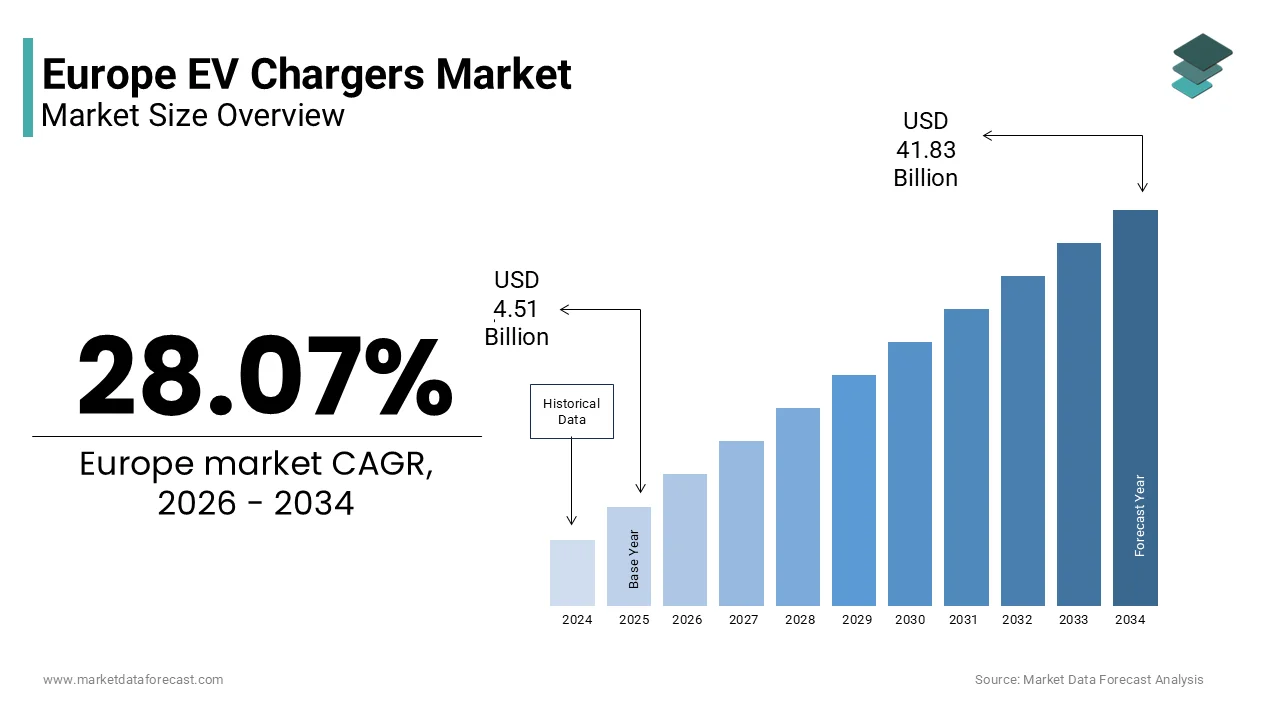
The Europe EV chargers market was valued at USD 4.51 billion in 2025 and is estimated to reach USD 5.78 billion in 2026, further projected to reach USD 41.83 billion by 2034, growing at a CAGR of 28.07% during the forecast period. Market growth is driven by accelerating electric vehicle adoption, stringent carbon emission regulations, and strong government incentives supporting charging infrastructure deployment. Expanding public and private investments in charging networks, increasing residential EV ownership, and integration of smart charging technologies are significantly boosting market expansion. In addition, Europe’s ambitious climate neutrality targets and expansion of renewable energy integration are strengthening long term infrastructure development.
Key Market Trends
- Rapid expansion of Level 2 charging infrastructure across residential and commercial settings due to its cost effectiveness and compatibility with daily charging needs.
- Strong growth in residential charger installations supported by rising home EV ownership and government subsidy programs.
- Increasing deployment of smart chargers with load management, remote monitoring, and grid balancing capabilities.
- Growing partnerships between utilities, automotive manufacturers, and charging network providers to accelerate infrastructure rollout.
- Expansion of ultra fast and DC fast charging corridors across highways to support long distance EV travel.
Segmental Insights
- Based on charging level, the Level 2 chargers segment accounted for 58.4% of the Europe EV chargers market share in 2025. The segment’s dominance is attributed to its balance between charging speed and installation cost, making it suitable for residential, workplace, and public charging applications.
- Based on installation site, the residential installations segment led the Europe EV chargers market with a 52.7% share in 2025. Growth in this segment is driven by increasing adoption of private EVs, home charging convenience, and supportive government incentives.
- Based on application, the home application segment was the largest in the Europe EV chargers market and held a 48.5% share in 2025. The segment’s leadership is supported by rising consumer preference for overnight home charging and improved residential electrical infrastructure.
Regional Insights
- Western European countries continue to lead EV charger deployment due to strong EV penetration rates, regulatory support, and well established charging infrastructure networks.
- Countries such as Germany, France, the United Kingdom, and the Netherlands are at the forefront of infrastructure expansion driven by ambitious decarbonization goals and public funding initiatives. Eastern Europe is gradually witnessing accelerated deployment supported by cross border infrastructure programs.
Competitive Landscape
The Europe EV chargers market is highly competitive with the presence of established electrical equipment manufacturers and specialized charging infrastructure providers. Companies are focusing on smart charging solutions, scalable network expansion, interoperability standards, and partnerships with automotive OEMs to strengthen their market position. Key players operating in the Europe EV chargers market include Pod Point Ltd., ABB Ltd., Mennekes Elektrotechnik GmbH and Co. KG, Silicon Laboratories Inc., Innogy SE, Schaffner Holding AG, Robert Bosch GmbH, KEBA AG, Chroma ATE Inc., Chargemaster PLC, and Siemens AG.
Europe EV Chargers Market Size
The Europe EV chargers market size was valued at USD 4.51 billion in 2025 and is projected to reach USD 41.83 billion by 2034 from USD 5.78 billion in 2026, growing at a CAGR of 28.07%.
An EV Charger (technically known as Electric Vehicle Supply Equipment or EVSE) is a device that safely delivers electrical energy from the power grid to an electric vehicle's battery. These systems, ranging from 3 kW residential wallboxes to 350 kW ultra fast DC chargers, are engineered to deliver safe, interoperable, and grid responsive power while complying with stringent EU safety and communication standards such as IEC 61851 and ISO 15118. The market is shaped by binding regulatory mandates, urban planning policies, and cross border interoperability frameworks under the Alternative Fuels Infrastructure Regulation. As per various sources, European environmental and energy agencies have documented a rapid expansion in the regional charging network, with a substantial majority of the infrastructure currently concentrated in a small number of leading Western European nations. According to the European Commission, the Fit for 55 package mandates that every major highway in the EU must have DC fast chargers every 60 kilometers by 2025, driving unprecedented deployment momentum. Furthermore, research shows that while fully electric vehicles represent an increasingly significant portion of new car sales compared to several years ago, their market share has experienced recent fluctuations that emphasize the ongoing need for expanded charging availability. This convergence of policy, consumer behavior, and grid integration defines the Europe EV chargers market as a critical enabler of the continent’s transport decarbonization strategy.
MARKET DRIVERS
Binding EU Regulatory Mandates for Charging Infrastructure Deployment
European Union legislation has created a non-discretionary framework for EV charger rollout, which drives the growth of the Europe EV charger market. This directly fuels market expansion through enforceable targets and funding mechanisms. Regional regulations now require high-power charging hubs at regular intervals along major international highways, while also setting new technical standards for communication between vehicles and chargers to simplify the user experience. According to the European Commission, this translates to a minimum of 1 million public chargers by 2025 and 3.5 million by 2030. Germany is deploying significant multi-year federal funding to expand its national charging network, leading to a steady annual increase in the total number of publicly accessible charging locations. Similarly, France is utilizing targeted investment plans to improve charging accessibility in remote areas and along major transit routes to ensure the transition to electric mobility is geographically balanced. The Urban Mobility Framework further mandates that all new residential and non residential buildings with more than 10 parking spaces must include EV ready infrastructure. These legally binding requirements transform charger installation from optional investment to compliance necessity, ensuring steady, long term demand irrespective of short term economic fluctuations.
Rapid Growth in Electric Vehicle Adoption Across Private and Fleet Segments
The surge in EV sales across the region is generating organic, usage driven demand for charging infrastructure at home, work, and on the go, which further propels the expansion of the Europe EV charger market. Regional automotive industry data indicates that while the registration of fully electric cars has grown significantly over the past several years, the current market share remains a smaller portion of total sales than some high-growth projections anticipated. Corporate fleets are accelerating this trend. Corporate vehicle procurement is increasingly shifting toward electric models, largely encouraged by favorable tax policies and corporate commitments to reducing carbon footprints. In the world's leading electric vehicle market, the vast majority of new car buyers now choose fully electric models, supported by building regulations that facilitate the installation of charging infrastructure in professional environments. Similarly, logistics giants like DHL and Amazon are electrifying delivery vans, requiring depot based DC fast chargers capable of rapid turnaround. This dual pressure, from individual consumers seeking home convenience and businesses needing operational reliability, creates multi layer demand across AC slow, AC fast, and DC ultra fast segments, ensuring sustained market growth beyond policy mandates.
MARKET RESTRAINTS
Grid Capacity Limitations and Lengthy Grid Connection Approval Processes
Insufficient local grid capacity and bureaucratic delays in obtaining utility interconnection permits restrict the growth of the Europe EV chargers market. This affects the deployment of high power EV chargers. High-power charging projects across Western Europe are increasingly facing significant wait times for electrical grid integration due to a lack of available capacity at local distribution points. In highly developed markets, the rollout of ultra-rapid charging stations along major transit routes is being hampered by localized energy shortfalls that require substantial infrastructure reinforcement. Similarly, in Southern Germany, distribution system operators imposed moratoriums on new DC charger connections in urban centers until 2026. Recent economic analyses indicate that the expenses associated with linking high-power charging equipment to the electrical network have escalated sharply in urban areas, significantly impacting the financial viability of new installations. These constraints disproportionately affect rural and peri urban locations where grid reinforcement is uneconomical, creating “charging deserts” that undermine EV adoption equity and contradict EU mobility goals.
Fragmented Payment and Authentication Systems Across Networks
Incompatible payment methods, roaming agreements, and authentication protocols across charging networks are limiting the expansion of the Europe EV charger market. Even with EU-mandated interoperability, European EV users continue to encounter major charging hurdles. Consumer advocacy groups have highlighted that a substantial portion of electric vehicle drivers continue to face technical hurdles and payment difficulties when attempting to use charging infrastructure outside of their primary provider's network. Focuses on the mandate and the existence of variable implementation. Details the specific examples of that varied implementation Details the specific examples of that varied implementation (RFID, apps, lack of updates). Studies indicates that while charging networks in Eastern Europe are expanding, there is still a noticeable gap in universal payment accessibility compared to more established western markets. This fragmentation erodes user trust and increases perceived range anxiety, slowing EV uptake. The revised AFIR regulation now requires standardized payment. However, legacy hardware and commercial disputes between operators delay harmonization. Seamless plug and charge must become universal. Until then, the charging experience remains a barrier to mass market adoption.
MARKET OPPORTUNITIES
Integration of Smart Charging and Vehicle to Grid Technologies
The convergence of smart charging and vehicle-to-grid (V2G) capabilities offers a transformative opportunity for the Europe EV chargers market. This shift turns EV chargers into dynamic grid assets that balance supply and demand in real time. New European Union building and infrastructure directives increasingly require that charging installations possess the technical capability to communicate with the power grid to optimize energy consumption. Research suggests that if charging is effectively coordinated, the resulting shift in energy usage could significantly decrease the maximum load on the electrical system during periods of high demand. Experimental projects in Northern Europe have successfully demonstrated that electric vehicles can function as mobile energy storage units, allowing users to receive financial benefits by returning power to the grid when it is most needed. Germany’s national energy regulator has introduced new pricing frameworks that offer financial incentives to consumers who shift their high-power energy usage to times when the electrical network is under less strain. Advancements in smart charging allow electric vehicles to consume surplus green energy, shifting charging infrastructure from a static load to a dynamic, flexible grid asset.
Expansion of Ultra Fast Charging Corridors for Long Distance and Commercial Mobility
The development of high power charging corridors along major European highways paves the way to support long distance travel and commercial fleet operations, which is likely to promote the expansion of the Europe EV chargers market. New European transport regulations require high-capacity charging hubs at regular intervals along major international highways, with power levels specifically scaled to support both consumer vehicles and long-haul commercial transport. Leading high-power charging networks across Europe are seeing a significant rise in usage, while advancements in vehicle battery technology are beginning to allow for much faster turnaround times during long-distance travel. Logistics companies are capitalizing on this. Major logistics providers are rapidly expanding their fleets of zero-emission delivery vehicles across Europe, supported by large-scale deployments of proprietary charging infrastructure at their regional distribution hubs. Similarly, Manufacturers of heavy-duty electric trucks are partnering with energy companies to develop specialized high-power charging corridors designed to meet the unique energy demands of commercial freight. These high utilization sites generate strong revenue per unit, attracting private investment from oil majors, utilities, and automakers. The proliferation of battery electric trucks and long-range EVs is transforming ultra-fast charging into a critical commercial need, resulting in a rapidly growing, high-value industry.
MARKET CHALLENGES
Supply Chain Constraints for Power Electronics and Critical Components
Persistent component shortages are hindering high-power EV charger production and the growth of the Europe EV chargers market. These include silicon carbide MOSFETs, DC contactors, and liquid cooling systems. These parts rely on advanced semiconductor fabrication and rare earth materials, with global supply concentrated in Asia. European automotive component providers continue to monitor the availability of advanced semi-conductors, as international trade policies and manufacturing limits influence the delivery schedules for power electronics. Similarly, manufacturers of specialized high-voltage switching components have seen a normalization of their order fulfillment timelines as global logistics and production capabilities align with the needs of the charging infrastructure sector. Small charger manufacturers like ABB E-mobility and Kempower lack the purchasing power to secure priority allocations, forcing project deferrals. Industry associations for mechanical engineering report that fluctuating expenses for essential parts and logistical hurdles have forced manufacturers to adjust their pricing and delivery expectations for new charging equipment. The European power electronics market will remain vulnerable to disruptions and diminished investor confidence until autonomous supply chains are developed.
Cybersecurity Vulnerabilities in Network Connected Charging Infrastructure
The transformation of EV charging stations into connected network nodes creates increasing cybersecurity exposures, which negatively impacts the expansion of the Europe EV chargers market. These vulnerabilities can jeopardize sensitive data, financial transactions, and electrical infrastructure stability. Modern chargers run full operating systems, store payment credentials, and communicate with cloud platforms, making them attractive targets for ransomware, data theft, and denial of service attacks. Cybersecurity authorities have identified charging infrastructure as an emerging area of risk within the broader transport sector, leading to increased monitoring of unauthorized access attempts against networked power dispensers. Regional charging providers in Central Europe are increasing their digital defenses following a series of service disruptions that highlighted the vulnerability of public refueling networks to malicious software. Legacy systems are especially vulnerable, many still run unpatched Linux kernels with known exploits, non compliant with the EU NIS2 Directive’s requirement for timely vulnerability management. Studies indicate that while modern security features are essential for protecting the power grid, a significant portion of older charging hardware still requires updates to meet the latest regional standards for data protection and device authentication. Public trust and grid stability are at risk until cybersecurity is built into the design and operation of chargers.
REPORT COVERAGE
| REPORT METRIC | DETAILS |
| Market Size Available | 2025 to 2034 |
| Base Year | 2025 |
| Forecast Period | 2026 to 2034 |
| CAGR | 28.07% |
| Segments Covered | By Charging Level, Installation Site, Application, and Region |
| Various Analyses Covered | Global, Regional, & Country Level Analysis; Segment-Level Analysis; DROC, PESTLE Analysis; Porter’s Five Forces Analysis; Competitive Landscape; Analyst Overview of Investment Opportunities |
| Regions Covered | UK, France, Spain, Germany, Italy, Russia, Sweden, Denmark, Switzerland, Netherlands, Turkey, and the Czech Republic |
| Market Leaders Profiled | Pod Point Ltd., Abb Ltd, Mennekes Elektrotechnik Gmbh & Co. Kg, Silicon Laboratories, Inc., Innogy Se, Schaffner Holding Ag., Robert Bosch Gmbh, Keba Ag, Chroma Ate Inc., Chargemaster Plc, Siemens Ag |
SEGMENTAL ANALYSIS
By Charging Level Insights
In 2025, the level 2 chargers segment dominated the Europe EV chargers market and accounted for a 58.4% share. The dominance of the segment is driven by its optimal balance of speed, cost, and grid compatibility for residential, workplace, and urban public applications. These units enable overnight or daytime top ups without requiring expensive three phase upgrades or high voltage infrastructure. Regional data monitors indicate that the vast majority of alternating-current charging equipment is being deployed in non-public settings, particularly within homes and office environments. The EU’s revised Energy Performance of Buildings Directive mandates that all new residential buildings with parking must include pre cabling for Level 2 charging, directly fueling deployment. German housing authorities are seeing a rise in the inclusion of networked charging solutions in new residential developments, though the adoption of advanced automated authentication technology varies across different housing projects. Similarly, France continues to offer significant financial incentives and tax relief to homeowners to lower the cost of installing personal charging equipment, contributing to a steady increase in domestic charging capacity. Their affordability, ease of installation, and alignment with daily driving patterns make Level 2 chargers the backbone of Europe’s EV charging ecosystem.
The ultra fast chargers segment is anticipated to witness the fastest CAGR of 32.4% from 2026 to 2034 due to binding EU regulations and rising demand for long distance EV travel. New European transport laws require the installation of high-capacity charging hubs at regular intervals along major international highways to ensure seamless long-distance travel. Sources indicate a massive required increase in high-power charging capacity over the next several years to keep pace with the growing number of electric vehicles on the road. Leading high-power charging providers are seeing a significant rise in network utilization, while advancements in vehicle battery technology are beginning to allow for much shorter stops during long-distance trips. The Swedish government is providing substantial financial support to modernize its national road network with high-output charging stations to facilitate electric travel across the country. Additionally, logistics companies like DHL and Amazon are installing ultra fast chargers at depots to support electric delivery vans requiring rapid turnaround. Battery capacities are increasing and consumer expectations for convenience are rising. Consequently, ultra-fast charging is transitioning from a luxury to a necessity, creating a high-growth corridor.
By Installation Site Insights
The residential installations segment led the Europe EV chargers market and captured a 52.7% share in 2025. The leading position of the segment is attributed to the reality that most EV owners charge primarily at home during off peak hours. Private dwellings, apartment complexes, and housing cooperatives represent the largest deployment base due to convenience, lower electricity tariffs, and supportive policy frameworks. According to Eurostat, 69 percent of EU households owned their homes in 2024, providing direct access to dedicated parking and electrical infrastructure. Updated European building codes now require new residential developments to include the underlying infrastructure necessary to support future charging installations. German federal development banks have previously utilized large-scale grant programs to significantly lower the upfront cost of home charging for citizens, though the focus has shifted toward integrated renewable energy solutions. Similarly, France continues to prioritize low-income households in its broader home energy efficiency initiatives, though support for vehicle charging remains distinct from general residential renovation grants. Residential sites form the foundational layer of Europe’s charging ecosystem, where overnight Level 2 charging adequately covers the typical 50km daily commute.
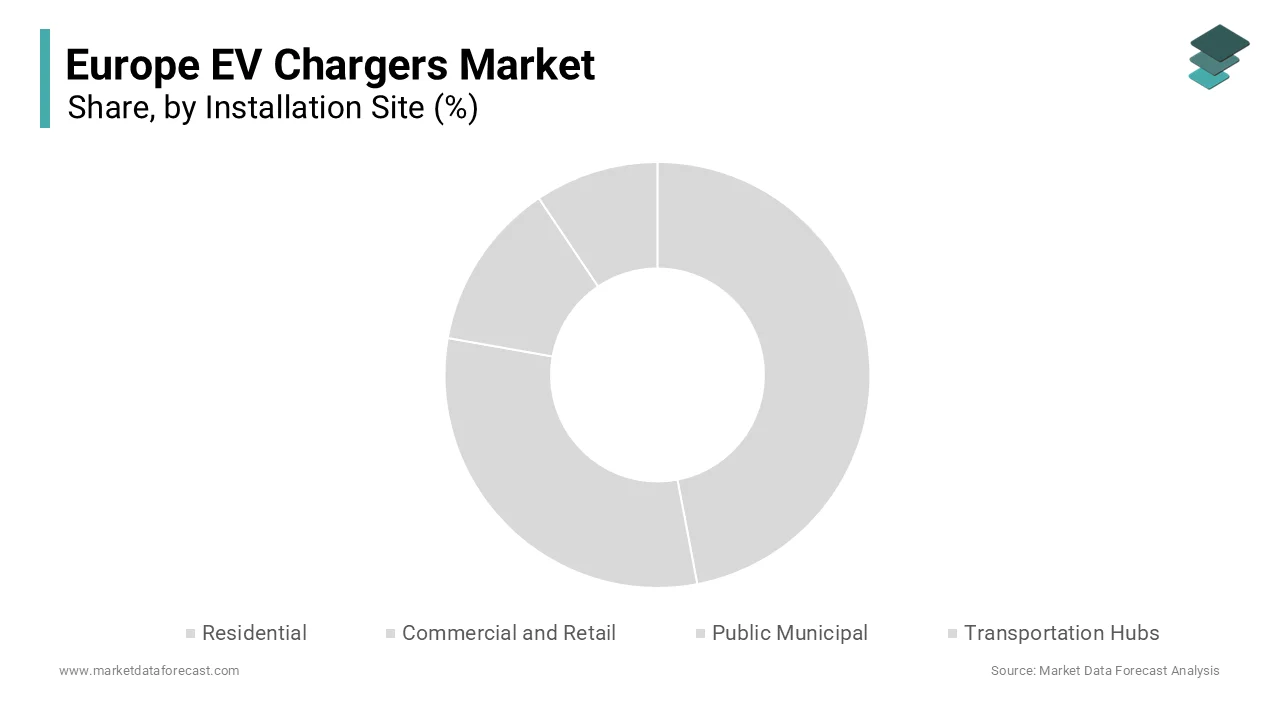
The transportation hubs segment is likely to experience the fastest CAGR of 28.7% during the forecast period owing to the integration of EV charging into multimodal mobility strategies and the need to serve ride hailing, taxi, and rental fleets. European transport strategies are encouraging the integration of electric vehicle charging at multimodal hubs, leading to new building regulations that require larger parking facilities at transit stations to provide accessible charging points. Leading international airports are significantly expanding their high-power charging capacity to support the complete electrification of ground operations and commercial transport services. Similarly, Germany’s national railway operator is installing rapid-charging stations at key metropolitan rail hubs to better integrate train travel with electric road transport and shared mobility services. The automotive rental sector is steadily increasing the proportion of electric vehicles in its inventory, creating a growing requirement for high-availability charging infrastructure at major travel gateways. These hubs generate high utilization rates and premium revenue per session, attracting investment from operators like Shell Recharge and TotalEnergies. Cities are increasingly restricting internal combustion vehicles in their central zones. Consequently, transportation hubs have become critical nodes in seamless, zero-emission travel chains.
By Application Insights
The home application segment was the largest segment in the Europe EV chargers market and occupied a 48.5% share in 2025, as it aligns with the primary charging behavior of private EV owners who prefer convenient, low cost overnight replenishment. Most European drivers travel less than 50 kilometers daily, making 7 to 11 kW Level 2 home chargers sufficient for full battery recovery. Regional environmental and energy monitors observe that the vast majority of electric vehicle drivers in developed European markets prefer to charge their vehicles at their primary residence, citing logistical ease and lower energy costs as the main drivers for this behavior. National policies strongly support this trend. German federal development banks have historically utilized massive subsidy programs to incentivize the installation of private charging points, though recent funding rounds have been highly targeted and characterized by extremely rapid exhaustion of available resources. France continues to utilize large-scale financial aid programs to improve domestic energy efficiency, while separate, dedicated incentives are employed to specifically expand the network of personal vehicle charging units across the country. The EU’s Energy Performance of Buildings Directive further institutionalizes home charging by mandating EV ready infrastructure in all new residential constructions. Unlike public or workplace charging, home units avoid queueing, payment friction, and vandalism, offering a seamless user experience. This combination of behavioral preference, economic incentive, and regulatory mandate ensures home charging remains the cornerstone of Europe’s EV adoption strategy.
The fleet and depot charging segment is on the rise and is expected to be the fastest growing segment in the market by witnessing a CAGR of 35.2% over the forecast period. The swift acceleration is fuelled by corporate sustainability mandates, urban zero emission zones, and the electrification of commercial vehicle fleets. Corporate vehicle procurement is increasingly shifting toward electric models, largely encouraged by favorable tax policies and corporate commitments to reducing carbon footprints. Logistics giants are leading the shift. Major logistics providers are rapidly expanding their fleets of zero-emission delivery vehicles across Europe, supported by large-scale deployments of proprietary charging infrastructure at their regional distribution hubs. Similarly, as part of its long-term climate commitments, Amazon is investing heavily to transition its European delivery network to zero-emission vehicles and install necessary charging equipment at its logistics facilities. Municipalities are also electrifying public service fleets. European metropolitan areas are progressively replacing traditional diesel refuse collection fleets with fully electric models to reduce noise and local emissions in dense urban centres. These applications demand high power, high utilization, and smart load management to avoid grid penalties. As total cost of ownership for EVs becomes favorable and urban access restrictions tighten, fleet and depot charging emerges as the highest growth frontier in the market.
REGIONAL ANALYSIS
Germany EV Chargers Market Analysis
Germany was the top performer in the Europe EV chargers market and accounted for a 21.5% share in 2025. It continues to set the pace for infrastructure density across the continent. The German government has implemented an aggressive expansion strategy under its Masterplan Ladesäulen which aims to install one million public charging points by 2030 to support its booming electric mobility sector. Domestic automotive giants like Volkswagen and BMW are investing heavily in ultra fast charging networks to alleviate range anxiety among consumers. Recent data indicates that Germany added nearly 20,000 chargers in H1 2025. The integration of smart grid technologies allows for dynamic load management which is crucial as the number of electric vehicles on German roads surpasses two million units. This robust combination of state support and private sector innovation ensures that Germany remains the primary engine for market growth and technological standardization in Europe.
France EV Chargers Market Analysis
France was the next prominent country in the European EC chargers market and captured a 16.2% share in 2025. The growth of the French market is driven by a strong push toward equitable access with a specific focus on deploying chargers in rural areas and small towns to complement urban hubs. Paris has launched the Advenir program which provides substantial financial aid to businesses and condominiums for installing charging infrastructure thereby removing key barriers to entry. The country recently reported having over 115,000 public charging stations making it one of the few nations to double its network size. The government mandate requiring all parking lots with more than twenty spaces to include charging facilities has driven a surge in private sector investment. Major energy providers like EDF and TotalEnergies are collaborating to build high power charging corridors along major highways connecting France to its neighbors. Electric vehicle sales in France now represent over 20% of new car registrations which directly fuels the demand for reliable and fast charging solutions. This strategic alignment between legislative mandates and utility company investments creates a sustainable ecosystem for long term market expansion.
United Kingdom EV Chargers Market Analysis
The United Kingdom maintains a significant position in the European market. London serves as a global hub for fintech and energy innovation which has led to the rapid deployment of app based charging solutions and contactless payment systems across the nation. Private companies such as InstaVolt and Gridserve are leading the charge by installing ultra rapid chargers at service stations and retail parks without relying solely on public grants. Data shows that the UK has over 90,000 public connectors with a significant portion being rapid or ultra rapid devices capable of adding hundreds of miles of range in minutes. The rollout of the Local Electric Vehicle Infrastructure fund empowers local councils to address charging deserts in residential streets where off street parking is scarce. This unique blend of strict regulatory deadlines and vibrant private enterprise fosters a dynamic market environment that prioritizes speed and user experience.
Sweden EV Chargers Market Analysis
Sweden is moving ahead steadfastly in the European market due to the highest per capita adoption of electric vehicles in Europe which necessitates a dense and reliable charging network. The government has introduced generous tax deductions for individuals and companies installing charging points which has resulted in a massive proliferation of private and semi public chargers. Sweden is also at the forefront of electric road systems where trucks can charge while driving a technology that could revolutionize heavy transport logistics. Major utilities like Vattenfall are investing in battery storage solutions at charging stations to stabilize the grid during peak demand times. The cold climate conditions in Sweden have driven innovation in battery thermal management and heater equipped charging cables ensuring reliability year round. This focus on technological resilience and green energy alignment positions Sweden as a critical testbed for future European charging standards.
Italy EV Chargers Market Analysis
Italy is expected to be the most lucrative region in the European market during the forecast period. The Italian market is undergoing a significant transformation driven by the National Recovery and Resilience Plan which allocates billions of euros specifically for sustainable mobility infrastructure. Rome and Milan are leading the urban transition with low emission zones that restrict internal combustion engines and mandate the installation of chargers in public parking facilities. The geography of Italy with its long north south highway network has prompted a focused effort to deploy fast charging hubs along the Autostrada to facilitate cross country travel. Italian energy giant Enel X is a global player in smart charging services and leverages its domestic presence to offer vehicle to grid solutions that turn cars into mobile energy storage units. The rising cost of fossil fuels and strong consumer incentives for purchasing electric vehicles have created a perfect storm for infrastructure demand. This convergence of EU funding national strategy and corporate innovation ensures that Italy will remain a key driver of market volume in the Mediterranean region.
COMPETITIVE LANDSCAPE
The Europe EV chargers market features a dynamic competitive landscape shaped by technology leadership, regulatory alignment, and strategic partnerships rather than price alone. Global leaders like ABB, Siemens, and TotalEnergies dominate through end to end solutions that integrate hardware, software, and energy services. Competition centers on charging speed, uptime reliability, cybersecurity, and renewable integration. While Chinese manufacturers offer lower cost alternatives, they struggle with EU certification and service coverage. The market sees rapid consolidation as software capabilities become critical—vendors without smart charging or roaming platforms lose relevance. Regional strengths vary: Germany excels in industrial and depot charging, France leads in highway corridor deployment, and the Nordics pioneer vehicle to grid pilots. New entrants face high barriers due to type approval processes and grid interconnection complexities. However, opportunities exist in fleet electrification and smart residential systems. Overall, success depends on transforming chargers from passive devices into intelligent, sustainable nodes in Europe’s clean mobility ecosystem.
KEY MARKET PLAYERS
Some of the notable key players in the Europe EV chargers market are
- Pod Point Ltd.
- ABB Ltd.
- Mennekes Elektrotechnik GmbH & Co. KG
- Silicon Laboratories, Inc.
- Innogy SE
- Schaffner Holding AG
- Robert Bosch GmbH
- KEBA AG
- Chroma ATE Inc.
- Chargemaster PLC
- Siemens AG
Top Players in the Market
- ABB E-mobility is a global leader in electric vehicle charging infrastructure with a dominant presence in the Europe EV chargers market. Headquartered in Switzerland, the company supplies a full portfolio of AC wallboxes, DC fast chargers, and ultra high power megawatt systems for public, commercial, and fleet applications. ABB contributes significantly to global standards through its role in developing IEC 61851 and ISO 15118 protocols. In Europe, ABB powers major networks including Ionity and Fastned. It also expanded its smart charging platform to integrate with European grid operators for demand response, reinforcing its position as a provider of intelligent, grid compatible charging solutions.
- Siemens Smart Infrastructure is a key European player in EV charging, offering integrated solutions from residential wallboxes to high power depot systems for commercial fleets. The company leverages its deep expertise in energy management and building automation to embed chargers within holistic electrification ecosystems. In Europe, Siemens supplies charging infrastructure for corporate campuses, public transport depots, and municipal fleets. The company also partnered with German housing cooperatives to deploy shared charging systems in apartment complexes, addressing urban accessibility challenges. These initiatives strengthen Siemens’ role as an enabler of equitable, secure, and scalable EV adoption across the continent.
- TotalEnergies has rapidly emerged as a major force in the Europe EV chargers market by transforming its extensive fuel station network into multi energy hubs. The French energy giant operates over 40,000 public charging points across Europe, including 3,500 high power DC fast chargers along major highways. TotalEnergies contributes globally by advocating for interoperable payment systems and renewable powered charging. It also launched a pan European roaming agreement with several operators to enable seamless plug and charge access. By integrating EV charging into its broader energy transition strategy, TotalEnergies positions itself as a one stop mobility provider, bridging fossil fuel legacy with zero emission future.
Top Strategies Used by the Key Market Participants
Key players in the Europe EV chargers market prioritize compliance with EU interoperability standards like ISO 15118 and Open Charge Point Protocol to ensure seamless cross network access. They invest in ultra fast and megawatt class charging technologies to support long distance travel and commercial fleet operations. Companies integrate smart charging and vehicle to grid capabilities to enable grid balancing and dynamic tariff optimization. Strategic partnerships with automakers, utilities, and real estate developers accelerate deployment in residential and workplace settings. Emphasis on cybersecurity through secure boot, encrypted communications, and NIS2 compliance builds user trust. Expansion of renewable powered charging sites aligns with corporate sustainability goals and EU Green Deal objectives. These strategies collectively address the dual imperatives of user convenience and grid resilience in a rapidly scaling market.
MARKET SEGMENTATION
This research report on the European EV chargers market has been segmented and sub-segmented based on categories.
By Charging Level
- Level 1
- Level 2
- DC Fast
- Ultra Fast
- Megawatt Class
By Installation Site
- Residential
- Commercial and Retail
- Public Municipal
- Transportation Hubs
By Application
- Home
- Workplace
- Public Urban
- Highway Corridor or En Route
- Fleet and Depot
By Country
- UK
- France
- Spain
- Germany
- Italy
- Russia
- Sweden
- Denmark
- Switzerland
- Netherlands
- Turkey
- Czech Republic
- Rest of Europe
Frequently Asked Questions
1. What is the Europe EV chargers market?
The Europe EV chargers market refers to the manufacturing, installation, and operation of electric vehicle charging infrastructure across residential, commercial, and public locations in European countries.
2. What are EV chargers?
EV chargers are devices that supply electric energy to recharge the batteries of electric vehicles, including battery electric vehicles and plug in hybrid electric vehicles.
3. What are the main types of EV chargers available in Europe?
The primary types include AC chargers for home and workplace use, DC fast chargers for public and highway charging, and ultra fast charging stations.
4. What factors are driving growth in the Europe EV chargers market?
Growth is driven by increasing electric vehicle adoption, supportive government incentives, strict emission regulations, expansion of public charging networks, and investments in sustainable mobility.
5. Which countries lead the Europe EV chargers market?
Germany, the Netherlands, France, Norway, and the United Kingdom are leading markets due to strong EV penetration and supportive policy frameworks.
6. What role do government policies play in market expansion?
European Union climate targets, subsidies for EV purchases, and funding for charging infrastructure development significantly accelerate charger deployment.
7. What are the key applications of EV chargers?
EV chargers are installed in residential buildings, commercial spaces, public parking areas, highways, fleet depots, and retail locations.
8. What challenges does the Europe EV chargers market face?
Challenges include high installation costs, grid capacity constraints, interoperability issues, and uneven distribution of charging infrastructure across regions.
9. Who are the key players in the Europe EV chargers market?
Major companies include ABB, Siemens, Schneider Electric, Alfen, Wallbox, EVBox, and other infrastructure providers.
10. What is the future outlook for the Europe EV chargers market?
The market is expected to grow rapidly due to accelerating EV adoption, expansion of ultra fast charging networks, technological innovation, and strong regulatory support for carbon neutrality goals.
Related Reports
Access the study in MULTIPLE FORMATS
Purchase options starting from
$ 2000
Didn’t find what you’re looking for?
TALK TO OUR ANALYST TEAM
Need something within your budget?
NO WORRIES! WE GOT YOU COVERED!
Call us on: +1 888 702 9696 (U.S Toll Free)
Write to us: sales@marketdataforecast.com