Europe EV Battery Recycling Market Size, Share, Trends & Growth Forecast Report, Segmented By Vehicle Type, Type, Process, And By Country (UK, France, Spain, Germany, Italy, Russia, Sweden, Denmark, Switzerland, Netherlands, Turkey, Czech Republic & Rest of Europe), Industry Analysis From 2026 to 2034
Market Size, 2025
$215.25 MnMarket Estimate, 2026
$259.07 MnMarket Forecast, 2034
$968.79 MnCAGR, 2026–2034
20.34%Europe EV Battery Recycling Market Report Summary
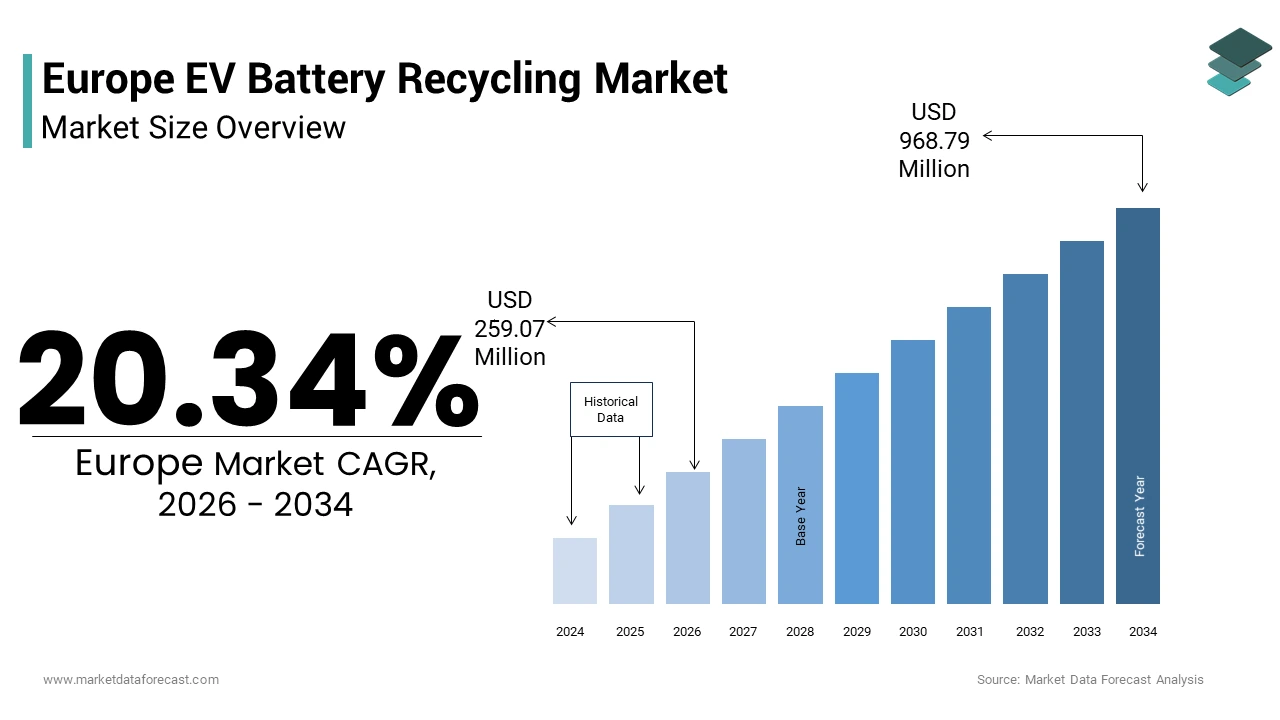
The European EV battery recycling market was valued at USD 215.25 million in 2025, is estimated to reach USD 259.07 million in 2026, and is projected to reach USD 968.79 million by 2034, growing at a CAGR of 20.34% during the forecast period from 2026 to 2034. The rapid growth of the market is driven by the accelerating adoption of electric vehicles, rising volumes of end-of-life batteries, and stringent EU regulations on battery waste management and circular economy practices. Increasing investments in green mobility, critical raw material recovery, and closed-loop battery supply chains are further strengthening the market outlook across Europe.
Key Market Trends
- Rising EV penetration across Europe is increasing the volume of spent lithium-ion batteries requiring safe disposal and recovery.
- Strong regulatory push under the EU Battery Regulation is mandating higher recycling efficiency and traceability.
- Growing demand for recovered lithium, cobalt, and nickel to reduce reliance on imported raw materials.
- Expansion of hydrometallurgical and direct recycling technologies for higher metal recovery rates.
- Integration of recycling into vertically aligned EV and battery manufacturing value chains.
Segmental Insights
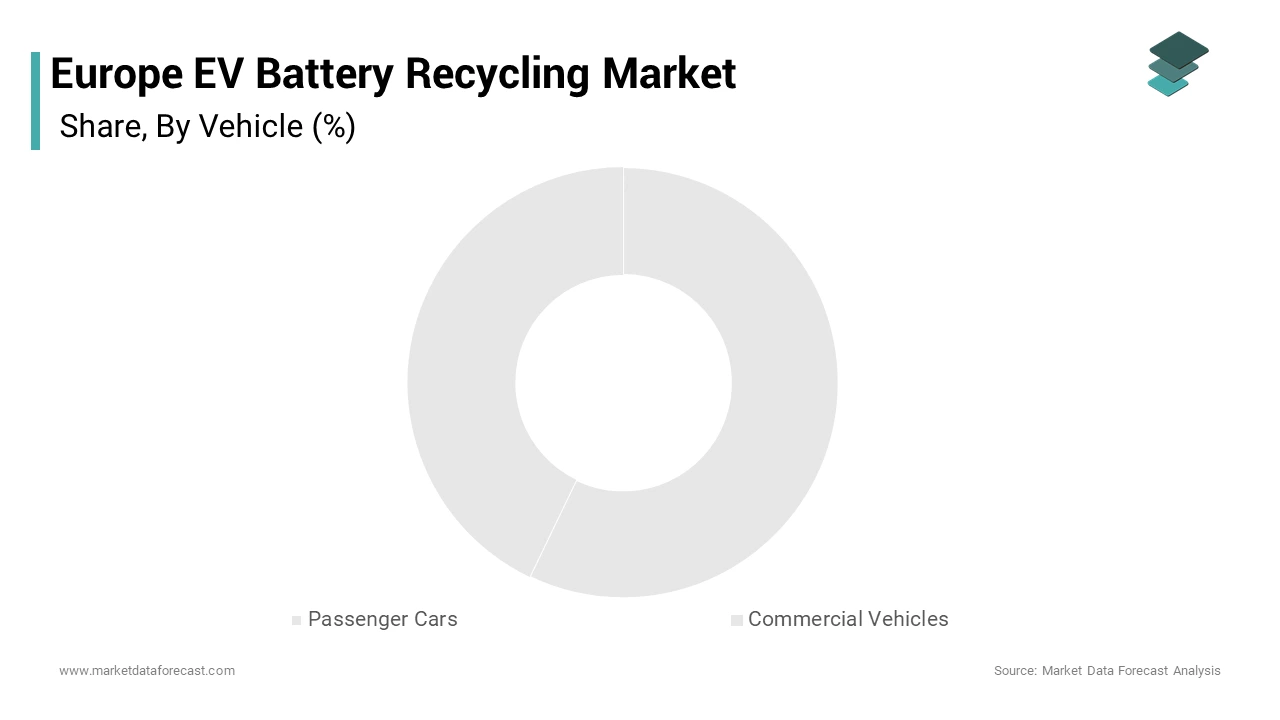
- Based on vehicle type, the passenger cars segment was the largest and held a dominant share of the European EV battery recycling market in 2024, supported by the rapid growth of electric passenger vehicles across the region.
- Based on battery type and recycling process, the lithium-ion batteries segment accounted for the largest share of the market in 2024 due to their widespread use in electric vehicles and the high recovery value of critical metals.
Regional Insights
- Germany led the European EV battery recycling market by accounting for 28.4% of the regional share in 2024, driven by its strong automotive ecosystem, EV production base, and sustainability mandates.
France followed as the second-largest market with 17.6% share, supported by national battery recycling initiatives and EV adoption. - Belgium is expected to grow at the fastest CAGR during the forecast period due to its advanced recycling infrastructure and logistics connectivity.
- Sweden’s growth is driven by its vertically integrated green battery value chain and strong clean energy policies.
- The United Kingdom is also emerging as a key market, supported by its automotive engineering capabilities and evolving post-Brexit regulatory framework.
Competitive Landscape
The European EV battery recycling market is moderately consolidated, with leading players focusing on advanced recycling technologies, strategic partnerships with EV manufacturers, and capacity expansions across the region. Companies are investing heavily in hydrometallurgical and closed-loop recycling solutions to meet regulatory standards and secure critical materials.
Prominent players in the European EV battery recycling market include Umicore NV/SA, Neometals Ltd., Li-Cycle Corp., Recyclico Battery Materials Inc., Accurec-recycling GmbH, Fortum, Cirba Solutions, CATL, Ecobat, Shenzhen Highpower Technology, Redwood Materials, GEM Co., Ascend Elements, BatX Energies, Glencore, Ace Green Recycling, Primobius GmbH, Attero Recycling, Trishulavel Eshan (Li-circle), and Eramet.
Europe EV Battery Recycling Market Size
Europe EV battery recycling market was valued at USD 215.25 million in 2025 and is anticipated to reach USD 259.07 million in 2026 to USD 968.79 million by 2034, growing at a CAGR of 20.34% during the forecast period from 2026 to 2034.
Current Introduction of the Europe EV Battery Recycling Market Report
The EV battery recycling is the collection logistics dismantling and material recovery processes applied to end-of-life traction batteries from electric passenger vehicles light commercial vehicles and two wheelers. Unlike conventional lead acid recycling, this sector focuses on lithium ion chemistries, primarily nickel manganese cobalt (NMC) and lithium iron phosphate (LFP) requiring advanced hydrometallurgical or direct recycling techniques to recover raw materials, such as lithium cobalt nickel and graphite. According to the European Environment Agency over 1.2 million electric vehicles reached end of life in the European Union between 2020 and 2023 with battery volumes projected to exceed 700000 metric tons annually by 2030. As per the European Commission’s Battery Regulation, adopted in 2023 all new EV batteries placed on the EU market from 2027 must declare aminimum recycled content, 16% for cobalt, 6% for lithium, and 6% for nickel, which shall create a regulatory imperative for closed loop supply chains. The emergence of environmental mandate resource security and industrial policy positions EV battery recycling not as a waste management activity but as a foundational pillar of Europe’s clean tech sovereignty.
MARKET DRIVERS
EU Battery Regulation Mandates Minimum Recycled Content Driving Industrial Scale Recycling
The European Union’s landmark Battery Regulation adopted in 2023 for industrial scale EV battery recycling by legally requiring minimum recycled material content in new batteries is solely prompting the growth of Europe EV battery recycling market. According to the regulation, all electric vehicle batteries placed on the EU market from 2027 must contain at least 16% recycled cobalt 6% recycled lithium and 6% recycled nickel with thresholds rising to 26% 10% and 15% respectively by 2031. This creates a guaranteed offtake for high purity recycled salts and metals directly linking recycling output to new battery production. As per the European Commission’s, impact assessment over 850000 metric tons of lithium ion batteries will reach end of life annually by 2030. Automotive giants like BMW and Stellantis have already signed long term offtake agreements with recyclers, such as Northvolt and Umicore to secure compliant materials.
Strategic Imperative to Reduce Reliance on Imported Critical Raw Materials
Europe’s acute dependency on extra EU sources for battery metals has elevated EV battery recycling to a matter of industrial and geopolitical security, which is additional factor elevating the growth of Europe EV battery recycling market. According to Eurostat, the European Union imported 87% of its lithium, 63% of its cobalt, and 58% of its nickel in 2023, with the majority originating from Chile Democratic Republic of Congo and Indonesia, where regions marked by supply chain opacity and environmental governance concerns. The European Commission’s 2023 Critical Raw Materials Act identifies lithium cobalt and nickel as strategic materials and sets a target for 15% of EU consumption to be met by domestic recycling by 2030. According to research, European banks have support for five large scale battery recycling plants, across Germany, France, and Poland. This resource sovereignty agenda ensures sustained public and private investment in recycling infrastructure as a buffer against trade disruptions and price volatility in global mineral markets.
MARKET RESTRAINTS
Limited Availability of End of Life Batteries Delays Economies of Scale
The structural supply chains due to the long operational lifespan of electric vehicle batteries and the recent surge in EV adoption are majorly declining the growth of Europe EV battery recycling market. According to the European Environment Agency, the average electric vehicle remains in service for 12 to 15 years meaning the first major wave of end of life batteries will not peak until 2030–2035. In 2023, only 42000 metric tons of EV batteries reached recyclers across the EU, far below the 150000 ton annual capacity of existing and announced facilities, as per Circular Energy Storage data. This mismatch forces recyclers to rely on production scrap and defective cells which account for 60% of current feedstock but lack the scale and consistency of true end of life streams. As a result, many recycling plants operate below 40% capacity increasing per ton processing costs and delaying profitability. A 2023 study by the Fraunhofer Institute found that without secondary feedstock from energy storage systems or policy mandated early collection schemes most recyclers cannot achieve cost breakeven before 2028. This supply lag constrains investment returns and slows technological maturation despite strong regulatory tailwinds.
High Capital and Operational Complexity of Advanced Recycling Technologies
The deployment of efficient and compliant is hindered by the significant capital intensity and technical sophistication required for modern hydrometallurgical and direct recycling processes. The high capital and operational complexity of advanced recycling technologies is impeding the growth of Europe EV battery recycling market. According to the research, establishing a 20000 metric ton per year hydrometallurgical plant requires upfront investment of 180 to 250 million euros with additional 30 to 50 million euros for environmental permitting and waste handling infrastructure. These facilities must manage complex chemical flows including acid leaching solvent extraction and precipitation under strict Industrial Emissions Directive controls, which is requiring specialized engineering teams and continuous emissions monitoring. As per Germany’s Federal Environment Agency, denied permits for two proposed recycling plants due to inadequate wastewater treatment plans for lithium and fluoride residues. Moreover, the variability in battery chemistries formats and state of health demands flexible and robust preprocessing lines capable of safe discharge mechanical shredding and black mass separation with a capability few operators possess.
MARKET OPPORTUNITIES
Integration of Recycling into Battery Passport and Digital Traceability Frameworks
The upcoming EU Battery Passport system to institutionalize traceability and optimize recycling logistics, across the battery value chain is ascribed to set up new opportunities for the growth of Europe EV battery recycling market. According to the European Commission, every EV battery placed on the market from 2026, must carry a digital passport containing verified data on material composition carbon footprint and end of life instructions. This standardized digital identity enables recyclers to pre-sort batteries by chemistry state of health and disassembly requirements, thereby reducing preprocessing costs by up to 25%, as demonstrated in a 2023 pilot by Northvolt and Volvo. The passport also links to national collection registries ensuring that batteries are diverted from landfills and routed to certified recyclers. In France, the national battery registry already tracks over 380000 EV batteries in real time allowing recyclers like Verkor to forecast feedstock volumes and plan capacity. This digital infrastructure will turn recycling from a reactive waste operation into a predictive and integrated supply chain function.
Repurposing of Second Life Batteries for Stationary Energy Storage Creates Hybrid Value Chains
The growing deployment of second life EV batteries in stationary energy storage systems is creating a dual pathway that extends battery utility and enhances recycling economics. This factor is additionally to enhance the growth of Europe EV battery recycling market. According to the European Battery Alliance, over 40% of retired EV batteries still retain 70 to 80% of their original capacity sufficient for less demanding applications like grid balancing or backup power. In 2023, BMW and Bosch launched a 20 megawatt hour second life storage project in Hamburg using modules from i3 vehicles, while Nissan deployed 1000 repurposed Leaf batteries in UK social housing complexes for solar energy buffering. These applications delay entry into recycling by 5 to 8 years but generate additional revenue that subsidizes eventual recycling costs. The European Commission’s Battery Regulation permits second life use without compromising future recyclability provided modules are tracked via the battery passport. Recycling firms like Li Cycle, now offer integrated “collect repurpose and recycle” services capturing value across the entire lifecycle.
MARKET CHALLENGES
Lack of Standardized Collection and Logistics Infrastructure Across Member States
The fragmented and underdeveloped collection networks that impede efficient feedstock aggregation is one of the challenges for the growth of Europe EV battery recycling market. According to the European Environment Agency, only 14 member states have established dedicated take back systems for EV batteries as of 2023 with the remainder relying on ad hoc arrangements between automakers dismantlers and waste handlers. In Eastern Europe, collection rates remain below 30% due to limited certified treatment facilities and unclear producer responsibility enforcement. Germany mandates that all vehicle dismantlers hold a 11 KrW/AbfG permit for battery handling but neighboring Poland has no equivalent requirement creating compliance gaps.
Technological Uncertainty in Lithium Recovery Efficiency and Purity Standards
The persistent technical and regulatory ambiguity around lithium recovery is also inhibiting the growth of Europe EV battery recycling market. According to Circular Energy Storage, only 35% of lithium in EU recycled batteries was recovered in 2023 due to losses in slag during pyrometallurgy and incomplete precipitation in hydrometallurgical flowsheets. Moreover, the European Commission has not yet defined purity thresholds for recycled lithium salts eligible for battery grade reuse creating market uncertainty. Battery manufacturers like CATL and LG Energy Solution require lithium carbonate with purity exceeding 99.995% but most European recyclers produce 99.5% grade suitable only for ceramics or lubricants. In 2023, Umicore invested 70 million euros in a new lithium refining unit in Belgium to bridge this gap but scalability remains unproven.
REPORT COVERAGE
| REPORT METRIC | DETAILS |
| Market Size Available | 2025 to 2034 |
| Base Year | 2025 |
| Forecast Period | 2026 to 2034 |
| CAGR | 20.34% |
| Segments Covered | By Vehicle Type, Type, Process, and Region. |
| Various Analyses Covered | Global, Regional, and Country Level Analysis, Segment-Level Analysis, DROC, PESTLE Analysis, Porter’s Five Forces Analysis, Competitive Landscape, Analyst Overview of Investment Opportunities |
| Regions Covered | UK, France, Spain, Germany, Italy, Russia, Sweden, Denmark, Switzerland, Netherlands, Turkey, Czech Republic, c & Rest of Europe |
| Market Leaders Profiled | Umicore NV/SA (Belgium), Neometals Ltd. (Australia), Li-Cycle Corp. (Canada), Recyclico Battery Materials Inc. (Canada), Accurec-recycling GmbH (Germany), Fortum (Finland), Cirba Solutions (U.S.), Contemporary Amperex Technology Co., Limited (CATL) (China), Ecobat (U.S.), Shenzhen Highpower Technology Co., Ltd. (China), Redwood Materials Inc. (U.S.), Gem Co., Ltd. (China), Ascend Elements, Inc. (U.S.), BatX Energies (India), Glencore (Switzerland), Ace Green Recycling (U.S.), Primobius GmbH (Germany), Attero Recycling Pvt. Ltd. (India), Trishulavel Eshan Pvt. Ltd. (Li-circle) (India), Eramet (France) |
SEGMENTAL ANALYSIS
By Vehicle Insights
The passenger cars segment was the largest by holding a dominant share of the Europe EV battery recycling market in 2024 with the composition of Europe’s electric vehicle fleet, where passenger cars represent over 92% of all EVs registered since 2015. According to Eurostat, 2.6 million battery electric passenger vehicles were newly registered in the EU in 2023 alone compared to just 180000 electric light commercial vehicles. Automakers, such as Volkswagen, Renault, and Stellantis, have deployed take back systems exclusively for passenger car batteries through their dealer networks facilitating streamlined collection once vehicles reach end of life. Additionally, most early EV models like the Nissan Leaf and BMW i3 used standardized NMC or LFP packs that are now entering the recycling pipeline in predictable volumes. In Germany, the Federal Motor Transport Authority reported that 380000 electric passenger cars reached 10 years of age in 2023 triggering mandatory battery health assessments and initiating recycling pathways.
The commercial vehicle segment is expected to grow at a fastest CAGR of 18.3% from 2025 to 2033 owing to the rapid electrification of urban logistics and public transport fleets under EU clean mobility mandates. The European Commission required all new city buses to be zero emission by 2025 and all new medium and heavy duty vehicles to cut CO2 emissions by 45% by 2030, policies that have driven over 42000 electric delivery vans and 8500 electric buses onto European roads in 2023 alone. These vehicles use significantly larger battery packs, typically 100 to 400 kilowatt hours compared to 60 to 100 kilowatt hours in passenger cars meaning each unit contributes disproportionately to future recycling volumes. DHL’s StreetScooter fleet in Germany and Amazon’s Rivian vans in the UK are already establishing dedicated battery return protocols with recyclers like Li Cycle. Moreover, commercial operators prioritize battery repurposing for stationary storage due to predictable duty cycles enhancing residual value. As per the International Energy Agency, commercial EV battery volumes are expected to grow sevenfold by 2030 making this segment the highest growth frontier despite its current modest base.
By Battery Type and Recycling Process Insights
The lithium ion batteries segment was the largest by holding a significant share of the Europe EV battery recycling market in 2024. This near universal adoption reflects the EU’s exclusive use of lithium-ion chemistries in all new electric vehicles since 2012 due to their high energy density long cycle life and declining costs. Lead acid and nickel metal hydride batteries are confined to legacy hybrids and auxiliary systems and are excluded from EV traction battery recycling streams. Within lithium ion NMC (nickel manganese cobalt) remains the most prevalent chemistry in European EVs accounting for 72% of packs in circulation as per the European Battery Alliance’s 2023 material flow analysis. Automakers like BMW, Mercedes, and Volvo, standardized on NMC for its power and energy balance while LFP adoption is rising in entry level models from Tesla and Renault. This technological and regulatory alignment ensures lithium ion will remain the sole focus of Europe’s EV battery recycling infrastructure for the foreseeable future.
The hydrometallurgical recycling segment was the largest by holding a dominant share of the Europe EV battery recycling market in 2024 owing to its superior lithium recovery rates typically 85 to 95% compared to less than 40% in pyrometallurgy and compliance with the EU’s strict environmental permitting standards. Unlike high temperature smelting hydrometallurgy operates at ambient to moderate temperatures using aqueous chemistry to selectively leach and precipitate high purity salts suitable for direct cathode precursor synthesis. Umicore’s Hoboken plant in Belgium and Northvolt’s Revolt facility in Sweden both use proprietary hydrometallurgical flowsheets to produce battery grade nickel sulfate and lithium carbonate with purity exceeding 99.95%. The European Commission’s Industrial Emissions Directive classifies pyrometallurgical off gases as hazardous requiring costly scrubbing systems whereas hydrometallurgical effluents can be treated in standard industrial wastewater plants.
The hydrometallurgical segment is also projected to expand at a CAGR of 22.1% throughout the forecast period owing to the policy alignment technological maturity and offtake agreements with battery cell producers. The European Commission approved 1.8 billion euros in public funding for five large scale hydrometallurgical plants under the Important Project of Common European Interest framework. Li Cycle’s Spoke and Hub model, deploying smaller shredding facilities (Spokes) near collection points and centralized hydrometallurgical refineries (Hubs), which is being replicated across Germany, France, and Poland to minimize transport emissions. Moreover, battery giants like ACC and Verkor have signed 10 year offtake contracts for recycled nickel sulfate and lithium carbonate exclusively from hydrometallurgical sources to meet EU recycled content rules. A 2023 Fraunhofer study confirmed that hydrometallurgical recycling emits 45% less CO2 per kilogram of recovered material than pyrometallurgy making it compatible with the EU’s Carbon Border Adjustment Mechanism. These regulatory economic and environmental advantages position hydrometallurgy as the unchallenged engine of Europe’s circular battery economy.
COUNTRY ANALYSIS
Germany EV Battery Recycling Market Analysis
Germany was the top performer of the Europe EV battery recycling market by capturing 28.4% of share in 2024 owing to its position as Europe’s top automotive producer and early adopter of electric mobility. According to the Federal Motor Transport Authority, over 1.1 million battery electric vehicles were registered in Germany by the end of 2023 creating the continent’s largest pipeline of future end of life batteries. The country hosts flagship recycling facilities including Umicore’s Hoboken adjacent operations and BASF’s pilot plant in Schwarzheide which recover high purity metals for domestic battery cell production. Germany’s Battery Act 2023 mandates that all EV manufacturers establish take back systems and achieve 95% recovery rates for cobalt nickel and copper requirements that have spurred partnerships between BMW Volkswagen and recyclers. The Federal Ministry for Economic Affairs and Climate Action allocated 620 million euros in 2023 under its Battery Innovation Initiative to scale hydrometallurgical capacity. This combination of industrial scale regulatory enforcement and public investment ensures Germany’s continued leadership in the recycling value chain.
France EV Battery Recycling Market Analysis
France EV battery recycling market was ranked second by holding 17.6% of share in 2024 with its integrated national strategy linking mining refining and recycling, under the France 2030 investment plan. The government has mandated that all new EV batteries sold from 2027 contain a minimum of 15% recycled content by exceeding EU requirements and established a national battery registry to track units from sale to recycling. Verkor’s recycling plant in Dunkirk will process 20000 metric tons annually using hydrometallurgy to supply its adjacent cell factory. Additionally, France hosts the European Battery Alliance’s recycling task force which coordinates R&D on direct recycling methods. The French Environment and Energy Management Agency funded 12 recycling startups in 2023 through its ADEME program.
Belgium EV Battery Recycling Market Analysis
Belgium EV battery recycling market is esteemed to grow at a fastest CAGR during the forecast period due to its role as Europe’s recycling technology and logistics hub. According to the Belgian Federal Public Service Economy, over 120000 metric tons of EV batteries passed through Antwerp and Zeebrugge ports in 2023 for processing or transshipment. The country’s central location allows it to serve German French and Dutch automakers under 500 kilometers. Belgium’s Waste Electrical and Electronic Equipment directive mandates extended producer responsibility with financial guarantees for battery collection ensuring consistent feedstock. The Flemish government approved a 180 million euro subsidy for a second recycling line at Umicore to meet EU recycled content targets.
Sweden EV Battery Recycling Market Analysis
Sweden EV battery recycling market growth is driven by its integration of recycling into a vertically aligned green battery value chain. According to the Swedish Energy Agency, the country aims to produce 150 gigawatt hours of battery cells annually by 2030 using fossil free electricity from hydropower. Northvolt’s Revolt recycling plant in Skelleftea, where the world’s first integrated “cell to cell” recycling facility processes 100000 electric vehicle batteries, per year using hydrometallurgy to recover materials directly fed into adjacent cathode production. Volvo and Polestar have committed to using 50% recycled content in all new batteries by 2025. Sweden’s Environmental Protection Agency enforces some of the EU’s strictest lithium recovery standards requiring recyclers to achieve minimum 80% efficiency.
United Kingdom EV Battery Recycling Market Analysis
The United Kingdom EV battery recycling market growth is expected to grow with its advanced automotive engineering base and post Brexit regulatory autonomy. The UK’s Environment Agency implemented its own Battery Regulations in 2023 mirroring EU recycled content mandates and requiring all producers to register take back schemes. Britishvolt’s planned gigafactory in Blyth includes an integrated recycling unit while startup ACE Green Recycling launched Europe’s first zero emission hydrometallurgical pilot in Essex in 2023. The UK Research and Innovation agency awarded 75 million pounds in 2023 for battery recycling projects under the Faraday Battery Challenge.
COMPETITIVE LANDSCAPE
Competition in the Europe EV battery recycling market is highly concentrated among a handful of technologically advanced and strategically integrated players backed by significant public and private capital. Incumbents like Umicore and emerging leaders like Northvolt dominate due to their closed loop models where recycled materials feed directly into European gigafactories under regulatory mandates. The market is characterized by high entry barriers including capital intensity permitting complexity and the need for offtake agreements with battery producers. While pyrometallurgical players like Glencore maintain niche roles most new investment flows into hydrometallurgical and direct recycling due to superior lithium recovery and lower emissions. Competition is less about price and more about material purity traceability and alignment with EU sustainability criteria. Startups such as ACE Green and RecycLiCo are gaining traction through innovative chemistries but lack scale.
KEY MARKET PLAYERS
A few of the market players in the Europe EV battery recycling market are
- Umicore NV/SA (Belgium)
- Neometals Ltd. (Australia)
- Li-Cycle Corp. (Canada)
- Northvolt AB
- Recyclico Battery Materials Inc. (Canada)
- Accurec-recycling GmbH (Germany)
- Fortum (Finland)
- Cirba Solutions (U.S.)
- Contemporary Amperex Technology Co., Limited (CATL) (China)
- Ecobat (U.S.)
- Shenzhen Highpower Technology Co., Ltd. (China)
- Redwood Materials Inc. (U.S.)
- Gem Co., Ltd. (China)
- Ascend Elements, Inc. (U.S.)
- BatX Energies (India)
- Glencore (Switzerland)
- Ace Green Recycling (U.S.)
- Primobius GmbH (Germany)
- Attero Recycling Pvt. Ltd. (India)
- Trishulavel Eshan Pvt. Ltd. (Li-circle) (India)
- Eramet (France)
Top Players In The Market
- Umicore SA/NV is a Belgium headquartered global materials technology and recycling leader with the most advanced EV battery recycling operations in Europe. The company’s Hoboken facility in Antwerp employs a proprietary hydrometallurgical process to recover over 95% of cobalt nickel and copper and 85% of lithium from end-of-life batteries at battery grade purity. Umicore supplies recovered metals directly to major cathode and cell manufacturers including CATL and Northvolt under long term offtake agreements aligned with EU recycled content rules. In 2024 Umicore commissioned a new lithium refining line capable of producing 7000 metric tons of lithium carbonate annually to meet rising demand from European gigafactories. It also expanded its take back network to cover all 27 EU member states through partnerships with automotive dismantlers and logistics providers.
- Northvolt AB is a Sweden based battery innovator that has integrated recycling into its core manufacturing strategy through its Revolt initiative. The company operates Europe’s first industrial scale “cell to cell” recycling plant in Skelleftea which processes black mass from end of life EV batteries and production scrap to produce new cathode active material with up to 50% recycled content. Northvolt supplies this material to its own gigafactories and automotive partners including Volvo BMW and Volkswagen who require certified circular inputs to comply with the EU Battery Regulation. Northvolt launched a digital battery passport system in collaboration with Volvo to track material flows from recycling to new cell production.
- Li Cycle Holdings Corp is a Canada headquartered recycler with a significant European footprint through its Spoke and Hub model adapted to EU logistics and regulatory requirements. The company operates Spoke facilities for safe battery discharge and shredding in Germany and the Netherlands with processed black mass shipped to its central Hub for hydrometallurgical refining. Li Cycle’s technology achieves over 95% recovery of metals and has received certification under the EU Battery Regulation’s recycling efficiency criteria. Li Cycle signed offtake agreements with three European battery cell producers to supply nickel sulfate and lithium carbonate from its upcoming European Hub. It also partnered with DHL and Amazon to establish reverse logistics channels for commercial EV batteries across urban centers. These strategic collaborations ensure feedstock security and market access in Europe’s rapidly scaling circular battery economy.
Top Strategies Used by the Key Market Participants
Key players in the Europe EV battery recycling market focus on vertical integration by linking recycling output directly to cathode and cell production through long term offtake agreements. They invest in hydrometallurgical technologies to achieve high lithium recovery rates and battery grade purity required under the EU Battery Regulation. Companies expand collection networks through partnerships with automakers logistics firms and certified dismantlers to secure consistent feedstock. Strategic alignment with national battery passport and digital traceability systems enables material verification and compliance.
MARKET SEGMENTATION
This research report on the Europe EV battery recycling market is segmented and sub-segmented into the following categories.
By Vehicle Type
- Passenger Cars
- Commercial Vehicles
By Type
- Lithium-ion
- Lead Acid
- Nickel
- Others
By Process
- Pyrometallurgical
- Hydrometallurgical
By Country
- UK
- France
- Spain
- Germany
- Italy
- Russia
- Sweden
- Denmark
- Switzerland
- Netherlands
- Turkey
- Czech Republic
- Rest of Europe
Frequently Asked Questions
What is the Europe EV battery recycling market?
The Europe EV battery recycling market involves processes to collect, dismantle, and recover valuable materials from electric vehicle batteries for reuse and sustainable waste management.
Why is the EV battery recycling market growing in Europe?
Growth is driven by rapid EV adoption, regulatory mandates for battery waste management, sustainability goals, and rising demand for recovered materials like lithium and cobalt.
What materials are recovered through EV battery recycling?
Key materials include lithium, cobalt, nickel, manganese, copper, and aluminum that can be reused in new batteries or industrial applications.
Which technologies are used in EV battery recycling?
Common technologies include pyrometallurgical, hydrometallurgical, and direct recycling methods that extract and refine battery materials.
What are the benefits of EV battery recycling?
Benefits include reduced reliance on virgin raw materials, lower environmental impact, decreased landfill waste, and enhanced circular economy practices.
How do regulations impact the Europe EV battery recycling market?
EU regulations require producer responsibility, safe disposal practices, recycling targets, and sustainable materials recovery, accelerating industry investment.
Which countries lead the Europe EV battery recycling market?
Germany, France, the Netherlands, Belgium, and Sweden are key markets due to EV growth, advanced recycling infrastructure, and supportive policies.
What role does sustainability play in EV battery recycling?
Sustainability drives recycling to minimize environmental pollution, conserve resources, and meet Europe’s climate and circular economy goals.
What challenges does the EV battery recycling market face?
Challenges include high processing costs, technological limitations, collection infrastructure gaps, fluctuating raw material prices, and safety concerns.
How does EV battery recycling support the circular economy?
Recycling recovers critical metals for reuse in manufacturing, reducing extraction impacts and closing material loops within the EV supply chain.
Related Reports
Access the study in MULTIPLE FORMATS
Purchase options starting from
$ 2000
Didn’t find what you’re looking for?
TALK TO OUR ANALYST TEAM
Need something within your budget?
NO WORRIES! WE GOT YOU COVERED!
Call us on: +1 888 702 9696 (U.S Toll Free)
Write to us: sales@marketdataforecast.com