Global Electric Vehicle Battery Recycling Market Size, Share, Trends and Growth Forecasts Report, Segmented By Application (Electric Cars, Electric Busses, Energy Storage Systems, And Others), And Region (North America, Europe, Asia-Pacific, Latin America, Middle East And Africa), Industry Analysis (2026 to 2034)
Market Size, 2025
$9.13 BnMarket Estimate, 2026
$12.04 BnMarket Forecast, 2034
$110.10 BnCAGR, 2026–2034
31.87%Global Electric Vehicle Battery Recycling Market Size
The global electric vehicle battery recycling market size was valued at USD 9.13 billion in 2025 and is anticipated to reach USD 12.04 billion in 2026 from USD 110.10 billion by 2034, growing at a CAGR of 31.87% during the forecast period from 2026 to 2034.

Electric vehicle battery recycling is the systematic recovery of important minerals, including lithium, cobalt, nickel, and manganese, from spent lithium-ion traction batteries, transforming end-of-life liabilities into circular resource streams. Millions of electric vehicles reached end-of-life globally, yet a smaller share of their batteries underwent formal recycling. The European Commission’s Battery Regulation, effective, mandates that all new EV batteries must declare recycled content thresholds, which institutionalizes circularity as a compliance imperative rather than an environmental option.
MARKET DRIVERS
Geopolitical Risks and Regulations Propel Growth of the Electric Vehicle Battery Recycling Market
The geopolitical fragility of important mineral supply chains, compelling automakers to secure domestic secondary sources, is driving the growth of the electric vehicle battery recycling market. According to the study, a portion of global cobalt originates from the Democratic Republic of Congo, where artisanal mining accounts for a share of output under conditions flagged. Simultaneously, China controls a portion of global lithium refining capacity, as per research. In response, the U.S. allocated millions to establish regional battery recycling hubs, aiming to recover a portion of cathode metals domestically. Volkswagen and Stellantis now require suppliers to source at least a portion of battery metals from recycled streams, which embeds circularity into procurement contracts.
The tightening regulatory architecture mandating producer responsibility and material recovery rates also fuels the growth of the electric vehicle battery recycling market. As per the research, all EV batteries placed on the EU market must contain a minimum recycled content: cobalt, lithium, and nickel. The UK’s Extended Producer Responsibility scheme imposes financial penalties on automakers failing to demonstrate a portion of material recovery from retired packs. These legislative frameworks transform recycling from a voluntary ESG gesture to an operational necessity.
MARKET RESTRAINTS
Fragmented Chemistries and Weak Collection Systems Restrain Growth of the Electric Vehicle Battery Recycling Market
The heterogeneity of battery chemistries and pack designs complicates automated disassembly and material recovery, restraining the expansion of the electric vehicle battery recycling market. As per research, many distinct lithium-ion cell formats and cathode chemistries ranging from NMC 622 to LFP to NCA were deployed in EVs sold. Each requires unique dismantling protocols and hydrometallurgical leaching conditions. As per the study, manual disassembly consumes a portion of total recycling labour costs and introduces safety risks from residual charge. This fragmentation impedes economies of scale.
The insufficient collection infrastructure for end-of-life EV batteries, resulting in hoarding, landfilling, or informal dismantling, is impeding the growth of the electric vehicle battery recycling market. According to the research, only a portion of retired EV batteries in Southeast Asia and Sub-Saharan Africa entered formal recycling channels, with the remainder stockpiled by fleet operators awaiting higher scrap values. Notable metric tons of lithium-ion batteries were landfilled due to a lack of certified handlers. India reported illegal battery dismantling units shut down, where crude acid leaching contaminated groundwater with heavy metals. Recyclers face chronic feedstock shortages without standardized take-back logistics and incentivized return mechanisms, even with a mounting regulatory burden.
MARKET OPPORTUNITIES
Direct Cathode Recycling and AI-Driven Automation Unlock New Opportunities in the Electric Vehicle Battery Recycling Market
Direct cathode recycling is a process that preserves the original crystal structure of battery materials, thereby slashing energy use and cost, and is setting up new opportunities for the expansion of the electric vehicle battery recycling market. The direct recycling reduces energy consumption compared to conventional smelting and hydrometallurgy, while maintaining cathode performance within a portion of virgin material. Companies deploy hydro-to-cathode systems that regenerate NMC 811 powder without breaking molecular bonds. BMW and Redwood Materials have a battery recycling partnership. Thus, this technology is poised to redefine recovery economics.
Integrating AI-driven robotic disassembly to overcome labor-intensive and hazardous manual sorting provides potential opportunities for the growth of the electric vehicle battery recycling market. As per the study, AI-vision systems can identify and classify battery modules with accuracy, reducing disassembly time versus human operators. Startups deployed robotic arms with force-feedback sensors to safely extract cells from crushed packs, which cuts workplace injuries. According to a study, the global installation of battery disassembly robots will grow. Hyundai has a smart factory at its Ulsan campus that uses automation and AI-guided technology, which signals industrial scalability for next-generation recycling plants.
MARKET CHALLENGES
Economic and Diagnostic Barriers Hamper Expansion of LFP Battery Recycling in the Electric Vehicle Market
The economic non-viability of recycling LFP (lithium iron phosphate) batteries, which dominate China’s EV market and are gaining global traction, challenges the growth of the electric vehicle battery recycling market. As per research, LFP cathodes contain no cobalt or nickel, the high-value metals that subsidize recycling economics, and recoverable lithium commands per kg are insufficient to offset processing costs per kg. According to a study, a portion of EVs sold in China used LFP chemistry, creating a looming wave of low-value end-of-life packs. Thus, LFP recycling remains a stranded asset due to the lack of lithium price surges or policy subsidies.
The absence of standardized state-of-health (SoH) assessment protocols for retired EV batteries, leading to misclassification and value leakage, is hampering the expansion of the electric vehicle battery recycling market. As per research, a portion of batteries labeled end-of-life by automakers retained a percentage usable capacity, sufficient for stationary storage, but were erroneously routed to shredders. The absence of universal diagnostic interfaces forces recyclers to perform destructive testing, increasing cost and safety risk. Consequently, second-life operators report higher acquisition costs due to inconsistent grading, while recyclers lose potential feedstock to premature destruction.
REPORT COVERAGE
| REPORT METRIC | DETAILS |
| Market Size Available | 2025 to 2034 |
| Base Year | 2025 |
| Forecast Period | 2026 to 2034 |
| CAGR | 31.87% |
| Segments Covered | By Application and Region. |
| Various Analyses Covered | Global, Regional, & Country Level Analysis; Segment-Level Analysis; DROC, PESTLE Analysis; Porter’s Five Forces Analysis; Competitive Landscape; Analyst Overview of Investment Opportunities |
| Regions Covered | North America, Europe, APAC, Latin America, Middle East & Africa |
| Market Leaders Profiled | ACCUREC Recycling GmbH, American Manganese Inc., Battery Solutions, LI-CYCLE CORP., G&P Company, Recupyl, Retriev Technologies, SITRASA, SNAM S.A.S., Umicore, and Others. |
SEGMENTAL ANALYSIS
By Application Insights
The electric vehicles segment dominated the electric vehicle battery recycling market by capturing a significant share in 2025. As per the study, millions of passenger EVs reached end-of-life, dwarfing commercial and stationary sources. Automakers like Tesla and BYD now embed recycling passports in each pack, digital twins recording chemistry, cycle count, and disassembly instructions, which accelerates sorting efficiency. EVs sold must include standardized battery removal points, reducing dismantling labour.

The Energy storage systems segment is predicted to witness the highest CAGR of 29.3% from 2026 to 2034. The swift growth of the energy storage systems segment is fueled by the global deployment of grid-scale lithium-ion installations nearing end-of-life. According to a study, notable metric tons of ESS batteries will retire, a portion of which use LFP chemistry. Unlike automotive packs, ESS units retire based on calendar life, not mileage, creating predictable, bulk feedstock streams. Fluence and Tesla’s Megapack installations now integrate design-for-recycling features, modular racking, uniform cell formats, and QR-coded material manifests, which slash disassembly costs.
REGIONAL ANALYSIS
North America Market Analysis
North America grew steadily in the electric vehicle battery recycling market by accounting for 28.3% share of the global market share in 2025. The prominence of North America in the global market is due to regulatory foresight and industrial mobilization rather than volume dominance. The region is pioneering policy-backed circular infrastructure. The U.S. allocated funds to build regional lithium-ion battery recycling hubs, with already operational in Ohio, Nevada, Georgia, and Quebec. The Advanced Clean Cars II regulations require an informational label on zero-emission vehicle (ZEV) batteries to ensure they are managed properly at their end-of-life.
Europe Market Analysis
Europe was the top performer in the electric vehicle battery recycling market by capturing 35.7% of the global market in 2025. The growth of Europe in the global market is propelled by regulatory compulsion and industrial symbiosis. The EU Battery Regulation compels automakers to fund collection networks and disclose recycled content; failure incurs fines up to a portion of regional revenue. Germany invested in scaling hydrometallurgical plants capable of recovering a portion of cobalt and nickel. France’s agency certified recyclers under its Batterie Circulaire label, requiring compliance and third-party material audits.
Asia-Pacific Market Analysis
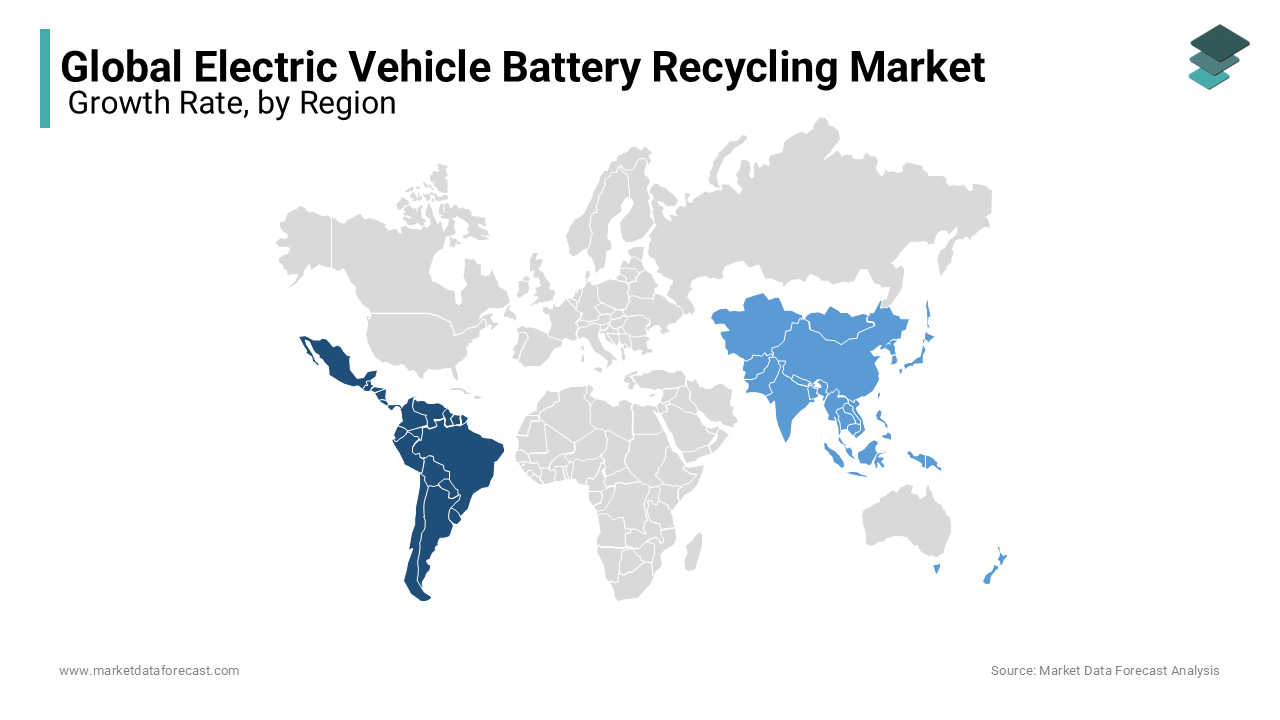
Asia-Pacific was the second-largest in the electric vehicle battery recycling market by accounting for 31.8% share of the global market: China dominates volume, while Japan and South Korea lead in technology. China generated notable metric tons of retired EV batteries, as per the study, yet only a portion entered formal recycling due to fragmented collection. CATL’s Bangbang app incentivizes returns with cash vouchers, boosting formal recovery. Japan certified recyclers under its Urban Mine initiative, mandating material recovery from Nissan Leaf packs. South Korea developed AI-guided laser ablation to separate electrode foils without shredding, reducing cross-contamination. India introduced IS 18287, requiring all EV batteries to carry QR-coded recycling instructions, targeting formal recovery by 2030.
Latin America Market Analysis
Latin America is gradually expanding in the electric vehicle battery recycling market due to mineral sovereignty and regional collaboration. Brazil mandates that EVs sold must contain a percentage of recycled content, triggering partnerships between Fiat and startup Ecobat to recover nickel from Palio elétrico packs. The battery industry is investing heavily in recycling to recover valuable metals like lithium, cobalt, and nickel because the demand for EVs and battery storage is growing. Mexico’s PROFEPA agency shut down illegal dismantling yards, redirecting tons to certified recyclers. Argentina developed a low-cost hydrometallurgical process using citric acid, reducing chemical costs, licensed to three regional recyclers.
Middle East & Africa Market Analysis
The Middle East and Africa region is likely to grow in the electric vehicle battery recycling market owing to strategic mineral positioning and leapfrog technologies. Morocco launched a joint venture with Glencore to recover lithium and cobalt from Renault Zoe packs, targeting integration into its fertilizer-grade LFP cathode plant. South Africa’s CSIR developed a gravity-separation technique to isolate copper and aluminum from shredded packs without chemicals, which cuts processing costs. Nigeria mandated battery take-back obligations for all EV importers, penalizing non-compliance with import license revocation. Saudi Arabia’s PIF invested millions in a Red Sea coastal recycling hub by using solar-powered hydrometallurgy to serve NEOM’s electric fleet.
COMPETITIVE LANDSCAPE
The EV battery recycling sector is transitioning from fragmented recovery operations to vertically integrated material platforms competing on purity, carbon intensity, and supply chain control. Leaders no longer merely dismantle pack; they regenerate cathode precursors and anode graphite for direct reuse in gigafactories. Competition pivots on technological differentiation: hydrometallurgical efficiency, robotic disassembly throughput, and digital traceability. Regulatory compliance is table stakes. Winners embed circularity into OEM design via battery passports and design-for-recycling standards. Talent acquisition focuses on electrochemists and automation engineers. M&A targets include preprocessing spokes and material analytics firms. The most advanced players now compete as material suppliers, not waste handlers, commanding premium pricing for low-carbon, high-purity battery-grade outputs.
KEY MARKET PLAYERS
A few of the market players in the global electric vehicle battery recycling market include
- ACCUREC Recycling GmbH
- American Manganese Inc.
- Battery Solutions
- LI-CYCLE CORP
- Redwood Materials, Inc.
- CATL’s Brunp Recycling (Guangdong Brunp Recycling Technology Co., Ltd.
- G&P Company
- Recupy
- Retriev Technologies
- SITRASA
- SNAM S.A.S.
- Umicore
Top Players In The Market
- Li-Cycle operates a global hub-and-spoke recycling network, deploying its proprietary “Spoke & Hub” model to preprocess batteries locally before centralized metal recovery. The company signed offtake agreements with GM and LG Energy Solution for black mass supply, embedding itself into OEM supply chains.
- Redwood Materials, founded by ex-Tesla CTO JB Straubel, integrates closed-loop battery material recovery with domestic cathode and anode production. The company secured long-term supply pacts with Toyota, Panasonic, and Volvo, guaranteeing feedstock from end-of-life packs and manufacturing scrap. It also launched a consumer battery take-back program across U.S. retail locations, which establishes front-end collection infrastructure important for circularity.
- Brunp, a subsidiary of CATL, dominates Asia’s recycling landscape through vertically integrated recovery and remanufacturing. The company pioneered cell-to-pack disassembly robotics, reducing labor costs and increasing throughput by 4x.
Top Strategies Used by Key Market Participants
Leading recyclers deploy hub-and-spoke architectures to decentralize preprocessing and minimize transport emissions. They forge long-term offtake agreements with automakers and cell manufacturers, locking in feedstock and revenue. Direct cathode regeneration replaces smelting, slashing energy use and preserving material value. AI-guided robotic disassembly overcomes labor problems and safety risks. Blockchain-enabled battery passports ensure traceability from pack retirement to material reincorporation. Geographic expansion targets policy-rich regions like the EU and California. Partnerships with retailers and fleet operators establish front-end collection. Licensing proprietary hydrometallurgical tech to regional players accelerates global scaling without capital overextension.
MARKET SEGMENTATION
This research report on the global electric vehicle battery market has been segmented and sub-segmented into the following categories.
By Application
- Electric Cars
- Electric Buses
- Energy Storage Systems
- Others
By Region
- North America
- Europe
- Asia Pacific
- Latin America
- Middle East and Africa
Frequently Asked Questions
Why is battery recycling becoming essential as electric vehicles grow worldwide?
Used batteries contain valuable materials that can be recovered instead of mined again.
What happens to an EV battery before it reaches recycling facilities?
It is usually tested to determine whether reuse or material recovery is the better option.
Why do manufacturers view battery recycling as a supply security strategy?
Recovered metals reduce dependence on volatile global raw material markets.
How does recycling lower the environmental footprint of electric mobility?
It minimizes waste while reducing energy-intensive extraction of new minerals.
What challenge makes EV battery recycling technically complex?
Different battery chemistries require specialized dismantling and processing methods.
Why are second-life battery applications gaining attention?
Partially used batteries can still store energy for stationary power systems.
How does battery design influence recyclability?
Simpler pack structures allow safer and faster material separation.
Why is logistics important in the battery recycling ecosystem?
Transporting high-voltage batteries safely requires controlled handling systems.
What economic benefit comes from recovering lithium and nickel?
Reclaimed materials can re-enter battery production, lowering manufacturing costs.
How are regulations shaping battery recycling practices globally?
Governments increasingly require responsible end-of-life battery management.
Related Reports
Access the study in MULTIPLE FORMATS
Purchase options starting from
$ 2500
Didn’t find what you’re looking for?
TALK TO OUR ANALYST TEAM
Need something within your budget?
NO WORRIES! WE GOT YOU COVERED!
Call us on: +1 888 702 9696 (U.S Toll Free)
Write to us: sales@marketdataforecast.com