Europe Facade Market Size, Share, Trends & Growth Forecast Report – Segmented By Type (Ventilated, Non-Ventilated, Others), Facade System Type, Material, Installation, End User, and Country (UK, France, Spain, Germany, Italy, Russia, Sweden, Denmark, Switzerland, Netherlands, Turkey, Czech Republic & Rest of Europe), Industry Analysis From 2026 to 2034
Market Size, 2025
$64.24 BnMarket Estimate, 2026
$67.14 BnMarket Forecast, 2034
$95.63 BnCAGR, 2026–2034
4.52%Europe Facade Market Report Summary
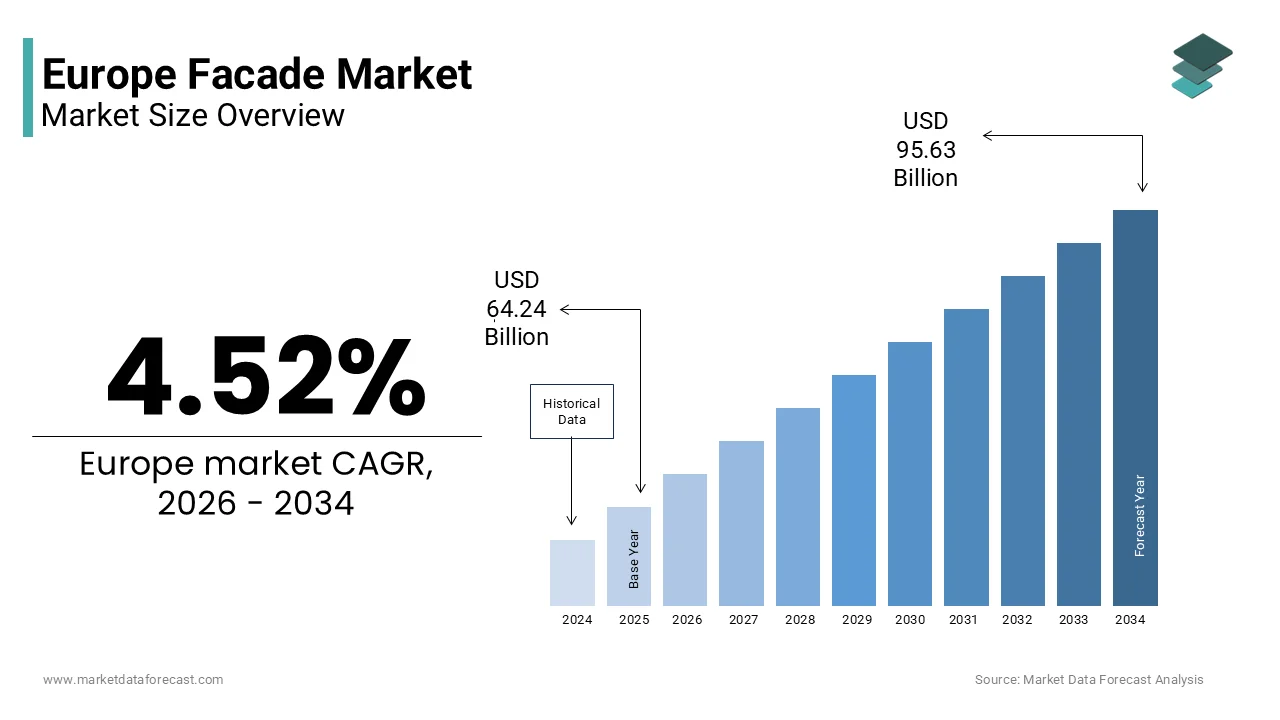
The Europe facade market was valued at USD 64.24 billion in 2025, is estimated to reach USD 67.14 billion in 2026, and is projected to reach USD 95.63 billion by 2034, growing at a CAGR of 4.52% during the forecast period. Market growth is primarily driven by rising commercial construction activity, increasing investments in energy-efficient and sustainable buildings, and strict European regulations promoting thermal insulation and low-carbon construction. Growing adoption of modern architectural designs, renovation of aging infrastructure, and demand for high-performance facade systems in commercial and institutional buildings are further supporting market expansion across the region.
Key Market Trends
-
Increasing demand for energy-efficient and thermally insulated facade systems to comply with EU sustainability and building performance regulations.
-
Strong adoption of glass and aluminum facades driven by modern architectural aesthetics and daylight optimization.
-
Rising renovation and retrofit projects across Western Europe to upgrade aging commercial and residential buildings.
-
Integration of smart facade technologies, including solar control and adaptive shading systems, to improve energy performance.
-
Growing preference for durable, low-maintenance facade materials in large-scale commercial developments.
Segmental Insights
- Based on type, the non-ventilated facade segment dominated the Europe facade market by holding 56.1% of the market share in 2025. This dominance is attributed to lower installation costs, structural simplicity, and widespread use in commercial and mid-rise residential buildings.
- By material, the glass segment held the largest share of 41.1% in 2025, driven by increasing use of curtain walls and glazed facades in office buildings, retail complexes, and mixed-use developments to enhance aesthetics and natural lighting.
- Based on end user, the commercial segment led the market with a 51.5% share in 2025, supported by continuous investments in offices, shopping centers, hotels, hospitals, and public infrastructure projects across major European economies.
Regional Insights
- Germany was the largest contributor to the Europe facade market, accounting for 20.8% of the regional share in 2025. The country’s leadership is driven by strong construction activity, high renovation demand, and strict energy-efficiency standards.
- Other key markets across Western and Northern Europe continue to witness steady growth, supported by sustainable building initiatives and commercial construction demand.
Competitive Landscape
The Europe facade market is moderately consolidated, with the presence of global and regional players focusing on technological innovation, sustainable materials, and large-scale commercial projects. Key companies emphasize customized facade solutions, energy-efficient systems, and long-term partnerships with architects and developers. Prominent players operating in the market include Permasteelisa Group, Schüco International KG, Saint-Gobain S.A., Lindner Group, Reynaers Aluminium NV, Kawneer (Arconic) Europe, AluK Group, Kingspan Group, Hydro Building Systems, Yuanda Europe, STO SE & Co. KGaA, Etex Group (EOS Facades), Sapa Building Systems, Gartner, Trimo d.o.o., Glas Trösch Group, AGC Glass Europe, Focchi SpA, Josef Gartner GmbH, and Alucraft Systems.
Europe Facade Market Size
The Europe facade market size was valued at USD 64.24 billion in 2025 and is projected to reach USD 95.63 billion by 2034 from USD 67.14 billion in 2026, growing at a CAGR of 4.52%.
Facade include cladding, glazing, insulation and structural systems that define a structure’s thermal performance aesthetic identity and environmental resilience. Unlike generic building materials, facades are engineered systems subject to rigorous standards for energy efficiency fire safety and wind load resistance. For instance, a significant share of new non-residential buildings completed in the EU in 2024 featured advanced facade systems such as unitized curtain walls or ventilated cladding. As per Eurostat, the average service life of a commercial building envelope in Europe exceeds 40 years, making facade choices a long-term determinant of operational carbon emissions. Furthermore, according to the European Environment Agency, buildings account for 40% of total EU energy consumption, with the facade responsible for a substantial portion of heat loss or gain. These systemic roles position the facade not as a decorative skin but as a critical interface between architecture, climate policy, and urban sustainability across the European built environment.
MARKET DRIVERS
EU Energy Performance of Buildings Directive Mandates Drive High Performance Envelope Adoption
The tightening of Europe’s building energy regulations has made advanced facades indispensable in new construction and deep renovation, which is one of the key factors propelling the European façade market growth. According to the revised Energy Performance of Buildings Directive, all new buildings must be nearly zero energy by 2030 and public buildings by 2026, requiring U values for facades below 0.35 W per square meter per kelvin. This has accelerated adoption of triple glazed curtain walls, insulated spandrel panels, and dynamic glazing with solar heat gain coefficients under 0.25. As per the European Commission’s Building Stock Observatory, a large share of new office developments in Germany, the Netherlands, and Sweden in 2024 specified high performance facades to meet national Nearly Zero Energy Building criteria. Additionally, the EU Taxonomy for Sustainable Activities now classifies low embodied carbon facades as eligible green investments, guiding institutional capital toward projects with certified environmental performance. This regulatory pressure transforms facade specification from an aesthetic choice into a compliance necessity with direct implications for energy certification and financing eligibility.
Urban Density and Architectural Identity Fuel Demand for Customized Aesthetic Solutions
European cities’ historic fabric and zoning constraints necessitate facades that balance contemporary performance with contextual sensitivity, which is further boosting the expansion of the European façade market. According to the European Urban Initiative, many new developments in city centers like Paris, Barcelona, and Vienna are infill projects on constrained sites where facade design mediates between heritage and innovation. This has spurred demand for bespoke terracotta panels, glass fiber reinforced concrete, and digitally fabricated metal screens that respond to local material palettes and light conditions. As per the Royal Institute of British Architects, planning approvals in London and Amsterdam often require facade studies demonstrating visual compatibility with neighboring structures. Moreover, the rise of mixed-use towers demands vertical zoning in facade expression requiring integrated engineering and design workflows. This architectural complexity elevates the facade from a standardized component to a signature element that defines urban legibility and brand identity in dense environments.
MARKET RESTRAINTS
Stringent Fire Safety Regulations Post Grenfell Restrict Material Choices and Increase Costs
The 2017 Grenfell Tower fire in London triggered sweeping changes to facade fire safety across Europe, which is constraining material selection and inflating project expenses and impeding the European façade market growth. According to the European Committee for Standardization, EN 13501-1 now mandates that all facade materials on buildings over 18 meters must achieve Class A2 s1 d0 or Class A1 non combustibility ratings. This has effectively banned polyethylene cored aluminum composite material, which was widely used for its cost and workability. As per the European Fire Safety Alliance, hundreds of existing high-rise buildings across the EU have undergone costly recladding due to non-compliant systems. Furthermore, testing and certification processes have lengthened, and the British Board of Agrément notes that fire performance validation now adds several weeks to facade approval timelines. These safety imperatives, while necessary, have reduced design flexibility and increased budgets, particularly for social housing where cost sensitivity is acute.
Skilled Labor Shortages Delay Installation and Compromise Quality Control
The Europe facade market faces persistent bottlenecks due to a critical shortage of trained installers capable of handling complex high-performance systems. According to the European Construction Sector Observatory, there is a notable deficit in skilled facade workers across the EU, with the gap widest in Germany, France, and the Netherlands where construction activity is strongest. Installing unitized curtain walls or ventilated rainscreens requires precision in sequencing, sealing, and anchoring—tasks that cannot be easily automated. As per the German Federation of Skilled Crafts, many facade contractors reported project delays due to labor unavailability. Moreover, improper installation compromises thermal and air tightness performance, and the Fraunhofer Institute confirmed that building envelope energy underperformance often stems from installation errors rather than material flaws. Without coordinated vocational training and digital work instruction tools, this skills gap will continue to inflate costs and undermine the energy integrity of Europe’s building stock.
MARKET OPPORTUNITIES
Integration of Building Integrated Photovoltaics Creates Renewable Energy Generating Envelopes
The convergence of facade engineering and renewable energy is unlocking new value through solar active building skins, which is a prominent opportunity in the European façade market. According to SolarPower Europe, building integrated photovoltaics (BIPV) installations across Europe have been steadily increasing, with growth concentrated in commercial and public buildings. Unlike rooftop solar, BIPV facades generate power while serving as weather barriers, cladding, or sunshades. The European Commission’s REPowerEU plan now includes BIPV in its renovation wave funding, with countries such as France and the Netherlands offering subsidies for solar facades on public buildings. As per pilot projects in Northern Europe, south facing BIPV curtain walls on municipal offices have demonstrated the ability to cover a significant share of electricity demand. As module efficiency exceeds 20% and costs continue to decline according to BloombergNEF, this dual function transforms facades from passive shells into active energy assets aligned with EU decarbonization goals.
Retrofitting Historic and Post War Buildings Opens Large-Scale Renovation Pipeline
Europe’s aging building stock presents a structural opportunity for the European façade market. According to Eurostat, more than one third of EU residential buildings were constructed before 1970 and a large share between 1970 and 1990. The European Investment Bank allocated billions of euros in 2023 specifically for deep energy retrofits including facade insulation and window replacement across Italy, Poland, and Greece. The EU’s Social Climate Fund further supports low-income households with grants covering a high proportion of facade upgrade costs. As per the OECD, buildings retrofitted with external thermal insulation composite systems can reduce heating demand significantly while improving indoor comfort. Unlike new construction, this segment offers recurring demand over decades as cities systematically address energy poverty and emissions in existing neighbourhoods, making facade renovation a cornerstone of Europe’s just transition strategy.
MARKET CHALLENGES
Fragmented National Standards for Testing and Certification Impede Cross Border Projects
The lack of harmonized facade performance verification across EU member states complicates pan European construction and increases compliance costs, which is a major challenge to the growth of the European façade market. While the Construction Products Regulation establishes a common framework, actual testing methodologies for wind load, water tightness, and thermal bridging vary significantly. According to the European Organisation for Technical Assessment, national bodies in France, Germany, and Spain require distinct documentation and physical testing even for identical facade systems. Industry studies confirm that manufacturers often spend considerable time and resources to certify a single system in multiple markets. This fragmentation discourages innovation and favors incumbents with established certification libraries. Moreover, post Brexit the UK now operates a separate UKCA regime, adding another layer of complexity for firms operating across the Channel. Until the EU advances mutual recognition of technical assessments, facade suppliers will face redundant validation processes that delay deployment and inflate project budgets.
Volatility in Aluminum and Glass Prices Disrupts Budget Stability and Design Continuity
The Europe facade market remains highly exposed to fluctuations in key raw material costs, particularly aluminum and float glass which constitute the majority of system expenses. According to the European Aluminium Association, primary aluminum prices experienced sharp swings in 2023 due to energy cost volatility in smelters and global trade dynamics. Similarly, the European Flat Glass Sector reported significant increases in clear float glass prices during 2023 driven by natural gas surcharges and furnace maintenance cycles. These instabilities force contractors to include escalation clauses in contracts or switch to alternative materials mid project, compromising design intent. As per the German Construction Industry Federation, many facade projects exceeded initial budgets due to material cost overruns. Until supply chains diversify or circular material streams scale, the market will remain vulnerable to commodity cycles that undermine cost predictability and design fidelity.
REPORT COVERAGE
| REPORT METRIC | DETAILS |
| Market Size Available | 2025 to 2034 |
| Base Year | 2025 |
| Forecast Period | 2026 to 2034 |
| CAGR | 4.52% |
| Segments Covered | By Type, Facade System Type, Material, Installation, End User, and Region |
| Various Analyses Covered | Global, Regional, & Country Level Analysis; Segment-Level Analysis; DROC, PESTLE Analysis; Porter’s Five Forces Analysis; Competitive Landscape; Analyst Overview of Investment Opportunities |
| Regions Covered | UK, France, Spain, Germany, Italy, Russia, Sweden, Denmark, Switzerland, Netherlands, Turkey, and the Czech Republic |
| Market Leaders Profiled | Permasteelisa Group, Schüco International KG, Saint-Gobain S.A., Lindner Group, Reynaers Aluminium NV, Kawneer (Arconic) Europe, AluK Group, Kingspan Group (Facade & Insulated Panels), Hydro Building Systems (Technal and Wicona), Yuanda Europe, STO SE & Co. KGaA, Etex Group – EOS Facades, Sapa Building Systems, Gartner (Permasteelisa), Trimo d.o.o., Glas Trösch Group, AGC Glass Europe, Focchi SpA, Josef Gartner GmbH, and Alucraft Systems |
SEGMENTAL ANALYSIS
By Type Insights
The non-ventilated facade segment led the market by holding 56.1% of the regional market share in 2025. The dominance of non-ventilated façade segment in the regional market is driven by its widespread use in conventional construction across residential and commercial sectors. Non-ventilated systems are the default solution for energy retrofits and new housing across Southern and Central Europe. As per the European Investment Bank, a large share of deep energy renovation projects funded under the EU Recovery and Resilience Facility in 2024 specified ETICS due to cost efficiency and compatibility with existing masonry. In countries like Italy and Poland where multi-family housing dominates, ETICS offers a seamless finish that preserves architectural continuity while achieving U values below 0.30 W per square meter per kelvin. According to the OECD, ETICS retrofits have been shown to reduce heating energy demand significantly in post war apartment blocks. This regulatory alignment with the Energy Performance of Buildings Directive makes non-ventilated facades the practical choice for large scale public and private housing programs.
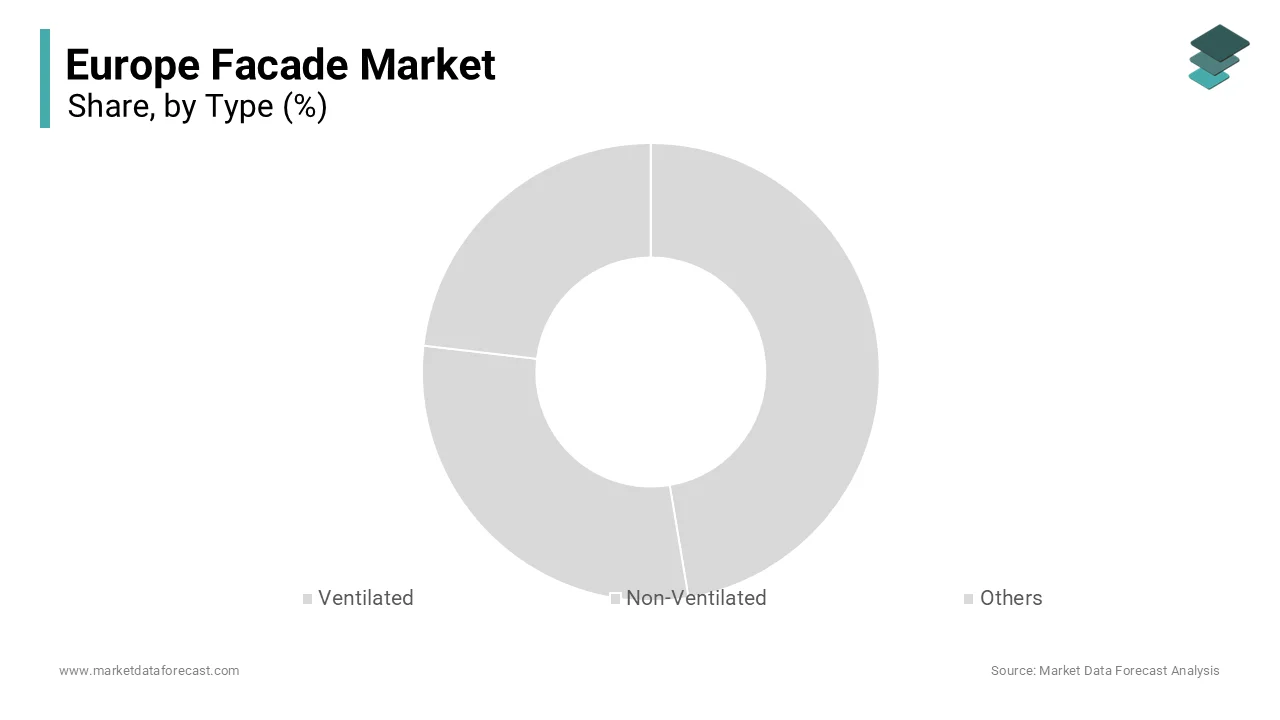
The ventilated facade segment is the fastest growing with a projected CAGR of 8.12% over the forecast period. Ventilated facades excel in climates with high rainfall or pollution by creating a drainage and drying cavity that prevents moisture entrapment and facade degradation. As per the Fraunhofer Institute, buildings in coastal and industrial zones retrofitted with ventilated systems demonstrated improved durability and reduced maintenance compared to sealed render systems. In cities like Rotterdam and Hamburg where salt air accelerates corrosion, ventilated metal and terracotta panels offer resilience unattainable with organic renders. The European Environment Agency notes that many EU urban areas exceed WHO particulate matter limits, making facade cleanability a growing concern. Ventilated systems allow easier washing or panel replacement without structural damage—a key advantage for commercial buildings where appearance impacts tenant value.
By Material Insights
The glass segment dominated the market by capturing 41.1% of the regional market share in 2025 due to its irreplaceable role in daylighting, transparency, and modern architectural expression. European building codes increasingly mandate minimum daylight factors in workplaces and residences to support occupant health and reduce lighting energy. According to the European Committee for Standardization, EN 17037 requires new offices to provide useful daylight illuminance for at least 50% of annual working hours. Glass facades are the only viable solution to meet this without compromising spatial quality. Additionally, urban density drives demand for visual connection to the street. As per the Royal Institute of British Architects, planning approvals in London and Amsterdam often required transparent ground floors for active street frontages. Triple glazed units with warm edge spacers now achieve U values below 0.7 W per square meter per kelvin, making them compliant with energy codes while delivering aesthetic and wellness benefits. This dual compliance with energy and human centric design cements glass as the material of choice.
The metal segment is the fastest growing segment and is likely to register a CAGR of 7.4% over the forecast period in this regional market. Aluminum and steel facade systems offer near infinite recyclability without quality loss, which is a critical advantage under the EU Construction Products Regulation’s emerging circularity requirements. According to the European Aluminium Association, over 95% of structural aluminum from demolition is currently recycled with embodied carbon far lower than primary production. Architects increasingly specify aluminum composite material with mineral cores or perforated stainless steel for long life and end of life recovery. As per the Dutch Green Building Council, metal facades scored higher on life cycle assessments than polymer-based alternatives due to durability and recyclability. With the EU Ecodesign for Sustainable Products Regulation preparing mandatory recycled content disclosures, metal’s closed loop potential becomes a decisive specification criterion.
By End User Insights
The commercial segment led the market by occupying a share of 51.5% of the regional market in 2025. Office, retail, and institutional buildings drive demand for high performance and branded facades. Commercial developers and occupiers face mounting pressure to demonstrate environmental performance through certifications like BREEAM, LEED, and EU Taxonomy alignment. According to the World Green Building Council, a majority of European corporate tenants now require energy performance data as part of lease negotiations. Facades directly impact these metrics by governing heating, cooling, and lighting loads. As per JLL Europe, Class A office buildings with high performance facades achieved higher occupancy rates and rent premiums compared to conventional stock. Additionally, institutional investors such as Allianz and AXA now exclude buildings without near zero energy certification from portfolios. This financial and reputational imperative makes the facade a strategic asset rather than a cost center, which is justifying investment in dynamic glazing, ventilated systems, and integrated renewables.
The residential segment is a promising segment and is estimated to register a CAGR of 7.12% over the forecast period. The European Commission’s Social Climate Fund has allocated billions of euros through 2026 to upgrade energy efficiency in low-income housing with facades as a core component. According to Eurostat, tens of millions of EU households live in energy inefficient buildings constructed before 1990. In countries like Romania and Greece where heating poverty affects a significant share of residents, facade insulation is the most effective single measure. As per the OECD, ETICS retrofits on post war apartment blocks reduced heating bills substantially on average. National programs such as France’s MaPrimeRénov and Germany’s KfW 461 offer grants covering a high proportion of facade upgrade costs for eligible households. This public investment creates a massive and stable demand pipeline independent of private market cycles.
REGIONAL ANALYSIS
Germany Facade Market Analysis
Germany accounted for the largest share of 20.8% of the regional market in 2025. The dominance of Germany in the European market is driven by its robust construction sector, stringent energy codes, and engineering culture. As per the German Federal Ministry for Housing, hundreds of thousands of new residential units were completed in 2024, nearly all requiring facade systems compliant with the EnEV ordinance mandating U values below 0.28 W per square meter per kelvin. The country’s Energiewende policy also prioritizes building integrated renewables, with numerous public and commercial projects specifying BIPV facades in 2024 according to the German Solar Association. Additionally, Germany’s strong industrial base supplies high precision aluminum and glass components to the entire EU. The Fraunhofer Institute’s continuous innovation in thermal break technology and fire safe insulation ensures German specifications often set de facto European standards, making the country both a market and a technological benchmark.
France Facade Market Analysis
France held the second largest share of the European façade market in 2025 with demand propelled by urban densification and large-scale social housing renewal. According to France’s Ministry of Ecological Transition, the government’s France Relance plan allocated billions of euros in 2023 for building envelope retrofits targeting hundreds of thousands of homes annually. The RE2020 environmental regulation now bans facades with high embodied carbon, pushing developers toward timber, aluminum, and recycled content systems. In Paris, zoning codes mandate that new facades incorporate vegetation or solar elements on a portion of surface area, driving innovation in green and energy generating envelopes. As per the French Building Performance Institute, compliant facades have demonstrated measurable reductions in urban heat island intensity in pilot districts. This policy driven integration of climate adaptation and social equity ensures France remains a high volume and high complexity market.
United Kingdom Facade Market Analysis
The United Kingdom occupied a prominent share of the Europe facade market in 2025, with activity shaped by post Grenfell safety reforms and commercial office redevelopment. According to the UK Ministry of Levelling Up, all residential buildings over 11 meters must now use Class A non-combustible materials, a rule that eliminated a large share of previous facade product options. This triggered a multibillion-pound recladding program across hundreds of thousands of units as per the National Audit Office. Simultaneously, London’s office market is undergoing transformation with numerous new towers under construction requiring high performance double skin or dynamic glazing to meet NABERS UK energy ratings. A 2024 RIBA report confirmed that most new commercial facades in the City of London now integrate automated blinds and solar control glass. This dual pressure from safety compliance and premium workplace standards sustains demand for technically advanced and certified systems.
Italy Facade Market Analysis
Italy is expected to exhibit a healthy CAGR in the European façade market over the forecast period with growth fuelled by seismic retrofitting and historic city center regeneration. According to Italy’s National Institute of Statistics, a majority of the building stock was built before modern seismic codes, making facade upgrades essential for structural resilience. The government’s Superbonus 110% tax credit drove unprecedented activity with millions of projects initiated. As per ANCE construction reports, many of these retrofits used lightweight ventilated systems to avoid overloading existing structures. Additionally, cities like Rome and Florence enforce strict aesthetic guidelines requiring facades to match historic palettes through terracotta, stone, or custom-colored renders. This blend of technical necessity and cultural preservation creates a uniquely demanding and high value market that prioritizes both engineering and craftsmanship.
Netherlands Facade Market Analysis
The Netherlands is estimated to hold a notable share of the European facade market over the forecast period. Netherlands serves as a testbed for circular and climate adaptive building envelopes. According to the Dutch Ministry of Infrastructure, most new public buildings must achieve BENG nearly energy neutral standards, with facades playing a central role. The Amsterdam Circular Strategy 2025 mandates that new facades use recycled or bio-based materials and be designed for disassembly. Pilot projects in Rotterdam have featured facades made entirely from recycled aluminum and demountable glass, demonstrating future recyclability potential. Additionally, the country’s low elevation drives demand for flood resilient and moisture managing systems, with ventilated rainscreens now standard in coastal developments. With strong government support for innovation and a dense urban geography that magnifies climate risks, the Netherlands exemplifies the future trajectory of the European facade market.
COMPETITIVE LANDSCAPE
Competition in the Europe facade market is characterized by a convergence of technical rigor aesthetic innovation and regulatory compliance. The market is dominated by established material and systems providers who compete on performance certification sustainability credentials and digital engineering support. Barriers to entry are high due to stringent fire safety testing complex thermal modeling requirements and long qualification cycles with major contractors. Competition is intensifying around circularity as the EU prepares mandatory environmental product declarations and recycled content rules. At the same time architectural demand for contextual yet iconic facades push manufacturers to offer customization without compromising performance. The post Grenfell safety regime has further consolidated the market around certified non-combustible solutions favoring incumbents with tested product libraries. Unlike commoditized building products success here depends on integrated value—combining engineering digital services and sustainability storytelling—making the competitive landscape both technically demanding and creatively dynamic.
KEY MARKET PLAYERS
Some of the notable key players in the European facade market are
- Permasteelisa Group
- Schüco International KG
- Saint-Gobain S.A.
- Lindner Group
- Reynaers Aluminium NV
- Kawneer (Arconic) Europe
- AluK Group
- Kingspan Group (Facade & Insulated Panels)
- Hydro Building Systems (Technal, Wicona)
- Yuanda Europe
- STO SE & Co. KGaA
- Etex Group - EOS Facades
- Sapa Building Systems
- Gartner (Permasteelisa)
- Trimo d.o.o.
- Glas Trösch Group
- AGC Glass Europe
- Focchi SpA
- Josef Gartner GmbH
- Alucraft Systems
Top Players in the Market
- Saint-Gobain is a global leader in sustainable building materials with deep integration across the Europe facade market through its Weber ETICS systems and Glassolutions high performance glazing. The company contributes significantly to worldwide facade innovation by advancing low carbon mortar formulations and dynamic glass with integrated solar control. In Europe Saint-Gobain has strengthened its position by launching Circular Glass—produced with up to 90% recycled content—and expanding its ventilated facade solutions for social housing retrofits. Recent actions include partnerships with EU municipalities to deliver energy efficient envelopes under the Renovation Wave initiative. Its commitment to science-based targets and EPD verified products aligns with EU Green Public Procurement criteria reinforcing its role as a sustainability pioneer in building envelopes.
- Alucobond by 3A Composites is a globally recognized brand in architectural metal panels with a strong presence in Europe’s premium facade segment. The company specializes in aluminum composite material systems that combine design versatility with fire resistant mineral cores compliant with post Grenfell regulations. Alucobond contributes to global facade aesthetics through collaborations with leading architects on landmark cultural and commercial projects. In Europe the company has reinforced its market position by introducing A2 fire rated panels with enhanced recyclability and digital color matching services. It also invested in local fabrication hubs in Germany and Spain to support just in time delivery for complex projects. These actions ensure Alucobond remains the material of choice for iconic and compliant urban developments.
- Schüco International is a leading European provider of facade engineering systems known for precision engineered curtain walls and window solutions that integrate energy efficiency and smart building technologies. The company plays a pivotal role in advancing unitized facade systems that reduce on site labor and improve thermal performance. Schüco has strengthened its market presence by launching its SunSlide sliding facade system with integrated photovoltaics and automated solar shading. It also expanded its digital twin platform for facade performance simulation enabling architects to optimize energy and daylight metrics early in design. With manufacturing facilities across Germany and partnerships with BIPV developers Schüco bridges high performance engineering with renewable energy integration in Europe’s evolving built environment.
Top Strategies Used by the Key Market Participants
Key players in the Europe facade market prioritize compliance with EN 13501 1 fire safety and EPBD energy efficiency standards by developing non-combustible insulation and high-performance glazing systems. They invest in circular material innovation using recycled aluminum glass and bio-based binders to meet EU Green Public Procurement requirements. Companies expand localized fabrication and digital design support to reduce lead times and ensure precision in complex urban projects. Strategic partnerships with architects developers and municipalities align facade solutions with social housing and climate adaptation programs. Additionally, they integrate building integrated photovoltaics and smart shading into unitized systems to transform facades from passive envelopes into active energy generating assets.
MARKET SEGMENTATION
This research report on the European facade market has been segmented and sub-segmented based on categories.
By Type
- Ventilated
- Non-Ventilated
- Others
By Facade System Type
- Rainscreen Cladding
- Curtain-Wall Systems
- Others
By Material
- Glass
- Metal
- Plastic & Fibers
- More
By Installation
- New Construction
- Renovation & Retrofit
By End User
- Commercial
- Residential
- Others
By Country
- UK
- France
- Spain
- Germany
- Italy
- Russia
- Sweden
- Denmark
- Switzerland
- Netherlands
- Turkey
- Czech Republic
- Rest of Europe
Frequently Asked Questions
1.What is the Europe façade market?
The Europe façade market includes exterior building systems such as curtain walls, cladding, ventilated façades, and insulation solutions that improve building performance, safety, and aesthetics.
2.What factors are driving growth in the Europe façade market?
Growth is driven by strict energy-efficiency regulations, building safety upgrades, urban redevelopment, and rising demand for sustainable construction materials.
3.Which façade types are most commonly used in Europe?
Common façade types include curtain wall systems, ventilated (rainscreen) façades, exterior insulation and finish systems (EIFS), and cladding panels.
4.Which countries dominate the Europe façade market?
Germany, the United Kingdom, France, Italy, and Spain lead the market due to strong construction activity and high renovation demand.
5.How do building safety regulations impact the façade market?
Stricter fire-safety and material-compliance regulations have increased demand for certified, non-combustible façade systems, especially for retrofitting older buildings.
6.What role does sustainability play in façade system demand?
Sustainability is a major driver, encouraging the use of energy-efficient façades, low-carbon materials, recyclable components, and solar-integrated systems.
7.Is façade retrofitting more important than new construction in Europe?
In many mature European markets, façade retrofitting and refurbishment generate higher demand than new construction due to aging buildings and renovation-focused policies.
8.What materials are commonly used in European façade systems?
Common materials include glass, aluminum, stone, ceramics, composite panels, and advanced insulation materials.
9.What are the main challenges in the Europe façade market?
Key challenges include high material costs, complex regulatory compliance, skilled labor shortages, and supply-chain disruptions.
10.What is the future outlook for the Europe façade market?
The market is expected to grow steadily, supported by renovation programs, sustainability targets, and ongoing innovation in façade technologies.
Related Reports
Access the study in MULTIPLE FORMATS
Purchase options starting from
$ 2000
Didn’t find what you’re looking for?
TALK TO OUR ANALYST TEAM
Need something within your budget?
NO WORRIES! WE GOT YOU COVERED!
Call us on: +1 888 702 9696 (U.S Toll Free)
Write to us: sales@marketdataforecast.com