- Product Description Description
- Table of Contents TOC
- List of Table & Figure LOT
- Get Free Sample PDF Sample PDF
Executive Summary: Europe Fiber Laser Market
- Market Scope: Comprehensive European fiber laser industry analysis covering laser type classifications, industry application sectors, country leadership frameworks, strategic corporate developments, and competitive landscapes.
- Market Valuation: Valued at USD 1.72 billion (2025), estimated at USD 2.03 billion (2026), and projected to reach USD 8.14 billion by 2034, registering a robust CAGR of 19.1% (2026–2034).
- Primary Growth Drivers: Advanced manufacturing base, stringent environmental regulations favoring energy-efficient laser technologies, automotive/aerospace/medical adoption, Industry 4.0 smart factory integration, and EV battery precision micro-machining. Restraints include high initial capital expenditure and specialized optical component supply chain constraints.
Key Market Segment Metrics (2026–2034)
| Category | Leading Segment / Country (Position) | Fastest-Growing Segment |
|---|---|---|
| By Type | Fiber laser cutting systems (dominated with a 48.7% share in 2025) | Fiber laser welding systems (projected fastest-growing segment at a CAGR of 21.3% through 2033) |
| By Application | Automotive sector (accounted for 38.4% of total demand in 2025) | Medical devices segment (anticipated to grow at highest CAGR of 22.6% over forecast period) |
| By Region / Country | Germany (led European market with a 32.1% share in 2025, followed by Italy at 18.7%) | Eastern Europe (expected to exhibit fastest regional growth due to expanding industrial automation investments) |
Major Market Players & Market Structure
Market Structure: Highly competitive European industrial laser ecosystem driven by localized R&D centers, niche technology acquisitions, ultrafast picosecond laser innovations for semiconductor packaging, and high-power green laser introductions for EV battery copper welding.
Key Companies: IPG Photonics Corporation, TRUMPF GmbH + Co. KG, Coherent Corp., Mazak Corporation, Amada Co., Ltd., Bystronic AG, Prima Power, Jenoptik AG, Rofin-Sinar Technologies (Coherent), and Lumentum Holdings Inc.
Europe Fiber Laser Market Size
The Europe Fiber Laser Market is projected to grow from USD 1.72 billion in 2025 to USD 1.91 billion in 2026 and reach USD 4.57 billion by 2034, registering a CAGR of 11.50% from 2026 to 2034.
Fiber laser is a technologically advanced segment of industrial photonics characterized by high beam quality, exceptional electrical efficiency, and robust performance in demanding manufacturing environments. Fiber lasers utilize doped optical fibers as gain media to generate coherent light output primarily in the near infrared spectrum and are widely deployed for cutting, welding, marking, and micro processing across automotive, aerospace, electronics, and medical device sectors. Unlike traditional CO2 or lamp-pumped solid-state lasers, fiber lasers offer superior wall plug efficiency, exceeding 30% and require minimal maintenance due to their monolithic all-fiber architecture. Fiber lasers have become the dominant choice in industrial applications, with a majority of new installations in Europe adopting this technology, reflecting a structural shift toward precision and energy-conscious manufacturing. Industrial processes account for nearly 27% of Europe’s final energy consumption, which is making energy-efficient tools like fiber lasers critical to the EU’s Fit for 55 decarbonization agenda. Furthermore, the European Commission’s Chips Act allocated 3.3 billion euros in 2025 to bolster semiconductor manufacturing, which relies heavily on ultrafast fiber lasers for wafer dicing and circuit trimming. This regulatory and industrial alignment positions fiber lasers not merely as production tools but as enablers of strategic autonomy in advanced manufacturing.
MARKET DRIVERS
Adoption in Electric Vehicle Manufacturing Drives Demand
The rapid expansion of electric vehicle production across Europe has significantly elevated demand for high-power fiber lasers in battery and powertrain manufacturing, which is one of the key factors driving the fiber laser market growth in Europe. Each electric vehicle requires thousands of laser welds primarily for battery tab connections, cell sealing, and motor stator hairpin welding. Fiber lasers dominate these applications due to their ability to deliver precise high-speed welding of dissimilar metals such as copper and aluminum, which are prevalent in battery architectures. In 2023, Europe produced over 2.9 million electric vehicles according to the European Automobile Manufacturers Association, marking a 32% year-on-year increase. This surge has prompted gigafactories operated by Northvolt, CATL, and Volkswagen to integrate multi-kilowatt fiber laser systems capable of processing hundreds of battery modules per hour. The German Federal Ministry for Economic Affairs confirmed in 2025 that a majority of new battery production lines funded under the Important Project of Common European Interest scheme specified fiber laser welding stations. Additionally, the need for hermetic sealing of battery housings to IP67 standards necessitates the beam stability and consistent penetration depth only achievable with single-mode fiber lasers. As Europe targets 100% zero-emission car sales by 2035, this manufacturing transformation ensures sustained and deepening reliance on fiber laser technology.
Integration in Semiconductor and Photonics Fabrication
The strategic push of Europe to rebuild semiconductor sovereignty has intensified the use of ultrafast fiber lasers in photonic integrated circuits and advanced packaging processes, which is further contributing to the fiber laser market growth in Europe. The European Chips Act aims to double the continent’s global semiconductor market share to 20% by 2030, which requires precision laser systems for dicing silicon carbide wafers, structuring waveguides, and trimming passive components. Picosecond and femtosecond fiber lasers are increasingly standard in European pilot lines for compound semiconductor processing due to their sub-micron ablation accuracy and negligible heat-affected zones. In 2025, the European Commission approved 11 new semiconductor facilities across France, Germany, and Italy with collective investments exceeding 22 billion euros as documented in its Strategic European Investment Pipeline. These fabs rely on fiber lasers for tasks such as selective emitter doping in power devices and trench formation in 3D NAND stacks. ASML’s development of next-generation lithography tools also incorporates fiber laser-based metrology systems for real-time alignment verification. Over 40% of Europe’s photonics output now involves laser-based fabrication steps, which indicates fiber lasers as foundational to the region’s high-tech industrial renaissance.
MARKET RESTRAINTS
Supply Chain Vulnerability for Rare Earth Dopants
The European fiber laser market faces significant input constraints due to its dependence on rare earth elements such as ytterbium, erbium, and thulium, which serve as active dopants in laser gain fibers. Over 90% of global rare earth oxide processing capacity resides in China, which is making Europe highly susceptible to export restrictions and price volatility. In 2023, the average price of rare earth oxides in Europe surged significantly following Chinese export licensing reforms. This dependency is particularly acute because a single 6-kilowatt industrial fiber laser requires high-purity ytterbium. The European Commission’s 2023 Critical Raw Materials Act identified ytterbium as a strategic material but acknowledged that Europe currently recovers less than 1% of rare earths from end-of-life electronics. Although pilot recycling projects like SUSMAGPRO have demonstrated high recovery efficiency from magnet scrap, these have not yet scaled to support laser manufacturing. Consequently, European laser builders such as IPG Photonics and Trumpf maintain a strategic stockpile, which inflates working capital costs and limits pricing flexibility. Until a circular supply chain or alternative dopant chemistry emerges, this material bottleneck will continue to restrain market resilience.
Skilled Labor Shortage in Laser System Integration
A critical shortage of engineers proficient in photonics automation and laser material interaction is impeding the deployment and optimization of fiber laser systems across European manufacturing, which is further restraining the regional market growth. According to the estimations of the European Photonics Industry Consortium, Europe faces a significant shortfall of photonics technicians and engineers by 2025, yet annual graduate output in relevant disciplines remains well below industry demand. This gap is most acute in Central and Eastern Europe, where new laser cutting facilities are being established, but local expertise lags. In Germany, many machine tool builders reported project delays in 2023 due to the inability to staff laser integration teams. Fiber lasers require nuanced parameter tuning for different materials and thicknesses and improper setup leads to defects such as dross formation or micro cracking which are unacceptable in aerospace or medical applications. Although initiatives like Photonics21 Skills Alliance have trained thousands of professionals since 2020, the pace remains insufficient relative to industry demand. This human capital deficit not only slows adoption but also reduces return on investment as underutilized laser systems operate below optimal throughput thereby undermining the economic rationale for advanced manufacturing upgrades.
MARKET OPPORTUNITIES
Expansion into Green Hydrogen Component Manufacturing
The emergence of Europe’s green hydrogen economy is creating new frontiers for fiber laser processing in the fabrication of electrolyzer and fuel cell components, which is a promising opportunity for the European market. Proton exchange membrane electrolyzers require bipolar plates with intricate flow field channels typically 0.8 to 1.2 millimetres wide which fiber lasers can cut with micron level precision in titanium and stainless steel. According to the European Hydrogen Backbone initiative, 40 GW of electrolysis capacity is planned for deployment by 2030 across 28 European countries, which is requiring tens of millions of precision laser processed plates. In 2025, ThyssenKrupp Nucera commissioned a new gigafactory in Germany where fiber lasers cut thousands of plates per day for its 20 MW electrolyzer stacks. Similarly, fuel cell manufacturers like SFC Energy use nanosecond fiber lasers to structure gas diffusion layers without compromising porosity. The European Clean Hydrogen Partnership confirmed that a majority of its 2025 manufacturing innovation grants included laser-based process development. As fiber lasers enable high speed contamination free processing of corrosion resistant alloys, they are becoming indispensable to scaling hydrogen infrastructure with the required quality and volume.
Growth in Additive Manufacturing of High-Performance Alloys
Fiber lasers are increasingly central to Europe’s industrial additive manufacturing ecosystem particularly in aerospace and energy sectors where high performance nickel and titanium alloys demand precise melt pool control, which is another notable opportunity for the regional market. A majority of powder bed fusion metal 3D printers in Europe utilize ytterbium fiber lasers with power outputs between 500 watts and 1 kilowatt. In 2023, European aerospace firms including Safran and MTU Aero Engines produced tens of thousands of flight certified turbine components via laser powder bed fusion, which is reducing material waste by up to 90% compared to subtractive methods. The European Space Agency has qualified fiber laser additive manufacturing for satellite thruster nozzles made from Inconel 718 which withstand temperatures above 1200 degrees Celsius. Furthermore, the European Defence Fund allocated 320 million euros in 2025 to develop next generation combat vehicle parts using laser based directed energy deposition which relies on multi kilowatt fiber lasers for real time alloying. This convergence of design freedom, material efficiency, and performance validation is transforming fiber lasers from auxiliary tools into core enablers of advanced industrial production.
MARKET CHALLENGES
Energy Intensity and Grid Compatibility Constraints
Despite their superior efficiency, fiber laser systems with power ratings above 4 kilowatts impose substantial localized electricity demands that strain aging industrial grid infrastructure in parts of Europe, which is significant challenge to the regional market growth. A single 10-kilowatt fiber laser installation can draw up to 16 kilowatts of continuous power requiring three phases 400-volt supply with stable harmonics. Many industrial zones in Southern and Eastern Europe operate on grids not upgraded since the 1990s, which is limiting reliable deployment of high-power laser systems. In 2023 several automotive suppliers in Italy delayed laser cutting line installations due to insufficient substation capacity. Moreover, the EU’s Carbon Border Adjustment Mechanism now mandates granular energy sourcing disclosure which complicates procurement for manufacturers in regions reliant on coal-based grids. Although regenerative power supply units can recover up to 30% of braking energy in dynamic laser operations, these add significant capital cost. Until grid modernization, fiber laser adoption will remain unevenly distributed favouring Northern industrial clusters with robust renewable integration.
Thermal Management Limitations at Ultra High-Power Levels
As fiber laser power scales beyond 20 kilowatts for applications such as shipbuilding and pipeline welding thermal lensing and photodarkening effects increasingly degrade beam quality and system reliability, which is further challenging the growth of the regional market. At these power densities the core temperature of the doped fiber can exceed 300 degrees Celsius leading to irreversible refractive index changes that distort the output mode. Continuous operation above very high kilowatt levels in single mode fiber lasers reduces mean time between failures compared to lower power systems due to accelerated fiber degradation. European heavy industry trials in 2025 revealed that only a fraction of multi kilowatt fiber lasers deployed in offshore wind tower fabrication-maintained beam parameter product stability over 2000 operating hours without active cooling recalibration. While coherent beam combining offers a path to higher power it introduces phase control complexity that demands real time adaptive optics rarely available outside research labs. Consequently, many European shipyards including Meyer Werft have reverted to hybrid laser arc systems for thick section welding. Until thermal management breakthroughs such as hollow core photonic crystal fibres mature at industrial scale the performance ceiling for fiber lasers in heavy fabrication will remain constrained limiting their applicability in capital intensive sectors.
REPORT COVERAGE
| REPORT METRIC | DETAILS |
| Market Size Available | 2025 to 2034 |
| Base Year | 2025 |
| Forecast Period | 2026 to 2034 |
| Segments Covered | By Output Power, Laser Type, Application and Region. |
| Various Analyses Covered | Global, Regional and Country-Level Analysis, Segment-Level Analysis, Drivers, Restraints, Opportunities, Challenges; PESTLE Analysis; Porter’s Five Forces Analysis, Competitive Landscape, Analyst Overview of Investment Opportunities |
| Countries Covered | UK, France, Spain, Germany, Italy, Russia, Sweden, Denmark, Switzerland, Netherlands, Turkey, Czech Republic, Rest of Europe |
| Market Leaders Profiled | IPG Photonics Corporation, TRUMPF GmbH + Co. KG, Coherent Corp., nLIGHT, Inc., Jenoptik AG, Lumentum Holdings Inc., SPI Lasers (a TRUMPF subsidiary), Fanuc Corporation, Rofin-Sinar Technologies Inc. (part of Coherent), Amplitude Laser Group, Raycus Fiber Laser Technologies Co., Ltd., NKT Photonics A/S, Laserline GmbH, IMRA America, Inc. (a subsidiary of Aisin Seiki), JPT Opto-Electronics Co., Ltd., TOPTICA Photonics AG, Bystronic Laser AG, OXiGENO Laser Systems, Precitec GmbH & Co. KG, Hamamatsu Photonics K.K. |
SEGMENTAL ANALYSIS
By Output Power Insights
The medium power segment accounted for 52.5% of the European fiber laser market in 2025. The dominance of the medium power segment is driven by its versatility across industrial cutting welding and surface treatment applications in automotive aerospace and general manufacturing. This power range optimally balances processing speed, precision and energy consumption for sheet metal up to 10 millimetres thick which constitutes a majority of industrial laser workloads. In 2023, European automotive suppliers installed more than 1800 medium power laser systems for battery tab welding and body in white fabrication. The prevalence of small and medium enterprises that account for nearly all EU manufacturing firms and favour 1 kilowatt to 2 kilowatt systems for their cost efficiency and compact footprint is driving the growth of the medium segment in the European market. Additionally, the European Commission’s Eco Design Directive mandates that new industrial machinery achieve minimum energy performance standards which medium power fiber lasers exceed by delivering wall plug efficiencies above 35%. Leading system integrators such as Bystronic and Prima Power have standardized their entry level laser cutting platforms around 1500-watt fiber sources enabling rapid adoption across job shops in Germany, Italy and Poland.
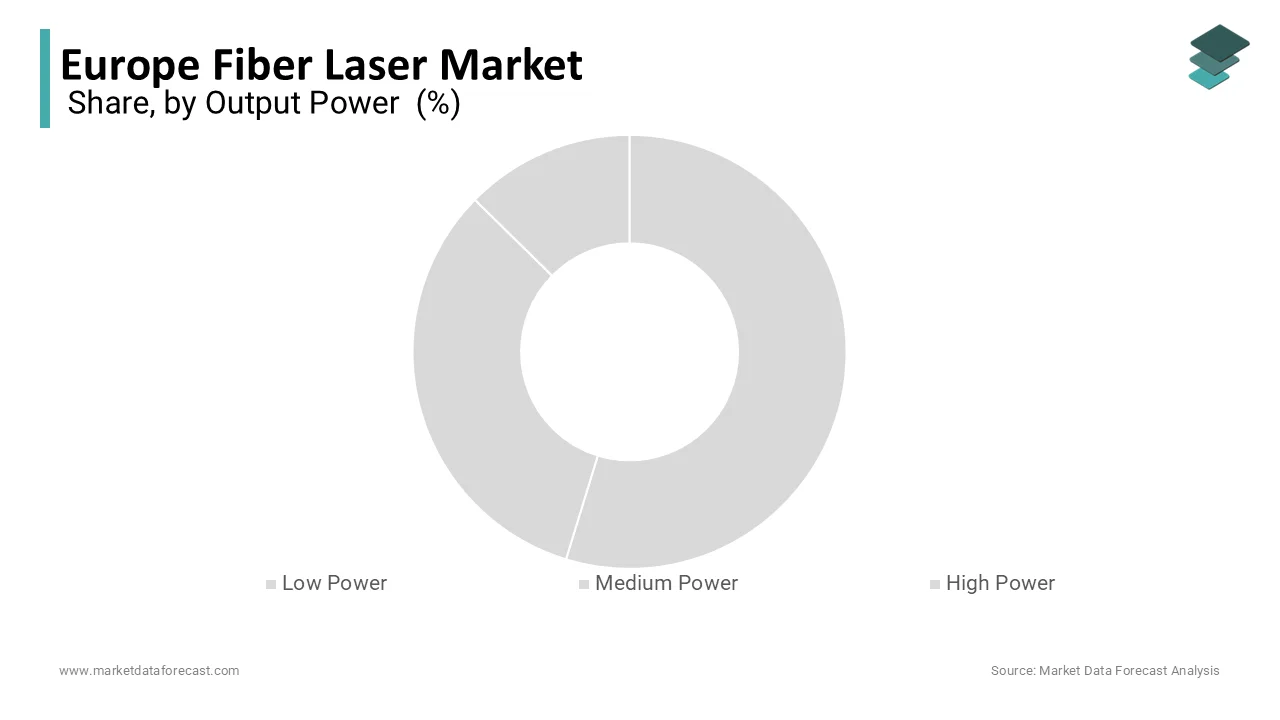
The high-power segment is expected to expand at a CAGR of 13.3% over the forecast period in the European market owing to the growing demand for thick section processing in shipbuilding renewable energy infrastructure and defense applications. Offshore wind tower fabrication alone requires cutting and welding of steel plates exceeding 50 millimeters in thickness, which is a task that requires lasers rated at 6 kilowatts or higher. According to WindEurope, Europe installed 18.7 gigawatts of new offshore wind capacity in 2023 with each turbine foundation requiring extensive laser processed seam welds. In response, companies like Meyer Werft and Siemens Energy have deployed 20-kilowatt fiber laser systems capable of achieving single-pass weld depths of 25 millimeters. The European Defence Agency’s 2025 procurement guidelines also mandate laser based joining for next generation armoured vehicle chassis to ensure structural integrity under ballistic stress. Furthermore, as per the European Clean Steel Partnership, high power lasers reduce energy consumption in heavy fabrication compared to plasma cutting due to narrower kerf widths and faster traverse speeds. As Europe scales its industrial sovereignty in energy and defense, this segment will continue its accelerated trajectory.
By Laser Type Insights
The continuous wave segment led the market by holding 58.8% of the European market share in 2025. The growth of the continuous wave segment in the European market is attributed to their suitability for high-speed uninterrupted processing tasks such as sheet metal cutting pipe welding and cladding. CW lasers deliver stable output essential for applications requiring consistent melt pool dynamics across long seam lengths which is critical in automotive and HVAC manufacturing. In 2023, a majority of laser cutting machines installed in German industrial facilities utilized CW fiber sources primarily in the 1-to-6-kilowatt range. The maturity of CW technology that offers lower cost per watt and simpler cooling requirements compared to pulsed alternatives is boosting the expansion of the continuous wave segment in the European market. European OEMs including Trumpf and Amada have optimized their flagship cutting platforms around CW lasers achieving cutting speeds of 45 meters per minute on 1 millimeters stainless steel. Additionally, the European Union’s Industrial Emissions Directive incentivizes technologies that minimize particulate generation and CW fiber lasers produce significantly less fume than mechanical shearing. This regulatory, industrial and economic alignment ensures CW lasers remain the backbone of European laser manufacturing.
The pulsed segment is fastest growing segment in the European market and is likely to register a CAGR of 13.3% over the forecast period owing to the surging demand in microelectronics medical device manufacturing and precision surface structuring. The rise of advanced semiconductor packaging and miniaturized sensors requires ablation with micrometer precision and negligible heat affected zones achievable only through nanosecond to femtosecond pulsed lasers. In 2023, European advanced packaging pilot lines increasingly integrated pulsed fiber lasers for wafer dicing, which is redistribution layer patterning and via drilling. In the medical sector, the European Medical Devices Regulation mandates laser marking of Unique Device Identification codes on implants that pulsed lasers accomplish without altering biocompatibility. Companies like IPG Photonics and Bright Solutions have launched compact air-cooled pulsed lasers with repetition rates exceeding 2 megahertz enabling high throughput in stent manufacturing. Furthermore, pulsed laser texturing is now standard in tribological surface enhancement for aerospace turbine blades, reducing friction in endurance testing. This convergence of regulatory precision and high value applications drives exceptional growth.
By Application Insights
The cutting segment remains the largest application segment for fiber lasers in Europe and had 47.5% of the regional market share in 2025. The growth of the cutting segment in the European market is driven by their unmatched speed precision and cost efficiency in processing metals across automotive construction and mechanical engineering sectors. In 2023, European manufacturers processed millions of metric tons of sheet metal using laser cutting systems with fiber lasers accounting for the majority of new installations. The dominance of the cutting segment in the European market is driven by the ability of fiber lasers to cut reflective materials like copper and brass without back reflection damage, a critical advantage over CO2 lasers. Automotive suppliers such as Bosch and ZF rely on 2-kilowatt fiber lasers to cut thousands of unique part numbers annually for electric drivetrains. Modular steel construction has grown significantly since 2021, which is driving demand for laser cut structural components with tight tolerances. Additionally, the European Union’s Circular Economy Action Plan promotes material efficiency and fiber laser cutting reduces scrap rates compared to plasma methods. This blend of industrial scale, regulatory alignment and material performance secures cutting’s leading position.
The fine and micro processing segment is predicted to register a CAGR of 15.4% over the forecast period in the regional market owing to the Europe’s strategic investments in photonics quantum technologies and medical microsystems. This segment encompasses drilling scribing and structuring at micron scale critical for sensors microfluidics and photonic integrated circuits. According to the Quantum Flagship initiative the European Commission allocated 1.2 billion euros in 2025 to develop quantum sensors which require femtosecond fiber lasers to pattern superconducting circuits with sub 100 nanometre accuracy. In the medical field, European firms produced millions of lasers processed catheter components in 2023 with pulsed fiber lasers enabling clean cuts in nitinol without burrs. The European Space Agency uses micro processing lasers to fabricate lightweight optical benches for satellite interferometers achieving surface roughness below 50 nanometres. Furthermore, the European Electronics Circularity Initiative mandates high precision recycling of printed circuit boards, a process that relies on ultrafast lasers to delaminate layers without toxic emissions. This nexus of frontier science, regulatory compliance and miniaturization ensures exponential growth of the fine and micro processing segment in the European market.
COUNTRY LEVEL ANALYSIS
Germany Fiber Laser Market Analysis
Germany stands as the undisputed leader in the European fiber laser market and the dominating share of 28.5% of the regional market in 2025. The dominance of Germany in the European market is driven by its world class machine tool industry deep photonics expertise and robust industrial automation ecosystem. Germany is home to global laser system integrators such as Trumpf and laser component innovators like LASER COMPONENTS. The country hosts a significant share of Europe’s high power laser installations. In 2023 the mechanical engineering sector invested 11.4 billion euros in digital and laser-based production technologies as per the VDMA. The German government’s High-Tech Strategy 2025 allocated 2.3 billion euros to photonics including fiber laser development for battery and hydrogen applications. Fraunhofer institutes in Aachen and Stuttgart operate Europe’s most advanced laser application centers validating new processes for automotive and aerospace sectors. With over 12000 photonics engineers employed in Baden Württemberg alone Germany combines R&D depth, manufacturing scale and export orientation to maintain its technological edge and market dominance.
Italy Fiber Laser Market Analysis
Italy held a strong second position in the European fiber laser market in 2025. The growth of Italy in the European market is driven by its dynamic metalworking sector specialization in laser cutting of stainless steel and growing adoption in fashion and luxury goods manufacturing. The Italian machine tool industry ranks second in Europe with over 2500 companies producing laser-based fabrication systems primarily for sheet metal processing. In 2023 Italy exported 1.8 billion euros worth of laser cutting machines particularly to Eastern Europe and North Africa. The Lombardy and Emilia Romagna regions host clusters of job shops using 1-to-3-kilowatt fiber lasers to produce components for automotive and white goods with lead times under 48 hours. The Italian Ministry of Economic Development’s Industry 4.0 Plan provided 600 million euros in 2025 tax credits for laser automation enabling SMEs to upgrade from CO2 to fiber systems. Additionally Italian luxury brands such as Luxottica use pulsed fiber lasers for micro engraving on eyewear frames achieving precision unattainable with mechanical tools. This blend of industrial pragmatism and high value customization fuels sustained demand.
France Fiber Laser Market Analysis
France occupied a strategic position in the European fiber laser market in 2025. The prominent position of France in the European fiber laser market is attributed to the French aerospace, defense and nuclear energy sectors that demand high reliability laser processing. Airbus facilities in Toulouse and Saint Nazaire utilize multi kilowatt fiber lasers for wing rib cutting and fuselage welding with zero defect tolerance as confirmed by their 2025 production data. The French Alternative Energies and Atomic Energy Commission operates Europe’s largest laser facility at CEA Le Ripault where high power fiber lasers test materials for next generation nuclear reactors. In 2025 the French government launched the France 2030 investment plan allocating 500 million euros to photonics including development of radiation hardened fiber lasers for space applications. Companies like Lumibird and Quantel have pivoted from solid state to fiber architectures to meet certification requirements. Furthermore, France’s strong academic base at institutions like École Polytechnique drives innovation in ultrafast laser matter interaction. This concentration of sovereign high-tech applications ensures consistent and sophisticated laser adoption.
United Kingdom Fiber Laser Market Analysis
The United Kingdom is predicted to hold a notable share of the European fiber laser market over the forecast period due to its excellence in scientific research quantum technologies and medical device innovation. Despite Brexit, the UK remains a core participant in European photonics initiatives with over 30 universities conducting advanced fiber laser research. In 2025 the UK’s National Quantum Strategy committed 2.5 billion pounds to develop quantum sensors and clocks which rely on precision fiber laser cooling and trapping systems. Medical device manufacturers in Cambridge and Oxfordshire use femtosecond fiber lasers to fabricate microfluidic diagnostic chips with channel widths below 10 micrometers. Companies like SPI Lasers, a subsidiary of Trumpf, supply specialty pulsed fiber lasers to hundreds of European medtech firms. The UK also leads in laser based nuclear decommissioning with the National Nuclear Laboratory deploying 4-kilowatt fiber lasers for remote cutting of radioactive components. This science driven ecosystem sustains high value laser consumption beyond traditional manufacturing.
Sweden Fiber Laser Market Analysis
Sweden emerges as a high impact player in the European fiber laser market through its focus on sustainable manufacturing green technology and precision engineering. Sweden is home to global industrial leaders like Sandvik and ABB Sweden leverages fiber lasers for cutting of advanced stainless steels and welding of electric vehicle motors with minimal energy waste. Industrial laser systems are increasingly recognized for their role in improving energy efficiency in manufacturing with studies highlighting their contribution to reducing energy intensity in production processes. In 2025, Sweden’s Vinnova Innovation Agency funded several projects focused on advancing laser-based hydrogen component manufacturing, including work on electrolyzer technologies. Swedish automotive supplier Northvolt integrates fiber laser welding in its Skellefteå gigafactory, supporting high-speed battery cell production as part of its sustainability initiatives. Additionally, Chalmers University of Technology is advancing research in AI-driven laser processing to enable adaptive manufacturing. This synergy of clean tech precision and innovation positions Sweden as a model for future-oriented laser adoption.
COMPETITIVE LANDSCAPE
The Europe fiber laser market exhibits intense but structured competition characterized by technological differentiation rather than price rivalry. Dominated by a mix of European industrial champions and global photonics leaders the landscape rewards deep application expertise regulatory compliance and localized support. Incumbents leverage decades of process know how to embed their lasers into certified production lines particularly in aerospace and medical sectors where qualification cycles exceed two years. New entrants from Asia face significant hurdles due to stringent CE marking requirements machine safety directives and customer preference for local service networks. Innovation is concentrated in ultrafast pulse control beam shaping and energy efficiency with European research institutions like Fraunhofer acting as neutral testbeds for pre competitive collaboration. The absence of commoditization allows premium pricing for lasers that demonstrably reduce scrap energy use or cycle time. As Europe prioritizes strategic autonomy in semiconductors batteries and defense the competitive advantage increasingly lies with players who combine photonics excellence with supply chain resilience and sustainability transparency.
KEY MARKET PLAYERS
Some of the companies that are playing a dominating role in the global europe fiber laser market include
- IPG Photonics Corporation
- TRUMPF GmbH + Co. KG
- Coherent Corp.
- nLIGHT, Inc.
- Jenoptik AG
- Lumentum Holdings Inc.
- SPI Lasers (a TRUMPF subsidiary)
- Fanuc Corporation
- Rofin-Sinar Technologies Inc. (part of Coherent)
- Amplitude Laser Group
- Raycus Fiber Laser Technologies Co., Ltd.
- NKT Photonics A/S
- Laserline GmbH
- IMRA America, Inc. (a subsidiary of Aisin Seiki)
- JPT Opto-Electronics Co., Ltd.
- TOPTICA Photonics AG
- Bystronic Laser AG
- OXiGENO Laser Systems
- Precitec GmbH & Co. KG
- Hamamatsu Photonics K.K.
TOP LEADING PLAYERS IN THE MARKET
- Trumpf is a German multinational and a global pioneer in industrial laser technology with deep roots in the European fiber laser market. The company designs and manufactures a comprehensive portfolio of CW and pulsed fiber lasers ranging from a few watts to over 20 kilowatts used extensively in automotive aerospace and sheet metal fabrication. Trumpf integrates its lasers into its own machine tools and also supplies OEM laser sources to third party system builders worldwide. In 2025 the company launched its TruFiber Pulse 20000 platform featuring real time beam shaping for battery welding applications. It also expanded its Ditzingen photonics campus to accelerate development of green hydrogen compatible laser systems reinforcing its leadership in high precision sustainable manufacturing across Europe and globally.
- IPG Photonics is a US based global leader in fiber laser innovation with a substantial operational footprint in Europe including manufacturing sites in Germany and the UK. The company pioneered high power single mode fiber lasers and continues to set benchmarks in electrical efficiency and beam quality for cutting welding and additive manufacturing. IPG supplies core laser engines to major European machine tool builders and directly serves automotive and energy sector clients. In early 2025 IPG introduced its YLPN series of nanosecond pulsed lasers with enhanced pulse control for semiconductor packaging and medical device marking. The company also deepened partnerships with European research institutes to co develop radiation hardened lasers for space applications strengthening its strategic relevance in high tech European markets.
- Coherent is a global photonics innovator headquartered in the United States with significant presence in Europe through its acquisition of Rofin and integration of former Lumibird industrial assets. The company offers a diverse range of fiber lasers including QCW and ultrafast platforms tailored for microprocessing fine welding and defense applications. Coherent maintains application labs in Finland France and Italy enabling rapid process validation for European customers in medical electronics and aerospace sectors. In 2025 Coherent unveiled its HyperRapid NXT industrial femtosecond laser optimized for electric vehicle battery foil cutting with throughput exceeding 300 millimeters per second. This launch along with its expanded European service network underscores its commitment to capturing high growth precision laser segments across the continent.
TOP STRATEGIES USED BY THE KEY MARKET PARTICIPANTS
Key players in the Europe fiber laser market pursue vertical integration by developing in house laser sources beam delivery systems and processing software to ensure performance consistency and reduce dependency on third party components. They invest heavily in application specific R&D through partnerships with automotive aerospace and semiconductor manufacturers to co engineer laser parameters for emerging materials such as silicon carbide and solid state battery foils. Companies expand local manufacturing and service infrastructure across Western and Central Europe to shorten delivery lead times and comply with EU data sovereignty requirements. Strategic acquisitions of specialty laser firms enable rapid entry into niche segments like quantum or medical device processing. Additionally firms align product roadmaps with European sustainability mandates by enhancing wall plug efficiency enabling renewable energy integration and reducing rare earth material content in laser gain fibers.
MARKET SEGMENTATION
This research report on the europe fiber laser market is segmented and sub-segmented into the following categories
By Output Power
- Low Power
- Medium Power
- High Power
By Laser Type
- Continuous Wave (CW)
- Pulsed
By Application
- Cutting
- Welding
- Marking
- Fine & Micro Processing
- Additive Manufacturing
- Others
By Country
- Germany
- Italy
- France
- United Kingdom
- Sweden
- Rest of Europe