- Product Description Description
- Table of Contents TOC
- List of Table & Figure LOT
- Get Free Sample PDF Sample PDF
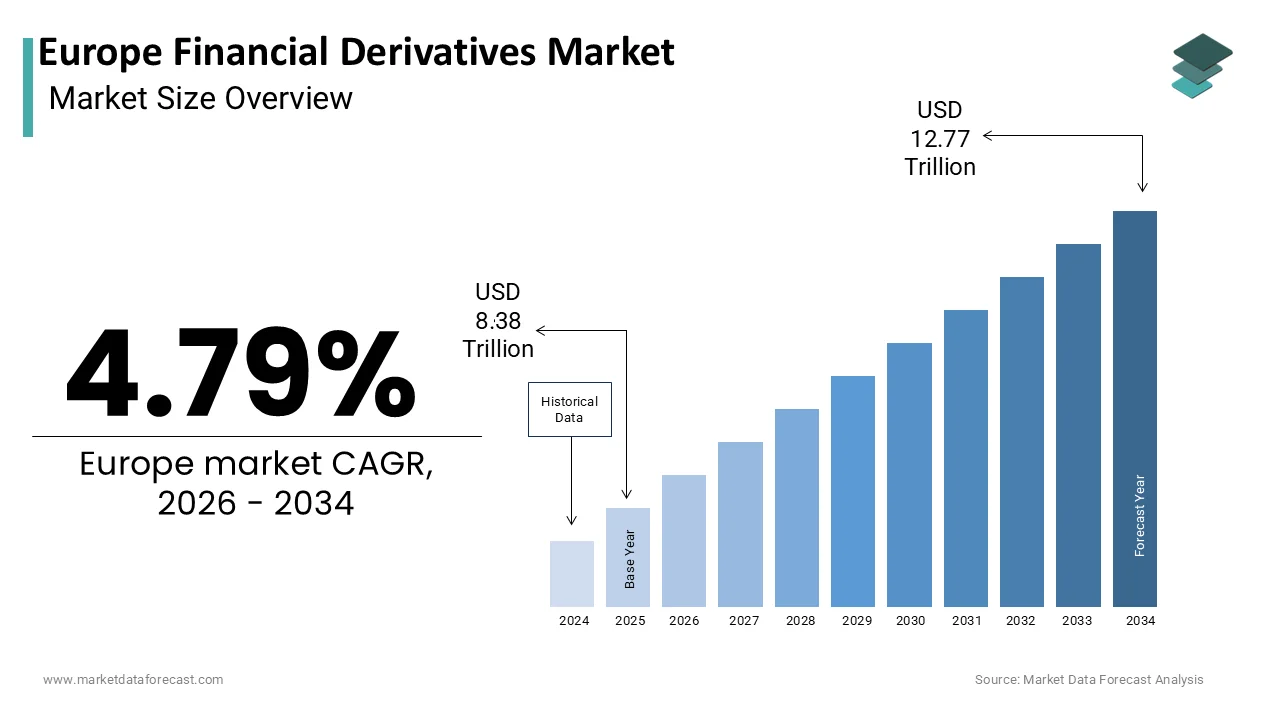
Market Size, 2025
$8.38 TrillionMarket Estimate, 2026
$8.78 TrillionMarket Forecast, 2034
$12.77 TrillionCAGR, 2026–2034
4.79%Europe Financial Derivatives Market Size
The europe financial derivatives market was valued at USD 8.38 trillion in 2025, is estimated to reach USD 8.78 trillion in 2026, and is projected to reach USD 12.77 trillion by 2034, growing at a CAGR of 4.79% from 2026 to 2034.
Financial derivatives constitute a sophisticated ecosystem of contractual agreements whose values are derived from underlying assets such as equities, interest rates, currencies, and commodities. These instruments, including futures, options, swaps, and forwards, serve as critical mechanisms for price discovery, risk mitigation, and speculative positioning within the continental economy. Unlike simple spot transactions, derivatives allow market participants to decouple the timing of asset delivery from the agreement itself, facilitating complex hedging strategies against volatility. The landscape is heavily influenced by the regulatory framework established post-crisis, particularly the European Market Infrastructure Regulation, which mandates central clearing for standardized over-the-counter contracts. According to data from the Bank for International Settlements, the notional amount of outstanding derivatives held by European banks exceeds several hundred trillion euros, which indicates the immense scale of exposure management in the region. Furthermore, the European Securities and Markets Authority notes that the shift toward electronic trading platforms has increased transparency, with algorithmic execution now accounting for a substantial majority of exchange-traded derivative volumes. The market operates as a vital nervous system for the Eurozone, enabling corporations to lock in borrowing costs and investors to gain leveraged exposure without owning the physical asset. This intricate web of financial engineering supports the stability of the broader banking sector while introducing unique systemic interdependencies that require constant supervisory oversight.
MARKET DRIVERS
Escalating Macroeconomic Volatility and Interest Rate Uncertainty
The growing macroeconomic instability characterized by fluctuating interest rates and inflationary pressures is one of the major factors driving the growth of the European financial derivatives market. As central banks across the continent adjust monetary policies to combat inflation, the cost of borrowing becomes unpredictable, which is forcing corporations and institutional investors to seek protection through interest rate swaps and futures. According to the European Central Bank, the deposit facility rate experienced its most rapid increase in decades recently, creating significant uncertainty for entities with variable-rate debt obligations. This volatility compels treasurers to utilize derivatives to lock in fixed rates, thereby stabilizing cash flow projections and protecting balance sheets from adverse movements. The geopolitical tensions affecting energy prices have further exacerbated currency fluctuations, which are driving up the usage of foreign exchange forwards and options among importers and exporters. According to the data from the International Swaps and Derivatives Association, the volume of interest rate derivative transactions in Europe surged as market participants rushed to hedge against potential rate hikes. The inability to forecast economic conditions with precision transforms derivatives from optional tools into essential components of corporate survival strategies. This environment ensures sustained demand as market actors continuously recalibrate their hedges to navigate the turbulent financial landscape.
Stringent Regulatory Capital Requirements and Risk Management Mandates
The rigorous regulatory environment that mandates the use of derivatives for effective risk management and capital optimization under frameworks like Basel III and Solvency II is another key factor boosting the expansion of the European financial derivatives market. Financial institutions and insurance companies are required to hold significant capital reserves against unhedged risks, which makes the use of derivatives a cost-effective method to reduce capital charges while maintaining exposure levels. According to guidelines issued by the European Banking Authority, banks must demonstrate robust risk mitigation strategies to avoid punitive capital buffers, which directly incentivize the adoption of credit default swaps and total return swaps. These regulations force entities to move away from bilateral over-the-counter arrangements toward centrally cleared contracts that offer greater transparency and lower counterparty risk. The push for standardization has also increased liquidity in specific derivative classes, making them more attractive for hedging purposes. As per the data from LCH Clearnet, the volume of cleared interest rate swaps in euros has reached record highs as compliance becomes non-negotiable. Furthermore, the requirement for real-time reporting under EMIR ensures that firms maintain accurate books, which fosters a culture where derivative usage is deeply embedded in daily operations. This regulatory compulsion creates a baseline demand that persists regardless of market sentiment and secures the long-term growth of the sector.
MARKET RESTRAINTS
Prohibitive Compliance Costs and Operational Complexity
The exorbitant cost associated with complying with a labyrinthine web of regulatory reporting and clearing obligations is significantly impeding the European financial derivatives market's growth. The implementation of the European Market Infrastructure Regulation requires firms to invest heavily in technology infrastructure, legal expertise, and operational staff to manage trade reporting and margin calculations. According to a study by Oliver Wyman, large European banks spend billions of euros annually solely on regulatory compliance related to derivatives, which is diverting resources from innovation and client service. Smaller regional banks and non-financial corporates often find these costs prohibitive, which is leading them to reduce their hedging activities or exit certain derivative markets entirely. The complexity of calculating initial and variation margins for non-centrally cleared trades adds another layer of administrative burden that discourages participation. According to the data from the European Commission, a significant number of small and medium-sized enterprises have reduced their use of hedging instruments due to the perceived complexity and cost of compliance. The fragmentation of rules across different member states further complicates cross-border transactions, which is creating inefficiencies that dampen market liquidity. These operational hurdles act as a barrier to entry, limiting the depth of the market and preventing smaller players from accessing crucial risk management tools, thereby constraining overall market expansion.
Persistent Counterparty Risk and Trust Deficits
Despite regulatory improvements, the lingering fear of counterparty default remains a potent restraint that limits the willingness of market participants to engage in extensive derivative transactions, which further hinders the regional market expansion. The memory of past financial crises, where major institutions failed to honour their derivative obligation,s continues to influence behavior, which is causing firms to be overly cautious in their exposure to single counterparties. According to analysis by Moody's Analytics, concerns regarding the creditworthiness of certain European banks during periods of stress lead to wider bid-ask spreads and reduced liquidity in the over-the-counter derivatives market. This risk aversion forces companies to collateralize positions more heavily, tying up capital that could otherwise be deployed for growth. The reliance on central counterparties mitigates some risk but introduces concentration risk, where the failure of a single clearing house could have catastrophic systemic implications. As per the data from the Financial Stability Board, while central clearing has increased, the concentration of exposures in a few major clearing houses remains a concern for regulators and participants alike. This inherent distrust necessitates complex legal agreements and continuous monitoring, increasing the friction and cost of trading. Consequently, some potential users opt to remain unhedged rather than navigate the complexities of counterparty risk management, which is stifling the full potential of the derivatives market.
MARKET OPPORTUNITIES
Integration of Blockchain Technology for Smart Contract Execution
The adoption of blockchain technology and distributed ledger systems provides a notable opportunity for the European financial derivatives market. Smart contracts can automate the lifecycle of derivative agreements, from initiation to margin calls and final settlement, which significantly reduces operational risks and costs. According to research by the European Central Bank, the use of distributed ledger technology could reduce settlement times from days to minutes and eliminate the need for multiple intermediaries, thereby lowering transaction costs substantially. This technological leap enables the creation of tokenized derivatives that can be traded on decentralized platforms, which increases accessibility for a broader range of investors. Several pilot projects involving major European banks are already testing the viability of blockchain-based repos and swaps, which are demonstrating significant efficiency gains. The immutability of the ledger provides an auditable trail that satisfies regulatory reporting requirements automatically, which addresses one of the major pain points of current systems. According to the data from the World Economic Forum, widespread adoption could save the global financial industry billions in reconciliation and dispute resolution costs. By embracing this innovation, the European market can position itself as a leader in next-generation financial infrastructure, which is attracting global capital seeking efficiency and transparency.
Expansion of Sustainability Linked Derivative Instruments
The growing global emphasis on environmental, social, and governance criteria offers a lucrative opportunity in the European financial derivatives market. These innovative instruments allow parties to hedge risks or speculate on outcomes tied to specific sustainability metrics, such as carbon emission reductions or renewable energy generation. According to the International Swaps and Derivatives Association, the issuance of sustainability-linked swaps and bonds has grown exponentially as corporations strive to meet net-zero targets and align with the European Green Deal. Financial institutions are increasingly designing custom derivatives that adjust payout structures based on the achievement of predefined ESG goals, which provides a financial incentive for sustainable practices. The European Union's taxonomy for sustainable activities provides a clear framework that enhances the credibility and standardization of these products, encouraging wider adoption. As per Bloomberg, the volume of green finance instruments in Europe is outpacing other regions, which is creating a fertile ground for derivative innovation. As regulatory pressure mounts for companies to disclose climate risks, the demand for tools to hedge against transition risks and physical climate impacts will surge. This niche represents a high-growth avenue where the derivatives market can directly contribute to the continent's sustainability objectives while generating new revenue streams.
MARKET CHALLENGES
Fragmentation of Liquidity Across Venues and Jurisdictions
The fragmentation of liquidity caused by the coexistence of multiple trading venues, clearing houses, and national regulatory regimes is one of the significant challenges to the European financial derivatives market growth. Unlike the United States, which benefits from a more unified market structure, Europe suffers from a patchwork of rules that trading activity across various platforms, reducing overall market depth and efficiency. According to a report by the European Securities and Markets Authority, liquidity in certain derivative classes is thinly spread across dozens of trading venues, leading to wider spreads and higher execution costs for end users. The lack of a single consolidated tape for derivatives data makes it difficult for participants to get a comprehensive view of market prices, hindering optimal decision-making. Cross-border transactions often face additional hurdles due to differing national interpretations of EU regulations, creating friction that impedes the free flow of capital. Data from the Trade Reporting and Compliance Engine shows that the fragmentation increases the complexity of best execution compliance for investment firms. This disjointed landscape prevents the market from achieving the economies of scale necessary to compete globally, leaving European participants at a disadvantage compared to their counterparts in more integrated markets.
Systemic Risks Posed by Interconnected Clearing Houses
The increasing reliance on central counterparties for clearing derivatives introduces a concentrated systemic risk,s further challenging the expansion of the European financial derivatives market. While central clearing reduces bilateral counterparty risk, it concentrates exposure in a few critical infrastructure entities whose failure could trigger a cascade of defaults across the continent. According to stress test results published by the European Systemic Risk Board, the interconnectedness of major banks with a limited number of clearing houses creates a vulnerability where distress in one node could propagate rapidly throughout the network. The requirement for substantial default funds and margin contributions ties up vast amounts of capital, which can become a source of liquidity strain during periods of market stress. The complexity of managing the default of a major clearing member involves intricate waterfalls and loss-sharing mechanisms that are untested in extreme scenarios. Data from the Bank for International Settlements highlights that the notional exposure concentrated in European clearing houses has reached unprecedented levels, amplifying the potential impact of any operational or financial failure. Regulators face the difficult task of ensuring these entities are resilient without imposing costs that stifle market activity, creating a delicate balancing act that defines the current risk landscape.
REPORT COVERAGE
| REPORT METRIC | DETAILS |
| Market Size Available | 2025 to 2034 |
| Base Year | 2025 |
| Forecast Period | 2026 to 2034 |
| Segments Covered | By Type, Underlying Asset, End User, and Region. |
| Various Analyses Covered | Global, Regional, and Country-Level Analysis, Segment-Level Analysis, Drivers, Restraints, Opportunities, Challenges; PESTLE Analysis; Porter’s Five Forces Analysis, Competitive Landscape, Analyst Overview of Investment Opportunities |
| Countries Covered | UK, France, Spain, Germany, Italy, Russia, Sweden, Denmark, Switzerland, Netherlands, Turkey, Czech Republic, Rest of Europe |
| Market Leaders Profiled | Eurex Exchange, Euronext N.V., London Stock Exchange Group, CME Group, Intercontinental Exchange, Nasdaq, Inc., SIX Swiss Exchange, Bolsas y Mercados Españoles, Cboe Global Markets, Deutsche Börse AG, LCH Group, Euroclear |
SEGMENTAL ANALYSIS
By Type Insights
The swaps segment led the market by accounting for 45.4% of the European market share in 2025 due to the critical role swaps play in managing long-term interest rate exposure and facilitating complex corporate financing strategies across the Eurozone. The supremacy of the swaps segment in the European market is also attributed to its indispensable function in allowing corporations and financial institutions to convert variable-rate debt into fixed-rate obligations, thereby stabilizing cash flows amidst volatile monetary policies. As the European Central Bank adjusted its deposit facility rate significantly in recent years to combat inflation, the demand for interest rate swaps surged as treasurers sought to lock in borrowing costs. According to data from the International Swaps and Derivatives Association, the euro-denominated interest rate swap market remains the deepest and most liquid segment globally, with daily trading volumes consistently exceeding hundreds of billions of euros. The flexibility of swaps allows parties to tailor maturities and payment frequencies to match specific liability profiles, a feature that standardized futures contracts cannot offer. Furthermore, the widespread adoption of the Euro Interbank Offered Rate replacement benchmarks has reinforced the reliance on swaps for hedging transition risks. The ability to execute large block trades without significant market impact makes swaps the preferred instrument for institutional players managing massive balance sheets. This deep integration into corporate treasury operations ensures that the swaps segment maintains its leading position as the backbone of European risk management infrastructure.
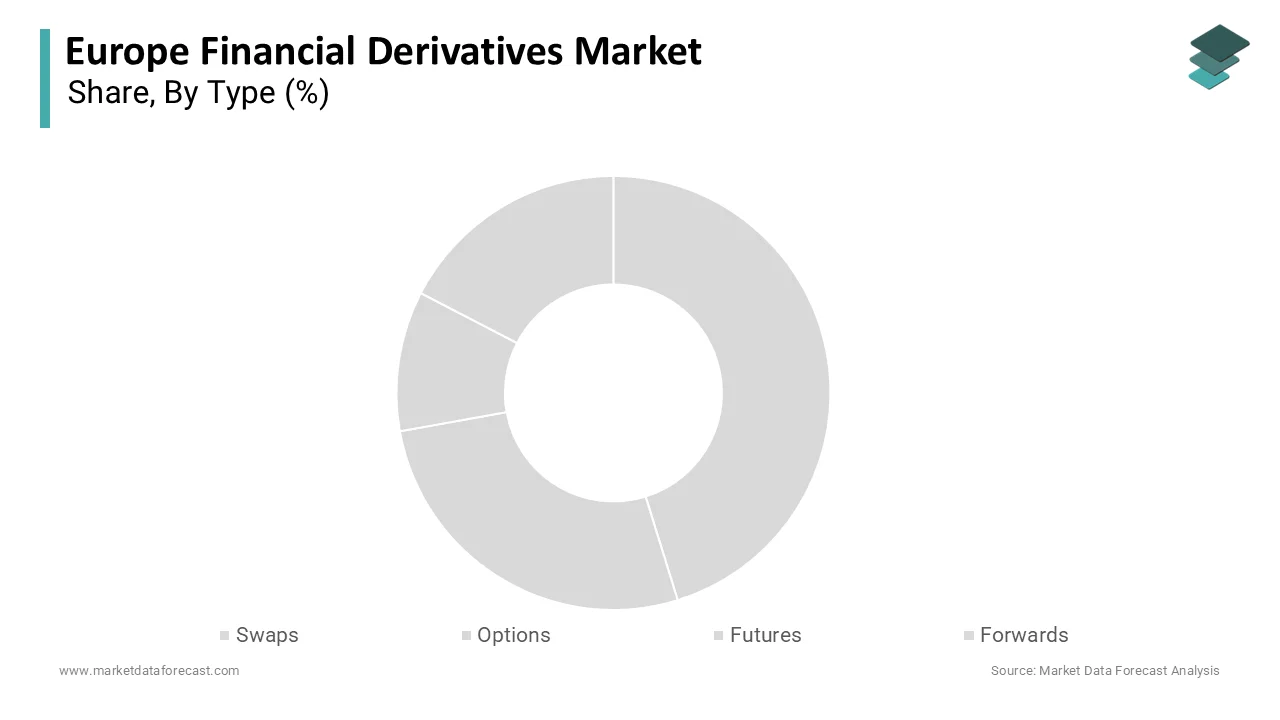
On the other hand, the options segment is projected to be the fastest-growing type in the European financial derivatives market and record a CAGR of 8.7% over the forecast period, owing to the increasing demand for non-linear payoff structures that allow investors to define risk precisely while retaining upside potential. The growing prevalence of tail risk hedging strategies among institutional investors who seek protection against extreme market moves without sacrificing capital efficiency is further propelling the expansion of the options segment in the European market. In an era marked by geopolitical shocks and sudden economic shifts, traditional linear hedges like futures often prove too costly or inefficient, driving demand for put options that provide asymmetric protection. According to analysis by Eurex Exchange, the volume of equity index put options traded in Europe has seen double-digit growth annually as fund managers prioritize capital preservation during periods of uncertainty. The ability to purchase downside protection for a limited premium appeals to asset managers who need to comply with strict drawdown limits imposed by clients. Furthermore, the rise of volatility as an asset class has led to sophisticated trading strategies involving straddles and strangles that profit from market turbulence rather than direction. According to the European Securities and Markets Authority, a marked increase in the open interest of single stock options as retail and professional traders alike utilize these instruments to express nuanced views on individual company performance. This shift toward dynamic risk management ensures that options remain the preferred tool for navigating complex market environments.
By Underlying Asset Insights
The interest rate underlying asset segment held the dominant position in the European financial derivatives market in 2025, with 54.4% of the regional market share in 2025. The growth of the interest rate underlying asset segment in the European market can be credited to the European sovereign debt market and the universal need for financial entities to manage exposure to fluctuating borrowing costs. The enormous volume of government bonds issued by Eurozone nations that serves as the foundational reference asset for a vast array of derivative contracts is further contributing to the expansion of the interest rate underlying asset segment in the European market. With the European Central Bank actively managing monetary policy to control inflation and stimulate growth, the sensitivity of bond yields to policy announcements creates constant hedging requirements for banks, insurers, and pension funds. According to data from the European Central Bank, the outstanding amount of euro area general government debt exceeds thirteen trillion euros, which provides a massive underlying base for futures and swaps trading. Institutions holding these bonds must hedge against duration risk to protect their net worth from yield curve shifts, which is leading to relentless activity in interest rate derivatives. The diversity of credit ratings across member states also fosters an active market for spread trading, where investors speculate on the divergence between core and peripheral nation yields. This macroeconomic backdrop ensures that interest rate derivatives remain the most heavily traded instruments, as they are essential for maintaining stability in the broader financial system. The sheer magnitude of the underlying debt market guarantees a perpetual flow of hedging demand that dwarfs other asset classes.
However, the commodity underlying asset segment is emerging as the fastest-growing category and is estimated to register a CAGR of 11.4% over the forecast period, owing to the extreme volatility in energy and agricultural markets following geopolitical disruptions and the global transition toward green energy. The growing volatility in energy prices triggered by geopolitical conflicts and supply chain disruptions has forced European industries to aggressively hedge their input costs, further fuelling the growth of the commodity underlying asset segment in the European market. The reduction of natural gas supplies from Russia and the subsequent price spikes created an urgent need for utilities and manufacturers to secure future prices through futures and options contracts. According to reports from the International Energy Agency, European natural gas prices experienced unprecedented fluctuations, prompting a record increase in hedging activity across the continent. Industrial consumers who previously relied on long-term fixed contracts are now turning to the derivatives market to manage spot price exposure, which is driving up volumes in power and gas derivatives. The instability extends to oil markets as well, where refining margins have become highly unpredictable, necessitating more frequent rebalancing of hedge portfolios. According to ICE Europe, a significant rise in the open interest of energy-related contracts as market participants seek to insulate themselves from further shocks. This environment of uncertainty transforms commodity derivatives from speculative tools into essential operational necessities, which is fuelling rapid market expansion.
By End User Insights
The commercial banks segment accounted for 40.8% of the European market share in 2025. The leading position of the commercial banks segment in the European market is attributed to its dual role as primary dealers, facilitating client flow, and as major proprietary hedge managers managing their own extensive balance sheet risks. The indispensable function of commercial banks as intermediaries who provide liquidity and execute derivative transactions on behalf of a diverse clientele ranging from multinational corporations to small businesses is further aiding the expansion of the commercial banks segment in the European market. As the primary conduit between end users and the market, banks absorb risk onto their own books before hedging it in the interbank market, a process that generates immense transaction volumes. According to data from the Bank for International Settlements, European reporting banks consistently report the highest gross notional amounts of derivatives held, reflecting their central position in the distribution chain. The breadth of their product offerings allows them to serve virtually every sector of the economy, from aviation fuel hedging to currency swaps for importers. Their extensive branch networks and relationship banking models ensure a steady stream of client mandates that drive daily trading activity. Furthermore, the requirement for banks to provide two-way quotes and market-making obligations ensures continuous liquidity even during stressed periods. This pivotal intermediary role means that almost every derivative transaction in Europe touches a commercial bank at some point, which is cementing their status as the dominant player in terms of volume and market influence.
On the other end, the hedge funds segment is identified as the fastest-growing end-user group and is expected to grow at a promising CGAR of 9.7% over the forecast period. The adoption of complex global macro and relative value strategies that rely heavily on derivatives to express nuanced market views and exploit pricing inefficiencies is propelling the expansion of the hedge funds segment in the European market. Unlike traditional long-only investors, hedge funds utilize the leverage and flexibility of derivatives to take both long and short positions across multiple asset classes simultaneously, generating returns regardless of market direction. According to a survey by Preqin, assets under management for European hedge funds have rebounded strongly, with a significant portion dedicated to strategies that require intensive derivative usage, such as convertible bond arbitrage and volatility trading. The ability to access leverage through total return swaps and futures allows these funds to amplify returns on capital, which is attracting high-net-worth individuals and pension funds seeking diversification. The dynamic nature of European markets, characterized by divergent monetary policies and political events, provides fertile ground for macro strategies that depend on rapid execution via derivatives. As per the data from Eurex, a rising share of trading volume is attributed to non-bank financial institutions, which reflects the growing influence of hedge funds. As market complexity increases, the demand for the specialized skills and agile execution capabilities of hedge funds continues to rise, which is driving their accelerated growth in the derivatives ecosystem.
COUNTRY LEVEL ANALYSIS
United Kingdom Financial Derivatives Market Analysis
The United Kingdom dominated the financial derivatives market in Europe in 2025 with 35.5% of the regional market share due to its status as a global hub for over-the-counter trading and clearing. Despite Brexit, London retains its preeminent position thanks to the deep liquidity of its markets and the concentration of global banking talent. The city hosts the headquarters of major clearing houses and the largest cluster of international banks, creating an ecosystem unmatched in scale. According to data from the City of London Corporation, the UK accounts for the majority of global foreign exchange and interest rate derivative trading, with daily turnover figures that dwarf other European centers. The legal framework based on English common law provides certainty and enforceability for complex derivative contracts, attracting international counterparties. The presence of the London Metal Exchange and ICE Europe further diversifies the product range available to traders. Although regulatory divergence with the EU poses challenges, the sheer inertia of existing infrastructure and the depth of the talent pool ensure continued dominance. The UK market benefits from a time zone advantage that bridges Asian and American sessions, which facilitates 24-hour trading. This unique combination of legal, structural, and human capital advantages secures the UK's top position in the regional hierarchy.
Germany Financial Derivatives Market Analysis
Germany held a promising share of the European financial derivatives market in 2025. The growth of Germany in the European market is majorly driven by its robust industrial base and the presence of Eurex, one of the world's leading derivatives exchanges. The German market is characterized by a strong focus on exchange-traded derivatives, particularly equity and interest rate futures, which serve as benchmarks for the entire Eurozone. According to Deutsche Börse Group, Eurex consistently ranks among the top global exchanges for derivatives volume, underpinned by the high participation of German institutional investors and corporates. The country's manufacturing sector relies heavily on commodity and currency derivatives to hedge against input cost volatility and export revenue fluctuations. The regulatory environment is stringent yet stable, fostering trust among conservative investors such as insurance giants and pension funds. Frankfurt serves as a key financial center post Brexit, attracting some displaced trading activities and talent from London. The integration of German banking giants like Deutsche Bank and Commerzbank in the global derivatives network ensures significant flow generation. The emphasis on technological innovation and low-latency trading infrastructure further enhances the attractiveness of the German venue. This blend of industrial hedging needs and advanced exchange infrastructure cements Germany's role as a critical pillar of the European derivatives landscape.
France Financial Derivatives Market Analysis
France is predicted to hold a prominent share of the European financial derivatives market over the forecast period owing to its strong sovereign debt market and the active participation of large domestic banks and asset managers. The French derivatives market is heavily influenced by the need to hedge exposure to French government bonds and the broader Eurozone interest rate curve. According to data from the Autorité des Marchés Financiers, the volume of interest rate derivatives traded by French entities remains substantial, reflecting the size of the national debt and the sophistication of local financial institutions. Paris is home to major global banks that maintain significant trading desks focused on rates and credit derivatives. The presence of Euronext Paris provides a regulated platform for equity derivatives, catering to both retail and professional investors. The French regulatory approach emphasizes consumer protection and systemic stability, which shapes the structure of products offered to the market. The energy sector, dominated by giants like TotalEnergies, drives significant activity in commodity derivatives, particularly in power and carbon markets. The government's support for financial innovation and fintech startups is beginning to introduce new efficiencies in trade processing. This combination of sovereign scale, institutional depth, and industrial hedging demand ensures France remains a key player in the regional market.
Netherlands Financial Derivatives Market Analysis
The Netherlands is estimated to witness a healthy CAGR in the European financial derivatives market during the forecast period due to its strategic location as a logistics hub and the presence of major multinational corporations that drive substantial hedging activity. The Dutch market is notable for its high concentration of commodity trading firms and energy companies that utilize derivatives to manage global supply chain risks. According to the Dutch Central Bank, the notional number of derivatives held by Dutch non-financial corporations is disproportionately high relative to the size of the economy, reflecting the international nature of its business sector. Amsterdam hosts a vibrant community of proprietary trading firms and market makers who contribute significantly to liquidity in equity and currency derivatives. The regulatory framework is known for its pragmatism and openness to innovation, attracting fintech companies focused on blockchain-based settlement solutions. The presence of major exchanges like Euronext Amsterdam facilitates easy access to equity derivatives for a broad investor base. The country's strong tradition in agriculture and food processing also generates consistent demand for agricultural commodity futures and options. The skilled workforce and favorable tax environment for financial professionals further enhance the competitiveness of the Dutch market. These factors combine to make the Netherlands a specialized but influential node in the European derivatives network.
Switzerland Financial Derivatives Market Analysis
Switzerland is predicted to register a notable CAGR in the European financial derivatives market during the forecast period due to its status as a global wealth management center and the home of major commodity trading houses. The Swiss derivatives market is heavily skewed towards wealth management products and structured notes that embed optionality for high-net-worth clients. According to the Swiss Financial Market Supervisory Authority, the volume of over-the-counter derivatives linked to investment portfolios is significant, driven by the need for customized risk-return profiles. Geneva and Zurich host the headquarters of many of the world's largest commodity traders, who generate immense volumes in energy and metal derivatives to hedge physical trading positions. The stability of the Swiss Franc creates a unique dynamic in currency derivatives, as investors frequently hedge CHF exposure or use it as a haven play. The regulatory environment is rigorous but designed to maintain the competitiveness of the Swiss financial sector globally. The presence of the SIX Swiss Exchange provides a solid platform for equity derivatives, although the market is more niche compared to its larger neighbors. The focus on privacy and bespoke service attracts ultra-high net worth individuals who utilize derivatives for estate planning and tax optimization. This specialization in wealth and commodities ensures Switzerland retains a distinct and valuable position in the broader European market.
COMPETITIVE LANDSCAPE
The competition within the European financial derivatives market is characterized by intense rivalry among established exchanges, clearing houses, and emerging electronic trading platforms vying for liquidity and market share. Incumbent operators leverage their extensive infrastructure and regulatory licenses to maintain dominance, while new entrants differentiate themselves through specialized niche products and superior technology. The landscape is fragmented due to varying national regulations and the coexistence of multiple trading venues, which forces companies to adopt localized strategies alongside pan-European offerings. Competitive pressure drives continuous investment in automation and artificial intelligence to optimize matching engines and reduce transaction costs. Brands compete fiercely for the loyalty of institutional investors by offering tighter spreads, enhanced data services, and robust risk management tools. The post-trade segment sees consolidation as clearing houses merge to achieve economies of scale and meet stringent capital requirements. Trust and systemic importance have become key differentiators, with firms highlighting their resilience and compliance records to appeal to cautious regulators and clients. The dynamic nature of financial regulation requires constant adaptation of operational frameworks to stay compliant. This high-stakes environment fosters rapid innovation but also leads to strategic alliances as players seek to combine strengths against global competitors from Asia and America.
KEY MARKET PLAYERS
Some of the companies that are playing a dominating role in the global Europe Financial Derivatives Market include
- Eurex Exchange (Deutsche Börse Group)
- Euronext N.V.
- London Stock Exchange Group (LSEG)
- CME Group (European operations)
- Intercontinental Exchange (ICE)
- Nasdaq, Inc. (European markets)
- SIX Swiss Exchange
- BME (Bolsas y Mercados Españoles)
- Cboe Global Markets (Cboe Europe)
- Deutsche Börse AG
- LCH Group (LSEG clearing)
- Euroclear
TOP LEADING PLAYERS IN THE MARKET
- Deutsche Börse Group stands as a preeminent infrastructure provider operating Eurex, one of the largest derivatives exchanges globally. The company facilitates immense liquidity in European interest rate and equity derivatives, serving as a critical pricing benchmark for the global financial system. Its contribution extends beyond trading to include clearing and settlement services that ensure systemic stability across borders. Recent actions to strengthen its market position involve significant investments in cloud technology and data analytics to enhance platform resilience and speed. The group has also expanded its product suite to include sustainability-linked derivatives, catering to the growing demand for environmental risk management tools. By integrating post-trade services with trading venues, Deutsche Börse offers a seamless ecosystem that reduces operational friction for international clients. These strategic initiatives reinforce its role as a cornerstone of European financial infrastructure while attracting global capital seeking efficient and secure derivative execution capabilities in a volatile economic landscape.
- CME Group maintains a dominant presence in the European financial derivatives market through its extensive portfolio of interest rate and foreign exchange products tailored for European hedgers and speculators. Although headquartered in the United States, the group operates dedicated European facilities and aligns its trading hours to serve the continental time zone effectively. Its global contribution lies in providing deep liquidity and robust risk management solutions that bridge American and European markets. Recent actions to strengthen its position include the launch of new micro futures contracts denominated in euros to attract retail and smaller institutional participants. The firm has also enhanced its electronic trading platforms to support lower latency execution, appealing to high-frequency traders. Strategic partnerships with European data providers have improved market transparency and analytics offerings. By continuously innovating its product lineup to address specific regional regulatory requirements and hedging needs, CME Group solidifies its status as an essential partner for European entities managing cross-border financial risks and seeking diversified exposure opportunities.
- Intercontinental Exchange operates as a global leader in derivatives trading and clearing, with a significant footprint in Europe through its ownership of ICE Europe and LCH Clearnet. The company plays a pivotal role in the global market by providing critical clearing services for interest rate swaps and credit default swaps, thereby mitigating systemic counterparty risk. Its involvement spans energy, currency, and bond derivatives, offering comprehensive solutions for diverse asset classes. Recent actions to strengthen its market position include substantial upgrades to its clearing technology to handle increased volumes and meet evolving regulatory capital standards. The exchange has introduced new green bond futures and carbon allowance derivatives to support the European transition to a low-carbon economy. Expanding its data services to provide real-time analytics on market volatility has further enhanced value for clients. These efforts demonstrate a commitment to maintaining market integrity and efficiency, ensuring that Intercontinental Exchange remains a trusted hub for global participants navigating the complex European derivatives landscape.
TOP STRATEGIES USED BY THE KEY MARKET PARTICIPANTS
Key players in the European financial derivatives market primarily employ strategies centred on technological innovation and product diversification to secure competitive advantages. Operators heavily invest in low-latency trading infrastructure and cloud computing to ensure rapid execution and system resilience during periods of high volatility. This technical superiority allows them to attract high-frequency traders and institutional clients who demand speed and reliability. Another prevalent strategy involves expanding product suites to include sustainability-linked derivatives and crypto asset futures, catering to evolving investor preferences and regulatory mandates. Companies also focus on vertical integration by combining trading venues with clearing and settlement services to reduce operational costs and mitigate counterparty risk for users. Enhancing data analytics capabilities serves as a critical tactic to provide clients with deeper market insights and better risk management tools. Furthermore, operators prioritize strategic partnerships with fintech firms to accelerate digital transformation and improve user experience. These combined approaches enable firms to navigate the complex regulatory environment effectively while capturing growth in emerging asset classes.
MARKET SEGMENTATION
This research report on the europe financial derivatives market is segmented and sub-segmented into the following categories.
By Type
- Swaps
- Options
- Futures
- Forwards
By Underlying Asset
- Interest Rate
- Equity
- Commodity
- Currency
By End User
- Commercial Banks
- Investment Banks
- Hedge Funds
- Corporates
- Others
By Country
- United Kingdom
- Germany
- France
- Netherlands
- Switzerland
- Rest of Europe