- Product Description Description
- Table of Contents TOC
- List of Table & Figure LOT
- Get Free Sample PDF Sample PDF
Market Size, 2025
$3.13 BnMarket Estimate, 2026
$3.29 BnMarket Forecast, 2034
$4.90 BnCAGR, 2026–2034
5.09%Europe Online Trading Platform Market Summary
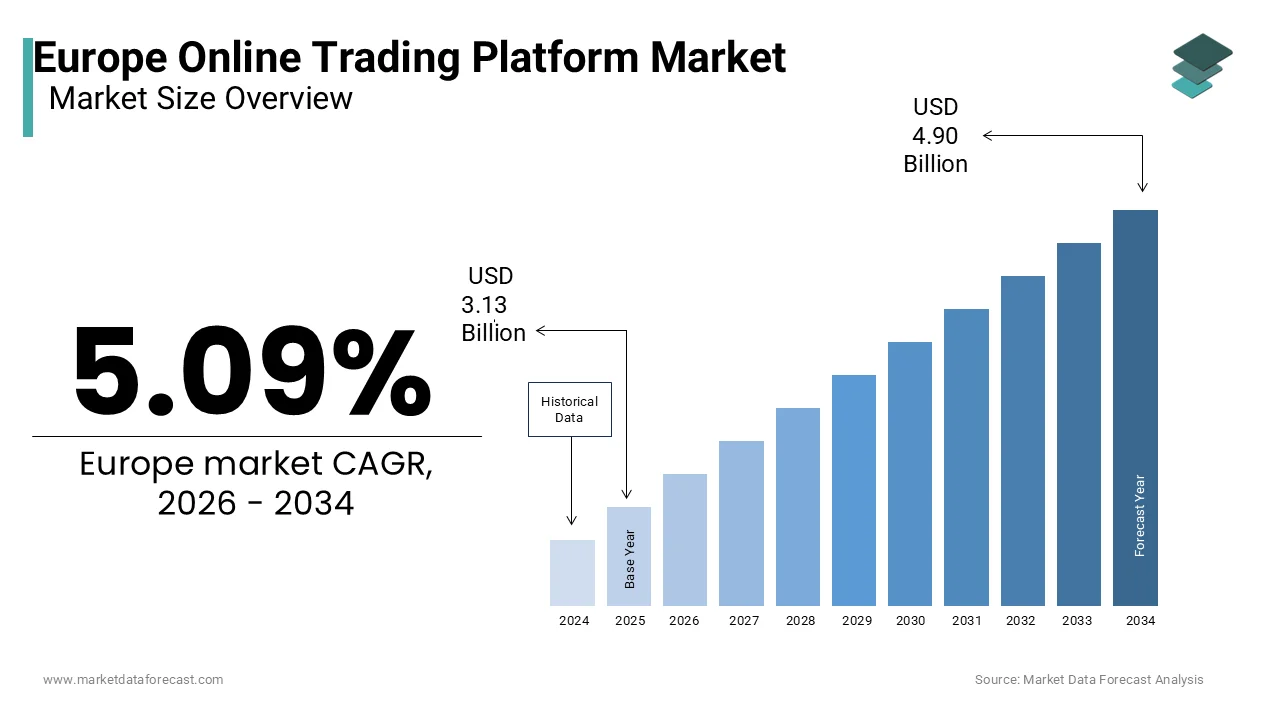
The Europe online trading platform market, valued at USD 3.13 billion in 2025, is projected to reach USD 4.90 billion by 2034, growing at a CAGR of 5.09%, driven by commission-free trading models, ESG-integrated investing tools, and AI-enabled digital brokerage platforms under MiFID II regulation.
Key Market Insights
- 2025 Market Size: USD 3.13 billion
- 2026 Estimate: USD 3.29 billion
- 2034 Forecast: USD 4.90 billion
- CAGR (2026–2034): 5.09%
- Base Year: 2025
- Forecast Period: 2026–2034
Quick Growth Drivers
- Rapid adoption of commission-free and fractional share trading
- Rising participation of young and first-time retail investors
- Expansion of mobile-first trading ecosystems
- Integration of ESG, SFDR, and sustainability analytics
- Growth of cross-border trading under MiFID II passporting
- Increased digital financial literacy initiatives across EU states
Principal Restraints
- High compliance burden under MiFID II and PRIIPs
- Lengthy onboarding due to KYC, suitability, and risk assessments
- Elevated development costs for regulatory reporting and disclosures
- Limited flexibility in launching complex or innovative instruments
- Slower innovation cycles for smaller fintech brokerage platforms
High-Value Opportunities
- AI-driven personalized portfolio construction and coaching
- Tokenized assets and blockchain-based settlement within regulated frameworks
- Embedded trading via banking and open finance ecosystems
- Subscription-based monetization for premium analytics and tools
- Automated tax optimization and long-term wealth planning features
Key Market Challenges
- Persistent digital literacy gaps among retail traders
- Misunderstanding of leverage and high-risk instruments
- Cybersecurity vulnerabilities in cloud-native trading systems
- Fragmented national interpretation of EU financial regulations
- Post-Brexit regulatory divergence between UK and EU markets
Fastest-Growing Segments
- Transaction Fee–Based Models: ~12.4% CAGR
- Web-Based Trading Platforms: ~14.1% CAGR
- Bank-Embedded Trading Solutions: ~16.8% CAGR
- AI-enabled advisory and behavioral finance tools
Regional Leadership & Dynamics
- United Kingdom (24.7%) — fintech leadership, regulatory sandboxing
- Germany (21.4%) — ETF savings plans, disciplined retail investing
- France — ESG-first investing and tax-advantaged equity plans
- Netherlands — fractional trading and pan-European platform rollout hub
- Sweden — sustainability automation and pension-linked investing
What Wins Commercially
- Native integration of MiFID II, PRIIPs, and SFDR compliance
- Mobile-first UX with embedded education and risk prompts
- Transparent pricing replacing payment-for-order-flow models
- Strong cybersecurity and GDPR-aligned data governance
- Long-term wealth-building tools over speculative trading focus
Top Strategic Ask for Executives
Invest in AI-powered, compliance-native trading platforms that combine personalized guidance, ESG transparency, and embedded finance partnerships to capture long-term retail investor trust across Europe’s regulated digital capital markets.
Leading Players
Some of the companies that are playing a dominating role in the Europe online trading platform market include:
Interactive Brokers, Saxo Bank, eToro, Plus500, IG Group, CMC Markets, DEGIRO (a flatex group company), Robinhood Markets, Charles Schwab, TradeStation Group, Fidelity Investments, Swissquote Group, MetaTrader (MetaQuotes Software Corp.), Bloomberg Tradebook, JP Morgan e-Trading Services, and Goldman Sachs (Marquee).
Europe Online Trading Platform Market Size
The Europe online trading platform market was valued at USD 3.13 billion in 2025, is estimated to reach USD 3.29 billion in 2026, and is projected to reach USD 4.90 billion by 2034, growing at a CAGR of 5.09% from 2026 to 2034.
An online trading platform is a software solution, provided by a brokerage firm, that allows investors to buy and sell financial instruments like stocks, bonds, commodities, and currencies over the internet. These platforms integrate real-time market data, order routing risk management tools, and regulatory compliance modules within a secure cyber environment governed by stringent EU financial legislation. According to sources, increased access to digital technology and financial literacy initiatives has led to a growing number of young European adults utilizing digital platforms for managing their personal investments. European Securities and Markets Authority data indicate that retail investor engagement with regulated trading platforms has increased significantly, with a notable rise in cross-border activity. The market is uniquely shaped by the EU’s Markets in Financial Instruments Directive II, which mandates product governance suitability assessments and transparent cost disclosures, ensuring that technological accessibility is balanced with investor protection. This regulatory framework distinguishes Europe’s approach from more laissez-faire models elsewhere, making compliance as critical as user experience in platform design.
MARKET DRIVERS
Democratization of Investment Through Commission-Free and Fractional Trading Models
The proliferation of zero commission and fractional share trading has dramatically lowered barriers to market entry for European retail investors previously deterred by cost or capital thresholds, which contributes to the growth of the European online trading platform market. The barrier to entry for acquiring positions in major regional equities has decreased as the necessity to purchase whole shares has diminished. Advancements in trading technology now enable individuals to distribute small amounts of capital across a variety of high-value securities that were previously difficult to access. Financial platforms have expanded their offerings to include smaller transaction increments, allowing for more granular asset allocation. There is a noticeable trend of younger participants entering the stock market, often starting with modest financial commitments. Regulatory environments have seen a rise in new brokerage accounts as market infrastructure evolves to support broader participation. Investors are increasingly utilizing flexible entry points to gain exposure to specific growth sectors without the requirement of significant upfront capital. This model aligns with Europe’s inclusive finance agenda by enabling micro investing while maintaining MiFID II-mandated risk warnings, transforming passive savers into active participants in capital markets.
Integration of ESG and Sustainable Investment Tools into Core Platform Functionality
European investors increasingly demand environmental, social, and governance-aligned portfolios, prompting platforms to embed sustainability analytics directly into trading workflows, which further propels the expansion of the European online trading platform market. Retail investors within the European Union are increasingly incorporating environmental, social, and governance factors into their investment decision-making processes. Digital trading platforms have integrated ESG ratings and metrics directly into their user interfaces, allowing for the screening and comparison of investment options based on criteria like carbon intensity and corporate governance. A significant portion of domestic trading platforms in specific European markets now offer specialized tools designed to construct sustainable portfolios, adhering to regional disclosure regulations. Regulatory requirements for transparency in sustainable products have led to the automation of compliance checks within digital trading platforms. These tools transform ethical intent into actionable trades by making responsible investment a core component rather than a supplement, thereby strengthening Europe's leadership in the sector.
MARKET RESTRAINTS
Stringent Regulatory Compliance Burdens Under MiFID II and PRIIPs Frameworks
The operational complexity of adhering to the region’s comprehensive investor protection regime significantly constrains platform innovation, onboarding speed, and the growth of the European online trading platform market. Regulatory frameworks require platforms to implement customized assessments for clients, which include evaluating knowledge, risk tolerance, and product suitability before trading. Mandatory verification and documentation procedures on regulated platforms have resulted in extended account opening timelines, creating a slower onboarding experience compared to international counterparts. Requirements for detailed disclosure documents for complex instruments can cause delays in listing new financial products, such as ETFs or structured options. A significant portion of platform technical resources and updates is directed toward meeting compliance requirements rather than enhancing user experience. These requirements, while protective, increase development costs and slow time to market, particularly for smaller fintech entrants lacking legal infrastructure, which limits competitive diversity and feature velocity in an otherwise dynamic sector.
Persistent Digital Literacy Gaps and Risk Misunderstanding Among Retail Traders
Many European retail investors lack the financial literacy to fully comprehend the risks associated with leveraged products, algorithmic trading, or volatile assets like cryptocurrencies, despite growing adoption, which restrains the growth of the European online platform market. Many young and middle-aged adults in Europe demonstrate limited understanding of core financial concepts, such as compound interest and risk diversification, when surveyed on their knowledge. A gap in financial understanding appears to influence trading behaviors, with a notable portion of retail clients using complex instruments failing to fully grasp how leverage can impact their potential losses. Retail investors are frequently engaging in high-volatility trading, driven by social media trends rather than fundamental analysis, which can lead to significant financial losses. Despite the presence of mandatory risk warnings on trading platforms, a low percentage of users thoroughly engage with this information, limiting the effectiveness of these disclosures. Reputational and regulatory scrutiny of platforms will persist, regardless of disclosure quality, until coordinated financial literacy initiatives address the shortcomings.
MARKET OPPORTUNITIES
Expansion of AI-Driven Personalized Portfolio Construction and Behavioral Coaching
Advanced analytics and machine learning are enabling platforms to move beyond execution toward proactive financial guidance tailored to individual goals, risk tolerance, and behavioral patterns, which creates new opportunities for the European online trade platform market. Several prominent European trading platforms have incorporated artificial intelligence to provide automated financial advice and portfolio management tools. These AI-driven features assist users with tasks such as portfolio rebalancing, tax efficiency management, and goal tracking. In the Netherlands, an AI coaching tool helps reduce impulsive, emotional trading behaviors during market volatility by offering real-time alerts. This AI coach analyzes historical user behavior to provide personalized, timely alerts to curb panic-driven decisions. German trading platforms utilize simulation techniques to demonstrate potential long-term outcomes to their clients. The application of these simulations is designed to help investors focus on long-term strategy rather than immediate market fluctuations. Crucially, these tools operate within MiFID II boundaries by classifying recommendations as non-discretionary guidance unless explicit advisory agreements are signed. The European Commission’s Digital Finance Strategy further encourages such innovations as part of its financial inclusion agenda. Transforming platforms into educational partners shifts the focus from one-time transactions to long-term resilience and sustained engagement.
Integration of Tokenized Assets and Blockchain Settlement Within Regulated Frameworks
The region’s evolving regulatory stance on digital assets offers a high-growth area for platforms to offer tokenized securities and near-instant settlement via distributed ledger technology, which is predicted to fuel the expansion of the European online trading platform market. Regulatory frameworks in Europe are enabling licensed platforms to facilitate the listing of diverse tokenized assets, including government bonds, corporate shares, and private equity funds. Digital exchanges are utilizing blockchain technology to settle tokenized bonds with immediate finality, establishing operational models that are being adopted across multiple European jurisdictions. The European Union’s regulatory framework for crypto-assets offers established licensing paths for the custody and trading of specific tokens while focusing on consumer protection. Trading venues are launching compliant platforms for digital assets, integrating necessary identification and monitoring procedures to meet regulatory standards. Platforms that integrate conventional and tokenized assets will dominate Europe’s next-gen capital markets as on-chain migration accelerates.
MARKET CHALLENGES
Cybersecurity Threats and Systemic Vulnerabilities in Cloud-Based Trading Infrastructure
Cloud-native migration expands the attack surface, creating risks for data, transactions, and market stability, which in turn challenges the growth of the European online trading platform market. Evaluations of digital financial platforms indicate that a significant number possess vulnerabilities within API gateways, authentication protocols, or third-party integrations, which could be leveraged for credential stuffing or man-in-the-browser attacks. An incident involving a brokerage system hosted on cloud infrastructure demonstrated that attackers could gain unauthorized access to manipulate trading mechanisms. Regulatory updates are shifting to classify major trading platforms as essential entities, necessitating more rigorous incident reporting and resilience assessments. Many existing financial systems were developed without incorporating zero-trust principles, creating challenges for meeting modern security requirements. Cloud scalability poses hidden dangers, threatening investor confidence and prompting regulatory action, until advanced security measures like end-to-end encryption and anomaly detection become industry standards.
Fragmented Cross-Border Passporting and National Interpretation of EU Rules
National regulators continue to impose divergent interpretations of MiFID II and related directives, which create operational friction for pan-European platforms, despite the EU’s single market framework. This slows down the expansion of the European online trading platform market. National approaches to cost transparency disclosures vary, creating fragmentation despite efforts to standardize requirements across different jurisdictions. Certain national regulators have introduced additional risk disclosures for leveraged products and stricter limitations on marketing, requiring platforms to tailor their approaches. Different regulatory regimes necessitate maintaining localized compliance systems to address specific, country-level requirements. Divergence in regulatory frameworks following the UK's departure from the European Union introduces distinct reporting obligations, particularly regarding liquidity, that differ from European standards. Managing these cross-jurisdictional inconsistencies represents a significant component of legal and compliance expenses for platforms. This fragmentation inflates operational costs, deters SME entrants, ts and delays feature rollout, undermining the very integration that EU financial legislation was designed to achieve.
REPORT COVERAGE
| REPORT METRIC | DETAILS |
| Market Size Available | 2025 to 2034 |
| Base Year | 2025 |
| Forecast Period | 2026 to 2034 |
| Segments Covered | By Type, Modality, Interface Type, End User, and Region. |
| Various Analyses Covered | Global, Regional, and Country-Level Analysis, Segment-Level Analysis, Drivers, Restraints, Opportunities, Challenges; PESTLE Analysis; Porter’s Five Forces Analysis, Competitive Landscape, Analyst Overview of Investment Opportunities |
| Countries Covered | UK, France, Spain, Germany, Italy, Russia, Sweden, Denmark, Switzerland, Netherlands, Turkey, Czech Republic, Rest of Europe |
| Market Leaders Profiled | Interactive Brokers, Saxo Bank, eToro, Plus500, IG Group, CMC Markets, DEGIRO (a flatex group company), Robinhood Markets, TD Ameritrade (Charles Schwab), Charles Schwab, TradeStation Group, Fidelity Investments, Ally Invest, MetaTrader (MetaQuotes Software Corp.), Bloomberg Tradebook, Swissquote Group, Bank of America Merrill Lynch, JP Morgan e-Trading Services, Goldman Sachs (Marquee) |
SEGMENTAL ANALYSIS
By Type Insights
The commissions segment held the majority share of 58.5% of Europe online trading platform market in 2025. The supremacy of the commissions segment is driven by the continued reliance on per-trade fees for complex instruments and premium services despite the rise of zero-commission equity models. Fractional shares have eliminated basic trading commissions, but complex derivatives and international stocks remain fee-based due to higher execution and compliance costs. Regulatory requirements for transparent cost disclosure have resulted in a significant portion of retail CFD trades continuing to incur explicit commissions or spread markups. Trading platforms for options and futures, often considered higher risk, frequently charge commissions rather than utilize zero-fee models. Financial supervisors are mandating that providers of leveraged products disclose the total cost of ownership, which includes commissions, to prevent hidden pricing. This segment thrives because sophisticated investors accept fees as fair compensation for advanced order types, real-time data, and risk management tools, features essential for active trading but absent in stripped-down free platforms.
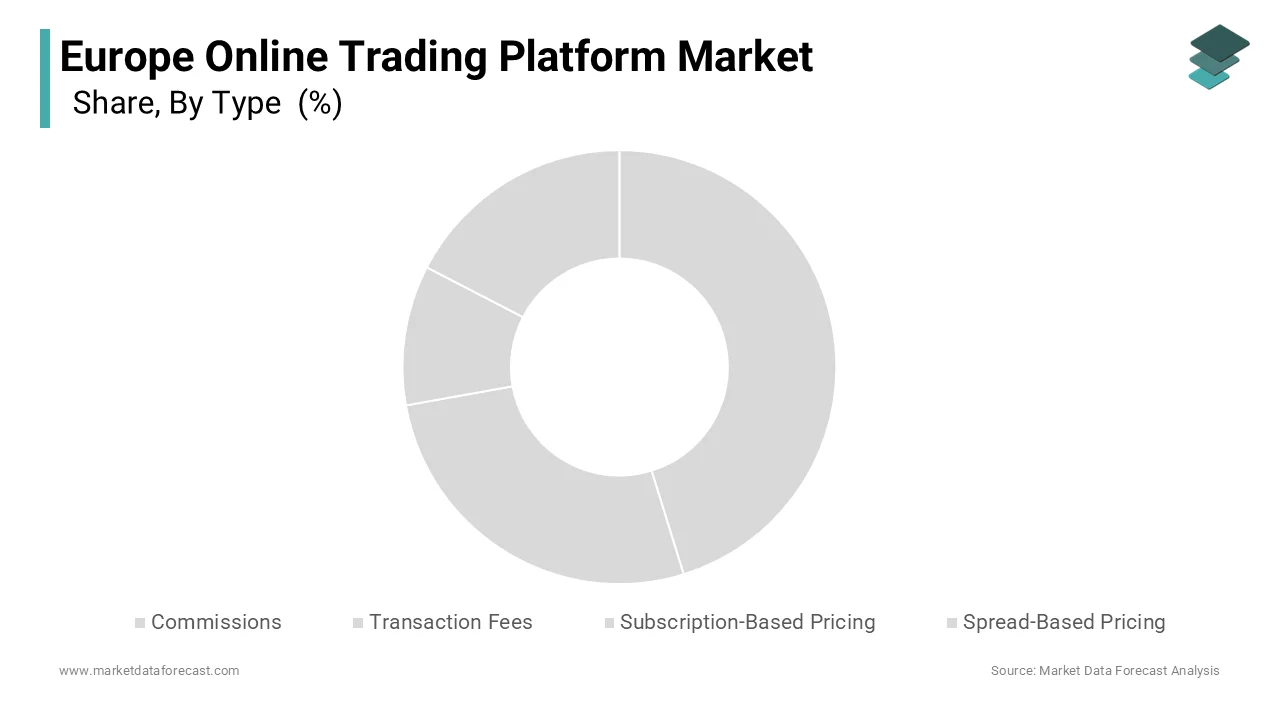
The transaction fees segment is on the rise and is expected to be the fastest-growing segment in the market by witnessing a CAGR of 12.4% from 2026 to 2034 due to the expansion of value-added services beyond pure execution. Beyond just trading, platforms are bundling premium wealth management, crypto, and ESG features into subscription models. Many prominent European trading platforms have adopted tiered subscription models, enabling users to pay monthly fees for premium features such as ad-free interfaces, enhanced customer support, and advanced charting tools. In Sweden, a significant portion of new account holders are selecting bundled service packages that include automated tax reporting and dividend reinvestment, allowing for revenue generation through transaction-linked fees. The European Union's Central Securities Depositories Regulation has established standardized settlement fees for cross-border trades, facilitating predictable, ancillary revenue streams for financial institutions. The pivot from speed to comprehensive financial health allows platforms to monetize trust and compliance, which transforms transaction fees into a cornerstone of long-term profitability.
By Interface Type Insights
The mobile app-based segment dominated the European online trading platform market by accounting for a substantial share in 2025. The dominance of the mobile app-based segment is attributed to the continent’s high smartphone penetration and demand for on-the-go financial management. The vast majority of young to middle-aged adults across the continent now rely on smartphones for digital connectivity, with mobile internet access far outpacing desktop usage. Trading applications have enhanced their functionality to prioritize user-friendly interfaces, instant alerts, and secure, quick-access logins to better engage younger users. A significant portion of personal investment activity is now conducted through mobile devices rather than traditional computers, particularly when reacting to breaking market news. Mobile platforms have become the dominant tool for retail trading, with a high concentration of transactions occurring at the beginning of the market day. The design emphasis on simplicity also aligns with MiFID II’s requirement for clear risk warnings, which are more effectively delivered through interactive mobile prompts than static web pages. Flexible work and improved in-app financial education have established mobile platforms as the primary entry point for Europe’s next generation of investors.
The web-based segment is expected to exhibit a noteworthy CAGR of 14.1% during the forecast period, owing to demand for advanced analytics, multi-screen dashboards, and institutional-grade functionality that mobile apps cannot replicate. Serious retail investors and semi-professional traders increasingly use browser-based platforms for technical analysis, backtesting, and portfolio monitoring across asset classes. Investors with higher-value portfolios often use desktop-based platforms to access advanced analytical tools and automated trading functionalities. Tokenized asset trading on specialized exchanges frequently relies on web-based interfaces to facilitate necessary compliance procedures and security protocols. The choice of trading interface appears influenced by the complexity of the tools required, such as charting libraries, rather than just the asset type. The necessity for detailed disclosure documentation encourages the use of broader, web-based displays over mobile alternatives. Multi-factor authentication workflows for asset transactions are commonly integrated into web-based trading experiences. Moreover, web platforms integrate more seamlessly with third-party tools like Excel, Python API,s and tax software, capabilities essential for sophisticated users. The maturation of retail investing is re-establishing the internet as the primary command center for informed, long-term financial planning.
By End Users' Insights
The retail investors segment led the European online trading platform market by capturing a significant share in 2025. The leading position of the retail investors segment is credited to rising financial literacy, digital inclusion, and the cultural normalization of self-directed investing. Retail brokerage participation has seen a marked increase across European markets. The frequency with which individual investors trade has risen, indicating a more active market presence. The adoption of fee-free, fractional trading models has made investing in high-priced stocks accessible to a broader demographic. A significant rise in younger demographics participating in investment markets has been observed. Social media communities appear to be a contributing factor in driving engagement among newer investors. Regulatory frameworks like MiFID II further empower this group by mandating suitability assessments and transparent cost disclosures, building trust in digital platforms. Low interest rates on traditional savings and strained pension systems are driving retail investors toward capital markets for long-term security, cementing this group as the foundation of platform growth.
The banking and financial institutions segment is predicted to witness the highest CAGR of 16.8% from 2026 to 2034 as traditional banks embed third-party trading platforms into their digital banking ecosystems to retain clients and offer integrated wealth services. Major financial institutions in the European Union are increasingly incorporating embedded brokerage solutions through partnerships or white-labeled technology. Banks are integrating external, specialized investment features directly into their digital platforms to allow users to move between savings and trading accounts. These collaborations with fintech providers enable users to access social trading and other specialized tools within a regulated environment. The EU’s Open Finance framework further accelerates this trend by enabling secure data sharing between banks and licensed investment platforms. Banks are shifting from competitors to facilitators of specialized trading technology, capitalizing on their stability to offer integrated, user-centric, and, and and, solutions that redefine the competitive landscape through partnership rather than disruption.
COUNTRY LEVEL ANALYSIS
United Kingdom Online Trading Platform Market Analysis
The United Kingdom was the top performer in the European online trading platform market by occupying a 24.7% share in 2025. The dominance of the UK market is propelled by its mature investor base, robust regulatory framework,k and fintech innovation ecosystem. London remains Europe’s financial capital, hosting global platforms like Interactive Brokers and Saxo Bank alongside homegrown leaders such as Hargreaves Lansdown. The UK’s early adoption of open banking and strong digital identity infrastructure enables seamless account funding and KYC verification. Post Brexit, the FCA maintains alignment with ESMA on investor protection while allowing faster sandbox testing for AI-driven robo advice and crypto integration. The UK stands as the definitive, foundational hub for Pan-European trading innovation, driven by elite fintech talent and deep financial market expertise.
Germany Online Trading Platform Market Analysis
Germany followed closely in the European online trading platform by capturing a 21.4% share in 2025. The growth of the German market is fuelled by mass retail participation, stringent regulatory adherence,e and preference for transparent fee structures. A significant surge of new retail investors in Germany, driven by the proliferation of user-friendly, low-cost digital brokerage platforms, resulted in widespread adoption of securities accounts, with many users seeking investment opportunities during a period of shifting interest rates and maximized tax-free allowances. Platforms thrive by combining zero commission stock trading with MiFID II-compliant risk profiling and German-language educational content. The country’s strong data privacy norms under GDPR also shape platform design, which limits behavioural tracking and requires explicit consent for marketing. Crucially, German investors favor long-term wealth building over speculation. New, self-directed investors in Germany are overwhelmingly prioritizing automated, diversified ETF savings plans over picking individual stocks, utilizing digital, recurring investment tools to build long-term wealth. This blend of scale discipline and trust makes Germany the cornerstone of sustainable retail investing in Europe.
France Online Trading Platform Market Analysis
France maintains a significant position in the European online trading platform market due to the rapid adoption of sustainable investing and social trading features among urban youth. The French retail investment market is experiencing a continued rejuvenation in investor age and increased adoption of digital tools like ETFs, with a growing, yet still cautious, interest in incorporating sustainability factors into portfolios. Platforms have localized their interfaces to highlight SFDR Article 9 funds and EU Taxonomy-aligned assets. The government’s Plan d’Épargne en Actions reform also incentivizes long-term equity ownership through tax advantages, boosting platform engagement. Paris has emerged as a hub for fintech collaboration, with La Banque Postale partnering with startups to offer embedded trading in its mobile banking app. France is accelerating financial inclusion for tech-savvy generations by blending ethical finance with digital convenience, highlighting the impact of values-driven design.
Netherlands Online Trading Platform Market Analysis
The Netherlands grew steadily in the European online trading platform market owing to its leadership in fractional share adoption and role as a gateway for pan-European platform rollouts. A high percentage of Dutch retail investors use platforms that allow for fractional share purchasing, a rate that stands out within Europe. This trend appears supported by strong financial literacy and language skills among the population. The acquisition of a major broker by an established firm has strengthened Amsterdam as a hub for low-cost trading. This, in turn, facilitates services for a diverse European clientele under a single regulatory framework. The Dutch Authority for the Financial Markets enforces strict transparency rules but allows efficient passporting under MiFID II, enabling rapid cross-border expansion. Moreover, the Netherlands’ advanced digital ID infrastructure reduces onboarding friction. This combination of openness, efficiency,cy and innovation makes the Netherlands a critical beachhead for platforms targeting the broader European retail market.
Sweden Online Trading Platform Market Analysis
Sweden is anticipated to expand in Europe online trading platform market over the forecast period due to its integration of sustainability automation and public pension linkage. Many Swedes in a younger to mid-career age bracket utilize investment platforms that automatically distribute contributions into sustainability-focused exchange-traded funds, a practice often integrated with national retirement savings. Certain digital investment platforms introduced automated, "set and forget" investing models, which feature regular portfolio rebalancing, tax-optimized strategies, and default exclusions for fossil fuel companies. The government’s digital infrastructure enables secure data exchange between pension authorities and brokers, creating a seamless path from mandatory savings to voluntary investing. Additionally, Swedish platforms lead inAI-drivenn behavioral coaching. Sweden’s integration of sustainable investing into national habits showcases a powerful partnership between public policy and private innovation, fostering a resilient, long-term retail investor culture.
TOP LEADING PLAYERS IN THE MARKET
- Interactive Brokers is a leading force in the European online trading platform market, offering institutional-grade execution, multi-asset access, and global market connectivity to retail and professional investors. The company leverages its deep liquidity pools and proprietary technology to provideultra-loww latency trading across equities, options, futures, and forex with seamless currency conversion. In recent years, Interactive Brokers has strengthened its European footprint by integrating ESG screening tools, real-time regulatory disclosures, and MiFID II-compliant cost transparency dashboards. It also expanded its fractional share offering to include European blue chips like ASML and SAP, enabling micro-investing without compromising diversification. Through its acquisition of DEGIRO, it gained significant scale in Western Europe while maintaining robust cybersecurity and segregated client asset structures. Globally, Interactive Brokers exports itsEurope-validatedd compliance architecture to emerging markets, establishing itself as a benchmark for secure,e transparent cross-border trading.
- eToro maintains a strong presence in the European online trading platform market through its pioneering social trading model, which allows users to copy portfolios of experienced traders in real time. The platform emphasizes user-friendly design, educational content, and responsible investing features aligned with EU sustainability mandates. Recently, eToro enhanced its European operations by launching SFDR-compliant ESG portfolios integrating MSCI ratings and offering tokenized asset exposure within regulated frameworks. It also partnered with major banks, including BNP Paribas,s to embed its social trading interface into digital banking apps, expanding its reach beyond standalone users. The company actively participates in ESMA consultations on crypto asset regulation, ensuring its product roadmap aligns with evolving investor protection standards. eToro has become a staple for Europe's digital-native investors by blending community-driven trading with regulatory compliance.
- Trading 212 plays a pivotal role in Europe online trading platform market by democratizing access through zero commission fractional trading and an intuitive mobile-first design. Headquartered in London with operational hubs in Sofia and Prague, the company serves millions of retail investors across the EU with real-time market data, advanced charting, and automated portfolio builders. It also launched a premium tier offering priority support and ad free experience funded by transparent subscription fees rather than payment for order flow. The platform’s commitment to simplicity, ty transparency, and financial education has made it a trusted entry point for first-time investors. Trading 212 is redefining ethical retail finance on a global scale by prioritizing simplicity and user empowerment.
KEY MARKET PLAYERS
Some of the companies that are playing a dominating role in the global Europe Online Trading Platform Market include
- Interactive Brokers
- Saxo Bank
- eToro
- Plus500
- IG Group
- CMC Markets
- DEGIRO (a flatex group company)
- Robinhood Markets
- TD Ameritrade (Charles Schwab)
- Charles Schwab
- TradeStation Group
- Fidelity Investments
- Ally Invest
- MetaTrader (MetaQuotes Software Corp.)
- Bloomberg Tradebook
- Swissquote Group
- Bank of America Merrill Lynch
- JP Morgan e-Trading Services
- Goldman Sachs (Marquee)
TOP STRATEGIES USED BY THE KEY MARKET PARTICIPANTS
Key players in the European online trading platform market prioritize regulatory compliance by embedding MiFID II and SFDR requirements directly into user workflows, including dynamic risk warnings and ESG disclosures. They invest in mobile-first and AI-driven interfaces that offer personalized portfolio construction, behavioral coaching, and automated tax optimization. Companies expand fractional and zero commission models while maintaining revenue through transparent subscription tiers or custody fees rather than payment for order flow. Strategic partnerships with traditional banks enable embedded finance distribution, leveraging existing trust and customer bases. Additionally, firms enhance cybersecurity through biometric authentication,n segregated accounts, and real-time anomaly detection to meet NIS2 and GDPR standards while fostering long term investor confidence.
COMPETITIVE LANDSCAPE
Competition in the European online trading platform market is defined by a delicate balance between innovation, accessibility, and stringent regulatory adherence. Unlike more permissive regions, European platforms must embed investor protection mechanisms such as suitability assessments, cost transparency, and ESG disclosures directly into their user experience, making compliance a core feature rather than an afterthought. The landscape features a mix of global giants, local champions, and bank-embedded solutions, each vying for trust in an environment where reputational risk outweighs short-term growth. Differentiation arises through educational content, behavioral design, and sustainable finance integration rather than just pricing or speed. Regulatory fragmentation across national interpretations of MiFID II adds complexity, favoring players with localized legal infrastructure. As retail investing matures from speculation to wealth building, the most resilient platforms are those that treat users as long-term financial partners offering guidance, transparency,y and security in equal measure within Europe’s uniquely protective regulatory ecosystem.
MARKET SEGMENTATION
This research report on the europe online trading platform market is segmented and sub-segmented into the following categories
By Type
- Commissions
- Transaction Fees
- Subscription-Based Pricing
- Spread-Based Pricing
By Interface Type
- Mobile App-Based
- Web-Based
- Desktop-Based
By End User
- Retail Investors
- Banking & Financial Institutions
- Professional & Institutional Traders
By Country
- United Kingdom
- Germany
- France
- Netherlands
- Sweden
- Spain
- Rest of Europe