- Product Description Description
- Table of Contents TOC
- List of Table & Figure LOT
- Get Free Sample PDF Sample PDF
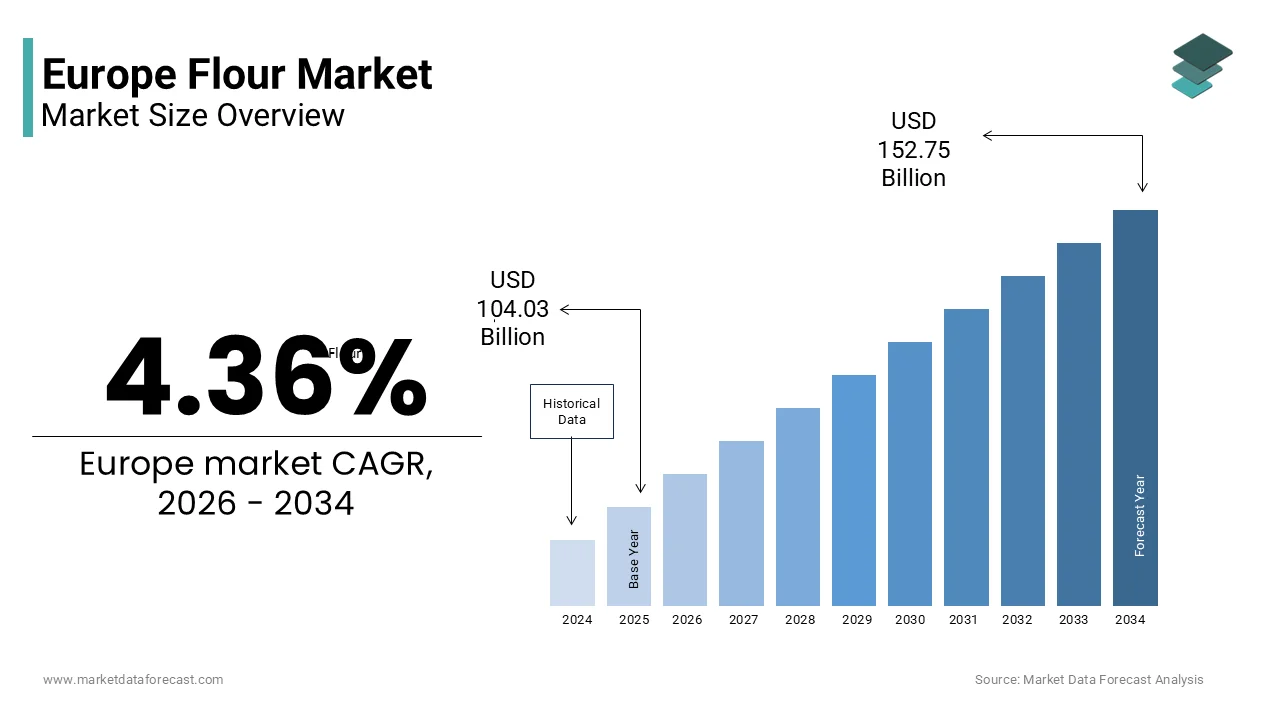
Market Size, 2025
$104.03 BnMarket Estimate, 2026
$108.57 BnMarket Forecast, 2034
$152.75 BnCAGR, 2026–2034
4.36%Europe Flour Market Report Summary
The Europe flour market size was valued at USD 104.03 billion in 2025 and is projected to reach USD 152.75 billion by 2034 from USD 108.57 billion in 2026, growing at a CAGR of 4.36% during the forecast period. The growth of the Europe flour market is driven by rising consumption of bread and bakery products, increasing demand for convenience foods, and steady expansion of the food processing industry. Growing urbanization, evolving dietary patterns, and the adoption of fortified and specialty flour products are further supporting market expansion across the region.
Key Market Trends
- Rising demand for wheat based flour due to its widespread use in bread, pastries, and processed food applications across Europe.
- Growing preference for packaged and branded flour products supported by retail expansion and private label penetration.
- Increasing innovation in fortified and functional flours, including high protein and fiber enriched variants.
- Expanding foodservice and quick service restaurant sectors contributing to consistent bulk flour demand.
- Technological advancements in milling processes improving flour quality, shelf life, and production efficiency.
Segmental Insights
- Based on raw materials, the wheat flour segment dominated the Europe flour market by holding 80.1% of the regional market share in 2025. Its leadership is attributed to extensive consumption in staple food products such as bread, pasta, and bakery items, along with established wheat cultivation and milling infrastructure across Europe.
- Based on type, the dry flour segment commanded 94.6% of the Europe flour market share in 2025. The dominance of dry flour is linked to its longer shelf life, ease of storage and transportation, and widespread application in both household and commercial food production.
- Based on application, the bread and bakery products segment held the major share of the European flour market in 2025. Strong consumer preference for bakery staples and artisanal baked goods continues to drive high flour consumption in this segment.
Regional Insights
- Germany dominated the flour market in Europe in 2025 by accounting for 20.3% of the regional market share. The country’s leadership is supported by its strong baking culture, advanced milling industry, high per capita bread consumption, and well established food processing sector.
- Other major European economies continue to contribute significantly to market growth, driven by stable food demand, retail expansion, and increasing consumption of processed and convenience foods.
Competitive Landscape
The Europe flour market is moderately consolidated with leading multinational and regional milling companies focusing on product diversification, supply chain efficiency, and capacity expansion. Companies are investing in advanced milling technologies and specialty flour development to strengthen their competitive positioning. Prominent players operating in the Europe flour market include Archer Daniels Midland Company, General Mills Inc., King Arthur Flour Company Inc., Associated British Foods Plc., Conagra Foods Inc., Hodgson Mill, White Wings Corporation, and Ardent Mills.
Europe Flour Market Size
The Europe flour market size was valued at USD 104.03 billion in 2025 and is projected to reach USD 152.75 billion by 2034 from USD 108.57 billion in 2026, growing at a CAGR of 4.36%.
Flour is milled wheat and alternative grain flours used across household, artisanal, industrial, and food service sectors. In 2025, this market is defined not merely by volume but by its deep integration into cultural foodways, regulatory frameworks, and evolving nutritional paradigms. As per Eurostat, Europe is a major producer of wheat, with a significant portion processed into flour for bread, pasta, pastries, and ready meals. The European Union enforces strict standards under Regulation (EC) No 852/2004, mandating hygiene, traceability, and allergen labeling for all flour products. Furthermore, the European Food Safety Authority monitors mycotoxin levels, particularly deoxynivalenol, with maximum limits established for common wheat flour. Cultural diversity shapes demand, with France’s baguette tradition requiring high protein T65 flour, while Italy’s pasta industry relies on durum semolina with specific gluten strength. Rising health consciousness also fuels demand for ancient grains, wholemeal, and gluten free alternatives. This confluence of heritage, regulation, and innovation positions flour as both a staple commodity and a dynamic ingredient at the heart of Europe’s food identity.
MARKET DRIVERS
Deep Cultural Integration of Bread and Baked Goods in Daily Diets
Bread remains a non-negotiable cornerstone of European culinary identity, which is driving consistent and resilient demand for wheat flour across all socioeconomic strata and is one of the major factors propelling the European flour market growth. As per the International Grains Council, Europeans consume bread in significant quantities annually, with countries like Germany and France showing higher per capita consumption. In France alone, baguette sales require millions of metric tons of specialized T65 flour according to FranceAgriMer. Artisanal bakeries in Germany and Italy rely on region specific flour types with precise protein and ash content to maintain traditional textures and flavors. Beyond households, the food service sector depends on consistent flour quality for pizza, pastries, and sauces. Even amid health trends, bread consumption remains stable. As per Eurobarometer, a large majority of EU citizens eat bread daily. This cultural embeddedness ensures flour demand is not easily displaced by substitutes, providing structural stability to the market despite economic fluctuations or dietary fats.
Expansion of Industrial and Convenience Food Manufacturing
The growth of processed and ready to eat foods has significantly amplified industrial demand for standardized and high-performance flour across Europe, which is further boosting the flour market expansion in Europe. As per the European Snacks Association, bakery-based convenience products have shown notable growth, driven by urbanization and time scarcity. Large food manufacturers require flour with tightly controlled specifications for protein content, water absorption, and enzymatic activity to ensure batch consistency in automated production lines. Companies like Nestlé, Barilla, and Vandemoortele source millions of tons annually from certified mills that provide real time quality data. The rise of plant based and hybrid meat alternatives further diversifies usage. As per the European Plant Based Foods Association, wheat gluten flour has become essential for texturizing vegan products. Additionally, private label expansion by retailers such as Aldi and Carrefour drives demand for cost optimized yet compliant flour blends. This industrial pull transforms flour from a basic ingredient into a precision engineered input, which is anchoring its relevance in Europe’s modern food ecosystem.
MARKET RESTRAINTS
Stringent EU Regulations on Mycotoxins and Allergen Labeling
The Europe flour market faces significant compliance burdens due to rigorous food safety regulations that constrain sourcing and processing flexibility. The European Commission enforces strict limits on mycotoxins, naturally occurring fungal toxins that proliferate in damp harvest conditions. For common wheat flour, maximum allowable levels are set under Regulation (EC) No 1881/2006. As per the European Food Safety Authority, a portion of wheat consignments tested in recent years exceeded this threshold, particularly from regions affected by late season rainfall. Non-compliant batches must be downgraded or rejected, increasing costs and supply volatility. Simultaneously, Regulation (EU) No 1169/2011 mandates clear allergen labeling, requiring gluten to be highlighted on all packaging. These rules necessitate costly investments in advanced testing and segregated production lines for gluten free variants. While protective of public health, these regulations disproportionately impact small mills lacking capital for compliance, accelerating market consolidation and limiting supply diversity.
Volatility in Wheat Supply Due to Climate Change and Geopolitical Disruptions
Europe’s flour market remains acutely vulnerable to climatic instability and geopolitical shocks that disrupt domestic wheat production and import flows. As per the Joint Research Centre of the European Commission, droughts and excessive rainfall have reduced yields and increased mycotoxin risks in recent years. Beyond weather, the war in Ukraine, historically a major wheat supplier to Southern Europe, triggered export restrictions and logistics bottlenecks, forcing mills to seek costlier alternatives from Canada or the United States. According to the International Grains Council, EU wheat import dependency has risen in recent years. Price volatility followed, with milling wheat prices fluctuating significantly within short periods, squeezing miller margins. Unlike commodities with deep futures markets, flour pricing is often fixed in long term contracts, preventing full cost pass through. This exposure to ecological and political fragility undermines planning certainty and threatens affordability in a market where flour is a foundational food security item.
MARKET OPPORTUNITIES
Rise of Ancient and Heritage Grain Flours in Premium and Health Segments
The growing consumer preference for nutritionally dense, sustainably grown ancient grains such as spelt, einkorn, emmer, and khorasan wheat is a prominent opportunity in the European flour market. These varieties appeal to health conscious and environmentally aware shoppers. As per FiBL, sales of ancient grain flours have shown notable growth across Germany, France, and Italy, primarily in organic and specialty retail channels. Artisanal bakers champion these flours for their complex flavor profiles and lower gluten reactivity. The European Commission supports this trend through the Common Agricultural Policy, which provides subsidies for low input heritage grain cultivation that enhances biodiversity. Brands like Mulino Marino in Italy and Moulin Des Moines in France have built loyal followings by emphasizing terroir and stone grinding. As consumers seek authenticity and functional benefits, ancient grain flours transition from niche curiosity to mainstream premium ingredient, opening higher margin avenues for innovative millers.
Adoption of Digital Traceability and Smart Milling Technologies
Digital innovation presents a transformative opportunity to enhance quality control, sustainability, and consumer trust across the European flour value chain, which is another notable opportunity in the regional market. Flouring mills are deploying Internet of Things sensors and artificial intelligence to monitor every stage, ensuring real time compliance with protein, moisture, and mycotoxin thresholds. As per Grands Moulins de Paris, digital twin systems have been implemented to optimize yield and energy use. Blockchain platforms further enable end to end traceability. German company Allos Hofmanufaktur allows consumers to scan QR codes and view farm location, harvest date, and carbon footprint of their spelt flour. The EU’s Farm to Fork Strategy actively encourages such transparency, with Horizon Europe funding pilot projects linking satellite field data to flour batches. As per Wageningen University, consumers are willing to pay more for fully traceable flour. By digitizing the first mile and the mill floor, Europe turns flour into a verifiable, story rich product aligned with its green and digital transition goals.
MARKET CHALLENGES
Declining Domestic Wheat Production and Farmland Fragmentation
The steady erosion of domestic wheat acreage due to urbanization, policy shifts, and farmer aging is challenging the European flour market growth. As per Eurostat, the EU’s total wheat harvested area has declined in recent years, as marginal lands were abandoned or converted to solar farms and afforestation. The Common Agricultural Policy’s greening requirements further reduce effective planting density. Compounding this, the average age of EU cereal farmers is high, with fewer than 11 percent under 40 according to the European Parliament’s Agriculture Committee. Small, fragmented plots common in Southern Europe hinder economies of scale and precision agriculture adoption, lowering yields. Without sufficient high quality domestic wheat, mills face greater reliance on imports, increasing exposure to global price swings and logistical risks. This agricultural contraction threatens long term flour self-sufficiency in a region where bread is culturally sacrosanct, demanding urgent investment in generational renewal and agronomic innovation to secure the foundational raw material of Europe’s food system.
Labor Shortages and Aging Workforce in Traditional Milling Operations
The Europe flour market faces a critical human capital deficit as skilled millers retire and younger generations pursue non-agricultural careers. Traditional stone grinding and roller milling require nuanced judgment honed over decades, skills increasingly scarce in an era of automation and urban migration. As per the European Millers’ Federation, a large portion of master millers in Germany, France, and Italy are aged 55 or older, with insufficient apprentices entering the trade. Vocational training pipelines are weak, with limited technical schools across the EU offering certified milling diplomas. This gap impedes both heritage preservation and technological adoption, as modern smart mills still require human oversight for calibration and troubleshooting. In rural areas, depopulation exacerbates the issue, with many small regional mills operating with skeleton crews, risking closure. Without coordinated efforts to professionalize, modernize, and promote milling as a high tech, sustainable career, Europe risks losing irreplaceable expertise that bridges centuries old craft with contemporary food safety and efficiency demands, undermining the very foundation of its flour quality and diversity.
REPORT COVERAGE
| REPORT METRIC | DETAILS |
| Market Size Available | 2025 to 2034 |
| Base Year | 2025 |
| Forecast Period | 2026 to 2034 |
| CAGR | 4.36% |
| Segments Covered | By Raw Materials, Types, Applications, and Region |
| Various Analyses Covered | Global, Regional, & Country Level Analysis; Segment-Level Analysis; DROC, PESTLE Analysis; Porter’s Five Forces Analysis; Competitive Landscape; Analyst Overview of Investment Opportunities |
| Regions Covered | UK, France, Spain, Germany, Italy, Russia, Sweden, Denmark, Switzerland, Netherlands, Turkey, and the Czech Republic |
| Market Leaders Profiled | Archer Daniels Midland Company (Wild Flavors), General Mills Inc., King Arthur Flour Company, Inc., Associated British Foods Plc., Conagra Foods, Inc., Hodgson Mill, White Wings Corporation, and Ardent Mills. |
SEGMENTAL ANALYSIS
By Raw Materials Insights
The wheat flour segment dominated the market by holding 80.1% of the regional market share in 2025. The growth of wheat flour segment in the European market is driven by its irreplaceable role in Europe’s culinary heritage, particularly in bread, pasta, and pastry production. As per Eurostat, the European Union produces large volumes of wheat annually, with a significant portion milled into flour for human consumption. In France, specialized T65 wheat flour is used extensively to produce baguettes according to FranceAgriMer. Italy’s pasta industry consumes durum semolina, a specialized wheat flour with high gluten strength essential for extrusion and drying. Germany’s artisanal bakeries rely on region specific wheat flours with precise protein content to maintain traditional rye blends and sourdough textures. Regulatory frameworks further reinforce wheat’s primacy, with the EU’s Common Agricultural Policy providing direct support to wheat farmers, ensuring stable supply. Unlike alternative flours, wheat offers unmatched functional properties such as elasticity, gas retention, and browning that are critical for industrial and artisanal baking alike. This deep cultural, economic, and technical entrenchment ensures wheat flour remains the backbone of Europe’s food system.
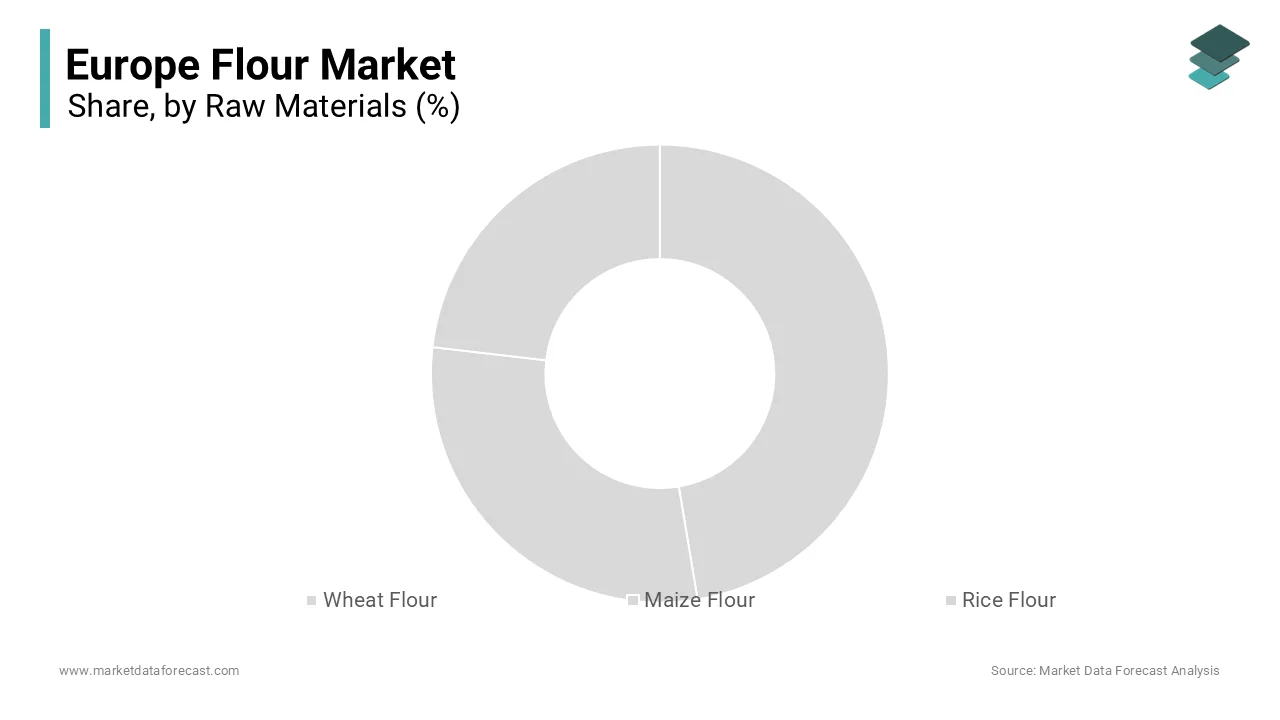
The rice flour segment is a promising segment and is estimated to record a CAGR of 10.6% over the forecast period owing to the rising demand for gluten free products among Europeans diagnosed with celiac disease and millions more pursuing gluten sensitive diets. As per the European Society for Pediatric Gastroenterology, gluten free product sales have shown notable growth, with rice flour serving as the primary base due to its neutral flavor and fine texture. The European Commission’s Regulation (EU) No 828/2014 mandates strict gluten thresholds for gluten free labeling, positioning rice flour as a compliant and versatile alternative. Beyond medical necessity, clean label trends fuel adoption, as rice flour is perceived as hypoallergenic and easily digestible. Industrial applications are expanding, with companies such as Nestlé and Barilla using rice flour in gluten free pasta and baby cereals. Additionally, Asian cuisine popularity boosts demand for rice noodles and tempura batters. As awareness grows and formulations improve, rice flour transitions from niche substitute to mainstream ingredient in Europe’s inclusive food landscape.
By Types Insights
The dry flour segment commanded for the overwhelming majority of the Europe flour market by capturing 94.6% of the regional market share in 2025. The dominance of dry flour segment in the European market can be credited to its stability, long shelf life, and universal applicability across household, artisanal, and industrial settings. Dry flour, typically containing less than 14% moisture, is essential for consistent baking performance. As per the European Millers’ Federation, large volumes of dry wheat flour are produced annually in the EU, milled using roller or stone techniques that preserve nutritional integrity while ensuring microbiological safety. Retail channels rely on dry flour for its ease of packaging, transport, and consumer handling, while industrial users depend on its standardized specifications for automated dough mixing and extrusion processes. Even in regions with high humidity like Southern Europe, advanced silo drying systems maintain moisture control. This combination of functional reliability, regulatory compliance, and logistical efficiency ensures dry flour remains the default form for virtually all European flour applications.
The wet flour segment is estimated to register a CAGR of 12.5% over the forecast period owing to the rise of fresh, ready to bake dough products in urban convenience markets. Wet flour, pre mixed with water and often yeast or enzymes, is used in centralized commissaries to produce fresh bread, pizza bases, and pastries delivered daily to in store bakeries and food service outlets. As per the European Bakery Association, sales of fresh bakery solutions using wet flour systems have shown strong growth, particularly in Germany, the UK, and Spain where labor shortages make scratch baking impractical. Retailers such as Carrefour and Tesco operate in store bakeries that rely on wet flour blends to ensure consistency and reduce skilled labor dependency. Technological advances in chilled logistics and anti mold additives have extended shelf life, enabling wider distribution. Additionally, plant-based meat analogs increasingly use hydrated wheat protein slurries derived from wet flour processing. As urbanization and labor constraints intensify, wet flour emerges as a high efficiency solution that bridges industrial scale with artisanal freshness, which is positioning it at the forefront of Europe’s evolving bakery ecosystem.
By Applications Insights
The bread and bakery products segment held the major share of the European flour market in 2025. The flouring position of bread and bakery products segment in the European market is attributed to the deep cultural and dietary integration of bread across the continent. As per the International Grains Council, Europeans consume bread in significant quantities annually, with France and Germany showing higher per capita consumption. In France, baguette sales require specialized T65 flour with precise protein and ash content. Germany’s artisanal bakeries produce thousands of regional bread varieties, each demanding specific flour types. Industrial bakeries further amplify demand, with companies such as Aryzta and Grupo Bimbo operating pan European networks producing pre sliced loaves, rolls, and croissants. The European Commission recognizes bread as a staple food, which is supporting millers through strategic grain reserves. Even amid health trends, bread remains non-negotiable. As per Eurobarometer, a large majority of EU households purchase bread weekly. This enduring centrality ensures bread and bakery applications remain the primary engine of Europe’s flour economy.
The noodles and pasta segment is the fastest growing application in the Europe flour market and is anticipated to grow at a CAGR of 9.4% over the forecast period. The shifting dietary preferences toward convenient, plant based, and globally inspired meals is primarily driving the noodles segment in the European market. As per the Italian Pasta Association, pasta consumption in the EU has reached significant volumes, with Italy alone accounting for the majority. Beyond traditional markets, Northern Europe shows rapid adoption, with pasta sales growing in countries such as Sweden and the Netherlands, fueled by student populations and working professionals seeking quick, nutritious meals. The rise of legume enriched and gluten free pasta further diversifies flour usage, with companies such as Barilla and De Cecco blending durum semolina with lentil or rice flour to meet protein and allergen demands. Ready meal manufacturers also incorporate short cut pasta into frozen dishes, requiring consistent hydration and cooking properties. As Mediterranean diets gain scientific endorsement for heart health, and as global flavors permeate European kitchens, pasta transitions from ethnic specialty to everyday staple, which is propelling sustained flour demand in this dynamic segment.
REGIONAL ANALYSIS
Germany Flour Market Analysis
Germany dominated the flour market in Europe in 2025 by holding 20.3% of the regional market share. The dominance of Germany in the European market is driven by Europe’s most populous nation, a powerhouse of artisanal and industrial baking and unparalleled diversity, with thousands of registered bread varieties produced by tens of thousands of bakeries requiring a wide spectrum of wheat flours from light Type 405 to wholemeal Type 1700. As per the German Federal Ministry of Food and Agriculture, annual flour consumption is significant, with bread and rolls accounting for the majority. Industrial players such as BackWerk and Kamps operate nationwide chains that rely on standardized flour blends for consistency. Simultaneously, the organic sector thrives, with a notable portion of flour sold in cities like Berlin and Munich carrying certified organic labels. Strict enforcement of the German Bread Ordinance ensures quality and authenticity, while investments in smart milling enhance traceability. This blend of tradition, regulation, and innovation makes Germany the continent’s most complex and influential flour market.
France Flour Market Analysis
France held the second largest share of the European flour market in 2025. The growth of France in the European market is driven by its iconic baguette culture, state protected milling standards and the T series classification system that mandates precise ash and protein content for each flour type, with T65 being essential for the legally defined “baguette de tradition française.” As per FranceAgriMer, annual wheat flour consumption is substantial, with bread production accounting for the majority. Thousands of artisanal boulangeries, many family run for generations, drive demand for locally milled, high quality flour. The government reinforces this ecosystem through certifications such as “Label Rouge” and subsidies for heritage wheat varieties. Industrial demand is also significant, with frozen dough producers supplying supermarkets and cafés nationwide. UNESCO’s recognition of the French baguette as intangible cultural heritage further elevated national pride and consumption. This fusion of legal precision, cultural reverence, and artisanal excellence ensures France remains a benchmark for flour quality in Europe.
Italy Flour Market Analysis
Italy is estimated to showcase a promising CAGR in the Europe flour market during the forecast period owing to its global flourership in pasta and durum wheat processing and the production of semolina, a coarse flour milled from durum wheat with high gluten strength essential for pasta extrusion and drying. As per the Italian Pasta Association, Italy produces millions of metric tons of pasta annually, consuming nearly equal volumes of durum semolina. Southern regions such as Puglia and Sicily cultivate large areas of durum wheat, much of it under PDO schemes. Beyond pasta, flour fuels pizza culture, with Naples alone consuming significant volumes of Type 00 flour yearly for authentic Neapolitan pies. The government enforces strict purity laws, prohibiting mixing soft wheat in dried pasta. This uncompromising focus on raw material integrity, combined with global brand power, positions Italy as the epicenter of premium flour applications in Europe.
United Kingdom Flour Market Analysis
The United Kingdom is estimated to hold a prominent share of the Europe flour market over the forecast period. The UK is notable for its blend of traditional baking and modern convenience trends, strong household baking habits and robust industrial demand for sliced bread, cakes, and biscuits. As per the National Association of British and Irish Millers, annual flour production is substantial, with bread accounting for the majority. Supermarkets such as Tesco and Sainsbury’s operate in store bakeries that rely on pre blended dry and wet flour systems to ensure freshness. Simultaneously, health trends drive demand for wholemeal and ancient grain flours, with spelt and rye blends showing growth. Post Brexit, the UK aligned its wheat import standards with EU mycotoxin limits, ensuring consistent quality. This duality, honoring traditional baking while embracing innovation, makes the UK a dynamic and adaptive flour market.
Spain Flour Market Analysis
Spain is anticipated to record a healthy CAGR in the European flour market over the forecast period due to its Mediterranean diet foundations and growing bakery industrialization. The country’s market status is shaped by traditional uses such as rustic breads and festive pastries, as well as rising demand for convenience products in urban centers. As per Spain’s Ministry of Agriculture, annual flour consumption is significant, with bread accounting for the majority. The drought prone climate has spurred investment in hardy wheat varieties and efficient irrigation, though imports supplement domestic output. Urban centers such as Madrid and Barcelona host expanding networks of artisanal bakeries promoting heritage grains. Industrial players supply frozen dough to café chains and supermarkets. The government supports millers through the Common Agricultural Policy, emphasizing sustainability. This balance of rural tradition and urban modernization positions Spain as a resilient and evolving flour market in Southern Europe.
COMPETITIVE LANDSCAPE
Competition in the Europe flour market is defined by a dual dynamic as large integrated millers compete on scale, consistency, and regulatory compliance, while regional and specialty producers differentiate through heritage grains, terroir identity, and nutritional innovation. Unlike commoditized markets, success hinges on balancing industrial efficiency with cultural authenticity particularly in nations like France and Italy where flour type is legally tied to traditional products. Retailers and food service chains exert growing influence, demanding certified sustainable sourcing, allergen safety, and functional performance. Climate volatility and geopolitical disruptions add supply chain pressure, rewarding companies with diversified sourcing and advanced quality control. Meanwhile, health trends fuel demand for alternative flours, fragmenting the market but opening premium avenues. Ultimately, the most resilient players harmonize centuries old milling craft with digital transparency and agronomic innovation, ensuring flour remains both a staple commodity and a trusted ingredient in Europe’s evolving food narrative.
KEY MARKET PLAYERS
Some of the notable key players in the Europe flour market are
- Archer Daniels Midland Company (Wild Flavors)
- General Mills Inc.
- King Arthur Flour Company, Inc.
- Associated British Foods Plc.
- Conagra Foods, Inc.
- Hodgson Mill
- White Wings Corporation
- Ardent Mills
Top Players in the Market
- Ardent Mills, though headquartered in the United States, maintains a significant footprint in the Europe flour market through its specialty grain and organic flour offerings distributed across the UK, Germany, and the Netherlands. The company supplies artisanal bakers, food manufacturers, and retail brands with identity preserved wheat, ancient grains, and gluten free blends. Ardent Mills contributes to global sustainability efforts by promoting regenerative agriculture practices among its European grower network. In recent years, it strengthened its European position by launching a certified organic spelt and einkorn flour line sourced from German and French farms. It also implemented blockchain enabled traceability for its heritage grain flours, allowing customers to verify farm origin and milling date. These initiatives align with Europe’s clean label and transparency demands, reinforcing Ardent Mills as a premium, responsible supplier in a values driven market.
- Grands Moulins de Paris is a historic French milling company and a key player in the Europe flour market, renowned for its T series flours essential to baguette and viennoiserie production. As part of the Soufflet Group, it operates state of the art mills across France, supplying both artisanal boulangeries and industrial bakeries with precisely calibrated wheat flours. The company plays a vital role in preserving France’s bread heritage while modernizing operations. Recently, it deployed a digital twin system across its Seine et Marne facility to optimize energy use and reduce mycotoxin risk through real time grain monitoring. It also launched a “Terroir Wheat” program, sourcing from heritage varieties like Rouge de Bordeaux to support biodiversity. These actions demonstrate its commitment to quality, innovation, and cultural stewardship in Europe’s most tradition bound flour market.
- Ceresana AG, based in Switzerland, is a flouring European producer of specialty flours including rice, spelt, and gluten free blends, catering to health-conscious consumers and food manufacturers across Germany, Austria, and Scandinavia. The company differentiates itself through rigorous allergen control and sustainable processing, operating dedicated gluten free facilities certified by the European Licensing System. Ceresana has strengthened its market position by expanding its wet flour pre mix portfolio for fresh bakery commissaries, reducing labor dependency for urban retailers. It also partnered with Swiss research institutes to develop low glycemic index flour blends using enzymatic modification. By focusing on functional nutrition, clean labels, and operational efficiency, Ceresana addresses emerging dietary trends while maintaining high safety standards in a rapidly evolving segment of the European flour landscape.
Top Strategies Used by the Key Market Participants
Key players in the Europe flour market invest in digital traceability systems to provide real time data on grain origin, protein content, and mycotoxin levels to meet stringent EU food safety regulations. They expand specialty flour portfolios including ancient grains, gluten free, and organic variants to capture premium segments driven by health and sustainability trends. Companies adopt smart milling technologies such as AI driven process optimization and moisture control to enhance yield and reduce energy consumption. Strategic partnerships with farmers promote regenerative agriculture and heritage wheat cultivation to ensure supply resilience and biodiversity. Additionally, firms develop wet flour and pre mix solutions to support labor constrained bakeries and convenience food manufacturers seeking consistent, ready to use ingredients.
MARKET SEGMENTATION
This research report on the European flour market has been segmented and sub-segmented based on categories.
By Raw Materials
- Wheat Flour
- Maize Flour
- Rice Flour
By Types
- Wet Flour
- Dry Flour
By Applications
- Bread and Bakery Products
- Noodles and Pasta
- Wafers
- Crackers and Biscuits
- Animal Feed
- Non Feed Application
By Country
- UK
- France
- Spain
- Germany
- Italy
- Russia
- Sweden
- Denmark
- Switzerland
- Netherlands
- Turkey
- Czech Republic
- Rest of Europe