Europe Foam Market Size, Share, Trends & Growth Forecast Report - Segmented By Type (PU Foam, PS Foam, PVC Foam, Phenolic Foam, Polyolefin Foam, Melamine Foam), Application, and Country (UK, France, Spain, Germany, Italy, Russia, Sweden, Denmark, Switzerland, Netherlands, Turkey, Czech Republic & Rest of Europe), Industry Analysis From 2026 to 2034
Market Size, 2025
$12.56 BnMarket Estimate, 2026
$13.05 BnMarket Forecast, 2034
$17.68 BnCAGR, 2026–2034
3.87%Europe Foam Market Size
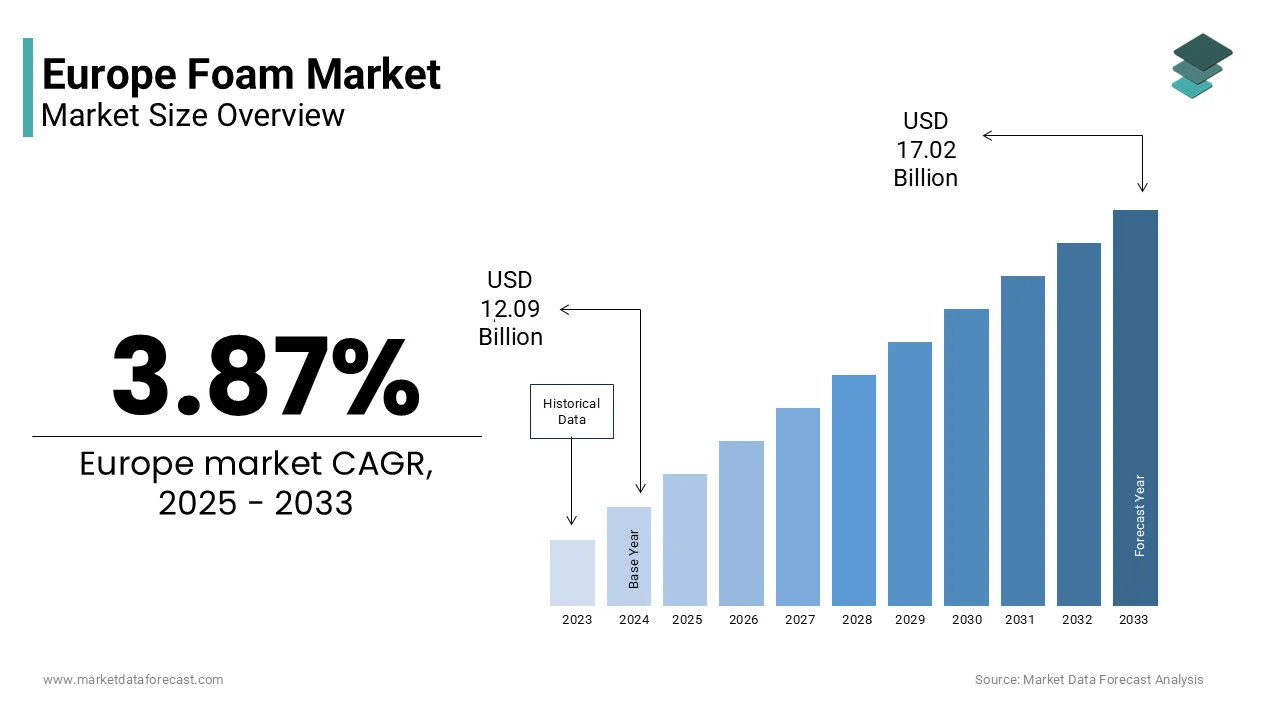
The Europe foam market size was valued at USD 12.56 billion in 2025 and is projected to reach USD 17.68 billion by 2034 from USD 13.05 billion in 2026, growing at a CAGR of 3.87%.
The foam is a diverse range of cellular polymeric materials, including polyurethane, polystyrene, polyethene, and polypropylene foams used across furniture, automotive, construction, packaging, and healthcare sectors. These materials provide critical functions such as thermal insulation, impact absorption, acoustic damping, and lightweight structural support. According to the European Environment Agency, the EU generates over 5.4 million tons of plastic foam waste annually, with less than 15% currently recycled. National building codes in Germany, France, and the Nordic countries mandate minimum thermal resistance values that necessitate advanced foam-based insulation systems.
MARKET DRIVERS
Stringent Building Energy Efficiency Mandates Boost Insulation Foam Demand
The European Union’s aggressive building decarbonization agenda is a primary driver of foam demand for rigid polyurethane and phenolic insulation boards used in walls, roofs, and facades, which is prompting the growth of the European foam market. The revised Energy Performance of Buildings Directive requires all new constructions to be nearly zero energy by 2030 and mandates deep energy retrofits for existing public buildings. Germany’s EnEV 2023 building code mandates a U value of 0.15 W/m²K for new residential walls, which is achievable only with 180 to 220 millimetres of polyurethane foam. The 850 million square meters of insulation foam were installed in EU buildings in 2023 alone.
Growth in Automotive Lightweighting and Interior Comfort Applications
The vehicle lightweighting to meet CO2 emission targets is significantly driving demand for flexible and semi-rigid polyurethane foams in seating, headliners, and dashboards is additionally propelling the growth of the European foam market. The average passenger car must achieve a fleet-wide CO2 emission of 95 grams per kilometre, with a target that has accelerated the substitution of metal and solid plastic components with lightweight foams. The shift to electric vehicles further intensifies this trend, nd with battery packs requiring polyurethane foam for thermal management and vibration damping, adding 5 to 8 kilograms per vehicle. Additionally, evolving consumer expectations for cabin comfort, 72% of EU car buyers prioritise seating ergonomics.
MARKET RESTRAINTS
Restrictive Chemical Regulations Under REACH and SCIP Limit Formulation Flexibility
The European Union’s Registration Evaluation Authorisation and Restriction of Chemicals framework, which continuously restricts substances used in foam production, is one of the factors hampering the growth of the European foam market. Key blowing agents, flame retardants, and isocyanate precursors are subject to authorisation or substitution requirements under Annexes XIV and XVII. The 2023 restriction on diisocyanates required mandatory training for all industrial users, which increased compliance costs and slowed production throughput. A 2025 survey by Plastics Europe, foam manufacturers delayed new product launches due to regulatory uncertainty. These chemical restrictions not only raise R&D costs but also limit performance optimisation, as safer alternatives often compromise on density, fire resistance, or durability by forcing trade-offs between compliance and functionality.
Low Recycling Rates and Waste Management Infrastructure Gaps
The end-of-life management, as most foam types remain difficult to recycle due to their low density, contamination, and multi-material composition, is restricting the growth of he European foam market. Only 12% of post-consumer polyurethane foam and 9% of expanded polystyrene are recycled in the EU, with the remainder landfilled or incinerated. Chemical recycling technologies like glycolysis for PU foam exist, but operate at a small scale of less than 50000 tons of capacity. The EU Packaging and Packaging Waste Regulation, set to tighten in 2026, will mandate 50 % recycled content in plastic packaging. Additionally, construction and demolition waste containing bonded insulation foam is often classified as mixed waste by disqualifying it from high-value recycling streams. These infrastructural and technical gaps expose foam producers to growing Extended Producer Responsibility fees and reputational risks with the sustainability narrative essential for market acceptance in Europe’s green economy.
MARKET OPPORTUNITIES
Development of Bio-Based and Circularity Compliant Foam Solutions
The transition toward bio-based and recyclable foam formulations by aligning with the EU’s Circular Economy Action Plan and Green Deal objectives is significantly boosting the growth of the European foam market. Companies are increasingly replacing petroleum-derived polyols with those sourced from castor oil, rapeseed, or recycled PET. The bio-based polyurethane foam production in Europe, with Covestro and BASF leading commercial-scale offerings. In furniture, IKEA now specifies 100% renewable or recycled content in all foam by 2030. Simultaneously, chemical recycling innovations are gaining traction, such as Econic Technologies’ catalyst technology enables CO2-based polyols that incorporate up to 20% captured carbon.
Expansion of Foam Applications in Renewable Energy and Cold Chain Logistics
The emerging roles in renewable energy infrastructure and temperature-controlled logistics are creating high-growth niches for specialised foams, which will additionally enhance the growth of the European foam market. In offshore wind, rigid polyurethane foam is critical for buoyancy modules and nacelle insulation, with each turbine requiring up to 2.5 tons of high-density closed-cell foam. Similarly, the EU’s Farm to Fork Strategy and vaccine distribution networks have intensified cold chain requirements. As per the European Cold Chain Federation, cold chain logistics will grow through 2028 with e-grocery and biopharma shipments. These applications demand foams with ultra-low thermal conductivity (below 0.022 W/mK) and long-term dimensional stability, where specifications that command premium pricing and technical differentiation.
MARKET CHALLENGES
Carbon Border Adjustment Mechanism Pressures on Imported Foam
The imposition of financial penalties on carbon-intensive imports from regions with lax environmental standards is a decline in the growth of the European foam market. Effective from 2026 for polymers, CBAM will require importers to purchase certificates based on the embedded emissions of foam products. Foam sourced from coal-dependent economies like China or Turkey could face surcharges of 15 to 25% by disrupting established supply chains. European converters reliant on imported slabstock or moulded components may face cost escalation or compliance complexity.
Volatility in Raw Material Prices and Energy Costs
The persistent instability in feedstock and energy pricing, which is directly impacting production economics and pricing strategies, is likely to showcase a significant decline in the growth of the European foam market. Polyurethane foam relies on isocyanates and polyols derived from crude oil and natural gas, both subject to geopolitical and market fluctuations. Simultaneously, benzene is a key precursor for MDI isocyanate, which experienced 35% price volatility in 2023 due to refinery outages and export restrictions. These swings compress margins, especially for small and medium converters without hedging capabilities.
REPORT COVERAGE
| REPORT METRIC | DETAILS |
| Market Size Available | 2025 to 2034 |
| Base Year | 2025 |
| Forecast Period | 2026 to 2034 |
| CAGR | 3.87% |
| Segments Covered | By Type, Application, and Region |
| Various Analyses Covered | Global, Regional, & Country Level Analysis; Segment-Level Analysis; DROC, PESTLE Analysis; Porter’s Five Forces Analysis; Competitive Landscape; Analyst Overview of Investment Opportunities |
| Regions Covered | UK, France, Spain, Germany, Italy, Russia, Sweden, Denmark, Switzerland, Netherlands, Turkey, and the Czech Republic |
| Market Leaders Profiled | BASF SE, Covestro AG, Huntsman Corporation, Dow Inc., Recticel NV/SA, Armacell International S.A., Sekisui Alveo AG, Vita Group, Zotefoams plc, Eurofoam Group, Trocellen GmbH, FoamPartner (a member of Recticel Group), Sika AG, Synthos S.A., and Saint-Gobain Performance Plastics |
SEGMENTAL ANALYSIS
By Type Insights
The polyurethane (PU) foam segment accounted in holding 48.3% of the European foam market share in 2025, with its unparalleled versatility across building insulation, automotive seating, furniture cushioning, and refrigeration sectors that form the core of European industrial and consumer demand. The PU foam delivers the highest thermal resistance millimetre among insulation materials, with a lambda value as low as 0.022 W/mK by making it indispensable for meeting the EU Energy Performance of Buildings Directive. In automotive, the average European car contains 15 to 20 kilograms of PU foam for comfort and acoustic damping. Additionally, the shift to electric vehicles has increased demand for PU in battery thermal management systems.
The melamine foam segment is expected to capture a CAGR of 9.4% throughout the forecast period, with its unique combination of fire resistance, acoustic absorption, and lightweight properties by making it ideal for high safety environments. Over 12000 railcars were retrofitted with melamine acoustic panels in 2023 alone. The aviation sector is another key driver; Airbus and Boeing specify melamine foam for cabin insulation due to its compliance with FAR 25.853 flammability standards.
By Application Insights
The building and construction segment accounted in holding 56.4% of the European foam market share in 2025, with the European Union’s legally binding climate targets for the built environment, which require deep energy retrofits and near-zero energy new builds by 2030. Germany’s KfW energy efficiency programs funded over 180000 building renovations in 2023, nearly all incorporating rigid foam insulation. Similarly, France’s RE2020 regulation ties building permits to lifecycle carbon assessments by favouring materials with low embodied energy and high thermal efficiency.
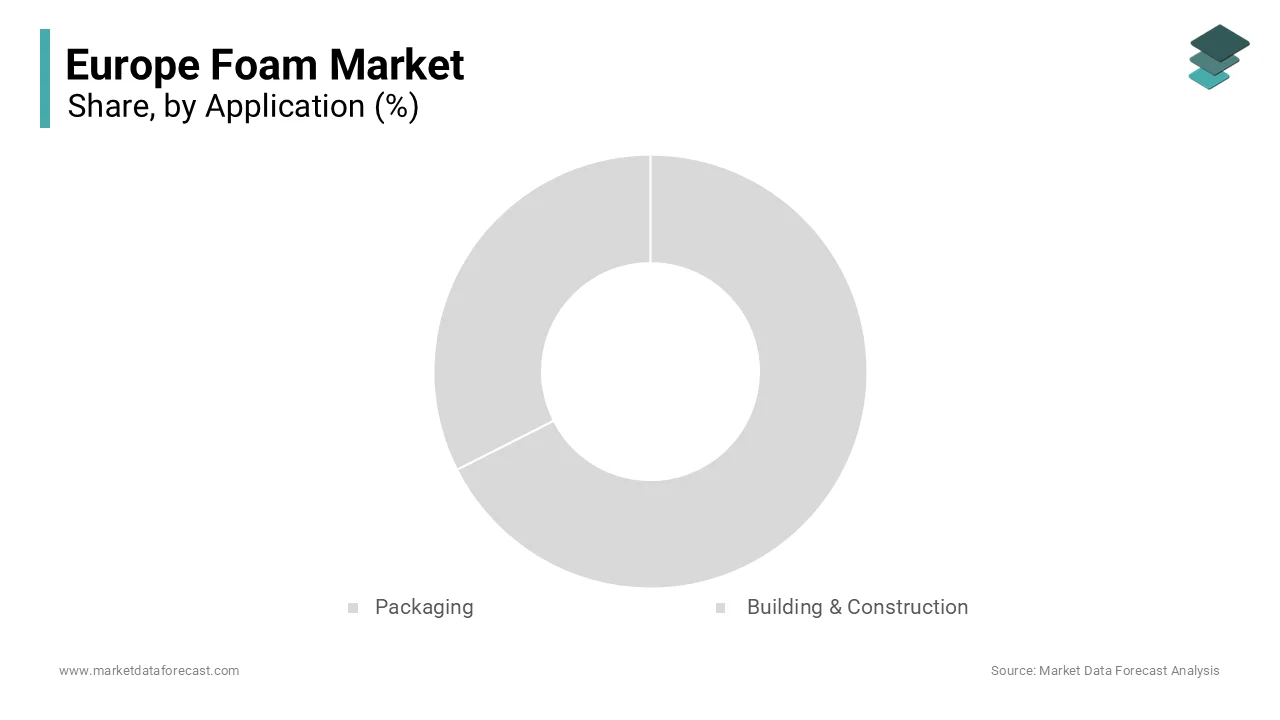
The packaging segment is anticipated to grow with a CAGR of 7.8% throughout the forecast period, with the rapid expansion tof emperature-sensitive logistics for e-grocery, pharmaceuticals, and biologics. The cold chain transport units were deployed in 2023 to support vaccine distribution and perishable food delivery. Expanded polyethene and polypropylene foams are preferred for their shock absorption, moisture resistance, and thermal stability in reusable containers. The rise of direct-to-consumer e-commerce, where to an increase in online grocery sales, further intensifying demand for insulated delivery boxes.
REGIONAL ANALYSIS
Germany Market Analysis
Germany was the largest contributor in the European foam market with 24.3% of the share in 2025, with its dual role as Europe’s largest chemical producer and most stringent enforcer of building energy codes. BASF, Covestro, and Recticel operate major foam production facilities in Ludwigshafen, Dormagen, and Hanover, supplying both domestic and export markets. Additionally, Germany’s automotive sector is home to BMW, Mercedes-Benz, and Volkswagen, which consume over 100000 tons of flexible PU foam annually for seating and interiors.
France Market Analysis
France was positioned second by holding 12.3% of the European foam market share in 2025 with its ambitious RE2020 building regulation, which evaluates structures on whole lifecycle carbon emissions, strongly favouring low embodied energy insulation like bio-based polyurethane. The national “MaPrimeRénov” scheme subsidised 850000 home retrofits in 2023, where each required 10 to 15 square meters of foam insulation.
Italy Market Analysis
The Italian foam market is growing substantially, with significant growth opportunities in next coming years. The high demand in furniture and appliance manufacturing, where flexible PU foam is essential for upholstery and refrigerator insulation. Italy produces over 20 % of Europe’s upholstered furniture, requiring 120000 tons of foam annually.
United Kingdom Market Analysis
The United Kingdom foam market is expected to have lucrative growth opportunities owing to the legally binding Future Homes Standard targets, whic h from 20,25 will prohibit fossil fuel heating in new builds, necessitating ultra-efficient building envelopes insulated with PU and phenolic foams. Post Brexit, where the UK maintains alignment with EU REACH and construction product regulations, ensuring the continued use of high-performance foams.
Spain Market Analysis
Spain's foam market growth is likely to grow in next coming years owing to the extreme climate adaptation needs and large-scale tourism infrastructure. Southern regions require high-performance roof and wall insulation to combat summer heat, with the CTE DB HE 2022 code mandating thermal transmittance below 0.35 W/m²K. Additionally, Spain leads in solar water heating, with over 3 million systems installed, many insulated with polyethene foam. The agricultural export sector also uses expanded polypropylene foam for fruit packaging.
COMPETITIVE LANDSCAPE
KEY MARKET PLAYERS
Some of the notable key players in the European foam market are
- BASF SE
- Covestro AG
- Huntsman Corporation
- Dow Inc.
- Recticel NV/SA
- Armacell International S.A.
- Sekisui Alveo AG
- Vita Group
- Zotefoams plc
- Eurofoam Group
- Trocellen GmbH
- FoamPartner (a member of Recticel Group)
- Sika AG
- Synthos S.A.
- Saint-Gobain Performance Plastics
TOP STRATEGIES USED BY THE KEY MARKET PLAYERS
Key players in the European foam market are accelerating the development of bio-based and CO2-derived polyols to reduce reliance on fossil feedstocks and lower carbon footprints. They are investing in chemical recycling technologies such as glycolysis and hydrolysis to enable circularity for post-consumer and post-industrial foam waste. Companies are reformulating products to comply with REACH restrictions on isocyanates and flame retardants while maintaining performance. Strategic partnerships with construction firms, automakers, and packaging converters are being formed to co-develop application-specific foam solutions. There is a strong emphasis on energy-efficient production processes to mitigate the EU Emissions Trading System costs. Manufacturers are also expanding digital tools for lifecycle assessment and carbon tracking to meet corporate sustainability reporting requirements.
COMPETITION OVERVIEW
The European foam market features a competitive landscape dominated by integrated chemical giants and specialised regional manufacturers, with differentiation increasingly based on sustainability, regulatory compliance, and application expertise rather than price alone. Global players like Covestro and BASF leverage scale, R&D infrastructure, and vertical integration to lead in high-performance segments such as insulation and automotive. Meanwhile, niche firms like Recticel and Armacell excel in tailored solutions and circular business models. Competition is shaped by stringent EU regulations on chemicals, energy efficiency, and waste, which raise barriers to entry but reward innovation in green chemistry. Pressure from the Carbon Border Adjustment Mechanism and Extended Producer Responsibility schemes further intensifies the focus on low-carbon and recyclable formulations.
TOP PLAYERS IN THE MARKET
- Covestro AG is a German chemical company and a global leader in polyurethane and polycarbonate technologies with deep integration across the European foam market. The company supplies high-performance rigid and flexible foams for building insulation, automotive seating, and refrigeration. In 2023, Covestro expanded itCarportfolio ofof CO2-basededsedd polyol technology that replaces up to 20 % of fossil feedstock with captured carbon. It also partnered with Recticel to develop circular foam solutions using chemically recycled content. These initiatives reinforce Covestro’s global leadership in sustainable polymer innovation while strengthening its position as a preferred supplier for EU-compliant, low-carbon foam systems in construction and mobility sectors.
- BASF SE is a multinational chemical manufacturer headquartered in Germany and a key provider of polyurethane systems for insulation, automotive, and packaging applications across Europe. The company offers tailored foam formulations under its Elastoflex and Lupranate brands, emphasising energy efficiency and fire safety. It also scaled up production of its Neopor graphite expanded polystyrene at its Ludwigshafen site to meet rising demand for high R-value insulation. These actions demonstrate BASF’s commitment to combining material science with sustainability to address Europe’s decarbonization and circularity mandates.
- Recticel is a Belgian speciality foam manufacturer with a strong focus on insulation, comfort, and automotive solutions throughout Europe. The company produces rigid polyurethane panels for building envelopes and flexible foams for furniture and vehicle interiors. It also expanded its circularity program by launchingaa take-back scheme for insulation offcuts in partnership with construction firms in France and Germany. These efforts position Recticel as an agile, sustainability-driven player that aligns product innovation with EU environmental regulations and customer demands for responsible materials.
MARKET SEGMENTATION
This research report on the European foam market has been segmented and sub-segmented based on categories.
By Type
- PU Foam
- PS Foam
- PVC Foam
- Phenolic Foam
- Polyolefin Foam
- Melamine Foam
By Application
- Packaging
- Building & Construction
By Country
- UK
- France
- Spain
- Germany
- Italy
- Russia
- Sweden
- Denmark
- Switzerland
- Netherlands
- Turkey
- Czech Republic
- Rest of Europe
Frequently Asked Questions
1. What is the Europe Foam Market?
The Europe Foam Market covers the production, distribution, and application of various foam materials such as PU, PS, PVC, and others across industries like construction, packaging, and automotive.
2. What is driving the growth of the Europe Foam Market?
The market is driven by rising demand for lightweight and energy-efficient materials, rapid growth in construction, and expanding use in automotive and packaging industries.
3. Which country dominates the Europe Foam Market?
Germany holds the largest market share, supported by its strong automotive and construction sectors.
4. Which foam type is most commonly used in Europe?
Polyurethane (PU) foam is the most widely used due to its versatility, insulation properties, and use across furniture, construction, and automotive applications.
5. Who are the major players in the Europe Foam Market?
Major companies include BASF SE, Covestro AG, Huntsman Corporation, Dow Inc., Recticel NV/SA, and Armacell International S.A.
6. What are the emerging trends in the Europe Foam Market?
Growing demand for bio-based and recyclable foams, along with advancements in lightweight materials and sustainability initiatives.
7. What challenges does the Europe Foam Market face?
Key challenges include stringent environmental regulations, fluctuating raw material prices, and recycling limitations for certain foam types.
8. What is the market outlook for 2033?
The Europe Foam Market is expected to witness steady growth through 2033, driven by green construction initiatives and the expansion of e-commerce packaging demand.
Related Reports
Access the study in MULTIPLE FORMATS
Purchase options starting from
$ 2000
Didn’t find what you’re looking for?
TALK TO OUR ANALYST TEAM
Need something within your budget?
NO WORRIES! WE GOT YOU COVERED!
Call us on: +1 888 702 9696 (U.S Toll Free)
Write to us: sales@marketdataforecast.com