- Product Description Description
- Table of Contents TOC
- List of Table & Figure LOT
- Get Free Sample PDF Sample PDF
Market Size, 2025
$6.28 BnMarket Estimate, 2026
$6.74 BnMarket Forecast, 2034
$11.90 BnCAGR, 2026–2034
7.37%Executive Summary: Europe Food Testing Market
- Market Scope: Comprehensive European food testing market analysis covering target contaminants, technological methods, food testing categories, country-level leadership frameworks, and adoption metrics.
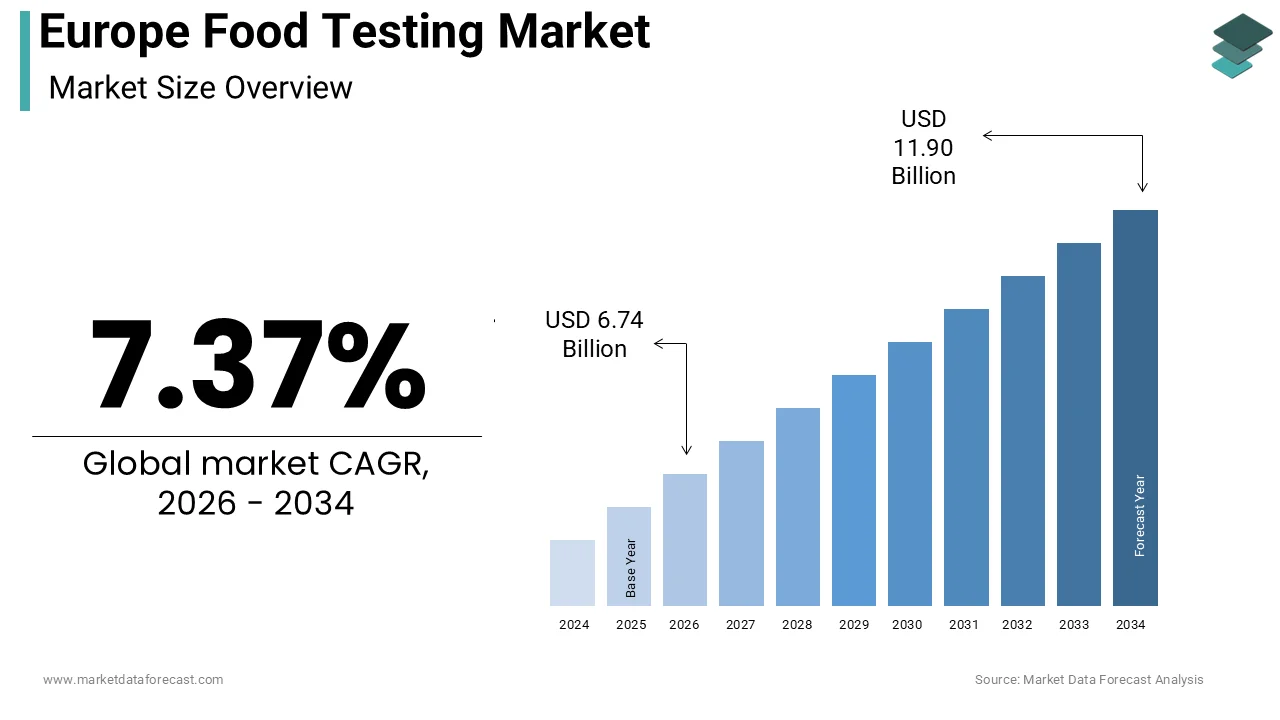
- Market Valuation: Valued at USD 6.28 billion (2025), estimated at USD 6.74 billion (2026), and projected to reach USD 11.90 billion by 2034, registering a robust CAGR of 7.37% (2026–2034).
- Primary Growth Drivers: Increasing prevalence of foodborne illnesses, stringent European food safety regulations, rising consumer awareness regarding food quality, expanding international food trade, and adoption of rapid testing technologies like PCR, spectroscopy, and chromatography. Market constraints include complex technologies and regulatory challenges.
Key Market Segment Metrics (2026–2034)
| Category | Leading Segment (2025 Position) | Fastest-Growing Segment |
|---|---|---|
| By Target Tested | Pathogens and Pesticides (leading target screening categories under regulatory compliance) | Pathogens (witnessing fastest growth due to rising incidence of foodborne diseases) |
| By Technology | Rapid Technology (holds the largest market share driven by demand for faster, more accurate testing methods) | Advanced Molecular Diagnostics and PCR Testing |
| By Food Tested | Meat & Poultry (accounts for largest market share due to demand for protein-rich foods and strict safety requirements) | Processed Foods and Dairy Categories |
| By Country / Region | UK, Germany, France, Italy, and Spain (major markets owing to strong food processing industries and strict regulations) | Emerging Eastern European food processing markets |
Major Market Players & Market Structure
Market Structure: Highly competitive landscape characterized by continuous investment in rapid testing technologies, expansion of contamination detection capabilities, strategic mergers and acquisitions, automation, and comprehensive food safety solutions.
Key Companies: Biocontrol Systems Incorporated, Roka Bioscience, Agilent Technologies Incorporated, Bio-Rad Laboratories Incorporated, IDEXX Laboratories Inc., Douglas Scientific, Ecolab Incorporated, and Intertek Group Plc.
Europe Food Testing Market Size
The food testing market size in Europe was valued at USD 6.28 billion in 2025. The European market is anticipated to be worth USD 11.90 billion by 2034 from USD 6.74 billion in 2026, growing at a CAGR of 7.37% from 2026 to 2034.
Food testing aids in the detection of disease-causing microorganisms, chemicals, and other dangerous compounds in foods, ensuring foodborne illness safety and reducing contamination risks. Food testing is an important part of maintaining food quality in terms of ingredients, taste, and appearance. Microbial contamination and chemical analysis are examples of food analysis procedures that ensure safe food production, processing, and delivery. Food poisoning outbreaks are becoming more common around the world, and the globalization of the food sector is pushing up demand for food safety testing services.
MARKET DRIVERS
The Europe food safety testing market is expanding as food-related issues have become more prevalent as the prevalence of foodborne illness has increased. In addition, increased consumer awareness of food safety, increased chemical contamination, and speedy inspection are all driving business growth. Furthermore, product quality is increasing as a result of changes in legislation aimed at reducing the number of persons affected by foodborne illnesses like nausea, food poisoning, and diarrhea. Because of urbanization, increased disposable income, and economic advancements, the food and beverage industry has grown significantly. As imports and exports rise, pollution levels rise as a result of ineffective control and monitoring, which encourages business engagement. In addition, as demand for pesticide residues and other pollutants in fruits and vegetables grows, as does fruit and vegetable commerce, industrial growth will improve during the forecast period. One of the most important components of changing your testing demands on imports is to enhance the amount of contamination to extend the product's shelf life. Seafood, fruits and vegetables, meat, and processed foods are the leading contributors to the Europe food testing market. Product development will be driven by emerging economic trends for processed foods and convenience foods and government measures to prevent foodborne illness and corporate expansion.
Patent filings for innovative contamination detection systems have risen as a result of increased competition among service providers. The Europe food testing industry is expanding as a result of technological advancements that allow for the implementation of reliable and fast testing technologies. In the coming years, numerous licenses for speedy advancements, such as continuing PCR and immunosorbent measurements, indicate tremendous growth potential. According to the industry, the innovation aimed to shorten the time it takes to acquire test results while also enhancing accuracy. Food availability and quality are both at risk around the world, prompting an increase in the demand for food testing. Because food processors are hindering industrial growth by ignoring routine food inspections in order to lower operational food.
In addition, in underdeveloped nations, generous food contamination regulations and punishments might hamper industrial development. However, as public awareness grows, the government has advocated for initiatives such as strengthening the level of proof to decrease food contamination and disease outbreaks. Furthermore, rising technological costs may have an impact on adoption rates in the coming years. In spectroscopy and chromatography, technological improvements and new technological developments have been created with the goal of reducing delivery times, sample usage, testing costs, and inadequacies associated with numerous technologies. The rising use of these technologies is expected to open up opportunities for small and medium-sized laboratories to compete with big companies in the market. Other advantages of these technologies include high sensitivity, high accuracy, reliability, non-target detection with various contaminants, and quick processing times.
MARKET RESTRAINTS
The Europe food testing market's expansion may be hampered by a lack of food management infrastructure. The food testing market's growth in Europe is projected to be hampered by the complexity of testing technologies and the absence of regulation.
REPORT COVERAGE
| REPORT METRIC | DETAILS |
| Market Size Available | 2025 to 2034 |
| Base Year | 2025 |
| Forecast Period | 2026 to 2034 |
| CAGR | 7.37% |
| Segments Covered | By Target Tested, Technology, Food Tested, And Region |
|
Various Analyses Covered | Global, Regional & Country Level Analysis; Segment-Level Analysis; DROC, PESTLE Analysis; Porter’s Five Forces Analysis; Competitive Landscape; Analyst Overview of Investment Opportunities |
| Regions Covered | UK, France, Spain, Germany, Italy, Russia, Sweden, Denmark, Switzerland, Netherlands, Turkey, Czech Republic, and Rest of Europe |
|
Market Leaders Profiled | Biocontrol Systems Incorporated, Roka Bioscience, Agilent Technologies Incorporated, Bio-Rad Laboratories Incorporated, IDDEX Laboratories INC, Douglas Scientific, Ecolab Incorporated, and Intertek Group Plc |
SEGMENTAL ANALYSIS
By Target Tested Insights
Based on product type, the pathogens segment is expected to develop at the fastest rate in the food testing market in Europe. Foodborne pathogens cause millions of cases of infectious gastrointestinal disorders each year, costing billions of dollars in medical care and lost productivity around the world. Pathogen evolution, changes in agricultural and food production methods, and changes in human host status are all likely to play an essential role in the emergence of new foodborne infections and disorders. As a result, food manufacturers all around the world are actively evaluating them.
By Technology Insights
The rapid technology segment is expected to account for the biggest market share in terms of technology. The industry's demand for faster, better, cheaper real-time test results has increased as the Hazard Analysis and Critical Control Points (HACCP) model and other food safety methods have been firmly entrenched in quality assurance/quality control (QA/QC) programs. E. coli O157:H7, Salmonella, Listeria monocytogenes, and Campylobacter jejuni are some of the most important microbes in today's food sector. In many cases, the rapid approaches developed to combat these microbes have overtaken older procedures in the last few years.
By Food Tested Insights
Over the forecast period, the meat, poultry, and seafood segments are expected to account for the greatest European food testing market share. The increased demand for seafood items, such as crustaceans, shrimp, crabs, lobsters, tuna, marlin, and swordfish, due to their nutritional qualities, such as the availability of omega fatty acids and other critical elements, is another major driver driving the rise of the testing service sector.
REGIONAL ANALYSIS
Europe has been a significant contributor to the global market, contributing to about one-third of total revenue in 2032. The growing number of food-related illnesses among consumers is expected to increase reliance on food testing procedures. In addition, the region's execution of tight regulatory standards is likely to expand the market's size. As a result, the food industries in the United Kingdom, Germany, France, Italy, and Spain are expected to be the major markets for food testing in Europe. Furthermore, in Europe, the market for functional food is expected to develop due to a high degree of knowledge about healthy meals and nutrition. Furthermore, it is expected to propel the region's food testing industry forward.
KEY MARKET PLAYERS
Biocontrol Systems Incorporated, Roka Bioscience, Agilent Technologies Incorporated, Bio-Rad Laboratories Incorporated, IDDEX Laboratories INC, Douglas Scientific, Ecolab Incorporated, and Intertek Group Plc are a few of the notable players in the Europe food testing market.
RECENT HAPPENINGS IN THE MARKET
- In December 2021, As the industrial giant sharpens its healthcare emphasis, 3M Company announced that it would merge its food-safety business with food testing and animal healthcare products producer Neogen Corp in a tax-free transaction.
MARKET SEGMENTATION
This research report on the Europe food testing market is segmented and sub-segmented into the following categories.
By Target Tested
- Pathogens
- Pesticides
- GMOs
- Toxins
By Technology
- Traditional
- Rapid
By Food Tested
- Meat, Poultry, & Seafood
- Dairy
- Processed Food
- Fruits & Vegetables
By Country
- UK
- France
- Spain
- Germany
- Italy
- Russia
- Sweden
- Denmark
- Switzerland
- Netherlands
- Turkey
- Czech Republic
- Rest of Europe