- Product Description Description
- Table of Contents TOC
- List of Table & Figure LOT
- Get Free Sample PDF Sample PDF
Market Size, 2025
$7.95 BnMarket Estimate, 2026
$8.31 BnMarket Forecast, 2034
$11.89 BnCAGR, 2026–2034
4.58%Executive Summary: Europe Frozen Meat Market
- Market Scope: Comprehensive market analysis of the European frozen meat industry covering product types (processed meat, whole cut frozen meat), end users (retail customers, food service), distribution channels (store-based channels, non-store-based distribution), and country-level landscapes across Germany, France, the United Kingdom, Spain, Italy, Russia, Sweden, Denmark, Switzerland, the Netherlands, Turkey, the Czech Republic, and the Rest of Europe.
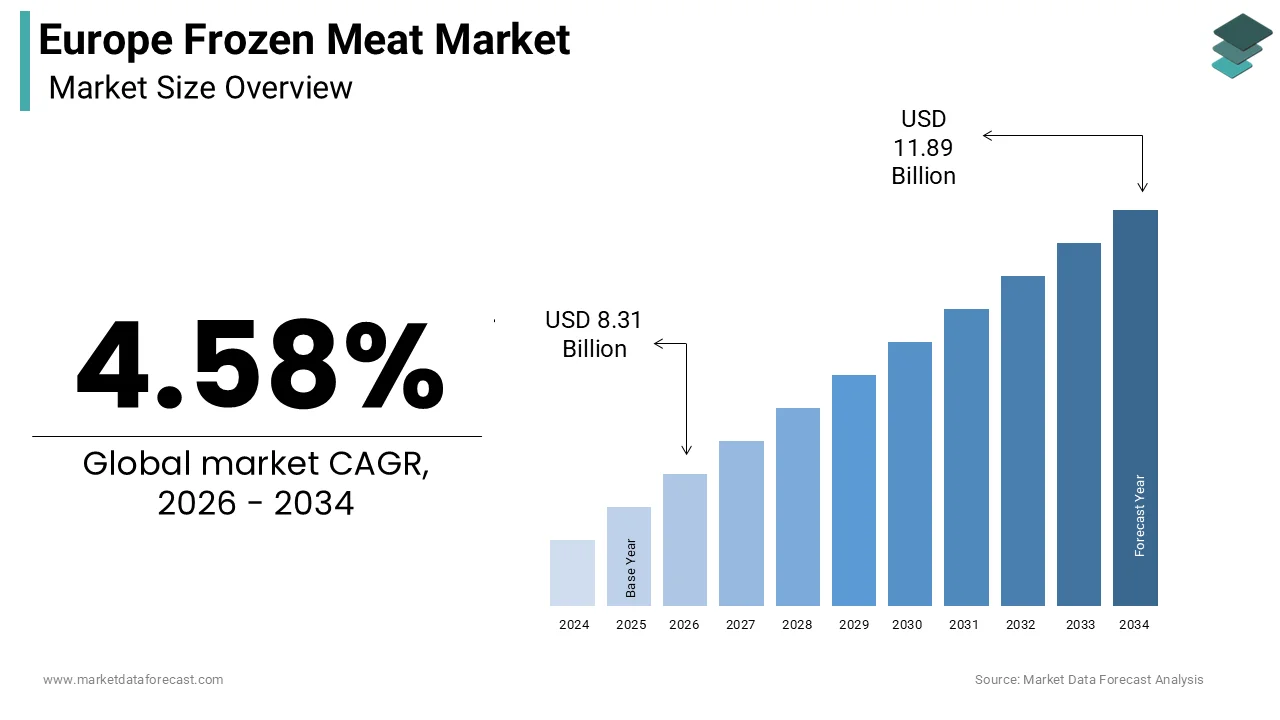
- Market Valuation: Valued at USD 7.95 billion in 2025, estimated at USD 8.31 billion in 2026, and projected to reach USD 11.89 billion by 2034, registering a steady CAGR of 4.58% (2026–2034).
- Primary Growth Drivers: Rising demand for convenience foods among urban populations and dual-income households; expansion and modernization of refrigerated cold chain logistics infrastructure enabling wider distribution; and the growth of e-commerce and digital grocery platforms.
Key Market Segment Metrics (2026–2034)
| Category | Leading Segment / Position | Growth Dynamics |
|---|---|---|
| By Product Type | Processed Meat (dominated with a 62.4% share in 2025 due to versatility, affordability, and deep institutional adoption) | Whole cut frozen meat is projected to experience the fastest CAGR of 5.8%, driven by premium food service demand and advanced blast freezing. |
| By End User | Retail Customers (captured a leading 57.6% share in 2025, supported by single-person households and supermarket private-label offerings) | The food service segment is the fastest-growing at a CAGR of 6.3%, driven by labor efficiency needs in quick-service restaurants and cloud kitchens. |
| By Distribution Channel | Store-Based Channels (largest overall market share in 2025, backed by extensive supermarket freezer networks and in-store cold chains) | Non-store-based distribution is expanding at a fast CAGR of 9.1%, propelled by digital grocery adoption and rapid cold-delivery startups. |
| By Country | Germany (occupied the largest country share of 18.2% in 2025, driven by industrial-scale meatpackers and high institutional demand) | France and the UK maintain robust positions supported by strict institutional food standards, public procurement, and supply chain recalibration. |
Major Market Players & Market Structure
Market Structure: Intense competitive environment featuring large integrated processors, regional cooperatives, and specialized premium suppliers competing on supply chain reliability, animal welfare compliance, and sustainability credentials.
Key Companies: Associated British Foods Plc, Kerry Group Plc, BRF SA, JBS SA, Verde Farms LLC, Pilgrim's Pride Corporation, Marfrig Global Foods SA, Tyson Foods, Inc., Cargill Inc., and VH Group.
Europe Frozen Meat Market Size
The Europe frozen meat market size was calculated to be USD 7.95 billion in 2025 and is anticipated to be worth USD 11.89 billion by 2034, from USD 8.31 billion in 2026, growing at a CAGR of 4.58% during the forecast period.
Frozen meat is meat that has been preserved by lowering its internal temperature to at least -18°C (0°F). This process effectively halts the growth of microorganisms and slows down enzymatic activity, allowing for long-term storage while maintaining nutritional value. The market serves diverse end users ranging from retail consumers to food service operators and industrial processors. Freezing remains a critical preservation method in a region where cold chain infrastructure is highly developed yet increasingly scrutinized for energy consumption and environmental impact. Driven by public health awareness, manufacturers of indulgent beverages like bubble tea are actively lowering sugar content to align with consumer wellness trends. Many European consumers view bubble tea as an occasional, personalized indulgence rather than a daily habit, reflecting a trend towards mindful consumption. The structure of this market is shaped not only by consumer habits but also by stringent EU hygiene regulations, animal welfare standards, and sustainability mandates that influence sourcing, processing, and labeling practices across member states.
MARKET DRIVERS
Rising Demand for Convenience Foods Among Urban Populations
Urbanization across the region has significantly altered food consumption behaviors, with convenience emerging as a decisive purchase criterion, particularly in dual-income and single-person households, which contributes to the growth of the Europe frozen meat market. Urbanization in the European Union continues to rise, placing increasing logistical demands on the supply chain for fresh food delivery. In such settings, frozen meat offers a practical solution combining extended usability with minimal preparation time. Convenience-focused urban consumers in Europe are increasingly adopting frozen meat products as a regular part of their diet, citing time-saving benefits and better portion management. Furthermore, the rise of digital grocery platforms across major European markets has improved access to frozen meat, leading to increased online sales volume in Western Europe. Retailers like Carrefour and Tesco have expanded their premium frozen meat assortments, responding to demand for ready-to-cook formats such as marinated steaks and pre-portioned minced blends. This shift is reinforced by demographic changes, including an aging population that favors easy-to-prepare meals without compromising protein intake. The convenience-driven demand is not limited to low-income groups. Rather, it spans middle and upper income brackets seeking efficiency without sacrificing quality, a dynamic that sustains steady volume growth in the frozen meat category despite broader meat consumption plateaus.
Expansion of Cold Chain Infrastructure Enabling Wider Distribution
The reliability and reach of refrigerated logistics have become foundational enablers for the Europe frozen meat market. The European Union is experiencing significant growth in its refrigerated transportation network to meet increasing demand for temperature-controlled food and pharmaceutical logistics. The European livestock industry relies heavily on specialized refrigerated logistics to support the extensive trade of meat products among member states. Increased investment in advanced, automated cold storage, particularly in developing European regions, is significantly decreasing food spoilage rates. Moreover, the integration of real-time temperature monitoring using IoT sensors has enhanced compliance with Regulation EC No 852 2004 on food hygiene, ensuring consistent product integrity from slaughterhouse to retailer. Cross-border harmonization of cold chain standards under the EU Single Market framework further facilitates the seamless movement of frozen goods, reducing customs delays that previously risked thawing and refreezing cycles. These advancements have unlocked access to remote and island markets such as those in Greece and Finland, where fresh meat supply remains logistically challenging. Consequently, manufacturers can now deploy centralized production models serving multiple countries from fewer high-capacity plants, thereby achieving economies of scale while maintaining product safety, a structural advantage that continues to reinforce the competitiveness of frozen over fresh alternatives in specific geographies.
MARKET RESTRAINTS
Stringent Animal Welfare and Environmental Regulations Increasing Compliance Costs
European Union legislation imposes some of the world’s most rigorous standards on livestock farming and meat processing, which impedes the growth of the Europe frozen meat market. This directly affects the economics of frozen meat production. Regulation EC No 1 2005 mandates humane treatment during transport, while Council Directive 98 58 EC requires housing conditions that minimize stress and injury, requirements that elevate operational expenses for producers. Compliance with evolving EU welfare and environmental standards raises operating expenses for small-scale slaughterhouses, reducing their competitiveness due to high investment needs. Additionally, European sustainability policies aimed at slashing antimicrobial use and nutrient pollution are challenging the intensive farming models that previously produced low-cost meat for the processing industry. Environmental reporting requirements under EU sustainability directives are forcing meat processors to disclose their carbon footprint as the sector faces pressure to account for its climate impact. These regulatory layers disproportionately impact frozen meat because its value proposition relies on price competitiveness against fresh alternatives, yet rising compliance expenditures erode that margin. Producers face difficult trade-offs between investing in certification schemes like RSPCA Assured or Global Animal Partnership or risking brand reputation through non-alignment. Consequently, several mid-tier processors have exited the frozen segment altogether, redirecting output to higher margin chilled or value-added lines where regulatory scrutiny is less acute on input sourcing.
Consumer Preference Shift Toward Fresh and Locally Sourced Meat Products
A pronounced cultural pivot toward freshness and provenance has slowed down the expansion of the Europe frozen meat market. European consumers in key markets are increasingly balancing a preference for the quality and nutritional value of fresh meat with a growing interest in convenient, sustainable, and alternative protein options. There is an upward trend in European consumer interest in local, short supply chain initiatives—including direct-from-farm purchasing—driven by demands for sustainability, transparency, and traceability in the food chain. National campaigns like France’s “Produit en France” label and Italy’s “Filiera Corta” certification explicitly promote unfrozen, locally slaughtered meat, creating implicit stigma around frozen alternatives as industrial or inferior. Retailers have responded accordingly, with major chains like Edeka and Coop Italia allocating prime shelf space to fresh counters while relegating frozen sections to peripheral aisles. Despite economic pressures and inflationary factors, frozen meat products in Western Europe have maintained their market position or gained popularity as a convenient, cost-effective alternative to fresh meat, rather than experiencing a significant decline in market share. The perception gap persists even though scientific studies, including one published by the European Journal of Clinical Nutrition, confirm that properly frozen meat retains comparable protein and micronutrient profiles to fresh counterparts. Nevertheless, marketing narratives emphasizing “farm to fork in under forty-eight hours” resonate more powerfully with contemporary consumers than technical assurances about cryogenic preservation. This attitudinal barrier proves especially resilient among millennials and Gen Z, who associate frozen meat with economic hardship or outdated culinary practices rather than modern food security solutions.
MARKET OPPORTUNITIES
Growth of Plant-Based and Alternative Protein Segments Capturing Traditional Meat Consumers
The rapid ascent of plant-based proteins offers a structural opportunity for the Europe frozen meat market. This enables hybrid product innovation that caters to flexitarian diets. According to the Good Food Institute Europe, the plant-based meat market is experiencing a shift toward frozen formats due to their enhanced stability and extended shelf life, with frozen products increasingly dominating the category's sales volume. Recognizing this trend, established meat processors such as Danish Crown and Cranswick have launched co-branded frozen lines blending minced beef with pea protein or mushroom mycelium to reduce saturated fat content while maintaining familiar textures. Driven by rising environmental awareness and health considerations, a significant portion of European consumers are adopting flexitarian diets, propelling demand for products that blend plant-based ingredients with animal protein. Regulatory tailwinds further support this convergence, with the EU’s updated Novel Foods Catalogue streamlining approval pathways for hybrid ingredients like cultivated fat cells or fermentation-derived heme. Retail partnerships have accelerated adoption. Nestlé’s Garden Gourmet range has significantly increased its market presence in Germany and Belgium, leveraging strong brand recognition to secure widespread distribution in supermarket retail channels. Plant-based meat brands are increasingly utilizing established frozen food logistics and supermarket infrastructure to reduce capital investment while efficiently meeting consumer demand for sustainable and convenient meat alternatives. The opportunity extends beyond burgers to sausages, meatballs, and ready meals, where texture masking is easier, and consumer expectations are more flexible.
Emergence of Premium Frozen Meat Niches Targeting Gourmet and Ethnic Cuisine Demand
Premiumization within the frozen meat segment is opening new revenue streams by aligning with evolving gastronomic interests and diaspora consumption patterns. This emergence is expected to boost the expansion of the Europe frozen meat market. European demand for specialized meat products has increased as diverse cultural communities across the continent continue to expand. These demographics prioritize authenticity and ritual compliance, often unattainable through local fresh supply chains, leading them to rely on trusted frozen imports from approved origin countries like New Zealand and Spain. Simultaneously, gourmet retailers such as Eataly and Waitrose have introduced chef-curated frozen meat collections featuring dry-aged beef portions or game birds sourced from protected designations of origin. Consumers in the United Kingdom and France are showing a greater preference for frozen meat products that offer clear information regarding their agricultural origins and specific animal lineages. Technological advances in blast freezing now preserve delicate marbling and connective tissue structures previously degraded by conventional methods, enabling premium positioning previously reserved for fresh counterparts. Certification schemes like EU Organic and Protected Geographical Indication further bolster credibility, with frozen organic meat sales growing at twice the rate of conventional frozen lines. This niche not only diversifies revenue away from commoditized ground meat but also builds brand equity through storytelling around terroir, craftsmanship, and ethical husbandry, attributes increasingly decisive in affluent urban markets where food is viewed as cultural expression rather than mere sustenance.
MARKET CHALLENGES
Volatility in Raw Material Prices Due to Geopolitical and Climatic Disruptions
Persistent input cost instability stemming from external shocks to global feed and livestock landscapes is inhibiting the growth of the Europe frozen meat market. European feed grain prices experienced intense volatility, peaking due to supply disruptions and drought before beginning a period of adjustment, driven by geopolitical instability and unfavorable weather patterns in the Americas and Europe. Feed constitutes the largest input cost for livestock production, creating substantial financial pressure on meat processors, who typically operate on very thin margins. The 2023 drought in Spain, the EU’s largest pork producer, reduced barley yields by thirty-one percent, forcing integrators to import corn from Ukraine at elevated freight rates documented by the International Grains Council. Unlike fresh meat vendors who can adjust daily pricing, frozen meat contracts are typically fixed for three to six months to ensure retail consistency, leaving manufacturers exposed to sudden cost spikes. Hedging on futures markets is low among European slaughterhouses, resulting in a limited number of industry participants managing commodity risk through derivatives. This vulnerability discourages long term investment in frozen capacity, particularly among smaller players who lack vertical integration. Consequently, supply becomes reactive rather than strategic, leading to periodic stockouts or rushed discounting that erodes brand value. Frozen meat producers are exposed to unpredictable agricultural volatility until the EU establishes strategic reserves or broader insurance mechanisms.
Energy Intensity of Freezing and Cold Storage Undermines Sustainability Credentials
Mounting pressure over its disproportionate energy footprint conflicts with the region’s decarbonization imperatives, which are a key challenge to the Europe frozen meat market. Refrigeration represents a significant share of energy demand within the European food chain, with frozen products necessitating constant, low-temperature, sub-zero cooling from production to consumption. Frozen beef entails higher carbon emissions during storage and transport compared to chilled beef due to the continuous energy consumption required for freezing throughout the logistics chain. Updated EU regulations are strengthening energy performance requirements, creating pressure on the cold chain industry to invest in retrofits and more efficient technology. The adoption of renewable energy in the cold logistics sector is growing but incomplete, resulting in continued reliance on traditional energy sources. Consumer awareness compounds the issue. Consumer interest in the environmental impact of food is rising, and awareness of the higher energy footprint of frozen foods may influence purchasing decisions. High-efficiency innovations like phase change materials and CO2 systems face limited adoption due to payback periods exceeding seven years, which is problematic for low-margin industries. The lack of tax credits for low-GWP systems and thermal storage threatens to leave the frozen meat sector out of corporate sustainability pledges.
REPORT COVERAGE
| REPORT METRIC | DETAILS |
| Market Size Available | 2025 to 2034 |
| Base Year | 2025 |
| Forecast Period | 2026 to 2034 |
| CAGR | 4.58% |
| Segments Covered | By Product Type, End User, Distribution Channel, And Region |
| Various Analyses Covered | Global, Regional & Country Level Analysis; Segment-Level Analysis; DROC, PESTLE Analysis; Porter’s Five Forces Analysis; Competitive Landscape; Analyst Overview of Investment Opportunities |
| Regions Covered | UK, France, Spain, Germany, Italy, Russia, Sweden, Denmark, Switzerland, Netherlands, Turkey, and the Czech Republic |
| Market Leaders Profiled | Associated British Foods Plc, Kerry Group Plc, BRF SA, JBS SA, Verde Farms LLC, Pilgrim's Pride Corporation, Marfrig Global Foods SA, Tyson Foods, Inc, Cargill Inc, and VH Group |
SEGMENTAL ANALYSIS
By Product Type Insights
In 2025, the processed meat segment dominated the Europe frozen meat market and accounted for a 62.4% share. The dominance of the segment is driven by its versatility, affordability, and alignment with fast-paced urban lifestyles across the region. Processed variants such as sausages, burgers, minced meat, and ready marinated cuts cater to both retail and food service demands with standardized portioning and extended shelf stability. A key driver is the deep integration of processed frozen meat into institutional catering, including school cafeterias, corporate canteens, and hospital kitchens, which collectively serve millions of meals daily across the EU. Additionally, frozen and processed beef options generally offer a more cost-effective alternative for consumers compared to fresh, whole muscle cuts, with this price advantage being especially pronounced in lower-priced markets like Poland and Germany. Retailers further amplify penetration through private label offerings, which now constitute a significant share of all frozen processed meat sales in Western Europe. The segment also benefits from evolving formulations that reduce sodium and eliminate artificial preservatives, responding to clean label trends without compromising convenience, a balance that whole cut products cannot easily replicate at scale.
The whole cut frozen meat segment is likely to experience the fastest CAGR of 5.8% between 2026 and 2034 due to rising demand from premium food service operators and gourmet retailers seeking consistent quality year-round without reliance on seasonal fresh supply. High-end restaurants in cities like Paris, Copenhagen, and Barcelona increasingly source frozen whole cuts of grass-fed lamb or heritage breed pork to ensure uniformity in portion size and marbling, attributes difficult to guarantee with variable fresh batches. Technological advancements in individual quick freezing have minimized ice crystal formation, preserving muscle fiber integrity and enabling near-fresh sensory profiles. Moreover, the rising Muslim population across Europe, fueled by immigration and demographic factors, is increasing the demand for halal-certified meat, driving retailers to expand their offerings of frozen, ethically sourced, and certified products imported from trusted international suppliers. Unlike processed meat, whole cuts avoid nitrate and phosphate additives, appealing to health-conscious consumers wary of long ingredient lists. This confluence of culinary precision, cultural necessity, and clean label appeal positions whole cuts as the most dynamic growth vector despite their smaller current market footprint.
By End User Insights
The retail customers segment led the Europe frozen meat market and captured a 57.6% share in 2025. The leading position of the segment is attributed to structural shifts in domestic food preparation, including the proliferation of single-person households, which now account for thirty-four percent of all EU residences, according to Eurostat. These smaller units favor frozen meat for its portion control, waste reduction, and extended usability, critical attributes when cooking for one or two. Supermarkets have reinforced this trend by dedicating expanded freezer sections to value-added frozen meat, including pre-seasoned steak,s oven-ready roasts, and ethnic blends tailored to local demographics. Discount retailers and private label products are increasing their share of the frozen meat market in the Netherlands and Sweden, driven by competitive pricing strategies. Furthermore, European consumers have maintained habits of keeping frozen food in storage as a method for convenience and emergency meal planning, even after the initial pandemic lockdown period. Unlike food service, which faces labor shortages and menu simplification pressures, retail demand remains resilient, driven by inflation sensitivity and the irreversible normalization of frozen as a mainstream protein source rather than a fallback option.
The food service segment is on the rise and is expected to be the fastest-growing segment in the market by witnessing a CAGR of 6.3% over the forecast period, owing to the professional kitchen’s need for operational efficiency, consistency, and cost predictability, qualities inherently delivered by frozen whole and processed cuts. Quick service restaurants and contract caterers particularly benefit from pre trimmed pre weighed and pre-marinated frozen portions that reduce prep time. The rise of cloud kitchens and delivery-only concepts across London, Berlin, and Madrid further amplifies demand since these models lack space for large fresh meat storage and rely entirely on frozen inventory managed through just-in-time logistics. Additionally, EU-wide labor shortages in culinary roles, with a significant number of unfilled chef positions, push establishments toward semi-prepared frozen solutions that require minimal skilled handling. Regulatory standardization also plays a role; frozen meat batches undergo centralized pathogen testing before distribution, ensuring compliance with EU hygiene regulations across thousands of outlets simultaneously. The shift toward digital ordering and the rebound of dining have solidified frozen meat’s place in the market, as it provides a practical solution for safety and rapid expansion.
By Distribution Channel Insights
The store-based channels segment was the largest in the Europe frozen meat market and held a substantial share in 2025. The supremacy of the segment is supported by decades of infrastructure investment in supermarket freezer networks, refrigerated transport, and in-store cold chain protocols that ensure product integrity from depot to checkout. Hypermarkets, supermarkets, and discounters collectively operate hundreds of thousands of dedicated frozen meat display units across the EU, enabling high visibility impulse purchases and promotional bundling. In Southern and Eastern Europe, where e-commerce penetration remains low, digital economy indicators, physical stores are often the only viable access point for frozen goods, particularly in rural areas lacking last-mile cold delivery capabilities. Loyalty programs further entrench store-based dominance with integrated discounts on frozen meat, driving repeat visits. For instance, in France, loyalty program members show higher engagement in purchasing frozen meat, highlighting the success of tailored retail promotions in driving category loyalty. Moreover Consumer trust in in-person inspection of packaging and labeling for frozen products remains high, with many shoppers preferring to visually check product information in-store. Despite the rapid growth of e-commerce, the logistical challenges and elevated return rates inherent in online sales, particularly regarding perishables, prevent an imminent overthrow of physical retail hegemony.
The non-store-based distribution segment is expected to exhibit a noteworthy CAGR of 9.1% during the forecast period. The swift expansion of the segment is propelled by the convergence of digital grocery adoption, specialized cold delivery startups, and changing generational shopping habits. Platforms like Picnic in the Netherlands and Getir in Turkey now offer sub-two-hour frozen meat delivery using electric cargo bikes equipped with phase-change material insulated compartments, maintaining temperatures below minus fifteen degrees Celsius throughout transit as confirmed by third-party thermal audits from TÜV Rheinland. Younger EU consumers are increasingly adopting online channels to purchase frozen food, driving up digital engagement with meat products as logistical solutions for home delivery improve. Subscription models further accelerate uptake; companies like Farmy in Switzerland deliver curated frozen meat boxes on recurring schedules, reducing decision fatigue and aligning with sustainable sourcing narratives. Improved, sustainable, and reusable gel pack technologies have significantly reduced cold-chain failure rates, facilitating the reliable nationwide delivery of frozen, perishable items in major European cities. Digital-first grocery platforms are leveraging advanced behavioral algorithms to offer personalized recommendations, leading to larger, higher-value basket sizes compared to traditional retail, particularly for premium and specialty items. Rising urban density combined with increased last-mile electrification will redefine convenience for frozen meat buyers.
REGIONAL ANALYSIS
Germany Frozen Meat Market Analysis
Germany outperformed other countries in the Europe frozen meat market and occupied a 18.2% share in 2025. The prominence of the German market is driven by a combination of industrial-scale meat processing, robust cold logistics, and deeply ingrained consumer acceptance of frozen protein. The country hosts Europe’s highest concentration of integrated meatpackers, including Tönnies and Westfleisch, which operate centralized freezing facilities serving both domestic and export markets. Total meat consumption in Germany has seen a slight recovery in 2024 after years of decline, primarily driven by increased poultry popularity, while remaining below long-term historic highs. Discount retailers and private label brands in Germany strengthen their market position by leveraging price-conscious consumer behavior, capitalizing on inflation-driven demand for cost-effective frozen products. Additionally Government-supported energy efficiency measures in the German industry are driving the adoption of modernized cooling technologies in food production to align with broader climate protection goals. The high demand for convenient, standardized protein in Germany’s extensive food service and fast-food sector, particularly in the kebab industry, creates a substantial, consistent market for frozen meat products.
France Frozen Meat Market Analysis
France was the second-largest frozen meat market in Europe and captured a 14.7% share in 2025. Despite a strong cultural preference for fresh butchered meat, frozen variants have gained ground through institutional channels and suburban retail adaptation. The French public school meal system serves millions of students daily, complying with strict EGALIM law standards that prioritize nutritional quality and local traceability, with frozen products used primarily to manage logistics and specific food requirements. Public procurement of food serves as a significant buyer of meat products for school canteens and institutions, driven by strict sustainability criteria. The proliferation of click-and-collect "drive" services at major French supermarkets has normalized the purchase of frozen foods in weekly grocery orders, as these formats facilitate the inclusion of bulky items like frozen meat. Poultry is a dominant protein in the French frozen market, reflecting a broader national shift towards, and a preference for, chicken over other meats. Specialized cooperatives are investing in advanced freezing techniques to enhance the quality of organic products, targeting a premium, specialized segment within the retail landscape. Thus, France’s market strength lies not in volume alone but in regulatory-driven institutional absorption and evolving retail hybridity.
United Kingdom Frozen Meat Market Analysis
The United Kingdom holds a significant position in Europe frozen meat market. Post Brexit supply chain recalibration has intensified reliance on domestically produced frozen meat to buffer against fresh import volatility, particularly from the EU. Driven by consumer demand for local produce and retailers' commitments, a growing proportion of frozen meat in the UK is being sourced from domestic farms. Supermarkets play a decisive role, with Tesco and Sainsbury’s dedicating entire freezer aisles to value-tier frozen beef burgers and sausages priced under £3 per kilogram to combat cost-of-living pressures. Frozen meat has become a staple in the vast majority of UK households during winter, propelled by both value-seeking behavior and consumer demand for convenient, high-quality food solutions. The food service rebound has further lifted demand as pubs and casual dining chains standardize on frozen portion-controlled steaks to manage kitchen labor costs amid ongoing hospitality staffing shortages documented by the British Hospitality Association. Notably, the UK remains at the forefront of frozen food innovation, with retailers employing advanced freezing technologies to deliver high-quality, convenient meat products that closely replicate the quality of fresh alternatives. This blend of economic pragmatism, supply sovereignty, and technical refinement sustains the UK’s robust frozen meat ecosystem.
Spain Frozen Meat Market Analysis
Spain witnessed a consistent growth of the Europe frozen meat market due to massive poultry production capacity, particularly in Castilla y León and Catalonia regions, which process significant tons of chicken annually, with more than half destined for freezing. High volumes of summer tourism placea significant strain on Spanish food supply chains, increasing reliance on frozen meat products in the hotel and catering sectors to ensurea consistent supply and meet dining demand. Consumer habits in Spain are shifting toward convenience, driving increased interest in frozen food options among urban consumers, though fresh, locally sourced meat remains highly valued. Regulatory support further bolsters the sector. Spanish food safety authorities strictly enforce cold chain regulations for all meat distributors to maintain high-quality standards for both fresh and frozen products. Besides, frozen Iberian pork products are gaining popularity in non-EU markets such as Japan and Mexico, providing a robust, high-quality export alternative to fresh, perishable options. Thus, Spain leverages both mass scale and niche valorization to sustain its frozen meat prominence.
Italy Frozen Meat Market Analysis
Italy is anticipated to expand in the Europe frozen meat market during the forecast period. While Italian cuisine traditionally emphasizes fresh ingredients, frozen meat has carved a stable niche through processed formats aligned with national culinary habits. Convenience-focused frozen meat items like meatballs and ragu bases are increasingly popular among consumers seeking traditional, time-saving meal solutions, representing a growing share of the ready-to-eat market. The Italian foodservice sector increasingly utilizes high-quality frozen ingredients to manage consistent supply and labor costs, particularly in modern dining contexts, as noted by industry analysts. Southern Italy shows the highest adoption due to limited cold chain access for fresh meat in rural Calabria and Sicily, where frozen provides reliable protein security. Importantly, Italian food producers are successfully expanding the availability of high-quality, pre-prepared meat options by incorporating recognized, premium ingredients into convenient packaging. The Italian industrial meat freezing sector is highly consolidated, with a few large-scale operators, including Inalca and Amadori, holding a dominant portion of production capacity. Though cultural resistance persists among older demographics, younger Italians increasingly view frozen food not as a compromise but as a modern convenience, a mindset shift accelerating category normalization beyond emergency use.
COMPETITION OVERVIEW
Competition in the Europe Frozen Meat Market is intense, characterized by a mix of large integrated processors, regional cooperatives, and specialized premium suppliers. Leading companies differentiate through technological innovation, sustainability credentials, and supply chain reliability rather than price alone. Regulatory compliance, animal welfare standards, and carbon footprint management have become critical competitive parameters. The market sees frequent collaborations between meat processors and logistics firms to optimize cold chain performance. New entrants face high barriers due to capital intensity, certification complexity, and established retailer relationships. Meanwhile, incumbents continuously upgrade freezing infrastructure, adopt automation, and expand into value-added segments to defend market positions against both traditional rivals and alternative protein disruptors.
KEY MARKET PLAYERS
A few major players of the Europe frozen meat market include
- Associated British Foods Plc
- Kerry Group Plc
- BRF SA
- JBS SA
- Verde Farms LLC
- Pilgrim's Pride Corporation
- Marfrig Global Foods SA
- Tyson Foods, Inc
- Cargill Inc
- VH Group
Top strategies used by the key market participants
Key players in the Europe Frozen Meat Market prioritize vertical integration to control quality and costs from farm to freezer. They invest in energy-efficient freezing technologies to comply with EU sustainability mandates while reducing operational expenses. Product diversification through premium ethnic and hybrid meat offerings caters to evolving consumer preferences. Companies enhance traceability using digital tools like blockchain to build trust and meet regulatory requirements. Strategic partnerships with retailers and food service chains ensure consistent distribution and brand visibility across urban and rural markets.
Leading Players in the Europe Frozen Meat Market
- Tönnies is a leading integrated meat processor in Europe with extensive operations in frozen pork and poultry. Headquartered in Germany, the company operates one of the continent’s largest slaughter and freezing facilities, enabling year-round supply to retail and food service channels across more than thirty countries. In recent years, Tönnies has invested heavily in cryogenic freezing technology to preserve meat quality while reducing energy consumption. The company also launched a blockchain-enabled traceability platform, allowing customers to verify animal welfare and origin data for every frozen batch. These initiatives reinforce its reputation for reliability and innovation in both European and global markets, where it supplies premium frozen cuts to Asia and the Middle East.
- Danish Crown is a cooperative owned by thousands of Danish and German pig farmers and ranks among Europe’s most influential frozen meat exporters. The company specializes in frozen pork products, including value-added ready-to-cook formats tailored for international cuisines. It has also expanded its halal-certified frozen offerings to meet rising demand in North Africa and Southeast Asia. Through strategic partnerships with global retailers and investments in sustainable logistics, Danish Crown continues to enhance its footprint beyond Europe.
- Cranswick is a UK-based premium food producer with a significant presence in the frozen meat segment, particularly in high-welfare pork, poultry, and lamb. The company supplies major British supermarkets and international food service operators with frozen products that emphasize provenance and quality. It also introduced a range of frozen blended meat plant protein products targeting flexitarian consumers. By combining ethical sourcing, advanced cold chain protocol,s and culinary innovation, Cranswick has solidified its role as a trusted supplier in both domestic and export frozen meat markets.
MARKET SEGMENTATION
This research report on the Europe frozen meat market has been segmented and sub-segmented based on product type, end user, distribution channel, & region.
By Product Type
- Pork
- Beef
- Chicken
By End User
- Foodservice
- Retail customers
By Distribution Channel
- Supermarket/Hypermarket
- Convenience stores
- Online
By Region
- UK
- France
- Spain
- Germany
- Italy
- Russia
- Sweden
- Denmark
- Switzerland
- Netherlands
- Turkey
- Czech Republic
- Rest of Europe