- Product Description Description
- Table of Contents TOC
- List of Table & Figure LOT
- Get Free Sample PDF Sample PDF
Market Size, 2025
$47.20 BnMarket Estimate, 2026
$50.18 BnMarket Forecast, 2034
$81.87 BnCAGR, 2026–2034
6.31%Europe Gambling Market Size, Growth, Trends & Forecast (2026–2034)
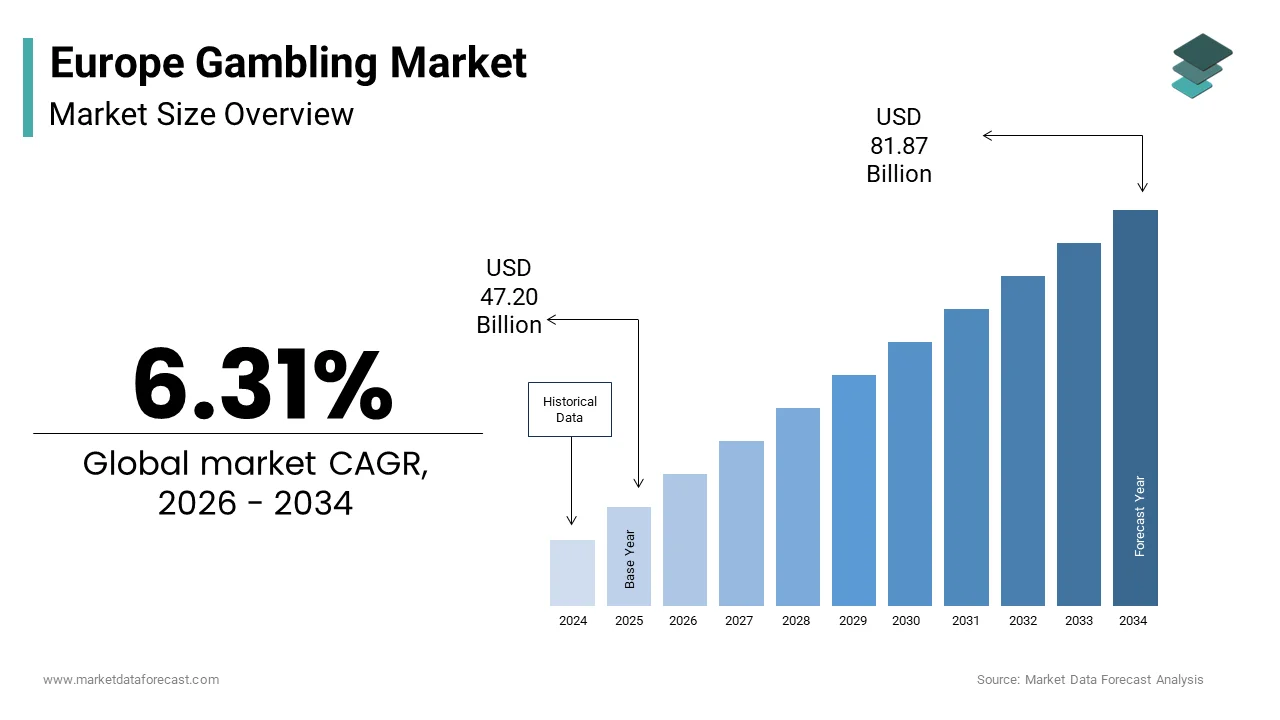
The Europe gambling market size was valued at USD 47.20 billion in 2025, is anticipated to reach USD 50.18 billion in 2026, and is projected to scale up to USD 81.87 billion by 2034, registering a compound annual growth rate (CAGR) of 6.31% during the forecast period from 2026 to 2034. Driven by pervasive smartphone penetration, advanced mobile connectivity, the cultural integration of sports betting, and the digital transformation of the sector, the gambling industry continues to expand steadily across the European continent.
Key Executive Metrics (At-a-Glance)
- 2025 Base Valuation: USD 47.20 Billion
- 2026 Current Valuation: USD 50.18 Billion
- 2034 Forecast Valuation: USD 81.87 Billion
- Compound Annual Growth Rate (CAGR): 6.31% (2026–2034)
- Dominant Game Type Segment: Sports Betting (holding 48.8% of the market share in 2025, driven by professional football integration)
- Dominant Age Group Segment: 25 to 40 Years (holding 55.4% of the market share in 2025, supported by high disposable income and digital fluency)
- Fastest-Growing Age Group Segment: Below 25 Years (growing at a fastest CAGR of 13.5% from 2026 to 2034, fueled by esports and competitive gaming)
- Dominant Region: United Kingdom (holding 28.3% of the share in 2025, supported by a mature, regulated, and liberalized licensing regime)
Core Market Drivers
- Pervasive Smartphone Penetration and Advanced Mobile Connectivity: Ubiquitous smartphone adoption and high-speed 5G networks transforming handheld devices into portable casinos and sportsbooks with negligible latency.
- Cultural Integration of Sports Betting: Deep entrenchment of sports wagering as an integral component of the fan experience for major football leagues, tennis tournaments, and live events.
- Expansion of Esports Betting: Rapid growth of competitive gaming offering a gateway to capture the attention and spending of younger demographics disengaged from traditional sports.
Primary Market Restraints & Challenges
- Stringent Regulatory Fragmentation and Compliance Burdens: Lack of regulatory harmonization forcing operators to navigate over 20 distinct national frameworks, increasing operational costs and complexities.
- Intensifying Social Scrutiny and Responsible Gambling Mandates: Escalating pressure and restrictive measures (such as deposit limits and advertising controls) impacting operator revenue and active player numbers.
- Escalating Cybersecurity Threats and Data Privacy Compliance: Sophisticated cyberattacks targeting financial data compounded by the rigorous compliance demands of the GDPR.
Europe Gambling Market Segmentation Breakdown
| Segment Category | Leading Sub-Segment (2025 Base) | Fastest-Growing Sub-Segment (2026–2034) |
|---|---|---|
| By Game Type | Sports Betting (holding 48.8% market share, anchored by professional football leagues) | Online Casino (projected to expand at a CAGR of 11.2% driven by live dealer games) |
| By Device | Mobile Devices (dominant share fueled by near-universal smartphone ownership and 5G) | Large-Screen Mobile Devices & Tablets (growing at a CAGR of 12.8% for immersive gambling) |
| By Age Group | 25 to 40 Years (holding 55.4% share, backed by peak disposable income and digital fluency) | Below 25 Years (fastest-growing at a 13.5% CAGR, driven by esports and social betting) |
Major Industry Players Profiled
Key enterprises shaping the competitive Europe gambling market include Flutter Entertainment, Entain plc, 888 Holdings plc, Betsson AB, Kindred Group plc, LeoVegas AB, Playtech plc, Evolution AB, Bet365 Group Ltd, GVC Holdings, Novomatic AG, International Game Technology PLC, Scientific Games Corporation, William Hill plc, and 888casino.
Europe Gambling Market Size
The Europe gambling market size was calculated to be USD 47.20 billion in 2025 and is anticipated to be worth USD 81.87 billion by 2034, from USD 50.18 billion in 2026, growing at a CAGR of 6.31% during the forecast period.
Gambling is a complex and highly regulated ecosystem encompassing land-based casinos, sports betting venues, lotteries, and an increasingly dominant online gaming sector. According to data from Eurostat, leisure and cultural expenditure accounts for a significant portion of household spending across the European Union, with gaming activities representing a consistent allocation of disposable income despite economic fluctuations. Furthermore, the European Gaming and Betting Association notes that the digital transformation of the sector has accelerated, with mobile devices now serving as the primary interface for wagering activities among younger people. The tension between maximizing state revenue through taxation and licensing fees, while simultaneously addressing growing societal concerns regarding problem gambling and addiction. As per findings from the European Commission, the emergence of telecommunications and gaming technologies has blurred traditional boundaries, necessitating updated regulatory frameworks that address cross-border services and digital advertising standards.
MARKET DRIVERS
Pervasive Smartphone Penetration and Advanced Mobile Connectivity
The ubiquitous adoption of smartphones coupled with the widespread deployment of high-speed fifth-generation mobile networks, which have fundamentally transformed access to wagering platforms, is propelling the growth of Europe gambling market. Consumers now possess powerful handheld devices that serve as portable casinos and sportsbooks by enabling real-time participation in games and live betting events from any location with internet coverage. According to data from the Global System for Mobile Communications Association, smartphone penetration in Western Europe has exceeded 85% by, creating a massive addressable audience that is constantly connected and capable of instant transaction execution. The rollout of fifth-generation infrastructure further enhances this capability by reducing latency to negligible levels, which is crucial for live in-play betting where odds fluctuate within seconds of sporting action. This technological backbone supports sophisticated graphical interfaces and live streaming capabilities that replicate the immersive experience of physical venues on small screens. The ability to utilize biometric authentication and digital wallets on these devices also streamlines the verification and payment processes, removing friction that previously hindered spontaneous engagement. The digital literacy of the European population has reached unprecedented levels by making the transition from desktop or land-based betting to mobile-first interactions complete.
Cultural Integration of Sports Betting and Live Event Engagement
The profound cultural entrenchment of sports betting where wagering is viewed not merely as a financial speculation but as an integral component of the fan experience for major sporting events. The cultural integration of sports betting and live event management is additionally leveraging the growth of Europe gambling market. The continent hosts some of the world's most prestigious football leagues, tennis tournaments, and motorsport events, all of which serve as magnets for betting activity that peaks during match days and championship seasons. According to the European Sports Security Association, a significant majority of adult males in countries like the United Kingdom, Germany, and Italy engage in some form of sports wagering annually, driven by a desire to enhance their emotional investment in the outcomes. The normalization of betting odds being displayed during live broadcasts and the presence of gambling sponsors on team jerseys have further cemented this connection, making wagering a socially accepted pastime. The rise of fantasy sports and e-sports betting has also expanded the demographic reach by attracting younger audiences who may not follow traditional sports but are keen on competitive gaming.
MARKET RESTRAINTS
Stringent Regulatory Fragmentation and Compliance Burdens
The lack of regulatory harmonization across the continent, which forces operators to navigate a labyrinth of divergent national laws, licensing requirements, and tax regimes, is a restraining factor for the growth of Europe gambling market. According to analysis by the European Gaming and Betting Association, operators must comply with over 20 distinct regulatory frameworks to cover the major European countries, each with its own rules regarding advertising, player verification, and game offerings. This fragmentation significantly increases operational costs and legal complexities, acting as a barrier to entry for smaller firms and limiting the scalability of larger operators. The uncertainty surrounding future legislative changes, such as potential bans on certain types of bonuses or stricter affordability checks, creates a volatile investment climate that can deter capital allocation. The administrative burden of maintaining compliance with constantly evolving rules diverts resources from innovation and customer acquisition, stifling the overall growth potential of the industry.
Intensifying Social Scrutiny and Responsible Gambling Mandates
The escalating societal and political pressure to address problem gambling and protect vulnerable populations has led to the implementation of increasingly restrictive responsible gambling measures. The intensifying social scrutiny and responsible gambling are hindering the growth of Europe gambling market. Governments and advocacy groups across Europe are demanding stricter controls on advertising, deposit limits, and mandatory loss thresholds, which directly impact operator revenue and customer acquisition strategies. According to reports from the Gambling Commission in the United Kingdom, recent regulatory interventions such as the ban on credit card gambling and strict affordability checks have resulted in a measurable contraction in active player numbers and gross gambling yield. The stigma associated with gambling addiction has intensified, prompting calls for comprehensive bans on sports sponsorship and aggressive marketing tactics that were once standard industry practices. Data from the European Association for the Study of Gambling indicates that public support for tighter regulations is at an all-time high, forcing policymakers to prioritize consumer protection over tax revenue generation. The requirement for operators to implement sophisticated monitoring systems to detect signs of harmful behavior adds high technical and operational costs. Furthermore, the threat of heavy fines and license revocations for non-compliance creates a risk-averse environment where operators may voluntarily limit their product offerings to avoid regulatory scrutiny.
MARKET OPPORTUNITIES
Expansion of Esports Betting and Engagement with Younger Demographics
The rapid growth of esports betting, which offers a gateway to capture the attention and spending of younger people who are increasingly disengaged from traditional sports wagering. This factor is creating new opportunities for the growth of Europe gambling market. The competitive gaming sector has exploded in popularity across Europe, with major tournaments drawing millions of viewers and creating a fertile ground for betting markets tailored to titles like League of Legends, Counter-Strike, and Dota 2. According to data from Newzoo, the European esports audience is projected to exceed one hundred million enthusiasts, a cohort that is digitally native and accustomed to interactive entertainment formats. Betting operators can leverage this trend by offering specialized markets such as first blood, map winners, and player-specific statistics that resonate with the deep knowledge these fans possess. The integration of betting streams directly into gaming platforms and social media channels allows for seamless engagement, turning passive viewing into active participation. Research from the Interactive Software Federation of Europe suggests that the overlap between gamers and bettors is significant yet largely untapped by traditional bookmakers who focus on conventional sports.
Integration of Blockchain Technology and Cryptocurrency Payments
The adoption of blockchain technology and cryptocurrency payment solutions to enhance transparency, security, and efficiency is also set to drive the growth of Europe gambling market. Distributed ledger technology can provide provably fair gaming mechanisms, where every transaction and game outcome is recorded on an immutable public chain, addressing longstanding concerns about trust and manipulation. The use of cryptocurrencies for online transactions is gaining traction among users who value privacy and speed by offering a viable alternative to traditional banking methods that often impose delays and restrictions on gambling-related transfers. Smart contracts can automate payout processes, which eliminates the need for manual intervention and reduces operational overhead, while ensuring instant settlement for players. Several jurisdictions within Europe are beginning to explore regulatory frameworks that accommodate digital assets, creating a pathway for licensed operators to legally accept Bitcoin and Ethereum.
MARKET CHALLENGES
Escalating Cybersecurity Threats and Data Privacy Compliance
The escalating sophistication of cyberattacks targeting financial transactions and personal data, compounded by the rigorous demands of the General Data Protection Regulation. This factor is one of the major challenges for the growth of Europe gambling market. As gambling platforms migrate to cloud-based infrastructures and integrate diverse payment gateways, they become prime targets for ransomware, phishing, and distributed denial-of-service attacks that can disrupt operations and compromise sensitive user information. According to the European Union Agency for Cybersecurity, the gaming and betting sector remains one of the most targeted industries for cyber incidents, with attacks increasing in frequency and severity, posing a direct threat to business continuity and brand reputation. The stringent requirements of GDPR mandate that any breach involving personal data must be reported within seventy-two hours, imposing immense pressure on operators to maintain impenetrable security postures and robust incident response plans. Balancing the need for seamless user experiences with the imperative of strict security controls creates a complex operational dilemma. Organizations must invest heavily in advanced encryption, multi-factor authentication, and continuous monitoring tools, which can strain budgets and slow down the deployment of new features.
Economic Volatility and Impact on Discretionary Consumer Spending
The pervasive economic uncertainty stemming from high inflation rates, rising energy costs, and stagnant wage growth across many European nations, which directly impacts discretionary spending on gambling activities. The economic volatility and impact on discretionary consumer spending are expected to slow down the growth of Europe gambling market. As households face increased costs of living, non-essential expenditures such as entertainment and wagering are often the first to be reduced or eliminated, leading to a contraction in betting volumes and average stake sizes. The persistent inflation has eroded the purchasing power of consumers by forcing a reprioritization of household budgets towards essential goods and services. This economic pressure is particularly acute in lower-income demographics, who traditionally contribute a significant portion of revenue to the lottery and low-stakes gaming sectors. Data from the Organisation for Economic Co-operation and Development warns that prolonged economic stagnation could lead to a structural shift in consumer behavior, where gambling is viewed as an unaffordable luxury rather than a routine leisure activity. The inability of operators to pass on increased costs to price-sensitive customers without risking churn creates a margin squeeze that threatens profitability.
REPORT COVERAGE
| REPORT METRIC | DETAILS |
| Market Size Available | 2025 to 2034 |
| Base Year | 2025 |
| Forecast Period | 2026 to 2034 |
| CAGR | 6.31% |
| Segments Covered | By Game Type, Device, Age Group, And Region |
| Various Analyses Covered | Global, Regional & Country Level Analysis; Segment-Level Analysis; DROC, PESTLE Analysis; Porter’s Five Forces Analysis; Competitive Landscape; Analyst Overview of Investment Opportunities |
| Regions Covered | UK, France, Spain, Germany, Italy, Russia, Sweden, Denmark, Switzerland, Netherlands, Turkey, and the Czech Republic |
| Market Leaders Profiled | Flutter Entertainment, Entain plc, 888 Holdings plc, Betsson AB, Kindred Group plc, LeoVegas AB, Playtech plc, Evolution AB, Bet365 Group Ltd, GVC Holdings, Novomatic AG, International Game Technology PLC, Scientific Games Corporation, William Hill plc, 888casino |
SEGMENTAL ANALYSIS
By Game Type Insights
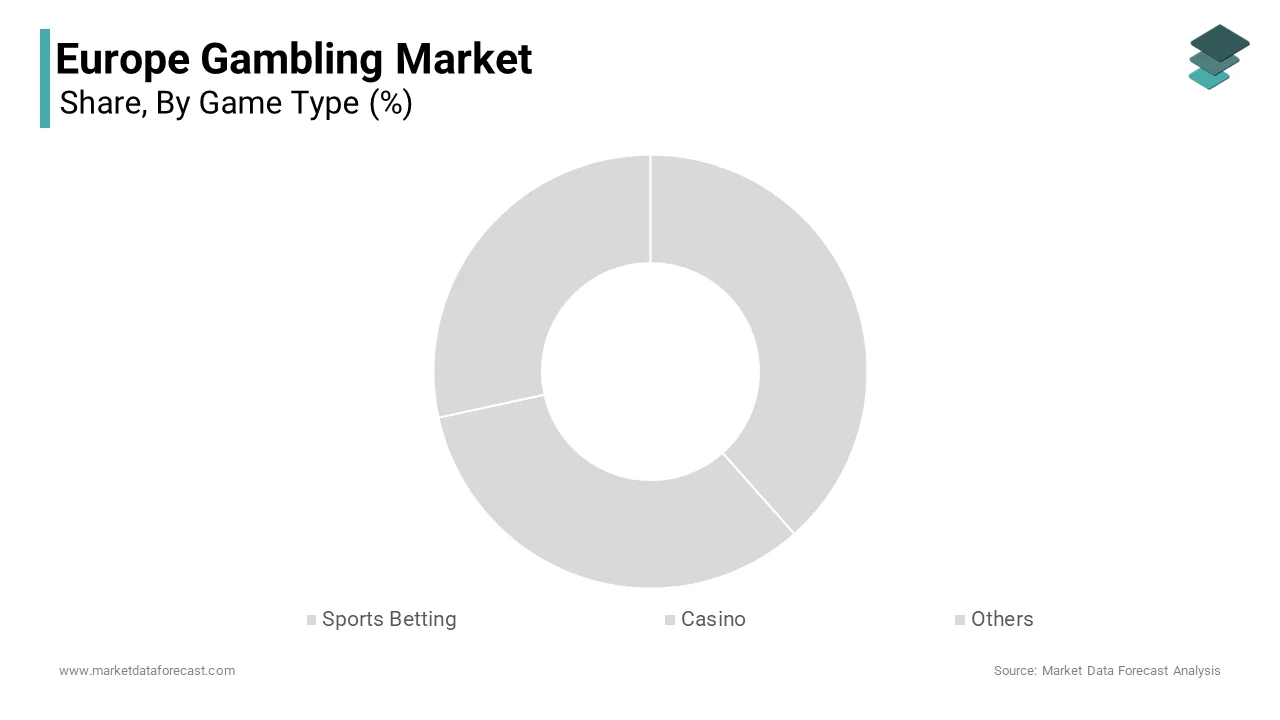
The sports betting segment was the largest by holding 48.8% of the Europe gambling market share in 2025. The growth of the segment is driven by the supremacy of sports betting, which is the seamless integration of wagering into the fabric of European professional football, where betting odds are displayed alongside match statistics, and sponsorship deals are ubiquitous. The continent hosts the most valuable football leagues globally, including the English Premier League and La Liga, which generate billions in viewing hours that directly correlate with betting volumes. The normalization of betting through broadcast graphics and stadium advertising has removed historical stigmas by making it a socially accepted leisure activity for millions. Data from YouGov indicates that during major tournaments like the World Cup or the Champions League, betting participation spikes dramatically, with even casual fans placing wagers. The technological evolution of live in-play betting, which allows users to place wagers on dynamic events occurring in real time, such as the next goal scorer or the outcome of the next set in tennis. The deployment of low-latency fifth-generation networks enables bookmakers to update odds within milliseconds of on-field action by providing a seamless and immersive user experience that desktop or land-based venues cannot match.
The online casino segment is projected to expand at a CAGR of 11.2% from 2026 to 2034. The rapid expansion of the online casino segment is primarily driven by the widespread adoption of live dealer games, which stream real human dealers conducting table games like blackjack and roulette from specialized studios directly to player devices. This format addresses the trust deficit some players feel towards random number generator software by offering transparency and social interaction that mimics the atmosphere of a land-based casino. High definition video streaming and advanced augmented reality features allow users to interact with dealers and other players, creating a communal environment that was previously exclusive to physical venues. The intense gamification of online slot machines and the optimization of these games for mobile platforms have transformed them from simple chance-based activities into complex entertainment products. Modern video slots incorporate narrative storylines, skill-based bonus rounds, and progressive jackpots that keep players engaged for longer sessions while offering the potential for life-changing wins.
By Device Insights
The mobile device segment accounted for a prominent share of the Europe gambling market in 2025. The engine behind the dominance of mobile gambling is the near-universal ownership of smartphones across Europe, combined with the rollout of high-speed 5th-generation networks that enable seamless real-time wagering. Consumers no longer need to be tethered to a desktop computer or visit a physical bookmaker to place a bet, as powerful handheld devices serve as portable casinos and sportsbooks. According to data from the Global System for Mobile Communications Association, smartphone penetration in Western Europe has exceeded 85%, creating a massive addressable audience that is constantly connected. The deployment of 5th-generation infrastructure reduces latency to negligible levels, which is crucial for live in-play betting, where odds fluctuate rapidly, by ensuring that mobile users do not miss out on opportunities due to lag. This technological backbone supports high-definition live streaming of sports and dealer games, replicating the immersive experience of larger screens on a pocket-sized device. The ability to utilize biometric authentication and digital wallets on mobiles also streamlines the login and payment processes, removing friction that previously hindered spontaneous engagement. The strategic advantage is offered by dedicated mobile applications, which provide a superior user experience compared to mobile browsers and allow operators to maintain direct engagement through push notifications. Apps offer faster load times, intuitive navigation tailored for touch screens, and offline capabilities for certain features, making them the preferred choice for regular users. According to a study by App Annie, gambling apps consistently rank among the most downloaded and highest revenue-generating applications in European app stores, indicating strong user preference and retention. Operators leverage push notifications to alert users about upcoming matches, live odds changes, and exclusive bonuses, driving immediate traffic and reactivating dormant accounts with precision timing.
The sub-segment of large-screen mobile devices and tablets used for immersive gambling is growing at the fastest CAGR of 12.8% during the forecast period. Players engaging in live dealer casino games or analyzing multiple sports markets simultaneously prefer the expanded real estate of tablets, which allows for clearer video feeds and a more comfortable interface interaction without sacrificing portability. According to data from IDC, shipments of premium tablets in Europe have seen a resurgence, partly fueled by media consumption and gaming needs, as users seek a middle ground between the intimacy of phones and the immersion of desktops. The enhanced graphical fidelity of modern slot games and the ability to view multiple camera angles in live sports betting are best experienced on these larger displays, leading to longer session times and higher average stakes. Research from Deloitte indicates that tablet users in the gambling sector exhibit higher lifetime value compared to smartphone-only users, as the device facilitates a more relaxed and engaged playing environment suitable for evening entertainment at home. The shift toward hybrid work models and flexible lifestyles, where individuals frequently switch between tasks and devices, is also prompting the growth of Europe gambling market. The versatility of these devices allows users to seamlessly transition from work applications to gambling platforms without the setup time required for a desktop, fitting gambling into fragmented pockets of time throughout the day. According to Eurostat, the prevalence of remote and hybrid work in Europe has increased the usage of personal tablets for both productivity and leisure, blurring the lines between office and home environments. Gambling operators have responded by optimizing their platforms for split-screen multitasking, allowing users to watch a live match while managing their bet slip or playing a slot game alongside other apps.
By Age Group Insights
The age group spanning 25 to 40 years segment was the largest by holding 55.4% of the Europe gambling market share in 2025. The growth of the segment is majorly driven by the supremacy of the twenty-five to forty age bracket, which is their position in the lifecycle where disposable income is typically at its highest relative to responsibilities, enabling consistent and higher value wagering activities. Unlike younger adults, who may still be students or entering the workforce with limited funds, this cohort has established careers and greater financial autonomy, allowing them to allocate a portion of their budget to entertainment and gambling without significant constraint. According to data from Eurostat, household disposable income in the European Union peaks for individuals in their 30’s, providing the financial fuel for regular participation in sports betting and online casino games. This demographic is also more likely to engage in high-stakes activities such as live dealer tables and accumulator bets, contributing disproportionately to gross gaming revenue. The stability of their financial situation allows for the adoption of subscription models and loyalty programs that require upfront commitments or consistent deposit levels. The deep familiarity and comfort this demographic possesses with digital technologies and online platforms, having grown up during the internet boom and adopted mobile banking and e-commerce early in their lives. According to research by Ofcom in the United Kingdom, over 90% of adults aged 25 to 40 use smartphones for daily internet access, and a significant majority have downloaded at least one gambling application. This digital fluency allows them to navigate complex betting interfaces, utilize advanced features like cash out and live streaming, and manage their accounts with ease by reducing barriers to entry and frequency of use. Data from the European Commission highlights that this age group is also the most responsive to digital marketing campaigns and social media promotions, thereby making them easier and cheaper for operators to acquire and retain.
The age group below 25 years is swiftly growing at a fastest CAGR of 13.5% from 2026 to 2034. The rapid ascent of people under 25 years of age is fundamentally linked to the explosive popularity of esports and competitive gaming, which has created a new avenue for wagering that resonates deeply with this generation. The e-sports titles like League of Legends, Counter-Strike, and FIFA are integral parts of youth culture, and betting on these events feels like a natural extension of their gaming hobbies. Operators are capitalizing on this by offering specialized markets such as first blood, map winners, and player performance stats that appeal to the deep knowledge these young fans possess. The integration of betting streams directly into platforms like Twitch and YouTube Gaming allows for seamless engagement, turning passive viewing into active participation. The rise of social betting and the influence of digital content creators, who normalize and promote gambling activities to their young followers, is additionally fuelling the growth of the segment. Platforms like TikTok, Instagram, and Discord have become hubs for sharing betting tips, showcasing big wins, and discussing strategies by creating a social environment where gambling is viewed as a communal and exciting activity. The gamification of betting through social features like leaderboards, friend challenges, and shared bet slips further enhances the appeal, tapping into the desire for social validation and competition among peers. The use of cryptocurrency and micro betting options also appeals to this tech-savvy demographic, offering low barrier entry points and anonymity.
REGIONAL ANALYSIS
United Kingdom Gambling Market Analysis
The United Kingdom was the top performer of the Europe gambling market by holding 28.3% of the share in 2025 due to its mature, highly regulated, and liberalized licensing regime that has fostered a dense concentration of global operators. The nation benefits from a long history of legal gambling acceptance, where betting is deeply embedded in the cultural fabric, particularly around horse racing and football. According to data from the UK Gambling Commission, the gross gambling yield in the country consistently ranks highest in Europe, driven by high per capita spending and widespread adoption of online platforms. The regulatory framework, while stringent regarding consumer protection, provides clarity and stability that attracts major international companies to establish their headquarters in London or Gibraltar. The presence of advanced digital infrastructure and high smartphone penetration ensures that mobile betting dominates the landscape. Furthermore, the sheer volume of sporting events hosted and broadcast from the UK creates a continuous cycle of betting opportunities.
Germany Gambling Market Analysis
Germany's gambling market held 18.2% of the share in 2025, with a massive population and a recently unified regulatory framework that has opened the door for a legalized and taxed online gambling sector. The implementation of the State Treaty on Gambling in 2021 marked a paradigm shift, moving from a restrictive monopoly model to a licensed market that encourages competition and consumer safety. According to the Joint Gambling Authority of the States, the number of licensed operators has surged, leading to a formalization of previously gray market activities and a significant increase in tax revenues. Data from the German Football Association shows that match days generate substantial betting volumes across both retail and online channels. The strict regulations on advertising and deposit limits have shaped a unique market dynamic where operators focus on compliance and product quality to retain users.
Italy Gambling Market Analysis
Italy's gambling market growth is driven by its pioneering role in regulating online gambling and its vibrant culture of sports betting and lottery participation. The first in Europe to introduce a comprehensive licensing system for online operators by creating a robust and competitive landscape that has matured over the last decade. The presence of a dense network of physical betting shops complements the online sector by providing a hybrid experience that appeals to diverse demographics. The cultural significance of football in Italy ensures that betting volumes spike during Serie A matches and international tournaments. The government's active management of the sector through regular tenders and strict enforcement against illegal operators ensures a healthy market environment.
France Gambling Market Analysis
France's gambling market growth is propelled by the state-controlled monopoly model for certain game types like lotteries and horse racing, alongside a regulated competitive market for sports betting and poker. According to the National Gaming Authority, the sports betting segment has seen steady growth, fueled by the popularity of Ligue 1 and major international sporting events, although the market is more restricted compared to the UK or Germany. The regulatory framework prioritizes consumer protection and the preservation of public order by leading to stricter advertising rules and lower allowable margins for operators. The recent opening of the online poker market to liquidity sharing with other European countries has revitalized this segment by attracting more players and increasing tournament prizes.
Spain Gambling Market Analysis
Spain's gambling market growth is likely to grow with a passionate sports culture, a thriving tourism industry, and a rapidly expanding online gambling sector following recent regulatory reforms. According to the Directorate General for the Regulation of Gambling, the number of licensed operators and registered players has grown substantially, indicating a successful transition from unregulated to regulated channels. Football is the primary driver of betting activity, with La Liga matches generating massive wagering volumes across the country. The prevalence of physical betting halls in urban centers complements the online boom, offering a social space for punters. Data from the Spanish Statistics Institute shows that leisure spending remains resilient despite economic fluctuations, supporting the gambling sector. The young people are increasingly engaging with online platforms, drawn by aggressive marketing and the convenience of mobile apps. The integration of gambling into the broader entertainment and tourism ecosystem in coastal regions adds another layer of demand.
COMPETITION OVERVIEW
The competition within the Europe gambling market is characterized by intense rivalry among established global giants, agile local operators, and emerging digital natives vying for market share in a highly fragmented regulatory landscape. Incumbent players leverage their extensive brand recognition, vast customer databases, and robust financial resources to maintain dominance while new entrants differentiate themselves through niche products, superior user interfaces, and innovative bonus structures. The complication of varying national regulations regarding taxation, advertising, and licensing forces companies to adopt localized strategies rather than a unified continental approach. Competitive pressure drives continuous investment in technology, particularly in areas of mobile optimization, live streaming, and real-time data processing to support fast-paced in-play wagering. Brands compete fiercely for sponsorship rights to major sports teams and leagues to capture the attention of passionate fans and build credibility. Price competition is evident as operators offer enhanced odds and generous promotions to attract and retain users in a saturated environment. Trust and safety have become key differentiators, with firms highlighting their commitment to responsible gambling and data security to appeal to cautious consumers and regulators.
KEY MARKET PLAYERS
A few major players of the Europe gambling market include
- Flutter Entertainment
- Entain plc
- 888 Holdings plc
- Betsson AB
- Kindred Group plc
- LeoVegas AB
- Playtech plc
- Evolution AB
- Bet365 Group Ltd
- GVC Holdings
- Novomatic AG
- International Game Technology PLC
- Scientific Games Corporation
- William Hill plc
- 888casino
Top Strategies Used by the Key Market Participants
Key players in the Europe gambling market primarily employ strategies centered on technological innovation and rigorous compliance to secure competitive advantages. Operators heavily invest in artificial intelligence and machine learning to personalize user experiences, optimize odds compilation, and detect problematic gambling behaviors early. This technical superiority allows them to offer dynamic in-play markets and seamless cross-device interactions that retain customer interest. Another prevalent strategy involves diversification of product portfolios to include esports, virtual sports, and live dealer casino games, catering to shifting consumer preferences, especially among younger demographics. Companies also focus on strategic mergers and acquisitions to enter new jurisdictions or acquire specialized technology capabilities rapidly. Enhancing responsible gambling frameworks serves as a critical tactic to build trust with regulators and the public, ensuring long-term operational licenses. Furthermore, operators leverage data analytics to refine marketing campaigns and maximize customer lifetime value while adhering to strict advertising restrictions.ns
Leading Players in the Europe Gambling Market
- Flutter Entertainment plc stands as a global leader in sports betting and gaming services with a profound footprint across the European continent through brands like Paddy Power and Betfair. The company contributes significantly to the global market by pioneering the betting exchange model, which allows users to bet against each other rather than the house. Its involvement in Europe is characterized by a deep integration of retail and digital channels, offering a seamless omnichannel experience. Recent actions to strengthen its market position include aggressive investments in proprietary technology platforms to enhance live streaming capabilities and data analytics for personalized user engagement. The firm has also expanded its sportsbook offerings to cover niche events and esports, attracting younger demographics.
- Entain plc operates as a diversified international sports betting and gaming group through iconic brands, such as Bwin and Ladbrokes. Its European strategy focuses on delivering localized experiences that cater to specific national preferences, while maintaining operational excellence. Entain has also launched comprehensive sustainability programs aimed at promoting safer gambling and reducing environmental impact. The group continues to expand its portfolio of live dealer casino games and virtual sports to diversify revenue streams.
- Bet365 Group Ltd remains a dominant force in the gambling market, renowned for its extensive sportsbook and casino offerings that serve millions of customers. The company contributes to the global market by setting high standards for product reliability, customer service, and technological innovation in real-time betting. Recent actions to strengthen its market position include the rollout of enhanced mobile applications featuring intuitive interfaces and faster load times to improve user experience. Bet365 has also expanded its coverage of live sports events with high-definition streaming and in-play statistics to engage bettors more deeply. The firm continues to invest heavily in artificial intelligence to detect fraudulent activities and promote responsible gambling behaviors.
MARKET SEGMENTATION
This research report on the Europe gambling market has been segmented and sub-segmented based on game type, device, age group & region.
By Game Type
- Sports Betting
- Casino
- Others
By Device
- Desktop
- Mobile
- Others
By Age Group
- Below 25 Years
- 25-40 Years
- Others
By Region
- UK
- France
- Spain
- Germany
- Italy
- Russia
- Sweden
- Denmark
- Switzerland
- Netherlands
- Turkey
- Czech Republic
- Rest of Europe