- Product Description Description
- Table of Contents TOC
- List of Table & Figure LOT
- Get Free Sample PDF Sample PDF
Market Size, 2025
$2.94 BnMarket Estimate, 2026
$3.07 BnMarket Forecast, 2034
$4.32 BnCAGR, 2026–2034
4.36%Europe Geosynthetics Market Report Summary
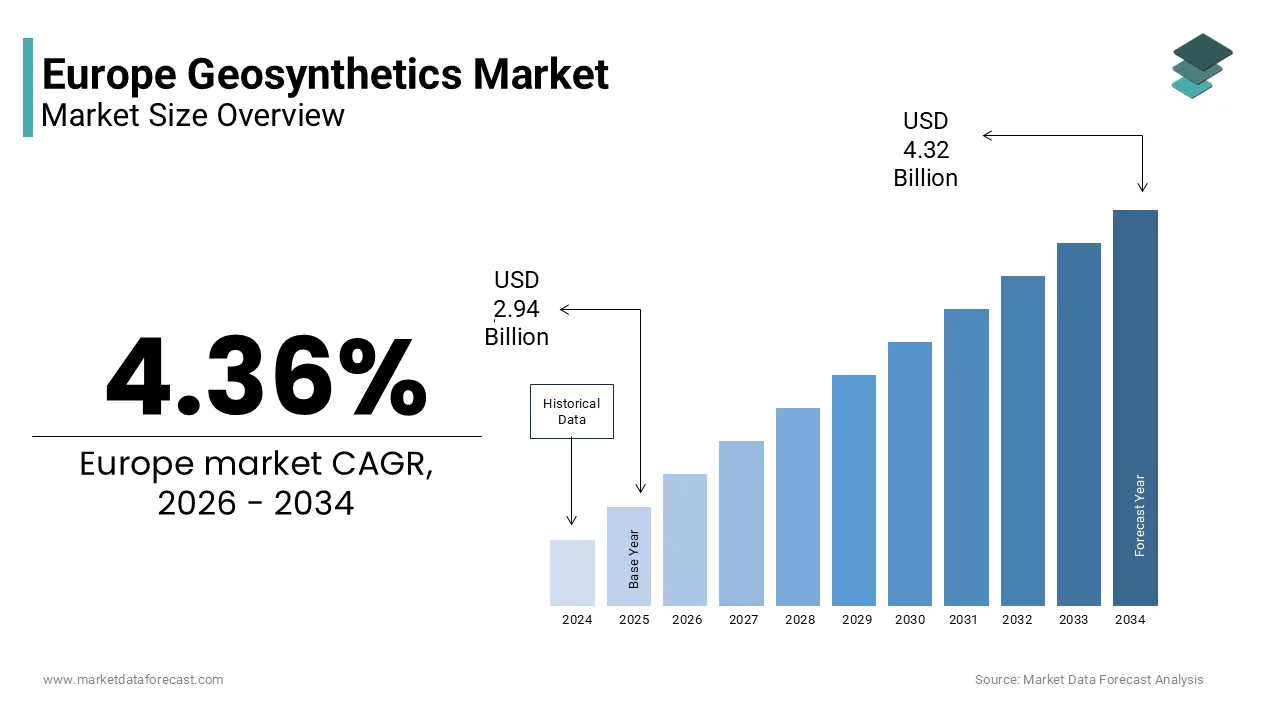
The Europe geosynthetics market was valued at USD 2.94 billion in 2025, is estimated to reach USD 3.07 billion in 2026, and is projected to reach USD 4.32 billion by 2034, growing at a CAGR of 4.36% during the forecast period. The growth of the Europe geosynthetics market is driven by increasing investments in infrastructure development, rising demand for durable and cost effective construction materials, and growing emphasis on sustainable civil engineering solutions. Expanding road construction activities, soil stabilization needs, and flood control projects are significantly supporting market growth. In addition, stricter environmental regulations and the need for long term performance in transportation and environmental applications are accelerating the adoption of geosynthetics across Europe.
Key Market Trends
- Increasing use of geotextiles in road construction, drainage, and soil reinforcement applications due to their durability and filtration properties.
- Growing adoption of geosynthetics in transportation infrastructure projects to improve pavement performance and extend service life.
- Rising demand for sustainable and eco friendly construction materials to reduce environmental impact and maintenance costs.
- Expanding use of geosynthetics in erosion control, landfills, and water management projects across Europe.
- Technological advancements in polymer materials improving strength, longevity, and performance of geosynthetic products.
Segmental Insights
- Based on product, the geotextiles segment held a significant 38.2% share of the Europe geosynthetics market in 2024.
- Based on application, the road construction segment was the largest, accounting for 32.1% of the Europe geosynthetics market share in 2024.
Regional Insights
- The Europe geosynthetics market is witnessing steady growth across major economies, supported by infrastructure modernization, public investment programs, and regulatory focus on sustainable construction practices.
- Germany emerged as the leading market, occupying 23.3% of the Europe geosynthetics market share in 2024
Competitive Landscape
The Europe geosynthetics market is moderately fragmented, with the presence of both global manufacturers and regional suppliers offering diverse product portfolios. Key players are focusing on product innovation, sustainable material development, and expansion of distribution networks to strengthen market presence. Strategic partnerships, capacity expansions, and compliance with environmental standards remain critical competitive strategies. Prominent players operating in the Europe geosynthetics market include Ensar, a Division of CMC, Leggett and Platt, Incorporated, Berry Europe, Inc., Carthage Mills, Inc., TENAX, Europe Synthetics, HUESKER, AGRU, SKAPS Industries, Glen Raven, Inc., SOLMAX, Schouw and Co., Naue GmbH and Co. KG, Officine Maccaferri Spa, Swicofil AG, PRS Geo Technologies, and Freudenberg.
Europe Geosynthetics Market Size
The Europe geosynthetics market size was valued at USD 2.94 billion in 2025 and is projected to reach USD 4.32 billion by 2034 from USD 3.07 billion in 2026, growing at a CAGR of 4.36%.
Geosynthetics are synthetic polymeric materials engineered for use in contact with soil rock or other geotechnical elements to perform functions such as separation filtration drainage reinforcement and containment in civil and environmental infrastructure. In Europe, these products including geotextiles geogrids geomembranes and geocomposites are integral to sustainable construction practices mandated under the European Green Deal and Circular Economy Action Plan. The European market operates under harmonised standards, such as EN ISO 10318 and EN 13252, which define performance criteria for durability chemical resistance and mechanical strength. As per Eurostat over 80% of municipal solid waste in the EU is now managed in engineered landfills or recycling facilities requiring high density polyethylene geomembranes as primary and secondary liners. Additionally, the European Environment Agency reports that Europe has over 22 000 kilometres of coastal and riverine flood defences many of which have been retrofitted with geotextile reinforced embankments to withstand intensifying climate events. These regulatory and environmental imperatives position geosynthetics as essential enablers of Europe’s climate resilient and resource efficient infrastructure transition.
MARKET DRIVERS
EU Mandates for Landfill Liner Systems and Waste Containment
The stringent EU waste legislation has made geosynthetics indispensable in modern landfill engineering by mandating multi barrier containment systems to prevent leachate migration into groundwater. The Eu mandates for landfill liner systems and waste containment is driving the growth of Europe geosynthetics market. As per the EU Landfill Directive 1999/31/EC, all new landfills receiving biodegradable or hazardous waste must incorporate a composite liner consisting of a compacted clay layer overlain by a high-density polyethylene geomembrane with a minimum thickness of 2.5 millimetres. Furthermore, the directive requires a leachate collection layer above the liner, typically constructed using geonet or geocomposite drainage cores wrapped in nonwoven geotextiles. The European Environment Agency confirms that over 95% of active landfills in Germany France and the Netherlands have been retrofitted or newly constructed to meet these standards since 2005. Companies like Solmax and NAUE supply multi million square metre liner systems annually to comply with these non-negotiable environmental safeguards, making waste management the single largest driver of geomembrane consumption in Europe.
Climate Resilience Investments in Flood Protection and Coastal Infrastructure
The escalating investment in flood defence systems driven by rising sea levels and extreme precipitation is significantly boosting demand for geotextiles and geogrids in hydraulic and coastal engineering. The climate resilience investments in flood protection and coastal infrastructure is As per the European Commission’s Climate Adaptation Strategy over 60 billion euros was allocated between 2021 and 2027 to strengthen flood resilience across member states particularly in the Rhine Danube and North Sea regions. These projects extensively use needle punched nonwoven geotextiles for soil stabilisation and erosion control and biaxial geogrids for reinforced embankments capable of withstanding wave overtopping. The Netherlands’ Delta Programme alone plans to invest 24 billion euros by 2050 to protect 1.2 million hectares of land using geosynthetic reinforced dikes, the majority incorporating polypropylene or polyester geotextiles with 50-year design life. Similarly, Germany’s Federal Waterways and Shipping Administration has mandated geotextile armoring for all riverbank restoration projects along the Rhine and Elbe.
MARKET RESTRAINTS
Regulatory Restrictions on Single Use Plastics and Polymer Sourcing
The European Union’s Single Use Plastics Directive and evolving Extended Producer Responsibility schemes are creating uncertainty around the long-term viability of conventional polyolefin based geosynthetics. While geosynthetics are exempt from outright bans due to their functional necessity the directive’s emphasis on reducing fossil based plastic use has prompted scrutiny of virgin polyethylene and polypropylene consumption in construction. As per the European Chemicals Agency, over 70% of geosynthetics rely on fossil derived polymers whose carbon footprint is increasingly at odds with the EU’s 2050 climate neutrality goals. Additionally, REACH regulations now require full disclosure of additives and stabilisers some of which face future restriction due to persistence or toxicity concerns. In France, the Anti Waste Law for a Circular Economy mandates that public infrastructure projects prioritise materials with recycled content, where technically feasible yet less than 15% of geosynthetics currently incorporate post-consumer recycled polymers due to performance and certification barriers. This regulatory tension pressures manufacturers to reformulate products while maintaining ISO 10319 tensile strength and EN 13491 puncture resistance standards with a complex balance that increases R&D costs and delays product approvals.
Fragmented National Standards for Installation and Quality Assurance
The harmonisation efforts significant disparities persist in national testing protocols and installation guidelines is significantly hampering the growth of Europe geosynthetics market. As per the European Committee for Standardisation CEN, while core material standards like EN ISO 10318 are harmonised member states maintain divergent acceptance criteria for field performance. For instance, Germany’s BAFA guidelines require geogrids used in road bases to undergo cyclic load testing under DIN 18196 whereas Italy’s ANAS specifications mandate static pull out tests under different boundary conditions. Similarly, the Netherlands’ CUR Recommendation 166 imposes stricter seam strength requirements for geomembranes than Spain’s UNE standards. These inconsistencies force contractors to qualify the same product multiple times for pan European tenders by adding 3 to 6 months to procurement timelines. Moreover, on site quality control varies widely a 2023 European Geosynthetics Society audit found that only 40% of Southern European landfill liner installations met prescribed overlap and welding standards compared to 85% in Northern Europe. This patchwork of practices undermines performance reliability and discourages innovation in advanced geosynthetic systems that require precise installation protocols.
MARKET OPPORTUNITIES
Integration of Recycled Polymers in Circular Infrastructure Projects
The use of post-consumer and post-industrial recycled polymers in geosynthetics as part of its Circular Economy Action Plan for sustainable material solutions is setting new opportunities for the growth of Europe geosynthetics market. As per the European Commission’s 2023 Circular Plastics Alliance over 30 infrastructure projects across Germany, the Netherlands, and Sweden, now specify geotextiles and geogrids containing at least 30% recycled polyethylene or polypropylene. The Dutch Rijkswaterstaat has mandated that all coastal reinforcement projects funded after 2025 use geosynthetics with minimum 40% recycled content provided they meet NEN EN ISO 10319 mechanical standards. Companies like HUESKER and Fibertex have responded by launching certified product lines using mechanically recycled ocean bound plastics and post-industrial film waste, diverting over 15,000 tonnes of plastic from incineration in 2023 alone. Furthermore, the EU’s Net Zero Industry Act includes advanced recycling of construction polymers as a strategic technology accelerating investment in compatibilisers and stabilisers that restore performance in recycled feeds. These initiatives transform geosynthetics from passive infrastructure components into active vectors of circularity aligning material supply with Europe’s decarbonisation and waste reduction targets.
Expansion into Green Infrastructure and Nature Based Solutions
The increasing hybrid-green, grey infrastructure systems that combine engineered materials with natural ecosystems to enhance climate resilience is ascribed to bolster the growth of Europe geosynthetics market. As per the European Commission’s Green Infrastructure Strategy, over 120 urban and rural projects funded under the LIFE Programme in 2023 integrated geotextiles into constructed wetlands green roofs and soil bioengineering slopes to control erosion while supporting vegetation growth. In urban settings, cities like Copenhagen and Vienna use needle punched biodegradable geotextiles made from polylactic acid to stabilise green roof substrates and manage stormwater runoff by reducing combined sewer overflows by up to 30%, according to local water utilities. Similarly, the Danube River Basin restoration initiative employs coir geotextiles wrapped in jute netting to reinforce riverbanks while enabling native riparian plant colonisation. The European Environment Agency validates that such nature-based solutions deliver 20 to 50% lower lifecycle carbon emissions than conventional concrete revetments. With the EU allocating 20 billion euros annually to biodiversity and water resilience through the Common Agricultural Policy and Horizon Europe geosynthetics are evolving from purely synthetic barriers to enablers of regenerative landscape engineering.
MARKET CHALLENGES
Limited Availability of Certified Recycled Feedstock Meeting Performance Standards
The adoption of recycled content is constrained by the scarcity of high quality post-consumer polymer streams that meet stringent mechanical and durability requirements is likely to decline the growth of Europe geosynthetics market. As per the European Plastics Converters Association, less than 10% of post-consumer polyethylene waste in Europe is suitable for geosynthetic reuse due to contamination degradation and inconsistent melt flow indices. A 2024 study by the German Federal Institute for Materials Research found that geotextiles with over 25% post-consumer content showed 15 to 20% reduced tensile strength after accelerated UV ageing failing EN ISO 10319 long term design criteria. Chemical recycling offers promise but remains nascent with less than 50,000 tonnes of output capacity, as per the research. Without scalable advanced recycling infrastructure and harmonised specifications for recycled feedstock geosynthetic manufacturers cannot reliably scale circular products, thereby delaying alignment with EU circular economy ambitions.
Inconsistent Long Term Performance Data Under Real World Climate Conditions
The lack of standardised long term field performance data for geosynthetics under Europe’s diverse and intensifying climate conditions poses a significant technical challenge to design confidence and regulatory acceptance. The inconsistent long term performance data under world climatre conditions is solely to hinder the growth of Europe geosynthetics market. Most durability predictions rely on accelerated laboratory ageing per ISO 13438, which may not accurately simulate real world synergies of UV exposure temperature cycling freeze thaw cycles and biological degradation. As per the European Geosynthetics Society, a 10-year monitoring programme across 15 landfill sites revealed that geomembranes in Southern Europe degraded 2.3 times faster than predicted due to extreme summer temperatures exceeding 60 degrees Celsius conditions not replicated in standard tests. Similarly, geotextiles in Nordic peatland applications showed unexpected hydrolysis due to low pH and high organic acid content. Although, the EU’s Horizon Europe is funding the GEOCLIMA project to establish a pan European performance database results will not be available before 2027.
REPORT COVERAGE
| REPORT METRIC | DETAILS |
| Market Size Available | 2025 to 2034 |
| Base Year | 2025 |
| Forecast Period | 2026 to 2034 |
| CAGR | 4.36% |
| Segments Covered | By Material, Prodcut, Function, Application, and Region |
| Various Analyses Covered | Global, Regional, & Country Level Analysis; Segment-Level Analysis; DROC, PESTLE Analysis; Porter’s Five Forces Analysis; Competitive Landscape; Analyst Overview of Investment Opportunities |
| Regions Covered | UK, France, Spain, Germany, Italy, Russia, Sweden, Denmark, Switzerland, Netherlands, Turkey, and the Czech Republic |
| Market Leaders Profiled | Ensar, a division of CMC, Leggett and Platt, Incorporated, Berry Europe, Inc., Carthage Mills, Inc., TENAX, Europe Synthetics, HUESKER, AGRU, SKAPS Industries, Glen Raven, Inc., SOLMAX, Schouw and Co., Naue GmbH and Co. KG, Officine Maccaferri Spa, Swicofil AG, PRS Geo Technologies, and Freudenberg |
SEGMENTAL ANALYSIS
By Product Insights
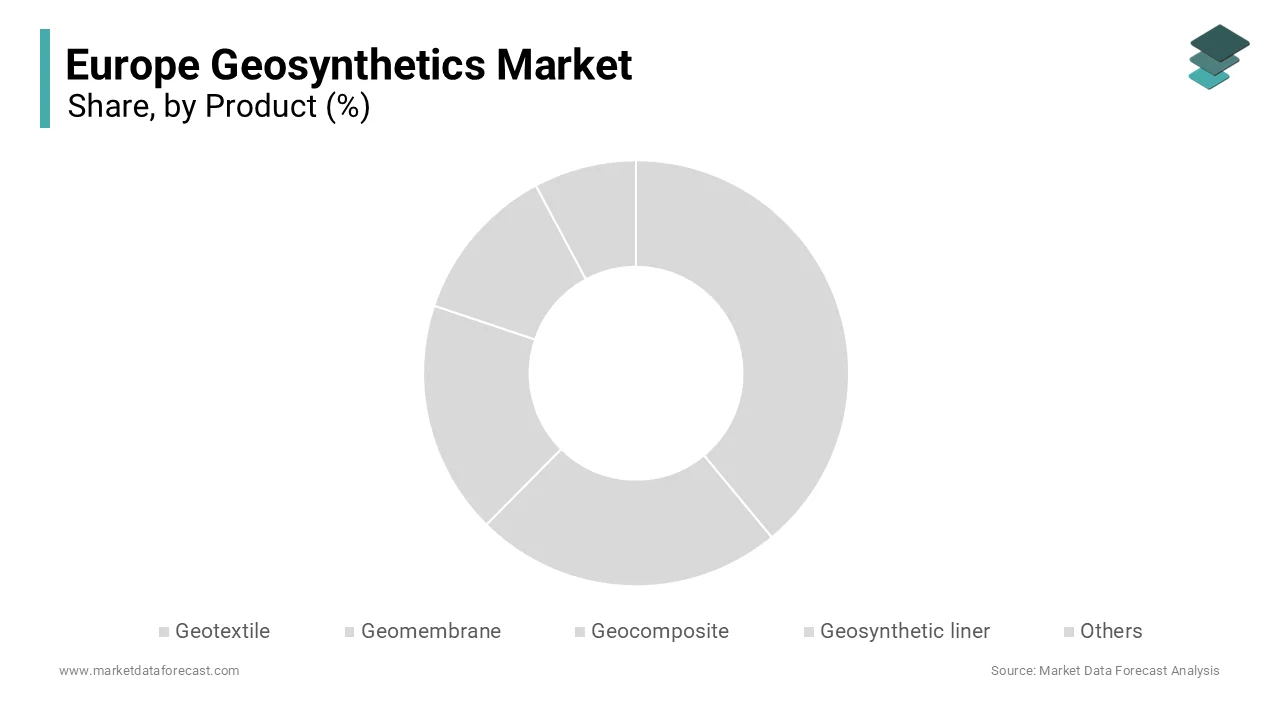
The geotextiles segment was accounted by holding a significant share of the 38.2% of the Europe geosynthetics market share in 2024 owing to their versatility across separation, filtration, and erosion control functions in civil and environmental engineering. As per the European Environment Agency, over 95% of engineered landfills in the EU utilise nonwoven geotextiles as protection layers above high density polyethylene geomembranes to prevent puncture from overlying waste. Additionally, Eurostat reports that Europe maintains over 2.5 million kilometres of paved roads, many of which incorporate geotextiles in base course separation to extend pavement life by 30 to 50%. In the Netherlands, Rijkswaterstaat mandates geotextile use in all dike reinforcement projects to prevent internal erosion during storm surges.
The geosynthetic clay liners (GCLs) segment is likely to witness a fastest CAGR of 9.3% from 2025 to 2033 owing to their dual role as sustainable and cost-effective containment solutions in secondary containment, brownfield redevelopment, and temporary landfill caps. Unlike compacted clay liners, which require 60 to 90 centimetres of natural clay, GCLs achieve equivalent hydraulic conductivity (<1 × 10⁻⁹ m/s) with just 6 millimetres of bentonite sandwiched between geotextiles, reducing excavation, transport, and carbon emissions by up to 70%, according to the European Geosynthetics Society. As per the European Commission’s Brownfield Land Strategy, over 25 000 hectares of contaminated industrial sites are targeted for remediation by 2030, many requiring impermeable caps that GCLs provide without heavy machinery. In Germany, the Federal Ministry for the Environment now permits GCLs, as primary liners in non-hazardous waste cells under Technical Guideline on Waste TA Abfall, accelerating adoption. Furthermore, the EU’s Farm to Fork Strategy promotes GCLs in agricultural slurry lagoons to prevent nitrate leaching opening a new rural application stream.
By Application Insights
The road construction segment was the largest by accounting for 32.1% of Europe geosynthetics market share in 2024 with the extensive highway maintenance programmes and the integration of geosynthetics into sustainable pavement design. National road agencies across Europe, increasingly specify geogrids and geotextiles to reduce aggregate thickness, delay reflective cracking, and extend service life in an era of constrained public budgets. As per the European Road Federation, over 70% of new pavement rehabilitation projects in Germany, France, and the Netherlands now incorporate geosynthetic reinforcement, reducing lifecycle costs by 20 to 35%. The German Federal Ministry of Transport’s 2023 Road Infrastructure Plan allocates 18 billion euros annually for network upgrades, with geogrids mandated in all base course stabilisation for heavily trafficked routes. Similarly, France’s National Road Directorate requires nonwoven geotextiles in all asphalt overlay projects to prevent moisture ingress and interlayer slippage. These institutionalised specifications backed by decades of performance data from the European Committee for Standardisation ensure consistent, large scale demand that dwarfs other application sectors.
The erosion control segment is expected to grow at a CAGR of 10.1% from 2025 to 2033. The growth of the segment is likely to grow with the directly linked to the EU’s intensified focus on climate adaptation, river basin management, and coastal resilience in response to escalating flood and landslide risks. As per the European Environment Agency, over 1,800 major hydro meteorological events occurred in Europe between 2000 and 2023, prompting the European Commission to allocate 60 billion euros under its Climate Adaptation Strategy for slope stabilisation and riverbank protection. These projects extensively use erosion control mats, coir geotextiles, and turf reinforcement meshes on vulnerable infrastructure. In the Netherlands, the Delta Programme mandates geosynthetic armoring for 100% of new dike upgrades along the North Sea coast. Similarly, Sweden’s Civil Contingencies Agency requires geocell and geotextile systems on all mountain road cut slopes to mitigate rockfall and soil washout. The EU’s Nature Restoration Law further promotes hybrid green grey solutions where biodegradable geotextiles support vegetation regrowth, transforming erosion control from temporary mitigation to long term ecological restoration. This convergence of climate policy, biodiversity goals, and infrastructure safety is driving unprecedented adoption across alpine, coastal, and riverine regions.
REGIONAL ANALYSIS
Germany Geosynthetics Market Analysis
Germany was the top performer of the Europe geosynthetics market by occupying 23.3% of share in 2024 with its advanced infrastructure maintenance regime stringent environmental regulations and in sustainable civil engineering. The country operates over 12,800 kilometres of federal highways managed under the Federal Highway Research Institute BASt, which mandates geogrid reinforcement in all heavily loaded pavement bases and geotextiles in asphalt overlays. As per the German Environment Agency, over 1 200 active landfills comply with Technical Guideline on Waste requiring double liner systems with geomembranes and protective geotextiles. Additionally, Germany’s Federal Water Act enforces rigorous riverbank stabilisation standards along the Rhine Elbe and Danube using geosynthetic reinforced revetments. The National Hydrogen Strategy further creates demand for geomembranes in hydrogen storage tank secondary containment.
France Geosynthetics Market Analysis
France held second position by capturing 16.3% of Europe geosynthetics market share in 2024 with its extensive road network national flood defence systems and remediation of industrial brownfields. The French Road Directorate DIR mandates geotextiles in all flexible pavement rehabilitation projects to extend service life and reduce aggregate use by covering over 1 million kilometres of national and departmental roads. As per the French Ministry of Ecological Transition, over 4 500 kilometres of riverbanks are under active erosion control programmes using coir and polypropylene geotextiles to comply with the EU Water Framework Directive. Additionally, France’s Anti Waste Law for a Circular Economy requires all new landfills to use composite liners with high density polyethylene geomembranes and protection geotextiles. The government’s France Relance plan allocated 5.2 billion euros for infrastructure resilience including geosynthetic reinforced coastal dikes in Brittany and Normandy. These coordinated public works ensure steady demand across transportation environmental and energy sectors.
Netherlands Geosynthetics Market Analysis
The Netherlands geosynthetics market growth is growing steadily with the existential reliance on flood protection and innovative use of geosynthetics in water management. The country’s Delta Programme, Europe’s most advanced climate adaptation strategy allocates 24 billion euros by 2050 to reinforce 1,500 kilometres of primary dikes using geotextile armoring and geogrid reinforced grass covers. As per Rijkswaterstaat, over 90% of new dike upgrades since 2020 incorporate nonwoven geotextiles to prevent internal erosion during extreme surge events. Additionally, the Netherlands mandates geosynthetic clay liners in all temporary landfill caps and slurry storage lagoons under the Manure Action Programme to prevent nitrate leaching into groundwater.
United Kingdom Geosynthetics Market Analysis
The United Kingdom geosynthetics market growth is driven by the focus on rail infrastructure resilience coastal defence and post-industrial land regeneration. Network Rail’s Earthworks Management Strategy requires geogrid and geotextile reinforcement on all embankment upgrades to mitigate rainfall induced landslides, a need given the 30% increase in extreme precipitation, since 2000. Additionally, the Environment Agency mandates geomembrane and geosynthetic clay liner systems in all new landfill cells and contaminated land caps under the Pollution Prevention and Control Regulations. The UK’s National Infrastructure Commission has prioritised coastal resilience with 6 billion pounds allocated for sea wall upgrades using geotextile sand containers and turf reinforcement meshes.
Italy Geosynthetics Market Analysis
Italy geosynthetics market growth is likely to grow with its mountainous terrain seismic activity and extensive highway network requiring slope stabilisation and erosion control. The Italian National Road Agency ANAS mandates geocell and geogrid systems on all alpine road cut slopes to prevent rockfall and soil erosion by covering over 20,000 kilometres of high-risk routes. As per the Italian Civil Protection Department, over 7,000 landslides occur annually necessitating emergency geotextile deployment for temporary slope armoring. Additionally, Italy’s National Recovery and Resilience Plan allocates 3.4 billion euros for hydraulic infrastructure including riverbank restoration along the Po and Arno using biodegradable coir geotextiles. The country also operates over 100 active landfills requiring geomembrane liner systems under EU Landfill Directive transposition.
COMPETITIVE LANDSCAPE
Competition in the Europe geosynthetics market is defined by technical certification sustainability credentials and integration into public infrastructure procurement rather than price alone. The market features a mix of large multinational producers like NAUE and HUESKER and regional specialists serving niche applications such as mining or coastal protection. Success depends on compliance with harmonised European standards EN ISO 10318 for materials and national installation guidelines which create high entry barriers for non-certified suppliers. Public tenders by accounting for over 65% of demand, require rigorous documentation of durability UV resistance and chemical compatibility often validated through third party bodies like the British Board of Agrement or DIBt. At the same time, the EU’s Green Deal pressures manufacturers to incorporate recycled content without compromising performance a balance few can achieve. While Asian producers offer lower cost alternatives they often lack EN certification and local technical support limiting their penetration in critical applications.
KEY MARKET PLAYERS
Some of the notable key players in the Europe geosynthetics market are
- Ensar, A Division of CMC
- Leggett and Platt, Incorporated
- Berry Europe, Inc.
- Carthage Mills, Inc.
- TENAX
- Europe Synthetics
- HUESKER
- AGRU
- SKAPS Industries
- Glen Raven, Inc.
- SOLMAX
- Schouw and Co.
- Naue GmbH and Co. KG
- Officine Maccaferri Spa
- Swicofil AG
- PRS Geo Technologies
- Freudenberg
Top Players in the Market
- NAUE GmbH & Co KG is a leading European manufacturer of geosynthetics with a strong global footprint in geotextiles geomembranes and geosynthetic clay liners. Headquartered in Germany the company supplies engineered solutions for landfill lining hydraulic engineering and infrastructure projects across more than 120 countries. NAUE is renowned for its Secugrid geogrids and Bentofix GCLs which meet stringent EN and ISO standards for durability and environmental safety. In 2024, NAUE launched a new generation of recycled content geomembranes containing 30% post-industrial polyethylene certified for landfill secondary containment under European environmental guidelines. It also expanded its technical support centres in France and Poland to assist public agencies with climate resilient infrastructure design.
- HUESKER Synthetic GmbH is a major European player in high performance geosynthetics specialising in geogrids geotextiles and geocells for road construction erosion control and mining applications. Based in Germany the company operates production facilities across Europe and exports to over 100 countries with a focus on engineered solutions for challenging terrains. HUESKER’s Fortrac and Secutex product lines are widely specified in EU infrastructure projects for soil reinforcement and drainage. In early 2024 HUESKER introduced a bio-based geotextile made from polylactic acid for temporary erosion control on green infrastructure projects compliant with the EU Nature Restoration Law. It also partnered with Rijkswaterstaat in the Netherlands to develop geogrid reinforced dike systems for the Delta Programme.
- Solmax International Inc maintains a strategic presence in the Europe geosynthetics market through its high density polyethylene and linear low density polyethylene geomembranes used in landfill mining and water containment. Although headquartered in Canada Solmax operates a major production and distribution hub in Spain serving Southern Europe and North Africa. The company’s products comply with EN 13361 and are certified for critical applications including drinking water reservoirs and hazardous waste cells. Solmax launched a circular economy initiative in Europe recovering end of life geomembranes from landfill closures and reprocessing them into non critical drainage layers. It also secured contracts for secondary containment systems in Germany’s hydrogen storage terminals under the National Hydrogen Strategy.
MARKET SEGMENTATION
This research report on the European geosynthetics market has been segmented and sub-segmented based on categories.
By Material
- Polypropylene
- Polyethylene
- Polyester
- Others
By Product
- Geotextile
- Geomembrane
- Geocomposite
- Geosynthetic liner
- Others
By Function
- Separation
- Drainage
- More
By Application
- Construction
- Transportation
- Environmental
- Other applications
By Country
- UK
- France
- Spain
- Germany
- Italy
- Russia
- Sweden
- Denmark
- Switzerland
- Netherlands
- Turkey
- Czech Republic
- Rest of Europe