- Product Description Description
- Table of Contents TOC
- List of Table & Figure LOT
- Get Free Sample PDF Sample PDF
Market Size, 2025
$1.70 BnMarket Estimate, 2026
$2.18 BnMarket Forecast, 2034
$15.92 BnCAGR, 2026–2034
28.18%Europe GPU as a Service Market Size, Growth, Trends & Forecast (2026–2034)
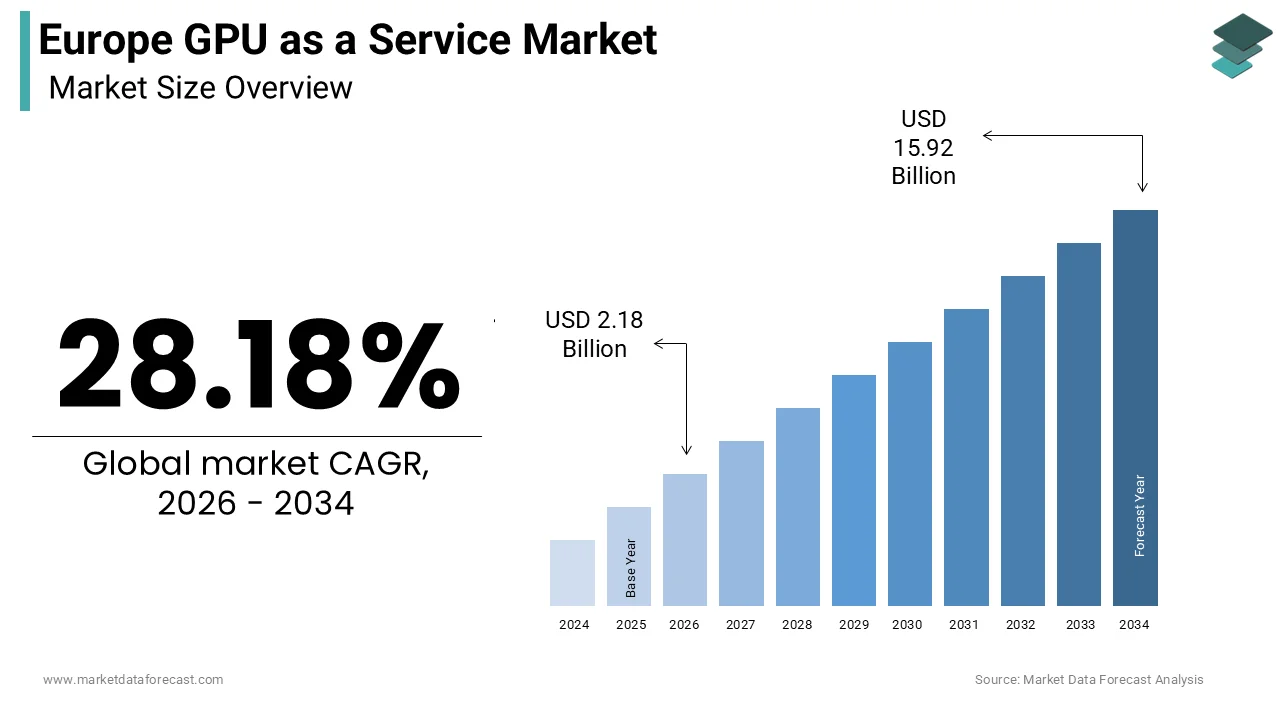
The Europe GPU as a service market size was calculated to be USD 1.70 billion in 2025, is anticipated to be worth USD 2.18 billion in 2026, and is projected to scale up to USD 15.92 billion by 2034, registering a compound annual growth rate (CAGR) of 28.18% during the forecast period from 2026 to 2034. Growth is primarily propelled by the exponential growth in artificial intelligence and machine learning workloads, alongside the rapid expansion of high-performance computing in scientific research and healthcare.
Key Executive Metrics (At-a-Glance)
- 2025 Base Valuation: USD 1.70 Billion
- 2026 Current Valuation: USD 2.18 Billion
- 2034 Forecast Valuation: USD 15.92 Billion
- Compound Annual Growth Rate (CAGR): 28.18% (2026–2034)
- Dominant Application Segment: AI Segment (51.9% share in 2025)
- Fastest-Growing Application Segment: High-Performance Computing Segment (19.1% CAGR)
- Dominant Enterprise Size Segment: Large Enterprises Segment (60.6% share in 2025)
- Fastest-Growing Enterprise Size Segment: Small and Medium Enterprises Segment (20.9% CAGR)
- Dominant End User Segment: BFSI Segment (26.7% share in 2025)
- Fastest-Growing End User Segment: Automotive and Mobility Sector Segment (22.9% CAGR)
- Dominant Country: United Kingdom (26.2% share in 2025)
Core Market Drivers & Restraints
- Key Drivers: Accelerating adoption of generative AI and large language models across industries, and increased demand for cloud supercomputing in healthcare and scientific research.
- Market Restraints: Stringent data privacy regulations like the GDPR, and high network latency and connectivity issues impacting real-time workloads.
Europe GPU as a Service Market Segmentation Breakdown
| Segment Category | Leading Sub-Segment | Fastest-Growing Sub-Segment |
|---|---|---|
| By Application | AI Segment (51.9% share in 2025) | High-Performance Computing Segment (19.1% CAGR) |
| By Enterprise Size | Large Enterprises Segment (60.6% share in 2025) | Small and Medium Enterprises Segment (20.9% CAGR) |
| By End User | BFSI Segment (26.7% share in 2025) | Automotive and Mobility Sector Segment (22.9% CAGR) |
| By Region/Country | United Kingdom (26.2% share in 2025) | Germany, France, and others |
Major Industry Players Profiled
Key cloud computing and GPU infrastructure leaders driving the European market include Amazon Web Services, Microsoft Azure, Google Cloud, IBM, Oracle, NVIDIA, Intel, Advanced Micro Devices (AMD), OVHcloud, Hetzner, Paperspace, Lambda Labs, and Scaleway.
 Download Free Sample Report
Europe GPU as a Service Market Size
The Europe GPU as a service market size was calculated to be USD 1.70 billion in 2025 and is anticipated to be worth USD 15.92 billion by 2034, from USD 2.18 billion in 2026, growing at a CAGR of 28.18% during the forecast period.
GPU as a Service represents a specialized segment of cloud computing where high-performance graphics processing units are delivered over the internet on a subscription or pay-per-use basis. This model allows businesses and researchers to access immense computational power for tasks such as artificial intelligence training, deep learning, rendering, and scientific simulations without the capital expenditure of purchasing physical hardware. The region is witnessing accelerated adoption driven by the urgent need for digital transformation and the proliferation of data-intensive applications. As per Eurostat, 45.2% of enterprises in the European Union used cloud computing services in 2023, which indicates a growing digital infrastructure ready for advanced workloads. Furthermore, the European Commission has emphasized the strategic importance of semiconductor sovereignty and high-performance computing through initiatives like the European High Performance Computing Joint Undertaking. According to the International Energy Agency, data centers and data transmission networks each account for about 1% to 1.5% of global electricity use, prompting a shift towards shared resources to optimize energy efficiency. GPU as a Service enables organizations to scale computational resources dynamically, aligning with fluctuating project demands. This flexibility is crucial for startups and small enterprises that lack the financial capacity for extensive IT infrastructure. The market definition encompasses not only the rental of GPU instances but also the associated software ecosystems, including machine learning frameworks and development tools. Regulatory frameworks, such as the General Data Protection Regulation, influence how data is processed and stored within these services, ensuring compliance and security. The convergence of artificial intelligence advancements and cloud accessibility defines the current trajectory of this sector.
MARKET DRIVERS
Exponential Growth in Artificial Intelligence and Machine Learning Workloads
The rapid expansion of artificial intelligence and machine learning applications is propelling the growth of the Europe GPU as a Service market. Modern AI models, particularly large language models and generative AI, require massive parallel processing capabilities that only GPUs can provide efficiently. According to the European Commission, the adoption of artificial intelligence in enterprises is accelerating, with many organizations integrating AI into their core business processes to enhance productivity and innovation. Training these complex models involves processing vast datasets, which necessitates high-throughput and low-latency computing resources. As per Statista, there are approximately 574 million internet users in Western, Central, and Eastern Europe as of 2024, generating unprecedented volumes of data that fuel AI algorithms. Companies across various sectors, including healthcare, finance, and automotive, are leveraging GPU power to develop predictive analytics, computer vision, and natural language processing solutions. The scarcity of skilled personnel to manage on-premises GPU clusters further drives the preference for managed cloud services. GPU as a Service providers offer pre-configured environments with optimized libraries and frameworks, reducing the time to deployment. This accessibility allows smaller firms to compete with larger entities by accessing state-of-the-art computational power. The iterative nature of model training requires flexible scaling, which cloud-based GPU instances provide seamlessly. Consequently, the demand for scalable and cost-effective GPU resources remains robust. This trend is reinforced by continuous advancements in AI algorithms that increase computational requirements. The strategic imperative to remain competitive in the digital economy ensures sustained investment in GPU infrastructure.
Expansion of High Performance Computing in Scientific Research and Healthcare
The increasing reliance on high-performance computing for scientific research and healthcare applications is further contributing to the Europe GPU as a Service market expansion. Researchers in fields such as genomics, climate modeling, and drug discovery require substantial computational power to simulate complex biological and physical processes. According to the European High Performance Computing Joint Undertaking, Europe is investing heavily in supercomputing infrastructure to maintain its leadership in scientific innovation. GPU acceleration drastically reduces the time required for simulations, enabling faster breakthroughs in critical areas. As per the World Health Organization, the integration of digital technologies in healthcare is transforming patient care and medical research. GPU as a Service allows hospitals and research institutions to perform real-time image analysis and personalized medicine computations without maintaining expensive on-site hardware. The collaborative nature of scientific research benefits from cloud-based platforms that facilitate data sharing and remote collaboration among international teams. Regulatory support for open science and data sharing further encourages the adoption of cloud computing resources. The ability to scale resources up or down based on project phases optimizes costs for grant-funded research projects. Additionally, the rise of digital twins in industrial applications requires continuous simulation and monitoring powered by GPUs. This technological capability enhances operational efficiency and predictive maintenance in manufacturing. The convergence of academic research and industrial application creates a diverse demand base. Government funding for digital health and green technology initiatives further stimulates market growth.
MARKET RESTRAINTS
Stringent Data Privacy Regulations and Compliance Complexities
The rigorous data protection laws in Europe, particularly the General Data Protection Regulation, are impeding the Europe GPU as a Service market growth. These regulations mandate strict controls over personal data processing, storage, and transfer, requiring service providers to implement robust security measures. According to the European Data Protection Board, non-compliance with GDPR can result in fines of up to 4% of global annual turnover or 20 million euros, whichever is higher, creating substantial financial risks for organizations. Many industries, such as healthcare and finance, handle sensitive data that must remain within specific geographical boundaries, limiting the choice of cloud providers. As per a survey by the International Association of Privacy Professionals, the complexity of data transfers remains a top concern for privacy professionals, which causes many companies to hesitate when migrating critical workloads to the cloud. The complexity of ensuring end-to-end encryption and access control in a shared GPU environment adds to the operational burden. Organizations must conduct thorough due diligence to verify that their GPU-as-a-Service providers meet all regulatory requirements. The lack of standardized compliance frameworks across different European countries further complicates multinational operations. Smaller enterprises may lack the resources to navigate these legal complexities, leading to delayed adoption. The requirement for data portability and the right to be forgotten also poses technical challenges for cloud architectures. These regulatory hurdles increase the total cost of ownership and slow down decision-making processes. Consequently, some organizations prefer to maintain on-premises infrastructure to retain full control over data. This caution restricts the potential market size for GPU as a Service provider.
High Latency and Network Connectivity Issues
Performance limitations related to network latency and connectivity are further hindering the regional market expansion. Applications that require real-time processing, such as autonomous driving simulations and interactive rendering, are highly sensitive to delays in data transmission. According to the European Telecommunications Standards Institute, while fifth-generation networks are expanding, coverage gaps remain in certain areas. Inconsistent bandwidth and high latency can degrade the performance of GPU-intensive applications, leading to suboptimal results. As per the Broadband Coverage in Europe report, 81.1% of EU households were covered by Next Generation Access technologies in 2023, but disparities in internet infrastructure across member states still affect the reliability of cloud services. For industries relying on instantaneous feedback, such as financial trading or remote surgery, even millisecond delays can be critical. The dependency on stable and high-speed internet connections makes GPU as a Service less viable for locations with poor infrastructure. Organizations may experience bottlenecks when transferring large datasets to and from cloud servers, impacting overall productivity. The cost of upgrading network infrastructure to support high-performance cloud computing can be prohibitive for some businesses. Furthermore, network congestion during peak usage times can lead to unpredictable performance fluctuations. These technical constraints limit the applicability of GPU as a Service for latency sensitive use cases. Companies may opt for hybrid models or on-premises solutions to ensure consistent performance. The variability in network quality across Europe creates an uneven playing field for adoption. Addressing these infrastructure gaps requires significant investment and time.
MARKET OPPORTUNITIES
Integration of Edge Computing with GPU Resources
The convergence of edge computing and GPU as a Service is a significant opportunity for market expansion in Europe. Edge computing brings computational resources closer to the data source, reducing latency and improving response times for real-time applications. According to the European Telecommunications Standards Institute, the deployment of edge data centers is accelerating to support Internet of Things devices and fifth-generation networks. By integrating GPU capabilities at the edge, providers can offer low-latency processing for applications such as smart city management, industrial automation, and augmented reality. As per McKinsey and Company, edge computing is expected to represent a significant portion of cloud spending as it addresses the need for low latency, which is essential for industries requiring immediate decision-making, such as autonomous vehicles and remote robotics. GPU as a Service providers can leverage existing telecommunications infrastructure to deploy distributed GPU nodes across urban centers. This decentralized approach enhances reliability and reduces bandwidth costs by processing data locally. The growing adoption of smart manufacturing practices in Europe drives demand for edge AI solutions. Providers who offer seamless integration between central cloud and edge GPU resources can capture a larger market share. The ability to process sensitive data locally also addresses privacy concerns associated with cloud computing. This hybrid model offers flexibility and scalability for diverse use cases. The expansion of fifth-generation networks further enables the viability of edge GPU services. This technological synergy creates new revenue streams and application scenarios.
Growth in Gaming and Media Rendering Services
The burgeoning gaming and media entertainment industry offers substantial opportunities for the Europe GPU as a Service market. Cloud gaming platforms allow users to stream high-quality games without needing expensive local hardware, relying instead on remote GPU power. According to Newzoo, Europe accounts for a significant portion of the global games market with a high concentration of active players seeking immersive experiences. GPU as a Service enables game developers to render complex graphics and physics simulations in real time, delivering console-quality performance on various devices. As per the Interactive Software Federation of Europe, the European video game market reached a value of 25.7 billion euros in 2023, and demand for cloud gaming is rising as internet speeds improve. Media production companies also utilize GPU clouds for video editing, animation, and visual effects rendering, which are computationally intensive tasks. The ability to scale rendering farms on demand reduces production timelines and costs for studios. The rise of virtual production techniques in film and television further increases the need for flexible GPU resources. Providers can offer specialized instances optimized for graphics rendering and ray tracing. The subscription-based model appeals to independent creators and small studios with limited budgets. The integration of artificial intelligence in content creation also drives GPU demand. This segment benefits from the continuous evolution of graphics technologies and consumer expectations. The cultural significance of gaming and media in Europe ensures sustained demand.
MARKET CHALLENGES
Supply Chain Constraints and Hardware Availability
The availability of advanced GPU hardware remains a major challenge for the Europe GPU as a Service market. Global supply chain disruptions and high demand for semiconductors have led to shortages of high-performance GPUs. According to the European Semiconductor Industry Association, the region is working to increase its share of global chip production to 20% by 2030, but currently relies heavily on imports for advanced chip manufacturing. Geopolitical tensions and trade restrictions further exacerbate the scarcity of critical components. As per Yole Développement, the demand for AI chips is projected to grow significantly, which has led to extended lead times for high-end GPUs and affected the ability of service providers to expand their capacity. This shortage limits the number of instances available for rent, leading to increased prices and waiting lists for customers. The rapid pace of technological obsolescence requires providers to continuously upgrade their hardware to remain competitive. However, the high cost and limited availability of new GPUs strain capital budgets. Small and medium-sized providers may struggle to secure sufficient inventory to meet demand. The dependency on a few major manufacturers creates a bottleneck in the supply chain. Diversifying suppliers is difficult due to the specialized nature of GPU technology. These constraints hinder the scalability of the GPU as a Service offering. Customers may face inconsistent service levels due to hardware limitations. The industry must navigate these supply chain complexities to ensure reliable service delivery. Strategic partnerships and long-term contracts with manufacturers are essential but not always sufficient.
Energy Consumption and Sustainability Concerns
The high energy consumption associated with GPU operations is another significant challenge to the sustainability goals of the Europe GPU as a Service market. Data centers housing GPU clusters consume substantial amounts of electricity, contributing to carbon emissions. According to the International Energy Agency, electricity consumption from data centers could reach over 1,000 TWh by 2026, which is roughly equivalent to the electricity consumption of Japan. European regulations, such as the Energy Efficiency Directive, impose strict requirements on data center energy usage and carbon footprints. As per the European Environment Agency, greenhouse gas emissions in the EU have decreased by 37% compared to 1990 levels, but organizations are under increasing pressure to adopt renewable energy sources. GPU as a Service providers must invest in energy-efficient cooling systems and renewable energy contracts to comply with these standards. The cost of green energy can be higher than that of conventional sources, impacting profit margins. Customers are increasingly prioritizing environmentally responsible providers, influencing procurement decisions. The lack of standardized metrics for measuring the carbon footprint of cloud computing complicates transparency. Providers must balance performance requirements with sustainability targets, which can be technically challenging. The transition to liquid cooling and other innovative technologies requires significant capital investment. Failure to address energy concerns can result in regulatory penalties and reputational damage. The industry must collaborate with energy providers and policymakers to develop sustainable solutions. This challenge requires ongoing innovation and commitment to environmental stewardship.
REPORT COVERAGE
| REPORT METRIC | DETAILS |
| Market Size Available | 2025 to 2034 |
| Base Year | 2025 |
| Forecast Period | 2026 to 2034 |
| CAGR | 28.18% |
| Segments Covered | By Application, Enterprise Size, End Use, And Region |
| Various Analyses Covered | Global, Regional & Country Level Analysis; Segment-Level Analysis; DROC, PESTLE Analysis; Porter’s Five Forces Analysis; Competitive Landscape; Analyst Overview of Investment Opportunities |
| Regions Covered | UK, France, Spain, Germany, Italy, Russia, Sweden, Denmark, Switzerland, Netherlands, Turkey, and the Czech Republic |
| Market Leaders Profiled | Amazon Web Services, Microsoft Azure, Google Cloud, IBM, Oracle, NVIDIA, Intel, Advanced Micro Devices (AMD), OVHcloud, Hetzner, Paperspace, Lambda Labs, Scaleway |
SEGMENTAL ANALYSIS
By Application Insights
The AI segment dominated the market by holding the highest share of 51.9% of the regional market in 2025. The dominance of the AI segment in the European market can be credited to the intensive computational requirements of training and deploying large language models and deep learning algorithms, which rely heavily on parallel processing capabilities. According to the European Commission, approximately 8% of EU enterprises used at least one AI technology in 2023, and organizations are increasingly integrating AI into their core business processes to enhance productivity. The complexity of modern neural networks requires thousands of GPU hours for training, making cloud-based access economically viable compared to on-premises infrastructure. As per Statista, the amount of data created and consumed globally is expected to reach 147 zettabytes in 2024, generating unprecedented volumes of data that fuel AI algorithms. Companies across various sectors, including healthcare, finance, and automotive, are leveraging GPU power to develop predictive analytics, computer vision, and natural language processing solutions. The scarcity of skilled personnel to manage on-premises GPU clusters further drives the preference for managed cloud services. GPU as a service providers offer pre-configured environments with optimized libraries and frameworks, reducing the time to deployment. This accessibility allows smaller firms to compete with larger entities by accessing state-of-the-art computational power. The iterative nature of model training requires flexible scaling, which cloud-based GPU instances provide seamlessly. Consequently, the demand for scalable and cost-effective GPU resources remains robust. This trend is reinforced by continuous advancements in AI algorithms that increase computational requirements. The strategic imperative to remain competitive in the digital economy ensures sustained investment in GPU infrastructure.
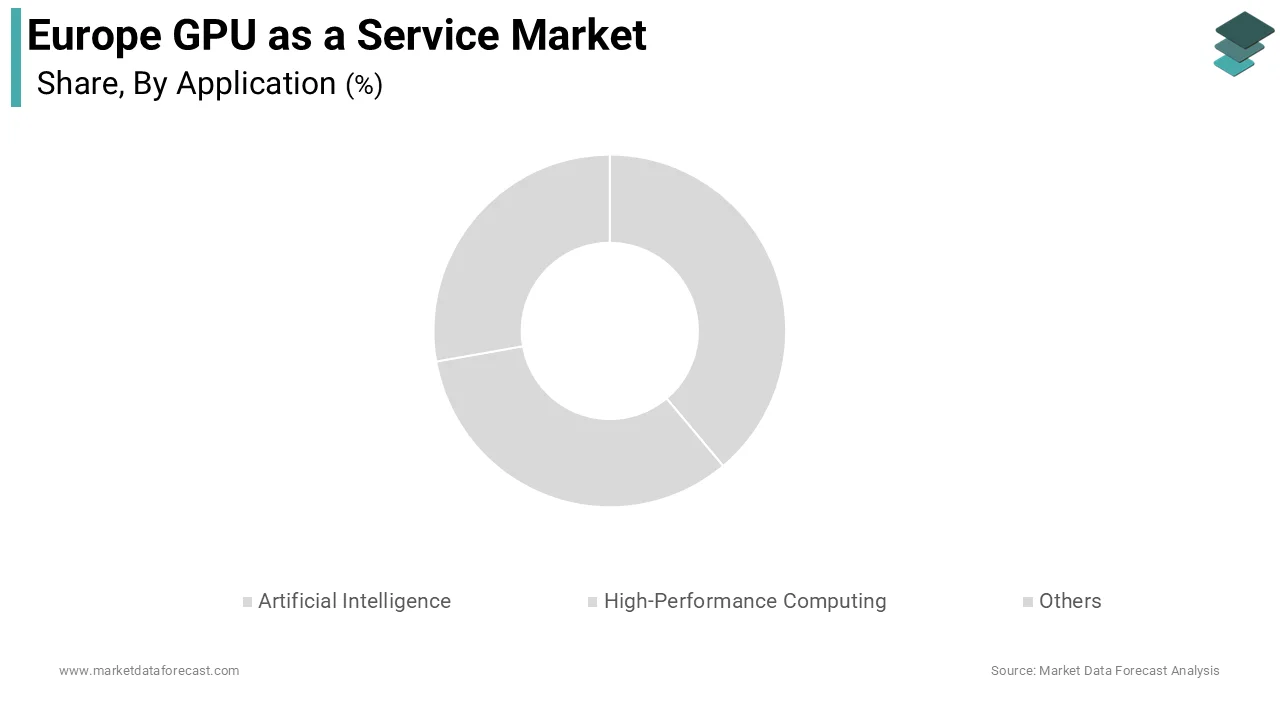
However, the high-performance computing segment is estimated to showcase a promising CAGR of 19.1% over the forecast period in this regional market. The growing reliance on simulation and modeling for scientific research, drug discovery, and climate analysis is driving the growth of the high-performance computing segment in the European market. According to the European High Performance Computing Joint Undertaking, Europe is investing heavily in supercomputing infrastructure to maintain its leadership in scientific innovation. GPU acceleration drastically reduces the time required for complex simulations, enabling faster breakthroughs in critical areas. As per the World Health Organization, 100% of member states in the European Region now have a national digital health strategy or policy as of 2023. GPU as a service allows hospitals and research institutions to perform real-time image analysis and personalized medicine computations without maintaining expensive on-site hardware. The collaborative nature of scientific research benefits from cloud-based platforms that facilitate data sharing and remote collaboration among international teams. Regulatory support for open science and data sharing further encourages the adoption of cloud computing resources. The ability to scale resources up or down based on project phases optimizes costs for grant-funded research projects. Additionally, the rise of digital twins in industrial applications requires continuous simulation and monitoring powered by GPUs. This technological capability enhances operational efficiency and predictive maintenance in manufacturing. The convergence of academic research and industrial application creates a diverse demand base. Government funding for digital health and green technology initiatives further stimulates market growth.
By Enterprise Size Insights
The large enterprises segment commanded the major share of 60.6% of the regional market in 2025. The growth of the large enterprises segment in the European market is driven by the substantial financial resources and extensive data processing needs of multinational corporations operating in sectors such as telecommunications, automotive, and financial services. According to Eurostat, 77.6% of large enterprises in the EU used cloud computing services in 2023, as they are at the forefront of digital transformation initiatives. These organizations require massive computational power for tasks such as fraud detection, risk modeling, and autonomous vehicle development, which necessitate dedicated GPU clusters. As per the European Commission, large enterprises account for a significant portion of total business expenditure on research and development in the technology sector. Their ability to integrate GPU as a service with existing enterprise resource planning and data lake systems creates a seamless operational ecosystem. The pressure to meet stringent sustainability and regulatory targets also drives large corporations to adopt tools that optimize energy usage through efficient cloud computing. Regulatory compliance across multiple jurisdictions further necessitates the use of robust software solutions that can handle diverse legal requirements. The strategic importance of computational power in maintaining competitive advantage ensures that large enterprises continue to lead in market adoption. Their early adoption sets industry standards and influences broader market trends. The capacity to invest in custom AI models tailored to specific business needs further solidifies their leadership.
On the other hand, the small and medium enterprises segment is emerging as the fastest growing category in the Europe GPU as a service market and is expected to witness a CAGR of 20.9% over the forecast period, owing to the democratization of artificial intelligence tools and the availability of affordable pay-per-use cloud services that lower barriers to entry. Previously, the high cost of GPU hardware restricted advanced computing to large corporations. However, the rise of subscription-based models has made these tools accessible to small and medium-sized entities, allowing them to innovate competitively. According to the European Commission, small and medium-sized enterprises represent 99.8% of all non-financial business sector enterprises in the EU, and they are increasingly recognizing the value of digital tools for efficiency. The need to improve customer service and operational efficiency in a competitive landscape drives this adoption. As per Eurostat, 59% of medium-sized enterprises and 41.7% of small enterprises used cloud computing services in 2023. These businesses benefit from automated data analysis and machine learning capabilities, which directly impact their bottom line. The ability to scale services according to demand allows small and medium enterprises to manage growth without substantial capital investment. Furthermore, government initiatives supporting digital transformation in small businesses provide additional incentives for adoption. The fragmentation of the service market means that many small players are seeking ways to differentiate themselves through superior digital experiences. AI-enabled insights enable them to offer personalized services, enhancing their market position.
By End User Insights
The BFSI segment dominated the market with 26.7% of the regional market share in 2025. The growth of the BFSI segment in this regional market is attributed to the critical need for real-time data processing for fraud detection, algorithmic trading, and risk assessment. According to the European Banking Authority, financial institutions are increasingly adopting cloud computing and AI to improve operational resilience and meet regulatory requirements. GPU as a service enables financial institutions to process vast amounts of transactional data instantly, identifying anomalies and preventing fraudulent activities. As per the International Association of Outsourcing Professionals, digital transformation is a top priority for 90% of financial services companies to enhance security and customer experience. The sector faces intense competition, prompting banks and insurers to differentiate themselves through personalized and efficient service. AI-powered models analyze customer behavior to offer tailored financial products, improving retention rates. The integration of GPU acceleration with blockchain technologies enhances security and transparency in transactions. Regulatory pressures, such as the Payment Services Directive 2, encourage open banking and digital innovation, further driving GPU adoption. The need for 24/7 availability in global financial markets makes GPU as a service an essential tool for continuous operation. The high value of customer relationships in this sector justifies significant investment in advanced computing capabilities. Trust and reliability are paramount, making secure and fast GPU interactions critical. The sector’s digital maturity facilitates the seamless integration of GPU resources into existing workflows.
However, the automotive and mobility sector segment is on the rise and is expected to exhibit a CAGR of 22.9% over the forecast period, owing to the intensive computational demands of developing autonomous driving systems and electric vehicle technologies. According to the European Automobile Manufacturers Association, the automotive industry is the largest private investor in R&D in the EU, accounting for 32% of total R&D spending. GPU as a service allows automakers to simulate millions of driving scenarios in virtual environments, accelerating the development of safe autonomous systems. As per the European Transport Safety Council, more than 20,000 people were killed on EU roads in 2023, and the reduction of road accidents through safety technologies creates opportunities for manufacturers to leverage high-performance computing. The ability to train machine learning models on diverse driving data enhances the accuracy of perception systems. European automakers are collaborating with tech companies to build robust AI pipelines supported by cloud GPU infrastructure. The shift towards connected cars generates real-time data that requires immediate processing for navigation and entertainment services. GPU acceleration enables over-the-air updates and personalized in-car experiences. Government initiatives supporting smart mobility and green transport further stimulate demand. The focus on reducing development cycles and costs drives the adoption of scalable GPU resources. This sector benefits from the convergence of automotive engineering and artificial intelligence. The potential for innovation in mobility services ensures sustained growth in GPU consumption.
REGIONAL ANALYSIS
United Kingdom GPU as a Service Market Analysis
The United Kingdom dominated the market with 26.2% of the European market share in 2025. This dominant position is primarily driven by the country’s strong fintech and artificial intelligence sectors, which drive significant demand for high-performance computing. London is a global hub for financial services and tech startups, creating a robust ecosystem for GPU-intensive applications. According to the Office for National Statistics, the digital sector contributed approximately 158.3 billion pounds to the UK economy in 2022, growing faster than the overall economy. The presence of major research institutions, such as the Alan Turing Institute, fosters innovation in machine learning and data science. As per Tech Nation, the UK reached a combined value of 1.1 trillion dollars for its tech ecosystem in 2024. The government’s National AI Strategy supports the development of AI capabilities, encouraging investment in computational infrastructure. The strong venture capital landscape provides funding for companies requiring GPU power for product development. The exit from the European Union has encouraged greater self-reliance in critical technologies, and the UK government is investing 1.1 billion pounds into the next generation of supercomputing and AI. The focus on digital services and creative industries, such as gaming and media, further boosts demand. These factors collectively ensure that the UK remains the primary driver of the European GPU as a service market. The emphasis on innovation and entrepreneurship sustains long-term growth.
Germany GPU as a Service Market Analysis
Germany held the second-largest share of the European GPU as a service market in 2025. The German market is characterized by a robust industrial base and leadership in automotive manufacturing, which relies heavily on simulation and AI. According to the Federal Ministry for Economic Affairs and Climate Action, Germany is investing 5 billion euros in the expansion of its semiconductor industry to support Industry 4.0 initiatives. The presence of major automotive companies, such as Volkswagen and BMW, drives demand for GPU resources for autonomous driving development. As per the German Semiconductor Industry Association, the country is home to key players in the technology supply chain. The manufacturing sector utilizes GPU acceleration for digital twins and predictive maintenance, enhancing operational efficiency. The government’s support for sustainable technologies aligns with the energy efficiency benefits of shared GPU resources. Collaborations between universities and industry accelerate the development of next-generation computing applications. The strong engineering culture in Germany fosters the adoption of complex technologies. The presence of multinational technology companies with research and development centers in the country further stimulates demand. Regulatory frameworks promoting digital sovereignty encourage local production and innovation. These factors collectively ensure that Germany remains a primary driver of the European GPU as a service market. The focus on industrial automation and smart manufacturing sustains long-term growth.
France GPU as a Service Market Analysis
France is anticipated to record a healthy CAGR in the European GPU as a service market during the forecast period, owing to its strong aerospace, defense, and telecommunications sectors. The French government’s France 2030 investment plan includes 54 billion euros of funding, with a significant portion dedicated to semiconductor and high-performance computing technologies. According to the French Ministry of Economy, Finance, and Industrial and Digital Sovereignty, the country aims to become a leader in green hydrogen and digital technologies. The presence of major telecommunications operators, such as Orange, drives the adoption of advanced computing solutions for network optimization. As per III V Lab, a leading research entity in France, there is significant expertise in compound semiconductor technologies that support GPU infrastructure. The aerospace industry’s requirement for high-reliability and performance components supports the development of specialized computing applications. French research institutions are collaborating with industry leaders to advance AI research, and the government has committed 1.5 billion euros specifically to AI development. The growing tech ecosystem in cities like Paris and Lyon provides a fertile ground for startups requiring scalable GPU resources. Strategic investments in digital infrastructure ensure that France maintains a competitive position in the regional market. The emphasis on technological sovereignty and industrial modernization drives sustained demand.
COMPETITION OVERVIEW
The competition in the Europe GPU as a service market is characterized by intense rivalry among global cloud hyperscalers, specialized GPU providers, and emerging sovereign cloud operators. Established players leverage their extensive infrastructure and integrated ecosystems to offer comprehensive solutions that appeal to large enterprises and government entities. These companies focus on scalability, reliability, and compliance with strict European data protection laws to maintain their dominant positions. Meanwhile, specialized providers differentiate themselves through high-performance hardware access and tailored support for specific industries such as automotive and healthcare. The market sees frequent collaborations between technology vendors and research institutions to advance artificial intelligence capabilities. Regulatory compliance, particularly regarding data sovereignty and sustainability, serves as a key differentiator influencing procurement decisions. Providers that demonstrate robust security measures and carbon-neutral operations gain a competitive advantage. The scarcity of advanced GPU hardware creates supply chain challenges that impact service availability and pricing. Innovation in software optimization and managed services helps mitigate these constraints. The rapid evolution of AI technologies requires continuous investment in research and development. This dynamic environment fosters a culture of innovation and strategic partnerships. Local players are gaining traction by offering alternatives that prioritize European digital independence.
KEY MARKET PLAYERS
A few major players of the Europe GPU as a service market include
- Amazon Web Services
- Microsoft Azure
- Google Cloud
- IBM
- Oracle
- NVIDIA
- Intel
- Advanced Micro Devices (AMD)
- OVHcloud
- Hetzner
- Paperspace
- Lambda Labs
- Scaleway
Top Strategies Used by the Key Market Participants
Key players in the Europe GPU as a service market primarily focus on expanding regional data center infrastructure to ensure low latency and data sovereignty compliance. Companies are increasingly investing in sustainable energy sources to power their GPU clusters, aligning with European environmental regulations. Strategic partnerships with local telecommunications providers and sovereign cloud operators help enhance network connectivity and market reach. Vendors also emphasize the development of specialized AI software stacks and managed services to simplify deployment for enterprise customers. Differentiation through custom silicon and optimized instance types offers cost-effective solutions for specific workloads. Continuous innovation in security features addresses growing concerns about data privacy and protection. These strategies collectively drive adoption and strengthen competitive positioning in the dynamic European landscape.
Leading Players in the Market
- NVIDIA Corporation stands as a dominant force in the Europe GPU as a service market, leveraging its advanced graphics processing units and comprehensive software ecosystem. The company contributes significantly to the global market by providing the foundational hardware and CUDA platform that powers most artificial intelligence and high-performance computing workloads. NVIDIA recently expanded its cloud partnerships across Europe to ensure localized access to its latest H100 and A100 tensor core GPUs. This strategic move allows European enterprises to deploy generative AI models with low latency and high security. The company actively collaborates with sovereign cloud providers to support digital sovereignty initiatives. Their focus on enterprise-grade security and compliance aligns with strict European data protection regulations. NVIDIA continues to invest in research and development to enhance energy efficiency and computational performance. These initiatives reinforce its position as the preferred provider for demanding AI applications. The integration of Omniverse platforms further extends its utility in industrial digital twins.
- Amazon Web Services Inc plays a critical role in the Europe GPU as a service market through its extensive cloud infrastructure and diverse instance types. The company contributes to the global market by offering scalable GPU resources via Amazon EC2 instances powered by NVIDIA and AMD chips. AWS has recently increased its investment in European data centers to meet the growing demand for machine learning and deep learning capabilities. This expansion ensures that customers can process large datasets while adhering to local data residency requirements. The introduction of custom silicon such as Trainium and Inferentia provides cost-effective alternatives for specific AI workloads. AWS focuses on providing managed services that simplify the deployment of complex AI models. Their commitment to sustainability drives the adoption of renewable energy in data center operations. These efforts demonstrate AWS’s dedication to supporting European innovation and digital transformation. The broad range of tools and integrations makes it a versatile choice for developers.
- Microsoft Corporation is a prominent player in the Europe GPU as a service market, known for its Azure cloud platform and strong enterprise relationships. The company contributes to the global market by integrating GPU capabilities with its extensive suite of productivity and developer tools. Microsoft has recently launched specialized AI supercomputing clusters in Europe to support large-scale model training and inference. This initiative enables organizations to leverage powerful GPU resources for advanced analytics and cognitive services. The partnership with OpenAI further enhances its offerings by providing access to state-of-the-art generative AI technologies. Microsoft emphasizes hybrid cloud solutions that allow seamless integration between on-premises and cloud GPU resources. Their focus on responsible AI and ethical guidelines builds trust among European regulators and users. The company continuously updates its Azure Machine Learning services to optimize GPU utilization. These actions solidify its reputation as a key enabler of intelligent cloud solutions. The comprehensive security framework appeals to highly regulated industries.
RECENT HAPPENINGS IN THE MARKET
- In March 2024, NVIDIA Corporation expanded its partnership with leading European cloud providers to deploy H100 GPUs. This expansion is anticipated to allow NVIDIA to enhance AI capabilities and strengthen the Europe gpu as a service market presence.
- In January 2024, Amazon Web Services Inc opened new data center regions in Europe dedicated to high-performance computing. This opening is anticipated to allow AWS to improve latency and strengthen its Europe GPU as a service market presence.
- In November 2023, Microsoft Corporation launched specialized AI supercomputing clusters in France and Germany. This launch is anticipated to allow Microsoft to support large-scale models and strengthen the Europe gpu as a service market presence.
- In September 2023, Oracle Corporation introduced new GPU-optimized instances for its European cloud infrastructure. This introduction is anticipated to allow Oracle to offer better performance and strengthen the Europe gpu as a service market presence.
- In June 2023, Google Cloud partnered with European telecommunications firms to enhance edge AI processing. This partnership is anticipated to allow Google Cloud to reduce latency and strengthen its Europe GPU as a service market presence.
MARKET SEGMENTATION
This research report on the European GPU as a service market has been segmented and sub-segmented based on application, enterprise size, end use & region.
By Application
- Artificial Intelligence
- High-Performance Computing
- Others
By Enterprise Size
- Small and Medium Enterprises
- Others
By End Use
- BFSI
- Automotive and Mobility
- Others
By Region
- UK
- France
- Spain
- Germany
- Italy
- Russia
- Sweden
- Denmark
- Switzerland
- Netherlands
- Turkey
- Czech Republic
- Rest of Europe