- Product Description Description
- Table of Contents TOC
- List of Table & Figure LOT
- Get Free Sample PDF Sample PDF
Market Size, 2025
$350.04 MnMarket Estimate, 2026
$563.11 MnMarket Forecast, 2034
$25,257 MnCAGR, 2026–2034
60.87%Executive Summary: Europe Green Ammonia Market
- Market Scope: Comprehensive European green ammonia market analysis covering electrolysis technologies, end-user applications across fertilizer, transportation, and power generation, and country-level frameworks spanning Germany, the Netherlands, Denmark, Spain, the UK, and the broader region.
- Market Valuation: Valued at USD 350.04 million (2025), estimated at USD 563.11 million in 2026, and projected to reach USD 25,257.67 million by 2034, registering an aggressive CAGR of 60.87% (2026–2034).
- Primary Growth Drivers: Legally binding decarbonization mandates under the European Green Deal and REPowerEU, rising carbon prices via the EU ETS, stringent environmental regulations in the agricultural sector, and the emergence of green ammonia as a dense renewable energy carrier and maritime fuel.
Key Market Segment Metrics (2026–2034)
| Category | Leading Segment (2025 Position) | Fastest-Growing Segment |
|---|---|---|
| By Technology | Alkaline Water Electrolysis (capturing 58.2% share in 2024 due to high technological maturity and cost efficiency) | Solid Oxide Electrolysis (SOEC) (projected at a 42.3% CAGR driven by high electrical efficiency and waste heat integration) |
| By End-User | Fertilizer (holding the largest share as an anchor market driven by EU Common Agricultural Policy and carbon pricing) | Transportation (growing at a 51.7% CAGR fueled by FuelEU Maritime mandates and clean shipping propulsion) |
| By Country | Germany (commanding a 19.3% share in 2024 via National Hydrogen Strategies, H2Global, and robust industrial clusters) | The Netherlands & Spain (expanding rapidly through strategic port infrastructure, hydrogen valleys, and low solar costs) |
Major Market Players & Market Structure
Market Structure: Highly dynamic ecosystem uniting energy majors, fertilizer pioneers, and clean-tech specialists, focusing on vertical integration, cross-sectoral offtake agreements, and strategic import corridors from global partners.
Key Companies: Yara International, Ørsted, Iberdrola, ACME Group, AMMPower Corp, CF Industries Holdings Inc., FuelPositive Corporation, ITM Power plc, Siemens AG, Starfire Energy, ThyssenKrupp AG, and Topsoe.
Europe Green Ammonia Market Size
Europe green ammonia market size was valued at 350.04 million in 2025 and is anticipated to reach USD 563.11 million in 2026 to reach USD 25,257.67 million by 2034, growing at a CAGR of 60.87% during the forecast period from 2026 to 2034.
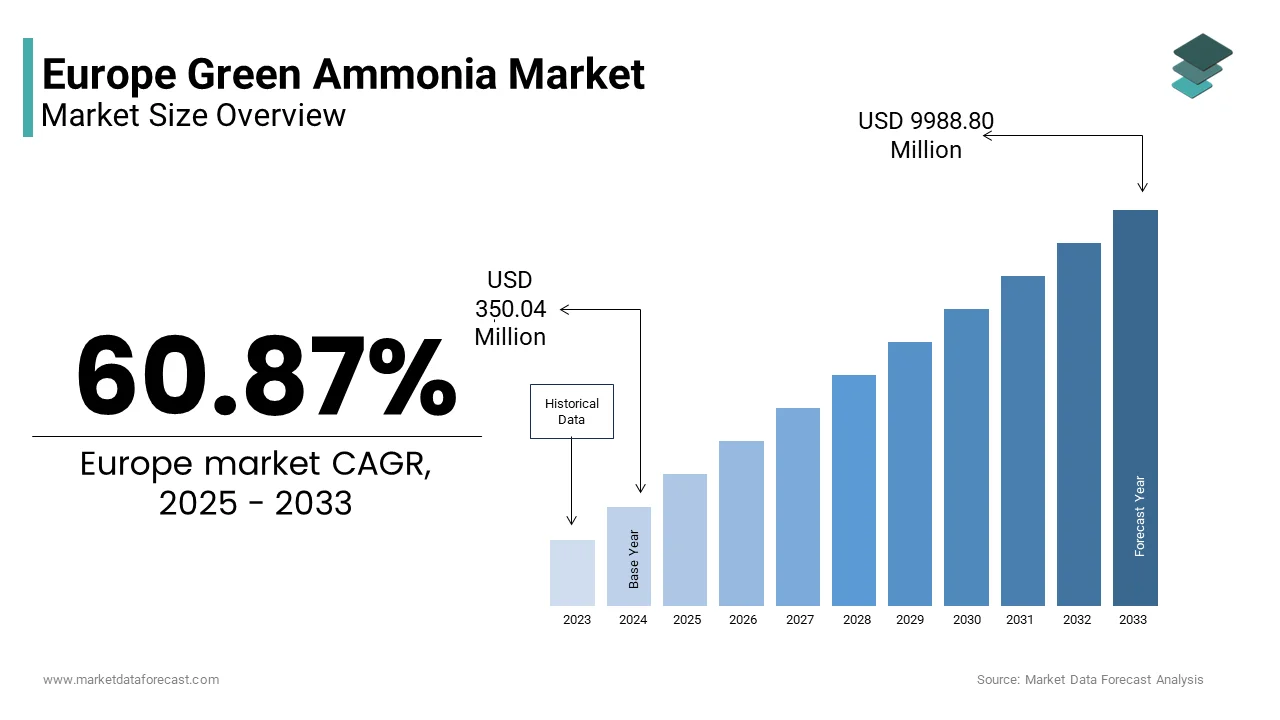
Green ammonia is defined as ammonia synthesized exclusively from renewable hydrogen produced through water electrolysis powered by zero-carbon electricity and nitrogen sourced via air separation. Unlike conventional grey ammonia derived from fossil fuel-based steam methane reforming, which emits approximately 1.8 tons of carbon dioxide per ton of ammonia produced, green ammonia enables deep decarbonization across hard-to-abate sectors. Europe has emerged as a strategic frontrunner in scaling green ammonia owing to its legally binding target under the European Green Deal to achieve net zero emissions by 2050 and the interim target of reducing greenhouse gas emissions by at least 55 percent by 2030 compared with 1990 levels as per the European Commission. The continent’s push is further reinforced by the REPowerEU plan, which aims to accelerate renewable hydrogen deployment, including derivatives like green ammonia, to reduce dependency on imported fossil fuels following geopolitical disruptions. As per the International Energy Agency, Europe accounted for about 12 percent of global hydrogen electrolyzer capacity additions in 2023, signalling strong infrastructure readiness for green ammonia production. Several demonstration and pilot facilities are already operational in countries such as Germany, the Netherlands, and Denmark, which are integrating offshore wind with electrolysis units to produce renewable hydrogen for ammonia synthesis.
MARKET DRIVERS
Accelerated Decarbonization Mandates in Fertilizer and Industrial Sectors
Mounting regulatory and market-driven pressure to eliminate carbon emissions from production processes is among the key drivers of the Europe green ammonia market. Europe’s fertilizer industry consumes a notable portion of the region’s total ammonia output. Traditional Haber Bosch based ammonia synthesis is responsible for nearly 1.4 percent of global carbon dioxide emissions, according to the International Fertilizer Association. Under the EU Emissions Trading System, the carbon price exceeded 80 euros per metric ton in early 2025, intensifying cost pressures on emitters and incentivizing a shift toward green alternatives. National governments are aligning agricultural subsidy frameworks with environmental performance metrics—as seen in France, where the Ecophyto plan restricts synthetic inputs unless derived from low-carbon processes. Simultaneously, industrial end users, including the steel and refining sectors, are under contractual and reputational obligations to reduce Scope 3 emissions, prompting procurement of green ammonia for feedstock substitution. The European Chemical Industry Council has publicly committed to achieving carbon neutrality in chemical production by 2050, with green ammonia identified as a critical enabler of nitrogen-based compounds. This institutional alignment creates a structural demand pull that is no longer speculative but increasingly embedded in compliance and sourcing strategies across value chains.
Emergence of Green Ammonia as a Renewable Energy Vector
The region’s energy security strategy has caused interest in green ammonia not merely as a chemical but as a high-density hydrogen carrier for long-distance transport and seasonal storage, which further contributes to the expansion of the Europe green ammonia market. Ammonia contains 17.6 percent hydrogen by weight and can be liquefied at minus 33 degrees Celsius or under 10 bar pressure at ambient temperature, making it significantly more practical to store and ship than pure hydrogen. The European Hydrogen Bank has a total budget of €3 billion from the Innovation Fund to support the production of renewable hydrogen through auctions. It acts as a financing instrument and market maker. As per research, several member states are evaluating ammonia co-firing in power plants to ensure grid stability during renewable intermittency, with trials underway in the United Kingdom and Germany targeting ammonia blends in the coming years. Moreover, the FuelEU Maritime regulation mandates a renewable maritime fuel share, rising by 2030, creating early demand for green ammonia as a marine fuel. This dual role as both an energy commodity and a chemical feedstock expands its addressable market beyond traditional boundaries and positions green ammonia at the nexus of Europe’s electrification and decarbonization architecture.
MARKET RESTRAINTS
High Capital and Operational Costs of Electrolytic Hydrogen Production
The elevated cost of renewable hydrogen generated via electrolysis remains the main barrier impeding the growth of the Europe green ammonia market. This constitutes a significant share of total green ammonia production expenses. As per sources, the cost of green hydrogen is higher than conventional alternatives due to intermittent renewable power, permitting hurdles, and grid delays. These issues undermine the cost-competitiveness of green ammonia against traditional and blue ammonia options. Grid connection delays and permitting hurdles further exacerbate project economics. These structural inefficiencies affect the cost competitiveness of green ammonia not only against conventional ammonia, which benefits from existing natural gas infrastructure and carbon capture subsidies under the EU Innovation Fund.
Limited Renewable Energy Surplus and Grid Integration Constraints
Many member states lack sufficient curtailed or surplus renewable generation to support large-scale electrolysis without straining grid stability or competing with other decarbonization priorities, which further constrains the expansion of the Europe green ammonia market. Europe’s capacity to produce green ammonia at scale is intrinsically tied to the availability of dedicated low-cost renewable electricity. According to research, renewable energy sources such as wind and solar have minimal wasted energy throughout the European Union, yet grid infrastructure poses substantial obstacles to expansion. This creates a serious barrier for the growth of green energy projects, including the production of green ammonia. Moreover, Congestion is particularly severe in high-potential generation areas like Northern Germany and the Iberian Peninsula, causing interconnection waiting periods for new capacity that can exceed four years. This hinders the timely integration of new projects and slows the overall shift towards a greener energy market. Green ammonia projects often require multi-hundred-megawatt dedicated wind or solar farms, but land use competition with agriculture and biodiversity conservation limits site availability. This supply side constraint forces developers to rely on power purchase agreements, which expose them to volatile wholesale electricity prices rather than true marginal cost renewable power, and thereby affects the economic rationale for green ammonia in the absence of substantial policy buffers or contract for difference mechanisms.
MARKET OPPORTUNITIES
European Green Deal Industrial Plan Enabling Public-Private Partnerships
The introduction of the European Commission’s Green Deal Industrial Plan is offering potential growth opportunities to the Europe green ammonia market. This introduction is revealing unprecedented coordination between national governments, industry, and financial institutions to de-risk early mover green ammonia projects. Through mechanisms such as the Net Zero Industry Act, the EU has designated renewable hydrogen and its derivatives, including green ammonia, as strategic net zero technologies eligible for fast-tracked permitting, streamlined state aid rules, and priority access to grid infrastructure. As per research, significant blended finance has been committed to green hydrogen and ammonia projects across Europe, with major allocations to integrated ventures such as the NEOM-backed Helios Green Fuels project and the NortH2 ecosystem in the Netherlands. Importantly, the plan enables cross-sectoral offtake agreements where utilities, fertilizer producers, and shipping companies jointly invest in production facilities to share infrastructure costs and guarantee demand. The institutional scaffolding transforms green ammonia from a high-risk niche product into a bankable industrial commodity with clear revenue visibility and shared risk allocation across the value chain.
Expansion of EU Green Ammonia Corridors with Global Export Partners
The continent is actively forging international supply corridors to secure cost-effective green ammonia imports from regions endowed with superior renewable resources such as Chile, Australia, and the Middle East, and this is also providing new prospects for the expansion of the Europe green ammonia market. As a result, this complements domestic production and stabilizes long-term supply. The European Union’s Global Gateway strategy has prioritized hydrogen partnerships with countries possessing high solar irradiance and wind potential, enabling them to produce green ammonia at half the cost estimated for Northwest Europe. As per the International Renewable Energy Agency, nations like Namibia and Morocco are advancing gigawatt-scale green hydrogen projects with dedicated ammonia export terminals targeting European buyers by 2027. Germany has an active "hydrogen diplomacy" (H2-Diplo) and has established formal partnerships with a specific number of countries, including Canada and Uruguay, to facilitate the import of green hydrogen. These corridors are not mere trade flows but integrated ecosystems involving joint certification standards under the EU Renewable Energy Directive II and co-investment in shipping and regasification infrastructure. This outward-looking strategy ensures Europe can meet its 2030 target of importing millions of metric tons of renewable hydrogen and derivatives without overburdening its own constrained renewable build-out.
MARKET CHALLENGES
Technological Immaturity of Ammonia Cracking and Fuel Utilization Systems
The downstream technologies required for its effective utilization, particularly in the energy and transport sectors, remain in early commercial stages, which holds back the growth of the Europe green ammonia market. This is despite green ammonia production being technically sound. Ammonia cracking for hydrogen recovery is emerging slowly due to significant technical and regulatory hurdles. The core issue lies in the process itself, which demands extreme temperatures exceeding 500 degrees Celsius and relies on costly ruthenium or nickel catalysts. These enablers, unfortunately, suffer from inherent degradation and efficiency losses over time, creating an ongoing operational challenge. As per studies, the commercial adoption of this technology remains very limited, with fewer than five large-scale ammonia cracking facilities globally as of 2025, and none in Europe are fully integrated with end-use applications. Similarly, the use of ammonia directly as a fuel faces combustion challenges, including high nitrogen oxide emissions and slow flame speed, which necessitate advanced burner designs and exhaust treatment systems. Green ammonia's potential as a major, fungible commodity in the energy transition cannot be realized until end-use technologies mature. This technological gap limits its applications beyond fertilizers, thereby curbing investor confidence and slowing overall market formation, notwithstanding current upstream production readiness.
Regulatory Ambiguity, Cross-Border Certification, and Trade Standards
The absence of harmonized international standards for certifying the renewable origin and carbon intensity of imported green ammonia poses a significant barrier to cross-border trade and market scalability within Europe. This greatly affects the expansion of the Europe green ammonia market. Although the EU’s Renewable Energy Directive II includes provisions for guarantees of origin for renewable hydrogen and derivatives, national interpretations vary widely on acceptable production methodologies, geographic criteria, and additionality requirements. As per studies, inconsistent certification rules between member states have led to some of the major green ammonia offtake agreements being renegotiated due to eligibility uncertainties under national subsidy schemes. Furthermore, the lack of mutual recognition with non-EU certification systems forces exporters to undergo redundant audits, which increases transaction costs. The absence of a universal registry and clear lifecycle assessment standards prevents green ammonia from being traded as a standard commodity, which hinders the creation of futures markets and predictable pricing needed for large-scale investment and industry-wide use.
REPORT COVERAGE
| REPORT METRIC | DETAILS |
| Market Size Available | 2025 to 2034 |
| Base Year | 2025 |
| Forecast Period | 2026 to 2034 |
| CAGR | 60.87% |
| Segments Covered | By Technology, End-User By Country |
| Various Analyses Covered | Global, Regional & Country Level Analysis; Segment-Level Analysis, DROC, PESTLE Analysis, Porter’s Five Forces Analysis, Competitive Landscape, Analyst Overview of Investment Opportunities |
| Regions Covered | UK, France, Spain, Germany, Italy, Russia, Sweden, Denmark, Switzerland, Netherlands, Turkey, Czech Republic & Rest of Europe |
| Market Leaders Profiled | ACME Group, AMMPower Corp, CF Industries Holdings Inc., FuelPositive Corporation, ITM Power plc, Siemens AG, Starfire Energy, ThyssenKrupp AG, Topsoe |
SEGMENTAL ANALYSIS
By Technology Insights
In 2024, the alkaline water electrolysis segment was the top performer in the Europe green ammonia market by accounting for a 58.2% share. Its technological maturity, low capital intensity, and compatibility with large-scale renewable integration have mainly contributed to the supremacy of the alkaline water electrolysis segment. As per research, Systems using alkaline technology have been available for over forty years, allowing for standardized manufacturing processes and dependable operational results that can be applied at gigawatt capacities. The average cost for alkaline electrolyzer stacks in 2024 was substantially less than for comparable PEM systems, providing a significant financial incentive for adoption in a highly cost-conscious industry. Apart from these, alkaline electrolyzers demonstrate higher tolerance to variable power input, which aligns well with intermittent wind and solar sources prevalent in Northern and Western Europe. Major energy companies have selected alkaline technology for large-scale green ammonia projects. This choice is driven by the technology's proven durability and reduced associated expenses for the balance of the plant. This cost reliability, combined with established supply chains for nickel-based electrodes, ensures alkaline remains the default choice for first-generation green ammonia facilities targeting fertilizer and industrial decarbonization.
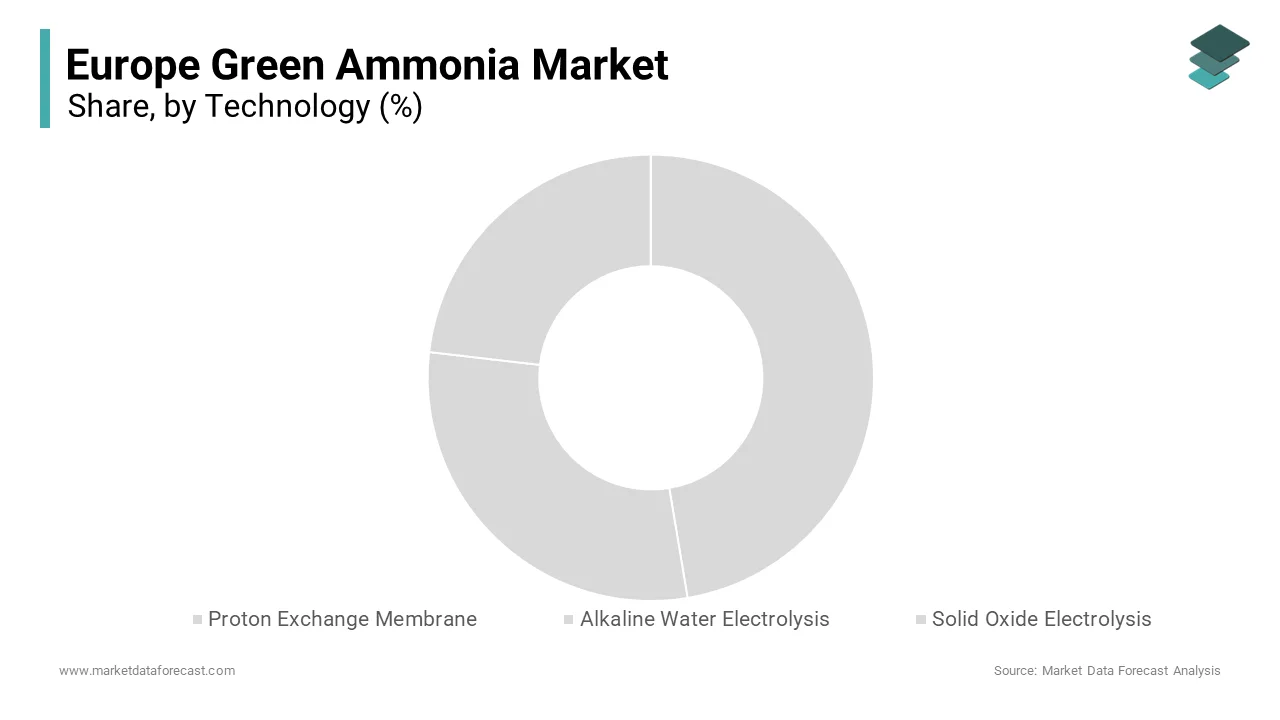
The solid oxide electrolysis segment is predicted to witness the highest CAGR of 42.3% from 2025 to 2033 and is driven by its unmatched electrical efficiency and synergies with industrial waste heat. Unlike low-temperature electrolyzers, SOEC operates at 700 to 850 degrees Celsius, enabling up to 90 percent system efficiency when integrated with high-temperature heat sources such as cement or steel plants. According to sources, the high electrical efficiency of SOECs is a crucial advantage in regions like Europe, where renewable electricity is a dominant and costly factor in green hydrogen economics. This efficiency gain helps mitigate high operating expenses. Significant EU funding signals strong policy support for upscaling SOEC technology, which de-risks investment for private companies and accelerates the transition from R&D to commercial-scale deployment. Companies are advancing stack durability beyond thousands of hours, addressing historical concerns around thermal cycling degradation. Policy drivers, such as the revised Energy Efficiency Directive, create a regulatory framework that incentivizes highly efficient technologies. This positions SOECs favourably for long-term growth by aligning them with Europe's energy goals, even while technical challenges in mass production are addressed.
By End User Insights
The fertilizer segment captured the largest share of the Europe green ammonia market in 2024. Regulatory and agricultural policy shifts are boosting the expansion of the fertilizer segment. The segment is growing due to Europe’s urgent need to decarbonize nitrogen fertilizer production, which accounts for a share of the EU’s industrial carbon emissions. The EU's Common Agricultural Policy (CAP) for 2023-2027 includes "enhanced conditionality" and mandatory "eco-schemes" where 25% of direct payments are allocated to climate and environment-friendly practices (e.g., organic farming, carbon farming). Yara's Porsgrunn plant recently started production of renewable hydrogen and ammonia in June 2024 at a 24 MW demonstration plant, which can produce approximately 20,500 metric tons of green ammonia per year. Moreover, the EU Fertilising Products Regulation (FPR) updated in 2023 sets quality, safety, and labelling requirements for fertilising products traded across the EU. The economic feasibility of green ammonia for fertilizers has reached a tipping point in parts of Western Europe, driven by significant CO2 emissions from traditional production methods and the rising cost of EU carbon permits. This regulatory, commercial, and environmental convergence ensures fertilizer remains the anchor market for green ammonia deployment through 2030 and beyond.
The transportation segment is estimated to register the fastest CAGR of 51.7% during the forecast period, owing to maritime decarbonization mandates and strategic investments in ammonia-ready propulsion. The International Maritime Organization revised its strategy, targeting net zero emissions from shipping by 2050 with interim checkpoints requiring a 20 percent emissions reduction by 2030, driving carriers to adopt zero carbon fuels. The FuelEU Maritime regulation enforces a greenhouse gas intensity cap on marine fuels starting in 2025, a move that effectively excludes conventional heavy fuel oil and favors green ammonia and methanol. As per research, European shipping companies have placed significant orders for ammonia-fueled vessels, including dual-fuel gas carriers and container ships. Ports are investing a notable amount in ammonia bunkering infrastructure. Apart from these, engine manufacturers have completed full-scale testing of two-stroke ammonia engines, achieving significant combustion efficiency with controlled NOx emissions. This rapid ecosystem build-out from regulation to vessel design to fueling logistics positions transportation as the most dynamic growth vector despite its current small base.
COUNTRY LEVEL ANALYSIS
Germany Green Ammonium Market Analysis
Germany was the second-largest country in the Europe green ammonia market by capturing a 19.3% share in 2024. The demand for green ammonia in Germany is driven by its National Hydrogen Strategy and robust industrial demand. The nation is developing a robust domestic green ammonia production capacity, with numerous projects underway in key industrial hubs, many of which are strategically integrated with existing steel, chemical, and fertilizer clusters to meet EU carbon leakage regulations. Simultaneously, the country is securing international supply chains. Initiatives like H2Global have already facilitated significant imports of green ammonia by connecting German buyers with international producers. This forward-thinking approach is complemented by major infrastructure investments, such as grid operator TenneT's development of a dedicated offshore wind to electrolysis corridor in the North Sea for green molecule production. So, Germany’s market dominance stems not from isolated pilot projects but from systemic industrial decarbonization planning anchored in policy certainty and cross-sectoral collaboration.
Netherlands Green Ammonium Market Analysis
The Netherlands is expected to be the most lucrative region in the Europe green ammonia market by leveraging its strategic port infrastructure and hydrogen corridor vision. The Port of Rotterdam aims to handle 4 million metric tons of green ammonia annually by 2030, serving as Europe’s primary import terminal under the Green Hydrogen Import Program. As per studies, the country has secured offtake agreements for green ammonia from Australia, Saudi Arabia, and the United States through the state-backed 2Auction scheme. The NortH2 consortium involving Shel,l Equi, and Gasunie is developing a 10-gigawatt offshore wind to ammonia pipeline linking the North Sea to industrial consumers in Germany and Belgium. Importantly, the Netherlands has implemented a carbon contract for difference mechanism, guaranteeing producers a fixed price for green ammonia over 15 years, reducing investment risk. This combination of geographic advantage, regulatory innovation, and multinational partnerships solidifies its role as the continent’s ammonia gateway.
Denmark Green Ammonium Market Analysis
Denmark remains a key player in the Europe green ammonia market due to its world-leading offshore wind resources and first-mover electrolysis integration. It is demonstrating leadership in the renewable energy sector, with wind power contributing significantly to its electricity needs. This has helped facilitate some of Europe's lowest renewable electricity costs. Major companies are collaborating on large-scale green ammonia projects. The national government supports this transition through policies like the landmark Energy Agreement 2022. The Danish Technological Institute has certified a standardized ammonia safety protocol adopted by the European Maritime Safety Agency, accelerating regulatory approval for bunkering. With per capita electrolyzer deployment three times the EU aveaverageDenmark transforms its renewable abundance into exportable green molecules, establishing a replicable model for small, high-renewable nations.
Spain Green Ammonium Market Analysis
Spain is moderately growing in the Europe green ammonia market, owing to its exceptional solar irradiance and ambitious hydrogen roadmap. Spain is a leading country for solar energy with 2,500 to 3,000 annual sunshine hours, enabling highly competitive utility-scale solar PV costs, which have driven a significant increase in solar power generation. In September 2025, solar PV was the leading renewable source in the Spanish electricity mix for the first time, contributing 23.2% of the total. Also, Spain is a focal point for green hydrogen and ammonia projects, particularly in regions like Andalusia and Extremadura, driven by excellent solar resources and port infrastructure. The project in Puertollano is a major operational flagship project for green hydrogen in Europe, with a 20 MW electrolyzer supplying a Fertiberia fertilizer plant. The Spanish government has supported the development of several hydrogen valleys as strategic hubs. Its proximity to North Africa also enables potential intercontinental green corridors with Morocco. Spain’s competitive advantage lies not in industrial demand but in its ability to produce the lowest-cost green ammonia in Europe, serving both domestic needs and export markets via Mediterranean ports.
United Kingdom Green Ammonium Market Analysis
The United Kingdom is also a major country in the Europe green ammonia market, with a distinct focus on maritime fuel and flexible power generation. The UK is scaling up its green ammonia economy to meet net zero goals, leveraging its substantial offshore wind capacity to power production. A government fund has allocated significant resources to support several green ammonia projects, including the Gigastack initiative. Trials are underway to use green ammonia as a co-firing fuel source at an existing power plant. Besides, the UK has established a safety framework for ammonia bunkering, enabling its use in the maritime transport sector. Its post-Brexit regulatory agility allows faster project approvals compared to EU counterparts, enhancing investor confidence in first-of-a-kind deployments.
COMPETITIVE LANDSCAPE
The Europe green ammonia market features intense competition among energy majors, industrial gas suppliers, and specialized clean tech firms. Traditional fertilizer companies are leveraging their ammonia expertise to pivot toward green production, while renewable energy developers are entering the market through vertical integration. New entrants, including electrolyzer manufacturers and maritime fuel startups, are forming consortia to share infrastructure costs and accelerate commercialization. Competition centers not on price alone but on access to low-cost renewable electricity project permitting speed and offtake security. The regulatory landscape under the EU Green Deal creates both opportunity and pressure, with companies racing to secure state aid grid connections and certification advantages. Strategic collaboration rather than pure rivalry defines the current phase as stakeholders build an entire value chain from molecule production to end-use applications across agriculture, transport, and power sectors.
KEY MARKET PLAYERS
A few of the market players in the Europe green ammonia market include
- ACME Group
- AMMPower Corp
- Yara International
- Ørsted
- Iberdrola
- CF Industries Holdings Inc.
- FuelPositive Corporation
- ITM Power plc
- Siemens AG
- Starfire Energy
- ThyssenKrupp AG
- Topsoe
Top Players In The Market
- Yara International is a global leader in nitrogen products and a pioneer in decarbonizing ammonia production. The company operates one of Europe’s first commercial-scale green ammonia plants in Porsgrunn, Norway, powered by renewable hydropower. It supplies green ammonia to agricultural and maritime customers across the continent and has partnered with major shipping firms to develop ammonia-fuelled vessels. Recently, Yara launched the Yara Green Ammonia initiative to scale production across Germany, the Netherlands, and Spain using offshore wind and solar energy. Its investment in electrolysis integration and offtake agreements with fertilizer distributors has accelerated the commercial viability of green ammonia in Europe and established a blueprint for global deployment in emerging markets.
- Ørsted has transitioned from a fossil fuel utility to a renewable energy champion and is now a key enabler of green ammonia in Europe. The company leverages its extensive offshore wind portfolio to produce renewable hydrogen for ammonia synthesis. It collaborates with engine manufacturers and ports to create end-to-end ammonia value chains. Recently, Ørsted signed a strategic agreement with Maersk to supply green ammonia for container ships and is advancing feasibility studies for large-scale production hubs in Denmark and Germany. Its vertically integrated approach from wind to molecule positions it as a catalyst for Europe’s clean fuel transition with replicable models for global markets.
- Iberdrola is driving green ammonia innovation in Southern Europe through its integrated renewable energy and electrolysis projects. The company inaugurated Spain’s first industrial-scale green ammonia plant in Puertollano, featuring a solar farm and an electrolyzer supplying Fertiberia. It actively participates in EU hydrogen corridors and has partnered with Portuguese and Moroccan entities to develop cross-border supply chains. Its focus on low-cost solar-driven production enhances Europe’s energy security and offers a scalable template for sun-rich regions worldwide.
Top Strategies Used By The Key Market Participants
Key players in the Europe green ammonia market are pursuing integrated renewable energy and electrolysis projects to secure low-cost power for hydrogen production. They are forming strategic offtake agreements with fertilizer producers, shipping companies, and utilities to guarantee demand and risk capital investments. Companies are actively participating in EU-funded hydrogen valleys and industrial clusters to access subsidies and fast-tracked permitting. They are investing in pilot projects for ammonia cracking and direct combustion to unlock new end-use applications. Additionally, they are forging international partnerships to establish import corridors from resource-rich countries, ensuring long-term supply diversification and price stability.
RECENT MARKET NEWS
In June 2024, Yara International inaugurated its green ammonia demonstration plant in Herøya, NNorwayered entirely by renewable electricity and partnered with Wilhelmsen to supply ammonia as marine fuel, enhancing its foothold in the Europe green ammonia market.
MARKET SEGMENTATION
This research report on the Europe green ammonia market is segmented and sub-segmented into the following categories.
By Technology:
- Proton Exchange Membrane
- Alkaline Water Electrolysis
- Solid Oxide Electrolysis
By End-User
- Power Generation
- Transportation
- Fertilizer
- Refrigeration
- Others
By Country
- UK
- France
- Spain
- Germany
- Italy
- Russia
- Sweden
- Denmark
- Switzerland
- Netherlands
- Turkey
- Czech Republic
- Rest of Europe