- Product Description Description
- Table of Contents TOC
- List of Table & Figure LOT
- Get Free Sample PDF Sample PDF
Market Size, 2025
$2.79 BnMarket Estimate, 2026
$4.31 BnMarket Forecast, 2034
$139.62 BnCAGR, 2026–2034
54.46%Executive Summary: Europe Green Steel Market
- Market Scope: Comprehensive European green steel industry analysis covering production technologies, application sectors, national leadership shares, carbon emissions metrics, and industrial decarbonization initiatives.
- Market Valuation: Valued at USD 1.80 billion (2024), estimated at USD 2.79 billion (2025), and projected to reach USD 59.80 billion by 2033, registering an explosive CAGR of 54.46% (2025–2033).
- Primary Growth Drivers: Stricter environmental regulations, heavy demand for low-carbon building and automotive materials, and major shifts toward fossil-free manufacturing processes. Key structural and sustainability benchmarks include green steel technologies achieving at least a 90% reduction in lifecycle emissions, steel production accounting for ~5%–6% of total EU CO₂ emissions, renewable electricity making up 44% of EU power generation in 2023, Europe’s steel scrap recycling rate standing at 78%, and European automotive green steel demand projected to reach 5 million tonnes annually by 2030.
Key Market Segment Metrics (2025–2033)
| Category | Leading Segment (2024 Position) | Fastest-Growing Segment |
|---|---|---|
| By Production Technology | Renewable Electric Arc Furnace / R-EAF (dominated the market in 2024, powered by extensive EU renewable energy capacity) | Hydrogen Direct Reduced Iron - Electric Arc Furnace / Hydrogen DRI-EAF (projected to grow at a massive 41.2% CAGR from 2025 to 2033) |
| By Application Sector | Building & construction (led with a 38.3% share in 2024, supported by green infrastructure mandates) | Automotive (projected to grow at a rapid 36.8% CAGR driven by decarbonized supply chain targets) |
| By End-Use Industry | Construction, infrastructure, and heavy transport manufacturing | Automotive original equipment manufacturers (OEMs) and renewable energy apparatus |
| By Country / Region | Sweden (led with a 26.4% market share in 2024, closely followed by Germany at 21.3%) | Nordic and Western European nations pioneering green hydrogen steel ventures |
Major Market Players & Market Structure
Market Structure: Highly strategic and competitive European green steel marketplace featuring major traditional steelmaking conglomerates and dedicated low-carbon disruptors competing intensely on renewable-powered EAF capacity, hydrogen-based DRI implementation, long-term industrial offtake agreements, verified emissions certifications, secure renewable-energy access, and EU-supported industrial decarbonization projects.
Key Companies: Swiss Steel Group, ArcelorMittal, Outokumpu Oyj, China Baowu Group, Salzgitter AG, H2 Green Steel, Nippon Steel Corporation, Nucor Corporation, SSAB, and Emirates Steel Arkan Group.
 Download Free Sample Report
Europe Green Steel Market Size
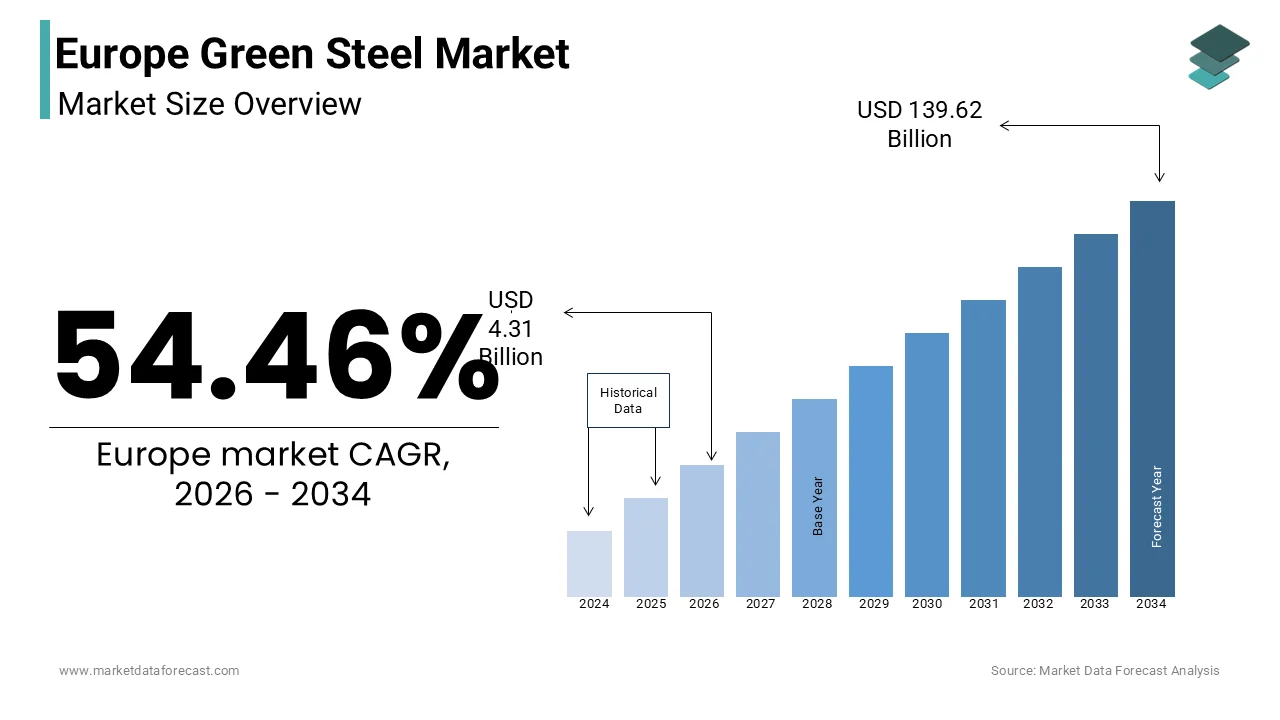
The Europe green steel market was valued at USD 2.79 billion in 2025 and is anticipated to reach a valuation of USD 4.31 billion in 2026 and USD 139.62 billion by 2034, growing at a CAGR of 54.46% 2026 to 2034.
Green steel refers to the steel manufactured using near-zero carbon technologies, primarily hydrogen-based direct reduced iron (H-DRI) and scrap-based electric arc furnace (EAF) processes powered by renewable electricity, instead of conventional coal-intensive blast furnaces. This emerging segment is central to the European Union’s industrial decarbonization strategy as steel accounts for approximately 5% to 6% percent of the EU’s total CO2 emissions, according to the European Environment Agency. Unlike traditional steel, green steel achieves at least a 90 percent reduction in lifecycle emissions while maintaining equivalent mechanical properties. The market is not yet defined by volume but by policy alignment, technological demonstration, and offtake agreements with sustainability-conscious industries. According to Eurostat, renewable electricity accounted for 44 percent of the EU’s power generation in 2023, providing the clean energy backbone for EAF expansion. Furthermore, the Carbon Border Adjustment Mechanism (CBAM) began its transitional phase in October 2023, where companies are only required to report their emissions, and the penalty system involving CBAM certificate purchases will only come into effect in January 2026, allowing them to prepare for the full implementation of the carbon pricing system during the transition period. Despite numerous subsidized industrial pilot projects across Europe, many large-scale ventures are stalled by high costs and economic challenges, demonstrating that scaling up remains a major hurdle even with a regulatory push and industry collaboration.
MARKET DRIVERS
EU Climate Legislation and Carbon Pricing Mechanisms
The region’s binding climate policy framework is the primary driver for the growth of the Europe green steel market. The EU Emissions Trading System saw carbon allowance prices exceed 85 euros per tonne in 2023, as per the European Environment Agency, making traditional blast furnace operations increasingly uncompetitive. Simultaneously, the Carbon Border Adjustment Mechanism CBAM requires importers to purchase certificates based on EU carbon prices (linked to the EU ETS price). As per studies, such as one cited by the Foundation for European Progressive Studies, it is estimated that the potential additional cost for high-emitting producers (e.g., Indian steel with emissions of 2.5 tCO₂/is be significant, with figures ranging from €173.8 to over €220 per tonne. This dual pressure incentivizes European steelmakers to decarbonize to avoid both operational costs and import competition. ArcelorMittal is indeed investing in decarbonization projects, including a move towards Direct Reduced Iron (DRI) technology using natural gas and, later, hydrogen at its Ghent plant (among others) to reduce emissions. Moreover, the EU Industrial Emissions Directive mandates Best Available Techniques for new steel capacity, which now includes hydrogen reduction. These regulatory instruments create a clear and enforceable trajectory toward green steel, making it not a choice but a compliance imperative.
Demand from Downstream Sectors with Wi-Science-Based Targets.
Automotive construction and machinery manufacturers are actively sourcing green steel to meet their own net zero commitments under the Science Based Targets initiative, and this factor also boosts the expansion of the Europe green steel market. Major European carmakers are committing to carbon-neutral production goals that necessitate the adoption of low-emission steel for vehicle frames, according to sources. This industry-wide shift is exemplified by Volvo Cars, which signed an offtake agreement for fossil-free steel to be used in an electric SUV model. Similarly, within the construction sector, giants such as Skanska are imposing strict environmental criteria, requiring structural steel for EU projects to meet specific, low-emissions standards, a threshold primarily achievable through electric arc furnace (EAF) or hydrogen-based direct reduced iron (H DRI) processes. Apart from these, supportive regulatory frameworks are emerging, with updated European Green Public Procurement criteria prioritizing the use of low-carbon steel in new infrastructure projects. This cascading demand from high-volume industrial buyers provides market certainty that de-risks green steel investments and accelerates commercial scale-up.
MARKET RESTRAINTS
Limited Availability of Green Hydrogen at Competitive Prices
Hydrogen-based steelmaking requires vast quantities of low-cost renewable hydrogen, but the region’s green hydrogen infrastructure remains nascent and expensive, which hampers the growth of the Europe green steel market. According to studies, green hydrogen currently faces cost challenges compared to conventional alternatives, hindering widespread adoption in industrial sectors like iron and steel production. A substantial cost difference must be overcome to reach price parity with established technologies. In addition, production of renewable hydrogen within the European Union is currently limited, falling significantly short of projected future demand from heavy industry, as per research. In Sweden, pilot projects are successfully demonstrating hydrogen-based steel production at a small scale. Green hydrogen's high cost due to limited electrolyzer capacity and high renewable electricity prices will continue to hinder the speed and competitive advantage of hydrogen-based steel production throughout Europe.
High Capital Expenditure and Long Payback Periods
Transitioning to green steel requires massive upfront investment in new plants or retrofitting existing assets with payback horizons exceeding several years. This hinders the expansion of the Europe green steel market. According to research, building a full-scale hydrogen-based direct reduced iron (DRI) plant involves substantial costs compared to a conventional facility, which poses a significant financial hurdle for producers. Major green steel projects, even with substantial public funding, continue to rely heavily on securing private capital to move forward. Macroeconomic uncertainty and rising interest rates have caused a majority of EU steel producers to delay planned green investments, as per studies. Apart from these, EAF expansion is limited by scrap availability. Europe’s scrap recycling rate is 78 percent, but high-quality scrap suitable for automotive use is constrained by legacy product lifecycles. The general steel scrap recycling rate in Europe is high, but the availability of the specific high-quality material essential for demanding applications such as automotive manufacturing is restricted by the current pace of product lifecycles.
MARKET OPPORTUNITIES
Integration with Circular Economy and Urban Mining Initiatives
The region’s mature economy generates substantial end-of-life steel scrap that can feed low-emission EAF production, supporting a circular industrial model and thereby providing new opportunities for the growth of the Europe green steel market. Companies are developing Greensteel hubs in the UK and Italy that use scrap and renewable power to produce low-carbon billets. Besides, urban mining projects in cities recover steel from demolished buildings for local reprocessing, reducing transport emissions. Scrap-based green steel is a practical and scalable solution for the near term, strengthening supply chains and working alongside hydrogen-based methods as the EU strengthens its standards for material efficiency and circular systems.
Export Potential Under Global Green Manufacturing Standards
The continent’s first mover advantage in green steel positions it to supply global markets with stringent environmental regulations, which creates fresh prospects for the expansion of the Europe green steel market. The United States Inflation Reduction Act includes tax credits for vehicles using low-carbon materials, while California’s Buy Clean Act sets emission thresholds for structural steel. Furthermore, the EU’s upcoming Digital Product Passport will certify the carbon footprint of exported steel, enabling premium pricing. Europe's certified green steel has become a strategic export commodity, boosting industrial competitiveness while simultaneously advancing global decarbonization, as carbon leakage concerns and international border measures proliferate.
MARKET CHALLENGES
Fragmented Renewable Energy Grid Access and Permitting Delays
Green steel plants require dedicated gigawatt-scale renewable energy connections, but grid access and permitting remain major barriers across the region. This negatively affects the growth of the Europe green steel market. Moreover, in France, the Dunkirk green steel cluster competes with data centers and hydrogen refineries for limited grid capacity in the Nord region. Green steel facilities may face underutilization or dependence on fossil-fuel-based grid electricity, jeopardizing their environmental claims and economic viability, without swift grid integration and priority access for industrial decarbonization projects.
Lack of Harmonized Certification and Green Steel Standards
The absence of a unified EU definition and verification protocol for green steel creates market confusion and risks greenwashing, which in turn constrains the expansion of the Europe green steel market. According to the European Commission, over 12 different methodologies are currently used to calculate steel’s carbon footprint, ranging from cradle to gate to full lifecycle. This inconsistency complicates procurement. Automakers struggle to compare emissions data from different suppliers. The German Federal Environment Agency found in 2023 that two nominally “green” steel offers varied by 0.4 tonnes CO2 per tonne due to differing allocation methods for scrap and electricity. The EU is developing the Product Environmental Footprint category rule for steel, but it will not be finalized before 2025. The green steel market cannot fully mature or facilitate cross-border trade until a single, transparent, and auditable standard is established, as buyers currently face high verification costs and suppliers lack clear investment signals.
REPORT COVERAGE
| REPORT METRIC | DETAILS |
| Market Size Available | 2025 to 2034 |
| Base Year | 2025 |
| Forecast Period | 2026 to 2034 |
| CAGR | 54.46% |
| Segments Covered | By Production Technology, Application, By Country |
| Various Analyses Covered | Global, Regional & Country Level Analysis; Segment-Level Analysis, DROC, PESTLE Analysis, Porter’s Five Forces Analysis, Competitive Landscape, Analyst Overview of Investment Opportunities |
| Regions Covered | UK, France, Spain, Germany, Italy, Russia, Sweden, Denmark, Switzerland, Netherlands, Turkey, Czech Republic & Rest of Europe |
| Market Leaders Profiled | Swiss Steel Group (Switzerland), ArcelorMittal (Luxembourg), Outokumpu Oyj (Finland), China Baowu Group (China), Salzgitter AG (Germany), H2 Green Steel (U.S.), Nippon Steel Corporation (Japan), Nucor Corporation (U.S.), SSAB (Sweden), Emirates Steel Arkan Group (UAE) |
SEGMENTAL ANALYSIS
By Production Technology Insights
The renewable EAF segment dominated the Europe green steel market by accounting for a substantial share in 2025. Its technological maturity and immediate scalability using existing infrastructure have mainly contributed to the dominance of the renewable EAF segment. R-EAF leverages a well-established electric arc furnace base; a notable share of EU steel capacity already uses EAF, requiring only a switch to renewable electricity to qualify as green steel. The EU has a considerably high steel recycling rate, which ensures a steady supply of scrap feedstock. This pathway avoids the decade-long lead times of new hydrogen plants and delivers near-term emissions reductions, which makes it the default choice for producers under CBAM and EU ETS pressure. Besides, converting an existing EAF to renewable operation costs a fraction of building a new H₂ DRI facility. Apart from these, R-EAF projects face fewer permitting hurdles since they do not require new hydrogen pipelines or large-scale electrolyzers. This combination of affordability, speed, and regulatory simplicity ensures R-EAF remains the dominant green steel production method across Europe’s diverse industrial landscape.
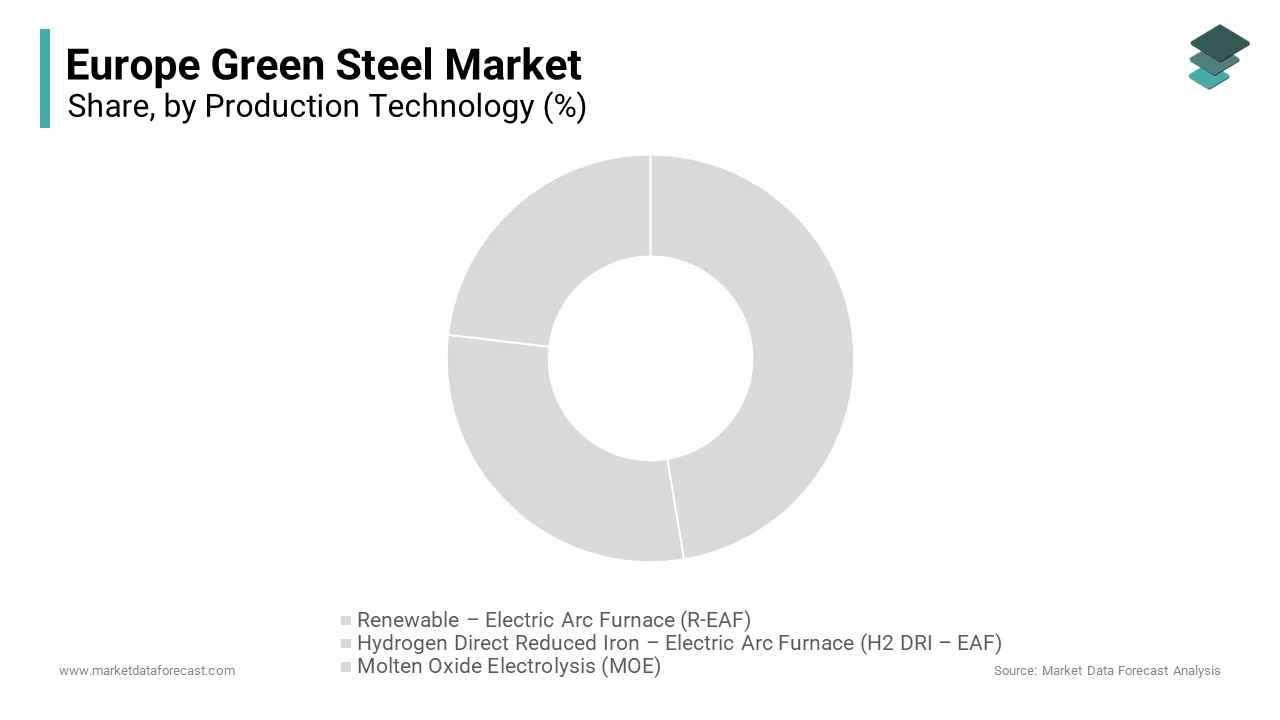
The hydrogen DRI–EAF segment is on the rise and is expected to be the fastest-growing segment in the market by witnessing a CAGR of 41.2% from 2025 to 2033 due to deep decarbonization mandates and flagship industrial alliances. Leading European steelmakers and their customers have formed binding alliances to commercialize hydrogen steel. The HYBRIT consortium—SSAB, LKAB, and Vattenfall—delivered the world’s first customer shipment of H₂ DRI steel to the Volvo Group (specifically Volvo Trucks and Construction Equipment) in August 2021 and plans full commercial production by 2026. The commitments de risk investment and create a pipeline of demand that accelerates technology deployment beyond pilot scale. Furthermore, the European Commission’s Important Project of Common European Interest on hydrogen has unlocked a substantial amount of public funding for industrial clusters integrating steelmaking electrolysis and pipeline networks. This coordinated infrastructure and policy support transforms hydrogen steel from isolated experiments into a systemic industrial strategy driving exceptional growth.
By Application Insights
The building & construction segment led the Europe green steel market by capturing a share of 38.3% in 2025. Factors such as steel’s structural role and public procurement influence the expansion of the building & construction segment in the regional market. Steel remains indispensable in commercial buildings, bridges, and industrial facilities across Europe due to its strength, recyclability, ty and speed of assembly. According to research, there is an increasing focus on the sustainability and material flows of construction materials in the EU, with the building sector being crucial for environmental goals. The EU's Green Public Procurement criteria for buildings encourage public authorities to consider life-cycle environmental impacts, including the disclosure and reduction of embodied carbon. This institutional demand creates a stable and growing market for green steel in construction. Apart from these, buildings have service lives exceeding 50 years, making upfront material choices critical for lifecycle emissions. Green steel’s durability and 100 percent recyclability at the end of life align perfectly with the EU Circular Economy Action Plan. According to studies, steel from demolished buildings in the UK (as a key example within Europe) has a high recovery and recycling rate, estimated at 96% to 99%, which is then used as scrap feedstock in new EAF steel production, leveraging steel's endless recyclability. The Netherlands has a strong focus on the circular economy and aims for full circularity by 2050. Besides, modular construction techniques using prefabricated steel components reduce on-site waste and emissions. These systemic advantages ensure that construction remains the largest and most structurally embedded application for green steel in Europe.
The automotive segment is expected to exhibit a noteworthy CAGR of 36.8% from 2025 to 2033, owing to science-based targets and consumer-facing sustainability. European automakers face stringent decarbonization deadlines. Steel constitutes up to a share of a vehicle’s weight, making its decarbonization essential. The contractual commitments create guaranteed demand that pulls green steel into high-volume production. According to BloombergNEF, automotive green steel demand in Europe could reach 5 million tonnes annually by 2030—up from negligible levels in 2023. The European Commission is required to develop a methodology for determining the full lifecycle CO2 emissions of new heavy-duty vehicles and present a feasibility assessment and legislative proposal by the end of 2026. Simultaneously, many European car buyers consider environmental impact in purchasing decisions. This dual pressure incentivizes automakers to showcase green steel in marketing. Furthermore, the EU Battery Regulation mandates carbon footprint declarations for electric vehicles, strengthening the case for low-emission materials. The increasing visibility of green steel in high-end and electric vehicles is accelerating its adoption; companies are now using it as a central component of brand strategy rather than just for compliance, leading to exceptional market expansion.
COUNTRY ANALYSIS
Sweden Green Steel Market Analysis
Sweden was the largest player in the Europe green steel market by holding a share of 26.4% in 2025. The country has established itself as the continent’s hydrogen steel pioneer through scientific leadership and industrial collaboration, which in turn propels the demand for green steel in Sweden. The country’s abundant hydropower and iron ore resources provide the ideal foundation for fossil-free production. The HYBRIT consortium, comprising SSAB, LKAB, and Vattenfall, has achieved the world's first commercial delivery of hydrogen-reduced steel to Volvo Cars. The group aims to significantly scale its annual production in the coming years. Green steel projects in Sweden have received substantial state support under programs designed to facilitate the transition to more sustainable industrial practices. Sweden’s small domestic market is offset by a strong export orientation, with SSAB supplying green steel to John Deere and Caterpillar globally. Sweden is at the forefront of Europe's hydrogen steel transition, uniquely positioned as a 'living lab' due to its near-zero grid emissions and broad political support for industrial change.
Germany Green Steel Market Analysis
Germany was the next prominent country in the Europe green steel market and captured a 21.3% share in 2025. Its massive steel industry base and national hydrogen strategy are the key factors driving the growth of the German market. Salzgitter's SALCOS project aims to replace traditional blast furnaces with hydrogen-based direct reduction iron (DRI) technology. This project is supported by the EU Innovation Fund. ArcelorMittal is converting its Hamburg facility to enable the annual production of green steel. The German government's H2Global initiative is a funding program designed to secure necessary imports of green hydrogen for industrial use. Apart from these, stringent state-level regulations in North Rhine-Westphalia mandate carbon reduction roadmaps for all heavy emitters. Germany’s combination of industrial scale policy coherence and technological capability ensures its leadership in both R-EAF and hydrogen routes.
France Green Steel Market Analysis
France maintains a noteworthy position in the Europe green steel market because of state-coordinated industrial policy and nuclear-powered decarbonization. The French government is supporting a significant investment in green steel production, which aims to transform the country's steel industry to use low-carbon methods and reduce its environmental impact. This initiative is focused on decarbonizing major facilities and increasing the proportion of low-carbon steel produced in France. France leverages its low-carbon nuclear grid to power R-EAF expansion. Vallourec and Ascometal are developing green steel for the energy and automotive sectors using nuclear-powered EAFs. Besides, the Grand Paris Express and other mega infrastructure projects create captive demand for certified low-emission steel. This top-down approach, blending public investment grid advantage and strategic procurement, sustains France’s high-impact role in Europe’s green steel transition.
United Kingdom Green Steel Market Analysis
The United Kingdom is expected to witness considerable growth in the Europe green steel market during the forecast period, owing to private sector innovation post-Brexit industrial strategy. Liberty Steel's "Greensteel" initiative focuses on producing scrap-based green steel using renewable energy sources at its facilities in Stocksbridge and Scunthorpe. This approach leverages the UK's robust scrap collection system, which efficiently recycles a large majority of structural steel, thereby enabling the rapid expansion of Electric Arc Furnace (EAF) operations. Furthermore, binding agreements with Jaguar Land Rover and Rolls-Royce create demand pull. The UK's strategy involves short-term, scrap-based decarbonization efforts, while simultaneously laying the groundwork for future hydrogen integration despite current infrastructure limitations, largely via North Sea offshore wind partnerships.
Italy Green Steel Market Analysis
Italy is moving ahead gradually in the Europe green steel market due to SME driven transformation and circular economy integration. The country’s steel sector is dominated by electric arc furnaces, with most of the production already scrap-based. Marcegaglia and Riva Group are leading R-EAF expansion using solar and hydro power under corporate PPAs. Italy’s high urban density and building renovation wave under the Superbonus scheme create steady demand for green structural steel. Apart from these, the circular economy decree mandates increasing recycled content in construction. This combination of existing EAF advantage policy support and domestic demand makes Italy a fast-scaling and pragmatic green steel market in Southern Europe.
COMPETITIVE LANDSCAPE
The Europe green steel market features intense strategic competition among incumbent steel producers transitioning their legacy assets and new entrants building greenfield hydrogen steel plants. Competition is defined less by price and more by technology readiness, certification credibility, and access to renewable energy and hydrogen infrastructure. Incumbents like ArcelorMittal and SSAB leverage existing customer relationships and industrial scale, while newcomers like H2GreenSteel in Sweden focus on pure green positioning and export orientation. The market is heavily shaped by public policy, with EU Innovation Fund grants, Carbon Border Adjustment Mechanism incentives, and national hydrogen strategies determining project viability. Moving from pilot projects to commercial green steel production requires a focus on securing long-term offtake contracts, verifying emission reductions, and integrating into industrial decarbonization clusters to establish market domination in this capital-intensive and regulation-driven transformation.
KEY MARKET PLAYERS
A few of the market players in the Europe green steel market include
- Swiss Steel Group (Switzerland)
- ArcelorMittal (Luxembourg)
- Outokumpu Oyj (Finland)
- China Baowu Group (China)
- Salzgitter AG (Germany)
- H2 Green Steel (U.S.)
- Nippon Steel Corporation (Japan)
- Nucor Corporation (U.S.)
- SSAB (Sweden)
- Emirates Steel Arkan Group (UAE)
Top Players In The Market
- SSAB is a Swedish steelmaker globally recognized as a pioneer in fossil-free steel production through its HYBRIT initiative with LKAB and Vattenfall. The company delivered the world’s first commercial shipment of hydrogen-reduced steel to Volvo Cars in 2023 and plans full-scale production by 2026. SSAB’s fossil-free steel is now supplied to global industrial customers, including John Deere, Caterpillar, ar Mercedes-Benz Benz demonstrating its export readiness. SSAB’s leadership in hydrogen-based steelmaking has set the global benchmark for deep decarbonization and positioned Europe at the forefront of green steel innovation.
- ArcelorMittal is the largest steel producer in Europe and a key driver of green steel deployment across multiple technological pathways. The company is advancing hydrogen-based direct reduced iron projects in Hamburg, Germany, and Ghent, Belgium, with pilot production already underway. It also operates large-scale-scale scale renewable powered electric arc furnaces in Spain and Italy using recycled scrap. The company actively participates in EU funding programs. ArcelorMittal is leveraging a dual approach of Electric Arc Furnace (EAF) electrification and hydrogen-based Direct Reduced Iron (DRI) to achieve scalable and widespread decarbonization across its various operations.
- Salzgitter AG is a German steel producer executing one of Europe’s most comprehensive green steel transformations through its SALCOS program. The company is replacing its entire integrated steelmaking route with hydrogen-based direct reduction and electric arc furnaces in phases through 2033. It has secured binding offtake agreements with Volkswagen and Bosch for automotive applications. Salzgitter also collaborates with Siemens Energy and Linde on an integrated hydrogen infrastructure. Salzgitter is leading the way in large-scale green steel transition by focusing its strategy on industrial cluster development and integrating renewable energy, illustrating Germany's organized approach to heavy industry decarbonization..
Top Strategies Used By The Key Market Participants
Key players in the Europe green steel market pursue dual technology pathways by scaling renewable-powered electric arc furnaces for near-term decarbonization while developing hydrogen direct reduced iron for deep emissions cuts. They secure long-term offtake agreements with automotive and industrial customers to de-risk investments and create predictable demand. Strategic participation in EU-funded industrial clusters enables access to non-dilutive capital and shared infrastructure, such as hydrogen pipelines and electrolyzers. Companies also invest in digital monitoring and certification systems to provide transparent carbon footprint data required under the EU’s Product Environmental Footprint and upcoming Digital Product Passport. Besides, they leverage national recovery funds and carbon contracts for difference to bridge the green premium gap and accelerate commercial-scale-up across the continent.
MARKET SEGMENTATION
This research report on the Europe green steel market is segmented and sub-segmented into the following categories.
By Production Technology
- Renewable – Electric Arc Furnace (R-EAF)
- Hydrogen Direct Reduced Iron – Electric Arc Furnace (H2 DRI – EAF)
- Molten Oxide Electrolysis (MOE)
By Application
- Building & Construction
- Automotive
- Renewable Energy Infrastructure
- Home Appliances
- Others
By Country
- UK
- France
- Spain
- Germany
- Italy
- Russia
- Sweden
- Denmark
- Switzerland
- Netherlands
- Turkey
- Czech Republic
- Rest of Europe