- Product Description Description
- Table of Contents TOC
- List of Table & Figure LOT
- Get Free Sample PDF Sample PDF
Market Size, 2025
$12.05 BnMarket Estimate, 2026
$13.20 BnMarket Forecast, 2034
$27.32 BnCAGR, 2026–2034
9.52%Europe Greenhouse Market Report Summary
The Europe greenhouse market was valued at USD 12.05 billion in 2025 and is expected to reach a valuation of USD 13.20 billion in 2026 and USD 27.32 billion by 2034, at a CAGR of 9.52%. Growth is driven by EU sustainability mandates, rising demand for year-round local produce, and expansion of high-tech horticulture across the Netherlands, Spain, Italy, Germany, and France. While high energy and capital costs remain key restraints, opportunities lie in renewable-powered greenhouses, circular resource systems, and urban vertical farming. Hardware continues to dominate market spending, with software and automation emerging as the fastest-growing segments.
What Is the Europe Greenhouse Market?
The Europe greenhouse market covers climate-controlled structures made of glass or plastic that enable year-round crop production through regulated temperature, moisture, lighting, and irrigation systems.
Why the Europe Greenhouse Market Matters
Greenhouses play a central role in Europe’s food security, sustainability goals, and climate adaptation strategies. They enable stable crop production despite seasonal limitations, reduce pesticide use, and support the EU’s vision for climate-neutral agriculture. As extreme weather events increase, controlled environments provide a reliable alternative to open-field farming.
Key Market Trends in the Europe Greenhouse Market
- Shift toward climate-neutral greenhouse systems driven by EU decarbonization and energy-efficiency mandates.
- Expansion of urban and rooftop greenhouses to reduce food miles and support city-level food resilience.
- Increased adoption of digital and automated greenhouse tools, including AI-driven climate systems, IoT sensors, and predictive irrigation.
- Rising interest in circular and resource-efficient systems, such as closed-loop water recycling and CO₂ reuse.
- Growth in high-value fruit, vegetable, and herb cultivation aligned with consumer demand for fresh, local, and sustainable produce.
- Greater emphasis on climate adaptation due to extreme weather events impacting energy supply, crop stability, and infrastructure resilience.
Segmental analysis
- Hardware accounted for the largest share (62.3%), driven by investments in climate control systems, glazing, and irrigation networks.
- Software is the fastest-growing segment, supported by automation needs, labor shortages, and digital climate optimization.
- Glass greenhouses dominate the market, offering superior light transmission and energy integration.
- Plastic greenhouses show the fastest growth, favored for affordability and suitability for Southern Europe.
- Fruits, vegetables, and herbs lead the crop category, serving year-round demand and policy-supported protected cultivation.
- Flowers and ornamentals are the fastest-growing crop segment, supported by gifting trends and urban greening policies.
Country-Level HighlThe ights
- Netherlands leads with a 29.4% share, driven by the world’s most advanced high-tech greenhouse clusters.
- Spain holds 22.6%, driven by extensive plastic greenhouse acreage in Almería,lmería supplying Europe year-round.
- Italy maintains steady growth through specialization in vegetables and ornamentals, supported by photovoltaic greenhouse adoption.
- Germany focuses on energy-efficient glass greenhouses, aligning with its national energy transition goals.
- France is expanding greenhouse capacity through food sovereignty initiatives, geothermal heating, and local sourcing requirements.
Competitive Landscape
The European greenhouse market is highly competitive and innovation-driven, with key players focusing on smart automation, advanced climate control, and modular greenhouse solutions. Strategic collaborations between greenhouse manufacturers, agricultural technology providers, and growers are accelerating digital transformation across the sector. Companies are also investing in sustainable materials and renewable energy integration to align with the European Union’s Green Deal objectives. Leading companies in the Europe greenhouse market include Sotrafa S.A., Ridder Group, Priva Holding BV, Berry Global, NETAFIM, Certhon, Richel Group SA, Stuppy Greenhouse, Logiqs B.V., Argus Control Systems Ltd., Poly-Tex Inc., The Glasshouse Company Pty Ltd, Luiten Greenhouses BV, and Agra Tech Inc.
Europe Greenhouse Market Size
The Europe greenhouse market size was valued at USD 12.05 billion in 2025 and is anticipated to reach a valuation of USD 13.20 billion in 2026 and 27.32 billion by 2034, growing at a CAGR of 9.52%, from 2026 to 2034.
A greenhouse is a climate-controlled structure enclosed by transparent or translucent materials as glass or plastic, that allows sunlight to enter. In addition, greenhouses in this region range from small-scale polytunnels to fully automated glass structures integrated with climate control, roll irrigation, and energy recovery systems. According to Eurostat, a significant share of the European Union’s total vegetable production under protected cultivation occurs in greenhouses, with the Netherlands, Spain, and Italy accounting for the majority of output. This infrastructure is critical in addressing seasonal limitations and enhancing food security. As the energy consumption of a modern greenhouse in Northern Europe is notable kilowatt hours per square meter annually, this emphasizes the sector’s energy intensity. National agricultural policies further shape adoption. Unlike regions where greenhouses serve primarily for yield extension, Europe’s focus centers on resource efficiency, circular systems, and decarbonization, aligning with the EU’s Farm to Fork and Fit for 55 strategies. This convergence of agronomic precision, environmental regulation, and technological integration defines the continent’s distinctive greenhouse landscape.
MARKET DRIVERS
EU Policy Mandates Driving Sustainable Horticulture Modernization
Stringent European Union environmental and agricultural policies are accelerating the growth of the Europe greenhouse market. The policy surges investment in advanced greenhouse infrastructure to meet decarbonization and resource efficiency targets. The Farm to Fork Strategy explicitly aims to reduce nutrient losses by fifty percent and chemical pesticide use by fifty percent by 20,30, compelling growers to adopt closed-loop systems and integrated pest management, which are most effectively implemented in controlled environments. The Netherlands’ National Greenhouse Horticulture Agreement requires all commercial greenhouses to be climate neutral by 2040, prompting a wave of retrofits with thermal energy storage and CO2 enrichment from biogas plants. These regulatory and financial levers transform policy compliance into a primary driver of capital expenditure and technological adoption across the sector.
Rising Demand for Year-Round Local Produce and Food Security Concerns
European consumers and institutions increasingly prioritize locally grown fresh produce available throughout the year, which further propels the expansion of the Europe greenhouse market. This heightens reliance on greenhouse cultivation to overcome climatic and seasonal constraints. According to studies portion of respondents expressed a preference for vegetables grown within their own country, with a share willing to pay a premium for winter-grown local tomatoes and cucumbers. This demand is amplified by public procurement policies. Greenhouses enable a consistent supply of high-quality produce during off-seasons when field cultivation is infeasible, particularly in Northern and Central Europe. Furthermore, war in Ukraine and subsequent disruptions to agricultural supply chains have intensified national food security strategies, with Sweden and Finland launching state-supported greenhouse initiatives to boost domestic vegetable self-sufficiency. This confluence of consumer preference, institutional policy geopolitical risk solidifies greenhouses as strategic assets in Europe’s resilient food system.
MARKET RESTRAINTS
High Capital and Operational Expenditure Barriers
The substantial upfront investment and ongoing energy costs associated with advanced controlled environment agriculture financially constrain the growth of the Europe greenhouse market. Constructing a modern glass greenhouse with automated climate control, hydroponic systems, and energy screens requires capital. In addition,n operational expenses are dominated by energy, with heating alone accounting for a portion of total costs in colder regions, as per research. The 2022 European energy crisis exacerbated this burden, with natural gas prices peaking, causing many small and medium growers to curtail production or shut down entirely. The subsidies available are limited, covering just a fraction of the total costs, and the application process is burdened by complex compliance documentation. These economic hurdles disproportionately affect family farms and new entrants, limiting sectoral diversification and slowing the transition to the next-generation sustainable infrastructure.
Stringent Land Use and Zoning Regulations
Restrictive land use planning laws and municipal zoning policies also impede the expansion of the Europe greenhouse market. This prioritizes conservation,n urban development, or traditional open field agriculture. In Germany, the Federal Building Code classifies large-scale greenhouses as industrial structures requiring special permits and environmental impact assessments, which can delay projects. Similarly, in France, the Loi Alur restricts construction in agricultural zones unless it demonstrably enhances soil preservation or biodiversity, a criterion many greenhouse proposals struggle to satisfy. The Netherlands, despite its horticultural leadership, enforces strict spatial planning under the National Environmental Vision, which caps greenhouse expansion in sensitive areas like the Green Heart region. These regulatory complexities not only increase project timelines but also deter private investment, particularly in peri-urban zones where market access is optimal. The absence of harmonized EU guidelines results in fragmented and geographically constrained growth of protected cultivation infrastructure.
MARKET OPPORTUNITIES
Integration of Renewable Energy and Circular Resource Systems
The transition toward net zero horticulture offers a significant opportunity for the growth of the Europe greenhouse market. This is done through the integration of on-site renewable energy and closed-loop resource systems in greenhouse operations. Solar photovoltaic panels combined with thermal storage can offset up to a portion of heating demand in Southern Europe, according to research. Apart from the circular water systems that capture condensate and recirculate irrigation water have been cuts in freshwater us have been made. These models not only lower operational costs but also generate carbon credits and qualify for green financing under the EU Taxonomy. Declining costs in renewable energy combined with favorable policies will enable greenhouses to become net energy producers, which will strengthen food and energy security.
Expansion of Urban and Vertical Greenhouse Farming
Urban and vertical greenhouse farming provides a potential prospect for the expansion of the Europe greenhouse market. The high growth frontier is made possible by bringing fresh produce production into cities, thereby reducing food miles, enhancing supply chain resilience, and engaging consumers directly. Rooftop greenhouses in cities like Paris, Berlin,n and Copenhagen utilize underused building space to grow leafy greens, herbs, and strawberries for local restaurants and retail. According to sources, numerous urban greenhouse projects were launched across the EU, with municipal governments providing grants covering a portion of setup costs. These initiatives align with the EU Mission for Climate Neutral Cities, which encourages food production as part of urban sustainability. Moreover, vertical greenhouses using stacked layers and LED lighting achieve higher yields per square meter than traditional field farming. Consumer proximity also enables premium pricing and educational outreach. This model transforms greenhouses from rural infrastructure into integrated urban amenities.
MARKET CHALLENGES
Vulnerability to Climate-Induced Extreme Weather Events
Regain remains vulnerable to external extreme weather events that disrupt energy supply, damaging infrastructure, and compromising crop integrity, thereby challenging the growth of the Europe greenhouse market. As per research, extreme heat events in Southern Europe have significantly strained greenhouse operations, overwhelming climate control systems, and leading to widespread crop damage. According to sources, intense winter storms in countries like the United Kingdom and France have caused major structural damage to greenhouse facilities, which prompts extensive repair and reconstruction efforts. As per research, flooding in regions such as Germany and Belgium has disrupted hydroponic cultivation systems by introducing contaminants and delaying production cycles. According to sources, despite the availability of insurance mechanisms, sms rising premium costs are increasing financial pressures on smaller greenhouse operators, making climate resilience investments more challenging. The sector's physical resilience is compromised without strong climate adaptation standards and disaster response protocols.
Skilled Labour Shortage and Technological Adoption Gaps
Shortage of skilled labor capable of operating and maintaining increasingly sophisticated climate-controlled agricultural systems holds back the expansion of the Europe greenhouse market. Modern greenhouses rely on integrated software for irrigation, CO2 dosing, and data analytics, requiring workers with cross-disciplinary competencies in agronomy, engineering, and digital literacy. The gap impedes the effective deployment of automation and precision farming tools even when capital is available. In Eastern Europe, where labor costs are lower, technical expertise is often insufficient to manage advanced systems, leading to suboptimal yields. The full potential of next-generation greenhouses cannot be realized across much of the continent until workforce capabilities catch up with technological complexity.
REPORT COVERAGE
| REPORT METRIC | DETAILS |
| Market Size Available | 2025 to 2034 |
| Base Year | 2025 |
| Forecast Period | 2026 to 2034 |
| CAGR | 9.52% |
| Segments Covered | By Component Type, Crop, And Country |
| Various Analyses Covered | Regional & Country Level Analysis, Segment-Level Analysis, DROCPESTLE Analysis’s Five Forces Analysis, Competitive Landscape, Overview of Investment Opportunities |
| Regions Covered | U, K Fran,ce Sp, ain Ger, many, Italy, Russia, Sweden, Denmark, Switzerland N, the Netherlands, Turkey Czech Republic, the Czech Republic, the Rest of Europe |
| Market Leaders Profiled | Sotrafa S.A. Berry Global NETAFIM Certhon Richel Group SA Stuppy Greenhouse Logiqs B.V. Argus Control Systems Ltd. Poly-TexI.c c The Glasshouse Company Pty Ltd, Luiten Greenhouses BV Agra Tech Inc. |
SEGMENTAL ANALYSIS
By Component Insights
The hardware segment held the largest share of 62.3% of the Europe greenhouse market in 2025. The dominance of the hardware segment is because of the foundational role of physical infrastructure, including glazing materials, climate control systems, irrigation networks, and structural frameworks, in enabling controlled environment agriculture. The high capital intensity of modern greenhouse construction necessitates substantial investment in durable and efficient hardware components. The Netherlands installed thousands of hectares of one energy-efficient glass with integrated thermal screens, as per studies. Apart from the sustainability mandates under the Energy Performance of Buildings Directive require new agricultural structures to meet minimum energy efficiency standards, driving upgrades in glazing and insulation. This structural reliance on robust physical systems ensures hardware remains the core expenditure category across both new builds and retrofits.
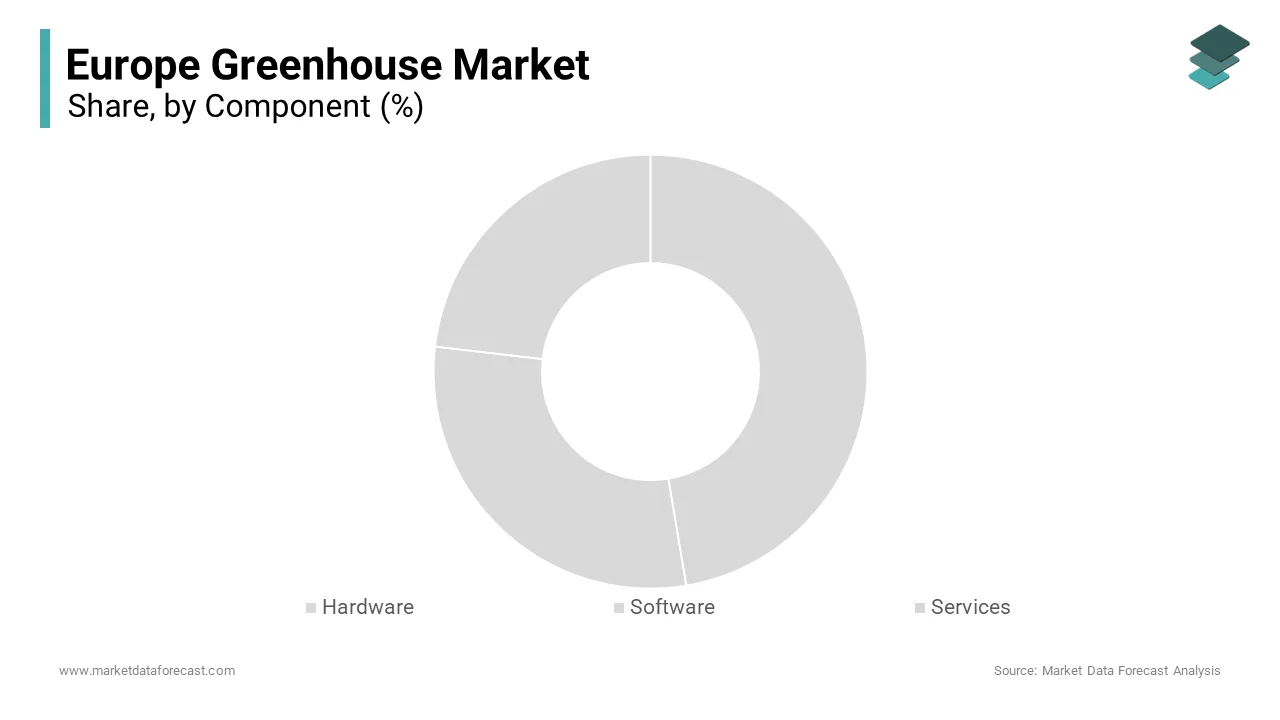
The software segment is predicted to witness the highest CAGR of 18.3% from 2025 to 2033 due to the increasing adoption of digital farming platforms that integrate climate, irrigation, scheduling, pest monmonitoringand yield prediction into unified dashboards. Growerseek real-time optimization to reduce energy and water use while maximizing output in line with EU sustainability targets. Moreover, interoperability standards are enabling seamless data exchange between sensors and machines, reducing vendor lock-in. Labor shortages are making software automation a critical need for operational continuity rather than a mere productivity tool. This convergence of regulatory pressure and resource efficiency,cy workforce constraints, positions software as the transformative engine of next-generation greenhouse farming.
By Type Insights
The glass greenhouses segment captured a dominant share of the Europe greenhouse market in 2025. In Northern and Western Europe, where long-term investment in high-tech horticulture prioritizes durability, light transmission thermal efficiency, it has largely contributed to the growth of the glass segment in the regional market. Glass structures offer superior longevity and provide optimal photosynthetically active radiation transmission. The Netherlands operates thousands of hectares of glass greenhouses primarily for tomatcucumberrmbe and pepper production as per research. National policies further reinforce this preference. Apart from these, glass enables seamless integration of advanced technologies such as semi-transparent photovoltaic panels and anti-reflective coatings that enhance energy balance. The cultural and institutional maturity of glass greenhouse farming in core EU horticultural regions ensures its continued dominance despite higher initial costs.
Fastest Growing Segment: Plastic
The plastic greenhouses segment is estimated to register the fastest CAGR of 12.7% during the forecast period, owing to Southern Europe, where lower capital requirements and suitability for warm climates make polyethylene and polycarbonate structures economically viable for small and medium growers. Recent innovations in inUV-stabilizedd and anti-drip films have extended service life to over five years while improving light diffusion and condensation control. Furthermore EU’s Common Agricultural Policy provides targeted grants for plastic greenhouse modernization in cohesion regions such as Southern Italy and Greece. This combination of affordability, climatsuitabilityy,, and policy support drives rapiadoptionion particularly among family farms transitioning from open field cultivation.
By Crop Category Insights
The fruit, vegetable, and herb segment led the Europe greenhouse moccupied occupieda a significant share in 2025. The prominence of the fruits, vegetables, and dandbsssegment is mainly propelled by strong consumer demand for year-round fresh produce and the economic viability of high-value crops like tomatoes, cucumbers, peppers, and leafy greens. The European Commission’s Farm to Fork Strategy actively promotes protected cultivation to reduce pesticide use. In the Netherlands, hundreds of thousands of tons of greenhouse tomatoes were produced, which meet a share of domestic demand and enable significant export, according to sources. Public procurement policies further bolster demand with France’s law requiring public canteens to source local produce, incentivizing institutional contracts for greenhouse growersBesidessd, vertical farming startups in urban centers increasingly focus on herbs and microgreens due to short growth cycles and premium pricing. This alignment of poli consumer preference, and economic return solidifies vegetables and herbs as the core output of European greenhouse agriculture.
The flowers and ornamentals segment is anticipated to witness the fastest CAGR of 9.8% from 2025 to 2033. The rapid expansion of the flowers and ornamentals segment is fueled by rising consumer expenditure on home aesthetics, wellness, and gifting, particularly in post-pandemic recovery periods. Urban greening initiatives also drive demand, with cities like Copenhagen and Vienna integrating ornamental greenhouse production into municipal biodiversity strategies. The Netherlands remains the epicenter with over sixty percent of EU flower exports originating from Dutch greenhouse nurseries, per the Dutch Flower Council. In addition,c environments enable precise flowering schedules and disease-free cultivation of critical high-value species like orchids and roses. Certification schemes such as MPS GAP have enhanced sustainability credentials, making European ornamentals competitive in global luxury markets. This blend of emotional consumption, urban policy, and export orientation accelerates growth in the segment.
COUNTRY ANALYSIS
Netherlands Greenhouse Market Analysis
The Netherlands outperformed other regions in the Europe greenhouse market by accounting for a 29.4% share in 2025. The country operates the world’s most advanced concentration of high-tech greenhouses primarily in the Westland region, where over ten thousand hectares produce tomatoes, peppers, and cut flowers for domestic and export markets. Dutch greenhouses achieve higher yields than open field farming through integrated systems for CO2 enrichment, geothermal heating, and closed-loop water recycling. The national Greenhouse Horticulture Agreement mandates climate neutrality, iv innovation in energy storage and residual heat utilization. This combination of technological leadership, policy coherence, and export infrastructure cements the Netherlands as the benchmark for controlled environment agriculture in Europe.
Spain Greenhouse Market Analysis
Spain was the next prominent region in the Europe greenhouse market and captured a 22.6% share in 2025. The growth of Spain in the regional market is mainly driven by its vast expanse of plastic greenhouses in Almería, the largest concentration in Europe. Covering thousands of hectares, this sea of plastic produces vegetables year-round for the Northern European market, leveraging abundant sunlight and low labor costs. Recent modernization efforts supported by EU cohesion funds have introduced drip irrigation UV-resistanttant fi, UV-resistant films, and biological pest control,l, reducing water use. Despite challenges in water scarcity and labconditionsitis Spain’s scale, le cost efficiency, and climatic advantage ensure its pivotal role in Europe’s fresh produce supply chain.
Italy Greenhouse Market Analysis
Italy grew steadily in the European greenhouse market due to strong regional specialization in both vegetables and ornamentals. The Po Valley focuses on tomato and cucumber production,n while Tuscany and Liguria lead in cut flowers and potted plants for domestic and Mediterranean markets. Italian greenhouses increasingly adopt photovoltaic roofs to offset energy costs. Apart from these, Italy’s emphasis on Protected Designation of Origin products extends to greenhouse tomatoes in Emilia Romagna, which command premium pricing. This blend of traditional horticultural expertise,licy support, and market diversification sustains Italy’s influential position in Southern Europe.
Germany Greenhouse Market Analysis
Germany is gradually expanding in the European greenhouse market with high-tech glass structures focused on energy efficiency and sustainability. Over seventy percent of German greenhouses use thermal screens and condensation recovery systems to minimize resource use in line with the country’s Energiewende energy transition policy. Strict building codes classify greenhouses as industrial facilities requiring environmental impact assessments, which limit expansion but ensure high standards. Besides research institutions like the Leibniz Institute for Vegetable and Ornamental Crops drive innovation in LED lighting and autonomous robotics. Germany’s market reflects a balance between technological rigor, regulatory compliance, and self-sufficiency in fresh produce.
France Greenhouse Market Analysis
France is predicted to grow in the European greenhouse market from 2025 to 203,3, going to its integration of greenhouse production into national food sovereignty and ecological transition goals. The government allocated funds for horticultural modernization with emphasis on geothermal heating and rainwater harvesting. Greenhouse cultivation is concentrated in Brittany for vegetables and the French Riviera for flowers. Public procurement laws mandate that public institutions source local products, boosting contracts for greenhouse growers near urban centers. Besides, research at INRAE has pioneered low-energy greenhouse designs using passive solar principles suitable for temperate climates. This alignment of policy innovation and territorial anchoring positions France as a model for sustainable protected cultivation in Western Europe.
COMPETITIVE LANDSCAPE
The Europe greenhouse market features a concentrated yet dynamic competitive landscape dominated by Dutch engineering and technology firms with growing participation from local integrators in Southern and Eastern Europe. Competition is defined less by price and more by technical sophistication, energy efficiency, and compliance with evolving EU environmental standards. Incumbents leverage decades of horticultural expertise to offer integrated hardware, software, and service bundles that maximize yield while minimizing resource use. New entrants focus on modular urban solutions or cost-effective retrofits for small-scale growers, creating niche differentiation. The high capital intensity and regulatory complexity create significant barriers to entry, yet also drive consolidation and strategic alliances. Public funding under the Common Agricultural Policy and national green deals influences procurement decisions, favoring vendors with proven sustainability credentials.
KEY MARKET PLAYERS
A few of the market players in the Europe greenhouse market include
- Sotrafa S.A.
- Ridder Group
- Priva Holding BV
- Berry Global
- NETAFIM
- Certhon
- Richel Group SA
- Stuppy Greenhouse
- Logiqs B.V.
- Argus Control Systems Ltd.
- Poly-Tex Inc.
- The Glasshouse Company Pty Ltd
- Luiten Greenhouses BV
- Agra Tech Inc.
Top Players In the Market
- Ridder Group is a leading Dutch technology provider specializing in climate control automation and drive systems for greenhouses across Europe. The company supplies integrated solutions for ventilation energy screens and irrigation that enable precise environmental management in high-tech horticulture. Ridder’s systems are deployed in countries supporting both glass and plastic greenhouse operations. It also expanded its service network to support the modernization of aging plastic greenhouse infrastructure. These initiatives reinforce Ridder’s role as an enabler of sustainable and efficient protected cultivation aligned with EU decarbonization goals.
- Priva Holding BV Netherlands-based innovator in building automation and horticultural process control with deep integration in the European greenhouse sector. The company offers end-to-end digital platforms that manage climate water and energy flows in real time across thousands of commercial greenhouses. Priva’s Connext platform enables remote monitoring and predictive analytics, helping growers comply with stringent EU environmental standards. It also introduced a carbon footprint tracking module compliant with the EU Taxonomy. These actions position Priva at the intersection of digitalization, ion energy transnanotechnology, and compliance in modern agriculture.
- Certhon Build B V is a prominent Dutch engineering and construction firm specializing in turnkey greenhouse projects across Europe and globally. The company designs and builds energy-efficient greenhouses integrated with geothermal heating, CO2 enrichment,t, and closed-loop water systems. Certhon has delivered large-scale facilities for tomato, cucumber, and strawberry production in Germany, New Fr, and the UK. The company also launched a modular greenhouse concept for urban environments, enabling deployment on rooftops and brownfield sites. These innovations demonstrate Certhon’s commitment to scalable, sustainable, and location-flexible greenhouse solutions.
Top Strategies Used By The Key Market Participants
Key players in the Europe greenhouse market pursue strategies centered on technological inintegrationsustainability compliance, and service diversification. Companies are embedding artificial intelligence and IoT sensors into climate and irrigation systems to optimize resource use and reduce carbon footprints in alignment with EU regulations. Strategic partnerships with energy utilities and research institutions facilitate the adoption of geothermal residual heat and solar integration. There is a strong emphasis on circular systems,, ems including closed-loop water recycling and biodegradable materials to meet Farm to Fork objectives. Additionally,y firms are expanding service offerings to include remote monitoring, predictive ace and carbon accounting software, transforming from equipment suppliers to holistic solution providers. Geographic expansion into Southern and Eastern Europe targets the modernization of legacy plastic greenhouse infrastructure. These approaches collectively address the dual imperatives of productivity and planetary boundaries in European horticulture.
MARKET SEGMENTATION
This research report on the Europe greenhouse market is segmented and sub-segmented into the following categories.
By Component Type
-
- Hardware
- Climate Control Systems
- Lighting Systems
- Sensors
- Irrigation Systems
- Others
- Software
- Web-Based
- Cloud-Based
- Services
- System Integration & Consulting
- Managed Services
- Assisted Professional Services
- Hardware
By Type
- Glass
- Horticulture Glass
- Others
- Plastic
- Polyethylene
- Polycarbonate
- Polymethyl-methacrylate
By Crop Category Type
- Fruits, Vegetables & Herbs
- Tomato
- Lettuce
- Bell & Chili Peppers
- Strawberry
- Cucumber
- Leafy Greens
- Herbs
- Others
- Flowers & Ornamentals
- Perennials
- Annuals
- Ornamentals
- Others
By End User Type
- Commercial Growers
- Research and Educational Institutes
- Retail Gardens
- Others
By Country
- UK
- France
- Spain
- Germany
- Italy
- Russia
- Sweden
- Denmark
- Switzerland
- Netherlands
- Turkey
- Czech Republic
- Rest of Europe