- Product Description Description
- Table of Contents TOC
- List of Table & Figure LOT
- Get Free Sample PDF Sample PDF
Market Size, 2025
$33.34 BnMarket Estimate, 2026
$36.79 BnMarket Forecast, 2034
$80.89 BnCAGR, 2026–2034
10.35%Executive Summary: Global Greenhouse Market
- Market Scope: Comprehensive global assessment of the greenhouse industry, evaluating hardware components, software platforms, structural types, crop categories, and regional metrics across North America, Europe, Asia Pacific, Latin America, and the Middle East & Africa.
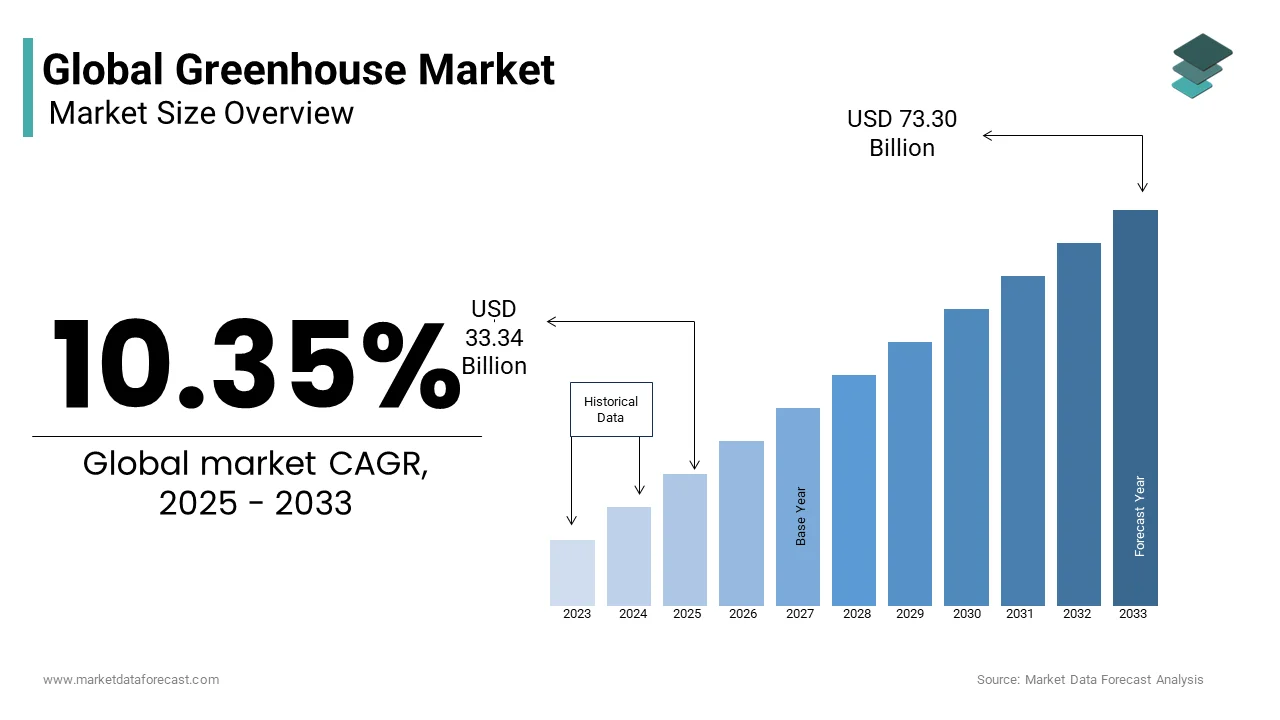
- Market Valuation: Valued at USD 33.34 billion in 2025, estimated at USD 36.79 billion in 2026, and projected to reach USD 80.89 billion by 2034, registering a robust compound annual growth rate (CAGR) of 10.35% from 2026 to 2034.
- Primary Growth Drivers: Escalating pressure on global food systems, shrinking arable land availability, rising water-scarcity mitigation requirements, and the widespread integration of advanced IoT sensors, automation, and AI-driven climate control systems.
Key Market Segment Metrics (2026–2034)
| Category | Leading Segment Position | Fastest-Growing / Key Growth Segment |
|---|---|---|
| By Component | Hardware Segment (dominated the global market with foundational physical infrastructure such as glazing, frames, and irrigation systems) | Software Segment (projected to expand at a leading CAGR of 14.6%, driven by cloud platforms and data-driven crop management) |
| By Type | Glass Greenhouses (held 54.3% market share in 2024, favored for commercial-scale horticulture, durability, and high light transmission) | Plastic Greenhouses (projected at a 9.3% CAGR from 2025 to 2033, powered by affordability, rapid deployment, and polyhouse adoption) |
| By Crop Category | Fruits, Vegetables, & Herbs (largest market share in 2024, driven by high-yield tomatoes, cucumbers, and urban food security demands) | Flowers & Ornamentals (registering an 8.9% CAGR supported by the expanding global floriculture export market in East Africa and Latin America) |
| By Region | Asia Pacific (largest contributor, capturing 46.3% of share in 2024, anchored by heavy plastic greenhouse adoption in China and India) | Middle East & Africa & North America (experiencing strong growth via national food security mandates, desert farming innovations, and urban agriculture) |
Major Market Players & Market Structure
Market Structure: Fragmented yet rapidly evolving landscape transitioning from hardware provision to integrated digital intelligence, featuring key international engineering firms and agri-tech solution providers.
Key Companies: Sotrafa S.A., Berry Global, NETAFIM, Certhon, Richel Group SA, Stuppy Greenhouse, Logiqs B.V., Argus Control Systems Ltd., Poly-Tex, Inc., The Glasshouse Company Pty Ltd, Luiten Greenhouses BV, Agra Tech, Inc., Ridder Group, and Priva.
Global Greenhouse Market Size
The global greenhouse market size was valued at USD 33.34 billion in 2025 and is anticipated to reach USD 36.79 billion in 2026 to reach USD 80.89 billion by 2034, growing at a CAGR of 10.35% during the forecast period from 2026 to 2034.
The greenhouse is a controlled-environment agricultural system designed to optimize plant growth through regulated temperature, humidity, light, and nutrient delivery. These structures range from simple polyethylene-covered tunnels to high-tech glasshouses integrated with automation, hydroponics, and climate control systems. Greenhouses enable year-round cultivation, reduce dependency on seasonal weather patterns, and enhance yield efficiency per unit area. As global food demand intensifies and arable land becomes increasingly constrained, such protected cultivation methods are gaining strategic importance.
MARKET DRIVERS
The escalating pressure on food systems due to population growth and shrinking arable land availability is driving the growth of the greenhouse market. Greenhouses offer a solution by enabling up to tenfold yield increases per hectare compared to open-field farming, particularly for high-value crops like tomatoes, cucumbers, and leafy greens. According to the International Institute for Applied Systems Analysis, protected agriculture can reduce water usage by 70% while maintaining consistent output, making it vital in water-scarce regions. Countries like Saudi Arabia and Israel have expanded greenhouse cultivation as part of national food security strategies, with Saudi Arabia aiming to increase domestic vegetable production by 30% by 2030 under its Vision 2030 initiative by largely through climate-controlled farming.
The integration of advanced technologies such as IoT sensors, artificial intelligence, and automated nutrient dosing systems into greenhouse operations is significantly improving efficiency and scalability. This factor is amplifying the growth of the greenhouse market. These digital tools allow real-time monitoring of microclimatic conditions and predictive analytics for pest outbreaks and harvest timing. According to the International Society for Horticultural Science, AI-driven climate control systems have reduced energy consumption in Dutch greenhouses by 25% between 2020 and 2023 while increasing tomato yields by 18%.
MARKET RESTRAINTS
The high initial capital expenditure required for advanced glasshouse infrastructure in regions with underdeveloped financial ecosystems is limiting the growth of the greenhouse market. This cost barrier limits adoption among smallholder farmers, who constitute over 80% of agricultural producers in sub-Saharan Africa and South Asia, according to the Food and Agriculture Organization. Even in developed economies, access to long-term financing remains a challenge; the U.S. Department of Agriculture noted that only 12% of farm loans in 2023 were allocated to controlled-environment agriculture.
The energy intensity of climate-controlled greenhouses in colder climates, where heating accounts for up to 60% of operational costs, is restricting the growth of the greenhouse market. Natural gas and electricity are primary energy sources, making greenhouse profitability vulnerable to energy price volatility. According to the International Energy Agency, European greenhouse operators faced a 40% increase in energy costs during the 2022–2023 winter due to supply disruptions, forcing some facilities to reduce production or shut down temporarily. In response, countries like the Netherlands have accelerated the phase-out of gas-fired heating, mandating CO₂-neutral greenhouse operations by 2030. However, transitioning to geothermal, solar thermal, or residual industrial heat requires substantial infrastructure investment.
MARKET OPPORTUNITIES
The repurposing of industrial waste heat and CO₂ for greenhouse cultivation is enhancing both sustainability and crop productivity, which is prompting the growth opportunities for the greenhouse market. Plants require CO₂ for photosynthesis, and concentrations above ambient levels (400 ppm) can boost yields by 20–30%, as demonstrated by research at Wageningen University & Research in 2023. Industries such as cement production, refineries, and power plants emit concentrated CO₂ streams that can be captured and piped into nearby greenhouses. In Denmark, the partnership between Yara International and Corticeira Amorim has established a commercial-scale project supplying captured CO₂ from a biorefinery to tomato greenhouses by reducing emissions while increasing yields.
The expansion of vertical farming within urban greenhouse ecosystems in megacities, facing land scarcity and food import dependency, is accelerating the growth of the greenhouse market. These multi-tiered, indoor cultivation systems maximize space efficiency and reduce transportation emissions. Sky Greens is a local operator that achieved a yield of 1 ton of vegetables per day from a 0.5-hectare facility using rotating A-frame towers.
MARKET CHALLENGES
The shortage of skilled labor capable of managing complex climate control systems, nutrient formulations, and pest management in high-tech environments is degrading the growth of the greenhouse market. According to the European Centre for the Development of Vocational Training, 42% of greenhouse operators in the EU reported difficulties in hiring staff with agronomic and technical dual expertise in 2023. This skills deficit leads to suboptimal system performance, increased crop loss, and slower adoption of advanced technologies, with the potential of greenhouse farming to deliver consistent, high-quality output at scale.
The vulnerability of greenhouse structures to extreme weather events exacerbated by climate change is additionally to hamper the growth of the greenhouse market. High winds, hailstorms, and heavy snowfall can damage glazing materials, frames, and ventilation systems, leading to costly repairs and crop losses. In 2023, typhoon Mawar caused over $78 million in damage to Okinawa’s greenhouse farms, destroying 40% of its vegetable production capacity, as reported by Japan’s Ministry of Agriculture, Forestry and Fisheries.
REPORT COVERAGE
| REPORT METRIC | DETAILS |
| Market Size Available | 2025 to 2034 |
| Base Year | 2025 |
| Forecast Period | 2026 to 2034 |
| CAGR | 10.35% |
| Segments Covered | By Component, Type, Crop Category, and Region |
| Various Analyses Covered | Global, Regional & Country Level Analysis, Segment-Level Analysis, DROC, PESTLE Analysis, Porter’s Five Forces Analysis, Competitive Landscape, Analyst Overview on Investment Opportunities |
| Regions Covered | North America, Europe, APAC, Latin America, Middle East & Africa |
| Market Leaders Profiled | Sotrafa S.A., Berry Global, NETAFIM, Certhon, Richel Group SA, Stuppy Greenhouse, Logiqs B.V., Argus Control Systems Ltd., Poly-Tex, Inc., The Glasshouse Company Pty Ltd, Luiten Greenhouses BV, Agra Tech, Inc |
SEGMENTAL ANALYSIS
By Component Insights
The hardware segment dominated the global greenhouse market by capturing a significant share in 2024, with the foundational necessity of physical infrastructure such as glazing materials, structural frames, ventilation systems, heating units, and irrigation networks, without which controlled-environment agriculture cannot function. According to the Food and Agriculture Organization of the United Nations, the average investment in greenhouse hardware per hectare exceeds $300,000 in high-tech facilities, with glass panels, climate control systems, and automated shading accounting for over 60% of this expenditure.
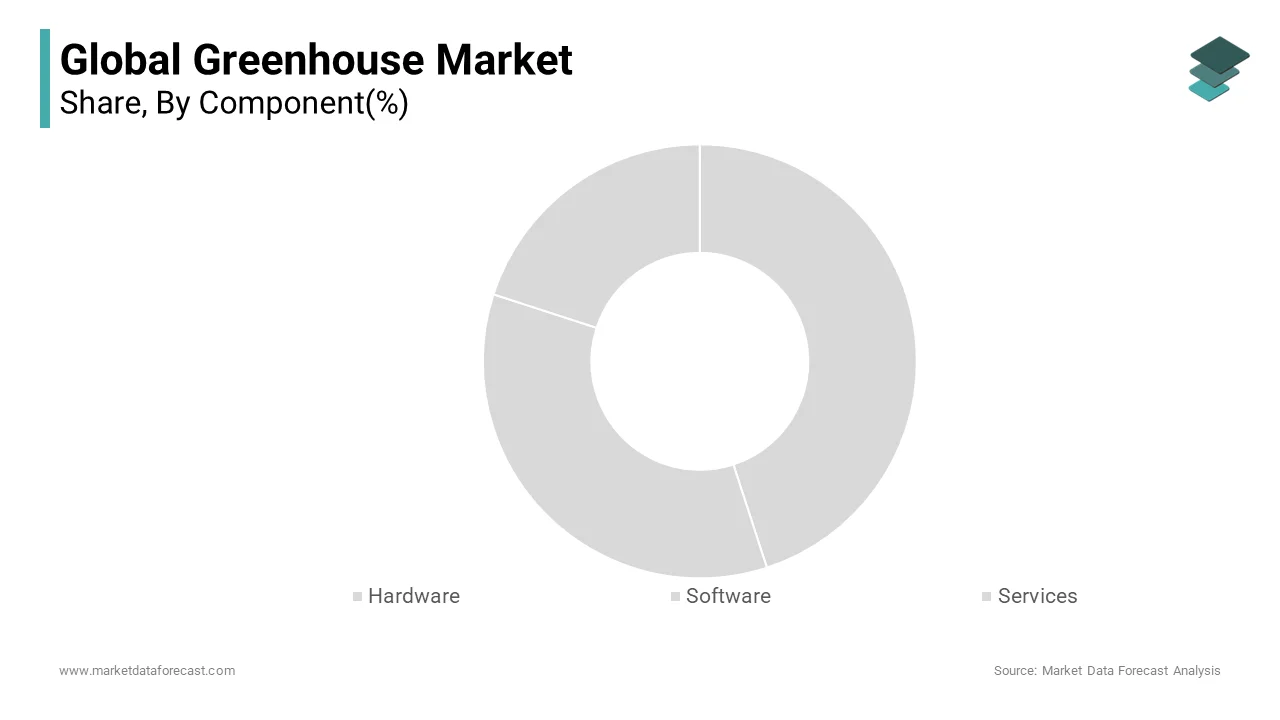
The software segment is projected to expand at a CAGR of 14.6% in the coming years with the rising adoption of data-driven farming, where real-time monitoring and predictive analytics enhance yield optimization and resource efficiency. The increasing integration of Internet of Things (IoT) sensors and cloud-based platforms that enable remote management of climate, irrigation, and nutrient levels is also leveraging the growth of the greenhouse market.
By Type Insights
The glass greenhouse segment held 54.3% of the greenhouse market share in 2024 with its widespread use in high-tech, commercial-scale horticulture in temperate regions where energy efficiency and light transmission are important. Glass greenhouses offer superior durability, longevity, and optical clarity compared to plastic alternatives, enabling consistent photosynthetic activity and higher yields. According to the Dutch Greenhouse Horticulture Council, the average lifespan of a glass greenhouse exceeds 25 years, with many facilities in the Netherlands operating beyond 30 years through modular upgrades.
The plastic greenhouse segment is anticipated to grow at a CAGR of 9.3% from 2025 to 2033, with its affordability, rapid deployment, and adaptability to diverse climates. Polyethylene (PE) and polyvinyl chloride (PVC) films are widely used for tunnels and structures, offering a low-cost entry point for smallholder and mid-sized farmers. The advancement in multi-layered, UV-stabilized, and anti-drip plastic films that extend service life and improve light diffusion. Modern films can last up to five years with proper maintenance, reducing replacement frequency and environmental impact. Additionally, plastic greenhouses are ideal for modular and temporary installations in urban and peri-urban areas. In India, the National Horticulture Board recorded a 22% increase in low-cost polyhouse installations in 2023, particularly in states like Maharashtra and Karnataka, where farmers cultivate high-value vegetables for metropolitan markets.
By Crop Category Insights
The fruits, vegetables, and herbs segment was the largest and held a prominent share of the greenhouse market in 2024, with the demand for fresh, pesticide-free, and nutritionally dense produce, particularly in urban centers where supply chain reliability is a concern. Tomatoes, cucumbers, bell peppers, and leafy greens are the most commonly grown crops under protected cultivation due to their high yield potential and market value. According to the Food and Agriculture Organization of the United Nations, greenhouse-grown tomatoes accounted for over 35% of global tomato production in 2023, with yields averaging 70 kg/m² annually in high-tech facilities, more than ten times the open-field average.
The flowers and ornamentals segment is likely to register a CAGR of 8.9% during the forecast period, with the rising demand for cut flowers, potted plants, and landscaping materials in both domestic and export markets. A primary catalyst is the expansion of the global floriculture industry, particularly in East Africa and Latin America, where favorable climates and low labor costs support high-quality production. According to the International Association of Horticultural Producers, Kenya exported 168,000 metric tons of cut flowers in 2023, with 90% grown in plastic and glass greenhouses near Lake Naivasha.
REGIONAL ANALYSIS
Asia Pacific was the largest contributor to the global greenhouse market by capturing 46.3% of share in 2024, with the massive agricultural modernization and population-driven food demand. China is the dominant force, operating over 2.8 million hectares of plastic greenhouses, primarily for vegetables and melons, as reported by the Chinese Academy of Agricultural Sciences. India is rapidly expanding its greenhouse capacity, with the Ministry of Agriculture noting a 21% year-on-year increase in greenhouse vegetable production in 2023. Japan and South Korea are investing in high-tech glasshouses with robotics and AI, particularly for leafy greens in urban vertical farms. Europe's greenhouse market was positioned second by holding 24.3% of the share in 2024, with high-efficiency, sustainable greenhouse horticulture. The Netherlands is the technological epicenter, producing 10% of the world’s vegetable exports from just 9,700 hectares of glasshouses, according to Wageningen University & Research. Dutch greenhouses are pioneers in energy-neutral operations, utilizing geothermal heating, residual CO₂ from industry, and circular water systems.
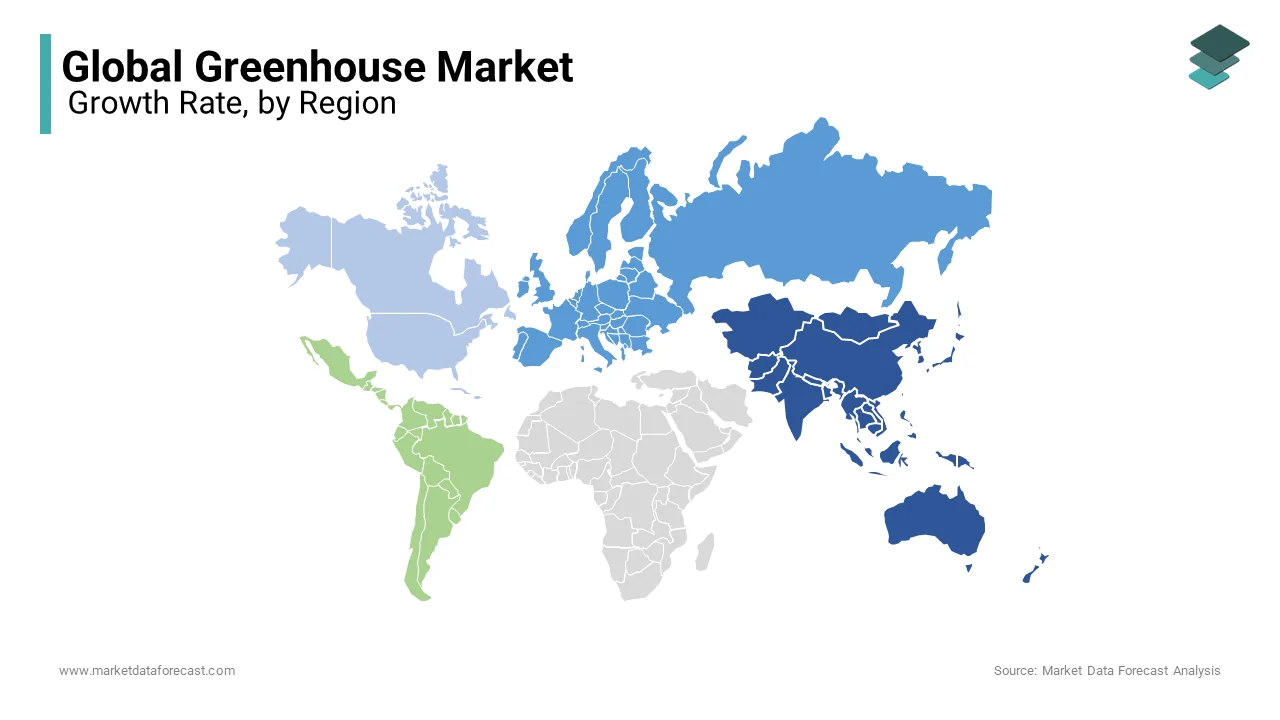
North America's greenhouse market growth is likely to grow with the urban agriculture and year-round food security initiatives. The U.S. greenhouse vegetable market reached $1.8 billion in 2023, with production concentrated in California, Arizona, and the Northeast, according to the U.S. Department of Agriculture. The American Society for Horticultural Science notes that vertical farms and rooftop greenhouses in cities like Chicago and New York are increasing fresh produce access while reducing food miles.
Latin American greenhouse market is likely to have steady growth opportunities in the coming years. Brazil is expanding greenhouse vegetable production to meet urban demand, supported by Embrapa’s research on low-cost polyhouse designs. However, inconsistent energy supply and limited access to financing constrain scalability.The
Middle East & Africa greenhouse market growth is with the food security imperatives and desert agriculture innovation. The UAE and Saudi Arabia are investing heavily in high-tech greenhouses to reduce reliance on food imports, which exceed 80% in some Gulf states, as reported by the Gulf Cooperation Council Secretariat. The UAE’s National Food Security Strategy 2051 includes a target to triple domestic vegetable production using hydroponic and aquaponic greenhouses.
KEY MARKET PLAYERS
Sotrafa S.A., Berry Global, NETAFIM, Certhon, Richel Group SA, Stuppy Greenhouse, Logiqs B.V., Argus Control Systems Ltd., Poly-Tex, Inc., The Glasshouse Company Pty Ltd, Luiten Greenhouses BV, Agra Tech, Inc. are the market players that are dominating the global greenhouse market.
Top Players In The Market
Ridder Group is a globally recognized innovator in climate control and automation systems for high-tech greenhouses, with a growing influence across the Asia Pacific region. The company has established strategic partnerships with greenhouse operators in China, South Korea, and Japan to integrate its advanced ventilation, screening, and irrigation controls into smart farming ecosystems. In 2023, Ridder launched a localized service hub in Shanghai to provide real-time technical support and system optimization for large-scale vegetable producers. The company has also collaborated with research institutions in Thailand and Vietnam to adapt its software platforms for tropical climates, enhancing humidity and heat management.
Netafim is a pioneer in drip irrigation and precision agriculture, and plays a transformative role in advancing sustainable greenhouse farming across the Asia Pacific. The company has tailored its hydroponic and nutrient delivery solutions for smallholder and commercial growers in India, Indonesia, and the Philippines, where water scarcity and land fragmentation are some challenges. In 2023, Netafim partnered with India’s National Horticulture Board to deploy modular greenhouse kits equipped with smart irrigation for 10,000 farmers in drought-prone regions. It also introduced solar-powered dosing systems in off-grid areas of rural Cambodia, improving input accuracy and reducing fertilizer waste. Netafim’s integration of IoT sensors with cloud-based farm management dashboards allows real-time monitoring of root zone conditions.
Priva is a Dutch leader in greenhouse automation and energy management, has expanded its footprint in the Asia Pacific by focusing on digital integration and sustainability-driven solutions. The company has implemented its climate control and energy optimization platforms in high-value greenhouse projects in Japan, South Korea, and Australia, particularly in urban vertical farms and pharmaceutical crop facilities. In 2023, Priva collaborated with a Singapore-based agri-tech startup to develop a fully automated greenhouse for medicinal herbs, utilizing its Connext platform for centralized control of lighting, irrigation, and HVAC systems. The company also launched a regional training initiative in collaboration with Australian universities to upskill engineers in greenhouse data management.
Top Strategies Used By The Key Market Participants
Key players in the greenhouse market are deploying integrated strategies centered on technological convergence, regional localization, strategic partnerships, digital service platforms, and sustainability innovation. Companies are embedding IoT, AI, and machine learning into hardware systems to offer predictive climate control and autonomous irrigation. Firms are also localizing product designs and support networks to meet regional climatic and economic conditions, particularly in emerging markets. Strategic alliances with governments, research institutions, and financial bodies are being leveraged to scale adoption among smallholders. Subscription-based software models are gaining traction, enabling recurring revenue and deeper customer engagement.
COMPETITION OVERVIEW
The competition in the greenhouse market is evolving beyond hardware provision into a battle for technological integration, data intelligence, and ecosystem control. Multinational firms with engineering expertise dominate high-end glasshouse automation, while regional players capture cost-sensitive plastic greenhouse segments. Differentiation is increasingly based on software capabilities, energy efficiency, and lifecycle support rather than price alone. Companies are investing heavily in R&D to develop interoperable systems that unify climate, irrigation, and lighting controls under a single digital platform. The rise of agri-tech startups is intensifying pressure on incumbents to innovate or partner. Regulatory trends favoring sustainable agriculture and food sovereignty are reshaping procurement preferences, particularly in Europe and the Gulf.
MARKET SEGMENTATION
This research report on the global greenhouse market is segmented and sub-segmented into the following categories.
By Component
- Hardware
- Climate Control Systems
- Lighting Systems
- Sensors
- Irrigation Systems
- Others
- Software
- Web-Based
- Cloud-Based
- Services
- System Integration & Consulting
- Managed Services
- Assisted Professional Services
By Type
- Glass
- Horticulture Glass
- Others
- Plastic
- Polyethylene
- Polycarbonate
- Polymethyl-methacrylate
By Crop Category
- Fruits, Vegetables, & Herbs
- Tomato
- Lettuce
- Bell & Chili Peppers
- Strawberry
- Cucumber
- Leafy Greens
- Herbs
- Others
- Flowers & Ornamentals
- Perennials
- Annuals
- Ornamentals
- Others
By Region
- North America
- Europe
- Asia Pacific
- Latin America
- Middle East and Africa