- Product Description Description
- Table of Contents TOC
- List of Table & Figure LOT
- Get Free Sample PDF Sample PDF
Market Size, 2025
$1.79 BnMarket Estimate, 2026
$1.98 BnMarket Forecast, 2034
$4.42 BnCAGR, 2026–2034
10.57%Europe Halal Ingredients Market Size
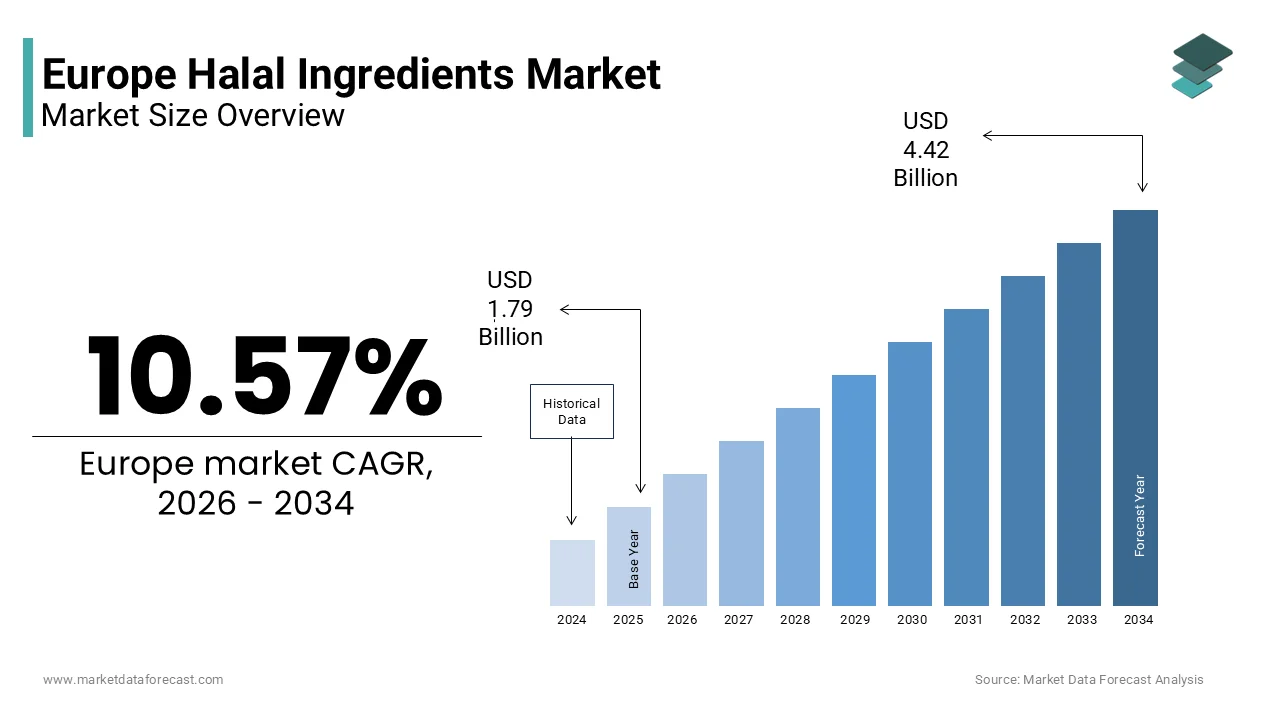
Europe halal ingredients market size was valued at USD 1.79 billion in 2025, and is expected to reach USD 4.42 billion by 2034 from USD 1.98 billion in 2026. The market is growing at a CAGR of 10.57% during the forecast period.
Europe halal ingredients market is an ingredient whose use is authorized in accordance with Islamic law. It can be designated for food, drinks, and other matters of daily life. The common elements of halal products are halal vegetables, plants, fish, and animal meat when the animal is slaughtered according to Sharia rules, and the chemical origin does not contain alcohol. Halal ingredients are used in beauty products because there is a high demand for cosmetic products made with pure ingredients. Scientists review products like lipsticks, creams, and soaps to make sure these products contain halal ingredients. People around the world, including non-Muslims, prefer food and drinks to be certified as halal because they are safe and healthy.
With the exponential growth of the European Muslim population in recent years, thousands of tons of religiously slaughtered halal meat are entering the global food chain, where it is also consumed by the non-Muslim population, as they are aware of the health benefits. To meet this growing demand, an increasing number of retail formats are selling halal food products, and supermarkets are required to label foods containing halal meat. Retail chains in Europe like Tesco, Sainsbury's, Marks & Spencer, and Waitrose sell halal food, including halal meat, confectionery, bread, cereal, and snacks. The demand for halal ingredients has increased in recent years, due to the increasing demand from the cosmetic industry. This is mainly due to the growing desire of Muslim women to associate their fashion with Islamic loyalties and the rising purchasing power of the Muslim population. The demand for halal ingredients has increased in recent years, due to the expanding demand from the cosmetic industry. This is mainly due to the growing desire of Muslim women to associate their fashion with Islamic loyalties and the rising purchasing power of the population. As the dynamics of the Muslim world change and globalization trends continue to shape the tastes, habits, and consumption habits of consumers around the world, the acceptance of halal-based ingredients in the European Halal Ingredients market is anticipated to increase during the forecast period.
REPORT COVERAGE
| REPORT METRIC | DETAILS |
| Market Size Available | 2025 to 2034 |
| Base Year | 2025 |
| Forecast Period | 2026 to 2034 |
| CAGR | 10.57% |
| Segments Covered | By Type, Application, and Region |
| Various Analyses Covered | Global, Regional and Country Level Analysis; Segment-Level Analysis; DROC; PESTLE Analysis; Porter’s Five Forces Analysis; Competitive Landscape; Analyst Overview of Investment Opportunities |
| Regions Covered | UK, France, Spain, Germany, Italy, Russia, Sweden, Denmark, Switzerland, Netherlands, Turkey, Czech Republic and Rest of Europe |
| Market Leaders Profiled | BASF SE, Cargill, Halagel Group of Companies, Solvay, Koninklijke DSM N.V., Archer Daniels Midland Company, Amara Cosmetics, Del Monte Philippines Inc., Unilever Food Solutions, and Tesco. |
REGIONAL ANALYSIS
Europe Halal Ingredients market has been classified on the basis of geography to provide a deeper understanding of the global Halal Ingredients market. The Europe Halal Ingredients Market has been divided into the United Kingdom, Germany, France, Italy, Spain, and the rest of Europe.
France has the most considerable Muslim community in Europe, and halal offerings have also gone from high-end, from the traditional neighborhood butcher who sold meat slaughtered in accordance with Islamic law, to a significant presence in the French food industries, supermarkets, and even restaurants. As the demand for the Halal Ingredients market changes constantly, supermarkets have begun to increase their services and dedicate more shelves to these types of products. For example, the second supermarket chain in Casino France has even created its own range of halal products, which it markets under the name of Wassila. In France, the government only participates in halal certification to the extent that it has designated the three main mosques as the sole distributors of halal killing permits.
KEY MARKET PLAYERS
- BASF SE
- Cargill
- Halagel Group of Companies
- Solvay
- Koninklijke DSM N.V
- Archer Daniels Midland Company
- Amara Cosmetics
- Del Monte Philippines Inc
- Unilever Food Solutions
- Tesco
SEGMENTAL ANALYSIS
This research report on the Europe halal ingredients market has been segmented and sub-segmented based on the following categories.
By Type
- Ingredients for the Food & Beverages industry
- Ingredients for the pharmaceutical industry
- Ingredients for the cosmetic industry
By Application
- Pharmaceuticals
- Food & beverages
- Cosmetics
By Country
- United Kingdom
- France
- Spain
- Germany
- Italy
- Russia
- Sweden
- Denmark
- Switzerland
- Netherlands
- Rest of Europe