- Product Description Description
- Table of Contents TOC
- List of Table & Figure LOT
- Get Free Sample PDF Sample PDF
Europe Healthcare Information System Market Report Summary
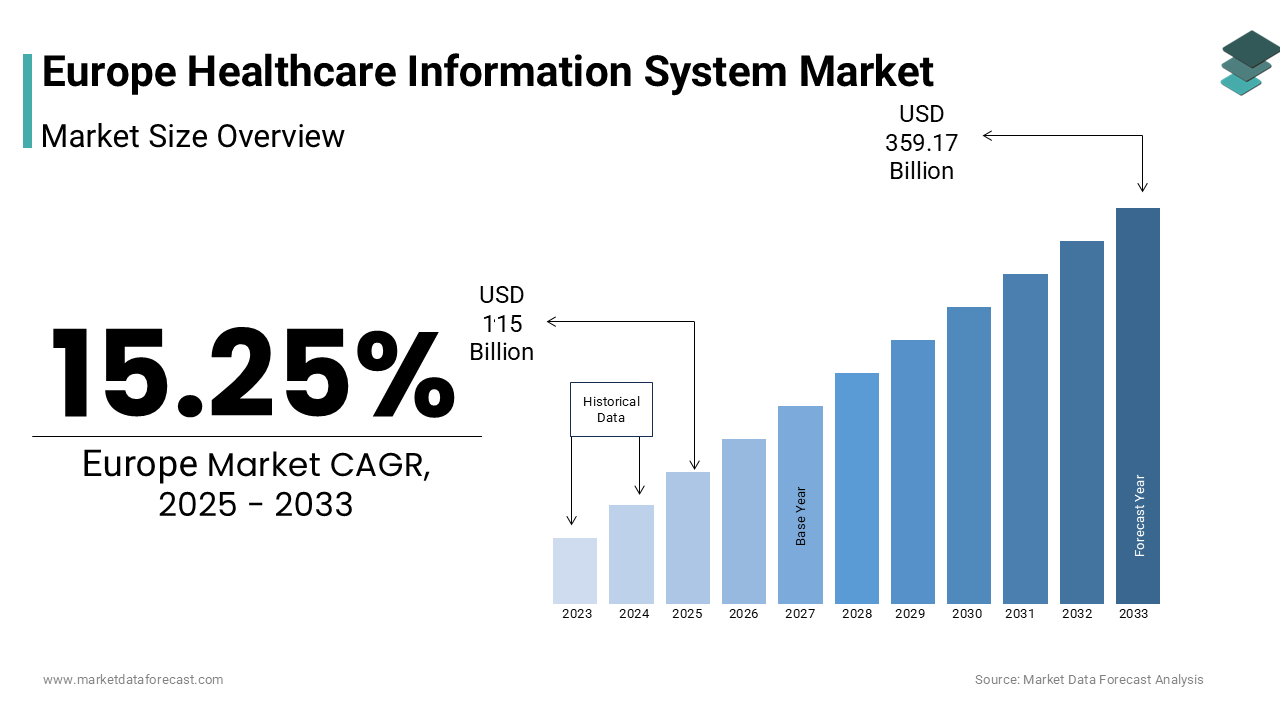
The Europe healthcare information system market was valued at USD 100.12 billion in 2024, is estimated to reach USD 115 billion in 2025, and is projected to reach USD 359.17 billion by 2033, growing at a CAGR of 15.25% during the forecast period from 2025 to 2033. The growth of the Europe healthcare information system market is driven by the increasing digital transformation of healthcare facilities, rising adoption of electronic health records (EHRs), and the growing need for integrated clinical workflow solutions. Expanding use of cloud-based healthcare platforms, advancements in AI-driven diagnostics, and increasing focus on interoperability and secure patient data exchange are further fueling market growth. Moreover, the rising demand for imaging management systems and real-time patient monitoring technologies is accelerating the adoption of healthcare information systems across Europe.
Key Market Trends
- Increasing adoption of cloud-based healthcare information systems enables scalability, remote access, and cost optimization.
- Growing integration of artificial intelligence, predictive analytics, and automation to enhance clinical decision-making and operational efficiency.
- Rising focus on interoperability and seamless health data exchange across hospitals, diagnostic centers, and care networks.
- Expansion of telehealth platforms and virtual care technologies has been accelerated by digital health initiatives.
- Strengthening emphasis on cybersecurity, data governance, and compliance with healthcare data protection regulations.
Segmental Insights
- Based on business segment, the PACS and VNA segment held the largest share of 34.1% of the Europe healthcare information system market in 2024. The dominance of this segment is attributed to the rising need for efficient storage, retrieval, and management of medical imaging data across hospitals and diagnostic facilities.
- Based on component, the software segment accounted for 58.2% of the Europe healthcare information system market share in 2024. This leadership is driven by the widespread adoption of EHR platforms, workflow management tools, clinical analytics solutions, and telehealth applications.
- Based on end user, the providers segment captured a substantial share of the Europe healthcare information system market in 2024, supported by increasing investments in digital infrastructure across hospitals, specialty clinics, and healthcare networks.
Regional Insights
The Europe healthcare information system market is witnessing strong growth across major healthcare economies, supported by increasing digitization efforts, government-backed healthcare IT initiatives, and the modernization of hospital information systems.
- Germany was the largest contributor, accounting for 25.5% of the Europe healthcare information system market share in 2024, driven by advanced healthcare infrastructure, high adoption of integrated IT platforms, and significant investments in digital health transformation.
- Western Europe including the U.K., France, Italy, and the Netherlands, continues to expand rapidly due to the rising implementation of EHR systems and hospital modernization programs.
- Nordic countries remain pioneers in digital health, supported by national e-health strategies and strong interoperability frameworks.
- Eastern European countries are experiencing steady growth with increasing funding for healthcare IT upgrades and digital integration.
Competitive Landscape
The Europe healthcare information system market is characterized by the presence of established technology providers with strong expertise in clinical IT, imaging systems, and hospital workflow optimization. Leading companies are focusing on cloud migration, AI-driven analytics, integrated platform development, and cybersecurity enhancements to meet the evolving digital healthcare needs. Strategic collaborations, innovation in patient-centric platforms, and expansion across digital and interoperable healthcare ecosystems are strengthening competitive positioning. Prominent players in the Europe healthcare information system market include Koninklijke Philips N.V., GE HealthCare, Oracle Health (formerly Cerner Corporation), Epic Systems Corporation, McKesson Corporation, Altera Digital Health (formerly Allscripts Healthcare, LLC), Siemens Healthineers, Agfa-Gevaert Group, IBM Corporation, Hewlett Packard Enterprise (HPE), and Carestream Health.
Europe Healthcare Information System Market Size
The europe healthcare information system market size was valued at USD 100.12 billion in 2024 and is anticipated to reach USD 115 billion in 2025 from USD 359.17 billion by 2033, growing at a CAGR of 15.25% during the forecast period from 2025 to 2033.
Healthcare information system refers to the integrated digital platforms that manage clinical administrative and operational data across hospitals clinics and public health networks. These systems include electronic health records hospital information systems laboratory information systems and health data exchange infrastructures designed to enhance care coordination patient safety and health system efficiency. Europe’s adoption is shaped by strong public health mandates interoperability directives and aging population pressures. According to a Digital Decade 2024 report from the European Commission, 81% of EU member states (22 countries) improved their eHealth scores in the past year, and many have national strategies for electronic health record deployment. As per Eurostat, the aging demographic in Europe consumes disproportionately high healthcare resources and benefits most from coordinated digital records, which is a key consideration in the development of EU health policy. The European Health Data Space (EHDS) initiative, launched in May 2022, aims to establish a federated infrastructure for cross-border health data sharing, enabling secondary use for research and policy while strengthening citizens' control of their data. Furthermore, as per the World Health Organization, the use of digital health technologies and certified health information systems can improve the effectiveness of healthcare systems and reduce errors. These structural demographic and policy drivers position healthcare information systems as foundational to Europe’s vision of value based resilient and patient centered care.
MARKET DRIVERS
-
Mandatory National EHR Deployment and EU Health Data Governance
The systematic rollout of national electronic health record systems driven by EU policy and member state legislation is a major driver of the Europe healthcare information system market. According to sources, most EU nations have established country-wide electronic health record systems, with some northern European countries having nearly complete participation. New EU rules are mandating that all member states create secure ways for citizens to access and share their health information with doctors in other countries within the next few years. Individual nations are investing significant funds to modernize their hospital operations and require healthcare facilities to use certified digital systems. Similarly, Many countries are successfully combining different types of patient data into single, national platforms that connect various healthcare providers. As per research, independent health policy analysis suggests that countries with well-developed electronic records systems are better at managing long-term health conditions. This top down regulatory and funding push transforms healthcare information systems from optional investments into essential public health infrastructure.
-
Rising Prevalence of Chronic Diseases and Care Coordination Needs
The growing burden of chronic conditions such as diabetes cardiovascular disease and cancer is accelerating the expansion of the Europe healthcare information system market. This enables longitudinal care management. According to sources, a significant majority of deaths in the European Union are linked to non-communicable diseases, requiring ongoing observation and coordinated care across medical fields. Millions of Europeans are estimated to live with diabetes or prediabetes, emphasizing the necessity for consistent information sharing among primary care doctors, specialists, and laboratories. In response, Italy's National Health Service initiated a chronic disease tracking system by establishing a unified platform for clinical data connecting primary care centers with hospital specialists. Sweden employs a national registry for diabetes that integrates with its larger health record system, facilitating prompt treatment modifications and contributing to a reduction in amputations. This clinical imperative is driving sustained investment in system integration across Europe.
MARKET RESTRAINTS
-
Fragmented Interoperability Standards and Legacy System Incompatibility
The persistent lack of harmonized interoperability standards across national and regional health IT infrastructures restricts the growth of the Europe healthcare information system market. According to research, The implementation of key EHR communication standards, specifically ISO 13606 and EN 13606, is inconsistent across EU member states, with only a small number of nations having fully adopted them. Within individual countries like Germany, the market for hospital information systems is highly fragmented, featuring numerous vendors, which often results in challenges with data exchange between different platforms. In addition, A significant portion of public hospitals, particularly in Southern Europe, continues to rely on older, outdated systems, rather than modern technology. These technical and semantic gaps lead to redundant testing care delays and safety risks. The realization of a truly federated and syntactically aligned health data ecosystem is necessary to overcome the interoperability deficits that currently impede system optimization and value realization.
-
Stringent Data Privacy Regulations and Cybersecurity Vulnerabilities
The region’s rigorous data protection framework while essential for patient trust also imposes significant compliance complexity that restrains system deployment and innovation and thereby constrains the expansion of the Europe healthcare information system market. Regulatory bodies are actively penalizing healthcare entities for failing to protect sensitive patient information, as per sources. New, stricter EU rules now classify hospitals and health IT providers as critical infrastructure, requiring them to implement enhanced security measures. However, despite the new regulations, many healthcare organizations still lack fundamental security defenses against common threats like ransomware. Significant cyber incidents have already caused major service disruptions in national health systems, which emphasizes an ongoing, real-world danger. Vendors must navigate divergent national interpretations of GDPR, such as France’s CNIL requiring explicit opt in for secondary data use while Germany permits broader research under strict oversight. This regulatory fragmentation increases development costs and delays product launches across the region.
MARKET OPPORTUNITIES
-
Integration of AI and Predictive Analytics into Clinical Workflows
The incorporation of artificial intelligence and predictive analytics into healthcare information systems provides a major opportunity for the growth of the Europe healthcare information system market. This enhances diagnostic accuracy and preventive care. Financial support for AI in healthcare is expanding, with significant public funding being directed towards integrating AI clinical decision support tools into existing patient record systems, as per studies. Hospitals are increasingly implementing AI solutions designed to enhance early diagnosis and treatment, which leads to improved patient outcomes and more efficient use of resources. Similarly, There is a growing focus on using AI to manage and monitor widespread public health data, such as national cancer registries, which allows for better tracking of patient care across numerous facilities. The European Medicines Agency accepts real world data from certified health information systems for post market drug surveillance accelerating pharmacovigilance. As per sources, a major push is underway to develop and test secure data-sharing methods, such as federated learning, which enable AI to learn from diverse data sources while fully protecting patient privacy. This convergence of clinical informatics and ethical AI positions Europe to lead in intelligent health system innovation.
-
Expansion of Cross Border Health Data Exchange Under EHDS
The European Health Data Space initiative opens potential opportunities for the expansion of the Europe healthcare information system market. This provides a pathway for interoperable and patient-controlled health data sharing across member states. According to sources, new European Union regulations require all member countries to establish digital access points for health data, allowing citizens to access and share their records when seeking care in other countries. In addition, initiatives are connecting countries by enabling millions of citizens to access digital prescriptions and discharge summaries across borders. The European Health Insurance Card system is integrating with national digital health records to improve emergency care coordination. Furthermore, frameworks are also facilitating the secondary use of anonymized health data for research under strict governance. This infrastructure not only improves patient mobility but also catalyzes pan European research and public health surveillance.
MARKET CHALLENGES
-
Workforce Resistance and Digital Literacy Gaps Among Clinical Staff
Clinician resistance and insufficient digital competencies among frontline health professionals continue to hamper the growth of the Europe healthcare information system market. According to studies, a considerable number of nurses in parts of Europe feel they lack sufficient instruction for new health technology, which often causes them to bypass the systems and enter information incorrectly. Radiologists in certain European nations spend a considerable amount of time each day performing manual data entry tasks because the technology is not user-friendly, as per sources. Many hospital electronic health record projects across the EU have faced substantial holdups due to staff resistance related to changes in their daily work routines. The clinical and economic value of advanced systems is at risk of being undermined by underutilization or abandonment unless there is a sustained investment in change management, human-centered design, and continuous education.
-
Sustainability and Long-Term Maintenance Costs of Health IT Infrastructure
The substantial operational and lifecycle costs of maintaining complex healthcare information systems pose a persistent financial challenge to the Europe healthcare information system market. This is especially for public health systems under fiscal pressure. Hospitals typically face notable annual costs for system upkeep, with maintenance expenses often a large portion of the initial price and frequently going over budget, as per research. Many health services are spending considerable funds simply to support old technology, including managing outdated connections and essential security updates for systems no longer backed by the original company. Moreover, a substantial share of national health information technology spending is used just to maintain older and less capable systems, as per research. Cloud migration offers relief but introduces new concerns around vendor lock in and long term data ownership. As per sources, only a portion of European hospitals have formal digital obsolescence strategies. These hidden costs and technical debt constrain new investments and create a cycle where underfunded systems deliver suboptimal outcomes despite high initial spending.
REPORT COVERAGE
| REPORT METRIC | DETAILS |
| Market Size Available | 2024 to 2033 |
| Base Year | 2024 |
| Forecast Period | 2025 to 2033 |
| Segments Covered | By Business Segment, Component, End-User, and Region |
| Various Analyses Covered | Global, Regional & Country Level Analysis, Segment-Level Analysis; DROC; PESTLE Analysis; Porter’s Five Forces Analysis, Competitive Landscape, Analyst Overview of Investment Opportunities |
| Regions Covered | United Kingdom, France, Spain, Germany, Italy, Russia, Sweden, Denmark, Switzerland, the Netherlands, Turkey, and the Czech Republic. |
| Market leaders Profiled | Koninklijke Philips N.V., GE HealthCare, Oracle Health (formerly Cerner Corporation), Epic Systems Corporation, McKesson Corporation, Altera Digital Health (formerly Allscripts Healthcare, LLC), Siemens Healthineers, Agfa-Gevaert Group, IBM Corporation, Hewlett Packard Enterprise (HPE), and Carestream Health. |
SEGMENTAL ANALYSIS
By Business Segment Insights
- The PACS and VNA segment held the leading share of 34.1% of the Europe healthcare information system market in 2024.
The dominance of the PACS and VNA segment is driven by the exponential growth in medical imaging volumes and the critical need for centralized long term storage interoperability and cross departmental image access. According to studies, a large number of diagnostic imaging studies were performed across EU hospitals driven by aging populations and rising cancer screening programs. Furthermore, the shift toward Vendor Neutral Archives enables institutions to decouple image storage from proprietary radiology systems reducing long term costs and vendor lock in. This cross specialty utility and regulatory alignment solidify PACS and VNA as the backbone of European clinical imaging informatics.
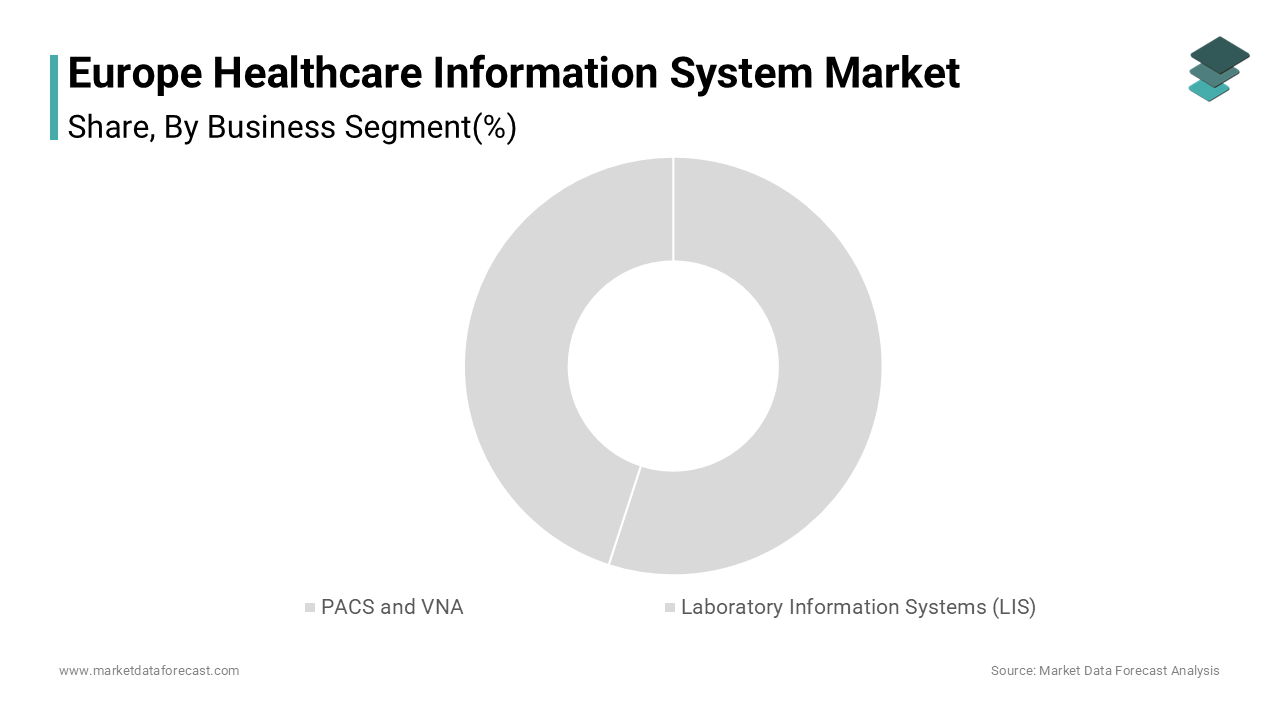
The laboratory information systems segment is anticipated to witness the fastest CAGR of 12.8% from 2025 to 2033. The rapid expansion of the laboratory information systems segment is propelled by the rising demand for high throughput diagnostics antimicrobial resistance monitoring and genomic testing across public health and precision medicine initiatives. Across the EU, clinical laboratory testing is extensive and ongoing, serving a major role in managing long-term illnesses and tracking the spread of infectious diseases. There is a strong push from the European Commission for countries to use laboratory information systems that can work together seamlessly and handle advanced genetic sequencing data. These clinical public health and regulatory drivers position LIS as the most dynamic growth segment in European health informatics.
By Component Insights
- The software segment led the Europe healthcare information system market and accounting for a 58.2% share in 2024.
The growth of the software segment is attributable to its role as the functional core enabling data capture analytics interoperability and clinical decision support. Moreover, France's "Mon Espace Santé" is a digital health platform that uses open-source software, which promotes a vendor-neutral approach. This platform, which is part of a broader European trend toward digital health infrastructure, ensures long-term sustainability by building upon a common framework. The European Health Data Space (EHDS) regulation requires that health data software used for secondary purposes, such as research, must adhere to the FAIR principles. This emphasis on intelligent scalable and compliant software cements its dominance in the European health IT value chain.
The services component segment is likely to experience the fastest CAGR of 14.2% during the forecast period owing to the increasing complexity of system implementation integration cybersecurity and user training in highly regulated environments. Hospitals across the EU are widely relying on outside help for crucial operational services like managing technical systems and providing ongoing support. As per research, a majority of healthcare providers in Europe are bringing in third-party companies to help meet new, mandatory cybersecurity rules and regulations. Cloud managed services are particularly in demand with national health systems signing long-term deals with providers to run and look after important digital platforms. Ongoing services become essential for sustainability, security, and value realization as systems evolve from standalone applications into integrated data ecosystems.
By End User Insights
- The providers segment captured a substantial share of the Europe healthcare information system market in 2024.
The expansion of the providers segment is propelled by national digitization mandates operational efficiency goals and clinical quality imperatives. Most public hospitals in the Scandinavian region use combined electronic health records to help manage the complex care needs of older populations facing multiple health conditions. Diagnostic imaging and laboratory digitization further amplifies provider demand. Radiology departments are modernizing their picture archiving systems to accommodate new artificial intelligence technologies. Providers remain the central engine of health IT investment and innovation across Europe because they are both the primary point of care delivery and data generation.
The payers segment is on the rise and is expected to be the fastest growing segment in the market by witnessing a CAGR of 15.6% from 2025 to 2033. The swift expansion of the payers segment is fueled by the shift toward value based reimbursement and real world evidence requirements across national health systems and private insurers. According to sources, a consistent pattern has emerged where national authorities now universally demand that health technology evaluations incorporate evidence from real-world patient data sources. Germany is implementing a major change, requiring a central health committee to connect public health insurers with hospital records to monitor treatment effectiveness for many long-term illnesses. The insurance sector is also moving toward digitalization, with numerous private health insurers introducing online systems for treatment approvals, resulting in quicker claim handling. The reliance of payers on integrated health information systems for analytics, fraud detection, and policy design is accelerating at an unprecedented pace as they transition from fee-for-service adjudicators to health outcome managers.
REGIONAL ANALYSIS
Germany Healthcare Information System Market Analysis
- Germany was the top performer in the Europe healthcare information system market by occupying a 25.5% share in 2024.
The prominence of the German market is propelled by the landmark Hospital Future Act which allocated 4.3 billion euros for digital transformation. The law mandates interoperability between EHRs PACS and laboratory systems using the national gematik TI platform. Germany also leads in radiology digitization. The presence of global health IT vendors and strong public private partnerships further accelerates adoption. This combination of regulatory enforcement fiscal investment and clinical integration establishes Germany as Europe’s most advanced and comprehensive health information market.
France Healthcare Information System Market Analysis
- In 2024, France secured 18.5% of the European healthcare information system market
The growth is attributed to its centralized Mon Espace Santé platform and robust public health surveillance architecture. France's electronic health record system covers almost all citizens and a vast network of medical staff, helping them easily share patient information across different care settings. Furthermore, the Digital Health Agency mandates that all medical devices including imaging and lab equipment interface with certified health information systems using HL7 FHIR standards. France exemplifies a top-down model of health data governance, characterized by strong state coordination, high citizen engagement, and advanced analytics, that drives deep and sustained market growth.
UK Healthcare Information System Market Analysis
- The United Kingdom experienced steady growth in the Europe healthcare information system market due to the NHS Long Term Plan and the rollout of Integrated Care Systems across England.
NHS England is mandating the creation of shared care records across all regional health and social care systems by allowing professionals to access a more complete patient history to support integrated care. There is a significant and ongoing financial commitment to modernizing the NHS's digital infrastructure, including upgrading electronic health records and enhancing data security measures. Additionally, the National Genomic Healthcare Strategy requires all genomic test results to be stored in interoperable LIS with links to EHRs. Despite Brexit the UK maintains alignment with EU health data standards through the UK Health Security Agency’s participation in cross border surveillance networks. This focus on system integration population health management and diagnostic modernization sustains the UK’s position as a high intensity health IT market.
Sweden Healthcare Information System Market Analysis
- Sweden expanded gradually in the European healthcare information system market owing to its near universal national EHR and deep primary care integration.
The national system supports advanced functionalities including ePrescriptions shared care plans and patient reported outcome measures. The Swedish Cancer Registry links pathology LIS and radiology PACS across all oncology centers providing real world evidence for national treatment guidelines. Furthermore, all health IT vendors must comply with the Swedish Standard for interoperability. This citizen centric seamless and data driven model makes Sweden a benchmark for national health information system maturity in Europe.
The Netherlands Healthcare Information System Market Analysis
- The Netherlands is anticipated to grow in the Europe healthcare information system market between 2025 and 2033 due to its national interoperability framework and health data innovation ecosystem.
All hospital EHRs must comply with the Nictiz ZIB specifications ensuring semantic interoperability across specialties. The Netherlands also hosts the European Health Data Hub pilot linking Dutch data with Estonia and Finland for cross border research. This combination of open standards citizen control and clinical AI positions the Netherlands as a high impact innovation market where health information systems enable both care delivery and scientific advancement.
COMPETITIVE LANDSCAPE
The Europe healthcare information system market features a dynamic competitive landscape shaped by stringent regulatory requirements national health strategies and varying levels of digital maturity. Competition is dominated by a mix of global EHR giants European imaging specialists and local vendors with deep regional expertise. Unlike more commercially driven markets European competition hinges on compliance with national and EU level mandates including data sovereignty interoperability certification and cybersecurity standards. Public procurement processes favor vendors with proven integration into national eHealth infrastructures such as Germany’s TI or France’s DMP. The rise of the European Health Data Space is intensifying focus on cross border data exchange capabilities giving an edge to platforms with modular open architecture. While global players lead in scale and R&D local vendors thrive through tailored workflows and long standing public sector relationships. Innovation increasingly centers on AI enabled clinical decision support real world data analytics and seamless patient engagement rather than core record functionality. This environment rewards adaptability regulatory fluency and strategic public private collaboration over pure technological prowess.
KEY MARKET PLAYERS
Some of the companies that are playing a dominating role in the Europe Healthcare Information System Market include
- Koninklijke Philips N.V.
- GE HealthCare
- Oracle Health (formerly Cerner Corporation
- Epic Systems Corporation
- McKesson Corporation
- Altera Digital Health (formerly Allscripts Healthcare, LLC)
- Siemens Healthineers
- Agfa-Gevaert Group
- IBM Corporation
- Hewlett Packard Enterprise (HPE)
- Carestream Health
Top Players in the Market
Siemens Healthineers AG
Siemens Healthineers AG is a leading force in the Europe healthcare information system market offering integrated imaging informatics and enterprise IT solutions including PACS VNA and teamplay digital health platforms. The company plays a critical role in connecting diagnostic imaging with clinical workflows across hospitals in Germany France and the Nordic countries. In 2023 Siemens Healthineers launched its AI enabled Teamplay Digital Health Ecosystem compliant with the European Health Data Space framework enabling secure data analytics across institutions. It also achieved certification under Germany’s gematik TI infrastructure allowing seamless integration with national EHRs. Through deep alignment with EU interoperability standards and clinical AI innovation Siemens Healthineers strengthens care coordination while contributing to global best practices in radiology and enterprise imaging informatics.
Epic Systems Corporation
Epic Systems Corporation has significantly expanded its footprint in the Europe healthcare information system market by deploying its comprehensive electronic health record platform in major academic medical centers across the UK Netherlands and Denmark. The company tailors its solutions to comply with national data sovereignty requirements including EU GDPR and local eHealth regulations. In 2024 Epic established a sovereign cloud region in Frankfurt ensuring all European patient data remains within the EU. It also integrated its platform with national identity schemes such as Sweden’s BankID and the UK’s NHS login to support secure citizen access. Epic’s emphasis on interoperability through FHIR APIs and cross border data exchange positions it as a key enabler of the European Health Data Space while reinforcing its global leadership in large scale EHR deployment.
Cerner Corporation (now Oracle Health)
Cerner Corporation now operating as Oracle Health is a major participant in the Europe healthcare information system market through its Millennium and HealtheIntent platforms serving hospitals and integrated care systems in the UK France and Spain. The company has strengthened its European compliance posture by achieving accreditation under the EU Cybersecurity Act and aligning its cloud infrastructure with the European Cloud Federation. In 2023 Oracle Health partnered with France’s Health Data Hub to enable real world evidence generation from anonymized EHR data for public health research. It also launched a localized version of its revenue cycle management suite compliant with EU VAT and billing regulations. By combining clinical depth with financial and operational modules Oracle Health supports value based care transformation across Europe while extending its global integrated health IT capabilities.
Top Strategies Used by the Key Market Participants
Key players in the Europe healthcare information system market pursue strategies centered on regulatory alignment interoperability innovation and localized delivery. Achieving compliance with EU frameworks such as the European Health Data Space GDPR and NIS2 Directive is foundational to market access and trust. Companies invest heavily in sovereign cloud infrastructure with data centers in Germany Ireland and the Netherlands to ensure data residency. Strategic integration with national health identity systems like FranceConnect and Sweden’s BankID enhances user adoption and security. Vendors prioritize FHIR based APIs and adherence to standards from Nictiz gematik and IHE Europe to enable cross platform data exchange. Partnerships with public health agencies and academic hospitals facilitate real world validation and co development of AI enabled clinical modules. These strategies collectively address Europe’s unique blend of regulatory rigor clinical complexity and public health ambition.
MARKET SEGMENTATION
The research report on the Europe Healthcare Information System Market has been segmented and sub-segmented based on categories.
By Business Segment
- PACS and VNA
- Laboratory Information Systems (LIS)
By Component
- Software
- Services
By End User
- Providers
- Payers
By Country
- UK
- France
- Spain
- Germany
- Italy
- Russia
- Sweden
- Denmark
- Switzerland
- Netherlands
- Turkey
- Czech Republic
- Rest of Europe