- Product Description Description
- Table of Contents TOC
- List of Table & Figure LOT
- Get Free Sample PDF Sample PDF
Market Size, 2025
$69.23 BnMarket Estimate, 2026
$73.40 BnMarket Forecast, 2034
$117.16 BnCAGR, 2026–2034
6.02%Europe Herbal Medicine Market Size
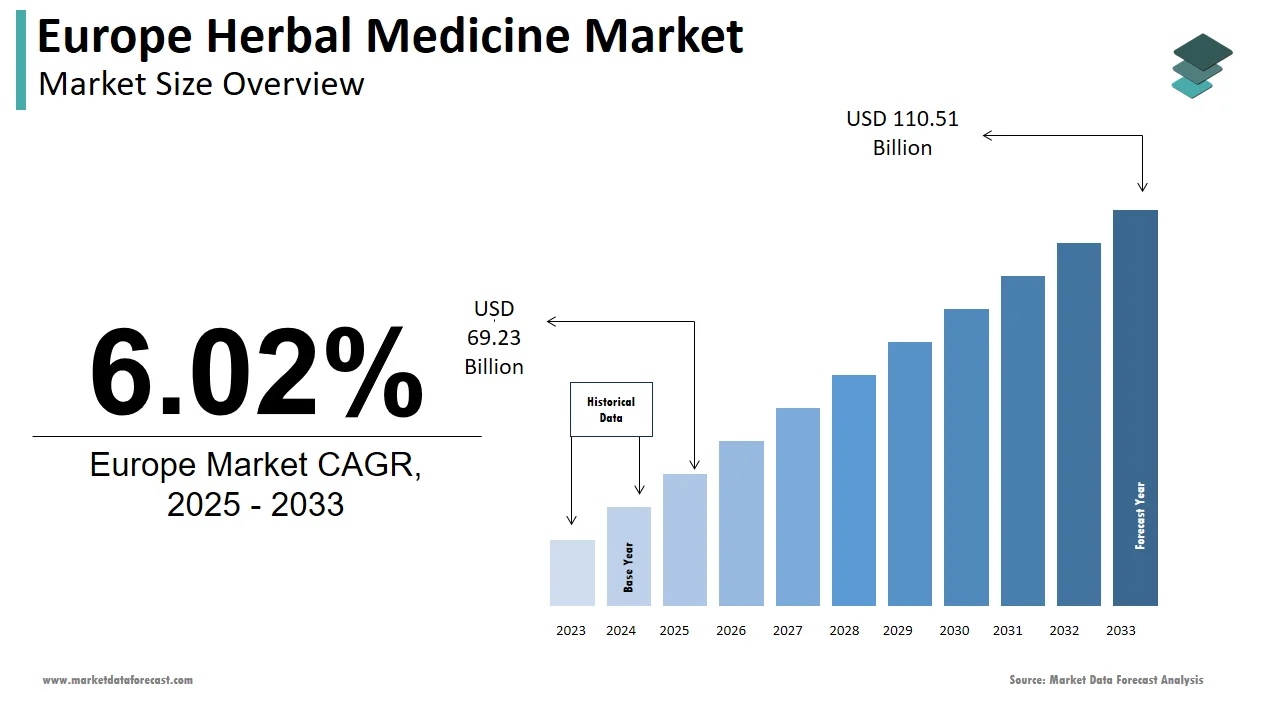
The herbal medicine market size in Europe was valued at USD 69.23 billion in 2025. The European market is estimated to be worth USD 117.16 billion by 2034 from USD 73.40 billion in 2026, growing at a CAGR of 6.02% from 2026 to 2034.
The herbal medicine is a complex intersection of cultural traditions, consumer health preferences, and regulatory frameworks that collectively sustain its growing relevance. Herbal medicine in this context refers to the therapeutic use of plants, botanical extracts, and natural compounds for preventive and curative purposes across a range of health conditions.
MARKET DRIVERS
Rising Consumer Preference for Natural and Preventive Health Solutions
The trend towards medicines as part of a shift toward preventive healthcare and holistic wellness is escalating the growth of the Europe herbal medicine market. The demand for natural health products is driven by rising health awareness and an aging population. In addition, in surveys in Europe, about 27 percent of respondents rate traditional European medicine as very or predominantly effective, while 44 percent rate it as partly effective, which shows that many consumers believe in its utility as a complement to conventional medicine. This positive consumer attitude encourages more frequent use of herbal formulations for stress, digestion, immunity, and sleep, expanding demand beyond niche users.
Supportive Regulatory Frameworks and Integration into Conventional Healthcare
The regulatory and institutional acceptance of herbal medicinal products within Europe, which helps legitimize them and integrate them into mainstream health systems, is accelerating the growth of the Europe herbal medicine market. Moreover, the European Scientific Cooperative on Phytotherapy (ESCOP) produces monographs and reviews that support evidence-based phytotherapy across national markets by helping professionals and regulators trust herbal products. Also, EU directives allow registration of traditional herbal remedies under special registration schemes that require less demanding clinical trial burdens compared to synthetic drugs, provided historical use is well documented. This encourages small and medium-scale herbal producers to bring products legally to market.
MARKET RESTRAINTS
Quality variability, adulteration, and contamination in supply chains
The inconsistent product quality caused by adulteration, contamination,n and mislabelling, which erode consumer trust and raise regulatory scrutiny, is hindering the growth of the Europe herbal medicine market. These findings illustrate that a substantial fraction of marketed botanicals may not contain the declared species or purity levels. Adulteration and contamination increase recalled product volumes, require additional safety testing, and force firms to run costly traceability programmes and advanced authentication analytics. Small-scale growers and processors often lack the capital to implement Good Agricultural and Collection Practices and rigorous third-party testing, so the burden falls on brands and distributors.
Safety signals herb drug interactions and limited high-quality clinical evidence
The interplay of safety signals, herb drug interaction, and gaps in robust clinical evidence, which limit medical endorsement and restrict claims that manufacturers may legally make, is impeding the growth of Europe’s herbal medicine market. Systematic reviews and pharmacovigilance studies have documented adverse events linked to herbal medicines, including hepatotoxicity, allergic reactions, and renal effects; a 2024 systematic review of adverse events associated with herbal medicines summarised heterogeneous but non-trivial reporting of harms across studies. The World Health Organization and patient safety guidance highlight that herb drug interactions add materially to polypharmacy risk, especially among older patients who take multiple prescription medicines.
MARKET OPPORTUNITIES
Expansion of herbal supplements as self-care and wellness supplements
The growing consumer demand for herbal supplements integrated into daily wellness and preventive care is a majorly factor in enhancing the growth opportunities for Europe’s herbal medicine market. The alignment of herbal medicine with self-care trends, consumers seeking natural immunity support, stress relief or digestive health is accelerating the market’s growth. Manufacturers can capitalise by innovating dosage forms, combining actives, and emphasising evidence-based efficacy and transparency. Growth in e-commerce, telehealth, and digital wellness platforms increases direct access for consumers purchasing herbal supplements.
Novel botanicals, functional foods and ingredient exports
The development of novel botanical ingredients and integration into functional foods, beverages, and the export of high-quality raw herbal materials is also to enhance the growth of Europe’s herbal medicine market. For example, baobab is successfully gained approval under the EU’s novel food regulation and is now marketed across Europe for immune support and digestive health. Botanical exporters can also position themselves in specialty niche sectors (e.g., adaptogens, nootropics, mood and cognitive support herbs) where consumer interest is rising. This indicates strong demand for botanical interventions within broader CAM services.
MARKET CHALLENGES
High incidence of adulteration, dilution and botanical misidentification
The pervasive risk of adulteration, misidentification, or dilution of botanical ingredients is challenging the growth of Europe’s herbal medicine market. Adulterants may include cheaper substitute species, non-declared excipients, or synthetic substances which dilute the expected activity and may pose safety risks.
Fragmented regulatory regimes and limited harmonized clinical evidence
The fragmented regulatory landscape across European jurisdictions, combined with the limited high-quality clinical evidence for many herbs, also inhibits the growth of Europe’s herbal medicine market. Under Directive 2004/24/EC, a simplified registration scheme exists for traditional herbal medicinal products, but it hinges upon documented traditional use rather than modern clinical trials. This limits acceptance of herbal medicines in conventional medical practice and restricts reimbursement by payers. Moreover, differences among national regulatory agencies in how they interpret safety thresholds, permitted dosages, labeling requirements, and risk monitoring lead to varied market access paths across countries.
REPORT COVERAGE
| REPORT METRIC | DETAILS |
| Market Size Available | 2025 to 2034 |
| Base Year | 2025 |
| Forecast Period | 2026 to 2034 |
| Segments Covered | By Type, Source, Form, and Region. |
| Various Analyses Covered | Global, Regional and Country-Level Analysis, Segment-Level Analysis, Drivers, Restraints, Opportunities, Challenges; PESTLE Analysis; Porter’s Five Forces Analysis, Competitive Landscape, Analyst Overview of Investment Opportunities |
| Countries Covered | UK, France, Spain, Germany, Italy, Russia, Sweden, Denmark, Switzerland, Netherlands, Turkey, Czech Republic, and the Rest of Europe. |
| Market Leaders Profiled | TSUMURA & CO., Dr. Willmar Schwabe India Pvt. Ltd., Blackmores Limited, NATURE’S ANSWER, Arkopharma, Arizona Natural Products, Bio-Botanica Inc., Herbal Africa, Sidomuncul, and Nature Herbs. |
SEGMENTAL ANALYSIS
By Type Insights
The herbal dietary supplements segment accounted in holding 46.3% of the European herbal medicine market share in 2024, with the well-established regulatory frameworks that facilitate safe commercialization and consumer access. As per the Robert Koch Institute, 58% of German adults use herbal supplements annually, primarily for sleep support, immune function, and digestive health. Additionally, reimbursement policies in countries like France and Austria cover certain herbal preparations when prescribed by licensed physicians, reinforcing medical legitimacy. The presence of trusted brands such as Bioforce, Weleda, and Dr Willmar Schwabe further strengthens consumer confidence.
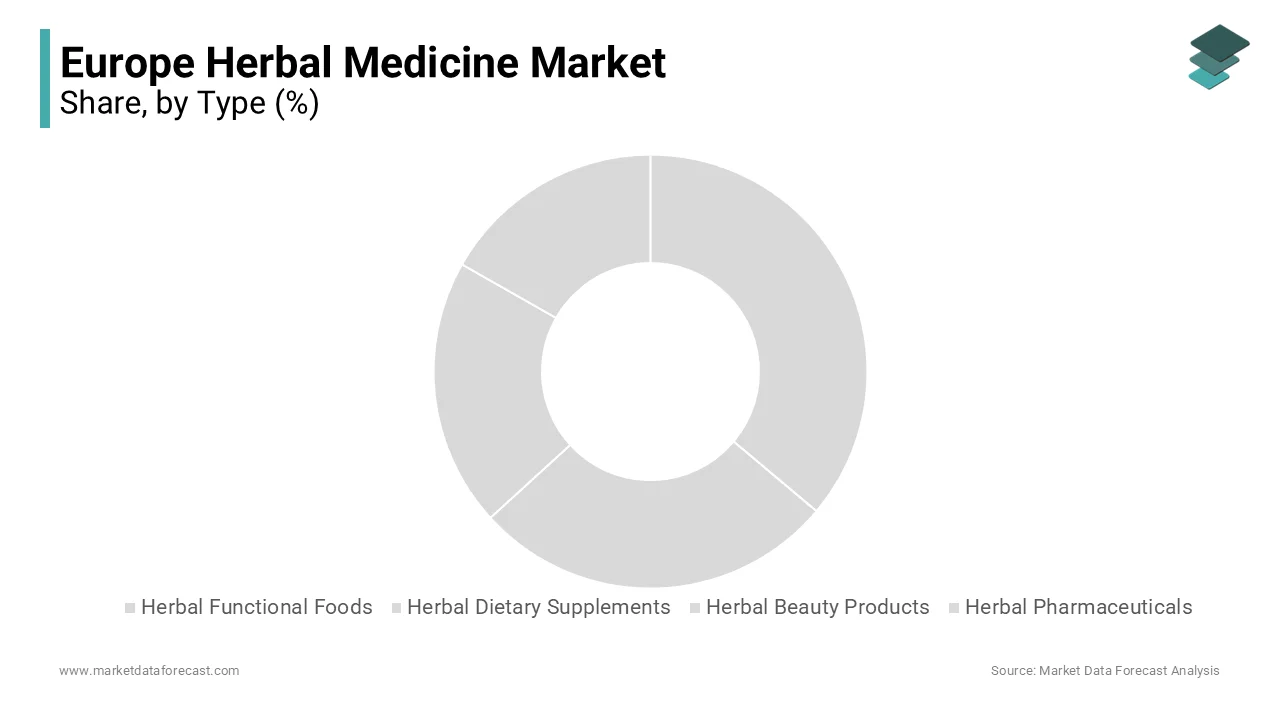
The herbal functional foods segment is likely to grow with an expected CAGR of 11.2% during the forecast period, with the shifting consumer behavior toward preventive healthcare and the seamless integration of medicinal plants into daily nutrition. A 2022 consumer study by Mintel revealed that 61% of UK respondents prefer obtaining health benefits through food rather than pills. Additionally, clean-label demands align with natural sourcing; over 70% of herbal functional foods in the EU carry organic certification, according to the Research Institute of Organic Agriculture. Urban wellness cafes and private supermarket labels increasingly incorporate adaptogenic herbs like ashwagandha and rhodiola into energy bars and smoothie blends.
By Source Insights
Whole Plants Dominate the Europe Herbal Medicine Market with 32% Share
The whole plants segment accounted in holding a dominant share of the European herbal medicine market in 2024. In traditional European herbalism in Germany and Austria, preparations such as fresh tinctures, teas, and poultices made from intact plants like Echinacea purpurea, Valeriana officinalis, and Hypericum perforatum are widely prescribed under the principle of "whole plant synergy." Regulatory frameworks such as the EU Traditional Herbal Medicinal Products Directive also facilitate market access for whole plant formulations that have documented historical use.
The leaves segment is likely to grow with an expected CAGR of 10.7% during the forecast period, with the rising popularity of adaptogenic and cognitive-enhancing herbs whose active constituents are concentrated in foliage. According to the German Federal Institute for Drugs and Medical Devices, over 42% of adults aged 35–60 in Germany regularly consume herbal supplements containing Ginkgo leaf extract for cognitive maintenance. Clinical trials coordinated by the Nordic School of Herbal Medicine confirmed that daily intake of Bacopa leaf extract improved memory retention in healthy adults by 23% over 12 weeks. Furthermore, sustainability advantages contribute to growth; leaf harvesting does not require plant destruction, enabling multiple harvests per season and aligning with regenerative agriculture principles.
By Form Insights
The capsules segment was the largest and held 38.2% of the European herbal medicine market share in 2024, with the consumer demand for standardized dosing, ease of ingestion, and perceived pharmaceutical-grade reliability. Additionally, manufacturers benefit from extended shelf life and lower susceptibility to microbial contamination compared to liquid forms. The use of vegetarian cellulose capsules has further enhanced appeal among health-conscious and ethically driven consumers, with over 80% of new herbal capsule launches in France and the Netherlands featuring plant-based shells, as noted by Mintel’s Global New Products Database.
The herbal extracts segment is deemed to grow with an expected CAGR of 12.4% during the forecast period, with the superior bioavailability, dose efficiency, and strong clinical backing for concentrated plant actives. Technological advancements in extraction method,s such as supercritical CO₂ and ethanol fractionatio,n have improved purity while preserving synergistic compounds. Furthermore, regulatory recognition under the EU monographs on herbal substances has legitimized extract-based products as medicinal agents rather than mere supplements.
COUNTRY LEVEL ANALYSIS
Germany Market Analysis
Germany was the largest contributor of the European herbal medicine market by accounting for 28.3% of the market share in 2024, with a long-standing tradition of scientific phytotherapy, where plant-based remedies are integrated into mainstream healthcare and often prescribed by physicians. Pharmacies dispense over 12% of all non-prescription medications as herbal formulations, reflecting deep consumer trust. St John’s wort, echinacea, and valerian root are among the most widely consumed, with brands like Kneipp, Dr Willmar Schwabe, and Weleda dominating retail shelves. Reimbursement policies further support access with certain herbal preparations are covered under statutory health insurance when prescribed.
France Market Analysis
France herbal medicine market was positioned second with the increasing disposable income and rising awareness of the healthcare systems. The government recognizes around 300 plant-based substances for therapeutic use, and many are reimbursed at partial rates under the national health system. Consumer preference leans toward liquid extracts, tinctures, and essential oil blends, with lavender, blackcurrant, and grape seed extract being top-selling ingredients. Retail availability is extensive, spanning pharmacies, parapharmacies, and organic stores such as Naturalia. Additionally, France leads in aromatherapy applications, with INRAE confirming that essential oil usage for respiratory wellness increased by 29% during seasonal illness periods.
United Kingdom Market Analysis
The United Kingdom herbal medicine market is likely to grow steadily during the forecast period. Over 1.5 million people in England and Wales use herbal remedies regularly, primarily for stress relief, joint health, and immune function, as reported by the Office for National Statistics. Echinacea, turmeric, and milk thistle are among the most popular, with Boots, Holland & Barrett, and Superdrug serving as major retail channels. Integrative clinics in London and Manchester increasingly combine herbal medicine with nutritional therapy, which is signaling evolving clinical acceptance.
Italy Market Analysis
Italy herbal medicine market is growing with its regional biodiversity and centuries-old traditions in botanical healing. Herbal medicine is deeply embedded in cultural practices, with household use of infusions, decoctions, and macerated oils remaining widespread, particularly in rural areas of Tuscany, Umbria, and Sicily. The country produces over 200 native medicinal plant species, with cultivation concentrated in the Apennine foothills and Alpine regions. The Italian Ministry of Health recognizes 180 plant species for therapeutic use, and university programs in pharmacognosy at Sapienza University of Rome sustain academic rigor.
COMPETITIVE LANDSCAPE
The competition in the Europe herbal medicine market is characterized by a balanced yet dynamic landscape where established pharmaceutical-grade manufacturers coexist with niche organic brands and emerging digital health players. Dominant companies such as Bionorica, Weleda and Dr Willmar Schwabe maintain strong positions through scientific validation, regulatory compliance, and deep integration into pharmacy networks across Germany, France and Scandinavia. These leaders differentiate themselves via standardized extracts, clinical research, and long-standing brand trust among both healthcare professionals and consumers. At the same time, regional producers and independent herbalists cater to localized preferences, particularly in Southern and Eastern Europe, where traditional preparations remain culturally significant. The rise of e-commerce and direct-to-consumer models has intensified rivalry, enabling agile startups to challenge incumbents with innovative delivery formats and sustainability claims. Retail chains like Holland & Barrett and Mercadona have developed private-label herbal lines, increasing price pressure. Regulatory harmonization under the Traditional Herbal Medicinal Products Directive ensures quality benchmarks but also raises entry barriers for smaller firms. Innovation is concentrated in adaptogenic blends, gut health formulations, and preventive wellness products aligned with consumer demand for natural solutions.
KEY MARKET PLAYERS
Some of the companies that are playing a dominating role in the global herbal medicine market include
- TSUMURA & CO.
- Willmar Schwabe India Pvt. Ltd.
- Blackmores Limited
- NATURE’S ANSWER
- Arkopharma
- Arizona Natural Products
- Bio-Botanica Inc.
- Herbal Africa
- Sidomuncul
- Nature Herbs
Top Players in the Herbal Medicine Market
Bionorica SE
Bionorica SE is a German-based leader in evidence-based phytotherapy with a strong presence across Europe and growing influence in the Asia Pacific herbal medicine market. The company specializes in standardized herbal extracts derived from whole plants, with flagship products like Sinupret for respiratory health and KLONOPHOBIN for anxiety management widely prescribed in European clinics. Bionorica has invested heavily in clinical research to validate the efficacy of its formulations, conducting over 50 peer-reviewed studies in the past decade. In Asia Pacific, it has expanded through scientific collaborations with universities in Japan and Australia to adapt its products for regional health needs. Recent initiatives include launching digital patient education platforms and strengthening distribution partnerships in Singapore and South Korea.
Weleda AG
Weleda AG operates as a globally recognized pioneer in anthroposophic and natural medicine, with deep roots in European herbal therapeutics and an expanding footprint in the Asia Pacific wellness sector. The company maintains cultivation sites across Europe and supports regenerative agriculture programs in India and Indonesia. In recent years, Weleda has intensified engagement in markets like Japan, Australia, and Taiwan by participating in integrative health expos and collaborating with naturopathic practitioners.
Dr Willmar Schwabe GmbH & Co KG
Dr Willmar Schwabe is one of Europe’s largest manufacturers of homeopathic and herbal medicinal products, which is known for scientifically validated formulations such as Lycopodium comp and Aconitum napellus. Based in Germany, the company adheres to strict Good Manufacturing Practice standards and holds numerous Traditional Herbal Registration certifications by ensuring compliance with EU regulatory frameworks. Schwabe has extended its reach into the Asia Pacific region by establishing distribution networks in India, Thailand, and Malaysia, where demand for integrative medicine is rising. The company supports clinical training for alternative medicine practitioners and sponsors research on herbal synergies at institutions in Chennai and Kuala Lumpur.
Top Strategies Used by Key Market Participants
Investment in Clinical Research and Scientific Key players are prioritizing clinical trials and pharmacological studies to substantiate the efficacy and safety of herbal formulations. Companies conduct randomized controlled trials, publish findings in peer-reviewed journals, and collaborate with academic institutions to build scientific credibility. This evidence-based approach supports regulatory approval, enhances physician recommendations, and differentiates products in a competitive market. Standardization of active compounds ensures batch consistency while mechanistic studies explain modes of action. Regulatory bodies such as EMA and national agencies favor clinically backed products for registration.
Expansion of Sustainable and Ethical Sourcing Practices, leading companies are implementing traceable supply chains that prioritize organic cultivation fair trade principles, and biodiversity conservation. They partner with smallholder farmers and cooperatives to ensure sustainable harvesting of medicinal plants while preserving ecosystems. Certifications such as Bio Suisse, Demeter, and FairWild reinforce transparency. Firms invest in biodynamic farming and seed preservation programs to protect endangered species like Valeriana officinalis and Gentiana lutea. Life cycle assessments minimize environmental impact from cultivation to packaging. These initiatives resonate with eco-conscious European consumers and align with EU Green Deal objectives.
Digital Engagement and Direct-to-Consumer Marketing Strategies market leaders are leveraging digital platforms to enhance consumer education, improve access, and personalize user experience. Companies have developed mobile applications, online symptom checkers, and teleconsultation services that guide patients toward appropriate herbal solutions. Social media campaigns, educational webinars, and influencer collaborations target younger demographics seeking natural alternatives. E-commerce integration with auto-refill options ensures consistent product availability. Data analytics enable tailored recommendations based on usage patterns and regional health trends. Multilingual websites and AI-driven chat support extend reach across diverse populations.
MARKET SEGMENTATION
This Europe herbal medicine market research report is segmented and sub-segmented into the following categories.
By Type
- Herbal Functional Foods
- Herbal Dietary Supplements
- Herbal Beauty Products
- Herbal Pharmaceuticals
By Source
- Roots and barks
- Fruits
- Whole plants
- Leaves
- Others
By Form
- Tablets
- Capsules
- Extracts
- Syrups
- Powders
- Others
By Country
- UK
- France
- Spain
- Germany
- Italy
- Russia
- Sweden
- Denmark
- Switzerland
- Netherlands
- Turkey
- Czech Republic
- Rest of Europe