- Product Description Description
- Table of Contents TOC
- List of Table & Figure LOT
- Get Free Sample PDF Sample PDF
Market Size, 2025
$8.48 BnMarket Estimate, 2026
$8.97 BnMarket Forecast, 2034
$14.10 BnCAGR, 2026–2034
5.81%Europe Home Fragrance Market Report Summary
The Europe home fragrance market was valued at USD 8.48 Bn billion in 2025, is estimated to reach USD 8.97 billion in 2026, and is projected to grow to USD 14.10 billion by 2034, advancing at a CAGR of 5.81% from 2026 to 2034. Growth is driven by rising consumer focus on wellness, emotional well-being, and home ambiance, alongside increasing demand for sustainable, non-toxic, and naturally derived fragrances. The expansion of e-commerce, premiumization of home care products, and strong cultural ties to scent in daily living—especially in Southern Europe—are further accelerating adoption. Innovations in long-lasting diffusers, refillable systems, and luxury artisanal formats are also reshaping product preferences across urban and suburban households.
Key Market Trends
- Surging preference for floral and botanical scents, reflecting Europe’s heritage of perfumery and demand for calming, nature-inspired aromas.
- Rapid shift toward eco-conscious formulations, with consumers seeking vegan, phthalate-free, and recyclable packaging—particularly in Nordic and Western European markets.
- Candles remain the dominant product format, prized for their dual role as mood enhancers and decorative home accessories.
- Online channels lead distribution, fueled by DTC (direct-to-consumer) brands, social commerce, and personalized subscription models.
- Rising interest in multi-sensory home experiences, with scent integrated into interior design, mindfulness routines, and smart home ecosystems.
Segmental Insights
- By fragrance type, floral was the largest segment in 2025, capturing 28.4% of the market—driven by timeless appeal and alignment with clean, fresh home aesthetics.
- By product, candles held the leading share at 34.2%, benefiting from affordability, gifting culture, and seasonal demand (e.g., holidays, hygge trends).
- By distribution channel, online sales accounted for 41.7% of total revenue in 2025, outpacing brick-and-mortar due to convenience, broader SKU availability, and targeted digital marketing.
Regional Insights
- France dominated the market with a 19.3% share in 2025, leveraging its global reputation in perfumery, luxury home brands, and high per-capita fragrance consumption.
- Germany remains a key market, characterized by strict regulatory standards, strong demand for eco-certified products, and a wellness-driven consumer base.
- Italy showcases steady growth, supported by artisanal craftsmanship, designer home collections, and abundant use of native botanicals like citrus, rosemary, and lavender.
- Sweden is poised for notable expansion through 2033, driven by minimalist interior trends, biophilic design, and leadership in sustainable consumption—making it a hotspot for clean-label and refillable fragrance solutions.
Competitive Landscape
The Europe home fragrance market features a blend of global FMCG giants, niche luxury houses, and agile digital-native brands. Leading players are focusing on sustainability storytelling, local ingredient sourcing, and omnichannel engagement to capture evolving consumer sentiment. Strategic launches of limited-edition scents, collaborations with interior designers, and investment in carbon-neutral production are key differentiation tactics.
Prominent companies include Reckitt Benckiser Group PLC (U.K.), Procter & Gamble (U.S.), S.C. Johnson & Son Inc. (U.S.), Newell Brands (U.S.), Richard Ginori (Italy), ESTEBAN PARIS (U.S.), Scentair Technologies, LLC (U.S.), Circle E Candles (U.S.), Broken Top Brands (U.S.), and 3M Company (U.S.).
Europe Home Fragrance Market Size
The Europe fragrance market size was valued at USD 8.48 billion in 2025 and is anticipated to reach a valuation of USD 8.97 billion in 2026 and USD 14.10 billion by 2034, growing at a CAGR of 5.81% from 2026 to 2034.
Home fragrance refers to the scented products, including candles, diffusers, room sprays, incense, and reed diffusers, designed to enhance indoor ambiance, emotional well-being, and perceived cleanliness within residential spaces. This market intersects lifestyle wellness and sensory design, reflecting evolving European attitudes toward the home as a sanctuary for mental restoration and personal expression. As per sources, the use of scented products is widespread in European households, and there is a growing consumer interest in the ingredients and potential health impacts of fragrance compositions. According to sources, the post-pandemic shift towards more remote work and increased time spent in residential settings has intensified public and regulatory focus on improving indoor environmental quality and air purity. Furthermore, Indoor air quality is a significant and evolving environmental and health policy priority across the European Union, which leads to increased scrutiny of chemical and fragrance components in household products. These behavioral and regulatory shifts position home fragrance not as a luxury but as an essential component of contemporary European domestic life, embedded in routines of self-care, spatial identity, and emotional regulation.
MARKET DRIVERS
Rising Integration of Home Fragrance into Mental Wellbeing and Self-Care Rituals
European consumers increasingly view home fragrance as a non-pharmaceutical tool for stress reduction,n mood enhancement, and sleep support, which accelerates the growth of the Europe home fragrance market. According to sources, interest in using natural aromatherapy for daily relaxation is growing across Europe. Scientific validation has accelerated this trend, with linalool, a compound in lavendeshowingows promise in clinical studies for reducing stress-related cortisol. Aromatherapy and sensory therapies are explored as complementary approaches in cognitive behavioral therapy (CBT) for insomnia in France and elsewhere. Apart from these, wellness influencers across Germany and Sweden have popularized the “scent layering” technique, combining candles and diffusers to create personalized emotional environments. This therapeutic reframing transforms home fragrance from a decorative accessory to a functional wellness aid, which drives consistent replenishment and premiumization across product categories.
Expansion of Sustainable and Clean Label Consumer Expectations
Demand for transparency and eco-conscious formulation has become a decisive purchase criterion across the Europe home fragrance market. As per sources, consumers across Europe are increasingly scrutinizing ingredient lists of scented products, showing a growing concern for potentially harmful substances like phthalates and parabens. This scrutiny is reinforced by regulatory momentum, with the European Chemicals Agency (ECHA) regularly updating its Candidate List of Substances of Very High Concern, including specific fragrance-related chemicals as part of ongoing regulatory processes. In response, brands have pivoted to plant-based wax, essential oils, and recyclable packaging. The home fragrance market in France shows a strong trend toward products with certified natural or organic labels like Ecocert or COSMOS, driven by consumer demand and regulatory pressures. Similarly, there is a noticeable market shift in Sweden, where products featuring biodegradable components, such as diffuser reeds, are experiencing increased consumer preference and sales growth. This alignment with Europe’s broader clean-living ethos ensures that sustainability is no longer optional but central to brand credibility and consumer loyalty.
MARKET RESTRAINTS
Stringent EU Chemical Regulations and Fragmented National Compliance Requirements
Strict EU chemical regulations impose a heavy burden on the home fragrance industry, which makes product formulation more complicated and causes delays in bringing items to market, thereby restricting the growth of the Europe home fragrance market. The use of fragrance ingredients is subject to extensive and evolving regulation in the European Union, primarily under the REACH and CLP regulations, which drive continuous safety assessments and substance restrictions to protect human health and the environment. As per research, updated allergen disclosure requirements under the CLP regulation have necessitated significant reformulation efforts for many consumer products, including home fragrances, to ensure clear communication of potential hazards to consumers. Besides, national deviations persist. Germany’s Blue Angel ecolabel prohibits certain natural extracts allowed under EU law, while Italy requires Italian language allergen labeling beyond EU minimums. As per research, the fragrance industry, particularly small and medium enterprises, faces substantial compliance costs and challenges related to ongoing regulatory changes and safety standards imposed by EU regulations and voluntary industry guidelines like the IFRA Standards. These regulatory hurdles disproportionately impact artisanal producers, limiting innovation and market entry despite strong consumer demand.
Growing Consumer Sensitivity and Indoor Air Quality Concerns
Heightened awareness of respiratory health has led a segment of European consumers to avoid synthetic fragrances altogether due to perceived air quality risks, which further obstructs the expansion of the Europe home fragrance market. According to sources, a growing number of individuals with asthma or allergies report changing or eliminating their use of scented home products due to concerns about triggering respiratory symptoms. Health and environmental agencies, including the EEA and EPA, advise that volatile organic compounds (VOCs) released from products like aerosol sprays and some candles can accumulate in poorly ventilated indoor spaces, posing potential health risks, especially to sensitive individuals. Public health guidance in some regions, including Denmark, increasingly suggests minimizing exposure to indoor scents in homes with young children due to growing evidence linking such exposures to respiratory issues and potential sensitization. This health-conscious backlash is amplified by “unscented” lifestyle movements on social media, particularly in Nordic countries, where minimalist and hypoallergenic living is culturally valorized. Such perceptions constrain market expansion even among otherwise wellness-oriented consumers.
MARKET OPPORTUNITIES
Personalization Through Digital and AI-Driven Scent Profiling
Advancements in digital olfaction and consumer data analytics are unlocking hyper-personalized fragrance experiences across the region, which in turn offers fresh opportunities for the growth of the Europe home fragrance market. Brands now deploy online scent quizzes powered by machine learning that correlate user preferences with olfactory families and emotional outcomes. According to sources, a growing number of premium home fragrance brands are integrating artificial intelligence (AI) and machine learning to offer personalized product recommendations and enhanced online shopping experiences. Startups and tech companies are exploring collaborations and developing smart home systems, particularly in the Netherlands and across Europe, that synchronize various environmental elements, such as lighting and scent diffusion, to align with user wellness preferences or natural circadian rhythms. Besides, subscription services like those in Germany allow customers to receive quarterly custom blended diffuser refills based on seasonal mood tracking via smartphone apps. As per Industry analysis, the implementation of advanced adaptive customer systems and data-driven personalization in retail can significantly improve customer loyalty and potentially lead to a decrease in product return rates. This fusion of sensory science and digital interactivity opens new revenue models grounded in individualized emotional wellness.
Integration into Smart Home Ecosystems and IoT-Enabled Ambient Control
These scented products are increasingly embedded within connected living environments, where scent becomes a programmable layer of ambient intelligence and provides potential prospects for the expansion of the Europe home fragrance market. Smart diffusers compatible with Apple Home, Google Home, and Amazon Alexa voice-activated or schedule-based scent release synchronized with waking routines or entertainment modes. As per sources, the market for IoT-enabled fragrance devices in Europe is a growing segment within the broader smart home industry. In Switzerland, a luxury real estate developer integrated programmable scent systems into all new smart apartments, allowing residents to select “forest” or “ocean” ambiance via touchscreen panels. Furthermore, the integration of smart technology into scent devices, enabling features like mobile app control and scheduling, is gaining traction among consumers seeking to enhance their environment. This convergence with ambient computing transforms home fragrance from an active object to a dynamic environmental parameter managed alongside light, temperature, and sound.
MARKET CHALLENGES
Volatility in Natural Raw Material Supply and Ethical Sourcing Pressures
A shift towards natural ingredients has impacted the Europe home fragrance market. It has led to significant supply chain instability and ethical scrutiny. As per research, climate change impacts, such as drought and the spread of plant diseases, pose an increasing threat to agricultural yields, including aromatic crops like lavender in the Provence region. Similarly, sandalwood from sustainable sources remains scarce, with the illegal and unsustainable trade of wild plants in global supply chains presenting a significant challenge to biodiversity conservation and local livelihoods. Consumers now demand traceability. Also, consumer demand for transparency regarding the origin of ingredients in products, including botanicals, is generally increasing. In response, brands must invest in long-term contracts. A limited number of companies in the fragrance industry currently have full visibility into their complex supply chains beyond immediate and first-tier suppliers. This gap between clean label promises and supply chain reality risks reputational damage and cost inflation.
Intensifying Competition from Private Labels and Mass Retailers
Premium home fragrance brands face mounting pressure from high-quality private label offerings in supermarkets and pharmacy chains that replicate luxury aesthetics at half the price, and thereby constrain the expansion of the Europe home fragrance market. According to studies, private label home fragrance products are increasingly focusing on premium features, such as essential oils, sustainable materials like recyclable glass, and minimalist design, as retailers invest more heavily in their in-house brands. These products benefit from prime shelf placement, captive foot traffic, and bundled promotions that independent brands cannot match. The quality and value proposition of mass-market home fragrance diffusers have improved significantly in recent years, which leads many consumers to perceive them as viable alternatives to more expensive, premium options. This value convergence erodes the exclusivity premium that once justified high margins and forces niche players to compete on storytelling rather than formulation alone. Artisanal brands must offer a unique customer experience or therapeutic value to stand out in today's competitive and cost-conscious retail environment.
REPORT COVERAGE
| REPORT METRIC | DETAILS |
| Market Size Available | 2025 to 2034 |
| Base Year | 2025 |
| Forecast Period | 2026 to 2034 |
| CAGR | 5.81% |
| Segments Covered | By Fragrance, Product, Category, Distribution Channel, and Country |
| Various Analyses Covered | Global, Regional & Country Level Analysis; Segment-Level Analysis, DROC, PESTLE Analysis, Porter’s Five Forces Analysis, Competitive Landscape, Analyst Overview of Investment Opportunities |
| Regions Covered | UK, France, Spain, Germany, Italy, Russia, Sweden, Denmark, Switzerland, Netherlands, Turkey, Czech Republic & Rest of Europe |
| Market Leaders Profiled | Broken Top Brands (U.S.), Circle E Candles (U.S.), ESTEBAN PARIS (U.S.), Scentair Technologies, LLC (U.S.), Newell Brands (U.S.), Reckitt Benckiser Group PLC (U.K.), S.C. Johnson & Son Inc. (U.S.), Procter & Gamble (U.S.), Richard Ginori s.r.l. Viale Giulio Cesare (Italy), 3M Company (U.S.) |
SEGMENTAL ANALYSIS
By Fragrance Insights
The floral segment remained the leading segment in the Europe home fragrance market and captured a share of 28.4% in 2025. The growth of the floral segment is credited to its enduring cultural resonance, emotional versatility ty and broad demographic appeal. Lavender rose and jasmine dominate formulations, with roots in Europe’s botanical heritage and aromatherapy traditions. As per sources, Consumers often associate floral fragrances with relaxation and cleanliness, leading to their common use in personal care and home environments. Provence is a key region in France for the production of lavender essential oil, which is a significant part of the global market for fragrance ingredients, according to research. Apart from these, the European Medicines Agency recognizes certain floral compounds like linalool for their anxiolytic properties, lending scientific legitimacy to their use in wellness routines. Floral-scented home fragrance products, such as candles and diffusers, are consistently strong performers in retail sales, particularly during major holiday and seasonal gifting periods. This deep integration into ritual, heritage, and therapeutic practice sustains floral’s market leadership.
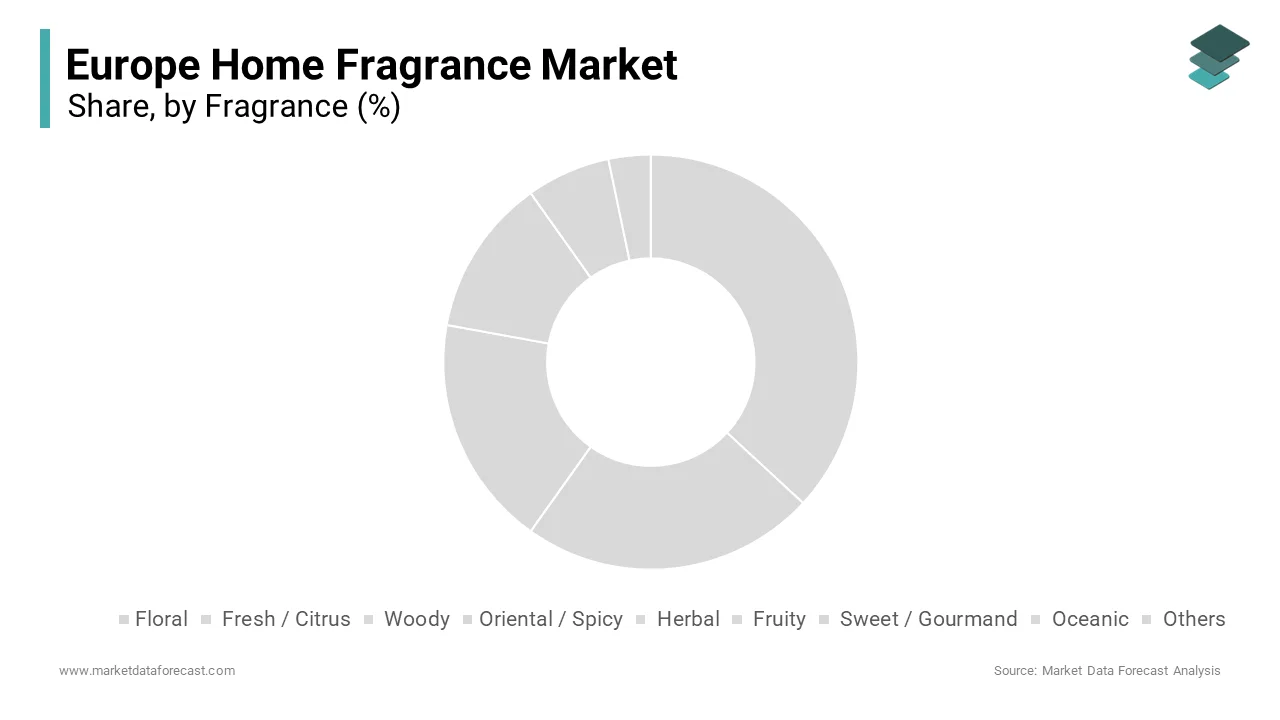
The herbal fragrances segment is estimated to register the fastest CAGR of 13.6% from 2026 to 2034 due to rising demand for functional scents that convey purity, mental clarity, and natural authenticity. Notes such as eucalyptus, sage,y ge, and thyme are increasingly favored for their perceived antibacterial cognitive-enhancing properties. Research conducted by Northumbria University indicates that exposure to the aroma of rosemary essential oil can enhance aspects of cognitive performance, including working memory and alertness, in both children and healthy adults. Regulatory bodies and consumer interest in Germany, as well as the broader European Union, reflect a growing focus on the safety of fragrance chemicals in household products, leading to a market trend towards natural or allergen-free alternatives. Moreover, Nordic wellness brands have popularized forest bathing-inspired blends featuring pine and wild herb accords. There is a notable consumer trend, particularly among urban populations, to purchase herbal diffusers and other natural wellness products to enhance their connection with nature and improve well-being. This convergence of cognitive science, sustainability, and biophilic design positions herbal as the fastest evolving olfactory category in the European home environment.
By Product Insights
The candles segment maintained the largest share of 34.2% of the Europe home fragrance market in 2025. The leading position of the candles segment is attributed to its dual function as ambient light sources and scent diffusers, creating multisensory emotional experiencesBeeswaxxx,x so, y, and rapeseed wax formulations have gained prominence as consumers reject paraffin due to environmental concerns. As per sources, candles produced in Western Europe tend to favor the use of renewable waxes, indicating a shift toward sustainable materials. Candles also dominate gifting behavior. Candles often feature prominently in holiday home fragrance purchases, appreciated for the aesthetic and symbolic warmth they provide. Households where individuals work remotely show an increased use of candles, possibly linked to the use of flame-based lighting as a stress-reducing activity. This fusion of functionality,ity, ritual, and sustainability ensures candles remain central to European home fragrance consumption.
The diffusers segment is anticipated to witness the fastest CAGR of 15.1% over the forecast period owing to its continuous scent de low mai, and compatibility with clean living aesthetics. Reed and electric diffusers avoid op, en flames, making them preferred in homes with children or pets. According to research, a notable number of European households using home fragrance now own at least one diffuser, a trend that appears to be increasing. The shift toward essential oil-based formulations has further accelerated adoption. The use of therapeutic diffusers for respiratory wellness has seen an increase. In the edition, the adoption of smart diffusers that integrate with wellness applications is growing in some specific regions. Apart from these, minimalist glass bottle designs align with Scandinavian and Benelux interior trends, making diffusers both functional and decorative. This blend of safety, efficacy design synergy drives rapid category expansion.
By Distribution Channel Insights
The online channels segment led the Europe home fragrance market and occupied a share of 41.7% in 2025. The prominence of the online channels segment is because of the ability to convey scent narratives through rich media immersive storytelling and personalized recommendations. E-commerce platforms enable detailed ingredient transparency, sustainability credentials, and user reviews, critical factors for informed purchasing. As per studies, Home fragrance shoppers often use video reviews and scent description blogs as part of their research process before buying a product. Direct-to-consumer brands leverage subscription models for refills and seasonal scent rotations. There has been an increase in the number of consumers signing up for fragrance box subscription services. Besides, online sales of home fragrance products across different countries have risen as people look for unique and specialized brands that are not available in their local shops. This digital ecosystem offers unmatched discovery try curated, and convenience, which makes online the primary gateway for modern fragrance engagement.
The online channels segment is likely to experience the fastest CAGR of 14.8% from 2025 to 2033. The rapid expansion of the online channels segment is fuelled by AI-driven personalization,n immersive technology,e, and seamless integration with smart home ecosystems. Brands in the European home fragrance sector are exploring the use of virtual scent profiling tools. These tools help recommend products based on consumer preference,,s such as mood and past purchasing habits. Augmented reality features are being adopted, allowing users to visualize how diffuser designs might look in their personal living spaces through their smartphone cameras. Moreover, platforms introduced “scent pairing” algorithms that suggest complementary candles and sprays based on purchase history. The rise of social commerce, where Instagram and TikTok shoppable videos drive instant purchases, further accelerates digital adoption. This evolution transforms online from a transactional channel into an experiential sensory journey that physical retail cannot replicate.
COUNTRY ANALYSIS
France Home Fragrance Market Analysis
France dominated the Europe home fragrance market and accounted for a 19.3% share in 2025. The domination of the French market is driven by its historic perfume industry, botanical resources, and cultural reverence for olfactory artistry. The country produces a portion of the European Union’s fine fragrance raw materials,w withGrasse alone cultivating jasmine, tuberose, and rose for both luxury and home applications. According to the French Ministry of Culture, scent is recognized as part of France’s intangible cultural heritage, influencing everything from interior design to public space policy. Artisanal ateliers in Provence and Normandy have pivoted to eco candles and diffusers using organic essential oils, supported by national clean label certification schemes. This fusion of heritage craftsmanship and modern sustainability ensures France’s continued leadership in sensory home culture.
United Kingdom Home Fragrance Market Analysis
The United Kingdom followed closely in the Europe fragrance market by capturing a share of 16.8% in 2025 because of high per capita spend on home ambiance and strong gifting traditions. Home fragrance has become a more notable expense for British households. British brands pioneer seasonal scent calendars and limited edition collaborations with artists. The popularity of luxury home fragrance increased during the recent holiday season. Additionally, the UK leads in therapeutic fragrance innovation. Despite post-Brexit regulatory shift, UK consumers remain highly receptive to premium natural formulations, making the market a key testing ground for European and global fragrance launches.
Germany Home Fragrance Market Analysis
Germany continues to hold a noteworthy position in the Europe home fragrance market, with its stringent product safety standards, demand for eco certifications, and wellness-oriented consumption. Home fragrance products are subject to an ecolabel that encourages the disclosure of full ingredient lists, a benchmark that influences broader policy discussions. A significant portion of buyers of home fragrances show a preference for products that are described as phthalate-free and vegan. Many households are incorporating fragrance products into personal wellness and mindfulness activities. German engineering also drives innovation in flameless diffusion. This blend of regulatory rigor, technological precision, and holistic wellness cements Germany’s role high-integrity, high-value market.
Italy Home Fragrance Market Analysis
Italy experienced a steady growth in the Europe home fragrance market due to its design heritage, artisanal craftsmanship hi, and Mediterranean botanical abundance. Italian home fragrance emphasizes olfactory storytelling through regional ingredients such as Sicilian lemon, bergamot from Calabr, and myrtle from Sardinia. Italian luxury houses like Santa Maria Novella and Acqua di Parma have expanded into home lines, centuries-old apothecary traditions. Additionally, the “Made in Italy” sustainability seal now requires traceability of essential oils, reinforcing authenticity. This fusion of artistry, botanical richness, and design excellence positions Italy as a premium creator of emotive home scent experiences.
Sweden Home Fragrance Market Analysis
Sweden is predicted to expand considerably in the Europe home fragrance market from 2025 to 2033, owing to its minimalist aesthetic, biophilic design principles,les and leadership in sustainable living. Swedish consumers prioritize unscented or subtly herbal notes that complement natural materials like wood and linen rather than dominate spaces. Brands have globalized the concept of hygge adjacent scent narratives centered on forest lakes and archipelago air. Furthermore, Swedish housing policy promotes natural ventilation, which influences preference for non-aerosol diffusers and beeswax candles that do not compromise indoor air quality. This ethos of restrained sensory enhancement defines Sweden’s distinctive and influential market identity.
COMPETITIVE LANDSCAPE
Competition in the Europe home fragrance market is defined by a dynamic interplay between heritage luxury houses, a niche of artisans, ns value-oriented mass brands, all navigating strict regulatory standards and evolving consumer ethics. Premium players differentiate through olfactory artistry storytelling and sustainable provena,nce while mass retailers compete on pricevaety and accessibility. The rise of direct-to-consumer digital brands has intensified pressure on traditional distribution, with personalized subscription models and social commerce reshaping discovery pathways. Simultaneously, your private label offerings from supermarkets replicate premium aesthetics at lower cost,,s narrowing the experiential gap. Regulatory complexity around allergen labeling and ingredient transparency raises compliance barriersparticularlyy for small producers. Success increasingly depends on balancing emotional resonance with scientific credibility, sustainability with sensory performance, and global scalability with local botanical authenticity in a market where scent is both science and soul.
KEY MARKET PLAYERS
A few of the market players in the Europe home fragrance market include:
- Broken Top Brands (U.S.)
- Circle E Candles (U.S.)
- Diptyque
- Jo Malone London
- Yankee Candle
- ESTEBAN PARIS (U.S.)
- Scentair Technologies, LLC (U.S.)
- Newell Brands (U.S.)
- Reckitt Benckiser Group PLC (U.K.)
- S.C. Johnson & Son Inc. (U.S.)
- Procter & Gamble (U.S.)
- Richard Ginori s.r.l. Viale Giulio Cesare (Italy)
- 3M Company (U.S.)
Top Players In The Market
- Diptyque holds a distinguished position in the Europe home fragrance market through its artisanal French heritage and meticulously crafted olfactory narratives. Globally recognized for transforming scent into an art form, the brand blends traditional perfumery with contemporary design to create premium candles, diffusers, and room sprays. In Europe, Diptyque emphasizes traceable natural ingredients and sustainable packaging, aligning with regional clean label expectations. It also partnered with French lavender cooperatives in Provence to secure ethically sourced essential oils, enhancing both quality and environmental credibility. These initiatives reinforce Diptyque’s commitment to sensory excellence and responsible luxury across the European home ambiance landscape.
- Yankee Candle maintains strong relevance in the Europe home fragrance market by offering accessible seasonal variety and powerful scent performance tailored to mass and mid-tier consumers. Gl, the brand is known for its extensive fragrance library and consistent quality, while it adapts to European preferences through localized scent profiles such as Nordic Forest and Mediterranean Citrus. Yankee Candle successfully connects with a broad European audience by strategically balancing affordability, innovation, and digital engagement in its home fragrance solutions.
- Jo Malone London contributes significantly to the Europe home fragrance market by elevating everyday rituals through minimalist British elegance and layerable scent philosophy. The brand’s home collection extends its signature colognes into candles and diffusers that emphasize sophistication and emotional subtlety. It also launched exclusive home fragrance experiences in partnership with luxury department stores in Paris, Mila, and Stockholm, and personalized scent consultations. These efforts strengthen its positioning as a curator of refined domestic ambiance while meeting European expectations for ethical luxury and experiential retail.
Top Strategies Used By The Key Market Participants
Key players in the Europe home fragrance market prioritize clean and traceable formulations using certified natural ingredients to align with stringent regional chemical regulations and consumer expectations. They invest in sustainable packaging,,g including refillable systems andrecyclabpackagingpackaginge as s aplastic-freer d aiming,, aiming to reduce environmental impact. Brands leverage digital innovation through AI-powered scent rerecommendationsirtutry-on on fefeatures r featureses and immersive storytelling to enhance online engagement. Seasonal and limited edition collections drive gifting relevance and replenishment, especially during key retail periods. Apart from these, companies form strategic partnerships with local botanical producers and luxury retailers to reinforce an authentic distribution reach across diverse European markets.
MARKET SEGMENTATION
This research report on the Europe home fragrance market is segmented and sub-segmented into the following categories.
By Fragrance Type
- Floral
- Fresh / Citrus
- Woody
- Oriental / Spicy
- Herbal
- Fruity
- Sweet / Gourmand
- Oceanic
- Others
By Product
- Candles
- Sprays
- Diffusers
- Essential Oils
- Incense Sticks
- Plug-in Devices
- Potpourri and Sachets
- Wax Melts
- Others
By Category
- Mass
- Premium
By Distribution Channel
- Hypermarkets/Supermarkets
- Specialty Stores
- Online channels
- Others
By Country
- UK
- France
- Spain
- Germany
- Italy
- Russia
- Sweden
- Denmark
- Switzerland
- Netherlands
- Turkey
- Czech Republic
- Rest of Europe