- Product Description Description
- Table of Contents TOC
- List of Table & Figure LOT
- Get Free Sample PDF Sample PDF
Market Size, 2025
$3.60 BnMarket Estimate, 2026
$3.77 BnMarket Forecast, 2034
$5.46 BnCAGR, 2026–2034
4.75%Europe Honey Market Size, Growth, Trends & Forecast (2026–2034)
The Europe Honey Market size was calculated to be USD 3.60 billion in 2025, is estimated to reach USD 3.77 billion in 2026, and is projected to expand to USD 5.46 billion by 2034, registering a compound annual growth rate (CAGR) of 4.75% during the forecast period from 2026 to 2034. Driven by a major consumer preference shift toward natural and functional sweeteners, expanding organic and regenerative agriculture, and rising adoption in pharmaceuticals and wellness, the market continues to experience steady upward trajectory.
Key Executive Metrics (At-a-Glance)
- 2025 Base Valuation: USD 3.60 Billion
- 2026 Current Valuation: USD 3.77 Billion
- 2034 Forecast Valuation: USD 5.46 Billion
- Compound Annual Growth Rate (CAGR): 4.75% (2026–2034)
- Leading Region: Germany (holding a dominant 21.4% share in 2025 backed by high per capita consumption and strong retail infrastructure)
- Key Growth Hubs: France (18.2% share in 2025), Spain, Italy, and the United Kingdom
Core Market Drivers
- Natural & Functional Sweetener Shift: Consumers actively substituting refined sugars with honey due to its antimicrobial properties and clean-label appeal.
- Organic & Regenerative Expansion: Institutional push under EU organic frameworks and the Farm to Fork Strategy encouraging sustainable apiary management and certified premium honey.
Primary Market Restraints & Challenges
- Adulteration & Mislabeling: Prevalence of cheaper sugar syrups and fragmented regulatory oversight undermining consumer trust.
- Supply & Environmental Threats: Declining bee populations from pesticide exposure, climate disruptions affecting floral bloom cycles, and fragmented enforcement of trade standards.
Market Segmentation: Largest and Fastest-Growing Segments
| Segment Category | Largest Segment | Fastest-Growing Segment |
|---|---|---|
| By Type | Acacia Honey (28.2% share in 2025) | Buckwheat Honey (CAGR of 9.2%) |
| By Application | Food & Beverages (Dominant share in 2025) | Pharmaceutical Applications (CAGR of 11.2%) |
| By Packaging | Glass Jars (Dominant share in 2025) | Squeezable Tubes (CAGR of 13.7%) |
| By Region | Germany (21.4% share in 2025) | United Kingdom & France |
Major Industry Players Profiled
Key market participants shaping the Europe honey landscape include Dabur India, McCormick & Co Inc, Capilano Honey, New Zealand Honey Company, Dutch Gold Honey, Südzucker AG, Rowse Honey Ltd, and Savencia Fromage & Dairy.
Europe Honey Market Size
The Europe honey market size was calculated to be USD 3.60 billion in 2025 and is anticipated to be worth USD 5.46 billion by 2034, from USD 3.77 billion in 2026, growing at a CAGR of 4.75% during the forecast period.
The honey is classified as a natural sweetener produced by Apis mellifera bees from nectar or honeydew with no added sugars or artificial ingredients. Europe maintains one of the world’s most rigorous regulatory frameworks for honey authenticity, including mandatory pollen analysis and geographical traceability. Consumer preference increasingly leans toward raw organic and monofloral varieties, reflecting broader trends in clean label and functional food consumption.
MARKET DRIVERS
Rising Consumer Preference for Natural and Functional Sweeteners Drives Demand
The consumers are progressively shifting away from refined sugars toward natural alternatives, with honey emerging as a leading choice due to its perceived health benefits and culinary versatility. This attribute is certainly a major factor propelling the growth of the Europe honey market. The growing awareness of honey’s antimicrobial and antioxidant properties, particularly in countries like Poland and Romania, where traditional apitherapy remains culturally embedded. Additionally, school nutrition programs in France and Italy have replaced industrial syrups with local honey in meal preparations following national dietary guidelines updated in 2022.
Expansion of Organic and Regenerative Agriculture Supports Premium Honey Growth
The institutional and consumer push toward organic farming practices has created fertile ground for premium honey segments, particularly those certified under EU organic standards, which is leveraging the growth of the Europe honey market. Honey produced from organic apiaries must comply with strict criteria, including a three-kilometer radius of organic or wild forage, which limits supply but elevates value. Furthermore, the EU’s Farm to Fork Strategy targets twenty-five % of agricultural land under organic cultivation by 2030, incentivizing beekeepers to adopt certified practices through subsidies and technical support.
MARKET RESTRAINTS
Persistent Adulteration and Mislabeling Undermine Consumer Trust
The widespread adulteration, primarily through the addition of cheaper syrups, such as rice, corn, or beet sugar, which compromises authenticity and erodes consumer confidence, is restricting the growth of the Europe honey market. Regulatory enforcement remains fragmented across member states, allowing non-compliant products to circulate through e-commerce and discount channels.
Declining Bee Populations Threaten Long-Term Supply Stability
The viability of the structural threat from the ongoing decline in managed and wild bee populations driven by habitat loss, pesticide use, and climate-induced stressors is limiting the growth of the Europe honey market. As per the European Food Safety Authority, this trend is largely due to neonicotinoid exposure and monoculture farming, which reduces floral diversity essential for bee nutrition. Beekeepers in France and Italy have reduction in average honey yield per hive over the past decade, directly impacting income and operational sustainability.
MARKET OPPORTUNITIES
Growing Integration of Honey in Functional Food and Wellness Products
Honey is increasingly leveraged as a bioactive ingredient in Europe’s expanding functional food and natural wellness sector, which is creating new opportunities for the growth of the Europe honey market. Its natural hydrogen peroxide content and low pH make it valuable in clean-label preservation, while its fructose-glucose profile offers slow-release energy favored by health-conscious consumers. Pharmaceutical companies in Germany and Sweden have incorporated medical-grade honey into wound care formulations following clinical validation by national health institutes. The European Medicines Agency has recognized certain honey types as medical devices for topical use, which opens reimbursement pathways in healthcare systems. Additionally, the rise of adaptogenic and immune-supporting blends has positioned honey as a carrier for herbs like echinacea and propolis.
Revival of Regional Terroir-Based Honey Brands Enhances Differentiation
A cultural and commercial renaissance of geographically distinct honey varieties is enabling producers to command premium pricing through storytelling and protected designation. This is an attribute that is also elevating the growth of the Europe honey market. The quality schemes registry over forty honey products now hold Protected Geographical Indication status, including Miel de Corse from France and Miele della Lunigiana from Italy. These designations require strict adherence to local flora production methods and seasonal cycles, ensuring authenticity and scarcity. Tourist-driven demand further amplifies this trend with agritourism farms in regions like Tuscany and Andalusia offering hive tours and tasting experiences that deepen consumer connection.
MARKET CHALLENGES
Climate Change Disrupts Floral Bloom Cycles and Nectar Availability
The increasing climatic volatility is destabilizing the delicate synchrony between bee activity and plant flowering periods, which is likely to limit the growth of the Europe honey market. Similarly, unseasonal frosts are damaging early blooming fruit trees for spring honey flows from recent years. These disruptions lead to inconsistent harvests and force beekeepers to migrate hives more frequently, increasing operational costs and colony stress.
Fragmented Regulatory Enforcement Enables Unfair Trade Practices
The honey standards enforcement varies significantly across member states, creating loopholes that distort competition and disadvantage compliant producers, which is likely to hamper the growth of the Europe honey market. This inconsistency allows mislabeled or blended imports that often from non-EU countries to enter the market under false claims of European origin. Small-scale beekeepers in countries like Romania and Bulgaria lack the resources to navigate complex certification processes while large importers exploit regulatory gaps to undercut prices. The absence of a unified EU honey traceability system further impedes accountability.
REPORT COVERAGE
| REPORT METRIC | DETAILS |
| Market Size Available | 2025 to 2034 |
| Base Year | 2025 |
| Forecast Period | 2026 to 2034 |
| CAGR | 4.75% |
| Segments Covered | By Type, Application, Packaging, and Region |
| Various Analyses Covered | Global, Regional & Country Level Analysis; Segment-Level Analysis; DROC, PESTLE Analysis; Porter’s Five Forces Analysis; Competitive Landscape; Analyst Overview of Investment Opportunities |
| Regions Covered | UK, France, Spain, Germany, Italy, Russia, Sweden, Denmark, Switzerland, Netherlands, Turkey, and the Czech Republic |
| Market Leaders Profiled | Dabur India, McCormick & Co Inc, Capilano Honey, New Zealand Honey Company, Dutch Gold Honey |
SEGMENTAL ANALYSIS
By Type Insights
The acacia honey segment held 28.2% of the Europe honey market share in 2025 with its mild flavor, slow crystallization, and broad consumer appeal across age groups and culinary applications. Additionally, its high fructose-to-glucose ratio reduces glycemic impact, which aligns with rising health consciousness. France and Hungary are two of Europe’s largest acacia producers that cultivate over two hundred fifty thousand hectares of black locust trees, which bloom reliably in late spring, providing consistent nectar flows.
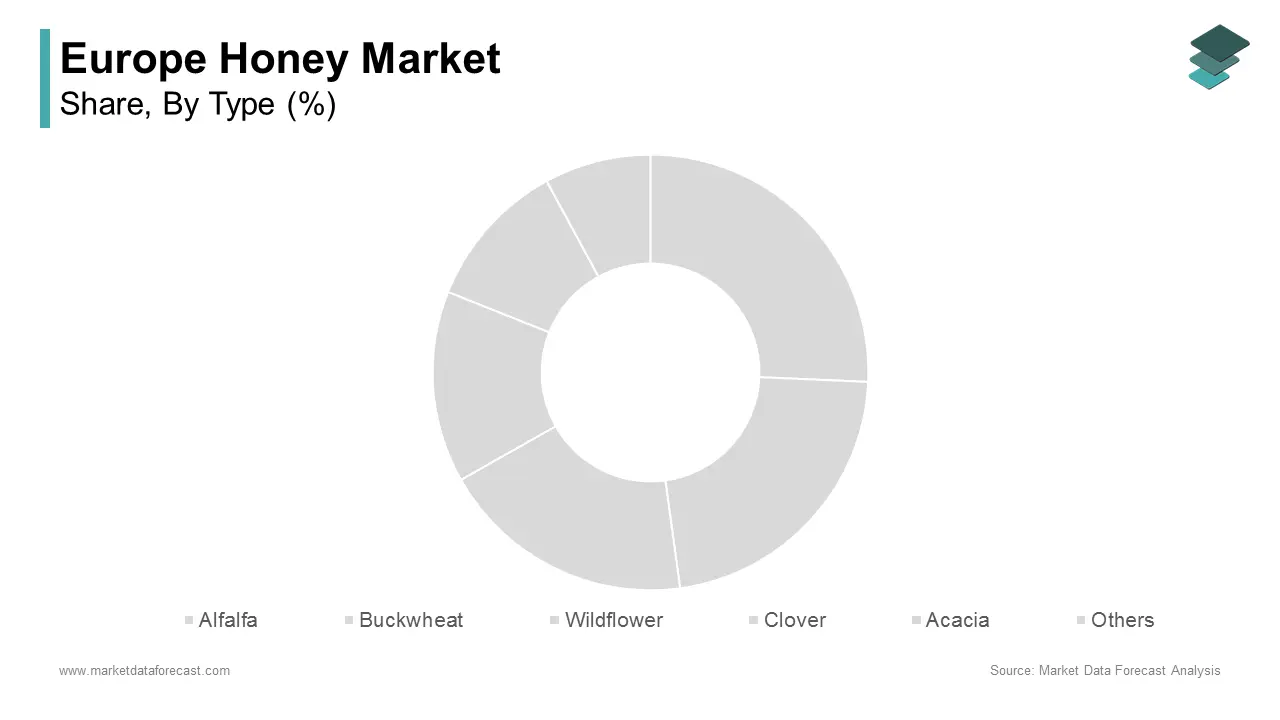
The buckwheat honey segment is lucratively growing with an expected CAGR of 9.2% during the forecast period, with the rising demand for functional and antioxidant-rich foods, particularly among health-oriented consumers in Northern and Eastern Europe. Furthermore, the European Medicines Agency has acknowledged buckwheat honey’s efficacy in soothing upper respiratory symptoms, leading to its inclusion in over thirty herbal cough syrups approved in Germany and Sweden. Retailers like dm Drogerie and Boots have expanded shelf space for dark honeys, citing double-digit sales growth in 2023.
By Application Insights
The food and beverages segment was the largest and held a significant share of the Europe honey market in 2025, with honey’s entrenched role as a natural sweetener in households, bakeries, and beverage formulations. Additionally, traditional breakfast consumption patterns in countries like Germany and the Netherlands, where honey is paired with bread and dairy that ensure a stable baseline demand. Artisanal bakeries across France and Italy also rely on specific honey types like chestnut or lavender for regional pastries protected under EU geographical indications.
The pharmaceutical application segment is anticipated to grow with an expected CAGR of 11.2% from 2026 to 2034. Regulatory recognition has been pivotal the European Medicines Agency classified certain sterilized honeys as Class IIa medical devices in 2022, enabling reimbursement under national health systems. Pharmaceutical companies like B. Braun and Hartmann have launched honey-based topical products across Germany, France, and Italy, with distribution extending to over two thousand pharmacies.
By Packaging Insights
The glass jars segment accounted in holding a dominant share of the Europe honey market in 2025, with the consumer perception of glass as a premium hygienic and chemically inert preserving honey’s aroma and purity over time. Retailers reinforce this preference by allocating prime shelf space to glass formats in supermarkets like Carrefour and Edeka. Beekeeping cooperatives in Italy and Greece often use standardized glass jars bearing Protected Geographical Indication seals, which enhances traceability and brand trust.
The honey packaged in squeezable tubes segment is likely to exhibit a noteworthy CAGR of 13.7% during the forecast, with convenience, portability, and portion control appealing to on-the-go consumers and food service operators. The packaging also enables precise dosing for medicinal and cosmetic applications such as throat soothers or facial masks. Advances in barrier technology now prevent moisture migration, ensuring honey stability without aluminum lining, which aligns with clean packaging trends.
REGIONAL ANALYSIS
Germany Honey Market Analysis
Germany was the largest contributor in the Europe honey market by capturing 21.4% of the share in 2025, with the high per capita consumption, strong retail infrastructure, and a well-organized beekeeping sector. Discounters like Aldi and Lidl have elevated honey to a staple category, offering both private label and premium PGI varieties.
France Honey Market Analysis
France was positioned second by occupying 18.2% of the Europe honey market share in 2025 with its diverse floral landscapes and protected designation system. French consumers place a high value on origin and craftsmanship, with a 2025 IFOP survey showing that sixty-eight % are willing to pay a thirty % premium for locally produced honey.
Spain Honey Market Analysis
Spain's honey market growth is expected to grow, with Key varieties including rosemary, thyme, and eucalyptus honey from regions like Andalusia and Castilla-La Mancha. The government has launched the “Apícola 2030” strategy to modernize hives and promote organic conversion with 20 million euros in funding.
Italy Honey Market Analysis
Italy's honey market growth is likely to be propelled by its exceptional biodiversity and artisanal production model. Direct sales through agriturismos and farmers' markets account for over thirty % of distribution,n bypassing industrial channels.
United Kingdom Honey Market Analysis
The United Kingdom honey market is likely to grow with the high import dependency and evolving health-driven consumption. UK consumers increasingly seek functional honeys with manuka and heather varieties growing at double-digit rates. The National Health Service’s endorsement of honey for cough relief in children over one year has further boosted household penetration. Retail innovation is notable with Waitrose and Tesco dedicating sections to ethical and traceable honey, including blockchain-verified jars.
COMPETITION OVERVIEW
Competition in the Europe honey market is defined by a dual structure comprising large integrated processors and thousands of small-scale artisanal producers. The former compete on traceability scale and distribution reach, while the latter differentiate through terroir authenticity and direct consumer relationships. Major players invest heavily in certification, organic compliance, and digital transparency tools to counter widespread consumer skepticism about honey purity. At the same time, regional cooperatives PGI-labeled producers leverage geographical identity to command premium pricing and resist commoditization. The market is further fragmented by private label offerings from retailers like Aldi and Carrefour, which pressure mid-tier brands on price. Regulatory complexity across EU member states creates uneven enforcement, allowing some imported honeys to bypass stringent authenticity checks.
KEY MARKET PLAYERS
A few dominating players in the Europe honey market include
- Dabur India
- McCormick & Co Inc
- Capilano Honey
- New Zealand Honey Company
- Dutch Gold Honey
Top Strategies Used by the Key Market Participants
Key players in the Europe honey market employ a combination of traceability enhancement, premiumization, and sustainability integration to differentiate themselves in a crowded landscape. Leading companies invest in blockchain and QR code systems to provide full transparency on the origin, floral type, and harvest date, addressing persistent concerns about adulteration. They also emphasize regional and organic certifications to align with clean label and local food movements. Strategic partnerships with beekeepers ensure ethical sourcing and supply stability while supporting pollinator health initiatives. Packaging innovation focuses on recyclable and functional formats such as squeezable tubes to meet convenience demands.
LEADING PLAYERS IN THE MARKET
Südzucker AG
Südzucker AG operates one of Europe’s most integrated honey supply chains through its subsidiary Benbee & Sons, which sources raw honey from over thirty countries and processes it in certified facilities across Germany and the Netherlands. The company supplies both retail private labels and food manufacturers across the continent. In 202,3, Südzucker launched a blockchain-enabled traceability platform for its premium honey lines, allowing European consumers to verify floral origin and harvest date via QR code. This initiative strengthens trust in an import-dependent market and aligns with EU clean label directives. The group also invested in sustainable beekeeping partnerships in Eastern Europe to secure long-term supply while promoting hive health and biodiversity.
Rowse Honey Ltd
Rowse Honey Ltd is a UK-based leader known for its vertically integrated model that combines British beekeeping with global sourcing. The company plays a significant role in shaping consumer standards through its “Hive to Home” transparency program, which details every step from apiary to jar. In early 2025, Rowse expanded its functional honey range with immunity-focused blends containing added propolis and vitamin C, targeting the wellness segment.
Savencia Fromage & Dairy leverages
Savencia Fromage & Dairy leverages its extensive dairy and specialty food distribution network to position premium honey as a complementary product in gourmet and organic channels across France, Italy, and Spain. The French group owns regional honey brands that emphasize terroir, such as Miel de Châtaigneraie, and collaborates with local beekeepers under long-term contracts.
MARKET SEGMENTATION
This research report on the Europe honey market has been segmented and sub-segmented based on type, application, packaging, and region.
By Type
- Alfalfa
- Buckwheat
- Wildflower
- Clover
- Acacia
- Others
By Application
- Food & Beverages
- Personal Care & Cosmetics
- Pharmaceuticals
- Others
By Packaging
- Glass Jar
- Bottle
- Tub
- Tube
- Others
By Region
- UK
- France
- Spain
- Germany
- Italy
- Russia
- Sweden
- Denmark
- Switzerland
- Netherlands
- Turkey
- Czech Republic
- Rest of Europe