- Product Description Description
- Table of Contents TOC
- List of Table & Figure LOT
- Get Free Sample PDF Sample PDF
Market Size, 2025
$6.48 BnMarket Estimate, 2026
$7.03 BnMarket Forecast, 2034
$12.5 BnCAGR, 2026–2034
8.5%Executive Summary: Europe Hydrogen Energy Storage Market
- Market Scope: Comprehensive European hydrogen energy storage industry analysis covering technology types, storage configurations, country leadership frameworks, strategic corporate developments, and competitive landscapes.
- Market Valuation: Valued at USD 2.89 billion (2025), estimated at USD 3.34 billion (2026), and projected to reach USD 12.45 billion by 2034, registering a strong CAGR of 17.6% (2026–2034).
- Primary Growth Drivers: European Green Deal’s REPowerEU mandate targeting 10 million tonnes of domestic renewable hydrogen by 2030, Innovation Fund financing for large-scale electrolysis, PEM electrolyzer grid balancing, and cross-border pipeline initiatives like H2Med. Restraints include high infrastructure costs and underground salt cavern permitting delays.
Key Market Segment Metrics (2026–2034)
| Category | Leading Segment / Country (Position) | Fastest-Growing Segment |
|---|---|---|
| By Technology | Proton Exchange Membrane / PEM electrolyzers (dominated with a 58.3% share in 2025 due to fast response times) | Alkaline electrolyzers (projected fastest-growing technology segment at a CAGR of 19.2% from 2026–2034) |
| By Storage Type | Underground salt cavern storage (held largest share at 62.4% in 2025 via established German and UK formations) | Above-ground pressurized tanks (anticipated highest growth at a CAGR of 21.3% for modular distributed generation) |
| By Region / Country | Germany (led regional market with a 28.7% share in 2025, followed by France, Netherlands, and Spain) | Spain (expected to register highest country-level CAGR of 22.4% through 2034 via National Hydrogen Strategy & solar resources) |
Major Market Players & Market Structure
Market Structure: Highly strategic European green energy and heavy industrial manufacturing ecosystem driven by multi-megawatt PEM/alkaline electrolyzer plant commissions, regional stack production capacity expansions, and utility-scale seasonal storage integrations.
Key Companies: Siemens Energy AG, Thyssenkrupp Nucera, Nel ASA, ITM Power plc, Linde plc, Air Liquide S.A., ENGIE SA, McPhy Energy S.A., Cummins Inc., Bloom Energy Corporation, Sunfire GmbH, Enapter AG, HES Energy Systems, Hydrogenics Europe NV, GKN Hydrogen, Elogen, Topsoe A/S, John Cockerill S.A., and Ohmium International Inc.
Europe Hydrogen Energy Storage Market Size
The Europe Hydrogen Energy Storage Market is projected to grow from USD 6.48 billion in 2025 to USD 7.03 billion in 2026 and reach USD 12.50 billion by 2034, registering a CAGR of 8.50% from 2026 to 2034.
Hydrogen energy storage is the process of storing excess electrical energy in the form of hydrogen gas, which can later be converted back to electricity or used for other purposes. Unlike short-duration battery systems, hydrogen enables seasonal and large-scale energy shifting, vital for balancing grids with high wind and solar penetration. Storage methods include underground salt caverns, depleted gas fields high high-pressure tanks, and emerging liquid organic carriers. As per sources, hydrogen storage capacity within the EU has reached levels sufficient to power millions of households for an extended period. Significant funding has been allocated through the European Commission’s Hydrogen Bank to support innovative, first-of-a-kind storage projects under a key European initiative. Apart from these, as per studies, a majority of EU member states now require a certain percentage of hydrogen to be blended into natural gas grids, establishing a built-in demand for stored hydrogen. This market is not merely a technical solution but a cornerstone of Europe’s strategy to achieve energy sovereignty and net zero emissions by 2050.
MARKET DRIVERS
EU Mandates for Renewable Integration and Grid Stability Under the Net Zero Industry Act
The region’s binding renewable energy targets and grid reliability requirements are accelerating the growth of the European hydrogen energy storage market. This mandate surges its deployment as a long-duration balancing mechanism. According to research, European policy emphasizes that a significant amount of electricity should come from renewables, with hydrogen storage identified as a key asset for managing supply variability, including during periods of low wind. There has been practical reliance on stored hydrogen to maintain grid stability and avoid the need for fossil fuel backup. Furthermore, Regulatory frameworks are in place that require new renewable energy projects to consider co-locating with storage solutions, which has led to numerous hydrogen storage integrations in certain regions. Substantial financial support is being allocated to the development of hybrid wind and hydrogen energy projects. These regulatory and operational imperatives transform hydrogen storage from experimental to essential.
Industrial Decarbonization Requirements Under the Carbon Border Adjustment Mechanism
The region’s industrial sectors are turning to stored green hydrogen to meet emissions targets imposed by the EU Emissions Trading System and the Carbon Border Adjustment Mechanism, which carbon-intensive imports, and thereby fuels the expansion of the European hydrogen energy storage market. As per studies, heavy industry is focusing on decarbonization efforts through the adoption of stored hydrogen in manufacturing processes. Key sectors, including steelmaking, chemical production, and refining, are transitioning away from traditional fuels. Moreover, A new European Union scheme has awarded substantial funding to several innovative projects across the region, facilitating the implementation of stored hydrogen in steelmaking and ammonia production. Major industrial players are making significant progress. One prominent steel producer has committed to utilizing a large annual volume of stored green hydrogen at its primary plant by 2027 to replace coal in direct reduced iron processes. These commitments create guaranteed offtake for storage developers, ensuring bankability and scale, which turns hydrogen storage into an industrial necessity rather than a grid afterthought.
MARKET RESTRAINTS
High Capital Intensity and Unproven Revenue Models for Long Duration Storage
Substantial upfront costs and the absence of mature monetization pathways for seasonal storage services constrain the growth of the European hydrogen energy storage market. According to research, high capital expenditure is required for typical salt cavern storage projects, with economic payback periods extending beyond fifteen years under current market conditions. A significant majority of hydrogen storage projects in the EU lack contracted revenue streams beyond initial EU grants, contributing to considerable investor uncertainty, as per studies. Unlike batteries, which earn from frequency regulation, hydrogen storage provides value during rare but critical multi-day outages, a service not yet compensated in European electricity markets. Consequently, developers rely heavily on public funding. Until regulatory frameworks recognize and reward long-duration resilience, hydrogen storage will remain financially marginal.
Limited Geological Storage Sites and Permitting Delays for Underground Infrastructure
The region faces significant geographical and bureaucratic constraints in scaling underground hydrogen storage, which hinders the expansion of the European hydrogen energy storage market. It is the most cost-effective method for large volumes. As per sources, only a limited number of countries possess viable salt dome formations suitable for cavern development, with a few nations holding the vast majority of identified capacity. Environmental concerns are a major obstacle. Some government ministries have rejected proposed storage sites due to seismic risk concerns. Projects in various locations have been halted over fears of groundwater contamination. Furthermore, the permitting process for underground storage is lengthy and arduous, nearly doubling the timeline required for alternative energy storage projects like batteries. Public opposition also plays a role. Failure to establish streamlined cross-border permitting and effective community engagement will result in geological storage falling behind hydrogen production goals, jeopardizing the entire value chain.
MARKET OPPORTUNITIES
Repurposing of Depleted Natural Gas Fields for Hydrogen Storage
Its extensive network of decommissioned natural gas reservoirs offers a major opportunity for low-cost hydrogen storage conversion, which ultimately provides new opportunities for the growth of the European hydrogen energy storage market. As per sources, Depleted gas fields across various European regions are being identified as significant potential storage sites for vast amounts of hydrogen. Major energy companies have initiated pilot projects, such as the Northern Lights initiative, successfully demonstrating the containment integrity of hydrogen in retired offshore reservoirs. Furthermore, these former gas storage fields have been validated as viable for repurposing with minimal modification, which offers considerable cost savings compared to developing new, greenfield storage solutions like salt caverns. This strategy leverages existing subsurface knowledge infrastructure and community familiarity to fast-track storage deployment at scale.
Integration with Cross-Border Hydrogen Backbone and Grid Interconnection Hubs
The development of the region's Hydrogen Backbone creates fresh opportunities for centralized storage hubs at interconnection nodes, which is likely to promote the expansion of the European hydrogen energy storage market. As per research, Storage facilities are planned at key junctions to buffer supply and enable arbitrage between regional markets. The Iberian Peninsula’s solar surplus can be stored in depleted fields in Aragon, then transported via pipeline to industrial clusters in the Ruhr Valley during winter demand peaks. These hubs will provide essential system services such as pressure balancing and seasonal shifting, functions that were previously handled by natural gas. This integrated infrastructure model transforms storage from isolated assets into dynamic components of a continent-wide hydrogen energy system.
MARKET CHALLENGES
Material Compatibility and Hydrogen Embrittlement in Existing Storage Infrastructure
The risk of hydrogen embrittlement, which involves the degradation of steel and other metals when exposed to high-pressure hydrogen and compromises the integrity of repurposed natural gas infrastructure, is a challenge for the European hydrogen energy storage market. According to sources, Hydrogen exposure can cause materials used in gas pipelines to degrade. This degradation includes the formation of micro-cracks in decommissioned pipelines under specific pressure conditions, as well as a significant loss of tensile strength in standard pipeline steel under pure hydrogen conditions. Because of this, pipeline operators may need to invest in costly solutions, such as internal lining or full material replacement, to accommodate hydrogen transport. These findings complicate the EU’s assumption that a portion of existing gas infrastructure can be reused for hydrogen, as stated in the Hydrogen Backbone roadmap. Operators confront liability risks and insurance uncertainty in the absence of standardized material certification protocols and in-line monitoring systems.
Absence of Unified Market Design for Valuing Long-Duration Storage Services
A lack of a harmonized electricity market framework that financially recognizes the unique grid reliability benefits of hydrogen energy storage during prolonged renewable droughts, thereby obstructing the expansion of the European hydrogen energy storage market. Current markets reward only short-term services like frequency regulation—favoring batteries over hydrogen. Investor confidence will not improve, and energy storage projects will continue to be fragile in Europe until providers can secure a predictable income stream for grid resilience, rather than relying on profits from energy arbitrage.
REPORT COVERAGE
| REPORT METRIC | DETAILS |
| Market Size Available | 2025 to 2034 |
| Base Year | 2025 |
| Forecast Period | 2026 to 2034 |
| Segments Covered | By Product Type, Physical State, End User Application, and Region. |
| Various Analyses Covered | Global, Regional, and Country-Level Analysis, Segment-Level Analysis, Drivers, Restraints, Opportunities, Challenges; PESTLE Analysis; Porter’s Five Forces Analysis, Competitive Landscape, Analyst Overview of Investment Opportunities |
| Countries Covered | UK, France, Spain, Germany, Italy, Russia, Sweden, Denmark, Switzerland, Netherlands, Turkey, Czech Republic, Rest of Europe |
| Market Leaders Profiled | Linde plc, Air Liquide S.A., Nel ASA, ITM Power plc, Siemens Energy AG, ENGIE SA, Hydrogenics Corporation (a Cummins Inc. company), Plug Power Inc., McPhy Energy S.A., Hexagon Purus ASA, Air Products and Chemicals, Inc., H2GO Power Ltd., HDF Energy (Hydrogène de France), FuelCell Energy, Inc., Ballard Power Systems Inc., Elcogen AS, GKN Hydrogen, Toshiba Energy Systems & Solutions Corporation, Ineratec GmbH, Haldor Topsoe A/S |
SEGMENTAL ANALYSIS
By Technology Insights
The compression segment dominated the European hydrogen energy storage market and accounted for a substantial share in 2025. The supremacy of the compression segment is fuelled by its maturity, scalability, and compatibility with existing industrial and grid balancing applications. High-pressure gaseous storage in steel or composite tanks at a notable number of bars remains the standard for short to medium duration storage in electrolysis hubs and refueling stations. As per sources, Hydrogen storage projects within the European Union predominantly utilize compressed gas systems, favored for their lower technical risk and rapid deployment. Moreover, the European Commission's funding initiatives have shown a preference for compressed storage solutions, allocating significant financial resources to projects using this method due to their commercial viability and immediate potential for achieving decarbonization goals. This technological readiness, regulatory preference, and industrial integration cement compression as the foundational storage method.
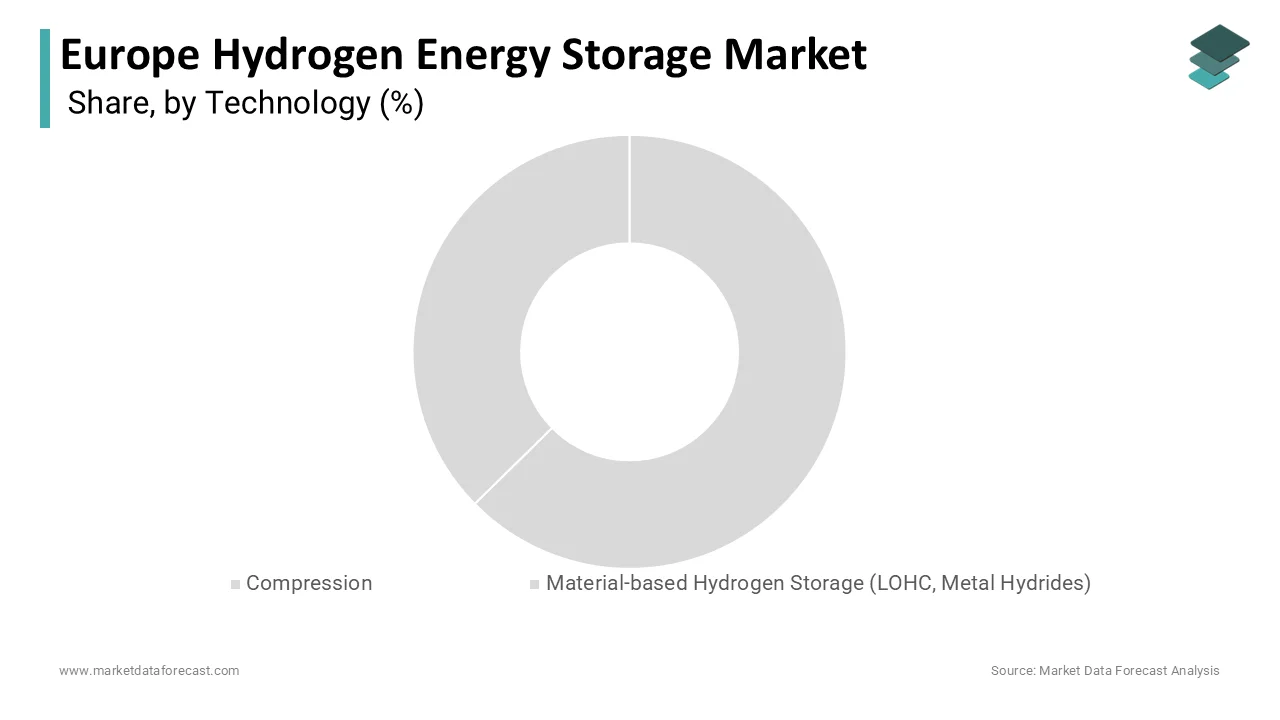
The material-based hydrogen storage segment is estimated to register the fastest CAGR of 29.3% from 2025 to 2033 due to breakthroughs in liquid organic hydrogen carriers and metal hydrides that enable safer ambient condition storage. Unlike high-pressure or cryogenic systems, these technologies store hydrogen through chemical bonding, allowing transport and handling with conventional fuel infrastructure. The first commercial-scale material-based storage and delivery unit was shipped to a chemical park, facilitating the transport of hydrogen via standard tanker trucks without requiring cryogenics. Substantial financial investment has been committed by the European Investment Bank to scale up material-based storage solutions, recognizing their potential for widespread, decentralized industrial use. Apart from these, Regulatory changes within the EU now incorporate LOHC refueling standards, which are set to accelerate commercial adoption across the region. These safety logistics and regulatory advantages position material-based storage as the frontier of hydrogen energy integration.
By Physical State Insights
The gaseous hydrogen storage segment led the European hydrogen energy storage market by capturing a significant share in 2025, as it aligns with current electrolyzer output pipelines and industrial consumption requirements. Most green hydrogen produced in Europe is used on-site or transported via pipeline in gaseous form, eliminating the energy penalty of liquefaction or chemical conversion. The European Commission’s Hydrogen and Decarbonized Gas Package mandates that all new hydrogen infrastructure must be compatible with gaseous storage, reinforcing its centrality. This operational simplicity and infrastructure synergy ensure gaseous storage remains the backbone of Europe’s hydrogen economy.
The liquid hydrogen storage segment is anticipated to witness the fastest CAGR of 27.8% during the forecast period, owing to demand for heavy-duty transportation and aerospace sectors requiring high energy density. Liquefaction, achieved at extremely low temperatures, is enabling greater storage density for hydrogen, which is a crucial development for the demanding energy needs of long-haul trucking, shipping, and aviation. The first liquid hydrogen bunkering terminal in Rotterdam has begun operations, supplying dual-fuel vessels. Aviation initiatives are also progressing, with major aircraft manufacturers confirming that future hydrogen-powered aircraft will rely exclusively on liquid storage, and ground facilities for this purpose are already in development at key airports. The demand for an extensive range and quick refueling, despite being an energy-intensive solution, is accelerating adoption in transport corridors throughout Northern and Western Europe.
By End User Insights
The industrial segment held the majority share of the European hydrogen energy storage market, as heavy industries require a reliable, buffered supply for continuous decarbonization processes. Steel ammonia refining and methanol production cannot afford electrolyzer intermittency, making stored hydrogen essential for operational stabilityGreen hydrogen is becoming essential for Europe's hard-to-abate industries as regulations and government incentives accelerate its adoption. Key sectors are being mandated to use clean hydrogen, driving significant storage demand. Innovative projects across the continent are already demonstrating large-scale storage solutions to support fossil-free production of materials like steel. This momentum is further bolstered by substantial financial support from the European Union for industrial storage projects, guaranteeing market offtake. This regulatory process-driven necessity cements the industry as the anchor market.
The commercial segment is likely to experience the fastest CAGR of 24.6% from 2025 to 2033. The rapid expansion of the commercial segment is propelled by hydrogen microgrids for data centers, hospitals, and retail complexes seeking energy resilience and sustainability credentials. Mandatory Scope 2 and 3 emission reporting under the Corporate Sustainability Reporting Directive (CSRD) is prompting commercial entities to rapidly adopt clean, resilient backup solutions, moving this practice beyond traditional industrial pioneers.
By Application Insights
The stationary power segment was the largest in the European hydrogen energy storage market and accounted for a substantial share in 2025, as grid balancing, industrial backup, and renewable integration remain the primary use cases. Unlike transportation, which requires mobility-optimized systems, stationary storage leverages large-scale, low-cost options like salt caverns and above-ground tanks. Industrial clusters in the Port of Rotterdam use stationary storage to decouple electrolysis from production schedules, ensuring24/77 supply. This systemic role in energy security and decarbonization ensures that stationary power remains the dominant application.
The transportation segment is on the rise and is expected to be the fastest-growing segment in the market by witnessing a CAGR of 31.2% between 2025 and 2033. The swift expansion of propelled by EU mandates for zero-emission heavy-duty vehicles and the rollout of hydrogen refueling infrastructure. Hydrogen refueling station networks are expanding across the European Union, driven by regulatory support for alternative fuels [1]. This expansion involves significant on-site hydrogen storage requirements at each station. Although currently small in volume, the policy push and infrastructure build-out will drive exceptional growth in transport-related storage demand.
COUNTRY LEVEL ANALYSIS
Germany Hydrogen Energy Storage Market Analysis
Germany led the European hydrogen energy storage market and accounted for a 28.7% share in 2025 as the industrial heartland of the EU with ambitious decarbonization mandates and robust state support. The country is advancing its hydrogen infrastructure with numerous storage projects across the European Union. Significant investment under the national strategy supports a comprehensive hydrogen network, including storage. Industrial demand from major corporations for applications like steel, chemicals, and power-to-X is a key driver for deploying both gaseous and liquid storage. This is further supported by the country hosting extensive electrolysis capacity, which necessitates integrated storage solutions. This combination of industrial demand policy backing and geological advantage solidifies Germany’s top position.
Netherlands Hydrogen Energy Storage Market Analysis
The Netherlands was the second-largest country in the European hydrogen energy storage market by capturing a 17.4% share in 2025 by leveraging its extensive gas infrastructure, port cluster, and North Sea offshore potential. Substantial funding has been dedicated to key projects aimed at repurposing existing infrastructure for hydrogen storage and transport. The Netherlands has operationalized infrastructure for supplying liquid hydrogen, positioning itself as a leader in this specific market segment. These geographic infrastructural and policy advantages position the Netherlands as Europe’s hydrogen storage gateway.
Spain Hydrogen Energy Storage Market Analysis
Spain is another key player in the European hydrogen energy storage market due to its vast renewable energy surplus and strategic role in the EU’s southern hydrogen corridor. Spain's significant solar energy potential facilitates cost-effective electrolysis, though the resulting excess power necessitates seasonal storage solutions. The government is actively supporting large-scale energy storage projects across the country. The EU designated the Iberian Peninsula as a renewable hydrogen export hub under REPowerEU, accelerating storage investment. This synergy of low-cost renewables policy support and export ambition defines Spain’s rising storage leadership.
France Hydrogen Energy Storage Market Analysis
France expanded moderately in the European hydrogen energy storage market owing to its nuclear-powered electrolysis strategy and industrial decarbonization programs. France is implementing a strategic initiative to develop its hydrogen sector through government investment aimed at fostering a domestic ecosystem with expanded production and distribution infrastructure. Key trends include significant investment to support decarbonization, integrated projects combining large-scale electrolysis with substantial storage, pioneering material-based storage solutions like LOHC units, leveraging nuclear power for stable production, and planning extensive hydrogen pipeline networks for system balancing. This unique nuclear renewable hybrid model shapes France’s distinctive storage trajectory.
United Kingdom Hydrogen Energy Storage Market Analysis
The United Kingdom is predicted to grow in the European hydrogen energy storage market between 2025 and 2033 due to its North Sea depleted gas fields and industrial cluster decarbonization. The HyNet and East Coast Hydrogen projects focus on extensive hydrogen storage in offshore reservoirs to supply heavy industries such as refineries, steel, and glass manufacturers. The UK government has committed significant funding to support hydrogen storage initiatives. The UK is also a leader in liquid hydrogen development for aviation, with an airport facility established for ongoing trials. Furthermore, the UK maintains alignment with EU hydrogen standards through ongoing energy cooperation. This blend of geological assets, industrial policy, and transport innovation ensures the UK’s continued relevance in the European storage landscape.
COMPETITIVE LANDSCAPE
Competition in the European hydrogen energy storage market is characterized by a mix of industrial gas majors, engineering conglomerates, and deep tech startups all navigating a pre-commercial landscape shaped by policy rather than price. Differentiation hinges on technological versatility, project integration capability, and access to EU funding streams rather than product cost alone. Large players like Linde and Siemens Energy leverage existing customer relationships and infrastructure to bundle storage with electrolysis and distribution, while innovators like Hydrogenious compete on breakthrough chemistry enabling new logistics paradigms. The market remains highly project-based with long lead times and dependency on regulatory milestones such as carbon contracts and grid connection rules. Geographic advantage—proximity to salt caverns, ports, or industrial clusters—further influences competitiveness. As the market evolves from demonstration to scale, le competition will increasingly center on operational reliability, safety certification, and lifecycle cost optimization across diverse storage modalities.
KEY MARKET PLAYERS
Some of the companies that are playing a dominating role in the global European Hydrogen Energy Storage Market include
- Linde plc
- Air Liquide S.A.
- Nel ASA
- ITM Power plc
- Siemens Energy AG
- ENGIE SA
- Hydrogenics Corporation (a Cummins Inc. company)
- Plug Power Inc.
- McPhy Energy S.A.
- Hexagon Purus ASA
- Air Products and Chemicals, Inc.
- H2GO Power Ltd.
- HDF Energy (Hydrogène de France)
- FuelCell Energy, Inc.
- Ballard Power Systems Inc.
- Elcogen AS
- GKN Hydrogen
- Toshiba Energy Systems & Solutions Corporation
- Ineratec GmbH
- Haldor Topsoe A/S
TOP LEADING PLAYERS IN THE MARKET
- Linde plc is a global leader in industrial gases and a pivotal player in the European hydrogen energy storage market through its integrated production, storage, and distribution solutions. The company contributes globally by pioneering large-scale liquid hydrogen storage and refueling infrastructure for mobility and industrial use. It also deployed advanced high-pressure gaseous storage systems at the Port of Rotterdam for industrial off-takers under the HySupply project. These initiatives reinforce Linde’s role as a backbone enabler of Europe’s hydrogen value chain with end-to-end technical and logistical capabilities spanning the continent.
- Siemens Energy AG plays a critical role in the European hydrogen energy storage market by integrating electrolysis with intelligent buffer storage and grid balancing systems. The company contributes globally through its hybrid energy platforms that combine proton exchange membrane electrolyzers with compressed hydrogen storage for industrial and utility applications. It also partnered with TenneT to develop storage-based grid inertia solutions for offshore wind integration in the North Sea. These actions position Siemens Energy at the intersection of renewable integration, industrial decarbonization, and grid stability across Europe.
- Hydrogenious LOHC Technologies is a European innovator specializing in material-based hydrogen storage using liquid organic hydrogen carriers. The company contributes globally by enabling safe ambient condition hydrogen transport and storage compatible with existing fuel infrastructure. Supported by EU Innovation Fund grants, Hydrogenious’ breakthroughs position material-based storage as a scalable alternative to high-pressure and cryogenic systems in Europe and beyond.
TOP STRATEGIES USED BY THE KEY MARKET PARTICIPANTS
Key players in the European hydrogen energy storage market align projects with EU funding mechanisms such as the Hydrogen Bank, Important Project of Common European Interest, and Innovation Fund to de-risk capital-intensive deployments. They integrate storage with electrolysis, renewable generation, and offtake agreements to create bankable bundled solutions. Companies prioritize repurposing existing infrastructure, including depleted gas fields and industrial sites, to reduce costs and accelerate permitting. Strategic partnerships with industrial clusters, ports, and grid operators ensure guaranteed demand and system relevance. Additionally, firms invest in multiple storage technologies, compressed liquid and solid, to serve cases across the stationary power and transportation sectors.
MARKET SEGMENTATION
This research report on the europe hydrogen energy storage market is segmented and sub-segmented into the following categories.
By Technology
- Compression
- Material-based Hydrogen Storage (LOHC, Metal Hydrides)
By Physical State
- Gaseous Hydrogen Storage
- Liquid Hydrogen Storage
By End User
- Industrial
- Commercial
By Application
- Stationary Power
- Transportation
By Country
- Germany
- Netherlands
- Spain
- France
- United Kingdom
- Rest of Europe