- Product Description Description
- Table of Contents TOC
- List of Table & Figure LOT
- Get Free Sample PDF Sample PDF
Market Size, 2025
$5.05 BnMarket Estimate, 2026
$5.39 BnMarket Forecast, 2034
$9.03 BnCAGR, 2026–2034
6.67%Europe Industrial Boilers Market Size, Growth Drivers, and Forecast (2026–2034)
- Market Scope: Comprehensive regional industry analysis of the European industrial boilers market covering types, fuel variants, application verticals, product capacity bands, and country-level breakdowns.
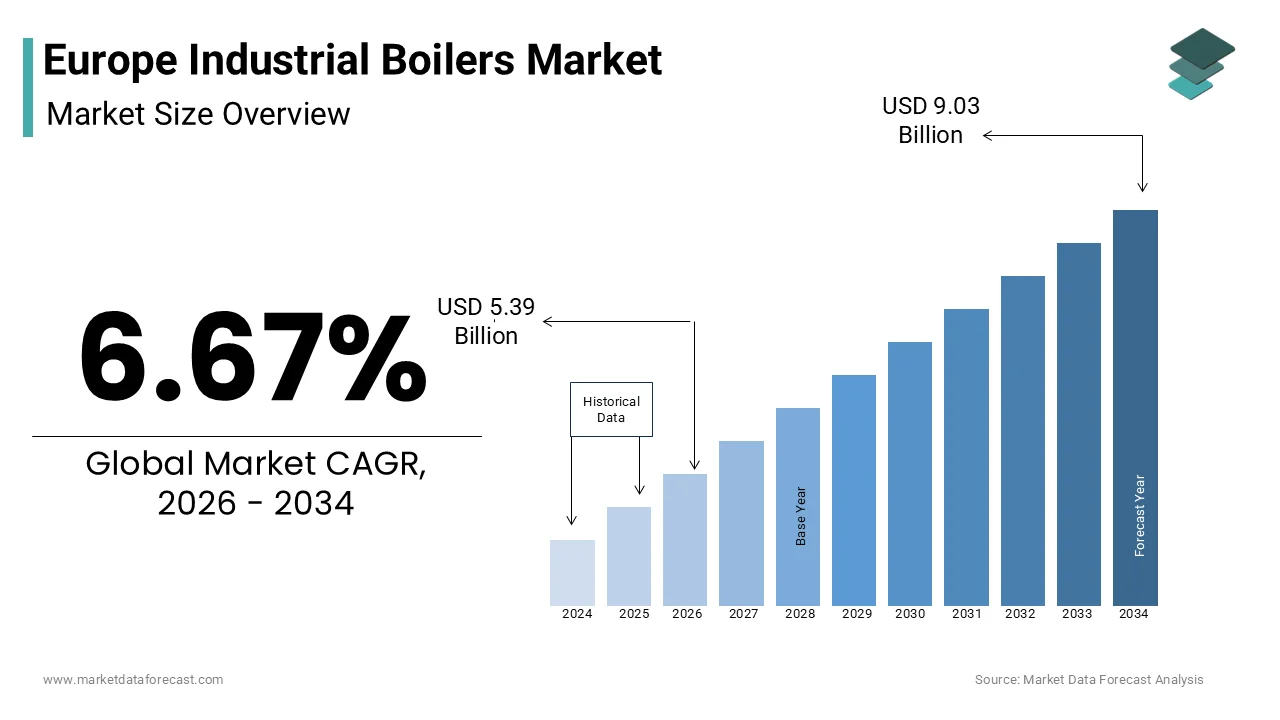
- Market Valuation: Valued at USD 5.05 billion in 2025, estimated at USD 5.39 billion in 2026, and projected to reach USD 9.03 billion by 2034, registering a robust CAGR of 6.67% from 2026 to 2034.
- Primary Growth Drivers: Strict European environmental regulations (such as EU Directive 2015/2193 targeting combustion plant emissions), corporate energy optimization mandates, and the shift toward energy-efficient heating systems and advanced biomass combustion beds.
Europe Industrial Boilers Market Segment Metrics (2026–2034)
| Category | Leading Segment (Base Position) | Fastest-Growing Segment |
|---|---|---|
| By Type | Water Tube Boilers (essential for high-pressure and heavy industrial capacity) | Fire Tube & Biomass-Integrated Boilers |
| By Fuel Type | Gas & Coal-fired Industrial Units | Eco-friendly Alternative Fuel & Biomass Systems |
| By Application | Refineries, Chemical, Primary Metal, & Food Processing Sectors | Specialized Petrochemical & Low-Emission Industrial Plants |
| By Product Capacity | 10BHP-150BHP & 151BHP-300BHP Ranges | High-Capacity 301BHP-600BHP Units |
| By Country | Germany, UK, France, and Spain (key hubs driving greenhouse gas reduction compliance) | Eastern & Central European Countries (Turkey, Czech Republic, and Rest of Europe) |
Europe Industrial Boilers Market Players & Industry Structure
Market Structure: Consolidated regional market characterized by global heavy engineering leaders and specialized boiler manufacturers focusing on emission-reduction technologies and high-efficiency thermal energy solutions.
Key Companies: Babcock & Wilcox Enterprises, Inc. (U.S.), Dongfang Electric Corporation Ltd. (China), Siemens AG (Germany), General Electric (U.S.), AC Boilers S.p.a. (Europe), Bharat Heavy Electricals Limited (India), Harbin Electric Group (China), IHI Corporation (Japan), Mitsubishi Hitachi Power Systems, Ltd. (Japan), and Thermax Limited (India).
 Download Free Sample Report
Europe Industrial Boilers Market Size
The Europe industrial boilers market size was valued at USD 5.05 billion in 2025 and is anticipated to reach a valuation of USD 5.39 billion in 2026 and USD 9.03 billion by 2034, growing at a CAGR of 6.67% from 2026 to 2034.
The industrial boilers are the installation of high capacity steam and hot water generation systems, utilized across heavy industries such as chemical processing food and beverage production and power generation within the European continent. Regulatory frameworks such as the European Green Deal mandate strict emission that limits pushing manufacturers to innovate in combustion efficiency and flue gas treatment. The aging infrastructure in many member states creates a substantial replacement cycle driven by safety compliance and operational efficiency goals. Stakeholders include original equipment manufacturers engineering firms and industrial end users collaborating to meet sustainability mandates, while maintaining production continuity. The integration of digital monitoring systems enhances predictive maintenance and energy optimization.
MARKET DRIVERS
Stringent Environmental Regulations Driving Decarbonization
The rigorous environmental policies and emission standards by compelling industrial facilities to replace outdated inefficient units with cleaner and more compliant technologies. The stringent environmental regulations is driving the growth of the Europe industrial boilers market. The Industrial Emissions Directive requires large combustion plants to adhere to strict limits on nitrogen oxides sulfur dioxide and particulate matter forcing operators to invest in advanced boiler systems equipped with selective catalytic reduction and flue gas desulfurization capabilities. As per the European Environment Agency, industrial facilities must reduce their greenhouse gas emissions by 43% by 2030 compared to 2005 levels under the Effort Sharing Regulation, which accelerates the retirement of coal and oil fired boilers in favor of natural gas biomass or electric alternatives. This regulatory pressure creates a mandatory upgrade cycle that sustains demand for new installations and retrofits. Manufacturers respond by developing low NOx burners and high efficiency condensing boilers that meet these stringent criteria. Compliance is not optional as non-compliant facilities face heavy fines and operational shutdowns. The push for carbon neutrality under the European Green Deal further incentivizes the adoption of hydrogen ready boilers. Industries such as paper and pulp, which are energy intensive are leading this transition to avoid carbon border adjustment mechanisms.
Modernization of Aging Industrial Infrastructure
The widespread presence of aging industrial infrastructure by creating a robust replacement demand for obsolete boiler systems that no longer meet current efficiency or safety standards. The modernization of aging industrial infrastructure is also escalating the growth of the Europe industrial boilers market. The industrial boilers in operation across Germany, France, and Italy are older than 20 years, resulting in higher maintenance costs and lower thermal efficiency compared to modern equivalents. The economic incentive drives capital expenditure decisions even in the absence of strict regulatory mandates. Older units often lack digital connectivity and predictive maintenance capabilities making them prone to unexpected failures that disrupt production. Modern boilers offer modular designs and faster installation times by minimizing downtime during upgrades. The reliability of new systems ensures consistent steam supply crucial for process industries. Safety regulations also require regular inspections and upgrades of pressure vessels, which often makes replacement more cost effective than repair. This structural obsolescence provides a stable baseline demand for boiler manufacturers and service providers. It supports the aftermarket segment through parts and maintenance contracts.
MARKET RESTRAINTS
High Capital Expenditure and Economic Uncertainty
The significant capital investment requirements and prevailing economic uncertainty unfavorably by causing industrial players to defer or cancel expansion and modernization projects, which is also restricting the growth of the Europe industrial boilers market. The rising interest rates have increased the cost of borrowing for industrial firms by approximately 2 to 3%age points over the past two years making large scale infrastructure investments less financially attractive. This financial constraint forces companies to prioritize essential maintenance over strategic modernization extending the life of existing inefficient assets. High upfront costs for advanced technologies such as hydrogen ready or electric boilers further deter adoption among small and medium sized enterprises. Supply chain disruptions increase lead times and installation costs adding to the financial burden. Economic slowdowns reduce production volumes lowering the immediate need for additional steam capacity. Investors become risk averse preferring short-term returns over long term infrastructure improvements.
Complexity of Integrating Renewable Fuel Sources
The technical and logistical challenges associated with integrating renewable fuel sources such as hydrogen and biomass into existing boiler systems is limiting the growth of the Europe industrial boilers market. As per the European Hydrogen Backbone initiative, the current infrastructure for hydrogen distribution is limited to pilot projects with less than 5% of industrial sites having direct access to green hydrogen supplies necessary for fuel switching. The uncertainty discourages investment in biomass compatible boilers that require specific handling and storage infrastructure. Retrofitting existing gas boilers for hydrogen blending requires extensive modifications to burners and control systems to prevent embrittlement and ensure safe combustion. Lack of standardized technical norms for hydrogen ready equipment creates regulatory ambiguity for manufacturers and end users. Storage requirements for biomass are space intensive and subject to strict fire safety regulations. These technical hurdles slow down the adoption rate of low carbon boiler technologies. Industries prefer to wait for mature solutions rather than pioneer unproven configurations.
MARKET OPPORTUNITIES
Expansion of Hydrogen Ready Boiler Technologies
The development and commercialization of hydrogen ready boiler technologies is solely attributed in creating new opportunities for the growth of the Europe industrial boilers market. As per the European Commission, the REPowerEU plan aims to produce 10 million tons of renewable hydrogen domestically and import another 10 million tons by 2030, creating a substantial future fuel source for industrial heating applications. Manufacturers are designing new boilers capable of burning 100% hydrogen or high blend ratios positioning themselves, as key enablers of the hydrogen economy. Early adopters in the chemical and refining sectors are piloting these systems to gain operational experience and regulatory approval. Government subsidies for hydrogen projects lower the total cost of ownership for end users. Partnerships between boiler makers and hydrogen producers facilitate integrated solutions. This technological readiness creates a first mover advantage for companies that certify their products for hydrogen use.
Digitalization and Smart Boiler Management Systems
The integration of digital technologies and Internet of Things sensors is also to escalate the growth of the Europe industrial boilers market. Boiler manufacturers are shifting from selling hardware to offering energy as a service where they monitor and optimize performance remotely. Cloud based platforms enable benchmarking across multiple sites identifying best practices and inefficiencies. Cybersecurity features protect critical infrastructure from digital threats. The ability to provide detailed emissions reporting helps companies comply with environmental regulations automatically.
MARKET CHALLENGES
Supply Chain Volatility for Critical Components
The disruptions in the supply chain for boiler components such as heat exchangers, valves, and control systems by causing project delays and cost overruns is a significant challenge for the growth of the Europe industrial. The prices for specialized steel alloys used in high pressure boiler construction have fluctuated by up to 25% in recent years due to raw material shortages and increased energy costs for smelting. The German Engineering Federation states that lead times for custom engineered boiler components have extended from 6 months to over 12 months impacting the ability of manufacturers to meet delivery commitments for large industrial projects. This volatility forces companies to hold higher inventory levels tying up working capital and increasing storage costs. Dependence on single source suppliers for specialized electronics creates vulnerability to geopolitical disruptions. Logistics bottlenecks at European ports further delay the arrival of imported parts. Project managers struggle to provide accurate timelines to clients leading to contractual penalties. The unpredictability of material availability hampers production planning and resource allocation. Manufacturers face pressure to absorb cost increases rather than pass them to customers. This environment reduces profit margins and operational stability.
Shortage of Skilled Technical Workforce
The shortage of skilled engineers and technicians capable of installing maintaining and servicing advanced industrial boiler systems is additionally to limit the growth of the Europe industrial boilers market. The demand for specialists in thermal engineering and automation has outpaced supply by 20% in key industrial nations such as Germany and France, leading to wage inflation and project staffing delays. The aging workforce in the manufacturing sector is retiring faster than new entrants are being trained, creating a knowledge gap in handling complex modern boiler technologies including hydrogen and digital systems. This skills deficit results in longer installation times and higher risk of commissioning errors. Companies invest heavily in training programs but retention remains difficult due to competition from other sectors. Lack of qualified personnel limits the number of projects a manufacturer can undertake simultaneously. Quality of service may suffer if inexperienced staff are deployed.
REPORT COVERAGE
| REPORT METRIC | DETAILS |
| Market Size Available | 2025 to 2034 |
| Base Year | 2025 |
| Forecast Period | 2026 to 2034 |
| CAGR | 6.67% |
| Segments Covered | By Type, Application, Product, Fuel Type, and Country |
| Various Analyses Covered | Regional and andCountry-Levell Analysis, Segment-Level Analysis, DROC, PESTLE Analysis, Porter’s Five Forces Analysis, Competitive Landscape, Analyst Overview of Investment Opportunities |
| Regions Covered | Germany, UK, France, Spain, Russia, Sweden, Denmark, Italy, Switzerland, Netherlands, and the Rest of Europe. |
| Market Leaders Profiled | Babcock & Wilcox Enterprises, Inc. (U.S.), Dongfang Electric Corporation Ltd. (China), Siemens AG (Germany), General Electric (U.S.), AC Boilers S.p.a. (Europe), Bharat Heavy Electricals Limited (India), Harbin Electric Group (China), IHI Corporation (Japan), Mitsubishi Hitachi Power Systems, Ltd. (Japan), and Thermax Limited (India). |
SEGMENTAL ANALYSIS
By Type Insights
The water tube boilers segment was the largest by capturing 44.3% of the Europe Industrial Boilers Market share in 2025 due to their ability to generate high-pressure steam efficiently, which is essential for large-scale industrial processes such as power generation and chemical manufacturing. According to the International Energy Agency, water tube boilers can achieve thermal efficiencies exceeding 90% when equipped with economizers and condensing technology by making them the preferred choice for energy-intensive industries aiming to reduce operational costs. The steam requirements in the European chemical sector are met by water tube boilers because they can handle pressures above 100 bar safely, ensuring consistent process performance. This technical superiority drives continuous demand for replacements and upgrades in existing facilities. Their modular design allows for easier maintenance and scalability compared to fire tube alternatives. Industrial operators prioritize these units for their longevity and reliability under continuous load conditions. The ability to burn various fuels including biomass and waste gases enhances their versatility in a decarbonizing economy.
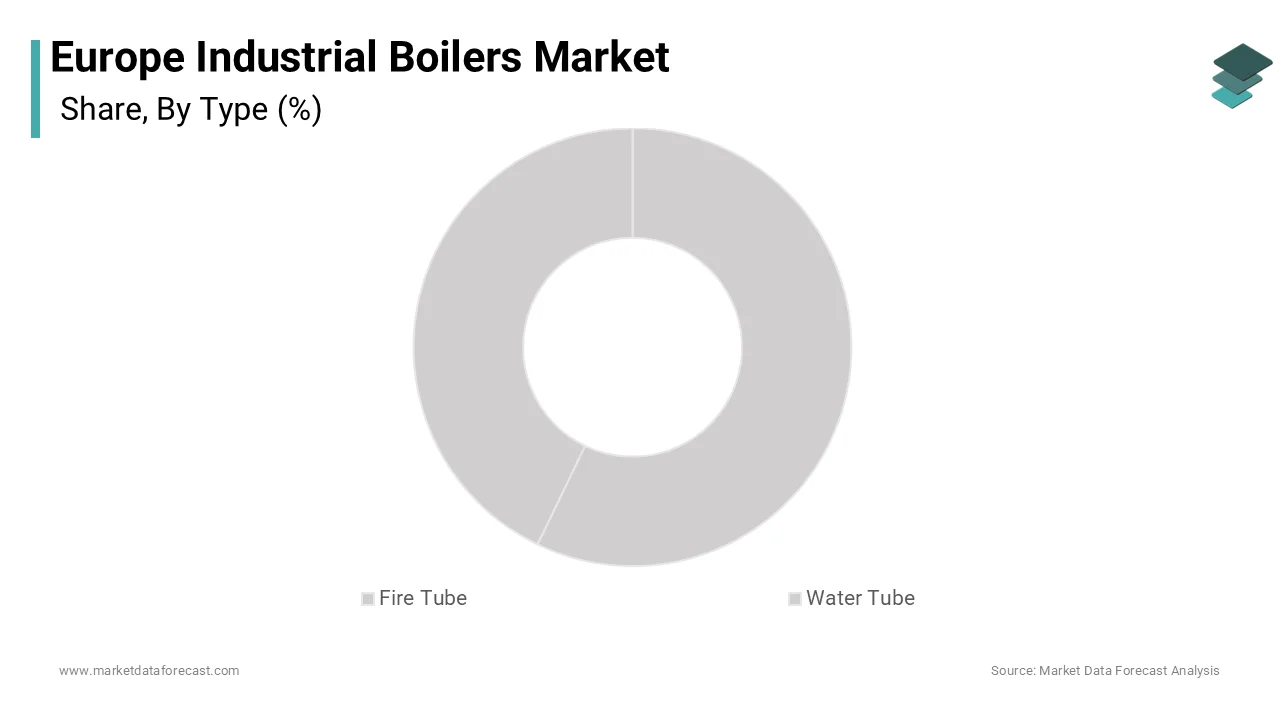
The fire tube boilers segment is likely to witness a fastest CAGR of 4.5% during the forecast period with the cost effectiveness and simplicity for small to medium scale industrial applications such as food processing and hospitality. The food and beverage sector, which relies heavily on low pressure steam for pasteurization and cleaning has increased its adoption of compact fire tube units by 15% annually due to their ease of installation and operation. This affordability drives demand in sectors where high pressure steam is not required. The simpler design reduces maintenance complexity and training requirements for staff. Rapid deployment times minimize production downtime during upgrades.
By Application Insights
The chemical industry segment was accounted for 49.1% of the Europe Industrial Boilers Market share in 2025 due to its intensive reliance on high-pressure steam for process heating distillation and reaction control in the production of basic chemicals and pharmaceuticals. This massive consumption base ensures steady demand for large-scale water tube boilers. The industry’s focus on precision temperature control necessitates advanced boiler automation and monitoring systems. Any disruption in steam supply can lead to significant product loss and safety hazards. Therefore, chemical plants invest heavily in high-quality redundant boiler systems.
The food and beverage industry segment is likely to witness a fastest CAGR of 4.2% from 2026 to 2034 with the expansion of processed food production and stringent hygiene standards that require consistent steam for sterilization and cleaning. The steam is the preferred method for cleaning in place systems due to its ability to reach high temperatures and eliminate pathogens without chemical residues. This focus on food safety drives investment in modern boiler systems. The rise of convenience foods requires continuous processing lines that depend on uninterrupted steam supply. Small and medium sized food producers are upgrading from outdated systems to improve efficiency.
By Fuel Insights
The natural gas segment held a significant share of the Europe Industrial Boilers Market in 2025 due to its extensive distribution infrastructure and lower carbon intensity compared to coal and oil making it the transitional fuel of choice for industrial decarbonization. The switching from coal to natural gas in industrial boilers can reduce carbon dioxide emissions by helping companies meet immediate regulatory requirements, while preparing for future renewable transitions. This environmental benefit drives continued preference for gas fired boilers. The existing pipeline network ensures secure supply in most industrial regions. Gas boilers offer rapid start up and shut down capabilities enhancing operational flexibility. They require less storage space and handling equipment than solid or liquid fuels. Maintenance costs are lower due to cleaner combustion.
The biomass and renewable fuels segment is likely to witness the fastest CAGR of 12.9% from 2026 to 2034 with the aggressive government incentives and corporate carbon neutrality goals that encourage the substitution of fossil fuels in industrial heating. The number of industrial biomass boiler installations has increased annually, as companies seek to qualify for green certifications and avoid carbon taxes. This policy support lowers the total cost of ownership for biomass systems. Industries with access to local agricultural or forestry waste find biomass economically viable. The carbon neutral status of biomass appeals to sustainability focused brands. It helps meet scope 1 emission reduction targets.
REGIONAL ANALYSIS
Germany Market Analysis
Germany was the top performer in the Europe Industrial Boilers Market by holding 36.7% of the share in 2025 with the strong manufacturing base and stringent environmental regulations. As per the Federal Ministry for Economic Affairs and Climate Action, Germany aims to reduce industrial greenhouse gas emissions by 47% by 2030, driving significant investment in high efficiency and hydrogen ready boiler systems. The chemical and automotive sectors are leading the adoption of advanced boiler technologies to maintain competitiveness and comply with the European Green Deal. The country s robust engineering sector supports local manufacturing of high-quality boilers. Government funding programs for energy efficiency upgrades stimulate demand. The phase out of coal accelerates the switch to gas and biomass. Industrial clusters benefit from shared infrastructure and expertise.
France Market Analysis
France industrial boilers market was ranked second by capturing 19.2% of the share in 2025 with its nuclear powered electricity grid and growing focus on biomass for industrial heating. The Multiannual Energy Program encourages the replacement of fossil fuel boilers with biomass and electric alternatives in industries not connected to natural gas networks. The country’s abundant forestry resources support biomass fuel supply. Nuclear power makes electric boilers an attractive option for some industries. Regulatory pressure to reduce carbon emissions drives upgrades. The market is influenced by national energy sovereignty goals. Local manufacturers play a key role in supply. The focus on rural industrial development supports decentralized heating solutions. France balances nuclear and renewable strategies.
Italy Market Analysis
Italy industrial boilers market growth is anticipated to have significant opportunities in coming years with the energy efficiency and modernization of its diverse industrial base. The Industry 4.0 plan provides tax credits for investments in digital and energy efficient technologies, including smart boiler systems. The food and beverage and ceramic industries are major consumers of industrial steam driving demand for high efficiency gas and biomass boilers. The country’s reliance on imported natural gas incentivizes energy saving measures. Retrofitting old plants is a priority due to aging infrastructure. Government incentives support the transition to renewable fuels. Local craftsmanship supports custom boiler solutions.
United Kingdom Market Analysis
The United Kingdom industrial boilers market growth is likely to grow with the strict carbon pricing and the phase out of coal fired industrial heating. The UK Emissions Trading Scheme imposes a carbon price that makes coal and oil boilers economically unviable for most industrial applications accelerating the switch to natural gas and biomass. The industrial sites have conducted energy audits leading to boiler upgrades and the installation of waste heat recovery systems to reduce operational costs. The net zero target by 2050 drives long term planning. Hydrogen pilot projects are emerging in industrial clusters. The market focuses on retrofitting existing assets. High energy prices spur efficiency investments. Regulatory clarity supports decision making.
Spain Market Analysis
Spain industrial boilers market growth is driven by its expanding renewable energy sector and industrial modernization efforts. The food and beverage sector is increasingly adopting high efficiency boilers to compete in export areas, where sustainability credentials are valued. The abundance of agricultural waste supports biomass growth. Solar integration reduces gas consumption. Government grants facilitate technology adoption.
COMPETITIVE LANDSCAPE
The competitive landscape of the Europe Industrial Boilers Market is characterized by intense rivalry among established multinational engineering firms and specialized regional manufacturers vying for leadership in the energy transition era. Major players compete on technological superiority, particularly in hydrogen compatibility digital integration and emission reduction capabilities rather than just price. Differentiation is increasingly achieved through comprehensive service offerings including energy audits financing models and lifecycle management which create long term customer lock in. Regional competitors leverage local regulatory knowledge and proximity to serve specific national markets more responsively than global giants. Innovation cycles have accelerated as companies race to certify products for emerging fuels like green hydrogen and biofuels. Consolidation trends see larger firms acquiring niche technology providers to fill portfolio gaps in electrification or waste heat utilization. Price competition remains relevant in standard segments but value-based selling dominates high end applications where reliability and compliance are paramount. Barriers to entry are high due to certification requirements and capital intensity protecting incumbents. Collaboration between competitors on standard setting fosters market development despite commercial rivalry.
KEY MARKET PLAYERS
Some of the major players in the Industrial Boilers market are
- Babcock & Wilcox Enterprises, Inc. (U.S.)
- Dongfang Electric Corporation Ltd. (China)
- Siemens AG (Germany)
- Viessmann Climate Solutions
- Alfa Laval AB
- Bosch Thermotechnology
- General Electric (U.S.)
- AC Boilers S.p.a. (Europe)
- Bharat Heavy Electricals Limited (India)
- Harbin Electric Group (China)
- IHI Corporation (Japan)
- Mitsubishi Hitachi Power Systems, Ltd. (Japan)
- Thermax Limited (India).
Top Players In the Market
- Bosch Thermotechnology maintains a prominent position in the Europe Industrial Boilers Market by delivering high efficiency steam and hot water systems tailored for diverse industrial applications. The company focuses on integrating digital connectivity and hydrogen readiness into its product portfolio to support European decarbonization goals. Recent actions include launching advanced condensing boiler series with enhanced heat recovery capabilities, specifically designed for chemical and food processing sectors. Bosch actively invests in research facilities across Germany to develop low emission combustion technologies that comply with stringent EU directives. Their comprehensive service network ensures rapid maintenance and optimization for industrial clients.
- Viessmann Climate Solutions contributes significantly to the Europe Industrial Boilers Market through its extensive range of sustainable heating solutions and integrated energy systems. The company emphasizes the development of hybrid systems combining gas boilers with heat pumps and renewable fuel capabilities to maximize operational flexibility. Recent initiatives involve expanding production capacity for hydrogen compatible industrial boilers at their Polish manufacturing site to meet growing demand in Central and Eastern Europe. Viessmann collaborates with industrial partners to pilot waste heat recovery projects that enhance overall plant efficiency. Their digital platforms provide real time monitoring and predictive maintenance services reducing downtime for critical processes.
- Alfa Laval AB plays a vital role in the Europe Industrial Boilers Market by specializing in compact and highly efficient thermal transfer technologies for demanding industrial environments. The company leverages its expertise in plate heat exchangers and spiral boilers to offer space saving solutions ideal for retrofitting aging infrastructure. Recent actions include introducing new exhaust gas cleaning systems integrated with boiler units to help marine and land-based industries meet sulfur oxide limits. Alfa Laval invests heavily in testing facilities in Sweden to validate performance under extreme conditions and alternative fuels. They provide lifecycle services that optimize energy consumption and extend equipment longevity.
Top Strategies Used by Key Market Participants
Key players in the Europe Industrial Boilers Market primarily focus on technological innovation to develop hydrogen ready and biomass compatible systems that align with EU decarbonization mandates. Companies invest substantially in digitalization offering smart monitoring and predictive maintenance services to enhance operational efficiency and customer retention. Strategic partnerships with energy providers and industrial clusters facilitate pilot projects for alternative fuels ensuring practical validation of new technologies. Expansion of local manufacturing and service networks reduces lead times and strengthens supply chain resilience against geopolitical disruptions. Sustainability is embedded in corporate strategies through circular economy initiatives, including remanufacturing programs and recycled material usage. Mergers and acquisitions are utilized to acquire specialized competencies in niche areas like waste heat recovery or electric steam generation. Compliance with evolving regulations such as the Industrial Emissions Directive drives continuous product upgrades.
MARKET SEGMENTATION
This research report on the Europe industrial boilers market is segmented and sub-segmented into the following categories.
By Type
- Fire Tube
- Water Tube
By Application
- Refineries
- Primary Metal
- Chemical
- Food
By Product
- 301BHP-600BHP
- 151BHP-300BHP
- 10BHP-150BHP
By Fuel Type
- Gas
- Coal
- Oil
By Country
- UK
- France
- Spain
- Germany
- Italy
- Russia
- Sweden
- Denmark
- Switzerland
- Netherlands
- Turkey
- Czech Republic
- Rest of Europe