- Product Description Description
- Table of Contents TOC
- List of Table & Figure LOT
- Get Free Sample PDF Sample PDF
Market Size, 2025
$8.03 BnMarket Estimate, 2026
$8.63 BnMarket Forecast, 2034
$15.43 BnCAGR, 2026–2034
7.53%Executive Summary: Europe Industrial Cybersecurity Market
- Market Scope: European industrial cybersecurity market analysis covering component segments, security types, industry verticals, regional leadership frameworks, and adoption metrics.
- Market Valuation: Valued at USD 8.03 billion (2025), estimated at USD 8.63 billion (2026), and projected to reach USD 15.43 billion by 2034, growing at a robust CAGR of 7.53% (2026–2034).
- Primary Growth Drivers: Industry 4.0 adoption, OT-IT convergence, and NIS2 requirements covering around 160,000 additional entities across sectors (including manufacturing, energy, water, and waste management). Key operational metrics include NIS2 non-compliance penalties reaching up to €10 million or 2% of global turnover, alongside significant talent gaps (fewer than 15% of EU cybersecurity education programs include dedicated industrial-protocol modules, while recruitment for qualified OT-security engineers can exceed 8 months).
Key Market Segment Metrics (2026–2034)
| Category | Leading Segment (2025 Position) | Fastest-Growing Segment |
|---|---|---|
| By Component | Services (dominated with 41.4% market share in 2025, driven by demand for vulnerability assessments, incident response, compliance auditing, and 24/7 OT monitoring) | — |
| By Security Type | Network security (held 39.4% of the market) | Cloud security (projected to expand at a 17.7% CAGR through 2034) |
| By Industry | Process industries (accounted for 51.5% of the regional market in 2025) | Discrete manufacturing (forecast to grow at a 13.1% CAGR) |
| By Region | Germany (led Europe with 23.7% market share in 2025, supported by its large industrial base, regulatory enforcement, Industry 4.0 adoption, and OT-security investment) | — |
Major Market Players & Market Structure
Market Structure: Highly competitive European industrial cybersecurity landscape featuring 10 prominent market leaders competing on OT-native security, managed services, AI-driven threat detection, IEC 62443-aligned solutions, and comprehensive NIS2 compliance capabilities.
Key Companies: ABB Group, IBM Corporation, Honeywell International, Cisco Systems, Schneider Electric, Rockwell Automation, Siemens, Microsoft, Palo Alto Networks, and Broadcom.
Europe Industrial Cybersecurity Market Size
The Europe industrial cybersecurity market size was valued at USD 8.03 billion in 2025 and is projected to reach USD 15.43 billion by 2034 from USD 8.63 billion in 2026, growing at a CAGR of 7.53%.
Industrial cybersecurity is an integrated suite of technologies, policies, and practices designed to protect operational technology systems in critical infrastructure sectors, including energy, manufacturing, water utilities, and transportation, from cyber threats that could disrupt physical processes or compromise safety. Unlike traditional IT security, industrial cybersecurity must address legacy control systems with long lifecycles, real-time operational requirements, and stringent safety protocols. The urgency of this domain has intensified as industrial environments undergo digital transformation through Industry 4.0 initiatives, which are connecting previously isolated machinery to corporate networks and cloud platforms. According to the European Union Agency for Cybersecurity (ENISA), many European critical-infrastructure operators have experienced at least one significant cyber incident between 2020 and 2023. The NIS2 Directive, which came into force in October 2025, now mandates comprehensive cyber-risk management for more than 160,000 entities across the energy, transport and manufacturing sectors. According to the European Commission, a substantial proportion of industrial facilities in the EU still operate with outdated control systems lacking basic security patches. This convergence of regulatory pressure, which is escalating threat landscapes and operational digitisation,,tion positions industrial cyber security as a non-negotiable pillar of Europe’s industrial resilience and strategic autonomy.
MARKET DRIVERS
Mandatory Compliance Under the NIS2 Directive as a Primary Growth Catalyst
The transposition of the NIS2 Directive into national law across all EU member states represents the most powerful driver accelerating investment in industrial cyber security, which is majorly driving the industrial cyber security market growth in Europe. Unlike its predecessor, the NIS2 Directive expands the scope to include medium-sized enterprises in manufacturing, energy, water and waste management, which is bringing around 160,000 additional entities under binding cybersecurity obligations. According to the European Commission, covered organisations must implement risk-management measures, including asset-inventory, vulnerability-handling, incident-response and supply-chain security by October 2025. Non-compliance can result in fines up to €10 million or 2% of global turnover. This regulatory shift transforms cybersecurity from a discretionary investment into a legal requirement with direct financial consequences. In Germany, as per the Federal Office for Information Security (BSI), a substantial share of industrial firms have initiated OT-security upgrades specifically to meet NIS2 mandates. Similarly, the ANSSI in France has launched sector-specific compliance guides for chemical and automotive plants, accelerating procurement of network-segmentation and anomaly-detection systems. The directive also mandates cross-border incident reporting via the EU Cyber Crisis Liaison Organisation Network, which is creating demand for standardised monitoring platforms. By institutionalising cyber hygiene across critical industrial sectors, NIS2 has created a structural and enforceable foundation for sustained market expansion.
Convergence of OT and IT Networks Through Industry 4.0 Adoption
The deep integration of operational technology and information technology systems driven by Industry 4.0 is fundamentally reshaping industrial cyber risk profiles and fuelling demand for specialised security solutions, which is further propelling the regional market expansion. Many large manufacturing enterprises in the EU now utilise cloud-based data analytics and IoT sensors on production lines, reflecting a deepening connectivity of operational technology with enterprise systems. This connectivity exposes previously air-gapped control systems to internet-borne threats such as ransomware and supply-chain compromises. A cyber-attack on a German steel plant that disrupted production for an extended period after malware infiltrated via a compromised remote maintenance portal exemplifies the operational consequences. In response, companies are deploying purpose-built industrial firewalls, secure remote access gateways and continuous OT-monitoring platforms. According to a survey by the German Engineering Federation, a substantial majority of industrial firms now allocate dedicated budgets for OT security separate from IT. According to the European DIGITAL SME Alliance, more than half of small and medium manufacturers plan to adopt zero-trust architectures for shop-floor networks by 2026. As digital twins, predictive maintenance and autonomous robotics become standard, the imperative to secure data flows between physical machinery and enterprise systems will sustain robust demand for integrated industrial cyber-security frameworks.
MARKET RESTRAINTS
Legacy Infrastructure and Technical Debt in Industrial Environments
The pervasive reliance on legacy operational technology systems that lack native security features and cannot support modern software updates is primarily hampering the growth of the industry cybersecurity market in Europe. Industrial control systems across the EU are now decades old, predating modern cyber-threat landscapes and standard security protocols. These systems often run on unsupported operating systems or proprietary firmware that cannot be patched without risking operational disruption. In the energy sector, a significant portion of grid-control infrastructure was installed before 2010 and was not designed for networked environments. Retrofitting security onto such systems is technically complex and costly. Engineering and validation of legacy PLCs in chemical plants can entail very high costs. Moreover, many plants operate under continuous production schedules, while leaving minimal maintenance windows for security upgrades. This technical debt creates persistent vulnerabilities that attackers increasingly exploit. Until decommissioning or virtual-patching strategies become widespread, the legacy infrastructure will remain a critical barrier to comprehensive cyber-resilience.
Shortage of Specialised OT Cyber Security Talent
The acute scarcity of professionals skilled in both industrial operations and cybersecurity is further restraining the growth of the European industry cybersecurity market. Unlike IT security, OT cybersecurity requires res deep understanding of process control l,, logic, safety, ty integrity level,s, real-timetime system constraints, which are competencies absent in conventional cyber curricula. Fewer than 15% of EU cybersecurity-education programmes include dedicated modules on industrial protocols such as Modbus or PROFINET. According to the European Commission, the shortfall of cybersecurity professionals across the bloc is estimated at a few hundred thousand. Industrial firms report average recruitment times exceeding eight months for qualified OT-security engineers. This human-capital gap forces organisations to rely on external consultants or over-extend IT staff, which is increasing response latency during incidents. In 2023, the Norwegian petroleum sector delayed six critical security-modernisation projects due to a shortage of OT-literate analysts. While initiatives like the Cybersecurity Skills Academy aim to address this, the pipeline remains insufficient to meet the rising demand driven by NIS2 and digitalisation. Without a coordinated up-skilling strategy, human-capital constraints will continue to undermine technical investments.
MARKET OPPORTUNITIES
In-Integration AI-Driven Threat Detection in Industrial Environments
The incorporation of artificial intelligence and machine learning into industry cybersecurity platforms presents a major opportunity for the European industry cybersecurity market. Traditional signature-based tools fail to detect novel or zero-day attacks targeting industrial protocols, but AI models trained on normal proc behaviour can identify subtle anomalies indicative of compromise. AI-powered systems have shown measurable improvements in industrial cyber-defence, which is reducing false positives and speeding incident detection, according to research by Fraunhofer Institute for Secure Information Technology and its partner institutes. The AIDOaRt pr, which is funded by the European Defence Agency,,ency has developed autonomous security orchestration tools for cyber-physical systems and demonstrated enhanced containment of simulated attacks on critical-infrastructure testbeds. Energy utilities are early adop,,ters with firms like E.ON and Enel deploying behavioural analytics to monitor SCADA traffic across substations. With the European Innovation Council projecting rising market penetration of AI-enabled OT security solutions in heavy industry, the regulatory pathway under the EU AI Act classifies industry cybersecurity applications as high-risk, which gives vendors a clearer route to scale certified AI solutions that balance automation with human oversight, thereby unlocking a new frontier in proactive industrial defence.
Expansion of Managed Security Services for OT Environments
The risespecialisedized managed security service providers offering 24x7 monitoring and incident response for industrial networks is creating a scalable and cost-effective opportunity for mid-sized European operators, which is another potential opportunity for the regional market. Most small and medium enterprises lack the resources to maintain-house OT security teams, yet NIS2 compliance demands continuous monitoring and rapid incident handling. Mindustrial SMEs regard outsourcing OT security as essential to meeting regulatory obligations. Leading providers have established dedicated industry security operations centres staffed by engineers certified in ICS protocols and safety standards. These services integrate with existing control systems via non-intrusive monitoring probes and are offered on subscription terms, which makes advanced protection more accessible. In Sweden, the national grid operator has adopted a managed detection and response service to protect its hydropower control infrastructure. At the same time, regulatory frameworks encourage third-party assessments and continuous vulnerability management, which is paving the way for managed services to democratise enterprise-grade OT protection across Europe’s industrial base.
MARKET CHALLENGES
Fragmented Regulatory Landscape Across EU Member States
The inconsistent national transposition and enforcement mechanisms create compliance uncertainty and operational complexity for multinational industrial operators, which is a significant challenge to the regional market growth. While the directive sets baseline requirements, member states retain discretion in defining incident thresh, old audit frequencies and penalty structures. Only a portion of EU Member States had fully enacted national laws aligned with the NIS2 Directive by early 2026, and significant divergence remains among those that have. The resulting regulatory patchwork forces companies like ArcelorMittal or BASF to maintain multiple compliance frameworks across their European facilities, which increases administrative overhead and causes security-configuration drift. As per a survey by the Confederation of European Industry, many multinational firms delayed OT-security investments because of regulatory ambiguity. Furthermore, national cyber-agencies such as Germany’s BSI and France’s ANSSI issue technical guidelines that differ in encryption standards and remote-access protocols. Until a unified EU certification scheme for industrial cybersecurity products and practices emerges under the Cyber Resilience Act, this fragmentation will impede standardisation, raise costs, and create exploitable gaps in cross-border critical-infrastructure defence.
Supply Chain Vulnerabilities in Industrial Software and Hardware
The increasing reliancethird-partyarty components in industrial control systems has exposed European operators to systemic cyber risks originating from global software and hardware supply chains, which is further challenging the growth of the European market. Compromised software updates and embedded firmware represent a growing proportion of industrial-cyber incidents. Many widely used industrial software vendors have been breached via trojanised installers, which is affecting manufacturing plants across Europe before detection. Hardware supply-chain risks are also apparent. Industrial networking gear sourced from some non-EU manufacturers was found to contain backdoor code. The Cyber Resilience, which is effective from 2026, mandates security-by-design for new digital products but does not apply retroactively to legacy industrial equipment already deployed. In European industry, only a minority of firms regularly conduct third-party code audits. The concentration of PLC and DCS manufacturing among a few global vendors, based primarily in the US, further limits procurement options. As geopolitical tensions heighten, Europe’s dependence on external suppliers for industrial-control technology introduces strategic vulnerabilities that endpoint security alone cannot address, requiring coordinated supply-chain risk-management frameworks and the development of trusted European alternatives.
REPORT COVERAGE
| REPORT METRIC | DETAILS |
| Market Size Available | 2025 to 2034 |
| Base Year | 2025 |
| Forecast Period | 2026 to 2034 |
| CAGR | 7.53% |
| Segments Covered | By Component, Security Layer, End User Industry, and Region |
| Various Analyses Covered | Global, Regional, & Country Level Analysis; Segment-Level Analysis; DROC, PESTLE Analysis; Porter’s Five Forces Analysis; Competitive Landscape; Analyst Overview of Investment Opportunities |
| Regions Covered | UK, France, Spain, Germany, Italy, Russia, Sweden, Denmark, Switzerland, Netherlands, Turkey, and the Czech Republic |
| Market Leaders Profiled | ABB Group, IBM Corporation, Honeywell International Inc., Cisco Systems Inc., Schneider Electric SE, Rockwell Automation Inc., Siemens AG, Microsoft Corporation, Palo Alto Networks Inc., and Broadcom Inc |
SEGMENTAL ANALYSIS
By Component Insights
The services segment held the major share of 41.4% of the regional market in 2025. The dominance of the services segment in the European market is driven by the operational complexity of industrial environments and the regulatory mandates requiring continuous risk management. Under the NIS2 Directive, more than th160,000000 critical-infrastructure operators must implement ongoing vulnerability assessments, incident-response planning and third-party-risk evaluations tasks that demand specialised expertise beyond typical in-house IT teams. Managed-security-service providers now offer 24 / 7 monitoring of OT networks using non-intrusive sensors and protocol-aware analytics, which is enabling real-time anomaly detection without disrupting production. According to the VDMA German Engineering Federation, a majority of industrial firms outsourced at least one core cybersecurity function in recent y, which is primarily incident response and compliance auditing. Furthermore, the shortage of OT-security talent in Europe makes external expertise essential. National initiatives such as ANSSI in France and BSI in Germany certify service-providers and consultants, which further institutionalise reliance on professional services. As industrial digitisation accelerates, the need for tailored lifecycle support from assessment to recovery ensures such services remain the backbone of industrial cyber-resilience.
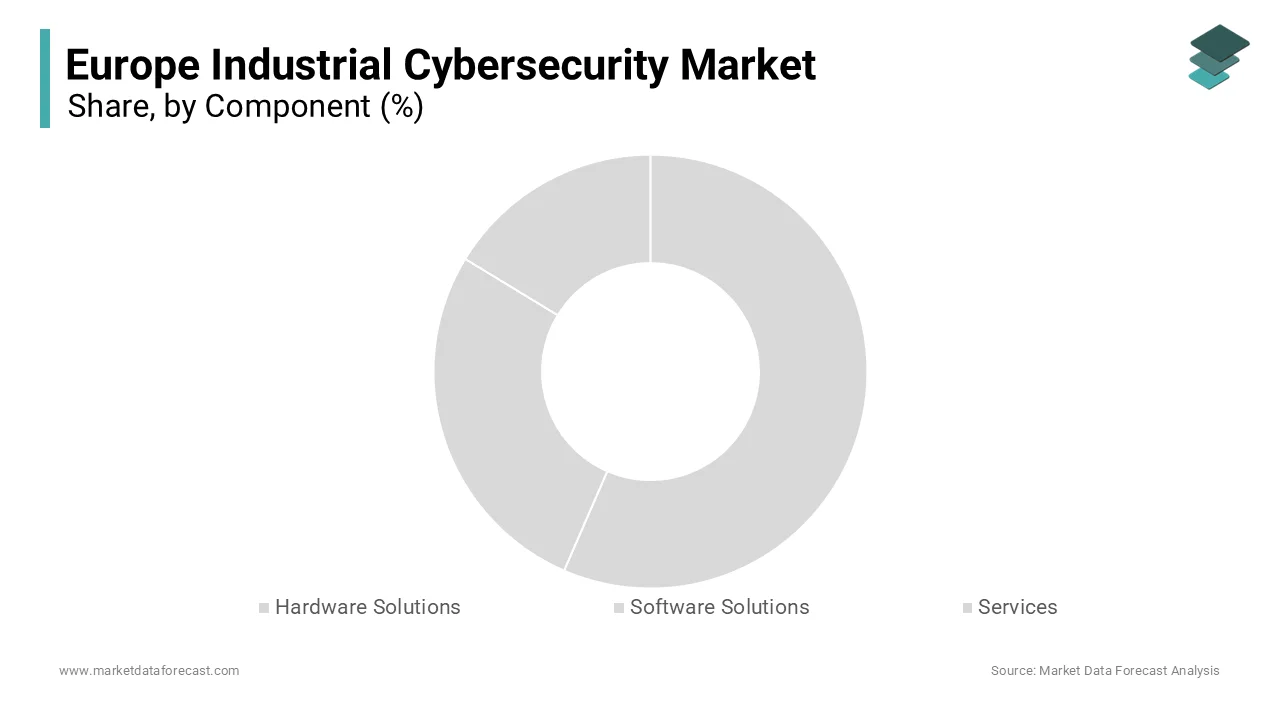
The software segment is anticipated to register a promising CAGR in the European industry cybersecurity market during the forecast pe,,riod owing to the shift to software-defined security architectures that can scale across distributed industrial assets without hardware retrofitting. Key innovations include behavioural oral analytics platforms that learn normal process patterns to detect zero-day threats and policy enforcement engines that automate NIS2 compliance workflows. AI-powered industrial security software has demonstrated significant improvements in detection for ransomware and other threats in trial settings at automotive plants. Cloud-delivered security orchestration tools are also gaining traction; for example, Microsoft Defender for IoT supports native industrial control system protocols and offers real-time monitoring of OT/ICS environments.
By Security Layer Insights
The network security segment commanded a share of 39.4% of the European market in 2025. The leading position of the network security segment is majorly driven by the foundational role of network segmentation and traffic monitoring in protecting operational technology environments, where direct internet exposure can cause physical disruption. Industrial control systems were historically isolated, ted, but the integration of IT and OT networks through Industry 4.0 has created numerous entry points for threats. Firewalls, intrusion detection systems and unidirectional gateways are now essential to enforce security zones as defined by the IEC 62443 standard. Many German manufacturing plants have implemented network segmentation to comply with enhanced regulatory requirements for asset inventory and boundary protection. The ransomware attack on an Italian water utility confirmed the criticality of network-layer controls. Utilities and energy firms are leading adoption; in the EU, grid-control-centre regulation mandates network monitoring in that sector. As industrial networks grow more complex with edge computing and private 5G networks, the need for protocol-aware and safety-certified network-security solutions ensures continued focus on this layer, which is expected to contribute to the growth of the network security segment in the European market during the forecast period.
The cloud security segment is estimated to grow at a CAGR of 17.7% over the forecast period in the European market due to the rapid migration of industrial data analytics and digital twin platforms to cloud environments. Many large EU manufacturers now store production data in hybrid or public clouds, reflecting rapid digitalisation trends. However, cloud adoption also introduces risks such as misconfigured storage buckets, insecure APIs and cross-tenant vulnerabilities. The EU’s GAIA X initiative promotes sovereign-cloud infrastructure with certified security controls, which is driving demand for cloud-workload protection and identity-governance tools tailored to industrial use-cases. For instance, some energy firms use cloud-based tooling to manage security policies across distributed renewable sites, ensuring consistent access controls and encryption. The Cyber Resilience Act further mandates that cloud-based industrial applications implement continuous vulnerability-scanning and secure-update mechanisms. Industrial IoT-IoT platforms like MindSphere and EcoStruxure scale across Europe, and cloud security has become indispensable to maintaining data integrity and operational continuity in decentralised production ecosystems, which is further anticipated to boost the expansion of the cloud security segment in the European market.
By End User Industry Insights
The process segment occupied 51.5% of the regional market share in 2025 and stood as the most dominating segment in the European market. This segment includes en,,ergy w, waterchemistrym,, and pharmaceuticals sectors, characterised by continuous operation, high safety requirements and inclusion as critical infrastructure under NIS2. Any cyber disruption can trigger physical consequences such as chemical spills, LS grid instability or wacontaminationmition making robust security non-negotiable. The European Network of Transmission System Operators for Electricity requires all member utilities to implement real-time intrusion detection on SCADA networks, which is driving widespread deployment of OT monitoring platforms. In the water sector, many major treatment facilities in Germany and France now employ protocol-aware firewalls following high-profile breaches that demonstrated the threat to public safety. Chemical plants face additional regulatory pressure with the European Chemical Industry Council mandating cyber-risk assessments as part of process-safety management. According to the European Environment Agency, a significant majority of EU refineries undertook OT-security upgrades in recent years. The inherent connectivity of process-control systems and their societal impact ensure this segment remains the primary focus of industrial cyber-investment.
The discrete manufacturing segment is predicted to witness a CAGR of 13.1% over the forecast period in the European industry cybersecurity market due to the deep digital integration of automotives, aerospace and machinery production lines through smart factories and collaborative robotics. Unlike process industries, ries prioritise safety,fety discrete emphasising production continuity and intellectual property protection. A single ransomware attack can halt just-in-time assembly lines and cost millions per hour, as seen in a 2023 breach at a major German automotive supplier that idled three plants for 36 hours. In response, companies such as BMW and Airbus now enforce zero-trust architectures on shop floors, which segment robot controllers from enterprise networks. The EU’s Secure Product Policy under Industry 5.0 requires all connected machinery to include secure boot and firmware update capabilities by 2026. Although exact figures are not published in the public Eurostat database for 2023, the increasing adoption of digital twins among large EU manufacturers is reported in a range of industry studies. The increasing attack surface from digital-twin use and the tightening of supply-chain cyber-requirements under the Cyber Resilience Act are driving discrete manufacturers to invest heavily to protect both operational uptime and proprietary engineering data.
REGIONAL ANALYSIS
Germany Market Analysis
Germany led the industrial cybersecurity market in Europe in 2025 with 23.7% of the regional market share. The growth of the German market is driven by its dense manufacturing base and stringent regulatory enforcement. Germany, with one of Europe’s largest industrial economies and faces acute exposure to cyber-threats targeting production continuity. The Bundesamt für Sicherheit in der Informationstechnik (BSI) enforces rigorous compliance with the NIS2 Directive, which requires critical operators to conduct annual OT-security audits. Significant government funding has been allocated to R&D in industrial-security innovation, including AI-driven anomaly detection and secure PLC firmware. Leading engineering associations such as Verband Deutscher Maschinen und Anlagenbau (VDMA) mandate cyber-security assessments for their supply-chain partners, which is elevating resilience across the sector. High-impact ransomware attacks at German manufacturing facilities have intensified board-level scrutiny of operational cyber-risk. With widespread adoption of industrial IoT platforms and Industry 4.0 test-beds, the growing use of network segmentation and managed-detection services is contributing to the dominating role of Germany in the European market.
France Market Analysis
France commanded a promising share of the European industrial cybersecurity market in 2025. The growth of the French market is attributed to its national strategy linking industrial cybersecurity to technological sovereignty and critical infrastructure protection. France’s ANSSI agency classifies energy, transport and health as vital sectors requiring mandatory security blueprints under the Military Programming Law. France included thousands of industrial sites in the scope of the NIS2 Directive in recent rule-making, reflecting a major expansion of regulated entities. The national public-private “Cyber Campus” in Lille coordinates R&D with major firms to develop sovereign OT-security stacks for nuclear, aerospace and other advanced applications. As part of its recovery strategy, the French government allocated substantial funding to boost cyber-resilience in manufacturing, which covers large portions of security audits and system-hardening activities. A major cyber-incident at a French water utility demonstrated the benefit of real-time OT monitoring and validated those preparedness investments. With companies operating highly automated facilities under constant threat, France’s integrated policy-and-industry approach continues to support leadership in industrial-cyber defence.
United Kingdom Market Analysis
The United Kingdom is a prominent regional market for industrial cybersecurity in Europe. The revised Network and Information Systems Regulations expanded critical sector coverage to include food and digital infrastructure, and board-level accountability for cyber risk. A large number of UK industrial operators are now required to report incidents and implement minimum security measures as part of national cyber-resilience mandates. The government’s Cyber Assessment Framework provides sector-specific OT guidance adopted by operators in oil and water utilities. In 2023, the UK launched the Industrial Cyber Security Innovation Hub with significant funding to accelerate SME adoption of zero-trust and secure remote access. Many major companies enforce end-to-end supply-chain cyber-clauses following large-scale supply-chain breaches. According to the Office for National Statistics, a majority of UK manufacturing firms have adopted cloud-based systems, with demand for hybrid-cloud security solutions surging. The UK’s proactive and adaptive stance secures its position as a resilient industrial-cyber market outside the EU regulatory structure.
Netherlands Market Analysis
The Netherlands is anticipated to register a healthy CAGR in the European market during the forecast period, owing to its role as a logistics, energy and digital gateway for Europe. Home to Europe’s largest port in Rotterdam and major gas infrastructure, the country treats industrial cybersecurity as a national security imperative. Several entities in the Netherlands now must comply with national cybersecurity legislation that mandates OT risk assessments and incident reporting. The National Cyber Security Centre (Netherlands) (NCSC-NL) is the national authority coordinating cyber resilience efforts in vital sectors. The Port of Rotterdam Authority requires terminal operators to build certified security architectures aligned with international control-systems standards (such as IEC 62443) and validated by independent third parties. Major industrial firms deployed advanced AI-driven network monitoring across multiple control systems following exercise-based preparedness efforts. Government programmes support cross-sector threat-intelligence-sharing and the protection of digital infrastructure. As the use of private 5G networks and industrial automation expands, the demand for wireless and endpoint security is high. The Netherlands’ dense critical infrastructure and proactive governance approach make it a model for integrated industrial cyber-resilience.
Sweden Market Analysis
Sweden is projected to grow at a prominent CAGR in the European industrial cybersecurity market during the forecast period ow, owing to its advanced digital infrastructure and commitment to climate climate-neutral industry. Sweden’s cyber security agency MSB enforces strict OT protection rules for hydropower grids, mining operations and electric vehicle supply chains. Many large manufacturers in Sweden now apply AI and robotics in production, creating increasingly complex attack surfaces. Companies such as Volvo Cars and SSAB have implemented zero-trust network architectures across their factories, requiring continuous device authentication and micro-segmentation. The national energy regulator mandates real-time intrusion detection for grid-control systems in the wake of past attacks on substations. Sweden’s participation in the EU Cyber Rapid Response Teams enhances cross-border incident coordination. With the national innovation agency Vinnova funding industrial cyber-R&D, including work on quantum-resistant communication for critical infrastructure, Sweden combines technological leadership with systemic preparedness, helping maintain its influential position in Northern Europe’s industrial-cyber landscape.
COMPETITIVE LANDSCAPE
KEY MARKET PLAYERS
Some of the notable key players in the European industrial cybersecurity market are
- ABB Group
- IBM Corporation
- Honeywell International, Inc.
- Cisco Systems, Inc.
- Schneider Electric SE
- Rockwell Automation, Inc.
- Siemens AG
- Microsoft Corporation
- Palo Alto Networks, Inc.
- Broadcom, Inc.
TOP STRATEGIES USED BY THE KEY MARKET PLAYERS
Key players in the European industrial cybersecurity market pursue four core strategies to enhance competitiveness and relevance. First, they develop OT native security platforms that understand industrial protocols and operate safely in real-time environments without causing downtime. Second, they establish strategic partnerships with automation vendors like Siemens, Schneider Electric, and Rockwell to embed security into industrial control ecosystems. Third, they localise threat intelligence and compliance capabilities to meet NIS2 requirements across diverse EU member states through regional security operations centres. Fourth, they invest in certified solutions aligned with IEC 62443 and national frameworks like Germany’s BSI IT Grundschutz to gain procurement eligibility in critical infrastructure sectors. These strategies collectively ensure technical, regulatory alignment and operational trust in high-stakes industrial settings.
COMPETITION OVERVIEW
Competition in the European industrial cybersecurity market is intensified by a number of technology leaders and specialised OT security firms vying for trust in safety-critical environments. Unlike generic IT security, the industrial segment demands deep domain knowledge, protocol expertise and a zero tolerance for operational disruption. Major vendors like Palo Alto Networks and Fortinet leverage their scale to extend IT security suites into OT, while pure play firms such as Dragos and Nozomi Networks emphasise purpose-built architectures with superior protocol visibility. Competition is less about price and more about certification compliancinteroperabilityity and incident response credibility. National regulatory bodies influence vendor selection through approved provider lists and technical standards, creating a fragmented yet high-barrier landscape. Strategic alliances with industrial automation giants and participation in EU-funded cyber resilience initiatives are critical for market access. As NIS2 enforcement intensifies, competition is increasingly focused on delivering integrated managed services that combine technology expertise and regulatory assurance for complex industrial operators across energy manufacturing and utilities.
TOP PLAYERS IN THE MARKET
- Palo Alto Networks is a leading force in the European industrial cybersecurity market through its specialised Cortex XDR and IoT Security solutions tailored for operational technology environments. The company enables manufacturers and utilities to detect and respond to threats across IT,,, OT and IoT devices using behavioural analytics and protocol-aware monitoring. Globally, Palo Alto Networks contributes to industrial resilience by integrating its platform with major cloud and automation vendors, including Microsoft Azure and Siemens. In 20, the company expanded its European OT Security Practice with dedicated teams in Germany, France, and the Netherlands, offering localised threat intelligence and compliance support for NIS2. It also launched pre-certified security blueprints for IEC 62443 compliance, accelerating deployment in critical infrastructure sectors across the continent.
- DragoInc.nc plays a pivotal role in Europe’s industrial cybersecurity ecosystem by delivering purpose-built threat detection and response platforms for industrial control systems. The company’s platform identifies adversary activity through deep packet inspection of industrial protocols and maintains a global ICS threat intelligence database that informs European incident response. Dragos collaborates with national agencies, including France’s ANSSI and Germany’s BS, to enhance sector-specific defences in energy and manufacturing. In 2023, Dragos opened its European headquarters in London and established a regional threat operations centre to provide 24/7 monitoring for European critical infrastructure operators. Its strategic partnerships with Siemens and Schneider Electric further embed its technology into industrial ecosystems, reinforcing its global leadership in OT cybersecurity.
- Nozomi Networks is a key enabler of industrial cyber visibility across Europe, offering AI-driven network detection and response solutions that map and monitor every asset in complex OT environments. The company’s platform supports over 70 industrial protocols and provides real-time anomaly detection without disrupting operations. Globally, Nozomi strengthens critical infrastructure resilience by serving energy grids, factories and transportation systems in over 30 countries. In 2, 24, Nozomi expanded its European presence with an innovation lab in Berlin focused on integrating 5G private networks and industrial automation security. It also achieved certification under the German BSI’s IT Grundschutz framework, enhancing its credibility for public sector and utility deployments. These actions solidify its position as a trusted provider of scalable industrial cyber defence.
MARKET SEGMENTATION
This research report on the European industrial cybersecurity market has been segmented and sub-segmented based on categories.
By Component
- Hardware Solutions
- Software Solutions
- Services
By Security Layer
- Network Security
- Endpoint Security
- Application Security
- Cloud Security
- Wireless Security
- Others
By End User Industry
- Process
- Oil and Gas
- Chemical
- Food and Beverages
- Energy and Power
- Other (Water, etc.)
- Discrete
- Automotive
- Electronics
- Heavy Manufacturing
- Packaging
- Others (Aerospace and Defence, etc.)
By Country
- UK
- France
- Spain
- Germany
- Italy
- Russia
- Sweden
- Denmark
- Switzerland
- Netherlands
- Turkey
- Czech Republic
- Rest of Europe