Europe Industrial Internet of Things (IIoT) Market Size, Share, Trends & Growth Forecast Report By Component, Deployment Model, Connectivity Technology, End User Vertical, and By Country (Germany, France, United Kingdom, Italy, Sweden, Rest of Europe) – Industry Analysis and Forecast, 2025 to 2033
Europe Industrial Internet of Things (IIoT) Market Summary
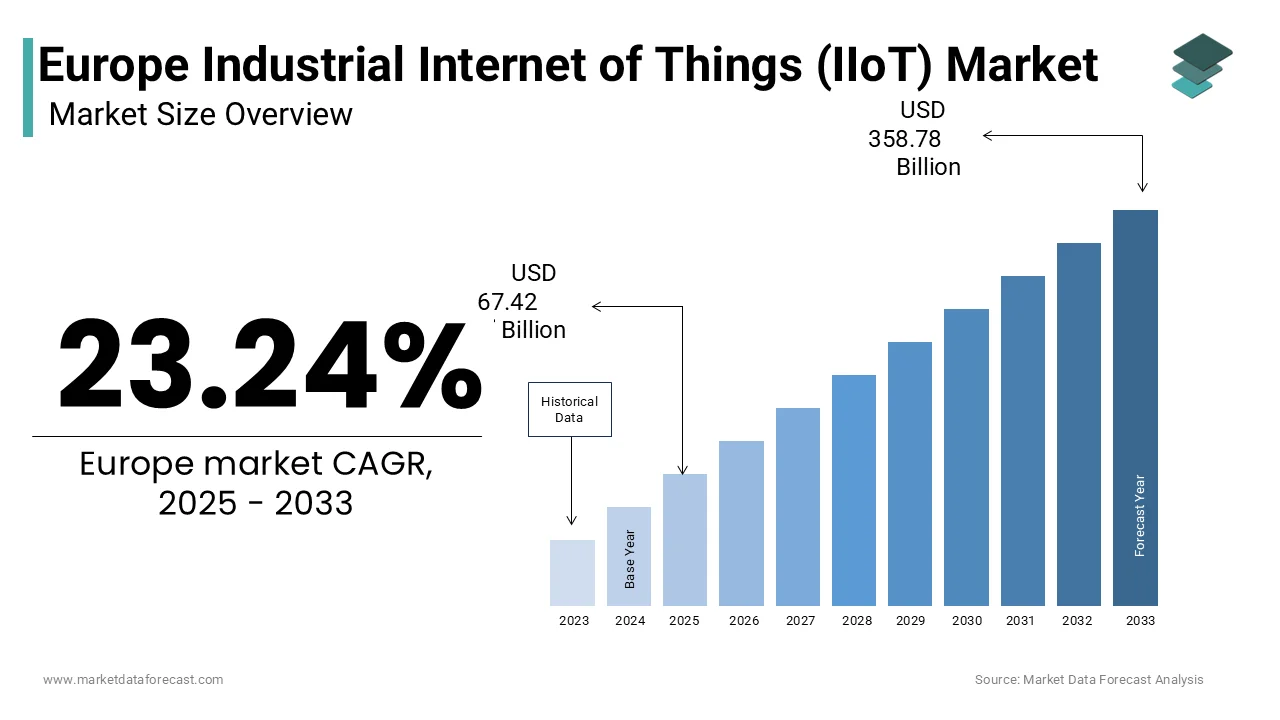
The Europe Industrial Internet of Things (IIoT) market was valued at USD 54.71 billion in 2024, is estimated to reach USD 67.42 billion in 2025, and is projected to grow at a strong CAGR of 23.24% from 2025 to 2033, reaching USD 358.78 billion by 2033, driven by EU Green Deal mandates, industrial decarbonization, private 5G deployment, and the rapid adoption of edge AI and digital twins across manufacturing and utilities.
Key Market Highlights
- 2024 Market Size: USD 54.71 billion
- 2025 Estimate: USD 67.42 billion
- 2033 Forecast: USD 358.78 billion
- CAGR (2025–2033): 23.24%
- Core Focus: Energy monitoring, predictive maintenance, digital twins, emissions tracking
Quick Growth Drivers
- EU Green Deal & CSRD mandates forcing real-time energy and emissions transparency
- Expansion of predictive maintenance and asset intelligence in factories
- Rapid rollout of private 5G networks for mission-critical IIoT workloads
- Growing use of digital twins in automotive, aerospace, and process industries
- Shift toward edge + cloud hybrid architectures for latency and data sovereignty
Principal Restraints
- Legacy machinery integration challenges in mature industrial bases
- High retrofit costs for SMEs with pre-2000 equipment
- Fragmented interoperability across PLCs, sensors, and platforms
- Uneven IIoT adoption between capital-intensive enterprises and SMEs
High-Value Opportunities
- Private 5G campus networks enabling low-latency industrial automation
- Digital Product Passports under the Circular Economy Action Plan
- Edge AI for real-time energy optimization and peak demand reduction
- Cross-border industrial data spaces for shared analytics and optimization
- IIoT-enabled remanufacturing and reverse logistics models
Key Market Challenges
- Rising cybersecurity risks from decentralized edge devices
- Limited endpoint visibility and OT security maturity
- Data governance fragmentation and vendor lock-in
- Cross-border interoperability barriers despite EU data-sharing ambitions
Fastest-Growing Segments
- Software: 21.7% CAGR – AI analytics, anomaly detection, digital twins
- LPWAN Connectivity: 25.2% CAGR – low-power monitoring in utilities & agriculture
- Hybrid / Edge Cloud Deployment: 23.4% CAGR – latency + sovereignty balance
- Process Manufacturing: 22.9% CAGR – decarbonization & safety compliance
Regional Leadership & Dynamics
- Germany (24.6%) – Industrie 4.0 leadership, private 5G, standardized platforms
- France (16.3%) – digital sovereignty, aerospace & nuclear IIoT adoption
- United Kingdom – life sciences, offshore energy, IIoT-driven compliance
- Italy – SME-led sensorization in heritage manufacturing
- Sweden – IIoT aligned with circular economy and climate monitoring
What Wins Commercially
- Platforms aligned with EU Green Deal, CSRD & Cybersecurity Act
- Hybrid edge-cloud architectures supporting low latency and sovereignty
- Open, standards-based interoperability (Gaia-X, IDS)
- Built-in AI at the edge for real-time decision making
- Strong OT cybersecurity and zero-trust frameworks
Top Strategic Ask
- Invest in private 5G + edge AI as a foundation, not an add-on
- Prioritize software-driven ROI over basic connectivity
- Build interoperable data models to avoid vendor lock-in
- Embed IIoT into sustainability and compliance reporting workflows
Leading Players
Some of the companies that are playing a dominating role in the Europe Industrial Internet of Things (IIoT) market include:
- Siemens AG
- SAP SE
- ABB Ltd.
- Schneider Electric SE
- Bosch Software Innovations
- Nokia Corporation
- Ericsson AB
Europe Industrial Internet of Things (IIoT) Market Size
The Europe Industrial Internet of Things (IIoT) market was valued at USD 54.71 billion in 2024, is expected to reach USD 67.42 billion in 2025, and growing at a CAGR of 23.24% from 2025 to 2033 is projected to reach USD 358.78 billion by 2033.
The Industrial Internet of Things (IIoT) refers to the extension and use of Internet of Things (IoT) technology in industrial sectors such as manufacturing, energy, and transportation. Unlike consumer IoT, industrial IoT in Europe is defined by deterministic networking, functional safety compliance, and interoperability across legacy machinery ecosystems. A defining feature of the European landscape is its convergence of industrial digitization with stringent sustainability mandates. According to multiple sources, large manufacturing enterprises across the European Union have been increasingly adopting Industrial Internet of Things (IIoT) applications for specific tasks, such as enhancing energy monitoring and enabling predictive maintenance operations. As per research, the implementation of advanced energy management systems, including those based on IIoT technologies, is a growing trend within European industrial facilities and is contributing to overall efforts in reducing direct (Scope 1) emissions. Furthermore, the European Commission is actively promoting the development of cross-sector data sharing frameworks through initiatives like the Industrial Data Space, encouraging broad participation from industrial partners in collaborative, secure IIoT testbeds. This regulatory and infrastructural alignment positions Europe’s IIoT evolution as a cornerstone of its green and digital twin transition.
MAKET DRIVERS
Mandates Under the EU Green Deal Driving Energy and Emissions Transparency
The European Green Deal’s binding decarbonization targets have transformed IIoT from an operational efficiency tool into a compliance necessity, which in turn drives the growth of the European industrial Internet of Things market. Industrial facilities across the EU are subject to the EU Emissions Trading System, which increasingly emphasizes robust and transparent monitoring and annual verification of emissions data. The revised EU Energy Efficiency Directive is driving large industrial facilities to adopt forThingsergy management systems or undergo regular energy audits to systematically improve efficiency. Digital solutions and advanced tracking technologies, such as those within the IIoT, are increasingly recognized for their potential to enhance the accuracy and reliability of industrial carbon emissions reporting, streamlining compliance efforts. Similarly, the EU’s Corporate Sustainability Reporting Directive requires a significantly expanded number of large companies to disclose extensive, externally-audited environmental performance metrics, encouraging the use of robust data management systems. The European steel industry is actively exploring advanced digital technologies like digital twins to model and simulate pathways for industrial decarbonization and improve production efficiency. These regulatory imperatives create a non-discretionary demand for IIoT infrastructure, particularly in heavy industry, where real-time visibility into thermal processes and compressor efficiency directly impacts carbon liability and operational licensing.
MARKET RESTRAINTS
Legacy Infrastructure Integration Constraints in Mature Industrial Bases
The region’s advanced but aging industrial asset base presents a significant technical and economic barrier to seamless IIoT adoption, which impedes the expansion of the European industrial internet of things market. Many manufacturing and utility facilities in Germany, France, and Italy operate machinery installed before 2000, lacking native connectivity or standardized communication protocols. According to a study, a significant portion of existing industrial machinery within the EU was manufactured before the widespread integration of digital control systems, necessitating substantial and often complex retrofitting efforts to enable modern connectivity and data exchange capabilities. Integrating Industrial Internet of Things (IIoT) solutions into existing legacy industrial environments generally incurs significantly higher expenses and complexity compared to implementing them in new, greenfield production facilities. Interoperability challenges remain a notable barrier to the widespread adoption of IIoT technologies; many small and medium-sized manufacturers encounter significant difficulties integrating new sensors and systems with their existing programmable logic controllers. Consequently, the pace of IIoT diffusion remains uneven, with adoption concentrated in capital-intensive sectors while fragmented SME ecosystems lag.
MARKET OPPORTUNITIES
Expansion of Private 5G Networks for Mission Critical Industrial Connectivity
The rollout of localized 5G networks is unlocking ultra-reliable low-latency communication essential for time-sensitive IIoT applications across the region, which provides new opportunities fEurope industrial internet of things market. Unlike public cellular networks, private 5G enables factory operators to guarantee sub 10 millisecond latency and high device density required for closed-loop cotime-sensitivenomous mobile robots. The number of dedicated, private wireless network deployments in industrialInternethroughout the region has surpassed a significant threshold. A notable concentration of these advanced network installations is observed within the manufacturing and processing industries in the central part of the region. The operational integrity and security protocols of these systems have been verified through a regional certification framework, ensuring their reliable separation from general corporate information technology environments. Initial project results in a specific heavy manufacturing facility indicate that connecting industrial internet sensors to robotic equipment via advanced networking solutions can lead to improvements in production consistency. Financial strategies have been implemented to support the expansion of this infrastructure, specifically targeting interconnected industrial zones that span multiple borders. This convergence of performance, security, and policy support transforms 5G from a connectivity layer into a foundational enabler of next-generation industrial automation.
Circular Economy Integration Through Product-Level Digital Identities
The EU’s Circular Economy Action Plan is causing IIoT adoption by mandating traceability of materials and components throughout industrial lifecycles, which offers potential prospects for the European industrial internet of things market growth. Regulations are shifting toward the mandatory implementation of digital documentation to track the lifecycle of goods across primary industrial sectors. Digital product records are increasingly incorporating data generated during the operational pEuropeano detail maintenance activities and usage patterns. A substantial portion of the information within these digital passports is expected to be derived from sensors that monitor physical stressors and functional duration. Automated tracking systems in assembly environments are enhancing the ability to assess and categorize components for potential reuse or secondary applications. The integration of intelligent tagging on containers is improving the accuracy of material classification and the management of hazardous substances. These developments position IIoT not merely as a production optimizer but as the data backbone of Europe’s resource loop economy by creating new value streams in remanufacturing, reverse logistics, and sustainable compliance.
MARKET CHALLENGES
Cybersecurity Vulnerabilities in Decentralized Edge Deployments
The proliferation of IIoT devices at the network edge has exponentially expanded the attack surface for industrial control systems, which raises acute cybersecurity concerns across the region and hampers the expansion of the European industrial internet of things market. Unlike centralized IT environments, edge IIoT nodes often operate with minimal processing power, limiting their ability to run advanced encryption or intrusion detection protocols. A notable majority of reported security events impacting operational technologies appear to originate from vulnerabilities within input sensors or network gateways that lack foundational security controls. Recent forensic investigations into successful ransomware incidents have identified initial access points as simple, unmonitored industrial monitoring devices connected to maintenance infrastructure. A significant portion of industrial organizations have not yet implemented comprehensive systems capable of tracking all connected industrial endpoints, indicating a potential gap in fulfilling new security requirements. This gap between regulatory expectations and operational readiness leaves critical infrastructure exposed, particularly in sectors with long equipment refresh cycles where firmware updates are impractical.
Fragmented Data Governance and Cross-Border Interoperability Gaps
Industrial data flows remain hindered by inconsistent national implementations of data sovereignty rules and proprietary platform lock-in, despite the EU’s ambition for a unified data economy, which holds back the growth of the European industrial Internet of Things market. Many IIoT solutions deploy vendor-specific data models that impede interoperability between machinery from different manufacturers, undermining the vision olock-inindustrial ecosystems. According to a study, only a portion of IIoT deployments in cross boEuropeanupply chainsInternetd fuThingsantic interoperability, forcing firmsvendor-specificrallel data pipelines. Additionally, national data localization preferences, such as France’s Cloud Souverain initiative or Germany’s Gaia X framework, create legal uncertainty for multinational operators seeking to centralize analytics. These governance and technical silos inhibit the scalability of IIoT platforms, which reduces ROI and slows the adoption of collaborative applications such as predictive logistics or shared energy optimization across industrial parks.
REPORT COVERAGE
| REPORT METRIC | DETAILS |
| Market Size Available | 2024 to 2033 |
| Base Year | 2024 |
| Forecast Period | 2025 to 2033 |
| Segments Covered | By Component, Deployment Model, Connectivity Technology, End User Vertical, and Region. |
| Various Analyses Covered | Global, Regional, and Country-Level Analysis, Segment-Level Analysis, Drivers, Restraints, Opportunities, Challenges; PESTLE Analysis; Porter’s Five Forces Analysis, Competitive Landscape, Analyst Overview of Investment Opportunities |
| Countries Covered | UK, France, Spain, Germany, Italy, Russia, Sweden, Denmark, Switzerland, Netherlands, Turkey, Czech Republic, Rest of Europe |
| Market Leaders Profiled | Siemens AG, General Electric Company (GE Digital), Cisco Systems, Inc., Hitachi, Ltd. (Hitachi Vantara), IBM Corporation, Microsoft Corporation (Azure IoT), SAP SE, Schneider Electric SE, PTC Inc., Rockwell Automation, Inc., Honeywell International Inc., Bosch Software Innovations (Robert Bosch GmbH), ABB Ltd., Oracle Corporation, Dassault Systèmes SE, PTC ThingWorx, Amazon Web Services, Inc. (AWS IoT), Nokia Corporation, Ericsson AB |
SEGMENTAL ANALYSIS
By Component Insights
The services segment dominated the European industrial Internet of Things market by accounting for a 34.9% share in 2024. The slowdown of the services segment is driven by the complexity of IIoT implementation, which demands extensive integration, cybersecurity hardening, and ongoing operational support, and the EU’s regulatory shift, European outcome compliance, compelling firms to outsource specialized expertise. Small and medium manufacturers increasingly depend on external expertise for managing and securing Industrial Internet of Things (IIoT) systems due to prevalent skill shortages in operational technology (OT) cybersecurity. The rise of managed IIoT services under industrial as a service models also contributes to the growth of this segment. The adoption of third-party industrial cloud services, particularly for applications like predictive maintenance, is a growing trend as manufacturers seek to increase operational efficiency and minimize unplanned production outages. These trends underscore how services have evolved from ancillary support to strategic enablers of IIoT value realization.
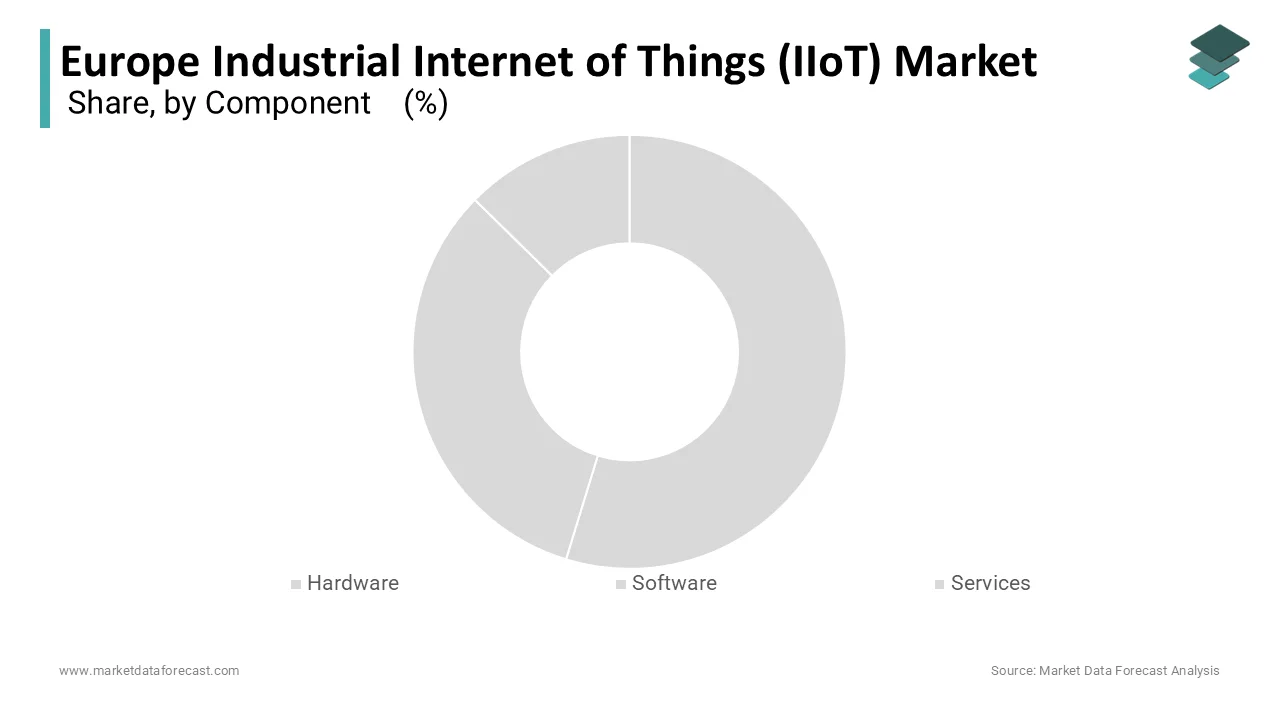
The software segment is on the rise and is expected to be the fastest-growing segment in the market by witnessing a CAGR of 21.7% from 2025 to 2033. The rapid acceleration of the software segment is propelled by the standardization of industrial data platforms, which is enabling scalable analytics. A large number of entities have collaborated to adopt a set offastest-growingdels. These common models facilitate the operation of software applications across diverse industrial machinery. The implementation of this framework has been associated with a significant reduction in expenses related to software customization. Moreover, AI-infused IIoT software is unlocking new operational capabilities. As per research, AI-driven anomaly detection software reduced false alarms in continuous process plants while improving early fault identification. Software is becoming the key factor in demonstrating IIoT ROI as European industries shift their focus from mere connectivity to integrated intelligence.
By Deployment AI-drivenights
The hybrid or Edge Cloud model segment held the leading share of 42.3% of the European industrial Internet of Things market in 2024. The leading position of the hybrid or edge cloud model segment is attributed to the need to process time-sensitive control data locally while leveraging cloud resources for long term analytics. This preference arises from Europe’s dual imperative of data sovereignInterneteal Thingsesponsiveness. According to sources, New Industrial Internet of Things deployments in sectors such as automotive and time-sensitive industries are increasingly adopting advanced network architectures, including hybrid approaches, to achieve very low latency communication for critical applications. A further growth driver is regulatory alignment with the EU Cybersecurity Act, which mandates segregation of operational technology networks from corporate IT. As per research, the European Union Agency for Cybersecurity emphasizes that adopting robust security measures, such as network segmentation and hybrid security models, can substantially mitigate cross-domain breach risks across various industrial environments, thereby improving overall operational resilience. This architecture thus satisfies both performance and compliance demands unique to Europe’s industrial landscape.
The hybrid or edge cloud segment is also expected to exhibit a noteworthy CAGR of 23.4% during the forecast period due to the convergence of edge AI and green manufacturing. According to various studies, factories using edge-based IIoT software for demand energy optimization cut peak electricity demand, directly supporting EU energy crisis mitigation goals. Additionally, sovereign cloud initiatives like Gaia X are accelerating hybrid adoption. Germany is actively fostering significant progress in enabling cross-edge-based data sharing for circular economy applications through the development of national industrial data ecosystems. These initiatives, supported by the Federal Ministry for Economic Affairs and Climate Action, promote numerous collaborative projects focused on developing and implementing secure, sovereign data spaces, leading to the creation of applications like digital product passports and shared spare parts inventories. These developments position hybrid edge cloud not merely as a technical choice but as a strategic enabler of Europe’s digital green twin vision.
By connectivity technologies Insights
The cellular technologies segment led the European industrial Internet of Things market and captured a 38.5% share in 2024. The supremacy of the cellular technologies segment is credited to the need for wide area, high bandwidth, and low latency connectivity across dispersed industrial assets. According to sources, the deployment of private 5G networks across industrial sites in the European Union has seen substantial growth, driven by the needs of advanced manufacturing and logistics sectors. A different growth driver is the spectrum allocation policy. Regulatory bodies across the European Union have increasingly facilitated local spectrum access for enterprises, leading to a supportive regulatory environment that encourages the adoption of private 5G networks for industrial applications. Germany is a leading market in Europe for private 5G network deployment, distinguished by favorable national policies that encourage a high number of individual enterprises to establish their own localized campus networks. This regulatory enabler has made cellular the default choice for greenfield IIoT deployments requiring mobility and reliability.
The LPWAN segment is predicted to witness the highest CAGR of 25.2% over the forecast period, owing to Europe’s push for energy-efficient monitoring in legacy and remote facilities. Low-power wide-area network sensors have been integrated into district heating infrastructure for improved oversight of network health and operational status. The extended battery longevity and low power consumption of these devices allow energy-efficient monitoring cycles and lower long-term upkeep requirements. Agricultural policy frameworks have begun to encourage the adoption of digital monitoring systems for the management of soil health and water distribution. A growing number of agricultural operations are implementing connected sensor technologies to enhance precision in irrigation and resource usage. The shift toward automated monitoring reflects a broader trend of utilizing connectivity solutions to streamline maintenance and resource management in utility and farming sectors. LPWAN’s ultra-low cost and power profile make it ideal for non-critical but high-volume sensing, aligning perfectly with Europe’s sustainability-driven IIoT expansion.
By End User Vertical Insights
The discrete manufacturing segment was the largest in the European industrial internet of things market and occupied a share of 36.1% in 2024. The prominent critical high-volume segment is supported by Europe’s strong sustainability-driven economy and electronics production base, where IIoT enables flexible, high-precision assembly, and the EU’s push for resilient supply chains, which has accelerated digital twin adoption. European carmakers are increasingly leveraging IIoT-connected digital twins to proactively simulate potential production disruptions and efficiently reconfigure manufacturing lines to maintain operational speed. An additional factor is workforce adaptation to human-machine collaboration. The use of IIoT-guided work instructions in factories is becoming more common, substantially enhancing product quality on the first attempt and significantly shortening the required training duration for new operators. These gains make discrete manufacturing the most IIoT mature sector in Europe.
The process manufacturing segment is estimated to register the fastest CAGR of 22.9% from 2025 to 2033. The swift expansion of the process manufacturing segment is fuelled by decarbonization mandates in continuous process industries. The chemical industry is increasingly adopting IIoT-based flare gas monitoring systems to improve operational efficiency and significantly reduce environmental emissions. Regulatory bodies, such as the European Commission, encourage the use of such advanced digital technologies in the pursuit of enhanced safety and environmental performance. A further growth enabler is safety modernization. The established Seveso III Directive and related safety regulations drive hazardous process facilities toward adopting advanced technologies, such as continuous monitoring and data-intensive smart sensors, to improve equipment integrity management, prevent major accidents, and enhance compliance with robust safety management principles. As per research, the integration of IIoT-enabled safety systems in process facilities can substantially enhance situational awareness, enabling significantly faster detection of anomalies and more efficient mitigation of potential hazards. As regulatory pressure intensifies, process manufacturing transforms from a laggard to an IIoT growth leader.
COUNTRY LEVEL ANALYSIS
Germany Industrial Internet Of Things Market Analysis
Germany was the top performer in the European industrial Internet of Things market and accounted for a 24.6% share in 2024. The supremacy of the German market is attributed to its Plattform Industrie 4.0 initiative, which has certified over 1200 interoperable IIoT solutions as of 2024. This shows its status as the continent’s manufacturing powerhouse and digital policy pioneer. A significant majority of large manufacturers have adopted industrial Internet of Things applications for predictive maintenance. This implementation has resulted in a measurable decrease in the amount of time machinery is out of service. There is a leading pattern of private, localized wireless network adoption within industrial sectors. A substantial number of Internet of Things or private spectrum usage have been allocated to various industrial entities. The combination of technical standardization, regulatory foresight, and deep industrial engineering expertise solidifies Germany’s dominant position in the regional IIoT ecosystem.
France Industrial Internet Of Things Market Analysis
France was the next prominent country, with a 16.3% share of the European industrial Internet of Things market in 2024. The demand for IIoT in France is fuelled by its state-driven digital sovereignty strategy, strong nuclear and aerospace sectors, and digital twin adoption. Public investment strategies are increasingly directed toward the modernization of industriEuropeanrastructureInternet advThingsdigital frameworks. There is a growing emphasis on developing independent technological architectures that align with international data sovereignty standards. Industrial facilities are progressively adopting connected monitoring systems to track resource consumption and operational efficiency. The integration of industrial internet technologies serves as a primary method for aligning manufacturing activities with national environmental and climate objectives. A shift is occurring toward standardized digital ecosystems that facilitate secure and interoperable data exchange across the industrial sector. Additionally, Airbus and Safran have embedded IIoT sensors in engine test benches across Toulouse and Bordeaux, enabling real-time material stress analytics that shortened certification cycles, as per sources. These top-down industrial policies amplify France’s IIoT momentum beyond its organic market size.
United Kingdom Industrial Internet Of Things Market Analysis
The United Kingdom remains a significant player in the real-time IIoT market due to its advanced life sciences, offshore energy, and fintech-enabled industrial services. Post Brexit, the UK has prioritized regulatory autonomy in industrial AI, with the National AI Strategy mandating IIoT-based transparency in automated decision-making. Advanced monitoring technology is increasingly being integrated within pharmaceutical manufacturing to track production in real time. This technological shift appears linked to an industry-wide effort to ensure product traceability and align with regulatory requirements. Analysis of the energy sector indicates the implementation of Internet of Things devices on offshore platforms to detect and mitigate gas emissions, with data suggesting this adoption is a factor in decreasing atmospheric releases from these operations. Overall, both sectors show a trend towards using digital infrastructure to enhance operational compliance and environmental performance. The UK’s blend of sectoral specialization and agile regulation sustains its strong IIoT position.
Italy Industrial Internet Of Things Market Analysis
Italy holds a noteworthy position in the European industrial Internet of Things market, with growth supported by its dense network of small and medium enterprises and heritage manufacturing sectors like textiles and machinery. A notable financial structure was created to promote the incorporation of industrial Internet of Things solutions. European companies have facilitated thousands of businesses in deploying sensor-focused methods for overseeing manufacturing workflows. The deployment of these oversight instruments aligned with an enhancement in operational performance, particularly concerning Internet of Things effectiveness. Besides, Italy leads in IIoT for cultural heritage industrialization, with firms like Luxottica using connected vision systems to ensure artisanal eyewear meets digital quality benchmarks across global supply chains. The fusion of tradition and technology creates a unique IIoT adoption pattern that prioritizes incremental digitization over wholesale transformation.
Sweden Industrial Internet Of Things Market Analysis
Sweden is anticipated to grow in the European industrial Internet of Things market over the forecast period, owing to its integration of IIoT with circular economy and climate goals. Facilities operating above a specified thermal capacity threshold are observed to employ real-time emissions monitoring technologies. A high rate of adoptioEuropeanthese monitoInternettemsThingseen noted among heavy material p,roducers. Significant sensor integration is evident in advanced production facilities focused on hydrogen-based reduction processes. The use of digital material passports has enabled the verifiable sourcing of a substantial portion of recycled materials across various industries. Industry-wide data sharing initiatives focused on material reuse are being established to promote circular economy practices. This systems-level approach positions Sweden as a sustainability-driven IIoT innovator.
COMPETITIVE LANDSCAPE
Competition in the European industrial Internet of Things market is defined by a convergence of industrial heritage, technological innovation,n and regulatory alignment. Unlike other regions where price or scale dominate the landscape, Europe’s sustainability-driveners focus on compliance, interoperability, and sustainability integration. Global industrial automation leaders compete alongside European software specialists, and telecom infrastructu,, re providers, each vying to offer sovereig,n secu, re astandards-basedsed solutions. The European Union’s emphasis on digital sovereignty has elevated local play, ers while compelling multinationals to establish regional data centers and open source collaborations. At the same time, stringent cybersecurity and environmental regulations raise the technical and legal barriers to entry,y favoring established firms with proven governance frameworks. Innovation is increasingly measured not by connectivity alone but by the ability to generate actionable insights that support decarbonization, circularity, and resilient supply chains. This unique competitive environment rewards those who can bridge the physical and digital industrial worlds within Europe’s distinct policy ecosystem.
KEY MARKET PLAYERS
Some of the companies that are playing a dominating role in the europe industrial internet of things (IIoT) market include
- Siemens AG
- General Electric Company (GE Digital)
- Cisco Systems, Inc.
- Hitachi, Ltd. (Hitachi Vantara)
- IBM Corporation
- Microsoft Corporation (Azure IoT)
- SAP SE
- Schneider Electric SE
- PTC Inc.
- Rockwell Automation, Inc.
- Honeywell International Inc.
- Bosch Software Innovations (Robert Bosch GmbH)
- ABB Ltd.
- Oracle Corporation
- Dassault Systèmes SE
- PTC ThingWorx
- Amazon Web Services, Inc. (AWS IoT)
- Nokia Corporation
- Ericsson AB
TOP LEADING PLAYERS IN THE MARKET
- Siemens is a pivotal force in the European industrial Internet of Things market through its MindSphere platform and embedded automation systems. The company integrates IIoT across its portfolio of programmable logic controllers, drives, and digital twins, enabling seamless data flow from the shop floor to enterprise analytics. It also expanded its Edge Computing portfolio with secure gateways compliant with the EU Cybersecurity Act. These initiatives reinforce Siemens’s global leadership while deepening its alignment with Europe’s digital sovereignty and green manufacturing agendas.
- SAP drives IIoT adoption in Europe via its integrated suite of intelligent asset management and supply chain solutions. Its SAP Edge Application Server and Asset Intelligence Network allow manufacturers to contextualize real-time sensor data within enterprise resource planning workflows. The company also partnered with Fraunhofer institutes to develop open data models for circular product passports. These moves position SAP as a critical enabler of Europe’s regulatory-driven industrial transformation.
- ABB leverages its domain expertise in electrification and robotics to deploy IIoT solutions across heavy industry and utilities in Europe. Its Ability platform connects millions of industrial assets, from transformers to industrial robots, enabling predictive maintenance and energy optimization. It also co-founded the European Industrial Edge Alliance to standardize edge computing interfaces for legacy machinery. ABB’s focus on operational safety, energy efficiency, and interoperability strengthens its influence in Europe’s mission-critical IIoT sectors.
TOP STRATEGIES USED BY THE KEY MARKET PARTICIPANTS
Key players in the European Internet of Things market consistently pursue five strategic imperatives to secure a competitive advantage. First, they embed artificial intelligence and machine learning directly into edge devices to enable real-time decision-making while minimizing data transmission. Second, they align their platformsInternetropThingsgulatory framework,s including the EU AI A,ct the Cybersecurity Act and the Corporate Sustainability Reporting Directive to ensure compliance and build trust. Third, they invest in open architecture and semantic interoperability through participation in initiatives like Gaia X and the Industrial Data Space. Fourth,h, they form deep vertical specific partnerships wi,th industrial leaders in automotive chemicals and en,ergyto developp use case-driven solutions. Fifth, they enhance cybersecurity by implementingzero-trustt architectures and hardware-rooted device identity management across their IIoT ecosystems.
MARKET SEGMENTATION
This research report on the europe industrial internet of things (IoT) market is segmented and sub-segmented into the following categories.
By Component
- Hardware
- Software
- Services
By Deployment Model
- On-Prem hardware-rooted / Edge Cloud
By Connectivity Technology
- Cellular Technologies
- LPWAN
- Industrial Ethernet
- Others
By End User Vertical
- Discrete Manufacturing
- Process Manufacturing
- Energy & Utilities
- Transportation & Logistics
- Others
By Country
- Germany
- France
- United Kingdom
- Italy
- Sweden
- Rest of Europe
Frequently Asked Questions
1. What drives growth in the Europe Industrial Internet of Things (IIoT) Market?
Key drivers for the Europe Industrial Internet of Things (IIoT) Market include Industry 4.0 adoption, government initiatives for industrial automation, and needs for productivity gains. Rising smart factories, autonomous robots, and centralized asset monitoring boost demand, especially in manufacturing and energy. Sustainability focus and data center proliferation further propel expansion.
2. Who are the top countries in the Europe Industrial Internet of Things (IIoT) Market?
Germany dominates the Europe Industrial Internet of Things (IIoT) Market due to its manufacturing prowess and digital twin usage, followed by UK, France, Italy, and Poland with high growth potential. These nations leverage automotive, chemical, and logistics sectors for IIoT deployment. Eastern Europe shows rapid CAGR from industrial base strengthening.
3. What is the role of manufacturing in the Europe Industrial Internet of Things (IIoT) Market?
Manufacturing holds the largest share in the Europe Industrial Internet of Things (IIoT) Market, driven by automation, robotics, and predictive maintenance. IIoT transforms supply chains into digital networks, enhancing quality and efficiency. Industry 4.0 trends and smart factories in Germany and Italy fuel this segment's dominance.
4. How does Industry 4.0 impact the Europe Industrial Internet of Things (IIoT) Market?
Industry 4.0 significantly boosts the Europe Industrial Internet of Things (IIoT) Market by enabling interconnected systems, real-time data, and intelligent automation. It supports smart factories and dynamic supply chains, with Germany leading adoption. This shift improves productivity and integrates ecosystem partners effectively.
5. What are the key components in the Europe Industrial Internet of Things (IIoT) Market?
Key components of the Europe Industrial Internet of Things (IIoT) Market include sensors, gateways, connectivity platforms, analytics, and security solutions. These enable remote monitoring and decision-making in industrial settings. Edge computing and 5G integration are rising, supporting applications in manufacturing and logistics.
6. What challenges exist in the Europe Industrial Internet of Things (IIoT) Market?
Challenges in the Europe Industrial Internet of Things (IIoT) Market involve data security, privacy concerns, and high implementation costs for IoT devices. Skilled specialist shortages also hinder adoption. However, outsourcing and cost reductions in connected devices are mitigating these issues across Europe.
7. What opportunities are there in the Europe Industrial Internet of Things (IIoT) Market?
Opportunities in the Europe Industrial Internet of Things (IIoT) Market arise from predictive maintenance, SME adoption, and sustainability drives. Advanced analytics, edge computing, and secure connectivity offer growth for innovators. Regulatory support for energy efficiency enhances prospects in manufacturing and utilities.
8. How large is the Germany segment of the Europe Industrial Internet of Things (IIoT) Market?
Germany accounts for the largest share in the Europe Industrial Internet of Things (IIoT) Market, propelled by automotive dominance and Industry 4.0. Digital twins and smart city projects boost productivity. Its manufacturing focus and tech readiness make it a leader, influencing regional trends.
9. Which sectors use IIoT most in the Europe Industrial Internet of Things (IIoT) Market?
Manufacturing, energy & utilities, oil & gas, and transportation lead in the Europe Industrial Internet of Things (IIoT) Market. Agriculture, retail, and telecom follow. These sectors benefit from automation, monitoring, and efficiency gains via connected devices and analytics.
10. What role does predictive maintenance play in the Europe Industrial Internet of Things (IIoT) Market?
Predictive maintenance is pivotal in the Europe Industrial Internet of Things (IIoT) Market, using sensors and analytics to foresee equipment failures. It reduces downtime and costs in manufacturing and energy. IIoT platforms enable real-time data for proactive repairs, enhancing reliability.
Related Reports
Access the study in MULTIPLE FORMATS
Purchase options starting from
$ 2000
Didn’t find what you’re looking for?
TALK TO OUR ANALYST TEAM
Need something within your budget?
NO WORRIES! WE GOT YOU COVERED!
Call us on: +1 888 702 9696 (U.S Toll Free)
Write to us: sales@marketdataforecast.com