- Product Description Description
- Table of Contents TOC
- List of Table & Figure LOT
- Get Free Sample PDF Sample PDF
Market Size, 2025
$4.66 BnMarket Estimate, 2026
$5.94 BnMarket Forecast, 2034
$41.48 BnCAGR, 2026–2034
27.5%Europe Predictive Maintenance Market Size
The Europe predictive maintenance market size was valued at USD 4.66 billion in 2025 and is projected to reach USD 41.48 billion by 2034 from USD 5.94 billion in 2026, growing at a CAGR of 27.5%.
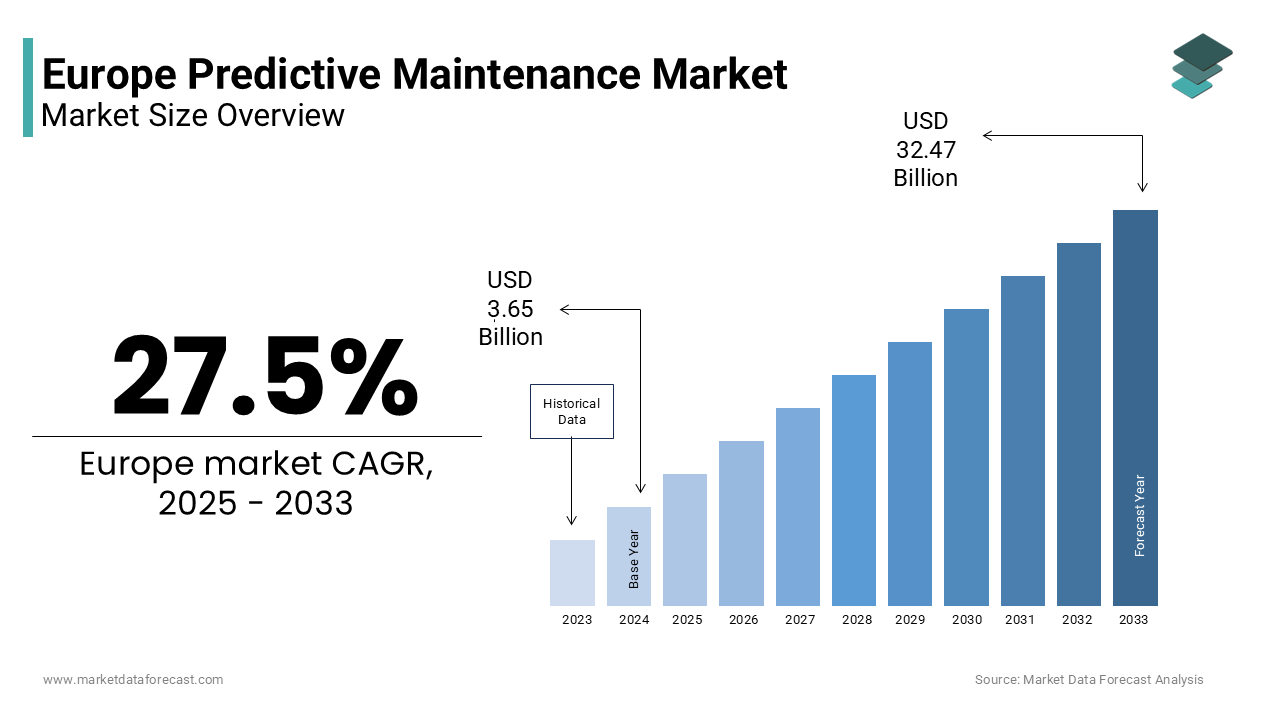
Predictive maintenance refers to the application of data driven analytics, sensor technologies, and artificial intelligence to anticipate equipment failures before they occur, thereby optimizing asset performance and minimizing unplanned downtime across industrial and infrastructure systems. Unlike reactive or scheduled maintenance, this approach leverages real time monitoring of parameters such as vibration, temperature, and acoustic emissions to forecast degradation patterns. The model has gained strategic relevance amid Europe’s industrial modernization agenda, where operational continuity is critical in sectors like energy, manufacturing, and transport. According to sources, unplanned machinery breakdowns in European Union industrial facilities significantly hinder productivity, with the impact being particularly notable in heavy industry sectors. As per the European Environment Agency, extending equipment lifespans through intelligent maintenance also contributes to circular economy objectives by reducing material waste and energy consumption. Furthermore, the European Commission’s Digital Europe Programme allocates significant funding to various digital technology areas, supporting initiatives such as smart manufacturing and the deployment of advanced maintenance solutions within small and medium enterprises via mechanisms like European Digital Innovation Hubs. This convergence of economic efficiency, sustainability mandates, and digital policy frameworks positions predictive maintenance as a cornerstone of Europe’s industrial resilience strategy.
MARKET DRIVERS
Integration of Industrial Internet of Things and Edge Computing
The proliferation of Industrial Internet of Things devices and edge computing infrastructure drives the growth of the Europe predictive maintenance market. This has fundamentally enabled the scalability and responsiveness of predictive maintenance systems across European factories and critical infrastructure. Modern industrial assets are increasingly embedded with sensors that continuously transmit operational data to localized edge processors, allowing real time anomaly detection without reliance on cloud latency. According to research, the adoption of native Industrial Internet of Things (IIoT) connectivity in new industrial machinery across Europe, particularly in leading industrial nations such as Germany, Italy, and France, continues to show significant growth as a key aspect of the ongoing digital transformation in manufacturing (Industry 4.0). This hardware foundation supports advanced analytics algorithms that can identify subtle performance deviations weeks before catastrophic failure. The implementation of edge-enabled predictive maintenance systems is an emerging trend, with industry reports emphasizing that processing data closer to the source can offer substantial reductions in data processing time and latency compared to reliance on centralized cloud models, which is a key benefit for high-speed production environments. Moreover, regulatory standards like the EU Cybersecurity Act have accelerated the adoption of secure, on-premise edge architectures that comply with data sovereignty requirements under the General Data Protection Regulation. This technological synergy not only enhances diagnostic accuracy but also aligns with Europe’s strategic autonomy goals in digital industrial infrastructure, making predictive maintenance both technically viable and geopolitically aligned.
Stringent EU Regulations on Industrial Emissions and Resource Efficiency
European Union environmental legislation has become a powerful accelerator for the Europe predictive maintenance market. This shift occurs because the regulations tie operational reliability directly to sustainability compliance. The Industrial Emissions Directive mandates that large installations minimize energy waste and unplanned releases, while the upcoming Energy Efficiency Directive revision requires manufacturers to demonstrate continuous improvement in asset performance. As per the European Court of Auditors, inefficient machinery accounts for a portion of avoidable energy consumption in EU industrial facilities, directly contravening Green Deal decarbonization targets. Predictive maintenance directly addresses this by ensuring equipment operates at optimal efficiency, thereby reducing both emissions and resource input. The production of cement is a major source of carbon emissions globally, and technological advancements, such as predictive maintenance, can contribute to operational efficiencies and help mitigate some of the associated environmental impact. Similarly, the European Union has implemented regulations that promote the design of products for increased durability, reparability, and prolonged use within the market. Companies that fail to adopt such technologies risk non-compliance penalties and reputational damage under expanding corporate sustainability reporting obligations. Thus, predictive maintenance is no longer merely an operational choice but a regulatory necessity in Europe’s regulated industrial landscape.
MARKET RESTRAINTS
High Initial Investment and Integration Complexity
Requirement of substantial upfront capital and technical integration challenges, despite its long-term benefits, act as a major restraint to the Europe predictive maintenance market. This is particularly true among small and medium enterprises that constitute a significant share of EU industrial firms. Implementing a full scale solution often necessitates retrofitting legacy machinery with sensors, establishing secure data pipelines, and retraining maintenance personnel—collectively costing significantly for a mid sized production line. Many older facilities, especially in Southern and Eastern Europe, lack standardized communication protocols like OPC UA, making interoperability with modern analytics platforms difficult. Furthermore, the return on investment timeline. As per a study, a notable share of SMEs cite cost and complexity as primary barriers to adoption, even when aware of potential downtime reductions. High levels of bureaucracy and stringent co-financing rules often make EU funding inaccessible for many applicants. This financial and technical friction creates a two-tier market where only large multinationals and well capitalized mid-caps can fully leverage predictive capabilities, thereby exacerbating competitive disparities within Europe’s industrial base.
Shortage of Skilled Workforce in Data Analytics and Industrial AI
A shortage of professionals with combined knowledge in industrial operations and data science is a significant issue for the Europe predictive maintenance market. This skill gap is severely hindering the effective adoption of predictive maintenance across the region. According to research, the European Union faces a significant and persistent skills gap, with an increasing demand for professionals skilled in digital technologies including artificial intelligence and machine learning across various industrial sectors. Maintenance technicians traditionally trained in mechanical diagnostics often lack the statistical literacy to interpret algorithmic outputs, while data scientists rarely possess domain knowledge of rotating equipment or process engineering. This skills gap leads to suboptimal model tuning, false alarms, and underutilization of deployed systems. Studies on the adoption of advanced manufacturing technologies, such as predictive maintenance tools, often emphasize that a lack of adequately trained staff is a major barrier to their full utilization in German and other European manufacturing plants. Educational curricula have been slow to adapt. There is a growing recognition within the European Association for Engineering Education and related bodies that engineering curricula must evolve to integrate interdisciplinary skills, combining fields like mechatronics and data analytics, to meet the demands of modern industry. Europe's ambition for smart manufacturing leadership is jeopardized, as advanced predictive platforms may go unused without both targeted reskilling and cross-functional teams.
MARKET OPPORTUNITIES
Expansion into Renewable Energy Infrastructure Monitoring
The rapid deployment of wind and solar power across the region has developed a focused area for predictive maintenance, which ultimately provides new opportunities for the growth of the Europe predictive maintenance market. This is essential for ensuring the reliability of distributed and often remote energy assets. Offshore wind farms, which contributed a portion of the EU’s total wind capacity in 2025, according to various studies, face extreme operational stresses that make unscheduled repairs both costly and logistically complex. Predictive systems that monitor blade erosion, gearbox vibration, and transformer temperature can prevent failures that would otherwise require multi day vessel mobilizations costing significant amount of euros per incident. Similarly, Utility-scale solar parks routinely utilize sophisticated diagnostic tools such as thermal imaging and IV curve tracing to proactively identify and address cell degradation, optimizing performance before significant yield losses occur. European grid integration policies, driven by the European Network of Transmission System Operators for Electricity (ENTSO-E), are increasingly emphasizing advanced technical requirements, such as mandatory grid-forming capabilities for new large-scale renewable and storage installations, to ensure system stability as variable generation grows. Unlike traditional industrial settings, renewable assets operate in unstaffed environments where continuous remote diagnostics are not optional but essential. This convergence of policy, economics, and operational necessity positions clean energy as a high growth frontier for predictive maintenance innovation.
Adoption in Rail and Urban Mobility Systems
Extensive rail and public transit networks in the region are emerging as fresh prospects for the expansion of the Europe predictive maintenance market. This is due to rising passenger volumes and aging infrastructure. Many railway agencies across Europe are focusing on significant investment and modernization programs to address the aging nature of both track infrastructure and rolling stock, in order to improve reliability and safety. Unplanned disruptions not only incur direct repair costs but also trigger cascading delays and passenger compensation liabilities under EU Regulation 1371 2007. In response, operators like Deutsche Bahn and SNCF have deployed vibration and acoustic sensors on wheelsets and pantographs to predict wear before safety thresholds are breached. As per the Community of European Railway and Infrastructure Companies, modern data analytics and condition-based monitoring are key strategies in reducing incidents and improving the overall safety performance of the rail network. Urban metro systems in Paris, London, and Madrid similarly use thermal cameras and current signature analysis to monitor escalators, elevators, and traction systems. The European Green Deal's emphasis on rail as a low-carbon transport option means that system reliability has become a crucial policy objective. Predictive maintenance thus serves not only operational efficiency but also broader modal shift objectives by enhancing public trust in mass transit reliability.
MARKET CHALLENGES
Fragmented Data Governance and Cross Border Compliance Risks
A complex patchwork of national data protection and industrial cybersecurity regulations complicate cross border deployment and cloud-based analytics, which in turn hampers the growth of the Europe predictive maintenance market. France, like other European nations, is promoting national and EU-based "sovereign cloud" initiatives and certifications (like the SecNumCloud) to ensure sensitive data remains under EU jurisdiction and is protected from foreign legal requests, such as those under the U.S. CLOUD Act. The German IT Security Act 2.0 mandates that operators of critical infrastructure implement and verify adherence to robust, state-of-the-art security measures, as defined by the Federal Office for Information Security, to ensure system availability, integrity, and confidentiality. Legal experts and industry bodies note that the complex web of varying national data residency requirements within the European Union, combined with the extraterritorial reach of non-EU laws, creates significant legal uncertainty for multinational manufacturers, potentially complicating the rollout of data-intensive operations like predictive maintenance. This fragmentation inhibits the aggregation of diverse operational datasets needed to train robust machine learning models, particularly for rare failure modes. Companies with fragmented data governance frameworks often experience redundant compliance processes and hindered model performance, which ultimately prevents them from achieving the economies of scale promised by data-driven maintenance.
Over Reliance on Proprietary Vendor Ecosystems
Many predictive maintenance implementations in the region remain locked within closed and vendor specific platforms that limit interoperability and long-term flexibility. As a result, this constrains the expansion of the Europe predictive maintenance market. Major industrial automation providers often bundle sensors, edge hardware, and analytics software into integrated suites that do not support open standards like MQTT or Asset Administration Shell, as promoted under the European Commission’s Industrial Digital Twin initiative. According to a survey, a portion of surveyed manufacturers expressed concern about vendor lock in, citing difficulties in switching analytics providers or integrating legacy diagnostic tools. This dependency not only inflates total cost of ownership but also stifles innovation by preventing best in class algorithm substitution. Such constraints contradict the EU’s vision of a sovereign, interoperable industrial data space. Predictive maintenance will be constrained by proprietary silos, hindering collaborative advancement and technological sovereignty, unless open architecture becomes a policy-supported norm.
REPORT COVERAGE
| REPORT METRIC | DETAILS |
| Market Size Available | 2025 to 2034 |
| Base Year | 2025 |
| Forecast Period | 2026 to 2034 |
| CAGR | 27.5% |
| Segments Covered | By Component, Deployment, Enterprise Type, Technology, Application, End Use, and Region |
| Various Analyses Covered | Global, Regional, & Country Level Analysis; Segment-Level Analysis; DROC, PESTLE Analysis; Porter’s Five Forces Analysis; Competitive Landscape; Analyst Overview of Investment Opportunities |
| Regions Covered | UK, France, Spain, Germany, Italy, Russia, Sweden, Denmark, Switzerland, Netherlands, Turkey, and the Czech Republic |
| Market Leaders Profiled | Robert Bosch Engineering & Business Solutions, Software AG, PTC, Cisco Systems Inc, SAS AB, Accenture PLC, Honeywell International Inc, Rockwell Automation Inc, GE Aerospace, Siemens AG, Siemens Healthineers AG, SAP SE, Microsoft Corp, International Business Machines Corp (IBM), Schneider Electric SE, and Hitachi Ltd. |
SEGMENTAL ANALYSIS
By Component Insights
In 2025, the hardware segment was the largest segment in the Europe predictive maintenance market by holding a 58.2% share. The dominance of the hardware segment is driven by pervasive sensor and edge device deployment in legacy industrial bases, and regulatory and safety mandates that drive physical monitoring infrastructure. Europe’s industrial landscape is characterized by a vast installed base of aging machinery that requires retrofitting with modern monitoring capabilities to remain competitive. Hardware, comprising vibration sensors, thermal cameras, acoustic emission detectors, and edge gateways, serves as the foundational enabler for any predictive maintenance initiative. According to research, a significant portion of manufacturing equipment within certain European nations does not have modern, built-in digital connectivity. This has triggered a wave of hardware upgrades. The number of industrial sensors being delivered throughout the European Union has recently increased. Government initiatives designed to help small and medium enterprises have supported the addition of condition monitoring devices to production lines. Without physical data capture points, software analytics remain inert. Consequently, hardware investment precedes and often dictates the pace of predictive adoption, especially in capital intensive sectors like steel, chemicals, and heavy machinery where asset failure carries severe safety and financial consequences. Industrial safety regulations across Europe increasingly mandate real time equipment health monitoring, particularly in high risk environments. The legal imperatives transform hardware from a discretionary investment into a compliance necessity. Moreover, insurance providers have begun offering premium reductions for facilities with certified predictive monitoring hardware. This regulatory and financial pressure ensures sustained demand for physical components even as software capabilities evolve.
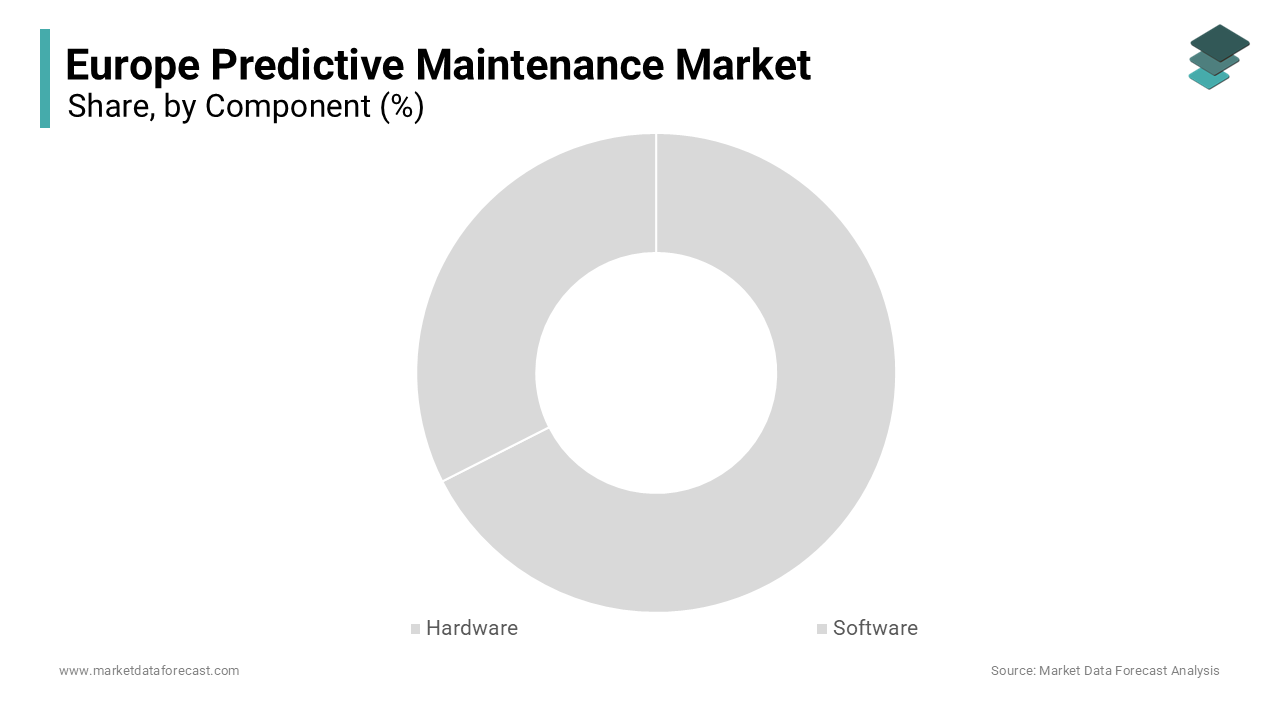
The software segment is predicted to witness the highest CAGR of 18.3% from 2026 to 2034 due to the advancement of AI-powered diagnostic algorithms and cloud analytics platforms, and integration with enterprise resource planning and digital twin frameworks. The shift from rule based to machine learning driven analytics has unlocked unprecedented accuracy in failure prediction, making software the true differentiator in predictive maintenance value chains. Modern platforms now use deep learning models trained on millions of operational hours to detect subtle degradation patterns, such as early bearing wear from micro vibration signatures, that traditional threshold based systems miss. Cloud based analytics providers like SAP and Siemens have further democratized access through subscription models, allowing even mid sized firms to leverage enterprise grade algorithms without on premise infrastructure. The increasing volume of data and the ability of models to self-optimize mean software is becoming the primary control center for asset management, which explains its quick growth. Predictive maintenance software is no longer a standalone function but a core module within broader industrial digital ecosystems. Furthermore, digital twin replicas rely on predictive software to simulate failure scenarios and optimize maintenance strategies. This systemic embedding ensures that software adoption scales with Europe’s broader industrial digitalization agenda, far outpacing the linear growth of hardware components.
By Enterprise Type Insights
The large enterprises segment continues to hold the leading share of the Europe predictive maintenance market in 2025. The leading position of the large enterprises segment is attributed to the capital availability and digital maturity of large industrial conglomerates, and regulatory and reporting obligations under EU corporate sustainability directives. Large enterprises in Europe, particularly in automotive, aerospace, and energy, possess the financial resources and technical infrastructure necessary to implement end to end predictive maintenance systems. Companies like Bosch, Siemens, and TotalEnergies operate dedicated Industry 4.0 labs where predictive models are co developed with software vendors and tested at scale. Large companies are securing financial support for digital initiatives. Predictive maintenance represents a common application of this funding. A significant portion of supported digitalization efforts involves this specific use case. Their centralized IT governance also facilitates standardization across global operations, allowing seamless deployment of unified platforms. In contrast, fragmented decision making and budget constraints in smaller firms slow adoption. This resource asymmetry ensures that large enterprises remain the primary drivers of market volume, not only through direct procurement but also by setting technical benchmarks that influence supplier ecosystems. Large enterprises are subject to stringent EU mandates that indirectly accelerate predictive maintenance adoption. The compliance and reputational incentives create a structural advantage for large enterprises, embedding predictive capabilities into their ESG and operational frameworks in ways that smaller competitors cannot easily replicate.
The SME segment is estimated to register the fastest CAGR of 21.6% during the forecast period owing to EU funded digitalization vouchers and national support schemes, and the rise of modular and pay per use predictive maintenance solutions. Recognizing that SMEs form the backbone of European manufacturing yet lack digital resources, the EU and member states have launched targeted subsidy programs to lower adoption barriers. Initiatives are providing funding specifically to help SMEs implement predictive maintenance pilot programs. Government-backed programs are assisting businesses with the implementation of predictive maintenance systems. Financial assistance is available, often covering a significant portion of the expenses related to necessary hardware and software for these technologies. Voucher programs are being utilized to help SMEs access various digital services, including predictive analytics tools. These programs bypass capital constraints by converting upfront costs into operational expenses, enabling rapid deployment. Crucially, they are coupled with training ensuring effective utilization. This policy driven acceleration is transforming SMEs from laggards into agile adopters. Technology providers have responded to SME needs with flexible, scalable offerings that eliminate traditional barriers. Cloud based platforms offer predictive maintenance as a service with monthly subscriptions, eliminating the need for capital expenditure. Moreover, partnerships with equipment lessors, such as Siemens Financial Services and Alfa Laval, embed predictive monitoring into asset leasing contracts, making it a default feature rather than an add on. This product model shift, combined with simplified user interfaces and automated diagnostics, empowers SMEs to achieve enterprise grade reliability without enterprise grade complexity, driving unprecedented growth in this segment.
By Application Insights
The condition monitoring segment led the Europe predictive maintenance market and captured a 34.5% share in 2025. The supremacy of the condition monitoring segment is credited to foundational role in mechanical failure prevention across core industries, and standardization through EU machinery and safety regulations. Condition Monitoring serves as the entry point for most predictive maintenance programs by continuously tracking physical parameters such as vibration, temperature, and acoustic emissions on critical rotating assets. The application’s dominance stems from its direct correlation with mechanical reliability and its compatibility with both legacy and new machinery. Unlike higher order analytics, condition monitoring delivers immediate, interpretable insights that maintenance teams can act upon without data science expertise, making it the most widely deployable and trusted layer of predictive infrastructure across Europe’s diverse industrial base. Condition Monitoring has been elevated from a best practice to a regulatory expectation under evolving EU industrial safety frameworks. The updated Machinery Regulation requires that equipment with high kinetic energy incorporate continuous diagnostic systems capable of triggering automatic shutdowns upon anomaly detection. National authorities enforce compliance rigorously. Insurance underwriters have also institutionalized its use. This regulatory and financial embedding ensures that condition monitoring remains the bedrock application, even as more sophisticated analytics layers emerge atop it.
The predictive analytics segment is anticipated to witness the fastest CAGR of 20.1% from 2026 to 2034. The rapid growth of the predictive analytics segment is fuelled by the integration of deep learning and multimodal data fusion, and adoption in complex, multi asset process industries. Modern predictive analytics transcends traditional statistical models by fusing data from vibration, thermal, electrical, and process control systems into unified AI engines that forecast failures with unprecedented lead time and accuracy. These systems now leverage transformer based neural networks originally developed for natural language processing, repurposed to interpret time series industrial data. Cloud platforms from Microsoft Azure and Google Cloud offer pre trained industrial models through their EU based data centers, ensuring GDPR compliance while delivering enterprise grade insights. This convergence of AI architecture and industrial physics is transforming predictive analytics from a diagnostic tool into a strategic forecasting capability. Industries like chemicals, pharmaceuticals, and food processing, where production involves tightly coupled sequences of reactors, pumps, and separators, are increasingly dependent on predictive analytics to avoid cascading failures. A single pump failure in a continuous pharmaceutical line can contaminate an entire batch worth million. In response, companies have deployed system wide predictive models that simulate how a degradation in one asset affects downstream units. The EU’s Pharmaceutical Strategy for Europe further encourages such approaches by linking process reliability to product quality assurance. Unlike discrete manufacturing, where failures are isolated, process industries require system level intelligence—making predictive analytics not just beneficial but essential for operational integrity and regulatory compliance.
By End Use Insights
The manufacturing segment dominated the Europe predictive maintenance market and accounted for a 38.1% share in 2025. The prominence of the manufacturing segment is driven by high density of capital-intensive machinery and production line interdependencies, and policy alignment with EU industrial strategy and green deal objectives. Europe’s manufacturing sector, spanning automotive, machinery, and electronics, is characterized by tightly synchronized production lines where a single machine failure can halt entire operations. The economic pressure has made predictive maintenance a strategic priority. Companies have embedded vibration and current sensors on every robotic arm and press in their European plants, feeding data into real time analytics dashboards. Moreover, just in time production models leave no buffer for spare parts, necessitating precise failure forecasting. This operational reality, where uptime equals revenue, makes manufacturing the natural epicenter of predictive maintenance adoption, driving both volume and innovation in the European market. The European Commission explicitly links predictive maintenance to its twin goals of industrial competitiveness and sustainability. Funding mechanisms like the Innovation Fund and Horizon Europe prioritize projects that integrate predictive maintenance into sustainable manufacturing. The policy endorsement transforms predictive maintenance from a cost center into a strategic asset for achieving regulatory and environmental targets, further cementing manufacturing’s dominance in end use adoption.
The energy and utilities segment is likely to experience the fastest CAGR of 22.4% over the forecast period. The swift expansion of the energy and utilities segment is propelled by the critical need for grid reliability amid renewable integration, and aging infrastructure and climate induced stress on transmission networks. Europe’s power grid is undergoing unprecedented transformation with the integration of volatile renewable sources, making predictive maintenance essential for grid stability. Wind and solar farms require constant monitoring of turbines, inverters, and transformers to prevent sudden output drops that can trigger frequency imbalances. Offshore wind operators use blade erosion detection via drone based thermal imaging combined with gearbox vibration analytics to schedule maintenance during low wind windows, avoiding curtailment penalties. Similarly, distribution system operators in Germany and Spain deploy predictive models on substation assets to anticipate failures before they cause localized blackouts. The EU’s Electricity Market Design reform mandates grid operators to demonstrate “resilience by design,” a requirement fulfilled through predictive infrastructure. This regulatory and operational imperative ensures exponential growth in predictive adoption across the energy value chain. Much of Europe’s transmission and distribution infrastructure was built in the 1970s and 1980s and is now operating beyond its intended lifespan under increasingly extreme weather conditions. Predictive maintenance offers the only viable path to extending asset life without full replacement. National grid operators use thermal and partial discharge sensors on high voltage transformers to forecast insulation degradation. Hence, predictive maintenance is not just a technical tool but a financial necessity to maximize the lifespan of every euro spent on infrastructure.
REGIONAL ANALYSIS
Germany Predictive Maintenance Market Analysis
Germany was the top performer in the European predictive maintenance market and accounted for a 22.5% share in 2025. Its position as the continent’s industrial powerhouse and pioneer in Industry 4.0 drives the leading position of the German market. The country’s dense concentration of automotive, machinery, and chemical plants drives relentless demand for reliability optimization. According to research, a portion of large manufacturers have implemented predictive maintenance across at least one production line, with vibration analytics and AI based diagnostics being standard. Government support through initiative has extended this adoption to numerous small and mid-sized enterprises. The Fraunhofer Society operates many industrial AI labs dedicated to predictive algorithm development, fostering close collaboration between academia and industry. Furthermore, Germany’s stringent occupational safety laws mandate real time monitoring of high risk machinery, creating a regulatory tailwind. So, Germany’s infrastructure is inherently conducive to sensor driven maintenance, solidifying its undisputed leadership.
United Kingdom Predictive Maintenance Market Analysis
The United Kingdom was the second largest country in the Europe predictive maintenance market and captured a 14.8% share in 2025. The growth of the UK market is propelled by its advanced adoption in energy, aerospace, and rail sectors. The UK’s offshore wind capacity relies heavily on predictive maintenance to manage turbine reliability in harsh North Sea conditions. Companies use digital twins integrated with real time engine health data to forecast component wear in military and civil aircraft. Despite Brexit, the UK remains aligned with EU cybersecurity and data standards through the National Cyber Security Centre’s Industrial Control Systems guidelines. Besides, London’s status as a global insurtech hub has spurred innovation in usage-based maintenance insurance products that incentivize predictive adoption. This blend of sectoral specialization, regulatory rigor, and financial innovation sustains the UK’s strong market position.
France Predictive Maintenance Market Analysis
France grew steadily in the Europe predictive maintenance market, with state led digitalization in nuclear energy, aerospace, and high speed rail. France’s 56 nuclear reactors require ultra reliable maintenance to meet safety and availability targets, driving extensive use of acoustic emission and thermal monitoring systems. The French Alternative Energies and Atomic Energy Commission has developed proprietary predictive models for reactor coolant pumps that are now being exported across Europe. Government initiatives have allocated funds to industrial AI, with predictive maintenance as a flagship application. The national cybersecurity agency ANSSI enforces strict data sovereignty rules, which encourages local software development by firms. This synergy of public sector dominance and industrial excellence underpins France’s robust market presence.
Italy Predictive Maintenance Market Analysis
Italy expanded moderately in the Europe predictive maintenance market due to modernization of its manufacturing and energy infrastructure. Italy’s 420000 small and medium enterprises, many in machinery and textiles, have historically lagged in digital adoption but are now rapidly deploying predictive solutions through EU Recovery Fund incentives. Industrial upgrades related to the Internet of Things are occurring. The implementation of predictive maintenance is a common feature in many of these projects. Companies in the energy sector are utilizing predictive analytics. The goal of using these analytics is to enhance maintenance scheduling and decrease operational expenses. The country’s aging grid further necessitates failure forecasting. Furthermore, Italy’s commmand in design and luxury manufacturing has spurred predictive adoption in high precision equipment where downtime equates to irreplaceable craftsmanship loss. This dual push from policy and sectoral need is driving Italy’s upward trajectory.
Netherlands Predictive Maintenance Market Analysis
The Netherlands is anticipated to grow in the Europe predictive maintenance market from 2026 to 2034. It is emerging as a hub for predictive maintenance innovation in logistics, chemicals, and agritech. Chemical clusters in Rotterdam and Geleen, operated by Shell and BASF, deploy multimodal analytics to monitor reactor integrity and prevent hazardous leaks. The Dutch government’s program has created regional data cooperatives where SMEs pool anonymized machine data to train shared predictive models, a model now being replicated across the EU. Furthermore, the Netherlands hosts major data centers from Google and Microsoft compliant with EU data regulations, enabling secure cloud-based analytics for industrial clients. So, the country’s digital infrastructure provides an ideal testing ground for next generation predictive solutions, ensuring its continued relevance in the European landscape.
COMPETITIVE LANDSCAPE
Competition in the Europe predictive maintenance market is highly dynamic, featuring a mix of industrial automation giants, enterprise software vendors, and specialized AI startups. Large players like Siemens and SAP leverage their installed base of control systems and ERP platforms to embed predictive capabilities as native features, creating high switching costs. Meanwhile agile entrants such as Augury and Senseye differentiate through vertical specific algorithms and edge first architectures. Intense rivalry centers on data interoperability, model explainability, and compliance with evolving EU cybersecurity and sustainability regulations. The market is also shaped by national industrial policies that favor local or European cloud solutions, limiting the dominance of non EU providers. As predictive maintenance shifts from pilot projects to enterprise scale deployments, competition increasingly hinges on integration depth, total cost of ownership, and the ability to deliver measurable uptime and energy efficiency gains across complex asset portfolios.
KEY MARKET PLAYERS
Some of the notable key players in the Europe predictive maintenance market are
- Robert Bosch Engineering & Business Solutions
- Software AG
- PTC
- Cisco Systems Inc
- SAS AB
- Accenture PLC
- Honeywell International Inc
- Rockwell Automation Inc
- GE Aerospace
- Siemens AG
- Siemens Healthineers AG
- SAP SE
- Microsoft Corp
- International Business Machines Corp (IBM)
- Schneider Electric SE
- Hitachi Ltd
Top Players in the Market
- Siemens is a leading force in the Europe predictive maintenance market through its comprehensive digital industrial portfolio, including the MindSphere IoT operating system and Senseye predictive analytics platform. The company integrates hardware sensors, edge computing, and cloud based AI to deliver end to end asset performance management across energy, manufacturing, and transportation sectors. In recent years Siemens has strengthened its position by embedding predictive capabilities into its automation and drive systems, enabling seamless data flow from machinery to maintenance dashboards. It has also expanded partnerships with European utilities and rail operators to deploy failure forecasting models tailored to critical infrastructure. These initiatives reinforce Siemens’s role as a foundational enabler of industrial digitalization across the continent.
- SAP contributes significantly to the Europe predictive maintenance landscape via its Asset Intelligence Network and predictive maintenance modules within the SAP S/4HANA Enterprise Asset Management suite. The company leverages machine learning to correlate operational data with maintenance histories, enabling proactive work order generation and spare parts optimization. SAP has deepened its European footprint by co innovating with automotive and chemical conglomerates to refine industry specific failure prediction models. Recent enhancements include real time integration with IoT platforms and digital twin environments, allowing maintenance forecasts to influence production planning. SAP elevates maintenance from a reactive cost center to a strategic operational function by embedding predictive logic directly within core ERP workflows.
- IBM drives predictive maintenance innovation in Europe through its Maximo Application Suite powered by Watson AI and hybrid cloud infrastructure hosted in EU based data centers. The platform unifies asset health data with environmental and operational context to deliver explainable failure predictions compliant with European data sovereignty requirements. IBM has intensified its focus on the energy and utilities sector by collaborating with grid operators to forecast transformer and substation failures using federated learning techniques that preserve data privacy. It has also launched industry accelerators for manufacturing and transportation, reducing deployment time through pre trained models. These actions position IBM as a trusted partner for complex, regulated industries seeking scalable and ethically aligned predictive solutions.
Top Strategies Used by the Key Market Participants
Key players in the Europe predictive maintenance market focus on embedding artificial intelligence into industrial software platforms to enhance failure forecasting accuracy. They form strategic alliances with equipment manufacturers to ensure native sensor integration and data compatibility. Companies invest in hybrid cloud architectures hosted within European data centers to comply with General Data Protection Regulation and Cyber Resilience Act requirements. They develop industry specific solution accelerators to reduce implementation time for clients in energy manufacturing and transport. Additionally they offer subscription based and pay per use pricing models to lower adoption barriers for small and mid sized enterprises across the region.
MARKET SEGMENTATION
This research report on the European predictive maintenance market has been segmented and sub-segmented based on categories.
By Component
- Hardware
- Software
By Deployment
- On-premise
- Cloud-based
By Enterprise Type
- Large Enterprises
- Small & Mid-sized Enterprises
By Technology
- IoT
- AI & Machine Learning
- Digital Twin
- Advanced Analytics
By Application
- Condition Monitoring
- Predictive Analytics
- Remote Monitoring
- Asset Tracking
- Maintenance Scheduling
By End Use
- Military & Defense
- Energy & Utilities
- Manufacturing
- Healthcare
- IT and Telecom
- Logistics & Transportation
By Country
- UK
- France
- Spain
- Germany
- Italy
- Russia
- Sweden
- Denmark
- Switzerland
- Netherlands
- Turkey
- Czech Republic
- Rest of Europe