- Product Description Description
- Table of Contents TOC
- List of Table & Figure LOT
- Get Free Sample PDF Sample PDF
Market Size, 2025
$7.85 BnMarket Estimate, 2026
$9.83 BnMarket Forecast, 2034
$59.33 BnCAGR, 2026–2034
25.2%Executive Summary: Global Predictive Maintenance Market
- Market Scope: Comprehensive analysis of the global predictive maintenance market segmented by component, vertical, deployment mode, organization size, and region.
- Market Valuation: Valued at USD 7.85 billion in 2025, estimated at USD 9.83 billion in 2026, and projected to reach USD 59.33 billion by 2034, growing at a significant CAGR of 25.2% during the forecast period (2026–2034).
- Primary Growth Drivers: High adoption of emerging technologies (IoT, Cloud, Big Data/AI), the critical need to reduce maintenance costs and operational downtime, and increased consumer awareness regarding machine failure impacts.
Key Market Segment Metrics (2026–2034)
| Category | Leading Segment Focus | Detailed Taxonomy |
|---|---|---|
| By Component | Solutions & Services | Software Solutions & Maintenance/Implementation Services |
| By Deployment | Cloud (Rapid Growth Segment) | Cloud-based & On-Premises |
| By Vertical | Energy & Utilities (Fastest Growing) | Govt/Defense, Manufacturing, Energy/Utilities, Oil & Gas, Transportation & Logistics |
Regional Insights & Market Dynamics
Regional Focus: North America is currently leading the global market, bolstered by early technological adoption and the presence of major industry players.
Market Challenges: A significant constraint is the demand for specialized, trained labor capable of implementing and managing AI-based IoT systems, requiring ongoing workforce upskilling.
Key Market Participants: IBM, Microsoft, SAP, Hitachi, PTC, GE, Schneider Electric, Software AG, SAS, TIBCO, C3 IoT, Uptake, Softweb Solutions, Asystom, Ecolibrium Energy, Fiix Software, OPEX Group, Dingo, Sigma Industrial Precision, Google, Oracle, HPE, AWS, Micro Focus, Splunk, Altair, RapidMiner, and Seebo.
Global Predictive Maintenance Market Size
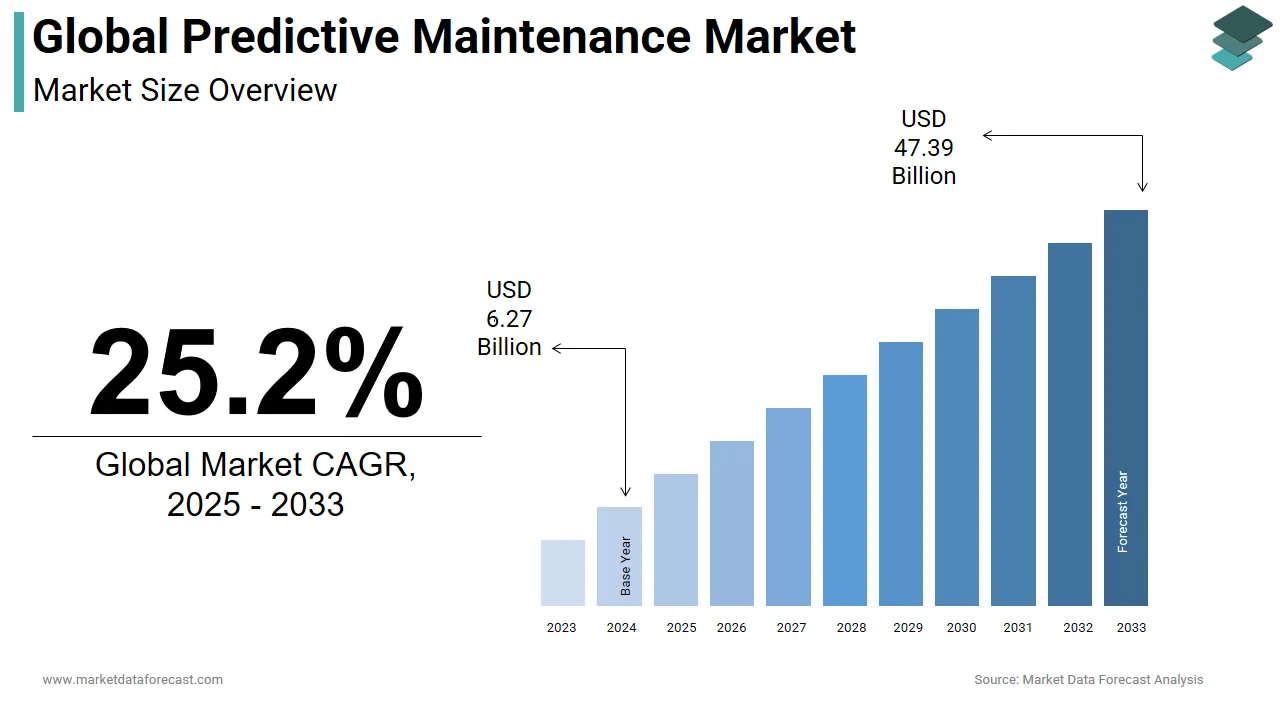
The global predictive maintenance market was valued at USD 7.85 billion in 2025. The market is estimated at USD 9.83 billion in 2026 and is projected to reach USD 59.33 billion by 2034, growing at a CAGR of 25.2% from 2026 to 2034.
Predictive maintenance is a technique that allows analyzing and determining the status of any equipment in order to effectively estimate the turnaround time for maintenance performance. The effective use of the technique saves time and money as it assists in the effective detection of any pattern of failure. There are several advantages associated with predictive maintenance techniques, such as savings in production time and expense related to equipment parts and associated raw materials. Predictive maintenance technique also minimizes the total duration of maintenance and repair of industrial equipment. It can minimize various reliability and quality issues, along with the reduction in excess inventory.
Given the aggressive time constraints for various industrial products and services, it is important to identify the causes of potential failure before they have a chance to occur. Evolving technologies such as the Internet of Things (IoT), cloud storage, and big data analytics allow more industrial equipment and assembly robots to deliver conditional data, which makes troubleshooting easier and trains us.
MARKET TRENDS
The predictive maintenance market is segmented according to verticals. Vertical sectors include government and defense, manufacturing, transportation and logistics, energy and utilities, healthcare and life sciences, and others (agriculture, telecommunications, media, and retail). The energy and utilities segment is the fastest growing segment due to the increasing demand for energy consumption analysis applications. The ability of standalone solutions to identify asset monitoring issues up front and make repairs that minimize disruptions to power generation would spur market growth.
The cloud deployment model is determined to record rapid growth during the anticipated period.
Most providers in the predictive maintenance market offer cloud-based maintenance solutions to maximize benefits and effectively automate the equipment maintenance process. Adoption of cloud-based predictive maintenance solutions is expected to grow, primarily due to their benefits, such as ease of maintenance of generated data, cost-effectiveness, scalability, and efficient management.
MARKET DRIVERS AND RESTRAINTS
The main drivers of market growth include the increasing use of emerging technologies to obtain valuable information and the growing need to reduce maintenance costs and downtime.
With the increasing consumer awareness related to the augmenting maintenance costs and downtime due to abnormal machine failures, the call for predictive maintenance solutions is multiplying globally. Predictive maintenance solutions help companies identify patterns in constant data streams to predict equipment failure.
Trained workers are needed to manage the latest software systems and implement AI-based IoT technologies and skills. Therefore, existing workers must receive training on how to operate new and improved systems. Furthermore, industries are dynamic in their adoption of new technologies.
REPORT COVERAGE
| REPORT METRIC | DETAILS |
| Market Size Available | 2025 to 2034 |
| Base Year | 2025 |
| Forecast Period | 2026 to 2034 |
| CAGR | 25.2% |
| Segments Covered | By Component, Vertical, Deployment Mode, Organization Size, and Region |
|
Various Analyses Covered | Global, Regional & Country Level Analysis, Segment-Level Analysis, DROC, PESTLE Analysis, Porter’s Five Forces Analysis, Competitive Landscape, Analyst Overview on Investment Opportunities |
| Regions Covered | North America, Europe, APAC, Latin America, Middle East & Africa |
|
Market Leaders Profiled | IBM (United States), Microsoft (United States), SAP (Germany), Hitachi (Japan), PTC (United States), GE (United States), Schneider Electric (France), Software AG (Germany), SAS (United States), TIBCO (United States), C3 IoT (United States), Uptake (United States), Softweb Solutions (United States), Asystom (France), Ecolibrium Energy (India), Fiix Software (Canada), OPEX Group (United Kingdom), Dingo (Australia), Sigma Industrial Precision (Spain), Google (USA), Oracle (USA), HPE (USA), AWS (USA), Micro Focus (UK), Splunk (USA), Altair (USA), RapidMiner (USA) and Seebo (Israel) and Others. |
REGIONAL ANALYSIS
Depending on the region, the global predictive maintenance market can be classified as North America, Europe, Asia-Pacific, the Middle East, Africa, and South America. Of these, North America, with its early adoption of technology and key players, is leading the global market.

COMPETITIVE LANDSCAPE
The players operating in the market are analytics providers, software platform providers, and software as a service (SaaS) providers. These players continually invest in research and development (R&D) to provide the most affordable and comprehensive solutions to end-user industries. The companies in this business are implementing several organic and inorganic growth strategies, like new products, updates, partnerships, business expansions, and mergers and acquisitions, in order to strengthen their offerings.
KEY MARKET PLAYERS
The main providers of the global predictive maintenance market are IBM (United States), Microsoft (United States), SAP (Germany), Hitachi (Japan), PTC (United States), GE (United States), Schneider Electric (France), Software AG (Germany), SAS (United States), TIBCO (United States), C3 IoT (United States), Uptake (United States), Softweb Solutions (United States), Asystom (France), Ecolibrium Energy (India), Fiix Software (Canada), OPEX Group (United Kingdom), Dingo (Australia), Sigma Industrial Precision (Spain), Google (USA), Oracle (USA), HPE (USA), AWS (USA), Micro Focus (UK), Splunk (USA), Altair (USA), RapidMiner (USA) and Seebo (Israel).
RECENT MARKET HAPPENINGS
- In May 2019, Microsoft collaborated with NXP Semiconductors to provide Azure IoT users with AI and ML fault detection capabilities. The collaboration resulted in the launch of a new anomaly detection solution that included predictive maintenance functions for rotating components, presence detection, and intrusion detection to avoid failures and reduce downtime, improving productivity and system security.
- In March 2019, TIBCO Software announced the acquisition of SnappyData, a high-performance in-memory data platform for mixed workload applications. This acquisition will combine the TIBCO Connected Intelligence platform with a unified analysis structure that improves data analysis, transmission, and multiple-use case management that requires speed, volume, and agility.
MARKET SEGMENTATION
This research report on the global predictive maintenance market has been segmented and sub-segmented based on the component, vertical, deployment, organization size, and region.
By Component
- Solutions
- Services
By Deployment Mode
- Cloud
- On-Premises
By Organization Size
- large
- SMEs
By Vertical
- Government and Defense
- Manufacturing
- Energy and Utilities
- Oil & Gas
- Transportation and Logistics
By Region
- North America
- Europe
- Asia-Pacific
- Latin America
- The Middle East and Africa