- Product Description Description
- Table of Contents TOC
- List of Table & Figure LOT
- Get Free Sample PDF Sample PDF
Market Size, 2025
$1.92 BnMarket Estimate, 2026
$2.04 BnMarket Forecast, 2034
$3.38 BnCAGR, 2026–2034
6.5%Executive Summary: Europe Laboratory Automation Market
- Market Scope: Comprehensive analysis of Europe's laboratory automation sector, detailing modular and whole lab automation, clinical and drug discovery systems, biotechnology applications, and country-level profiles.
- Market Valuation: Valued at USD 1.92 billion in 2025, reaching USD 2.04 billion in 2026, and projected to expand to USD 3.38 billion by 2034, growing at a CAGR of 6.5% from 2026 to 2034.
- Primary Growth Drivers: Increasing demand for high-throughput testing, technological advancements in laboratory robotics and AI, and the continuous expansion of research and development activities.
Key Market Segment Metrics
| Category | Leading Segment (Base Position) | Fastest-Growing / High-Growth Segment |
|---|---|---|
| By Type | Modular Automation (held 60.1% share in 2024, favored for incremental implementation and scalability) | Whole Lab Automation (projected at a 9.3% CAGR, driven by fully integrated workflow optimization) |
| By Equipment and Software Type | Automated Clinical Laboratory Systems (captured 55.4% share in 2024, essential for diagnostic testing efficiency) | Automated Drug Discovery Laboratory Systems (growing at a 10% CAGR, fueled by high-throughput screening needs) |
| By End User | Biotechnology and Pharmaceutical Companies (largest share at 40.4% in 2024, driven by extensive R&D usage) | Hospitals and Diagnostic Laboratories (projected at a 9.8% CAGR, propelled by urgent clinical care diagnostics) |
| By Country | United Kingdom (market leader with 25.6% share in 2024, backed by robust healthcare and life science sectors) | Germany (high growth rate with a 9.3% CAGR, supported by leading research institutions and pharmaceutical firms) |
Major Market Players & Industry Landscape
Market Structure: Highly competitive environment characterized by prominent diagnostic and life sciences corporations delivering advanced robotics, software integration, and modular solutions.
Key Companies: Danaher Corporation, Thermo Fisher Scientific Inc., Agilent Technologies Inc., Tecan Group Ltd, and Siemens Healthineers AG.
 Download Free Sample Report
Europe Laboratory Automation Market Size
The laboratory automation market size in Europe was valued at USD 1.92 billion in 2025. The European market is estimated to be worth USD 3.38 billion by 2034 from USD 2.04 billion in 2026, growing at a CAGR of 6.5% from 2026 to 2034.

The European laboratory automation includes automated equipment, software solutions, and integrated systems that streamline workflows in various laboratory settings, such as clinical, pharmaceutical, and research laboratories. The increasing complexity of laboratory tasks, coupled with the growing demand for high throughput testing and analysis, has driven the adoption of automation technologies. The growth of this market is fueled by several factors, including the need for improved productivity, reduced human error, and enhanced data management capabilities. The automation solutions are becoming essential for maintaining competitiveness as laboratories face increasing pressure to deliver results quickly and accurately. Additionally, advancements in robotics, artificial intelligence, and data analytics are further propelling the development of innovative laboratory automation technologies. The integration of automation into laboratory processes is expected to play a pivotal role in shaping the future of scientific research and diagnostics in Europe.
MARKET DRIVERS
Increasing Demand for High-Throughput Testing
The increasing demand for high-throughput testing is a primary driver of the European laboratory automation market. The pharmaceuticals, biotechnology, and clinical diagnostics, laboratories are increasingly adopting automation technologies to enhance their testing capabilities. According to a report by the European Federation of Pharmaceutical Industries and Associations, the global demand for high-throughput screening in drug discovery is expected to reach €2 billion by 2025, with Europe accounting for a significant share of this growth.
The importance of high-throughput testing lies in its ability to accelerate research and development processes by enabling laboratories to conduct a larger number of tests in a shorter timeframe. Automated systems facilitate the simultaneous processing of multiple samples, reducing the time required for analysis and increasing overall productivity. The adoption of laboratory automation technologies is expected to rise is driving growth in the European laboratory automation market.
Technological Advancements in Automation Solutions
Technological advancements in automation solutions are another key driver propelling the European laboratory automation market. Innovations in robotics, artificial intelligence, and data analytics have led to the development of sophisticated laboratory automation systems that enhance efficiency and accuracy. These technological improvements enable laboratories to streamline workflows, reduce human error, and improve data management capabilities. For instance, the integration of AI-driven software allows for real-time data analysis and decision-making by enhancing the overall efficiency of laboratory operations. Additionally, advancements in robotic systems enable precise handling of samples and reagents that further improving accuracy and reliability.
MARKET RESTRAINTS
High Initial Investment Costs
One of the significant restraints affecting the European laboratory automation market is the high initial investment costs associated with implementing automation technologies. The acquisition of advanced automated systems, along with the necessary infrastructure and training, can require substantial financial resources. This financial burden can deter smaller laboratories and research facilities from adopting automation solutions is limiting market growth. Moreover, the ongoing maintenance and operational costs associated with automated systems can further exacerbate financial challenges. Regular maintenance is essential to ensure optimal performance and longevity of the equipment, which can lead to additional expenses. As a result, laboratories may face difficulties in justifying the investment in automation technologies in a competitive environment where cost efficiency is paramount. Addressing the issue of high initial investment costs will be crucial for the long-term sustainability and growth of the European laboratory automation market.
Limited Awareness and Understanding of Automation Benefits
Another notable restraint is the limited awareness and understanding of the benefits of laboratory automation among potential users. Many laboratories remain unfamiliar with their applications and potential impact on productivity and efficiency despite the advantages of automation technologies. According to a survey conducted by the European Laboratory Automation Association, approximately 40% of laboratory professionals reported a lack of knowledge about automation solutions and their benefits. This lack of awareness can hinder market growth, as potential users may be hesitant to invest in technologies they do not fully understand.
Additionally, the transition from traditional laboratory practices to automated systems requires changes in workflow and employee training, which can pose challenges for organizations. The perceived complexity of adopting new technologies may deter some laboratories from exploring automation solutions. Market key players must focus on educational initiatives and marketing campaigns that promote the benefits and versatility of laboratory automation.
MARKET OPPORTUNITIES
Growth of Personalized Medicine
The growth of personalized medicine presents a significant opportunity for the European laboratory automation market. The demand for advanced laboratory testing and analysis is expected to rise as the healthcare industry increasingly shifts towards tailored treatment approaches based on individual patient characteristics. Laboratory automation technologies facilitate the efficient processing of large volumes of samples by allowing for rapid analysis and data generation essential for personalized medicine applications. Automated systems can streamline workflows, reduce turnaround times, and enhance the accuracy of test results, which are critical factors in delivering effective personalized treatments.
Expansion of Research and Development Activities
The expansion of research and development (R&D) activities across various sectors, including pharmaceuticals, biotechnology, and academic institutions that offers another promising opportunity for the European laboratory automation market. The demand for efficient laboratory processes and automation technologies is expected to increase as organizations invest in R&D to drive innovation and develop new products. Laboratory automation solutions can significantly enhance the efficiency and productivity of R&D activities by streamlining workflows by reducing manual errors, and enabling high-throughput testing. The adoption of automation technologies is likely to rise as researchers seek to accelerate their projects and improve data accuracy. Additionally, the integration of advanced data analytics and artificial intelligence into laboratory automation systems can further enhance research capabilities by providing valuable insights and accelerating the pace of innovation. The European laboratory automation market is poised for robust growth driven by these expanding opportunities with the growing demand for R&D activities continues to grow,.
MARKET CHALLENGES
Integration with Existing Systems
One of the primary challenges facing the European laboratory automation market is the integration of new automation technologies with existing laboratory systems and workflows. Many laboratories operate with legacy equipment and processes that may not be compatible with modern automation solutions. According to a survey conducted by the European Laboratory Automation Association, approximately 35% of laboratory professionals reported difficulties in integrating new automation technologies with their current systems. This challenge can lead to increased costs and extended timelines for implementation that is potentially deterring laboratories from adopting automation solutions.
Moreover, the complexity of integrating various automation technologies can create additional hurdles. Laboratories often require customized solutions that fit their specific needs, which can complicate the integration process. The need for extensive training and adjustments to existing workflows can also pose significant challenges, as staff may need to adapt to new systems and processes. This complexity can lead to resistance to change among laboratory personnel, further hindering the adoption of automation technologies.
To address these integration challenges, manufacturers and service providers must focus on developing flexible and adaptable automation solutions that can seamlessly integrate with existing laboratory systems. Providing comprehensive training and support during the transition process is also essential to ensure that laboratory staff are comfortable with the new technologies. The stakeholders in the laboratory automation market can enhance adoption rates and drive growth in the sector.
Regulatory Compliance and Standards
Another significant challenge in the European laboratory automation market is navigating the complex landscape of regulatory compliance and standards. Laboratories are subject to stringent regulations that govern the quality and safety of their operations, particularly in sectors such as pharmaceuticals and clinical diagnostics. According to a report by the European Medicines Agency, compliance with regulatory standards can increase operational costs by up to 25%, as laboratories must invest in technologies and processes that meet these requirements.
The evolving nature of regulations can create uncertainty for laboratories, as they must continuously adapt to changing compliance requirements. This can lead to delays in project timelines and increased operational costs, further complicating the implementation of automation technologies. Additionally, the need for rigorous validation and documentation processes can slow down the adoption of new automation solutions, as laboratories must ensure that their systems meet all regulatory standards before they can be fully operational.
To overcome these challenges, companies must prioritize compliance and work closely with regulatory bodies to ensure that their technologies meet the necessary standards. The market can enhance the adoption of laboratory automation technologies while ensuring the safety and quality of laboratory operations by fostering a culture of compliance and providing solutions that facilitate adherence to regulations.
REPORT COVERAGE
| REPORT METRIC | DETAILS |
| Market Size Available | 2025 to 2034 |
| Base Year | 2025 |
| Forecast Period | 2026 to 2034 |
| Segments Covered | By Type, Equipment and Software Type, End-user and Region. |
| Various Analysis Covered | Global, Regional & Country Level Analysis, Segment-Level Analysis; DROC, PESTLE Analysis, Porter's Five Forces Analysis, Competitive Landscape, Analyst Overview of Investment Opportunities |
| Countries Covered | UK, France, Spain, Germany, Italy, Russia, Sweden, Denmark, Switzerland, Netherlands, Turkey, Czech Republic, and Rest of Europe. |
| Market Leader Profiled | Danaher Corporation, Thermo Fisher Scientific Inc., Agilent Technologies Inc., Tecan Group Ltd, Siemens Healthineers AG, PerkinElmer Inc., Becton, Dickinson, Company (BD), and Others. |
SEGMENTAL ANALYSIS
By Type Insights
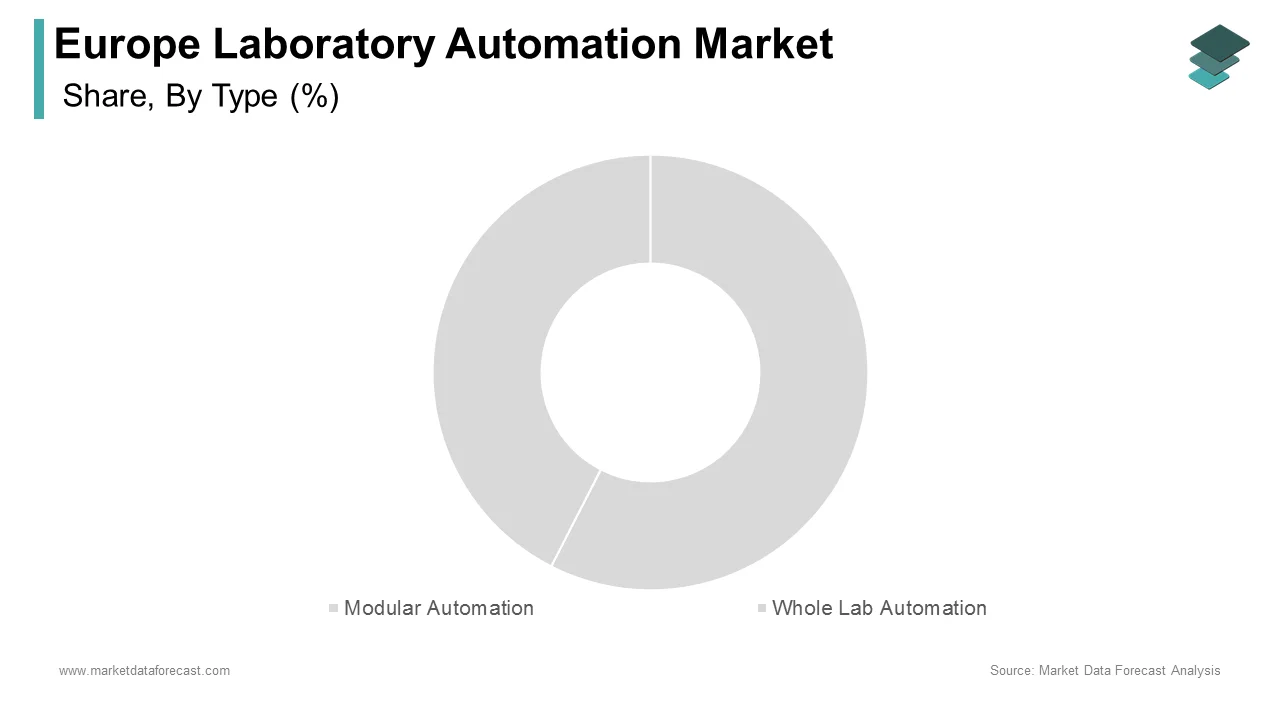
The modular automation segment was the largest and attributed in holding 60.1% of the Euroep laboratory automation market share in 2024. This dominance is primarily driven by the flexibility and scalability that modular automation systems offer to laboratories. The importance of the modular automation segment lies in its ability to allow laboratories to implement automation incrementally. This approach enables facilities to start with essential components and expand their automation capabilities over time, reducing the initial investment burden. Modular systems can be easily integrated with existing equipment by facilitating smoother transitions and minimizing disruptions to ongoing operations. The modular automation segment is expected to maintain its leading position in the European laboratory automation market by providing opportunities for innovation and tailored solutions.
The whole lab automation segment is swiftly emerging with an expected CAGR of 9.3% during the forecast period. This growth can be attributed to the increasing demand for fully integrated automation solutions that streamline entire laboratory workflows. The rising trend of implementing whole lab automation systems is a key driver of growth in this segment. These systems offer comprehensive solutions that encompass sample handling, analysis, and data management, significantly enhancing laboratory efficiency and accuracy. The demand for whole lab automation technologies is expected to rise as laboratories strive to improve throughput and reduce human error. Additionally, the integration of advanced data analytics and artificial intelligence into whole lab automation systems can further enhance research capabilities by providing valuable insights and accelerating the pace of innovation.
By Equipment and Software Type Insights
The automated clinical laboratory systems segment dominated the market by capturing 55.4% of share in 2024 due to the increasing demand for efficient and accurate diagnostic testing in clinical laboratories. The automated clinical laboratory systems segment growth is driven by the ability to enhance the efficiency of laboratory workflows. Automated systems facilitate the processing of large volumes of samples by reducing turnaround times and minimizing the risk of human error. The adoption of automated clinical laboratory systems is expected to rise as healthcare providers seek to improve diagnostic accuracy and speed. Additionally, the integration of advanced data management and reporting capabilities into these systems further enhances their appeal by making them essential tools for modern clinical laboratories.
The automated drug discovery laboratory systems segment is attributed to register a CAGR of 10% in next coming years. This growth can be attributed to the increasing investments in drug discovery and development processes, which require high-throughput screening and analysis capabilities. The rising trend of incorporating automated systems into drug discovery processes is a key driver of growth in this segment. Automated drug discovery systems enable researchers to conduct large-scale screening of compounds by significantly reducing the time and resources required for drug development. The demand for automated drug discovery laboratory systems is expected to increase with pharmaceutical companies seek to enhance their R&D capabilities and bring new therapies to market more quickly. Additionally, the integration of artificial intelligence and machine learning into these systems can further enhance their efficiency and effectiveness by providing valuable insights that drive innovation in drug discovery.
By End User Insights
The biotechnology and pharmaceutical companies segment was the largest in the European laboratory automation market by capturing a 40.4% of share in 2024. This dominance is primarily driven by the extensive use of automation technologies in drug development and research processes. Automation technologies facilitate high-throughput screening, sample processing, and data analysis by enhancing the efficiency and accuracy of laboratory operations. The adoption of laboratory automation solutions is expected to rise as these companies strive to accelerate their R&D efforts and improve patient outcomes. Additionally, the growing emphasis on personalized medicine and targeted therapies further supports the demand for advanced automation technologies in the biotechnology and pharmaceutical sectors.
The hospitals and diagnostic laboratories segment is projected to witness a CAGR of 9.8% in the next coming years. This growth can be attributed to the increasing demand for efficient diagnostic testing and patient care in healthcare settings. The rising trend of incorporating automation technologies into hospitals and diagnostic laboratories is a key driver of growth in this segment. Automated systems enable healthcare providers to process large volumes of samples quickly and accurately, reducing turnaround times and enhancing patient care. The adoption of laboratory automation solutions is expected to increase as hospitals seek to improve operational efficiency and meet the growing demand for diagnostic testing. Additionally, the integration of advanced data management and reporting capabilities into these systems further enhances their appeal by making them essential tools for modern healthcare facilities.
REGIONAL ANALYSIS

The United Kingdom dominated the European laboratory automation market by accounting for 25.6% of share in 2024. This dominance can be attributed to the UK's robust healthcare and pharmaceutical sectors, which are increasingly adopting automation technologies to enhance efficiency and accuracy in laboratory processes. Moreover, the UK's commitment to innovation and research in the life sciences sector further enhances the market for laboratory automation. The country is home to numerous leading pharmaceutical companies and research institutions that prioritize the adoption of advanced technologies to improve drug development and patient care.
Germany laboratory automation market is more likely to register a significant CAGR of 9.3% during the forecast period. Germany is home to numerous research institutions and pharmaceutical companies that are increasingly adopting automation solutions to enhance laboratory efficiency and accuracy. Germany is well-positioned to capitalize on the opportunities in the European laboratory automation market as the demand for high-throughput testing and data management continues to rise.
France laboratory automation market is anticipated to grow steadily in the foreseen years. The French government has set ambitious targets for research and innovation by aiming to increase investment in the life sciences sector. The significance of the French market lies in its commitment to enhancing healthcare and scientific research. France is home to several leading pharmaceutical companies and research institutions that prioritize the adoption of advanced technologies to improve laboratory processes.
Italy laboratory automation market is likely to pose significant opportunities in the coming years. The Italian government has recognized the potential of laboratory automation and is working to enhance its research capabilities. Italy is home to numerous research institutions and pharmaceutical companies that are increasingly adopting automation solutions to enhance laboratory efficiency and accuracy.
Spain laboratory automation market is gaining huge traction over the future period. The Spanish government has set ambitious targets for research and innovation by aiming to increase investment in the life sciences sector. Spain is home to several leading pharmaceutical companies and research institutions that prioritize the adoption of advanced technologies to improve laboratory processes.
KEY MARKET PLAYERS
Some notable companies that dominate the Europe laboratory automation market profiled in this report are Danaher Corporation, Thermo Fisher Scientific Inc., Agilent Technologies Inc., Tecan Group Ltd, Siemens Healthineers AG, PerkinElmer Inc., Becton, Dickinson and Company (BD), and Others.
MARKET SEGMENTATION
This Europe laboratory automation market research report is segmented and sub-segmented into the following categories.
By Type
- Modular Automation
- Whole Lab Automation
By Equipment and Software Type
- Automated Clinical Laboratory Systems
- Workstations
- LIMS (Laboratory Information Management Systems)
- Sample Transport Systems
- Specimen Handling Systems
- Storage Retrieval Systems
- Automated Drug Discovery Laboratory Systems
- Plate Readers
- Automated Liquid Handling Systems
- LIMS (Laboratory Information Management Systems)
- Robotic Systems
- Storage Retrieval Systems
- Dissolution Testing Systems
By End User
- Biotechnology and Pharmaceutical Companies
- Hospitals and Diagnostic Laboratories
- Research and Academic Institutes
By Country
- UK
- France
- Spain
- Germany
- Italy
- Russia
- Sweden
- Denmark
- Switzerland
- Netherlands
- Turkey
- Czech Republic
- Rest of Europe