- Product Description Description
- Table of Contents TOC
- List of Table & Figure LOT
- Get Free Sample PDF Sample PDF
Market Size, 2025
$308.51 MnMarket Estimate, 2026
$375.56 MnMarket Forecast, 2034
$1806.71 MnCAGR, 2026–2034
21.70%Executive Summary: Europe Laser Hair Removal Market
- Market Scope: Comprehensive regional market evaluation of laser hair removal in Europe covering laser types, end-use segments, and country-level distribution frameworks.
- Market Valuation: Valued at USD 308.51 million in 2025, estimated at USD 375.56 million in 2026, and projected to reach USD 1,806.71 million by 2034, registering a strong CAGR of 21.70% (2026–2034).
- Primary Growth Drivers: Rising consumer preference for long-term, cost-effective aesthetic solutions, proliferation of certified medical aesthetic clinics and trained practitioners, and the expanding adoption of treatments among male demographics.
Key Market Segment Metrics (2026–2034)
| Category | Leading Segment (2025 Position) | Fastest-Growing Segment |
|---|---|---|
| By Laser Type | Diode Lasers (held 46.1% of the market share in 2025 due to optimal balance between efficacy, safety, and adaptability) | Nd:YAG Lasers (exhibiting a noteworthy CAGR of 10.8% due to unmatched safety for darker skin tones) |
| By End-Use | Beauty Clinics (led the market by occupying a share of 52.3% in 2024 through accessible, bundled, and franchise-based locations) | Home Use (fastest-growing segment witnessing a CAGR of 12.3% driven by privacy, convenience, and e-commerce) |
| By Country / Region | Germany (outperformed other regions with an 18.5% share in 2025 backed by robust healthcare infrastructure) | United Kingdom, France, and Spain (showing high demand driven by aesthetic refinement, male grooming, and tourism) |
Major Market Players & Market Structure
Market Structure: Highly competitive European aesthetic technology landscape featuring major global medical device manufacturers and at-home device providers competing intensely on EU MDR regulatory compliance, AI integration, dual-wavelength capability, and clinical safety.
Key Companies: Lumenis Ltd., Candela Medical Corporation, Cutera, Inc., Lynton Lasers Ltd, Sciton, Inc., Viora, Inc., Lutronic Corporation, Alma Lasers Ltd., Cynosure, LLC, and Bausch Health Companies, Inc.
Europe Laser Hair Removal Market Size
The Europe laser hair removal Market was worth USD 308.51 million in 2025 and is estimated to grow at a CAGR of 21.70% from 2026 to 2034. The European market is predicted to be worth 1806.71 million by 2034 from USD 375.56 million in 2026.
Laser hair removal is the medical-grade and aesthetic technology designed to deliver long-term hair reduction through targeted photothermolysis. This non-invasive procedure has transitioned from exclusive dermatology clinics to mainstream beauty centers, driven by advancements in diode, alexandrite, and Nd: YAG laser systems. As per a study, a portion of women and men in Western Europe have engaged in some form of body hair removal, with a growing preference for clinical procedures over traditional methods such as waxing or shaving. According to research, demand for minimally invasive cosmetic treatments increased, with laser hair removal among the top three requested services. Regulatory oversight under the EU Medical Device Regulation (MDR) ensures device safety, which shapes a standardized yet dynamic service landscape across member states.
MARKET DRIVERS
Rising Consumer Preference for Long-Term Aesthetic Solutions
The increasing consumer shift toward long-term, cost-effective aesthetic solutions is among the key factors driving the expansion of the Europe laser hair removal market. Traditional hair removal methods such as waxing and shaving require frequent repetition and can cause skin irritation, which prompts individuals to seek more sustainable alternatives. According to the research, a number of non-surgical aesthetic procedures were performed in the UK, with laser hair removal accounting for a portion of total treatments. This trend is particularly pronounced among women, where a portion express willingness to invest in clinical-grade procedures for smoother and hair-free skin. Moreover, growing awareness of technological advancements, such as pain-reducing cooling systems and skin-type-specific lasers, has expanded patient eligibility. The perceived value of upfront investment in laser sessions continues to rise as clinics across Germany, France, and Scandinavia report higher patient retention rates post-treatment.
Expansion of Medical Aesthetic Clinics and Trained Practitioners
The proliferation of certified medical aesthetic clinics and skilled practitioners across Europe has enhanced the growth rate of Europe laser hair removal market. As per the research, the number of accredited aesthetic medicine training programs in EU countries increased, which leads to a more qualified workforce capable of operating advanced laser systems safely. Countries have seen a rise in licensed aesthetic centers, according to research. This expansion has reduced geographical disparities in service availability, particularly in suburban and mid-sized urban areas. Furthermore, collaboration between dermatologists and aesthetic nurses has improved treatment customization and safety protocols. The presence of stringent certification requirements under national health authorities ensures high standards, which strengthens consumer confidence and encourages repeat visits. As a result, this strengthens the growth trajectory of the laser hair removal sector.
MARKET RESTRAINTS
Stringent Regulatory and Safety Compliance Requirements
The rigorous regulatory framework governing aesthetic devices and procedures hampers the growth of Europe hair removal market. Since 2021, the EU Medical Device Regulation (MDR) has classified most laser systems as Class IIa or IIb medical devices, requiring extensive clinical evaluations, technical documentation, and notified body approvals. As per research, a portion of laser device manufacturers faced delays in product certification due to MDR compliance challenges. Apart from these, individual EU member states impose varying licensing requirements for operators, with countries like France mandating formal medical degrees for laser procedure administration. These complexities increase operational costs and limit market entry for smaller clinics. There has been a rise in adverse event reporting linked to improperly administered treatments, which strengthens the need for strict oversight.
High Treatment Costs and Limited Insurance Coverage
The high cost of professional laser hair removal remains an important barrier to the expansion of Europe laser hair removal market. The cumulative expense deters price-sensitive consumers because multiple sessions are required for optimal results. Unlike reconstructive or medically necessary dermatological treatments, laser hair removal is classified as a cosmetic procedure and is excluded from public healthcare reimbursement in nearly all EU nations. According to a study, less share of aesthetic procedures receive partial insurance coverage, primarily in cases of hirsutism linked to PCOS. This financial burden disproportionately affects younger demographics and lower-income groups, which constrains market penetration despite rising demand for long-term hair reduction solutions.
MARKET OPPORTUNITIES
Integration of AI and Smart Diagnostics in Laser Systems
The integration of artificial intelligence (AI) and real-time skin diagnostics within laser platforms is propelling new opportunities for the Europe laser hair removal market. Modern systems now employ AI algorithms to analyze skin tone, hair density, and follicular activity, which enables precise energy calibration and minimizes risks of burns or pigmentation. Companies have introduced smart handpieces with built-in spectral sensors that adapt to individual patient profiles. These innovations not only enhance treatment efficacy but also reduce operator dependency, which makes advanced care accessible in non-dermatologist-led clinics. The European Commission promotes digital health integration under its Digital Single Market strategy. This convergence of AI and aesthetic medicine is poised to redefine service delivery standards and attract tech-savvy consumers seeking personalized and data-driven beauty solutions.
Growing Male Aesthetic Consumer Base
The rising engagement of male consumers in aesthetic grooming is likely to create potential opportunities for the growth of Europe laser hair removal market. Traditionally dominated by female clients, the sector now sees increasing demand from men seeking hair reduction on the back, chest, and facial areas for hygiene, athletic, or cosmetic reasons. According to a research, a portion of patients undergoing laser treatments in Italy were male, up from that in 2019. Similar trends are observed in the UK and Scandinavia, where male grooming product sales have surged over the past years, as per research. This shift is driven by evolving societal norms, greater media representation, and targeted marketing by clinics. Brands are now launching male-specific packages and discreet clinic environments to cater to this demographic. The male segment offers a high-growth avenue for market expansion as gender-based stigma around aesthetic procedures continues to decline.
MARKET CHALLENGES
Variability in Skin Type Efficacy and Treatment Limitations
The variable efficacy of laser treatments across different skin and hair types is degrading the growth of Europe laser hair removal market. Traditional laser systems, particularly alexandrite and diode lasers, are most effective on individuals with light skin and dark hair due to optimal melanin contrast. However, patients with darker skin tones (Fitzpatrick types V–VI) face higher risks of hyperpigmentation or hypopigmentation, which limits treatment safety and accessibility. As per study, adverse events in darker-skinned patients are more likely when inappropriate wavelengths are used. Nd: YAG lasers offer safer alternatives. However, their lower melanin absorption requires more sessions for comparable results, which reduces cost-effectiveness. Technological improvements have occurred, but many clinics in Eastern and Southern Europe lack access to multi-wavelength platforms. This disparity in treatment equity not only restricts patient inclusivity but also challenges the market’s commitment to providing universally effective aesthetic care across Europe’s diverse population.
Unregulated Home-Use Devices Weakening Clinical Standards
The surge in at-home laser hair removal devices poses a challenge to the Europe laser hair removal market. Devices have gained popularity due to their affordability and convenience, with European sales exceeding. However, these devices operate at significantly lower fluence levels than clinical lasers, which results in inconsistent outcomes and prolonged treatment timelines. More importantly, improper usage without professional assessment increases the risk of skin damage, especially among users with contraindicated skin conditions. The European Dermatology Forum warns that unregulated use may lead to delayed diagnosis of underlying dermatological issues masked by self-treatment. Furthermore, the normalization of DIY aesthetics may erode consumer trust in the necessity of clinical procedures. This trend forces licensed providers to justify the premium cost and safety advantages of professional-grade treatments in an increasingly consumer-driven market
REPORT COVERAGE
| REPORT METRIC | DETAILS |
| Market Size Available | 2025 to 2034 |
| Base Year | 2025 |
| Forecast Period | 2026 to 2034 |
| Segments Covered | By Laser Type, End-Use and Region |
| Various Analyses Covered | Global, Regional, & Country Level Analysis; Segment-Level Analysis, Drivers, Restraints, Opportunities, Challenges, PESTLE Analysis, Porter’s Five Forces Analysis, Competitive Landscape, Analyst Overview of Investment Opportunities |
| Regions Covered | North America, Europe, Asia Pacific, Latin America, Middle East, and Africa |
| Key Market Players | Lynton Lasers Ltd, Sciton, Inc., Viora, Inc., Lutronic Corporation, Alma Lasers Ltd., Cynosure, LLC, Lumenis Ltd. (XIO Group), Candela Medical Corporation, Bausch Health Companies, Inc., and Cutera, Inc. |
SEGMENTAL ANALYSIS
By Laser Type Insights
The diode lasers segment was the largest segment and held 46.1% of the Europe laser hair removal market share in 2025. Diode laser’s optimal balance between efficacy, safety, and adaptability across a wide range of skin types is primarily attributed to the growth of the diode lasers segment in the regional market. Its longer wavelength (800–810 nm) enables deeper follicular penetration with reduced epidermal damage, which makes it suitable for both light and moderately pigmented skin. Apart from these, manufacturers such as Asclepion and Cutera have enhanced diode platforms with contact cooling and adjustable pulse durations, which improves patient comfort and treatment speed. The widespread integration of diode lasers in both dermatology and beauty clinics across Germany, France, and the UK further consolidates its dominance. This is supported by strong practitioner confidence and patient satisfaction metrics.
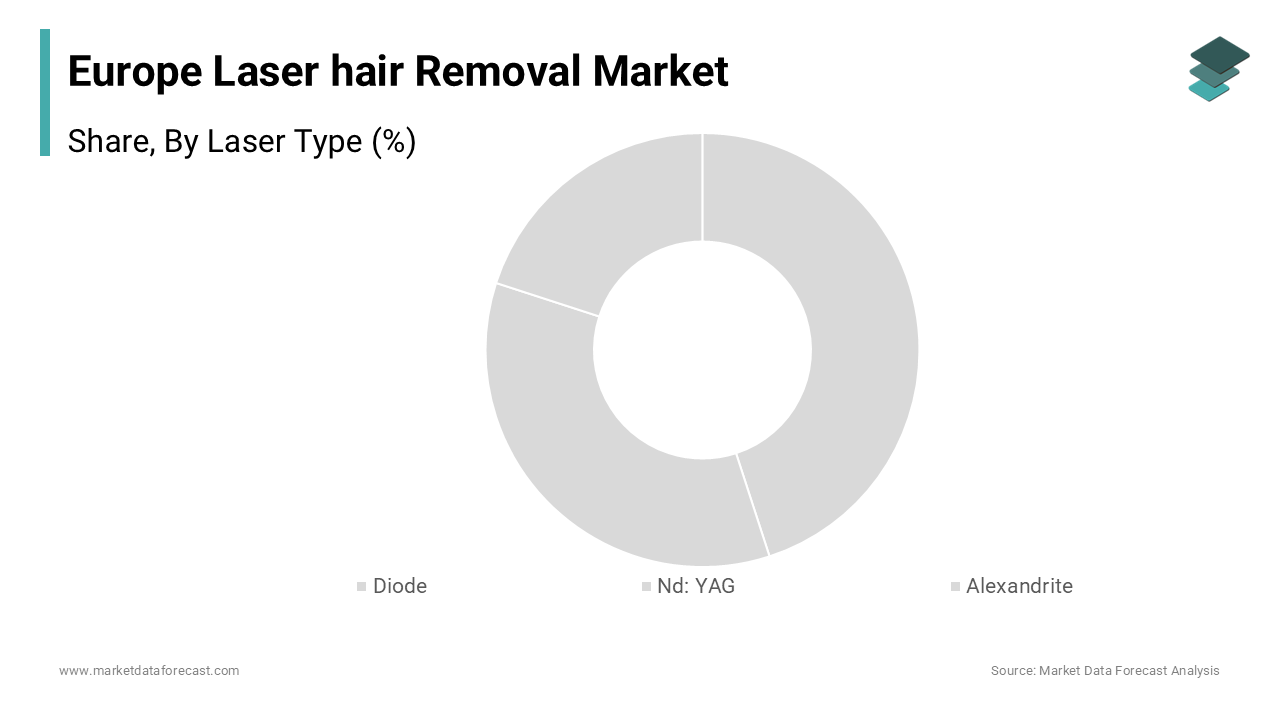
The Nd: YAG laser segment is expected to exhibit a noteworthy CAGR of 10.8% from 2026 to 2034 owing to its unmatched safety profile for darker skin tones, an important advantage in increasingly diverse urban populations across Western and Southern Europe. The Nd: YAG laser with a 1064 nm wavelength minimizes melanin absorption in the epidermis significantly reducing the risk of thermal injury in individuals with Fitzpatrick skin types V and VI. As per study, adverse event rates in dark-skinned patients treated with Nd: YAG lasers were lower than those undergoing alexandrite treatments. Moreover, rising awareness of inclusive aesthetics has prompted clinics in multicultural hubs such as Amsterdam, Paris, and Birmingham to invest in multi-platform devices featuring Nd: YAG capabilities.
By End-use Insights
The Beauty Clinics segment led the Europe laser hair removal market by occupying a share of 52.3% in the global market in 2024. The growing consumer preference for accessible, non-medicalized environments that offer aesthetic treatments at competitive pricing is accelerating the beauty clinics segment in the regional market. Unlike dermatology clinics, beauty clinics often operate in high-footfall urban locations and provide bundled services such as skincare, waxing, and body contouring, which creates a holistic beauty experience. Furthermore, the expansion of franchise-based beauty chains across Spain, Italy, and Poland has standardized service quality while enabling rapid scalability. These clinics increasingly employ certified laser technicians under medical supervision, which aligns with EU safety standards while maintaining cost efficiency. This strengthens their dominance in volume-driven markets.
The home-use segment is on the rise and is expected to be the fastest growing segment in the global market by witnessing a CAGR of 12.3% during the forecast period owing to the rising consumer demand for privacy, convenience, and long-term cost savings, particularly among younger demographics. Devices have gained traction, with large number of units sold across Europe. Technological advancements, such as smart skin sensors, app-based session tracking, and adjustable intensity levels, have enhanced usability and safety, narrowing the performance gap with professional systems. Besides, e-commerce platforms like Amazon and Zalando have streamlined access, supported by aggressive digital marketing and subscription-based refill models. Clinical efficacy remains lower than professional treatments. The democratization of hair removal technology continues to reshape consumer behavior and expand market reach.
REGIONAL ANALYSIS
Germany outperformed other regions in the Europe laser hair removal market by accounting for 18.5% share of the regional market share in 2025. The prominence of Germany in the regional market is primariy credited to its robust healthcare infrastructure, high consumer spending on personal care, and stringent regulatory oversight that ensures treatment safety and device efficacy. Germany has clinic densities in Europe, particularly in urban centers like Munich, Frankfurt, and Berlin owing to number of certified aesthetic clinics offering laser services. The country also leads in technological adoption, with clinics increasingly integrating AI-assisted diode and Nd:YAG systems. Moreover, Germany’s dual public-private healthcare model allows for flexible payment options, which enable broader access to elective aesthetic procedures. This strengthens its market supremacy.
The United Kingdom is closely following in the Europe laser hair removal market by capturing 16.2% share of the regional market in 2025. The growth of United Kingdom in the regional market is propelled by its well-established network of dermatology and beauty clinics, particularly in London, Manchester, and Edinburgh, where aesthetic medicine is deeply integrated into mainstream consumer culture. Consumer demand is further amplified by rising male participation. The proliferation of premium clinic chains such as sk:n and Lynton Lasers, combined with strong digital marketing and financing options, has made treatments more accessible. Furthermore, the NHS’s recognition of laser therapy for hirsutism in PCOS patients has indirectly validated the procedure’s medical credibility, which boosts public confidence.
France ranks third in the European market, holding a 13.8% share in 2025, driven by a deeply rooted cultural emphasis on personal grooming and aesthetic refinement. A high density of beauty institutes, numerous registered salons offering aesthetic services is attributed to the growth of France in the regional market. Paris alone accounts for a portion of all laser treatments performed in the country. The French market also benefits from strong regulatory clarity. This has fostered trust in professional treatments, which discourages unregulated home-use adoption. Furthermore, collaborations between dermatologists and cosmetic brands have led to innovative hybrid treatment models, blending medical precision with beauty retail. This enhances market sophistication.
Italy has experienced steady growth in the Europe laser hair removal market due to its rapidly expanding aesthetic medicine sector and evolving consumer behaviour. As per the research, the number of laser hair removal procedures increased, outpacing growth in several Northern European markets. This surge is driven by shifting social norms, particularly among younger men and women in cities like Milan, Rome, and Florence, where body grooming is increasingly associated with professionalism and self-care. Italy’s market is also distinguished by a high concentration of family-run aesthetic clinics that offer personalized care at competitive prices. Moreover, the integration of laser treatments into wellness retreats and thermal spas in Tuscany and Veneto has broadened the service appeal beyond urban centers, which contributes to sustained market expansion.
Spain is likely to grow in the Europe laser hair removal market, with rising tourism-driven demand and increasing domestic consumer engagement. As per research, in Spain, number of aesthetic procedures were performed, with laser hair removal among the top three non-invasive treatments. The country’s warm climate and cultural norms around body exposure during summer months amplify seasonal demand, particularly for bikini and leg treatments. Apart from there, Spain has become a destination for aesthetic tourism, which attractes patients from Northern Europe due to lower prices and high service quality. Cities like Barcelona and Valencia host internationally accredited clinics that combine medical expertise with hospitality services. The government’s recent push to regulate aesthetic practitioners has further strengthened market credibility, which positions Spain as a dynamic and rapidly evolving player in the regional landscape.
COMPETITIVE LANDSCAPE
The competition in the Europe laser hair removal market is marked by a convergence of technological innovation, regulatory rigor, and shifting consumer expectations. Established medical device manufacturers face increasing burden or puch from emerging players introducing cost-effective, multi-functional platforms. Differentiation is achieved not only through laser performance but also via integrated diagnostics, AI-driven treatment planning, and comprehensive training ecosystems. The market is further fragmented by the coexistence of professional clinics and at-home device providers, creating a dual-tier competitive environment. Regulatory compliance under the EU MDR has become an important differentiator, eliminating non-compliant operators and favoring companies with robust clinical data. Geographic disparities in aesthetic acceptance and spending power also influence competitive dynamics, with Western Europe leading in adoption while Eastern markets provide untapped potential. The race is intensifying to deliver smarter, safer, and more inclusive laser solutions across the region owing to patient safety and treatment personalization gain prominence.
KEY MARKET PLAYERS
Some of the companies that are playing a dominating role in the europe laser hair removal market include
- Lynton Lasers Ltd
- Sciton, Inc.
- Viora, Inc.
- Lutronic Corporation
- Alma Lasers Ltd.
- Cynosure, LLC
- Lumenis Ltd. (XIO Group)
- Candela Medical Corporation
- Bausch Health Companies, Inc.
- Cutera, Inc.
Top Players in the Europe Laser Hair Removal Market
Lumenis Ltd.
Lumenis, a global pioneer in energy-based medical and aesthetic technologies, plays a transformative role in the Europe laser hair removal market through its clinically validated platforms such as the Lightsheer and Splendor X systems. The company has established strong partnerships with dermatology clinics and aesthetic centers, emphasizing safety, efficacy, and operator training. In recent years, Lumenis has intensified its focus on multi-application devices that combine hair removal with skin rejuvenation, enhancing return on investment for clinics. Apart from these, Lumenis conducts regular certified training programs in collaboration with the European Society for Laser Dermatology, which ensures adherence to EU MDR standards and strengthening trust among medical professionals across the region.
Candela Medical (a subsidiary of Syneron Candela)
Candela Medical is a dominant force in the European aesthetic technology space, renowned for its GentleLase and GentleMax Pro systems, which integrate alexandrite and Nd:YAG lasers for broad skin-type compatibility. The company has significantly contributed to advancing safe laser treatments for diverse European populations, particularly in multicultural urban centers where skin type inclusivity is important. Its robust customer support network, including on-site technical training and remote diagnostics, which ensures high device uptime and clinician satisfaction across major EU markets.
Cutera, Inc.
Cutera has carved a distinct presence in the Europe laser hair removal market with its advanced Xeo and Excel HR platforms, known for high fluence delivery and integrated cooling systems that enhance patient comfort. The company differentiates itself by focusing on dual-modality devices that support both aesthetic and dermatological applications, appealing to hybrid clinics seeking versatility. Its emphasis on evidence-based marketing, continuous education, and compliance with EU MDR regulations has strengthened its reputation as a trusted provider of high-performance laser solutions.
Top Strategies Used by the Key Market Participants
Key players in the Europe laser hair removal market are deploying multifaceted strategies to consolidate their influence and respond to evolving consumer and regulatory demands. A primary approach is technological differentiation, with companies integrating AI, real-time skin sensing, and dual-wavelength capabilities to enhance treatment safety and efficacy. Firms are also prioritizing regulatory compliance and clinical validation, investing in MDR-certified device documentation and post-market surveillance to maintain market access. Strategic partnerships with dermatologists and aesthetic training institutes are being leveraged to build credibility and ensure proper device utilization. Besides, companies are expanding their direct-to-clinic support networks by offering on-site training, maintenance, and financing models to improve adoption. Geographic expansion into high-growth Southern and Eastern European markets, where demand for aesthetic services is rising, is another growing strategy. Lastly, digital engagement through tele-aesthetics platforms and patient outcome tracking apps is being used to strengthen brand loyalty and differentiate service offerings in a competitive landscape.
MARKET SEGMENTATION
This research report on the Europe laser hair removal market has been segmented and sub-segmented into the following categories.
By Laser Type
- Diode
- Nd: YAG
- Alexandrite
By End-use
- Beauty Clinics
- Dermatology Clinics
- Home Use
By Country
- United Kingdom
- France
- Spain
- Germany
- Italy
- Russia
- Sweden
- Denmark
- Switzerland
- Netherlands and
- Rest of Europe