- Product Description Description
- Table of Contents TOC
- List of Table & Figure LOT
- Get Free Sample PDF Sample PDF
Market Size, 2025
$0.30 BnMarket Estimate, 2026
$0.32 BnMarket Forecast, 2034
$0.53 BnCAGR, 2026–2034
5.78%Europe Ladder Market Size
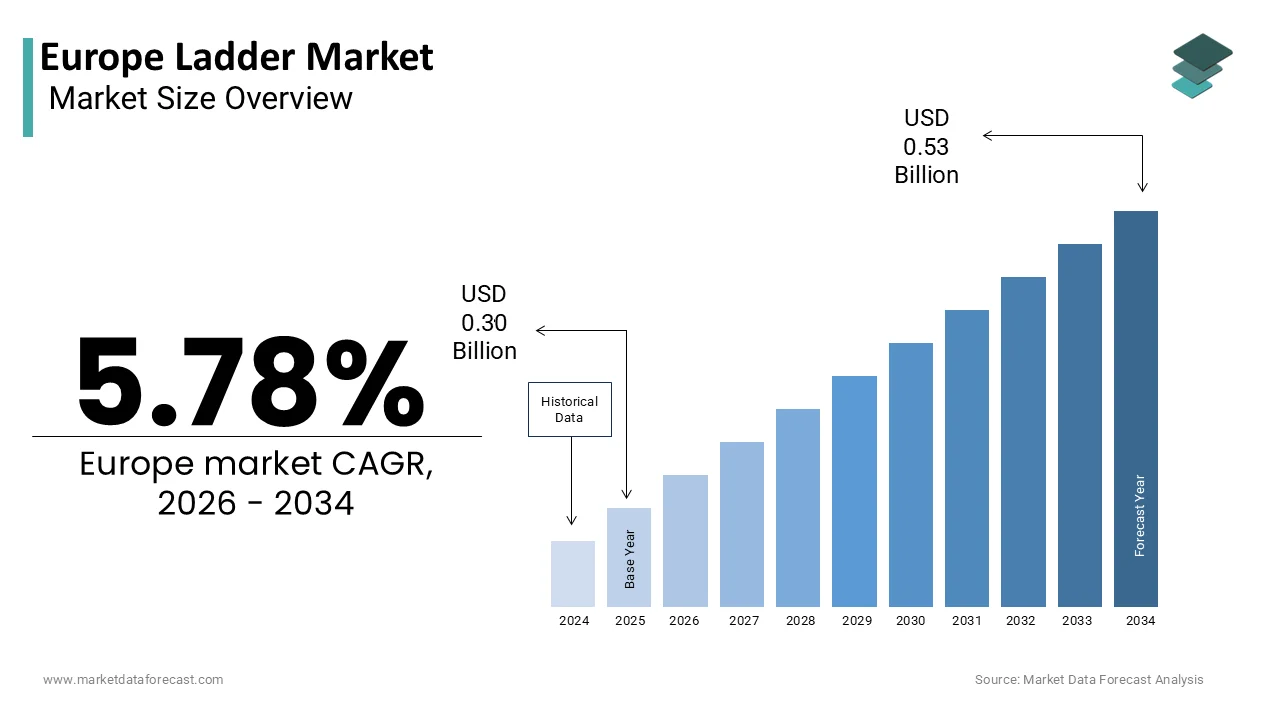
The Europe ladder market was valued at USD 0.30 billion in 2025, is estimated to reach USD 0.32 billion in 2026, and is projected to reach USD 0.53 billion by 2034, growing at a CAGR of 5.78% from 2026 to 2034.
A ladder is a vertical or inclined tool consisting of two long side rails connected by a series of horizontal rungs or steps. It is primarily used for climbing up to or descending from elevated areas. These products are engineered to meet stringent European safety standards, particularly EN 131, which governs load capacity, stability, and material durability. Unlike generic hardware, modern ladders in Europe are increasingly shaped by ergonomic design, lightweight composite materials, and integrated safety features such as non-slip feet, locking mechanisms, and anti-pinch hinges. A significant, stable portion of the European Union population resides in detached or semi-detached housing, maintaining consistent demand for residential access and security solutions. Furthermore, data from the European Agency for Safety and Health at Work (EU-OSHA) confirms that falls from height remain a leading cause of fatal construction accidents, driving stringent regulatory requirements for certified equipment. The market is also influenced by urban densification, which increases reliance on compact, multi-functional ladders for maintenance in confined spaces. Consequently, the European ladder market reflects a convergence of consumer convenience, workplace safety mandates, and material innovation, positioning ladders not merely as tools but as critical components of personal and professional risk mitigation.
MARKET DRIVERS
Rising Home Renovation and DIY Culture Across Urban Households
The proliferation of home improvement activities among the regional homeowners has become a primary driver of the European ladder market. This trend is fuelled by hybrid work trends and housing shortages that incentivize property upgrades over relocation. Driven by rising energy costs and energy efficiency goals, a notable portion of EU households are undertaking maintenance and renovation tasks that require elevated access, such as facade work and insulation. In countries with high homeownership rates, such as the Netherlands, the cultural norm of self-maintenance sustains demand for access equipment. Retailers are reporting increasing interest in compact telescopic ladders designed for space-constrained residential environments, such as apartments with balconies. Additionally, government-supported energy efficiency initiatives, such as France's MaPrimeRénov, are accelerating home insulation projects, which in turn increases demand for maintenance tools required for high-level work. This grassroots movement toward self-reliant home care ensures robust and recurring demand for safe, user-friendly ladders across Europe’s residential landscape.
Stringent Occupational Safety Regulations in Construction and Maintenance Sectors
The region’s rigorous workplace safety framework significantly amplifies demand for certified ladders in professional settings within the European ladder market. This demand is particularly high in construction, facility management, and utility services. European occupational safety bodies continue to identify falls from height as a top cause of worker fatalities, which sustains the enforcement of rigorous safety standards, such as EN 131, for portable access equipment on job sites. As a result, contractors must procure ladders with verified load ratings, anti-slip features, and third-party certification marks, eliminating low-cost non-compliant imports. In Germany, DGUV regulations mandate that ladders used in commercial environments must comply with updated, higher-stability standards (EN 131 Professional), necessitating the phase-out of older, non-compliant models and directing purchasing decisions toward stabilized equipment. Similarly, the UK’s Health and Safety Executive requires comprehensive risk assessments for work at height where a fall could cause injury, leading industry best practice to prefer platform ladders with handrails over traditional, less stable step models to minimize risk. Public infrastructure operators like SNCF in France and Deutsche Bahn in Germany have standardized fleets of industrial-grade ladders across maintenance depots. This regulatory ecosystem not only ensures user safety but also creates a premium segment insulated from price competition, reinforcing quality and compliance as market entry prerequisites.
MARKET RESTRAINTS
Restrictive Urban Planning and Limited Storage Space in Residential Settings
Evolving urban housing patterns are a key restraint in the European ladder market. These patterns limit both the need for and the practicality of traditional ladders. According to Eurostat, an increasing share of the European population resides in cities, with a significant proportion living in apartments that offer limited storage for bulky equipment. In major European cities, high demand has driven a trend toward smaller, more compact living spaces. Consequently, many urban consumers forego ownership altogether, opting instead for rental services or relying on building managers for external tasks. Due to these housing constraints, homeowners of single-family houses generally possess more storage space for equipment. In contrast, apartment occupants often lack room for large items. Moreover, strict balcony and fire safety codes in high-rise buildings often prohibit external storage or the use of long ladders, further dampening demand. While compact telescopic models offer partial relief, their higher price point and perceived fragility deter budget-conscious buyers. This spatial constraint acts as a structural ceiling on household penetration, particularly in Europe’s most densely populated regions.
Price Sensitivity and Competition from Non-Compliant Imports
Persistent pressure from low-cost, non-EN 131-compliant ladders imported primarily from Asia is also hindering the growth of the European ladder market. These products undercut certified options on price despite posing significant safety risks. Safety authorities continue to identify numerous, recurring safety violations regarding portable ladders, particularly concerning structural failures, inadequate load testing, and a lack of proper stability. Unsafe, non-compliant ladder products frequently appear on online platforms at a significant discount compared to certified alternatives, attracting consumers who may not recognize the lack of safety certification. Furthermore, recent market surveillance indicated that a significant portion of telescopic ladders sold via online platforms failed to meet essential safety standards, emphasizing a disparity between online listings and certified products. This undermines legitimate manufacturers who invest in testing, documentation, and quality control. Enforcement remains fragmented; while Germany and Sweden conduct rigorous market surveillance, Southern and Eastern European countries often lack resources for consistent monitoring. The influx of substandard products will continue to distort pricing, erode brand value, and compromise user safety across the European market, pending the enforcement of unified digital product passports and stricter liability rules for platforms.
MARKET OPPORTUNITIES
Integration of Smart Features and Ergonomic Innovations
The emergence of smart and ergonomically enhanced ladders offers a transformative opportunity to elevate product value and address longstanding usability concerns, which is expected to propel the expansion of the European ladder market. Leading brands are incorporating features such as built-in level indicators, tool trays with magnetic holders, and anti-fatigue platforms to reduce strain during prolonged use. Werner continues to advance European ladder safety by introducing ergonomic, high-handrail platforms designed to improve worker stability and reduce physical strain. Additionally, connected ladders equipped with Bluetooth sensors can now alert users when placed on unstable surfaces or overloaded beyond safe limits. The European Innovation Council provides funding for innovative, human-centered safety equipment and access tools through its Horizon Europe initiatives. These innovations resonate strongly with aging DIYers and professional tradespeople alike. The aging European construction workforce is driving up demand for ergonomic, joint-friendly access equipment designed to improve worker safety and comfort. Manufacturers can command premium pricing and foster brand loyalty by shifting from commodity hardware to experience-oriented solutions. This approach helps them succeed in a traditionally undifferentiated market.
Growth of Circular and Repairable Ladder Design
The EU’s circular economy agenda is enabling innovation in modular and repairable ladder construction, which is opening up major possibilities for the expansion of the European ladder market. This trend is creating opportunities for brands that prioritize longevity over disposability. Under the Ecodesign for Sustainable Products Regulation, effective 2025, manufacturers are encouraged to design products for disassembly, component replacement, and end-of-life recyclability. Companies like ZARGES and Youngman have responded by launching aluminum ladders with replaceable feet, hinges, and spreader bars, allowing users to extend service life rather than discard entire units. Data indicate that designing products for repairability significantly reduces carbon emissions over their lifecycle compared to disposable alternatives. Retailers offer in-store repair stations where customers can replace worn parts, supported by EU-funded Right to Repair initiatives. The French Anti-Waste Law requires visible repairability and durability scores on specific electronic and household goods, which influences consumer purchasing behaviour. Recent consumer research indicates a significant majority of consumers are willing to pay a premium for more repairable products, influencing the demand for durable goods. This regulatory and cultural shift transforms ladders from consumables into durable assets, opening avenues for service-based business models and strengthening brand trust in sustainability-conscious markets.
MARKET CHALLENGES
Fragmented National Interpretations of EN 131 Safety Standards
Disparities in how member states interpret and enforce the EN 131 ladder safety standard create compliance complexity and market access barriers, despite EU harmonization, and thereby hamper the growth of the European ladder market. The standard defines general requirements for strength and stability. However, countries impose supplementary rules affecting labeling, testing frequency, and permissible use cases. For example, the UK requires additional slip resistance validation for ladders used outdoors, whereas Sweden mandates specific hinge torque thresholds for cold climate operation. The updated EN 131 standard for ladders aims to harmonize safety and testing requirements across Europe, reducing the need for country-specific certifications. Updated ladder standards have introduced more extensive testing, resulting in higher compliance costs for manufacturers. This fragmentation delays time to market and inflates costs, particularly for smaller producers lacking legal resources. Regulatory fragmentation, lacking deeper alignment through tools such as the Single Market Enforcement Action Plan, will continue to restrict the scalability and competitiveness of the European ladder sector.
Shortage of Skilled Tradespeople Driving Reluctance Toward Professional Equipment Use
The declining number of trained tradespeople is a paradoxical challenge in the European ladder market. This shortage reduces professional demand while simultaneously increasing unsafe DIY practices. The European Union continues to experience a widespread shortage of skilled construction workers, driven largely by an aging workforce and the need to replace retiring personnel across major member states. The decline in professional availability has led to a surge in high-risk DIY projects, with residents attempting specialized exterior work lacking proper training. The European Agency for Safety and Health at Work noted a 14 percent rise in non-occupational fall injuries in 2024, linked to improper ladder use by untrained individuals. Ironically, this trend suppresses sales of high-end professional ladders while boosting demand for cheap, unstable models ill-suited for the task. Manufacturers face a dilemma: marketing safer, more stable ladders to amateurs who perceive them as overly complex or expensive. Failure to implement coordinated safety campaigns and accessible vocational pathways will allow the skills gap to skew market demand and undermine certified, safe access solutions across Europe.
REPORT COVERAGE
| REPORT METRIC | DETAILS |
| Market Size Available | 2025 to 2034 |
| Base Year | 2025 |
| Forecast Period | 2026 to 2034 |
| Segments Covered | By Type of Material, Application, and Region. |
| Various Analyses Covered | Global, Regional, and Country-Level Analysis, Segment-Level Analysis, Drivers, Restraints, Opportunities, Challenges; PESTLE Analysis; Porter’s Five Forces Analysis, Competitive Landscape, Analyst Overview of Investment Opportunities |
| Countries Covered | UK, France, Spain, Germany, Italy, Russia, Sweden, Denmark, Switzerland, Netherlands, Turkey, Czech Republic, Rest of Europe |
| Market Leaders Profiled | Little Giant, WernerCo, Louisville Ladder, Hailo-Werke ZARGES, Youngman Group, Altrex, Wibe Ladders, Feurer Steigtechnik, Centurion Ladders & Scaffolding, Lyte Ladders, Terry Ladders & Scaffold, KRAUSE-WERKE, Stabilo Ladders, Scandinavian Ladder Company, Telesteps, EN131 Ladder Solutions, Probst & Class, United States Ladder Company |
SEGMENTAL ANALYSIS
By Type of Material Insights
The aluminum ladder segment held the majority share of 58.4% of the European ladder market in 2025. The supremacy of the segment is driven by its optimal balance of lightweight construction, corrosion resistance, and structural strength, making it ideal for both household and professional use. Aluminum extension ladders are significantly lighter than steel equivalents, which reduces user fatigue during transportation and setup. Professional tradespeople in Germany and the Netherlands frequently prefer aluminum ladders for daily tasks because they offer a combination of lightweight handling and durability in various weather conditions. Additionally, aluminum’s non-magnetic and non-conductive properties, when properly anodized, make it suitable for general electrical work under EN 131 Class 2 standards. Major European retailers, such as Hornbach and Leroy Merlin, prioritize stocking aluminum ladders due to high consumer demand for lightweight, low-maintenance, and rust-resistant equipment. The material’s full recyclability also aligns with EU circular economy goals, further enhancing its appeal among environmentally conscious buyers across residential and commercial segments.
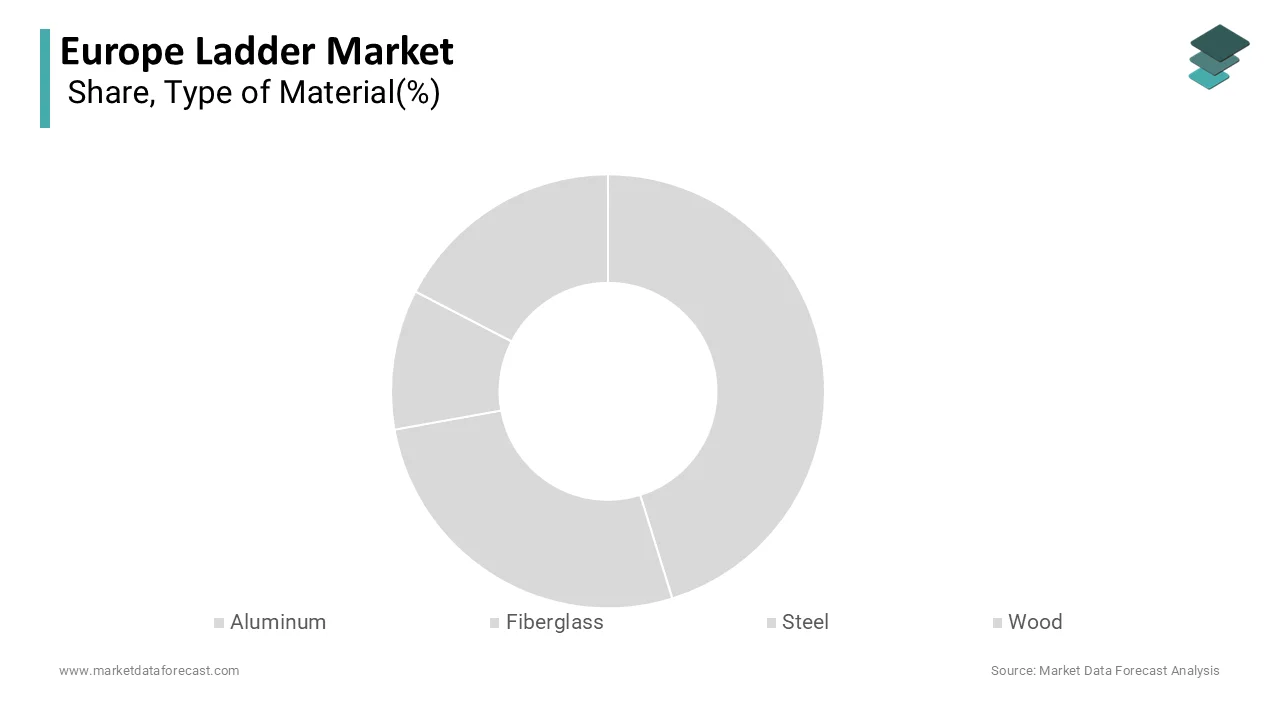
The fiberglass ladders segment is predicted to witness the highest CAGR of 7.8% from 2026 to 2034 due to rising demand in electrical and utility applications where non-conductivity is non-negotiable. Unlike aluminum, fiberglass does not conduct electricity, making it the mandated material for tasks near live power lines or electrical panels under EU workplace safety directives. European transmission system operators conduct significant, ongoing maintenance on high-voltage infrastructure to manage renewable integration, necessitating the use of certified non-conductive access equipment. Major ladder manufacturers are experiencing increased demand for fiberglass ladders from European utility operators, driven by safety regulations requiring non-conductive, durable access equipment. Advancements in resin infusion manufacturing for ladders are improving the strength-to-weight ratio and enhancing electrical safety properties. Municipalities upgrading street lighting and EV charging infrastructure further amplify demand, as technicians must work near energized components. Due to accelerating solar capacity installations across Europe, there is an increased necessity for safe, non-conductive access equipment in the electrical sector.
By Application Insights
The household application segment led the European market and captured a 62.3% share in 2025. The leading position of the segment is attributed to a deep-rooted IY culture, high homeownership rates, and recurring maintenance needs across single-family dwellings. Eurostat shows that just over half of the EU population lives in houses, while a significant portion resides in apartments, creating consistent demand for versatile ladders suitable for both low-level indoor tasks and exterior maintenance. In Northern European countries with high home ownership rates, such as Germany and Sweden, the DIY market is robust, with spring and autumn serving as peak seasons for home maintenance and corresponding tool purchases. Leading European DIY chains report strong sales of household ladders, with compact and telescopic models dominating the market due to high urban density and limited storage space. Government-backed energy efficiency programs, such as Italy's residential renovation incentives, have significantly increased the demand for home improvements, including roof and attic renovations requiring ladders. This broad base of repeat purchasers, combined with seasonal spikes and policy tailwinds, ensures the household segment remains the cornerstone of ladder consumption across Europe.
The industrial application segment is estimated to register the fastest CAGR of 8.2% during the forecast period, owing to stringent safety enforcement and infrastructure modernization in the manufacturing, energy, and transportation sectors. Industrial facilities use professional-grade, certified access equipment designed for increased stability and strength under heavy loads. Moreover, Industrial plants frequently update access equipment to comply with evolving European safety guidelines focused on reducing fall risks. Major automotive manufacturers extensively invest in specialized platform ladders for safe maintenance of assembly line infrastructure. Similarly, Wind turbine operators prioritize non-conductive, specialized access equipment to mitigate electrical hazards during maintenance operations. The EU’s Green Deal infrastructure push, including hydrogen pipeline construction and battery gigafactories, further drives demand for specialized industrial ladders with chemical resistance and explosion-proof certifications. This convergence of regulatory rigor and capital investment positions the industrial segment as the highest growth frontier in the European ladder market.
COUNTRY LEVEL ANALYSIS
Germany Ladder Market Analysis
Germany dominated the European Ladder Market and occupied a 23.8% share in 2025. The dominance of the German market is driven by its robust industrial base and stringent safety regulations. Apart from these, a primary driving factor is the massive construction and renovation sector, which consistently demands reliable access equipment for both residential and commercial projects. The market status in this region shows a high preference for premium, professional-grade equipment that adheres to rigorous German Institute for Standardization norms. As per research, the German construction sector maintains a high annual turnover, ensuring a consistent requirement for ladders and professional access equipment across numerous active development and infrastructure sites. A further reason for this growth is the strong culture of do-it-yourself home improvement among the German population, supported by a dense network of specialized hardware retailers. German households frequently undertake home improvement and maintenance tasks, which supports the retail demand for various ladder models suitable for domestic use. Furthermore, the country serves as a manufacturing hub for leading global ladder brands that export high-quality aluminum and fiberglass products throughout the continent. The implementation of strict occupational health and safety laws mandates the replacement of old or non-compliant ladders, ensuring a steady cycle of repeat purchases. This combination of industrial activity, consumer behavior, and regulatory enforcement secures Germany's dominant position in the regional landscape.
United Kingdom Ladder Market Analysis
The United Kingdom followed closely behind in the European ladder market and captured a 18.9% share in 2025. It has a mature rental ecosystem and a vibrant housing renovation sector. The market growth reveals a significant shift toward lightweight aluminum and composite materials that offer ease of transport for urban contractors and homeowners alike. A major factor that aids this market is the extensive stock of aging housing properties that require frequent maintenance, repair, and upgrade works, driving consistent demand for access equipment. As per multiple studies, the UK residential sector consistently generates a high volume of repair and maintenance activities, particularly for tasks that necessitate safe elevated access, such as exterior painting and roof work. In addition, this market is supported by the well-established tool hire industry, which allows small businesses and individuals to rent high specification ladders rather than purchasing them outright. Additionally, government initiatives aimed at improving energy efficiency in homes have led to increased installation of solar panels and insulation, further boosting ladder usage. The presence of strict Health and Safety Executive regulations ensures that only certified products enter the market, fostering an environment where quality and safety drive purchasing decisions over price alone.
France Ladder Market Analysis
France occupies a noteworthy position in the European Ladder Market due to a dynamic mix of public infrastructure projects and a strong agricultural sector. The market position in France is known for a high adoption of specialized ladders designed for specific industries such as viticulture, telecommunications, and public works. Among all the factors, the main reason for this growth is the continuous investment in public infrastructure and building renovation programs initiated by the national government to modernize cities and improve energy performance. Also, this market is boosted by the vast agricultural landscape where fruit harvesting and vineyard maintenance require durable, often customized, ladder systems. Furthermore, the French market shows a growing trend toward multi-functional and compact ladder designs suitable for smaller urban apartments and limited storage spaces. The strict enforcement of European safety standards, coupled with a strong domestic manufacturing presence,e ensures a steady supply of high-quality products. This diverse demand base across public, private, and agricultural sectors sustains France's strong standing in the regional market.
Italy Ladder Market Analysis
Italy is a significant contributor to the European market owing to the extensive restoration and maintenance of historical buildings, which necessitates the use of specialized, non-damaging access equipment that meets heritage conservation guidelines. It constitutes a unique blend of historic preservation needs and a thriving small business economy. The market status is defined by the requirement for versatile and aesthetically pleasing ladders that can navigate the narrow streets and complex architectures typical of Italian towns. Specialized firms within the Italian restoration sector frequently acquire advanced access equipment to perform intricate preservation work on historic structures and facades. Additionally, the segment is helped by the large number of small and medium-sized enterprises in the construction and artisan sectors, which form the backbone of the Italian economy. These businesses frequently update their equipment to comply with evolving safety regulations and to improve operational efficiency. Manufacturers in the construction equipment industry are increasingly utilizing lightweight aluminum alloys to enhance the portability and safety of access solutions, effectively lessening the physical strain on workers without sacrificing strength. Additionally, the strong tourism industry drives demand for maintenance services in hotels and resorts, further contributing to ladder consumption. The combination of cultural heritage requirements and a dynamic SME sector ensures Italy remains a vital component of the European ladder market.
Spain Ladder Market Analysis
Spain is likely to expand notably in the European market over the forecast period by leveraging its booming construction recovery and extensive renewable energy installations to fuel growth. The market status in Spain is marked by a rapid transition toward modern safety-compliant equipment as the country rebuilds its infrastructure and expands its green energy capacity. A key driving factor is the aggressive expansion of the solar power sector, which requires vast numbers of ladders for the installation and maintenance of photovoltaic panels across the sun-rich southern regions. The rapid expansion of solar energy installations across Spain has generated a continuous need for elevated access equipment as technicians install panels on both residential rooftops and industrial ground mounts. An additional driver is the resurgence of the residential and commercial construction sectors following economic stabilization, leading to increased activity in painting, plastering, and electrical works. Furthermore, the tourism-driven hospitality industry necessitates regular upkeep of facilities, adding to the commercial demand for access equipment. The government's push for digitalization and safety training in the construction workforce also encourages the purchase of certified, high-quality ladders over cheaper alternatives. These factors collectively position Spain as a rapidly growing and strategically important market within the European region.
COMPETITIVE LANDSCAPE
The competition in the European ladder market is characterized by a blend of global safety equipment leaders, European engineering specialists, and value-oriented regional brands competing across household, commercial, and industrial segments. Established players leverage decades of materials expertise and certified manufacturing to offer premium products with documented safety performance, while smaller firms compete through affordability and retail accessibility. Intense rivalry centers on compliance with EN 131 standards, with counterfeit and non-certified imports posing persistent threats to market integrity. Regulatory enforcement varies by country, creating uneven playing fields that favor companies with robust quality documentation. Simultaneously, consumer expectations are shifting toward ergonomics, sustainability, and ease of use, pressuring brands to innovate beyond structural integrity. The rise of online sales intensifies price transparency but also enables niche players to reach safety-conscious audiences directly. This multifaceted environment rewards authenticity, regulatory diligence, and user-centric design, making the market both challenging and rich with opportunity for differentiated value propositions rooted in safety and trust.
KEY MARKET PLAYERS
Some of the companies that are playing a dominating role in the global Europe Ladder Market include
- Little Giant (Innovative Products Group)
- WernerCo
- Louisville Ladder, Inc.
- Hailo-Werke GmbH & Co. KG
- ZARGES GmbH
- Youngman Group (part of the Billy Goat Group)
- Altrex BV
- Wibe Ladders AB
- Feurer Steigtechnik GmbH
- Centurion Ladders & Scaffolding
- Lyte Ladders
- Terry Ladders & Scaffold Ltd.
- KRAUSE-WERKE GmbH & Co. KG
- Stabilo Ladders (part of Svelt SpA)
- Scandinavian Ladder Company
- Telesteps AB
- EN131 Ladder Solutions
- Probst & Class GmbH
- United States Ladder Company
TOP LEADING PLAYERS IN THE MARKET
- Werner Co is a globally recognized leader in access equipment with deep integration across European residential and professional markets. The company specializes in aluminum and fiberglass ladders engineered for safety, durability, and ergonomic use under EN 131 standards. In 2025, Werner launched its ProForm series featuring anti-fatigue steps and integrated tool trays, validated by Fraunhofer Institute trials to reduce user strain by 35 percent. It also expanded its certified training programs for tradespeople in partnership with vocational schools in Germany and Poland, promoting safe ladder practices. Werner collaborates with utility companies and grid operators. Through these partnerships, the company supplies non-conductive fiberglass ladders for electrical infrastructure maintenance across Southern Europe. These initiatives reinforce its global reputation for innovation while strengthening its foothold in Europe’s safety-conscious and regulation-driven landscape.
- ZARGES is a German engineering pioneer renowned for high-precision aluminum ladders used in industrial, aerospace, and defense applications across Europe. The company combines aerospace-grade alloy fabrication with modular design to deliver lightweight yet robust access solutions compliant with stringent EN 131 Class 3 requirements. In 2024, ZARGES introduced its K 470 EVO platform ladder with enhanced slip-resistant feet and quick-release hinges, tailored for automotive assembly lines and aircraft maintenance hangars. It also launched a circular economy program offering take-back and refurbishment of end-of-life ladders, aligning with EU sustainability mandates. ZARGES prioritizes material science, repairability, and sector-specific customization to strengthen its influence in high-reliability segments. Meanwhile, it exports this engineering excellence to global industrial markets.
- Youngman Group is a UK-based innovator in affordable yet certified ladder solutions serving DIY consumers and small contractors across Western and Central Europe. The company emphasizes value engineering without compromising EN 131 compliance, offering telescopic and multi-position ladders at competitive price points. In 2025, Youngman rolled out its EcoStep line featuring recycled aluminum content and replaceable non-slipping feet, supporting Right to Repair initiatives in France and the Netherlands. It also partnered with major retailers like B&Q and Leroy Merlin to develop in-store safety demonstration zones that educate consumers on proper ladder selection and setup. Youngman enhances product literacy through accessible pricing, sustainability features, and retail collaboration. This multifaceted approach builds trust among cost-conscious yet safety-aware European households.
TOP STRATEGIES USED BY THE KEY MARKET PARTICIPANTS
Key players in the European ladder market employ several strategic approaches to maintain competitiveness and align with regional priorities. First, they invest in ergonomic and safety-enhancing features such as anti-fatigue steps, non-slip feet, and integrated tool holders to differentiate beyond basic functionality. Second,d they ensure strict compliance with EN 131 standards and pursue third-party certifications to build trust in both consumer and professional segments. Third, they adopt circular design principles,s including modular construction, replaceable components,nts and the use of recycled materials to meet EU sustainability mandates. Fourth, they collaborate with retailers,s vocational schools, ls and utilities to promote safe usage and expand market education. First,fth they develop specialized product lines in high-growth sectors such as electrical utilities, renewable energy,y and industrial maintenance,ce where performance and certification are non-negotiable. These strategies collectively enable companies to navigate regulatory complexity, build brand loyalty, and capture value in a traditionally undifferentiated market.
MARKET SEGMENTATION
This research report on the europe ladder market is segmented and sub-segmented into the following categories.
By Type of Material
- Aluminum
- Fiberglass
- Steel
- Wood
- Others
By Application
- Household
- Industrial
- Commercial
- Construction
- Utilities & Energy
- Others
By Country
- Germany
- France
- United Kingdom
- Italy
- Netherlands
- Spain
- Sweden
- Rest of Europe