- Product Description Description
- Table of Contents TOC
- List of Table & Figure LOT
- Get Free Sample PDF Sample PDF
Market Size, 2025
$9.83 BnMarket Estimate, 2026
$10.48 BnMarket Forecast, 2034
$17.47 BnCAGR, 2026–2034
6.6%Executive Summary: Europe Lead Acid Battery Market
- Market Scope: Comprehensive regional lead acid battery market analysis covering application categories, product types, country-level leadership frameworks, recycling trends, and environmental regulatory compliance.
- Market Valuation: Valued at USD 9.83 billion (2025), estimated at USD 10.48 billion (2026), and projected to reach USD 17.47 billion by 2034, registering a steady CAGR of 6.60% (2026–2034).
- Primary Growth Drivers: Persistent dominance in automotive starting, lighting, and ignition (SLI) applications across Europe’s 260 million passenger car fleet and mandatory uninterruptible power supply requirements for critical infrastructure under EU cybersecurity and resilience directives. Key industry trends include the integration of advanced lead-carbon chemistries in renewable microgrids and closed-loop recycling mandated by the new EU Battery Regulation. Growth remains constrained by stringent environmental regulations on lead emissions, competitive displacement by lithium-ion batteries, and operational cost pressures.
Key Market Segment Metrics (2026–2034)
| Category | Leading Segment (2025 Position) | Fastest-Growing Segment |
|---|---|---|
| By Application | SLI batteries segment (accounted for a significant share across internal combustion engine and mild hybrid fleets) | Stationary batteries segment (anticipated to witness a CAGR of 5.9%) |
| By Technology / Product Type | Flooded (wet) segment (captured 58.3% market share in 2025) | VRLA batteries (likely to grow at the fastest CAGR of 6.2%) |
| By Region / Country | Germany (dominated the regional market with a 26.3% share in 2025, followed by France at 15.3%) | United Kingdom, Italy, and Russia (key expanding revenue-generating markets) |
Major Market Players & Competitive Landscape
Market Structure: Highly competitive European industrial and energy landscape featuring major institutional and corporate players actively aligning with sustainability mandates, risk mitigation frameworks, and financial co-insurance structures.
Key Companies: Allianz Trade (Euler Hermes), Atradius N.V., Coface S.A., Zurich Insurance Group, AXA Group, Chubb Limited, American International Group, Inc. (AIG), QBE Insurance Group Limited, Tokio Marine HCC, Liberty Mutual Insurance Group, Swiss Re Group, Munich Re Group, Berkshire Hathaway Specialty Insurance, Credendo Group, and Mapfre S.A.
Europe Lead Acid Battery Market Size
The Europe Lead Acid Battery Market is projected to grow from USD 9.83 billion in 2025 to USD 10.48 billion in 2026 and reach USD 17.47 billion by 2034, registering a CAGR of 6.60% from 2026 to 2034.
The lead acid battery is based on lead dioxide positive plates, sponge lead negative plates, and sulfuric acid electrolyte, primarily deployed in automotive starting, lighting,g and ignition applications, uninterruptible power supplies, and industrial motive power systems. According to the International Lead Association, over 99% of lead-acid batteries sold in the European Union are collected and recycled at the end of life, making it one of the most circular product streams in the region. The European Commission’s Battery Regulation explicitly recognizes lead acid chemistry as a critical technology for specific applications where safety, temperature resilience, and recycling infrastructure outweigh energy density limitations, ensuring its continued relevance within a diversified energy storage landscape.
MARKET DRIVERS
Persistent Dominance in Automotive Starting, Lighting, and Ignition Applications
Lead acid batteries retain an overwhelming position in Europe’s automotive starting, lighting, ing and ignition segment due to stringent safety standards, cost constraints,,s and vehicle architecture inertia. The persistent dominance in automotive starting, ignition, and lighting applications is solely propelling the growth of Europe lead acid battery market. This reliance persists even in 48-volt mild hybrid systems, where a secondary lithium battery handles regenerative braking but a lead-acid unit remains for fail-safe starting and cabin electronics. As per the German Federal Motor Transport Authority, the average service life of these batteries is 4 to 5 years, creating a predictable replacement cycle across Europe’s 260 million passenger car fleet. The technology’s ability to deliver high cold cranking amperage at subzero temperatures, a frequent requirement in Nordic and Central European winters, further escalates its irreplaceability.
Mandatory Uninterruptible Power Supply Requirements in Critical Infrastructure
Europe’s regulatory framework for data centers, hospitals, and telecommunications infrastructure mandates redundant uninterruptible power supply systems, where lead acid batteries remain the default choice due to proven reliability and low total cost of ownership. The mandatory uninterruptible power supply requirements in infrastructure are additionally elevating the growth of the Europe lead acid battery market. According to the European Telecommunications Standards Institute, all Tier III and Tier IV data centers must maintain backup power during grid outages, a requirement met overwhelmingly byvalve-regulated lead-acidd batteries. As per the European Data Centre Association, many data centers operating in the European Union in 2024 use lead acid-based uninterruptible power systems due to their predictable failure modes, tolerance to overcharge,e and ease of state of health monitoring. Similarly, the European Union Agency for Cybersecurity requires continuous power for emergency communication networks, which rely on lead-acid batteries for grid independence during disasters. The European Commission’s Critical Entities Resilience Directive further tightens these obligations, creating non-discretionary demand insulated from technological disruption. This institutionalized need ensures steady consumption even as lithium alternatives gain traction in newer applications.
MARKET RESTRAINTS
Stringent Environmental Regulations on Lead Emissions and Workplace Safety
The handling of lead, a toxic heavy metal, subjects the lead acid battery value chain to some of the most rigorous environmental and occupational health controls. The stringent environmental regulations and workplace safety are hampering the growth of the European lead-acid battery market. According to the European Chemicals Agency, lead is classified as a substance of very great concern under REACH with workplace airborne exposure limits set at 0.05 milligrams per cubic meter over aeight-hourur period as stipulated in Directive 2009 148 EC. Compliance requires smelters and battery assemblers to invest in advanced fume suppression, secondary containment, and real-time monitoring systems. As per the European Environment Agency, lead acid battery recycling and manufacturing facilities across the European Union underwent enforcement inspections in 202,4 with issued corrective actions for exceedances in lead particulate emissions. These regulatory burdens increase operational cost, according to the International Lead Association, discouraging new entrants and pressuring small recyclers to consolidate.
Competitive Displacement by Lithium Ion in Emerging Energy Storage Applications
Although lead acid remains entrenched in traditional roles, it is experiencing rapid displacement in new stationary and motive power applications due to the superior energy density,y cycle li,f,e, and declining cost of lithium-ion batteries. The competitive displacement by lithium-ion in emerging countries is also hampering the growth of Europe lead acid battery market. In forklift and material handling equipment, historically a core lead acid domain, the European Materials Handling Federation reports that lithium-powered units captured new orders in 2024, up from 2020, due to opportunity charging and zero maintenance advantages. This shift is accelerated by the European Commission’s Battery Regulation, which prioritizes carbon footprint labeling and performance classes,s favoring high cycle chemistries. As per BloombergNEF, the levelized cost of storage for lithium systems in industrial applications fell below 150 euros per kilowatt hour in 2024, making them economically superior over a ten-year horizon. This erosion in emerging segments constrains lead acid growth to legacy replacement cycles rather than new market creation.
MARKET OPPORTUNITIES
Integration of Advanced Lead Acid Chemistries in Renewable Microgrid Systems
Innovations in lead acid technology, particularly lead carbon and advanced tubular plate designs, are enabling reentry into decentralized renewable energy applications across Europe’s remote and island communities. This integration of advanced lead acid chemistriesinI renewablmicrogridis systems is substantially to leverage new opportunities for the growth of Europe lead acid battery market. According to the European Commission’s Clean Energy for EU Islands initiative, over 200 microgrids in Greek, Spanish anothersh archipelagos now utililead-carbon batteriesies for solar and wind integration due to their enhanced partial state of charge cycling and tolerance to irregular charging patterns. The technology’s non-flammability and simple battery management requirements make it ideal for locations with limited technical expertise. Supported by Horizon Europe funding, theEU-fundedd STORE project demonstrated a reduction in levelized storage cost using lead carbon in Baltic island grids.
Expansion of Closed Loop Recycling Infrastructure Under the New EU Battery Regulation
The European Union’s 2023 Battery Regulation establishes unprecedented material recovery obligations that reinforce lead acid’s circular advantage and create new investment opportunities in refining and secondary lead production. This factor is also expected to enhance the growth of the Europe lead acid battery market in the coming years. According to the regulation, battery producers must ensure that new lead acid batteries placed on the market contain a minimum recycled lead by 2030, with a target already exceeded by current practice,ce but now legally binding. As per the European Recycling Platform, lead was recovered fromend-of-life batteriess in the European Union in 2024, representing the lead content. Companies like Recylex and Exide are expanding secondary smelting capacity in France and Germany to meet verified demand for battery-grade recycled lead. This regulatory reinforcement transforms recycling from a compliance cost into a strategic asset securing low-carbon material streams aligned with the European Green Deal.
MARKET CHALLENGES
Fragmentation in End-of-Life Collection Networks Across Member States
Despite a high overall recycling rate, the efficiency of lead-acid battery collection varies significantly across European Union member states due to inconsistent enforcement of Extended Producer Responsibility schemes and informal waste diversion. According to the European Environment Agency, collection rates exceed 95% in Germany, France, and the Netherlands, but fall below 75% in Bulgaria, Romania, and Greece,ece where unlicensed scrap dealers offer cash payments for batteries, bypassing official channels. As per the European Commission’s 2024 compliance report, an estimated 12 to 15 mmillion lead-acidbatteries annually enter informal recycling streams in Southern and Eastern Europe, often processed in unsafe backyard smelters that release lead and sulfur dioxide without emission controls. This undermines the environmental integrity of the circular model and creates unfair competition for licensed recyclers who bear full compliance costs. The lack of harmonized digital tracking under the new Battery Regulation exacerbates the problem, as cross-border movements of used batteries remain difficult to monitor.
Vulnerability to Lead Price Volatility and Raw Material Concentration
The economic stability is exposed to fluctuations in lead prices and geographic concentration of primary production, which also limits the growth of Europe lead acid battery market. According to the London Metal Exchange, the cash price of lead averaged 2,150 dollars per metric ton in 2024 but swung between 1,850 and 2,450 dollars within the year due to supply disruptions in major mining regions like Australia and China. As per the European Commission, over 60% of the European Union’s primary lead imports originate from just three countries: Australia, Peru, and the United States, creating supply chain concentration risk. Although recycling supplies most lead demand, sudden spikes in collection lags or smelter outages can force manufacturers to source expensive virgin metal. Unlike lithium-ion chemistries with diversified cathode options, lead acid has no alternative anode material.
REPORT COVERAGE
| REPORT METRIC | DETAILS |
| Market Size Available | 2025 to 2034 |
| Base Year | 2025 |
| Forecast Period | 2026 to 2034 |
| Segments Covered | By Application, Portable, Technology, and Region. |
| Various Analyses Covered | Global, Regional, and Country-Level Analysis, Segment-Level Analysis, Drivers, Restraints, Opportunities, Challenges; PESTLE Analysis; Porter’s Five Forces Analysis, Competitive Landscape, Analyst Overview of Investment Opportunities |
| Countries Covered | UK, France, Spain, Germany, Italy, Russia, Sweden, Denmark, Switzerland, Netherlands, Turkey, Czech Republic, and the Rest of Europe |
| Market Leaders Profiled | Clarios (formerly Johnson Controls Power Solutions), Exide Technologies, GS Yuasa Corporation, EnerSys, Hitachi Chemical Co., Ltd. (now part of Showa Denko), East Penn Manufacturing Co., Inc. (Deka Batteries), Crown Battery Manufacturing Company, FIAMM Energy Technology S.p.A., Saft Groupe S.A. (TotalEnergies), Banner GmbH, VARTA AG, Leoch International Technology Limited, Chilwee Group Co., Ltd., TAB Batteries (Turkey), Ducato Batteries (Europe-focused supplier), HBL Power Systems Ltd., Yuasa Battery Europe GmbH, Yinlong Energy Co., Ltd., Ultium Cells LLC, Panasonic Energy Co., Ltd. |
SEGMENTAL ANALYSIS
By Application Insights
The SLI (Starting Lighting Ignition) batteries segment accounted for a significant share of the Europe lead acid battery market in 2025. Europe’s vehicle fleet remains overwhelmingly dependent on 12-volt lead-acid batteries for core electrical functions, even as electrification advances. According to the European Automobile Manufacturers Association, many million new vehicles produced in the European Union in 2024, comprising internal combustion engine and 48 volt mild hybrid models, retained a dedicated SLI battery for engine cranking and cabin electronics. As per the survey, the average replacement interval for these batteries is 48 to 60 months,s by creating a consistent aftermarket demand across Europe’s 260 million passenger cars. The technology’s ability to deliver high cold cranking amperage at temperatures below 20 degrees Celsius with a requirement in Nordic and Alpine regions.
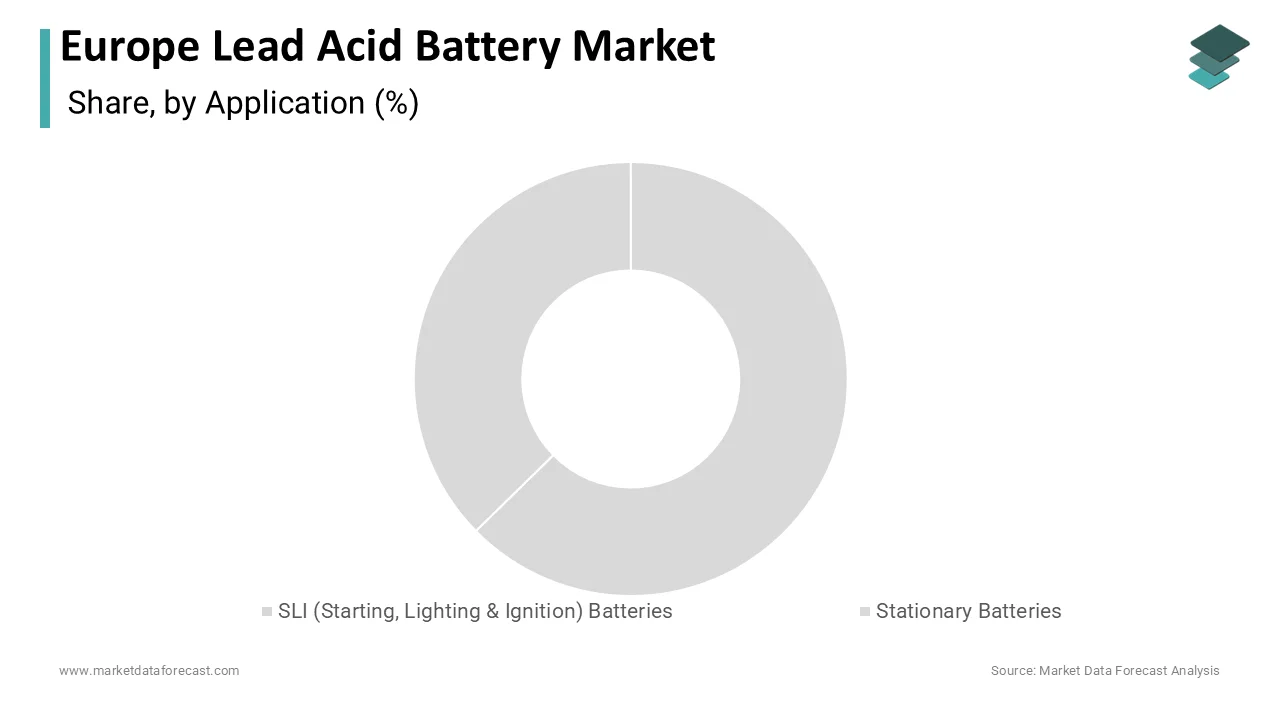
The Stationary Batteries segment is anticipated to witness the fastest CAGR of 5.9% from 2025 to 2033. Europe’s push for digital autonomy has triggered unprecedented data center construction requiring robust uninterruptible power systems, where lead acid remains the default. According to the European Data Centre Association, over 210 new Tier III and Tier IV facilities were commissioned across the European Union in 2024, with each deploying 500 to 2,00kilowatt-hour lead-acid-baseded UPS banks. The Joint Research Centre estimates that data center power demand will double by 2028, increasing stationary battery requirements proportionally. Lead acid’non-flammabilityty and tolerance to float charging make it the preferred choice in densely populated urban facilities where fire risk mitigation is paramount. The European Union’s Clean Energy for EU Islands initiative is driving the adoption of lead-acid-based stationary storage in decentralized renewable systems. According to the European Commission, over 200 island microgrids in Greece, Sweden, and Spain now integrate advanced lead-carbon batteries with solar and wind generation to ensure grid stability. The technology’s simplicity allows operation by local technicians without specialized training, an advantage in remote locations.
By Portable Insights
The other Applications segment was the largest by holding a significant share of theEuropeane lead acid battery market in 2025. Lead-acid batteries remain the backbone of electric forklift fleets in European warehouses and factories due to their low upfront cost and robust performance in controlled environments. As per the German Engineering Federation, these batteries dominate in indoor applications, where opportunity charging is impractical, and battery room infrastructure exists. The technology’s ability to deliver consistent torque across full discharge cycles and tolerance to deep cycling make it reliable for multi-shift operations. European rail networks rely heavily on lead-acid batteries for signaling, backup, emergency lighting,g and door operation during power failures. According to the European Union Agency for Railways, all new rolling stock certified under TSI LOC&PAS must include redundan110-volt lead-acidid banks with a minimum 30-minute autonomy. Similarly, emergency lighting in public buildings under EN 1838 standards specifies sealed lead-acid batteries for their stable voltage output over discharge.
The Industrial Motive Power segment is growing at a fast CAGR of 4.7% from 2025 to 2033. Europe’s e-commerce boom has intensified demand for automated and manual material handling equipment in distribution centers. As per the European Logistics Association, over 75 new mega fulfillment centers opened across Poland, Germany, and the Netherlands in 2024, each deploying 100 to 300 electric forklifts. While lithium adoption rises in new builds, the high cost of retrofitting existing fleets ensures continued lead-acid replacement demand. The German Engineering Federation notes that lead acid remains preferred in multi-shift operations, where centralized battery changing infrastructure already exists, avoiding the need for costly charging upgrades. Innovations in tubular plate technology have extended the service life of industrial lead acid batteries to 6,000 cycles or more,e enabling competitive operation in high utilization environments.
By Technology Insights
The Flooded (wet) segment was the largest by capturing 58.3% of thEuropeanpe lead acid battery market share in 2025. Flooded batteries remain the most economical option for applications where maintenance access is routine and weight is not important. According to the International Lead Association, the average manufacturing cost of a flooded battery is lower than that of an equivalent VRLA unit due to simpler casing and the absence of recombinant valve systems. As per the European Automobile Aftermarket Association, replacement SLI batteries sold in Europe are flooded types favored by independent garages for their ease of electrolyte level checking and potential for revival through desulfation. In industrial settings, flooded batteries can be regenerated through periodic equalization charging, extending life beyond sealed alternatives. This economic and operational flexibility ensures continued dominance in price-driven and service-oriented segments. Flooded batteries exhibit superior heat dissipation compared to VRLA designs, making them preferable in hot climates and high-discharge applications. According to the European Commission’s Joint Research Centre, flooded cells operating in Southern European forklifts showed lower internal resistance rise after many cycles compared to AGM counterparts due to direct exposure of plates to electrolyte. Similarly, in Mediterranean regions, where summer temperatures exceed 40 degrees Celsius, flooded SLI batteries experience less thermal runaway risk during engine bay operation.
The VRLA (Valve Regulated Lead Acid) batteries segment is likely to grow at the fastest CAGR of 6.2% from 2025 to 2033. VRLA batteries are AGM and gel variants, which are essential in applications where accessibility for maintenance is limited or impossible. According to the European Telecommunications Standards Institute, all new telecom backup cabinets deployed in 2024 use AGM batteries due to their orientation flexibility, spill-proof design, and low self-discharge. As per the European Data Centre Association, over 90% of new UPS installations specify VRLA for rack-mounted systems, where space efficiency and zero maintenance are mandatory. The technology’s recombinant chemistry prevents water loss, enabling 5 to 10-year service lives without intervention.
COUNTRY LEVEL ANALYSIS
Germany Lead Acid Battery Market Analysis
Germany was the top performer of the European lead-acid battery market by capturing 26.3% of the market share in 2025, driven by its dual dominance in automotive manufacturing and industrial logistics. According to the German Federal Motor Transport Authority, new vehicles equipped with lead acid SLI batteries were registered in 2024 alone, while the country’s many electric forklifts generate steady replacement demand. Germany also hosts Europe’s most advanced lead recycling infrastructure, with companies like Recylex and Exide operating closed-loop smelters that process battery scrap annually, as per the German Environment Agency. The nation’s strict enforcement of the EU Battery Regulation ensures near 100% collection rates, reinforcing circularity. Additionally, Germany’s Energiewende policy supports microgrid deployments in rural areas using advancedlead-carbonn stationary storage. This ecosystem of production, consumption, and recycling makes Germany the structural anchor of the European market.
France Lead Acid Battery Market Analysis
France's lead-acid battery market was positioned second by holding 15.3% of the share in 2025, with the mandatory vehicle inspection rules and national digital infrastructure expansion. France also operates over 85,000 telecom sites managed by Orange and Free Mobile, all requiring VRLA backup, as per ARCEP regulations. As per the French Environment and Energy Management Agency, the country achieved a 98.5% collection rate for end-of-life batteries through its SYBAVIL compliance scheme. France’s combination of regulatory enforcement and strategic infrastructure investment ensures consistent consumption across both mobile and stationary segments.
Italy Lead Acid Battery Market Analysis
Italy's lead-acid battery market growth is likely to grow with Europe’s second-highest vehicle density and a vast independent repair network. According to the Italian National Institute of Statistics, the country’s 38 million passenger cars generate over 7 million battery replacements annually, with flooded types dominating due to cost sensitivity. As per the Italian Federation of Automotive Repairers, independent garages prefer lead acid for its serviceability and compatibility with legacy diagnostic tools. Italy’s warm climate also reduces cold cranking demand,s extending battery life but increasing replacement frequency due to higher self-discharge.
Spain Lead Acid Battery Market Analysis
Spain'sin lead acid battery market growth is driven by its dominance in renewable microgrids and e-commerce warehousing. According to the Spanish Ministry for Ecological Transition, over 45 island communities now use lead-carbon stationary batteries for solar integration under the Clean Energy for EU Islands framework. Simultaneously, Spain’s role as a European logistics hub with 120 new distribution centers opened in 2024 drives industrial motive power demand. Spain’s unique blend of decentralized energy policy and supply chain expansion creates balanced growth across all lead acid segments.
Netherlands Lead Acid Battery Market Analysis
The Netherlands lead acid battery market growth is driven by its data center concentration and advanced recycling protocols. According to the Dutch Data Center Association, the country hosts over 200 facilities, including hyperscalers like Google and Microsoft, all mandatingVRLA-basedd UPS systems per national fire safety codes. The Dutch government’s National Battery Strategy explicitly supports lead acid circularity as a model for other chemistries. Additionally, the Port of Rotterdam’s fleet of 1,200 electric terminal tractors relies on flooded lead acid for motive power due to centralized charging infrastructure.
COMPETITIVE LANDSCAPE
Competition in the European lead acid battery market is characterized by a mature yet dynamic landscape where established multinational manufacturers coexist with specialized regional recyclers and technology innovators. The sector is not driven by price competition but by differentiation through product longevity, regulatory compliance,e and circular performance. Incumbents leverage decades of OEM relationships and integrated smelting operations to ensure supply chain control,ol while new entrants focus on niche applications such as microgrid storage or advanced diagnostics. The European Union’s stringent Battery Regulation acts as both a barrier and enabler—raising compliance costs for small players while rewarding those with certified recycling and low carbon production. Consolidation remains selective, with strategic acquisitions targeting recycling capacity or digital service capabilities rather than volume alone. Collaboration through industry consortia like the International Lead Association accelerates pre-competitive research in material science and life cycle assessment.
KEY MARKET PLAYERS
Some of the companies that are playing a dominating role in the global europe lead acid battery market include
- Clarios (formerly Johnson Controls Power Solutions)
- Exide Technologies
- GS Yuasa Corporation
- EnerSys
- Hitachi Chemical Co., Ltd. (now part of Showa Denko)
- East Penn Manufacturing Co., Inc. (Deka Batteries)
- Crown Battery Manufacturing Company
- FIAMM Energy Technology S.p.A.
- Saft Groupe S.A. (TotalEnergies)
- Banner GmbH
- VARTA AG
- Leoch International Technology Limited
- Chilwee Group Co., Ltd.
- TAB Batteries (Turkey)
- Ducato Batteries (Europe-focused supplier)
- HBL Power Systems Ltd.
- Yuasa Battery Europe GmbH
- Yinlong Energy Co., Ltd.
- Ultium Cells LLC
- Panasonic Energy Co., Ltd.
TOP LEADING PLAYERS IN THE MARKET
- Exide Industries maintains a robust presence in the European lead acid battery market through its extensive manufacturing footprint in Spain, Germany,y and the Czech Republic, ic serving automotive, industrial,,l and stationary sectors. The company supplies original equipment and aftermarket batteries to major European vehicle manufacturers and industrial clients while operating one of the continent’s largest closed-loop recycling networks. Exide has recently intensified its focus on advanced lead-carbon technology for renewable energy storage, aligning with EU microgrid initiatives. Globally,y Exide leverages its European R and D center to develop low-carbon battery chemistries deployed across North American and Asian markets. The company’s investment in digital battery monitoring systems for telecom and data center applications further strengthens its value proposition beyond traditional product supply.
- EnerSys is a key player in the Europe lead acid battery market with leadership in industrial motive power and reserve power solutions. Headquartered in the United States but deeply embedded in Europe through facilities in Belgium, Germany, and the U, the company provides advanced Thin Plate Pure Lead and flooded tubular batteries for forklifts, rail systems, and uninterruptible power supplies. EnerSys has expanded its European service network to support predictive maintenance and battery-as-a-service models for logistics and data center operators. The company actively contributes to global standards development for battery safety and recycling through international bodies. Its recent launch ofcarbon-enhancedd flooded batteries for high-cycle applications demonstrates a strategic pivot toward performance innovation within the lead-acid framework.
- Clarios holds a strategic position in the European lead acid battery market as a primary supplier of SLI and enhanced flooded batteries to leading automotive OEMs, including Volkswagen,n Stellant,s and BMW. The company operates high-efficiency plants in France, Italy, and Poland, integrated with real-time quality control and low-emission smelting technologies. Clarios has accelerated its development of batteries optimized for48-voltt mild hybrid systems, which dominate European new vehicle platforms. Globally, Clarios exportEurope-engineereded battery architectures to emerging markets while championing the industry’s circular model through its participation in the International Lead Association. Recent initiatives include deploying AI-driven state-of-health diagnostics in replacement batteries to extend service life and reduce waste.
TOP STRATEGIES USED BY THE KEY MARKET PARTICIPANTS
Key players in the European lead acid battery market employ a combination of technology innovation, regulatory alignment,t and circular integration to sustain competitiveness. Companies are investing in advanced chemistries such as lead carbon and thin plate pure lead to enhance cycle life and partial state of charge performance for renewable and motive power applications. They are expanding closed-loop recycling infrastructure to meet the European Union’s 85% recycled lead content mandate by 2030. Strategic partnerships with automotive OEMs and data center operators ensure co-development of application-specific solutions. Geographic focus on Southern and Eastern Europe targets high growth in vehicle replacement and digital infrastructure. Additionally, firms are digitizing battery management through embedded sensors and cloud platforms to offer predictive maintenance and battery-as-a-service models. These strategies collectively reinforce lead acid’s relevance in a transitioning energy landscape.
MARKET SEGMENTATION
This research report on the europe lead acid battery market is segmented and sub-segmented into the following categories..
By Application
- SLI (Starting, Lighting & Ignition) Batteries
- Stationary Batteries
By Portable
- Industrial Motive Power
- Other Applications
By Technology
- Flooded (Wet) Batteries
- VRLA (Valve Regulated Lead Acid) Batteries
-
- AGM
- Gel
By Country
- Germany
- France
- Italy
- Spain
- Netherlands
- Rest of Europe