- Product Description Description
- Table of Contents TOC
- List of Table & Figure LOT
- Get Free Sample PDF Sample PDF
Market Size, 2025
$2.8 BnMarket Estimate, 2026
$2.9 BnMarket Forecast, 2034
$3.85 BnCAGR, 2026–2034
3.6%Executive Summary: Europe Linear Alkyl Benzene Market
- Market Scope: Comprehensive European linear alkyl benzene (LAB) industry analysis covering application tiers, end-use segments, regional country leadership frameworks, strategic corporate developments, and competitive landscapes.
- Market Valuation: Valued at USD 2.80 billion (2025), estimated at USD 2.90 billion (2026), and projected to reach USD 3.85 billion by 2034, registering a steady CAGR of 3.60% (2026–2034).
- Primary Growth Drivers: Stringent EU regulations favoring biodegradable surfactants (LAS), institutional cleaning demand across healthcare and food processing sectors, bio-based LAB alternatives development, and circular water reuse integration. Restraints include feedstock volatility, benzene handling regulations, and high alkylation energy intensity.
Key Market Segment Metrics (2026–2034)
| Category | Leading Segment (2025 Position) | Fastest-Growing Segment |
|---|---|---|
| By Application | Linear Alkylbenzene Sulfonates (LAS) (held dominant share due to regulatory compliance and cleaning efficacy) | Non-surfactant applications (projected CAGR of 5.12%) |
| By End-Use Demand | Laundry detergents (accounted for 57.5% of end-use demand in 2025) | Industrial cleaners (anticipated to expand at a CAGR of 7.14%) |
| By Region / Country | Germany (led regional market with a 25.5% share / ~27.8% European revenue share, supported by the Rhine petrochemical corridor) | Western and Central European detergent manufacturing hubs (Spain, France, UK, Italy, Netherlands) |
Major Market Players & Market Structure
Market Structure: Highly consolidated European petrochemical and surfactant sector emphasizing benzene recovery efficiency, cold-water detergent formulations, renewable paraffin feedstock flexibility, and ISCC Plus certified bio-based pilot streams.
Key Companies: Saudi Basic Industries Corporation (SABIC), INEOS Group AG, Reliance Industries Limited, ExxonMobil Corporation, Shell Chemicals, TotalEnergies SE, BASF SE, LyondellBasell Industries N.V., Exol SA, Sasol, and CEPSA Química.
Europe Linear Alkyl Benzene Market Size
The Europe Linear Alkyl Benzene Market is projected to grow from USD 2.80 billion in 2025 to USD 2.90 billion in 2026 and reach USD 3.85 billion by 2034, registering a CAGR of 3.60% from 2026 to 2034.
Linear alkyl benzene is a critical organic intermediate primarily used in the production of linear alkyl benzene sulfonate, the dominant anionic surfactant in household and industrial detergents across Europe. Synthesized through the alkylation of benzene with linear paraffins derived from kerosene fractions, it serves as the foundational building block for biodegradable cleaning formulations mandated under EU environmental directives. Detergents remain one of the largest and most consistently purchased household product categories across the region, which is supporting stable demand for high‑purity linear alkyl benzene. Germany operates multiple large‑scale production facilities that supply both domestic and neighbouring EU markets, reflecting the region’s integrated petrochemical infrastructure. As per the EU’s REACH regulation, linear alkyl benzene is subject to strict quality and impurity thresholds, thereby incentivizing producers to maintain stringent process controls. According to the European Environment Agency, municipal wastewater treatment plants across Europe achieve high biodegradation rates for linear alkyl benzene sulfonate, reinforcing its regulatory acceptability. This combination of performance efficacy, biodegradability, and policy alignment ensures linear alkyl benzene remains indispensable in Europe’s hygiene and cleaning ecosystem.
MARKET DRIVERS
Stringent EU Regulations Favouring Biodegradable Surfactants
European environmental legislation actively promotes the use of readily biodegradable surfactants, which directly reinforces demand for linear alkyl benzene as the precursor to linear alkyl benzene sulfonate and is one of the promising factors propelling the European market growth. The EU Detergent Regulation mandates that all anionic surfactants in consumer cleaning products must demonstrate ultimate aerobic biodegradability of at least 60% within 28 days, which is a threshold that linear alkyl benzene sulfonate consistently exceeds. According to the European Commission’s Joint Research Centre, linear alkyl benzene sulfonate achieves high levels of biodegradation in OECD 301 tests, confirming compliance with EU requirements. In contrast, older branched alkyl benzene sulfonates fail this criterion and are effectively banned. Consequently, virtually all laundry, dishwashing, and hard surface cleaners sold in the EU rely on linear alkyl benzene-derived surfactants. As per the European Soap and Detergent Industry Association, the overwhelming majority of anionic surfactants used in European household detergents are based on linear alkyl benzene sulfonate, reflecting regulatory alignment. This regulatory lock-in ensures stable consumption despite price volatility or alternative chemistries. Furthermore, the European Green Deal’s Chemicals Strategy for Sustainability reinforces preference for substances with proven environmental safety profiles, positioning linear alkyl benzene as a compliant and low-risk ingredient in a tightening chemical governance landscape.
Growth in Institutional and Industrial Cleaning Demand
Beyond households, the expansion of institutional and industrial cleaning sectors across Europe is driving incremental linear alkyl benzene consumption, particularly in healthcare, hospitality, and food processing, which is further contributing to the regional market expansion. According to the European Hospital and Healthcare Employers’ Association, Europe operates thousands of hospitals, all requiring high efficacy, cost-efficient surfactants for laundry and surface disinfection, as these are the applications where linear alkyl benzene sulfonate offers superior foaming and grease cutting at low concentrations. Similarly, the food and beverage industry, which Eurostat identifies as one of Europe’s largest manufacturing sectors by turnover, mandates rigorous hygiene protocols that rely on linear alkyl benzene-based detergents for equipment and container cleaning. The rise of contract cleaning services further amplifies bulk demand. These professional users prioritize performance per liter and cost per wash, both areas where linear alkyl benzene sulfonate excels due to its high active matter content and compatibility with hard water. With the EU’s post pandemic emphasis on public hygiene, institutional cleaning expenditure has increased across multiple member states, directly translating into sustained feedstock demand for linear alkyl benzene producers.
MARKET RESTRAINTS
Volatility in Feedstock Availability and Paraffin Sourcing Constraints
Linear alkyl benzene production in Europe is heavily dependent on the supply of linear paraffins, whichares typically extracted from kerosene cuts in refineries, a stream increasingly constrained by shifting fuel demand and refining configurations, ns and is hampering the European linear alkyl benzene market growth. According to the European Commission’s Energy Directorate, kerosene output in Europe has fluctuated in recent years due to changes in aviation fuel demand and refinery optimization, which is affecting paraffin availability. This contraction limits the availability of high-purity C10 C13 linear paraffins essential for premium linear alkyl benzene grades. As per Eurostat, Europe has increased imports of paraffinic feedstocks from external regions, exposing producers to geopolitical and logistical risks. Additionally, the EU’s Carbon Border Adjustment Mechanism imposes indirect costs on imported hydrocarbons, raising input expenses. A shortage of suitable paraffin feedstock in early 2025 forced one German producer to operate at reduced capacity for several weeks, as reported by industry monitoring services. These structural supply vulnerabilities create production bottlenecks and price instability, which is undermining the reliability of the linear alkyl benzene supply despite steady end-user demand.
Escalating Regulatory Scrutiny on Benzene Handling and Emissions
The use of benzene, a known human carcinogen, as a core raw material in linear alkyl benzene synthesis subjects European producers to increasingly stringent occupational and environmental controls, which is also impeding the regional market growth. According to the European Environment Agency,y recent revisions to EU industrial emissions rules have tightened permissible benzene emission limits for petrochemical facilities, requiring significant upgrades. Compliance requires closed-loop systems, vapor recovery units, and continuous monitoring, with substantial retrofit investments for older plants. Furthermore, as per the EU Chemical Agents Directive, worker exposure limits for benzene have been tightened, necessitating advanced containment in alkylation units. These measures disproportionately affect older plants in Southern and Eastern Europe, where capital for upgrades is limited. In 2025, two facilities in Italy and Poland delayed expansion plans due to benzene handling compliance uncertainties. Such regulatory pressure not only increases operational costs but also discourages new capacity investment, which is constraining long term supply elasticity in the face of growing surfactant demand.
MARKET OPPORTUNITIES
Development of Bio-Basedd Linear Alkyl Benzene Alternatives
Innovations in renewable feedstocks are opening viable pathways to partially or fully bio-based linear alkyl benzene, which aligns with the EU’s circular economy and decarbonization objectives and is a prominent opportunity in the European linear alkyl benzene market. Companies like Neste and TotalEnergies have successfully demonstrated the production of linear paraffins from hydrotreated vegetable oils and waste fats, which can then undergo conventional alkylation with bio-benzene derived from lignin or pyrolysis oil. According to independent verification by TÜV Rheinland, pilot-scale production of bio-based linear alkyl benzene has demonstrated substantial lifecycle greenhouse gas reductions compared with fossil-based routes, which supports its environmental viability. The European Bioeconomy Alliance estimates that scalable bio-paraffin production could meet a meaningful share of Europe’s linear alkyl benzene demand by 2030. Major detergent brands, including Unilever and Henkel,l have expressed interest in certified renewable surfactants, with Henkel committing to increased use of bio-based carbon in cleaning ingredients. This emerging bio route not only reduces fossil dependency but also enhances brand sustainability credentials without altering downstream sulfonation processes, whicoffersng a drop in solution for the existing value chain.
Integration with Circular Water and Detergent Reuse Systems
The deployment of advanced detergent recovery and reuse technologies in industrial laundries and food processing is creating new demand niches for high-purity linear alkyl benzene with consistent performance characteristics, which is another promising opportunity in the regional market. Systems like those developed by Xeros Technology and EcoCore use polymer beads or membrane filtration to capture and regenerate surfactants from wash water, requiring feedstocks with minimal impurities to maintain efficiency over multiple cycles. Linear alkyl benzene with low dibenzyl content below 200 parts per million is essential for these closed-loop applications to prevent foaming instability and residue buildup. According to the European Textile Services Association, industrial laundries in several EU countries have adopted detergent recovery systems capable of reclaiming a significant share of active surfactant, demonstrating operational feasibility. The European Commission’s Industrial Symbiosis Program has allocated funding to scale these technologies by 2027, directly increasing demand forpremium-gradee linear alkyl benzene. This shift transforms linear alkyl benzene from a single-use input to a long-life circulating chemical, enhancing its resource efficiency profile and creating value beyond traditional detergent manufacturing.
MARKET CHALLENGES
Energy Intensity of Alkylation and Sulfonation Processes
The production of linear alkyl benzene and its conversion to surfactants remains highly energy-intensive, which conflicts with Europe’s binding industrial decarbonization targets and is one of the major challenges to the European linear alkyl benzene market. The alkylation reaction, typically catalysed by hydrofluoric acid or solid acids, operates at 50 to 70 degrees Celsius but requires extensive feedstock pre-purification and product distillation. According to the International Energy Agency, energy consumption for petrochemical alkylation and related processes falls within several gigajoules per metric ton, underscoring the sector’s high energy demand. Subsequent sulfonation using sulfur trioxide adds additional energy requirements. As per Eurostat, EU industrial electricity prices remained elevated in 2025, increasing cost pressure onenergy-intensivee chemical producers. The EU’s Industrial Emissions Trading System now includes process emissions from organic chemical synthesis, exposing producers to carbon compliance costs reported by the European Environment Agency. Without access to low-cost renewable power or carbon capture infrastructure, which remains limited ata commercial scale. European linear alkyl benzene producers face eroding competitiveness against lower cost regions, threatening long term investment and technological renewal in a sector critical to everyday hygiene.
Limited Diversification of End-Use Applications
The European linear alkyl benzene market remains overwhelmingly dependent on the detergent sector, with the vast majority of consumption tied to linear alkyl benzene sulfonate production according to industry data cited by the European Petrochemical Association, leaving it vulnerable to formulation shifts or substitution. Despite decades of research, viable non-detergent applications, such as in lubricant additives or agrochemical emulsifiers, account for only a small share of regional demand due to performance and cost barriers. The rise ofenzyme-basedd and non-ionic surfactant systems in premium eco detergents poses a latent threat; while not yet scalable for heavy-duty cleaning, the European Cleaning Products Association reports continued growth in alternative surfactant systems across Western Europe, reflecting evolving consumer preferences. Additionally, concentrated and solid detergent formats reduce overall surfactant usage per wash cycle, dampening volume growth. Without successful commercialization of alternative high-value uses, such as in enhanced oil recovery or specialty emulsion,s the market lacks resilience against regulatory or technological disruptions in its core segment. This narrow application base constrains innovation incentives and exposes the value chain to single sector volatility, limiting strategic flexibility for both producers and downstream formulators.
REPORT COVERAGE
| REPORT METRIC | DETAILS |
| Market Size Available | 2025 to 2034 |
| Base Year | 2025 |
| Forecast Period | 2026 to 2034 |
| Segments Covered | By Application, End Use, and Region. |
| Various Analyses Covered | Global, Regional, and Country-Level Analysis, Segment-Level Analysis, Drivers, Restraints, Opportunities, Challenges; PESTLE Analysis; Porter’s Five Forces Analysis, Competitive Landscape, Analyst Overview of Investment Opportunities |
| Countries Covered | UK, France, Spain, Germany, Italy, Russia, Sweden, Denmark, Switzerland, Netherlands, Turkey, Czech Republic, and the Rest of Europe |
| Market Leaders Profiled | Saudi Basic Industries Corporation (SABIC), INEOS Group AG, Reliance Industries Limited, ExxonMobil Corporation, Shell Chemicals (Shell plc), TotalEnergies SE, China Petrochemical Corporation (Sinopec), PetroChina Company Limited, BASF SE, LyondellBasell Industries N.V., Hengyi Industries Sdn. Bhd., Indian Oil Corporation Limited (IOCL), Formosa Petrochemical Corporation, LG Chem Ltd., Mitsubishi Chemical Corporation, PTT Global Chemical Public Company Limited, Sumitomo Chemical Co., Ltd., Exol SA, Fujian Zhongde Chemical Co., Ltd. |
SEGMENTAL ANALYSIS
By Application Insights
The linear alkylbenzene sulfonates segment held the most dominating share of the European linear alkyl benzene market in 2025. The dominance of the segment in this regional market is attributed to its irreplaceable role as the primary anionic surfactant in cleaning formulations. Linear alkylbenzene sulfonates are explicitly favoured under EU detergent legislation due to their proven environmental safety and cleaning efficacy. According to Regulation (EC) No 648/2004, all anionic surfactants must meet strict biodegradability requirements, a standard that LAS consistently exceeds in validated testing. This regulatory framework eliminated older branched surfactants from the market, cementing LAS as the dominant choice in household and industrial detergents. Wastewater‑treatment systems across Europe also achieve high LAS removal rates during secondary treatment, reinforcing institutional confidence in their environmental profile. Their strong performance in hard‑water conditions and compatibility with modern detergent formulations ensure continued leadership across laundry, dishwashing, and surface‑cleaning applications. LAS is expected to maintain its dominant position over the forecast period as EU regulations continue to prioritize biodegradable, high‑performance surfactants.
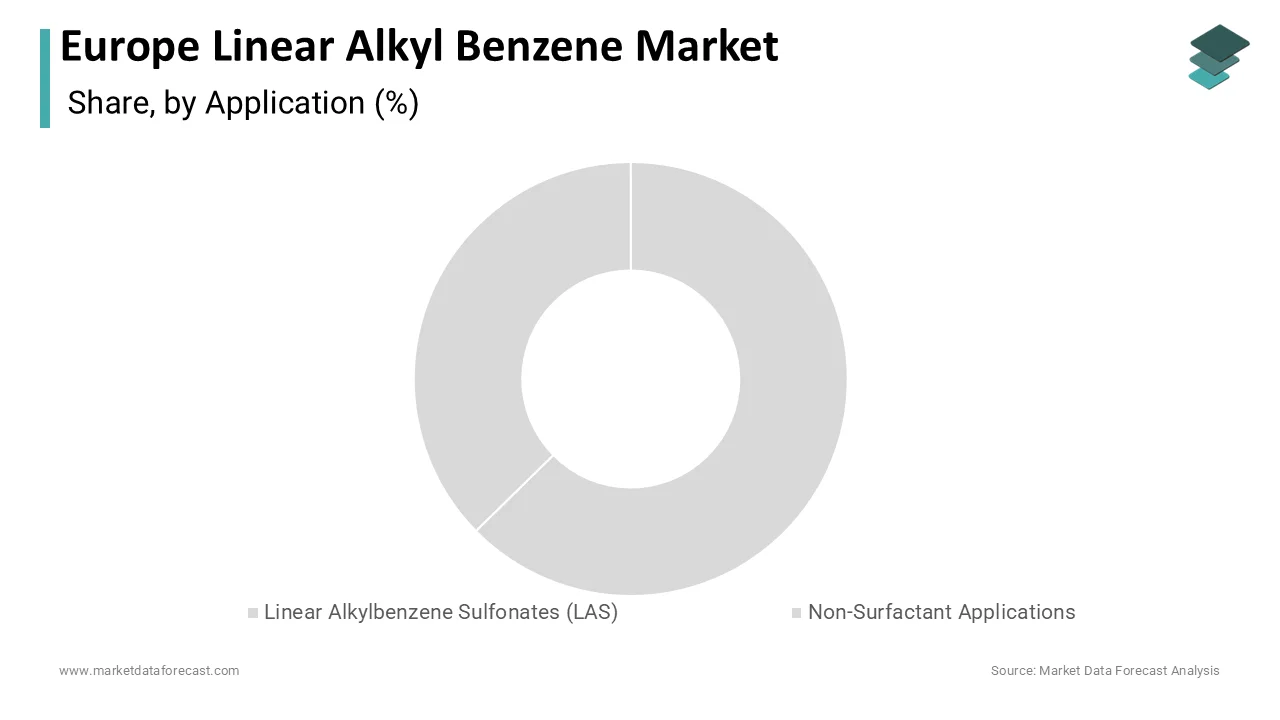
Although a smaller share, the non‑surfactant segment represents the fastest growing segment for linear alkyl benzene in Europe and is predicted to expand at a CAGR of 5.12% over the forecast period. Linear alkyl benzene is increasingly used as a synthetic base stock and detergent additive in specialty lubricants for automotive and industrial systems due to its thermal stability, low pour point, and solvency. Demand is rising in compressor oils, refrigeration lubricants, and rotary screw air‑compressor fluids used in food and pharmaceutical manufacturing. Its resistance to sludge formation under high‑temperature oxidation makes it a preferred alternative to mineral oils. As Europe’s electric‑vehicle fleet expands, lubricant manufacturers are incorporating LAB into dielectric‑stable thermal‑management fluids for EV systems. This niche but high‑value segment offers premium pricing and faces fewer regulatory constraints than detergent applications, attracting producer interest. Non‑surfactant applications are expected to grow steadily as Europe’s industrial and EV sectors adopt higher‑performance synthetic lubricants.
By End Use Insights
The laundry detergents segment was the largest end‑use segment and had 57.5% of the European market share in 2025. Laundry detergents require robust surfactants capable of removing sebum, protein, and particulate soil across varying water‑hardness conditions. LAS remains the only anionic surfactant that consistently delivers high cleaning performance across cold and hot wash cycles while remaining cost‑efficient. According to Eurostat, European households purchased millions of tonnes of laundry detergents in 2025, translating into substantial LAS demand. Even premium eco‑labelled brands continue to use LAS due to its biodegradability and low aquatic toxicity at use concentrations, consistent with EU chemical‑safety assessments. This technical indispensability, combined with consumer expectations for visible cleaning results, ensures laundry detergents remain the anchor of LAB consumption. Laundry detergents are expected to remain the dominant end‑use category as Europe maintains high household‑detergent consumption and strict hygiene standards.
The industrial cleaners segment is the fastest-growing end‑use segment for linear alkyl benzene in Europe and is predicted to grow at a CAGR of 7.14% over the forecast period. The European food and beverage sector mandates rigorous cleaning‑in‑place and sanitation procedures that rely heavily on LAS‑based formulations. According to Eurostat, the EU food and beverage industry generates more than a trillion euros in annual turnover, requiring extensive hygiene operations across processing facilities. LAS effectively removes protein, fat, and starch residues from stainless‑steel equipment without corrosion or toxic residues. Dairy processing consumes significant volumes of LAS‑based industrial detergents to maintain hygiene standards. The EU’s Farm to Fork Strategy has intensified hygiene audits, increasing detergent consumption per facility. Major sanitation providers have responded with high‑alkalinity LAS‑based cleaners for CIP systems, now widely used across large EU food plants. Industrial cleaners are expected to grow rapidly over the forecast period as hygiene regulations tighte,n and food‑processing capacity expands across Europe.
COUNTRY LEVEL ANALYSIS
Germany Linear Alkyl Benzene Market Analysis
Germany captured 25.5% of thEuropeanpe linear alkyl benzene market share in 2025 and held the leading position in this regional market. The dominating position of Germany in this regional market is strongly supported by its integrated petrochemical base, strong detergent‑manufacturing ecosystem, and strict environmental regulations. The Rhine corridor remains one of Europe’s most industrialized chemical zones, hosting major surfactant and petrochemical facilities that supply high‑purity LAB to leading detergent brands. Germany’s household‑cleaning sector is among the largest in Europe, with consistently high consumption of anionic surfactants across laundry and home‑care categories. Industrial cleaning demand is also substantial due to the country’s dense network of manufacturing plants, food processors, and metalworking facilities. National regulations require full disclosure of surfactant biodegradability, reinforcing the preference for LAB‑based formulations. Germany’s recycling systems also support sustainable packaging use in the cleaning sector. With its combination of production scale, regulatory rigor, and diversified end‑use demand, Germany is expected to maintain its central role in Europe’s LAB value chain.
France Linear Alkyl Benzene Market Analysis
France is another major regional segment in the European linear alkyl benzene market. The strong regulatory oversight and high institutional‑cleaning demand are driving the French market growth. National environmental‑labeling laws require cleaning products to disclose biodegradability and environmental impact, reinforcing the use of LAB‑based surfactants in compliant formulations. Major French detergent brands continue to rely on LAB for performance in hard‑water regions. France also maintains one of Europe’s largest networks of hospitals and long‑term‑care facilities, all of which require daily sanitation using anionic‑surfactant‑based cleaners. The country’s large food‑processing sector further contributes to industrial‑cleaner consumption. High household‑detergent penetration ensures steady retail demand. With its combination of regulatory leadership and strong institutional consumption, France is positioned to remain a high‑volume LAB market.
United Kingdom Linear Alkyl Benzene Market Analysis
The United Kingdom is expected to account for a prominent share of the European linear alkyl benzene market during the forecast period due to its large service economy and post‑Brexit regulatory flexibility. While the UK maintains alignment with EU biodegradability standards, its independent regulatory framework allows greater formulation freedom for surfactant blends. The hospitality, healthcare, and contract‑cleaning sectors generate substantial demand for LAB‑based detergents due to their cost‑effectiveness and cleaning performance. Household‑detergent consumption remains strong, supported by high penetration of private‑label and concentrated formulations. The UK’s Plastic Packaging Tax has encouraged brands to shift toward concentrated detergents, which rely on high‑active‑matter LAB surfactants. With its combination of service‑sector intensity and regulatory autonomy, the UK is expected to remain a resilient LAB market.
Italy Linear Alkyl Benzene Market Analysis
Italy is anticipated to showcase a healthy CAGR in the European linear alkyl benzene market during the forecast period due to the strong household‑detergent usage and a dense network of small and medium enterprises requiring daily cleaning. Italian consumers maintain high laundry‑detergent purchasing frequency, influenced by cultural preferences and regional water‑hardness challenges. The country’s large SME base relies heavily on manual‑cleaning products formulated with LAB surfactants. Italy’s food‑processing sector also contributes significantly to industrial‑cleaner demand. National green‑procurement criteria encourage biodegradable surfactants in public‑sector cleaning contracts, supporting continued LAB use. Although Italy does not produce LAB domestically, its major ports serve as key import hubs for European and global supply. With its blend of household habits, industrial needs, and policy support, Italy is expected to remain a strong and growing LAB market.
Netherlands Linear Alkyl Benzene Market Analysis
The Netherlands is projected to hold a notable share of the European linear alkyl benzene market during the forecast period due to its strategic logistics position and strong industrial‑formulation sector. Rotterdam, Europe’s largest petrochemical port, serves as a major entry point for LAB feedstocks and finished surfactants distributed across the continent. The country hosts major detergent‑blending and specialty‑chemical facilities that supply industrial and household‑cleaning markets in neighboring countries. The Netherlands’ large food‑export sector requires extensive sanitation under EU hygiene rules, reinforcing industrial‑cleaner demand. National circular‑economy initiatives encourage concentrated and refillable detergent formats, which rely on high‑purity LAB for performance. With a significant share of domestic LAB output destined for export, the Netherlands is expected to remain a key distribution and formulation hub in the European LAB market.
COMPETITIVE LANDSCAPE
Competition in the European linear alkyl benzene market is defined by technological capability, regulatory compliance, and integration with the detergent value chain rather than price alone. The market features a mix of global integrated players and regional specialists, with entry barriers rooted in capital intensity, benzene handling expertise, and environmental permitting. Leading producers compete through purity consistency, impurity control, and alignment with EU sustainability frameworks such as REACH and the Chemicals Strategy for Sustainability. Differentiation arises from innovations in solid acid catalysis, renewable feedstock adoption, and support for detergent concentration trends. While demand remains stable due to the irreplaceable role of linear alkyl benzene sulfonate in cleaning formulations, competition intensifies around future proofing—anticipating regulatory shifts, carbon costs, and circularity requirements. This environment rewards long term investment in cleaner production, supply chain transparency, and application development partnerships, ensuring that leadership is sustained through technical excellence and environmental stewardship rather than volume alone.
KEY MARKET PLAYERS
Some of the companies that are playing a dominating role in the europe linear alkyl benzene market include
- Saudi Basic Industries Corporation (SABIC)
- INEOS Group AG
- Reliance Industries Limited
- ExxonMobil Corporation
- Shell Chemicals (Shell plc)
- TotalEnergies SE
- China Petrochemical Corporation (Sinopec)
- PetroChina Company Limited
- BASF SE
- LyondellBasell Industries N.V.
- Hengyi Industries Sdn. Bhd.
- Indian Oil Corporation Limited (IOCL)
- Formosa Petrochemical Corporation
- LG Chem Ltd.
- Mitsubishi Chemical Corporation
- PTT Global Chemical Public Company Limited
- Sumitomo Chemical Co., Ltd.
- Exol SA
- Fujian Zhongde Chemical Co., Ltd.
TOP LEADING PLAYERS IN THE MARKET
- Sasol is a leading global producer of linear alkyl benzene with a significant footprint in Europe through its integrated facility in Marl, Germany. The company supplieshigh-purityy linear alkyl benzene to major detergent and specialty chemical manufacturers across the continent. Sasol plays a pivotal role in advancing sustainable surfactant feedstocks by optimizing its Detal solid acid catalytic process, which eliminates hydrofluoric acid handling and reduces waste generation. In 2025, Sasol enhanced its benzene recovery unit in Germany to improve yield efficiency and lower energy consumption per ton of output. The company also collaborated with European detergent formulators to develop low-impurity linear alkyl benzene grades compatible with concentrated and cold water detergent systems. These initiatives reinforce Sasol’s position as a technology-driven and environmentally responsible supplier in a highly regulated market.
- Petrobras, through its chemical subsidiary Petrobras Química, is a key supplier of linear alkyl benzene to the European market, leveraging its large-scale production capabilities in Brazil and strategic export partnerships. The company serves European detergent manufacturers with linear alkyl benzene produced from high-quality paraffinic feedstocks, ensuring consistent sulfonation performance. In early 2025, Petrobras upgraded its alkylation unit to reduce dibenzyl content below 200 parts per million, meeting stringent European specifications for premium surfactants. It also obtained ISCC Plus certification for its bio-based linear alkyl benzene pilot stream, enabling future supply of renewable content to sustainability-focused brands. These actions demonstrate Petrobras’s commitment to quality alignment and circular economy readiness, strengthening its foothold in Europe’s evolving linear alkyl benzene landscape.
- CEPSA, headquartered in Spain, operates one of Europe’s largest and most modern linear alkyl benzene plants in Huelva, serving both regional and global markets. The facility utilizes advanced solid acid technology to produce high-performance linear alkyl benzene with minimal environmental impact. CEPSA is deeply integrated into the European detergent value chain, partnering with leading formulators to ensure supply security and technical support. In 2025, CEPSA launched a new linear alkyl benzene grade specifically engineered for cold water laundry detergents, featuring optimized chain length distribution for enhanced solubility and foaming. The company also expanded its feedstock flexibility to include renewable paraffins from waste oils, aligning with EU circular economy directives. These strategic moves position CEPSA as an agile and innovation-oriented player capable of addressing both performance and sustainability demands in the European market.
TOP STRATEGIES USED BY THE KEY MARKET PARTICIPANTS
Key players in the European linear alkyl benzene market focus on process innovation to eliminate hazardous catalysts and reduce emissions through solid acid alkylation technologies. They invest in feedstock flexibility to incorporate renewable paraffins and enhance product purity for high-performance detergent applications. Strategic collaborations with downstream formulators enable co-development of application-specific grades that meet cold water and concentrated detergent requirements. Companies also pursue sustainability certifications such as ISCC Plus to support bio-based linear alkyl benzene supply chains. Additionally, they optimize energy efficiency in production units to comply with EU carbon pricing mechanisms and maintain cost competitiveness in a capital-intensive sector.
MARKET SEGMENTATION
This research report on the europe linear alkyl benzene market is segmented and sub-segmented into the following categories.
By Application
- Linear Alkylbenzene Sulfonates (LAS)
- Non-Surfactant Applications
By End Use
- Laundry Detergents
- Industrial Cleaners
- Dishwashing Detergents
- Household Cleaners
- Others
By Country
- Germany
- France
- United Kingdom
- Italy
- Netherlands
- Rest of Europe