- Product Description Description
- Table of Contents TOC
- List of Table & Figure LOT
- Get Free Sample PDF Sample PDF
Market Size, 2025
$16.91 BnMarket Estimate, 2026
$17.86 BnMarket Forecast, 2034
$27.68 BnCAGR, 2026–2034
5.63%Europe Lingerie Market Report Summary
The European lingerie market was valued at USD 16.91 billion in 2025, is estimated to reach USD 17.86 billion in 2026, and is projected to reach USD 27.68 billion by 2034, growing at a CAGR of 5.63% during the forecast period. The growth of the European lingerie market is driven by rising fashion consciousness, increasing demand for comfort-oriented intimate wear, and the expansion of e-commerce retail channels. Furthermore, the growing influence of body positivity movements, premiumization trends, and innovation in sustainable and adaptive fabrics are fueling market expansion across the region.
Key Market Trends
- Rising adoption of sustainable and eco-friendly lingerie materials such as organic cotton, bamboo fiber, and recycled fabrics.
- Increasing demand for inclusive sizing and body-positive lingerie collections.
- Expansion of online retail and direct-to-consumer (D2C) lingerie brands offering customization and subscription-based models.
- Growing popularity of athleisure-inspired and functional lingerie with supportive yet stylish designs.
- Technological innovations such as 3D body scanning and virtual fitting rooms enhancing the consumer experience.
Segmental Insights
- Based on product type, the brassieres segment was the largest, accounting for 41.2% of the European lingerie market share in 2025. The segment’s growth is driven by continuous design innovation, the rising demand for comfort and fit, and the introduction of non-wired and sports bras that cater to evolving consumer preferences.
- Based on material, the cotton segment dominated the market, holding 38.2% of the European lingerie market share in 2025. Its popularity stems from the material’s breathability, softness, and hypoallergenic properties, making it a preferred choice for daily wear across Europe.
- Based on price range, the economy-priced lingerie segment captured 62.3% of the European lingerie market share in 2025. The dominance of this segment is due to the wide availability of affordable lingerie options through supermarkets, mass retail, and online channels that cater to price-sensitive consumers.
- Based on distribution channel, the online channels segment accounted for 42.3% of the European lingerie market share in 2025. E-commerce platforms, social media marketing, and influencer-led brand promotion have boosted online sales, with consumers increasingly preferring the convenience, variety, and privacy offered by digital shopping.
Regional Insights
The European lingerie market demonstrates strong growth across both Western and Eastern European economies, supported by changing fashion dynamics and increased disposable incomes.
- France was the largest contributor to the European lingerie market, holding 24.3% share in 2025, driven by its long-standing reputation for luxury fashion, craftsmanship, and innovation in intimate apparel.
- Germany and the United Kingdom are witnessing steady growth fueled by the popularity of comfort lingerie and online retail adoption.
- Italy remains a hub for high-end designer lingerie brands, while Spain and the Nordic countries show increasing demand for sustainable and ethically produced lingerie collections.
- Eastern Europe is emerging as a fast-growing region, supported by the expansion of affordable lingerie brands and growing fashion awareness among younger consumers.
Competitive Landscape
The European lingerie market is highly competitive, characterized by a mix of global luxury labels and regional mass-market players. Leading brands are focusing on sustainability, innovation, and body inclusivity to differentiate their offerings and strengthen brand loyalty. Companies are also leveraging omnichannel strategies and investing in AI-driven personalization to enhance customer engagement. Key players in the European lingerie market include Jockey International, Inc., Victoria’s Secret, Triumph International, Spanx LLC, Hanesbrands Inc., Miraclesuit, Leonisa S.A., Wacoal Ltd., Belly Bandit, Lytess, Chantelle Group, MAS Holdings, Phillips-Van Heusen Corporation, Honey Birdette, and Hunkemöller International B.V.
Europe Lingerie Market Size
The Europe lingerie market size was valued at USD 16.91 billion in 2025 and is projected to reach USD 27.68 billion by 2034 from USD 17.86 billion in 2026, growing at a CAGR of 5.63%.
The lingerie is an intimate apparel designed for women and increasingly gender diverse consumers, spanning functional basics, fashion-led pieces, and specialized categories such as maternity, post-surgical, and adaptive wear. Urbanization further amplifies consumption, with city dwellers showing a higher propensity for trend-responsive intimate apparel.
MARKET DRIVERS
Rise of Body Positivity and Inclusive Sizing Drives Product Diversification
The mainstreaming of body positivity, which is moving away from narrow beauty standards toward inclusive representation, is driving the growth of the European lingerie market. French brand Etam launched its “All Bodies Welcome” campaign featuring models of varying sizes, ethnicities, and abilities, resulting in customer engagement.
Integration of Sustainable and Ethical Practices Reshapes Consumer Loyalty
The European consumers increasingly prioritize transparency and environmental responsibility in intimate apparel, compelling brands to adopt circular and low-impact production models, which is additionally prompting the growth of the European lingerie market. Brands like Cosabella and Naja have achieved B Corp certification, while Swedish label Björk and Daughters uses seaweed-based fibers and plastic-free packaging. France’s Anti-Waste Law further mandates that all textile brands implement take-back schemes by 2026, accelerating investment in reverse logistics.
MARKET RESTRAINTS
Persistent Sizing Inconsistencies Undermine Fit and Consumer Trust
The inconsistent sizing standards across European lingerie brands continue to frustrate consumers and drive high return rates, which is ascribed to hinders the growth of the European lingerie market. Many European women have abandoned purchases due to unreliable size charts. These fit failures not only erode trust but also increase carbon footprint through reverse logistics, which contradicts sustainability goals.
Regulatory Fragmentation on Textile Labeling Complicates Compliance
The European lingerie market operates under a patchwork of national and EU-level textile regulations that create compliance complexity and limit innovation in material disclosure. Over two hundred restricted substances are commonly used in dyeing and finishing intimate apparel.
MARKET OPPORTUNITIES
Expansion of Adaptive and Post-Surgical Lingerie Addresses Underserved Needs
The growing recognition of medical and functional intimate wear as essential rather than niche presents a significant opportunity for the growth of the European lingerie market. According to the International Agency for Research on Cancer, over five hundred thousand women in Europe are diagnosed with breast cancer annually by creating sustained demand for post-mastectomy bras with prosthetic pockets.
Digital Try On and Virtual Fitting Technologies Enhance E Commerce Experience
The adoption of AI-powered virtual fitting tools is transforming online lingerie shopping, which is anticipated to enhance the growth of the European lingerie market. Brands like Ysé and Dora Larsen integrate augmented reality try-on via their apps, allowing users to visualize how lace and cut interact with their body shape. These technologies not only improve customer satisfaction but also generate valuable anonymized data on regional fit preferences, such as narrower shoulders in Southern Europe or fuller busts in Eastern Europe.
MARKET CHALLENGES
Overreliance on Seasonal Promotions Erodes Brand Value and Profitability
The excessive discounting during key retail periods such as Black Friday and summer sales has normalized price-based purchasing is declining the growth of the European lingerie market. A Bain and Company analysis warns that constant discounting devalues perceived quality, particularly in mid-tier brands that lack the heritage or innovation to justify premium pricing. Furthermore, deep discounts contradict sustainability messaging, as they encourage overconsumption and disposal.
Supply Chain Vulnerability to Geopolitical and Environmental Disruptions
The highly dependent on imported raw materials like cotton from Turkey and India and elastane from Asia, which makes it susceptible to geopolitical tensions and climate shocks. These delays force brands to hold excess inventory or substitute materials, compromising quality and sustainability claims. Although nearshoring initiatives in Portugal and Greece are emerging, they lack scale to offset Asian dependency. Until diversified and resilient sourcing networks are established, the market will remain exposed to external volatility that threatens both cost stability and ethical commitments.
REPORT COVERAGE
| REPORT METRIC | DETAILS |
| Market Size Available | 2025 to 2034 |
| Base Year | 2025 |
| Forecast Period | 2026 to 2034 |
| CAGR | 5.63% |
| Segments Covered | By Product Type, Material, Price Range, Distribution Channel, and Region |
| Various Analyses Covered | Global, Regional, & Country Level Analysis; Segment-Level Analysis; DROC; PESTLE Analysis; Porter’s Five Forces Analysis; Competitive Landscape; Analyst Overview of Investment Opportunities |
| Regions Covered | UK, France, Spain, Germany, Italy, Russia, Sweden, Denmark, Switzerland, Netherlands, Turkey, Czech Republic, Rest of Europe |
| Market Leaders Profiled | Jocky International, Inc., Victoria's Secret, Triumph International, Spanx LLC, Hanesbrand Inc., Miraclesuit, Leonisa S.A., Wacoal Ltd, Belly Bandit, Lytess, Chantelle Group, MAS Holdings, Phillips-Van Heusen Corporation, Honey Birdette, and Hunkemöller International B.V., and others. |
SEGMENTAL ANALYSIS
By Product Type Insights
The brassieres segment was the largest by accounting for 41.2% of the European lingerie market share in 2025, with the functional necessity, frequent replacement cycles, and evolving design innovation that blends support with comfort. Additionally, medical and wellness trends amplify demand. Retailers like Etam and H&M dedicate lingerie floor space to brassieres by reflecting their role as anchor products.
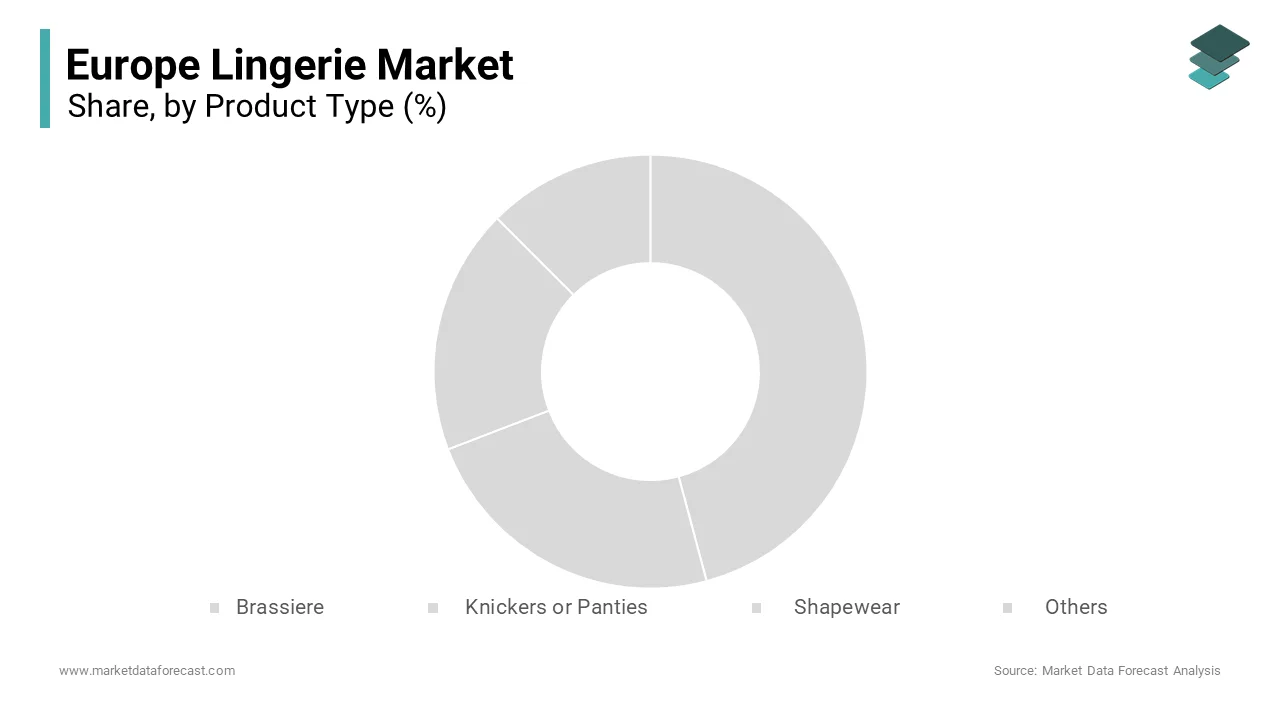
The shapewear is expanding at a CAGR of 12.3% during the forecast period, with the normalization of body contouring as self-care rather than concealment. Technological advances play a key role in rands like Spanx and Ysé use laser cut seams and breathable microfiber blends that reduce rolling and sweating, addressing historical complaints. The rise of hybrid workwear also contributes; with more women attending in-person meetings post-pandemic, demand for smoothing layers under tailored clothing has increased.
By Material Insights
The cotton segment was the largest by occupying 38.2% of the European lingerie market share in 2025, with the consumer preference for natural breathable fibers that minimize skin irritation and align with clean label values. The National health guidelines reinforce this trend, nd such as France’s dermatology association recommends cotton for daily wear due to its hypoallergenic properties moisture-wicking capacity.
The recycled nylon segment is lucratively growing with an anticipated CAGR of 15.3% during the forecast period, with the integration of performance and sustainability in fashion lingerie. Brands like Cosabella and Naja have transitioned entire collections to recycled nylon, achieving B Corp certification and attracting eco-conscious millennials. The EU Strategy for Sustainable Textiles further incentivizes adoption by prioritizing circular materials in green public procurement.
By Price Range Insights
The economy-priced lingerie segment was the largest by capturing 62.3% of the European lingerie market share in 2025, with the broad accessibility, high replacement frequency, and value-conscious shopping amid persistent inflation.
The premium lingerie segment is likely to grow with an anticipated CAGR of 10.8% during the forecast period, with the rise of “investment dressing” and emotional luxury. Brands like La Perla, Simone Pérè, le and Aubade emphasize artisanal lace hand finishing and heritage craftsmanship, positioning pieces as heirlooms rather than consumables.
By Distribution Channel Insights
The online channels segment accounted in holding 42.3% of the European lingerie market share in 2025, with the convenience, privacy, and the ability to access extended sizing and niche brands unavailable in physical stores. This channel’s scalability, personalization, and inventory depth make it the primary growth vector in a category defined by fit sensitivity and discovery.
The specialized lingerie boutiques segment expected to register a CAGR of 9.7% in the coming years with the resurgence of experiential retail and demand for expert fitting services. According to the European Retail Design Council, over 800 independent lingerie boutiques opened across Europe in 2023, with concentrations in Germany, France, and the Netherlands.
REGIONAL ANALYSIS
France Market Analysis
France was the largest contributor in the European lingerie market by accounting for 24.3% of the share in 2025, with its legacy as the birthplace of haute lingerie and ongoing leadership in design innovation. The government supports the sector through the “Savoir Faire” heritage label, which certifies artisanal craftsmanship. Brands like Chantel, le Aub, Ade, and Simone Pérèle export globally while maintaining domestic relevance through inclusive campaigns. Additionally, France’s strict textile labeling laws ensure transparency that builds consumer trust.
United Kingdom Market Analysis
The United Kingdom lingerie market held 18.3% of share in 2025 wi,th early adoption of body positivity e-and commerce sophistication. London serves as a hub for adaptive lingerie startups like Liberare, which designs for disabilities in collaboration with occupational therapists.
Germany Market Analysis
Germany's lingerie market growth is likely to grow with the pragmatic consumerism and strong environmental consciousness. The country’s engineering mindset favors functional design with seamless no-wire bras and moisture-wicking fabrics dominating bestseller lists. Retailers like Triumph and Schiesser invest heavily in R&D, with German patents accounting for over forty % of EU innovations in adaptive closures and breathable linings.
Italy Market Analysis
Italy's lingerie market gs expected to grow with its mastery of luxury materials and craftsmanship. Italian consumers exhibit strong brand loyalty with domestic labels for special occasion lingerie. The country’s fashion education system feeds a pipeline of designers who reinterpret tradition through modern silhouettes. Additionally, Italy leads in sustainable silk innovation with startups like Orange Fiber developing citrus-based alternatives to conventional satin. Though smaller in volume than mass markets, Italy’s influence on premium aesthetics and material excellence ensures an outsized global impact and premium pricing power.
COMPETITIVE LANDSCAPE
KEY MARKET PLAYERS
Some of the notable key players in the European lingerie market are
- Jocky International, Inc.
- Victoria's Secret
- Triumph International
- Spanx Llc
- Hanesbrand Inc
- Miraclesuit
- Leonisa S.A.
- Wacoal Ltd
- Belly Bandit
- Lytess
- Chantelle Group
- Mas Holdings
- Phillips-Van Heusen Corporation
- Honey Birdette
- Hunkemoller International B.V.
TOP STRATEGIES USED BY THE KEY MARKET PLAYERS
Key players in the European lingerie market prioritize inclusive sizing, digital fit innovation, and circular business models to differentiate ina values-driven landscape. They invest in AI-powered size recommendation tools and virtual try-on to reduce online returns and enhance confidence. Extended size ranges and diverse representation in marketing are now standard to meet body positivity expectations. Sustainability is embedded through certified organic cotton, recycled nylon, and transparent supply chains aligned with EU textile regulations.
COMPETITION OVERVIEW
Competition in the European lingerie market is defined by a dynamic interplay between heritage brands, fast fashion retailers, and digital natives vying for relevance in an era of conscious consumption. Traditional players like Etam and Triumph leverage fit expertise and trust, but face pressure from agile online brands that champion inclusivity and sustainability without legacy constraints. Mass merchandisers such as H&M and Primark dominate volume through affordability, yet struggle with perceived quality and environmental credibility. Simultaneously,usly niche labels gain traction by addressing underserved needs like adaptive wear or gender-neutral design. Regulatory complexity around textile labeling, chemical safety,an d ircularity raises operational barriers favoring larger firms with compliance resources.
TOP PLAYERS IN THE MARKET
- Etam Group is a France-based lingerie leader renowned for its blend of Parisian elegance and inclusive innovation. The company operates over six hundred stores across Europe and exports to more than thirty countries, serving as a cultural ambassador for European intimate apparel. It also introduced a certified organic cotton core line compliant with the Global Organic Textile Standard. These actions reinforce its commitment to accessibility and sustainability while strengthening its position as a progressive heritage brand in a rapidly evolving market.
- Triumph International is a Swiss-headquartered global powerhouse with deep roots in European engineering and fit science. The company supplies both mass and premium segments across the continent through brands like Triumph and Sloggi. It also achieved OEKO-TEX Standard 100 certification for ninety-five % of its European product range.
- Hunkemöller BV is a Netherlands-based retailer that has transformed from a traditional chain into a digital-first first inclusive brand. With over four hundred stores and a robust online presence, it serves customers in twelve European countries. It also introduced gender neutral intimate basics under its “For Every Body” collection. These initiatives position Hunkemöller as a pioneer in circularity and social inclusivity, aligning with progressive European values and regulatory trends.
MARKET SEGMENTATION
This research report othe European lingerieie market has been segmented and sub-segmented based on categories.
By Product Type
- Brassiere
- Knickers or Panties
- Shapewear
- Others
By Material
- Cotton
- Silk
- Satin
- Nylon
- Others
By Price Range
- Economy
- Premium
By Distribution Channel
- Mass Merchandisers
- Specialized Stores
- Online Stores
- Others
By Country
- UK
- France
- Spain
- Germany
- Italy
- Russia
- Sweden
- Denmark
- Switzerland
- Netherlands
- Turkey
- Czech Republic
- Rest of Europe