- Product Description Description
- Table of Contents TOC
- List of Table & Figure LOT
- Get Free Sample PDF Sample PDF
Market Size, 2025
$4.87 BnMarket Estimate, 2026
$5.23 BnMarket Forecast, 2034
$9.20 BnCAGR, 2026–2034
7.33%Europe Locomotive Market Report Summary
The Europe locomotive market was valued at USD 4.87 billion in 2025, is estimated to reach USD 5.23 billion in 2026, and is projected to reach USD 9.20 billion by 2034, growing at a CAGR of 7.33% during the forecast period from 2026 to 2034. The growth of the Europe locomotive market is attributed to the modernization of railway infrastructure, increasing demand for sustainable transport solutions, and expanding cross-border freight and passenger networks. Moreover, Europe’s emphasis on low-emission and high-efficiency rail transport, supported by government initiatives under the European Green Deal, continues to drive the adoption of advanced locomotive technologies.
Key Market Trends
- Rising investments in rail electrification projects across key European nations.
- Increasing adoption of hybrid and battery-electric locomotives for sustainable transportation.
- Technological advancements in traction systems, digital control modules, and regenerative braking.
- Growth in freight rail logistics driven by e-commerce and trans-European trade networks.
- Development of smart rail systems integrated with IoT and predictive maintenance solutions.
Segmental Insights
- Based on propulsion, the combustion segment was the largest, holding 65.3% of the Europe locomotive market share in 2025. Despite the ongoing shift toward electrification, diesel and hybrid combustion locomotives remain widely used due to their operational flexibility and established infrastructure in both freight and passenger applications.
- Based on end user, the passenger and freight segment accounted for a prominent share of the Europe locomotive market in 2025. The increasing preference for efficient, long-distance, and high-capacity rail transport in both sectors is a key growth driver, supported by growing intercity connectivity and sustainability goals.
- Based on technology, the IGBT module segment accounted for 50.3% of the market share in 2025, driven by the increasing use of advanced power electronics for improved energy efficiency, speed control, and reduced maintenance costs in electric and hybrid locomotives.
- Based on component, the motor segment was the largest, representing 45.3% of the Europe locomotive market share in 2024, reflecting the growing demand for high-performance traction motors that enhance locomotive efficiency, reliability, and load-handling capability.
Regional Insights
The Europe locomotive market is witnessing strong growth across major economies due to modernization initiatives and sustainability-driven investments in rail infrastructure.
- Germany was the largest contributor to the Europe locomotive market, accounting for 25.3% share in 2025, supported by its advanced manufacturing capabilities, high-speed train networks, and leading position in sustainable rail technologies.
- France continues to invest in high-speed and regional train networks, supporting locomotive demand through ongoing infrastructure renewal projects.
- The United Kingdom is expanding its electrification programs and rolling stock modernization to achieve net-zero transport emissions.
- Spain and Italy are seeing steady growth, driven by freight corridor development and modernization of regional passenger lines.
- Central and Eastern Europe are emerging as fast-growing regions, supported by EU funding for cross-border connectivity and logistics efficiency.
Competitive Landscape
The Europe locomotive market is highly competitive, with global and regional players focusing on technological innovation, fuel efficiency, and hybrid-electric solutions. Companies are also collaborating with governments and railway operators to develop low-carbon and digitalized locomotives that meet evolving regulatory standards. Key players in the Europe locomotive market include Progress Rail (U.S.), General Electric Company (U.S.), Anglo Belgian Corporation NV (Belgium), Toshiba Corporation (Japan), Cummins Inc. (U.S.), CRRC Corporation Limited (China), San Engineering (India), Alstom SA (France), Siemens AG (Germany), Kawasaki Heavy Industries, Ltd. (Taiwan), Kolomensky Zavod (Russia), Bharat Heavy Electricals Limited (India), Chittaranjan Locomotive Works (India), CAF S.A. (Spain), Hyundai Rotem Company (South Korea), Stadler, Inc. (Switzerland), Hitachi Rail Limited (U.K.), Republic Locomotive (U.S.), Wabtec Corporation (U.S.), and Medha (India).
Europe Locomotive Market Size
The Europe locomotive market size was valued at USD 4.87 billion in 2025 and is anticipated to reach a valuation of USD 5.23 billion in 2026 and USD 9.20 billion by 2034, growing at a CAGR of 7.33%, from 2026 to 2034.
The locomotive is the continent's transportation infrastructure, encompassing the design, manufacturing, and operation of locomotives that power rail networks across diverse terrains and urban landscapes.
MARKET DRIVERS
Infrastructure Modernization Initiatives
The infrastructure modernization initiatives are enhancing rail networks and supporting economic integration, thereby accelerating the growth of the Europe locomotive market. These efforts stem from substantial government funding aimed at upgrading aging systems, which directly influences demand for advanced locomotives. Additionally, the push for interoperability standards has led to a 40% rise in locomotive procurement, as countries like France and Spain integrate their systems.
Shift Towards Sustainable Energy Sources
The shift towards sustainable energy sources by prioritizing eco-friendly technologies in response to climate goals, which is prompting the growth of the Europe locomotive market with regulatory mandates and consumer preferences for greener transport by leading to increased adoption of electric and hydrogen-powered locomotives.
MARKET RESTRAINTS
Regulatory Compliance Burdens
The regulatory compliance burdens are hindering the Europe locomotive market by imposing stringent standards that elevate operational costs and delay innovations. These challenges stem from diverse national regulations across the EU, which complicate cross-border operations and increase administrative overheads.
Supply Chain Disruptions
The supply chain disruptions are creating uncertainties in component availability and escalating production timelines, which are inhibiting the growth of the Europe locomotive market. These issues arise from global events and logistical bottlenecks, which affect the procurement of essential materials like steel and electronics. The supply chain interruptions caused a 25% increase in material costs for European manufacturers in 2022, with delays in semiconductor imports from Asia prolonging assembly processes.
MARKET OPPORTUNITIES
Digitalization and Smart Technology Integration
The digitalization and smart technology integration to enhance predictive maintenance and enhanced operational efficiency are solely to create new opportunities for the growth of the Europe locomotive market with the adoption of IoT and AI, which optimize rail performance and reduce downtime. The growing connectivity demands, with the International Telecommunication Union, in urban areas, which is supporting real-time monitoring systems. s
Expansion of High-Speed Rail Networks
The expansion of high-speed rail networks by addressing the need for faster intercity connections which expected to boost the growth of the Europe locomotive market. This opportunity arises from urban sprawl and tourism growth by prompting infrastructure upgrades that demand advanced locomotives.
MARKET CHALLENGES
Skilled Labor Shortages
The skilled labor shortages are posing a formidable obstacle by limiting expertise in manufacturing and maintenance. This is a significant challenge for the Europe locomotive market players. Furthermore, the vocational training enrollments have declined by 15% over five years.
Economic Volatility and Funding Constraints
The economic volatility and funding constraints are disrupting investment flows and project financing, which will further degrade the growth of the Europe locomotive market. This challenge arises from inflation and geopolitical tensions, which strain budgets for rail development.
REPORT COVERAGE
| REPORT METRIC | DETAILS |
| Market Size Available | 2025 to 2034 |
| Base Year | 2025 |
| Forecast Period | 2026 to 2034 |
| CAGR | 7.33% |
| Segments Covered | By Propulsion, Component, Technology, End-User, And Country |
| Various Analyses Covered | Regional & Country Level Analysis, Segment-Level Analysis, DROC, PESTLE Analysis, Porter’s Five Forces Analysis, Competitive Landscape, Analyst Overview of Investment Opportunities |
| Regions Covered | UK, France, Spain, Germany, Italy, Russia, Sweden, Denmark, Switzerland, Netherlands, Turkey, Czech Republic, and the Rest of Europe |
| Market Leaders Profiled | Progress Rail (U.S.), General Electric Company (U.S.), Anglo Belgian Corporation NV (Belgium), Toshiba Corporation (Japan), Cummins Inc. (U.S.), CRRC Corporation Limited (CRRC) (China), San Engineering (India), Alstom SA (France), Siemens AG (Germany), Kawasaki Heavy Industries, Ltd. (Taiwan), Kolomensky Zavod (Russia), Bharat Heavy Electricals Limited (BHEL), Chittaranjan Locomotive Works (India), CAF, Construcciones y Auxiliar de Ferrocarriles, S.A. (Spain), Hyundai Rotem Company (South Korea), Stadler, Inc. (Switzerland), Hitachi Rail Limited (U.K.), Republic Locomotive (U.S.), Wabtec Corporation (U.S.), Medha (India) |
SEGMENT ANALYSIS
By Propulsion Insights
The combustion segment was the largest and held 65.3% of the Europe locomotive market share in 2025, with the regulatory pushes towards decarbonization and technological advancements that align with environmental goals. Stringent emission regulations are fueling the Electric segment's lead by mandating reduced carbon outputs across European transport. Advancements in battery and charging infrastructure are propelling the Electric segment's domination by improving the reliability and performance of locomotives. Innovations in lithium-ion batteries have extended operational ranges, making electric options viable for long-haul routes.
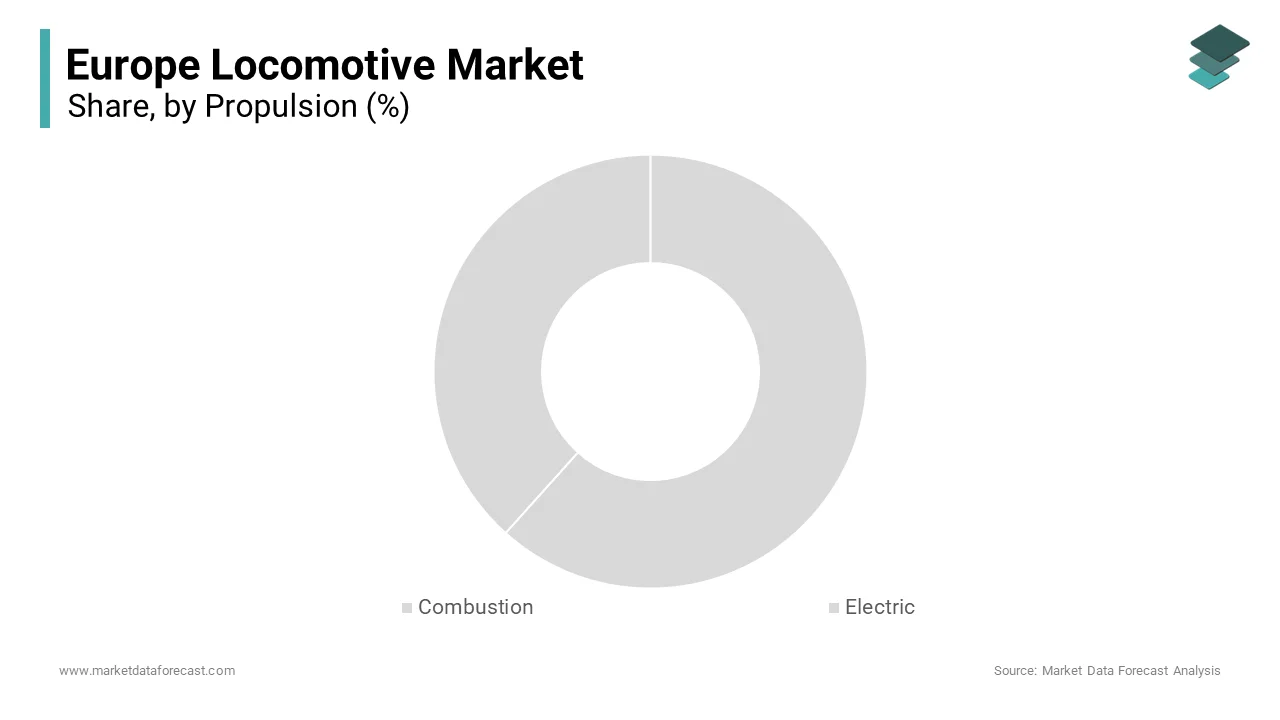
The Combustion is also projected to achieve a CAGR of 7.5% throughout the forecast period, with the emergence of Hydrogen as a clean alternative is accelerating the Combustion segment's growth by addressing gaps in electric infrastructure for remote routes. Government incentives for fuel diversification are fueling the Combustion segment's fastest rate by subsidizing hydrogen research and deployment. These supports mitigate risks associated with transitioning from traditional diesel, encouraging innovation.
By End-user Insights
The passenger and freight segment accounted in holding a prominent share of the Europe locomotive market in 2025, with the expansion of e-commerce and supply chain needs. As online shopping surges, freight rail provides a cost-effective alternative to road transport, reducing congestion and delivery times. Infrastructure investments in freight corridors are propelling the Freight segment's lead by improving connectivity and operational efficiency.
The passenger segment is projected to register a CAGR of 6.8% during the forecast period. Urbanization and public transport demand are accelerating the Passenger segment's growth by addressing population density and commuting challenges. The shift to sustainable commuting options is driving the Passenger segment's rapid growth by promoting eco-friendly travel alternatives.
By Technology Insights
The IGBT Module segment accounted in holding 50.3% of the Europe locomotive market share in 2025. owing to its efficiency in power conversion for modern locomotives. This dominance stems from its reliability in high-power applications. Superior energy efficiency is advancing the IGBT Module's domination by minimizing losses in locomotive operations. IGBT technology optimizes power usage, crucial for electric and hybrid systems. Integration with digital systems is propelling the IGBT Module's lead by enabling smart locomotive features.
The SiC Module segment is expected to witness a CAGR of 8.2% throughout the forecast period. High-temperature performance is accelerating SiC Module's growth by withstanding extreme conditions in locomotives. SiC offers better thermal management, ideal for high-speed applications. Cost reductions in manufacturing are fueling the SiC Module's rate by making it more accessible.
By Component Insights
The motor segment was the largest by accounting for 45.3% of the Europe locomotive market share in 2025. Motors power acceleration and speed, vital for freight and passenger needs. Technological upgrades in electric motors are propelling the segment's lead by incorporating smart features. These advancements reduce wear and energy use.
The rectifier segment is expected to showcase a noteworthy CAGR of 7.2% in next coming years due to power management needs. Voltage regulation demands are growing the Rectifier segment by stabilizing power in hybrid systems. Integration with renewable energy is accelerating Rectifier's rate by supporting green sources.
COUNTRY ANALYSIS
Germany Locomotive Market Analysis
Germany was the largest contributor in the Europe locomotive market with 25.3% of the share with its advanced manufacturing and export dominance. The precision engineering, with locomotive production reaching 500 units in 2023, with a 20% rise in exports to neighboring countries.
France Locomotive Market Analysis
Europe's locomotive market held 20.3% of the share in 2025 with its high-speed rail expertise.
France's market status is bolstered by TGV networks, transporting 300 million passengers in 2025, with sustainability initiatives cutting emissions by 30%.
United Kingdom Locomotive Market Analysis
The United Kingdom locomotive market growth is likely to have significant growth opportunities during the forecast period through logistics hubs with digital upgrades enhancing efficieItaly locomotive market growth is propelled by regional links with rail freight, rising gradually over the past few years.
Spain's locomotive market growth is likely to grow with its expanding high-speed lines.
COMPETITIVE LANDSCAPE
The competition in the Europe locomotive market is fierce and dynamic, shaped by technological advancements and regulatory pressures that drive innovation among major players. Companies vie for dominance through relentless pursuits of efficiency and sustainability, with a focus on electric and hydrogen technologies amid the continent's push for net-zero emissions.
KEY MARKET PLAYERS
A few of the market players in the Europe locomotive market include
- Progress Rail (U.S.)
- General Electric Company (U.S.)
- Anglo Belgian Corporation NV (Belgium)
- Toshiba Corporation (Japan)
- Cummins Inc. (U.S.)
- CRRC Corporation Limited (CRRC) (China)
- San Engineering (India)
- Alstom SA (France)
- Siemens AG (Germany)
- Kawasaki Heavy Industries, Ltd. (Taiwan)
- Kolomensky Zavod (Russia)
- Bharat Heavy Electricals Limited (BHEL)
- Chittaranjan Locomotive Works (India)
- CAF, Construcciones y Auxiliar de Ferrocarriles, S.A. (Spain)
- Hyundai Rotem Company (South Korea)
- Stadler, Inc. (Switzerland)
- Hitachi Rail Limited (U.K.)
- Republic Locomotive (U.S.)
- Wabtec Corporation (U.S.)
- Medha (India)
Top Players in the Market
- Siemens Mobility, a German engineering giant, contributes significantly to the global market by developing innovative locomotive technologies that enhance rail efficiency and sustainability worldwide. The company is actively involved in the Europe locomotive market through its production of electric and high-speed trains, supporting networks in countries like Germany and France. Recently, Siemens has strengthened its position by launching advanced digital signaling systems and forming partnerships with European rail operators to integrate AI for predictive maintenance, which improves reliability and expands its global footprint in smart transport solutions.
- Alstom, a French leader in rail transport, plays a key role in the global market by pioneering high-speed and sustainable locomotive designs that connect continents and reduce carbon emissions. In the Europe locomotive market, Alstom engages in manufacturing and maintenance services, particularly for urban and intercity rail systems across the UK and Spain. The company has recently bolstered its position through the acquisition of specialized manufacturing facilities and investment in hydrogen-powered train prototypes, enabling broader adoption of green technologies and reinforcing its influence in international rail infrastructure projects.
- Hitachi Rail, with its Japanese roots and European operations, contributes to the global market by supplying reliable and energy-efficient locomotives that support modern transit systems in various regions. In the Europe locomotive market, Hitachi focuses on digital integration and fleet upgrades by serving clients in Italy and the Netherlands. Recently, the company has enhanced its position by collaborating with local governments on smart city rail initiatives and developing battery-hybrid models, which promote interoperability and expand its capabilities in global sustainable mobility efforts, which is fostering innovation across borders.
MARKET SEGMENTATION
This research report on the Europe locomotive market is segmented and sub-segmented into the following categories.
By Propulsion Type
- Combustion
- Diesel
- Hydrogen
- Electric
By Component
- Rectifier
- Alternator
- Motor
- Others
By Technology
- IGBT Module
- GTO Module
- SiC Module
By End-user
- Passenger
- Freight
By Country
- UK
- France
- Spain
- Germany
- Italy
- Russia
- Sweden
- Denmark
- Switzerland
- Netherlands
- Turkey
- Czech Republic
- Rest of Europe