- Product Description Description
- Table of Contents TOC
- List of Table & Figure LOT
- Get Free Sample PDF Sample PDF
Market Size, 2025
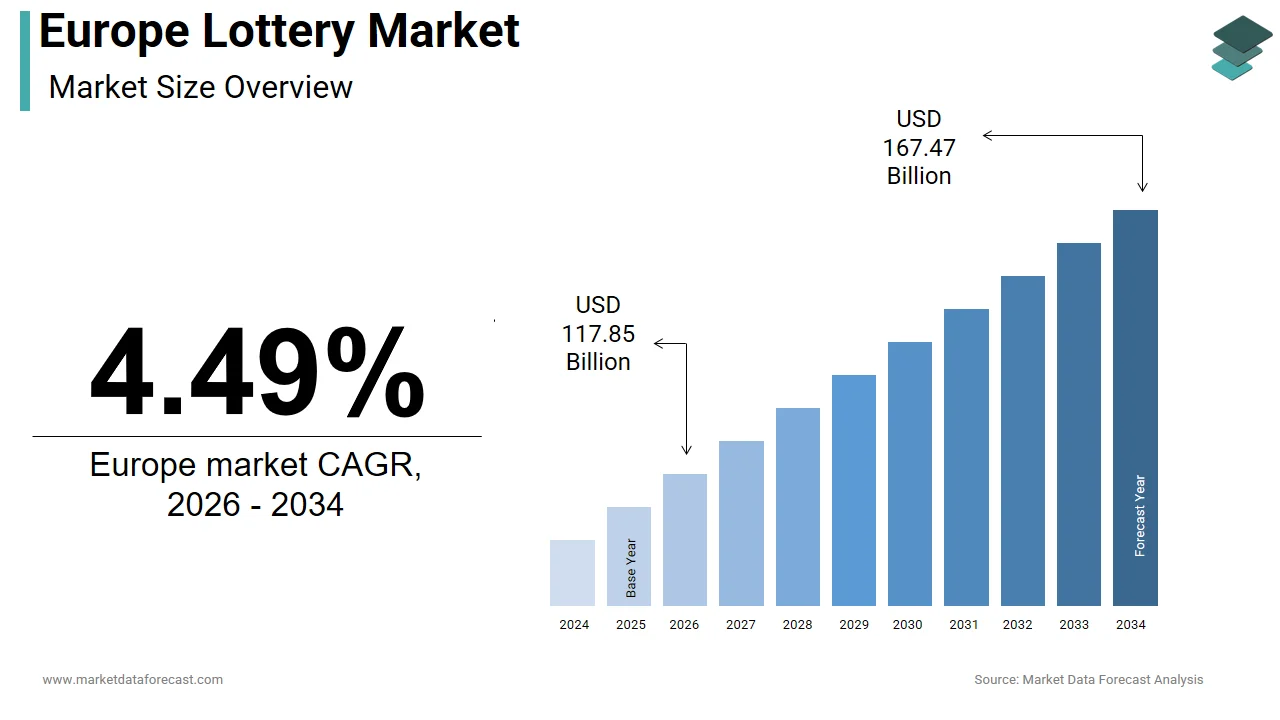
$112.79 BnMarket Estimate, 2026
$117.85 BnMarket Forecast, 2034
$167.47 BnCAGR, 2026–2034
4.49%Europe Lottery Market Report Summary
The Europe lottery market was valued at USD 112.79 billion in 2025, is estimated to reach USD 117.85 billion in 2026, and is projected to reach USD 167.47 billion by 2034, growing at a CAGR of 4.49% from 2026 to 2034. The market growth is driven by strong consumer participation in national and pan-European lottery draws, increasing prize pool sizes, and sustained cultural interest in lottery-based entertainment. Rising government support for regulated gaming, expanding digital infrastructure, and growing investments in responsible gaming platforms are further supporting market expansion. Additionally, the integration of mobile applications, secure payment systems, and data-driven player engagement tools is enhancing accessibility and user experience across Europe.
Key Market Trends
- Continued popularity of pan-European lottery draws is supported by large jackpots and cross-border participation.
- Gradual adoption of digital and mobile lottery platforms to complement traditional retail channels.
- Increasing focus on responsible gaming initiatives and regulatory compliance across European countries.
- Expansion of data analytics and player engagement systems to improve retention and personalization.
- Rising investments in secure payment technologies and fraud prevention solutions.
Segmental Insights
- Based on category, the draw-based games segment led the Europe lottery market in 2025 by accounting for 58.5% market share. The segment’s dominance is attributed to the sustained popularity of national lotteries, EuroMillions, and other large-scale draws offering high-value jackpots.
- Based on application, the offline segment retained dominance by capturing 63.7% share in 2025, supported by strong retail networks, authorized lottery outlets, and continued consumer preference for physical ticket purchases in many European countries.
Regional Insights
The Europe lottery market is witnessing steady growth across major economies, supported by high participation rates, strong regulatory frameworks, and deep-rooted cultural engagement with lottery games.
- The United Kingdom was the top performer, capturing 22.7% of the market share in 2025, driven by strong national lottery operations, extensive retail coverage, and high public trust in regulated gaming systems.
- France followed closely with 19.4% share in 2025, supported by the strong market presence of Française des Jeux (FDJ) and sustained consumer participation.
- Spain remains a major contributor, driven by enthusiastic participation in pan-European draws and deep cultural traditions surrounding major lottery events.
Competitive Landscape
The Europe lottery market is characterized by the presence of established lottery operators, technology providers, and government-backed organizations with strong regulatory oversight and extensive distribution networks. Market players are focusing on digital platform modernization, enhanced security systems, and responsible gaming frameworks to strengthen customer trust and operational efficiency. Strategic collaborations, technology upgrades, and cross-border partnerships are shaping competitive dynamics across the region.
Prominent companies operating in the Europe lottery market include International Game Technology (IGT), Scientific Games Corporation, Française des Jeux (FDJ), Lottomatica S.p.A., Loterías y Apuestas del Estado, Camelot Group, China Welfare Lottery, China Sports Lottery, Hong Kong Jockey Club, New York State Lottery, California Lottery, Florida Lottery, Singapore Pools, Ontario Lottery and Gaming Corporation (OLG), Mizuho Bank Ltd., The Government Lottery Office, Sazka Group, INTRALOT, BCLC (British Columbia Lottery Corporation), Loto-Quebec, and Lotto.com.
Europe Lottery Market Size
The Europe lottery market was valued at USD 112.79 billion in 2025, is estimated to reach USD 117.85 billion in 2026, and is projected to reach USD 167.47 billion by 2034, growing at a CAGR of 4.49% from 2026 to 2034.
A lottery is a form of gambling and a game of chance where participants buy numbered tickets, and winners are selected randomly to receive prizes, usually cash. Unlike unregulated gambling, these activities are typically managed by government monopolies or tightly controlled private concessionaires, with proceeds often directed toward cultural heritage, sports development, and public health initiatives. Regulated lotteries continue to be a deeply ingrained, dominant form of social and recreational activity across the European Union, representing the largest segment of the continent's gambling market. State-authorized lotteries across Europe generate substantial revenue that is consistently allocated toward public good initiatives, including sports development, cultural heritage, and community projects. The market is uniquely shaped by Europe’s dual commitment to harm minimization and civic contribution, ensuring that lottery participation remains a socially accepted leisure activity rather than a high-risk financial behavior.
MARKET DRIVERS
Allocation of Proceeds to Public Good Causes Enhancing Social Legitimacy
The channeling of lottery revenues into tangible societal benefits significantly bolsters public acceptance and sustained participation across the region, which drives the growth of the Europe lottery market. National lotteries consistently generate significant funding for public-interest initiatives, including amateur sports, community recreational activities, cultural preservation efforts, and health-related infrastructure development. Specific European lottery operators frequently allocate a portion of their annual earnings to national sports ministries, which helps finance local sports clubs and training facilities. National lottery programs often provide widespread funding support for heritage sites and cultural preservation projects over long-term periods. The established, visible connection between lottery participation and public funding contributions appears to foster higher levels of trust and a more favorable public perception compared to other forms of gambling. Public opinion surveys indicate that many European citizens regard lotteries positively, largely due to their perceived utility in supporting social and community causes. Lotteries secure an enduring social contract by positioning themselves as vital contributors to national growth, ensuring they are viewed as essential social assets rather than just entertainment providers.
Digital Transformation and Mobile Accessibility Expanding Player Engagement
The migration of lottery platforms to mobile and web channels has dramatically broadened access while maintaining regulatory safeguards, which further propels the expansion of the Europe lottery market. Lottery ticket purchases in certain European areas show a movement towards official digital platforms and applications. National operators are increasingly implementing user-friendly apps with features such as biometric login, location verification, and real-time notifications to adhere to regulations. Certain national operators have seen a rise in repeat player engagement after introducing instant-win games that include engaging interfaces and responsible gaming tools. Crucially, these digital platforms integrate mandatory affordability checks and self-exclusion tools as required by regulators like the UK Gambling Commission. Digitalization shifts lotteries from infrequent physical purchases to regular, safe digital experiences, boosting participation without compromising player protection.
MARKET RESTRAINTS
Stringent Advertising Restrictions Limiting Player Acquisition and Awareness
National regulations across the region increasingly curtail promotional activities for lottery products, which constrains the operator's ability to attract new participants and communicate game innovations, and thereby limits the growth of the European lottery market. Multiple European jurisdictions have introduced varying degrees of limitations on the advertising of lottery and gambling products. Some regions have implemented advertising prohibitions that include limitations inspired by existing alcohol and tobacco advertising restrictions. Certain restrictions now include total prohibitions on television and online advertisements that are aimed at younger demographics. New regulatory frameworks require that promotional materials prominently display responsible gambling information, which limits the creative options for marketers. Observational data suggests a correlation between stricter advertising bans and a decrease in consumer recognition of specific new gambling product formats. These constraints disproportionately affect younger demographics who rely on digital channels for discovery, accelerating player aging in markets. Robust innovation cannot save lotteries from declining relevance if communication is unbalanced.
Rising Competition from Unregulated Online Gambling and Social Gaming
The proliferation of offshore online casinos, fantasy sports apps, and skill-based social games is a significant diversion of discretionary spending away from regulated lotteries, which constrains the expansion of the Europe lottery market. According to sources, a notable portion of EU online gambling traffic in 2024 originated from unlicensed operators based outside the bloc, offering higher jackpots, faster gameplay, and fewer deposit limits. Platforms like Stake and Roobet, accessible via virtual private networks, lure younger users with cryptocurrency payments and influencer endorsements absent in state lotteries. Digital social gaming applications are generating substantial revenue through in-app purchases on a global scale. These platforms often integrate mechanics similar to traditional gambling, offering entertainment experiences that do not involve direct monetary risk. The prevalence of these digital games may be changing consumer perception of traditional, chance-based entertainment. A significant portion of younger adult demographics reports that social gaming is a primary source of exposure to chance-based mechanics. This ecosystem fragments attention and spending, pressuring lotteries to innovate while adhering to stricter rules than their unregulated competitors.
MARKET OPPORTUNITIES
Integration of Sustainable and Thematic Instant Win Games Aligned with Societal Values
Lotteries are increasingly leveraging thematic content to resonate with contemporary European values around sustainability, climate action, and inclusion, which paves the way for the expansion of the Europe lottery market. Lottery operators are increasingly integrating sustainability initiatives directly into their product offerings. These initiatives often leverage technology to provide verification of environmental impacts to consumers. Thematic campaigns focused on social themes, such as supporting education or recognizing achievement, are being adopted by state-endorsed lotteries. Marketing campaigns that connect lottery purchases to social or environmental causes appear to resonate with younger demographic groups. A significant trend among European lottery organizations is the inclusion of environmental or social narratives in their product lines. These initiatives align with the EU’s Green Deal and Gender Equality Strategy, enhancing brand affinity beyond chance. Lotteries turn ticket purchases into symbolic acts of support, enhancing emotional engagement and fostering a sense of shared purpose, providing a meaningful alternative to standard betting.
Expansion of Cross-Border Syndicated Draws Enhances Jackpot Appeal
Pan-European lottery collaborations are creating record-breaking jackpots that drive mass participation and media attention while maintaining regulatory integrity. This trend opens new prospects for the European lottery market. Multi-national lottery games frequently feature substantial jackpots, which drive increased public interest and higher ticket sales across different countries. Specific high-jackpot events often result in a significant surge in consumer participation and sales volume within individual participating nations. The collaborative structure of these lotteries creates shared excitement that crosses national borders, influencing purchasing behavior during major, guaranteed, or record-setting draws. The European Commission supports such initiatives under its internal market principles, provided operators adhere to national age verification and tax rules. New entrants like Austria’s participation in EuroJackpot have further expanded reach. These collaborations pool liquidity without compromising sovereignty, allowing smaller nations to offer world-class prizes while sharing operational costs, making them a scalable model for sustainable growth in an otherwise fragmented market.
MARKET CHALLENGES
Demographic Aging and Declining Youth Participation Threatening Long-Term Viability
The core lottery player base in the region is aging rapidly, with insufficient engagement from younger generations who perceive traditional draws as slow and outdated, which challenges the growth of the Europe lottery market. The average age of individuals engaging in traditional lottery games is increasing, reflecting a shift away from younger demographics. Participation rates among younger adults in these games are declining, even as digital, mobile-based alternatives are introduced. This pattern is visible across multiple European nations, where younger generations are showing less interest in conventional lottery formats. Cultural preferences appear to be shifting toward experiences that are immediate and interactive, rather than passive, number-selection games. The adoption rate of traditional lottery, including digital, app-based options, remains lower for younger demographic groups compared to older counterparts. Lotteries must embrace product innovation and authentic storytelling or risk becoming outdated, which will threaten their long-term funding for public projects.
Inconsistent Regulatory Frameworks Across Member States Hindering Innovation and Scale
National gambling laws remain highly divergent, creating operational friction for cross-border lottery services and stifling pan-European product development, which hinders the expansion of the Europe lottery market. This is despite EU harmonization efforts. The online lottery sector across the region operates under a variety of distinct, and at times contradictory, regulatory frameworks regarding stake limitations, funding, and consumer protection mechanisms. Discrepancies in policy, such as contrasting requirements for player loss constraints versus prohibitions on automated financial assessments, illustrate the lack of harmonization. This varied regulatory landscape necessitates that operators implement tailored compliance systems for each individual jurisdiction, which increases operational overhead. The inconsistencies in local regulations can lead to extended timelines for launching products across multiple markets. Lotteries cannot achieve the scale needed to compete with global, unregulated alternatives or invest in new responsible gaming technologies until a balanced EU framework emerges.
REPORT COVERAGE
| REPORT METRIC | DETAILS |
| Market Size Available | 2025 to 2034 |
| Base Year | 2025 |
| Forecast Period | 2026 to 2034 |
| Segments Covered | By Category, Application, and Country. |
| Various Analyses Covered | Global, Regional, and Country-Level Analysis, Segment-Level Analysis, Drivers, Restraints, Opportunities, Challenges; PESTLE Analysis; Porter’s Five Forces Analysis, Competitive Landscape, Analyst Overview of Investment Opportunities |
| Countries Covered | UK, France, Spain, Germany, Italy, Russia, Sweden, Denmark, Switzerland, Netherlands, Turkey, Czech Republic, and the Rest of Europe. |
| Market Leaders Profiled | International Game Technology (IGT), Scientific Games Corporation, Française des Jeux (FDJ), Lottomatica S.p.A., Loterías y Apuestas del Estado, Camelot Group, China Welfare Lottery, China Sports Lottery, Hong Kong Jockey Club, New York State Lottery, California Lottery, Florida Lottery, Singapore Pools, Ontario Lottery and Gaming Corporation (OLG), Mizuho Bank Ltd., The Government Lottery Office, Sazka Group, INTRALOT, BCLC (British Columbia Lottery Corporation), Loto-Quebec, Lotto.com, and Others. |
SEGMENTAL ANALYSIS
By Category Insights
The draw-based games segment led the Europe lottery market by accounting for a 58.5% share in 2025. The leading position of the draw-based games segment is driven by their cultural entrenchment, massive jackpot potential, and strong association with public funding missions. National lotteries like the UK National Lottery, EuroMillions, and Germany’s Lotto 6aus49 have operated for decades, embedding weekly draws into social routines and media cycles. The lottery industry demonstrates a pattern of generating substantial revenue, with a portion often directed toward supporting sports, culture, and heritage initiatives. The appeal of significant, potentially life-changing jackpots appears to maintain a strong psychological effect on consumers. Events offering special, high-value, guaranteed prizes tend to correlate with notable increases in sales. Moreover, draw-based formats align with Europe’s harm minimization ethos, low frequency play, high transparency, and no real-time betting reduce addiction risks compared to continuous gambling products. This combination of tradition, trust, and civic purpose ensures that draw-based games remain the bedrock of regulated lottery participation across the continent.
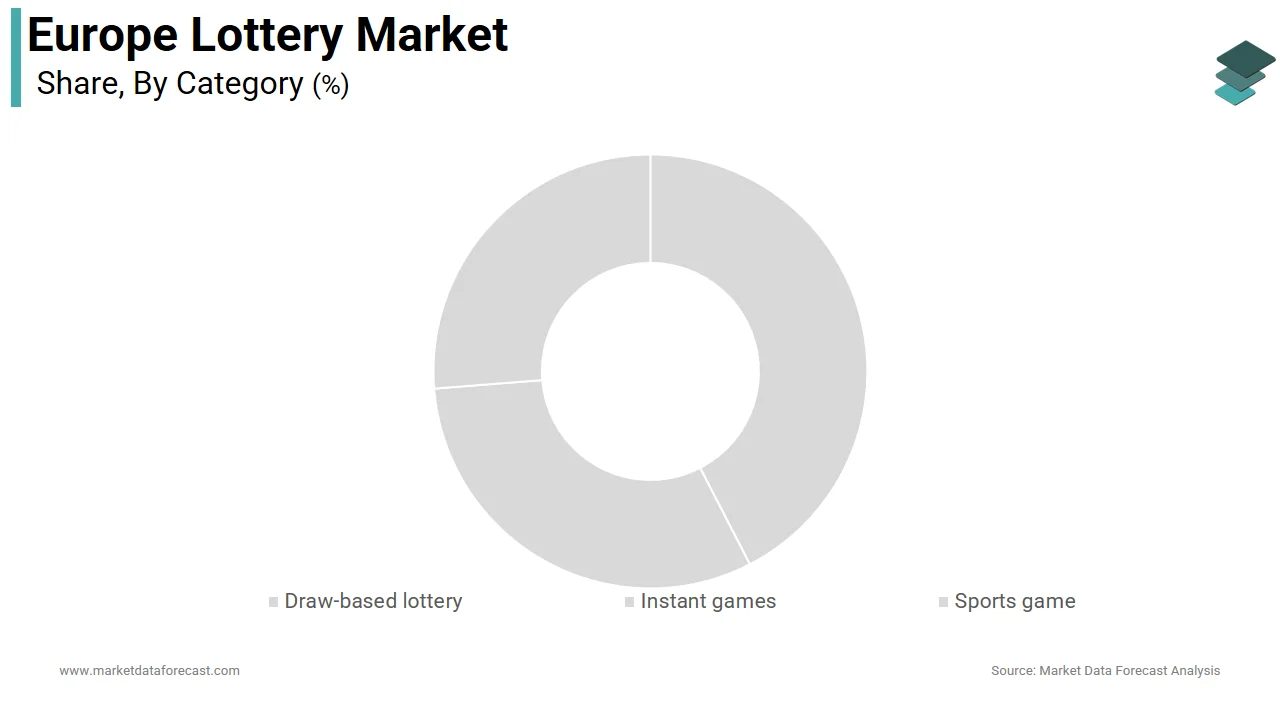
The instant games segment is anticipated to witness the fastest CAGR of 9.8% from 2026 to 2034 due to digital innovation, thematic storytelling, and alignment with contemporary consumer values. Unlike traditional scratch cards, modern instant win games feature animated interfaces, narrative arcs, and cause-linked mechanics that resonate with younger demographics. The integration of environmental and social causes into digital and instant lottery products has become a widespread initiative among European operators. Specific initiatives, such as tree-planting initiatives associated with digital scratch cards, appear to correlate with increased participation among younger demographics. Lottery campaigns are increasingly focusing on themes like gender equality, scientific education, and sustainability, often in collaboration with national organizations. There is a clear shift toward embedding social responsibility directly into product offerings rather than separating these efforts from the core lottery experience. Crucially, these games comply with strict affordability controls, including session timers and loss limits mandated by regulators like Sweden’s Spelinspektionen. Instant games are redefining lottery responsibility by blending entertainment with purpose, transforming passive wagering into active, symbolic participation.
By Application Insights
The offline segment retained dominance in the Europe lottery market by capturing a 63.7% share in 2025. The supremacy of the offline market is attributed to extensive retail networks, trusted physical touchpoints, and demographic inclusivity. A widespread network of physical locations across the EU offers in-person purchasing options for individuals who do not use digital platforms. Moreover, a notable portion of older adults expresses a preference for buying tickets in person rather than online, citing familiarity, tactile engagement, and social interaction. In rural regions where broadband access remains limited, offline remains essential. National operators also leverage physical retail for responsible gambling, trained staff can identify distress signs and enforce age verification more reliably than digital systems. The UK National Lottery’s partnership with thousands of post offices exemplifies how brick-and-mortar infrastructure sustains both reach and social responsibility in an increasingly digital age.
The online lottery sales segment is likely to experience the fastest CAGR of 12.3% during the forecast period, owing to mobile adoption, enhanced user experience, and embedded regulatory safeguards. According to sources, a portion of lottery tickets in Western Europe were purchased digitally in 2024, up from that in 2020. National operators have invested heavily in secure apps featuring biometric login, geolocation checks, and real-time self-exclusion tools compliant with national regulators. The use of animated instant games featuring mandatory play breaks and deposit limits is associated with increased player retention. Automated affordability assessments are being used to adjust spending caps based on self-reported income. These approaches reflect a pattern of integrating player protection tools within the design of digital gaming products. Crucially, online platforms enable personalized communication. Players receive tailored alerts about draws they follow without intrusive advertising. The rising adoption of digital skills and trusted, regulated apps enables scalable online growth without sacrificing European safety and inclusion standards.
COUNTRY LEVEL ANALYSIS
United Kingdom Lottery Market Analysis
The United Kingdom was the top performer in the Europe lottery market by capturing a 22.7% share in 2025. The dominance of the UK market is propelled by its pioneering model of linking lottery proceeds directly to public good causes. The national lottery operator distributes substantial funding to various arts, heritage, sports, and community initiatives across the country. A combined approach to sales is utilized, involving both a large network of physical retail partners and a digital mobile application. Digital channels have grown to represent a significant portion of total ticket sales. The overall sales strategy relies on a mix of local retail presence and user-friendly mobile technology. Regulatory oversight by the Gambling Commission ensures strict adherence to affordability checks and advertising codes. Post privatization, the new operator Allwyn has pledged further digital innovation while preserving the lottery’s social mission. The UK model shows that lotteries can achieve significant societal impact and mass engagement through transparent reporting and balanced access to games.
France Lottery Market Analysis
France followed closely in the Europe lottery market by holding a 19.4% share in 2025. The growth of the French market is supported by its state-backed monopoly, La Française des Jeux, and the strategic use of lottery revenues for national priorities. FDJ plays a significant role in funding French sports, supporting both local sports initiatives and high-level Olympic athlete preparation through partnerships with the National Sports Agency and the Ministry of Sports. The operator leverages digital transformation effectively. The FDJ mobile application has become a major revenue driver, offering users interactive features such as live draw broadcasting and integrated responsible gaming tools. France also leads in thematic innovation, launching eco-conscious instant games and collaborating with cultural institutions on heritage-themed draws. The Loi Évin-inspired advertising restrictions limit promotion but enhance public trust. Despite its partial privatization, a large majority of the French public continues to view FDJ as a legitimate entity providing a public service in gambling and sports funding. France’s lottery ecosystem remains a model of resilience and respect in Europe, anchored by a strategy of fiscal rigor, social utility, and measured modernization.
Spain Lottery Market Analysis
Spain is also a major player in the European lottery market due to its enthusiastic participation in pan-European draws and deep cultural rituals around major events. The Spanish state lottery operator manages major annual drawings known for significant prize distributions. Participation in a multinational lottery game contributes to large, cross-border jackpot opportunities that generate high consumer engagement. Digital adoption for purchasing lottery products has increased, with a substantial portion of transactions occurring through official mobile applications. Security measures for digital lottery participation include integrated, electronic identification verification processes. Proceeds support social welfare, including pensions and disability programs, reinforcing public goodwill. By blending tradition, spectacle, and civic contribution, Spain demonstrates how lotteries can remain central to national identity in the modern era.
Germany Lottery Market Analysis
Germany is steadily growing in the Europe lottery market owing to its federal structure, where many states operate independent lotteries under a unified framework coordinated by Deutsche Lotto- und Totoblock. This model ensures regional responsiveness while maintaining national standards for player protection. A significant portion of the German population engages in lottery participation, with a notable preference for purchasing tickets in person at local kiosks, a trend that is particularly prevalent among older demographics. Germany maintains a robust regulatory framework for responsible gambling, which includes measures such as mandatory loss limits and a centralized system for self-exclusion. Digital operators like Lotto Brandenburg lead in innovation with AI-driven affordability checks that adjust spending caps based on user-declared income. Germany champions a balanced approach, placing social sustainability above maximum revenue by emphasizing transparency and supporting the local economy.
Italy Lottery Market Analysis
Italy is anticipated to expand in the Europe lottery market from 2026 to 2034 due to high play frequency, dense retail penetration, and integration into daily commerce. The operator maintains a widespread physical retail network covering diverse commercial locations, which provides accessibility to its services across various geographic areas. Weekly draw games maintain steady participation, resulting in regular transaction volume for the operator. The business has integrated digital platforms while maintaining its traditional retail presence, with mobile applications handling a significant portion of transactions. Digital security features, such as biometric authentication and location verification, are utilized to meet regulatory standards. Proceeds fund healthcare and cultural restoration, including the Colosseum conservation project, enhancing public legitimacy. Despite advertising bans, Italy maintains robust participation through habitual play and trusted physical presence, making it a model of embedded community finance within Europe’s regulated gaming landscape.
COMPETITIVE LANDSCAPE
Competition in the Europe lottery market is defined not by price or jackpot size alone but by trust, transparency, and demonstrable social impact. The landscape features state-backed monopolies and licensed operators competing on civic contribution, responsible innovation, and channel accessibility rather than aggressive marketing. Regulatory fragmentation across member states creates operational complexity yet also reinforces localized accountability. Operators must align with national values, whether France’s sports funding or Spain’s Christmas tradition. Digital transformation is universal but carefully calibrated to embed harm minimization features mandated by bodies like the UK Gambling Commission or Sweden’s Spelinspektionen. As unregulated online gambling grows, lotteries differentiate through legitimacy, assuring players that every ticket supports public good. Success hinges on balancing modernization with moderation, ensuring that chance remains a socially accepted leisure activity rather than a financial risk, making Europe’s lottery sector a unique fusion of entertainment, public service, and ethical governance.
KEY MARKET PLAYERS
The leading companies operating in the Europe lottery market include:
- International Game Technology (IGT)
- Scientific Games Corporation
- Française des Jeux (FDJ)
- Lottomatica S.p.A.
- Loterías y Apuestas del Estado
- Camelot Group
- China Welfare Lottery
- China Sports Lottery
- Hong Kong Jockey Club
- New York State Lottery
- California Lottery
- Florida Lottery
- Singapore Pools
- Ontario Lottery and Gaming Corporation (OLG)
- Mizuho Bank Ltd.
- The Government Lottery Office
- Sazka Group
- INTRALOT
- BCLC (British Columbia Lottery Corporation)
- Loto-Quebec
- Lotto.com
TOP PLAYERS IN THE MARKET
- La Française des Jeux is a cornerstone of the Europe lottery market, operating France’s national lottery and sports betting monopoly with deep integration into public life. The company channels a portion of its profits to the Ministry of Sports, funding grassroots clubs and Olympic programs while maintaining strict adherence to responsible gambling standards. In recent years, FDJ has accelerated its digital transformation, launching a secure mobile app with biometric authentication, real-time draw streaming, and personalized play dashboards compliant with ARJEL regulations. It also pioneered thematic instant games linked to environmental causes, such as reforestation verified through blockchain ledgers. Globally, FDJ exports its model of state-aligned responsible gaming through technology partnerships and advisory services, particularly in emerging markets seeking to balance revenue generation with social protection.
- Camelot UK Lotteries Limited has long shaped the Europe lottery market through its operation of the UK National Lottery, which has awarded billions of pounds to good causes since 1994. The company maintains a dual-channel strategy with over forty thousand retail partners and a highly rated digital platform. Camelot recently enhanced player safety by integrating dynamic affordability checks and AI-driven behavioral monitoring approved by the Gambling Commission. It also launched cause-linked instant win games supporting mental health and heritage conservation. Following its acquisition by Allwyn, the company is expanding cross-border expertise, sharing its compliance frameworks and civic funding models with international operators, reinforcing the UK’s influence on ethical lottery design worldwide.
- Loterías y Apuestas del Estado is a pivotal force in the Europe lottery market as Spain’s state-owned operator managing iconic draws like El Gordo de Navidad and EuroMillions participation. The company leverages cultural tradition and digital innovation to sustain mass engagement with its official app, now handling a portion of transactions through secure DNI electronic ID verification. SELAE recently introduced sustainability-themed instant games with proceeds funding STEM education and climate initiatives endorsed by national ministries. It also strengthened its role in pan-European syndicates, ensuring record jackpots that drive cross-border excitement. SELAE demonstrates the successful blend of cultural heritage, social contribution, and modernization, allowing lotteries to remain vital community staples while adhering to contemporary standards of accountability.
TOP STRATEGIES USED BY THE KEY MARKET PARTICIPANTS
Key players in the Europe lottery market embed responsible gambling tools directly into digital platforms, including mandatory affordability checks, session timers, and centralized self-exclusion registers. They allocate significant portions of net revenue to publicly visible good causes such as sports culture and healthcare to reinforce social legitimacy. Companies invest in secure mobile applications with biometric authentication, geolocation verification, and real-time draw notifications compliant with national regulators. Thematic instant games linked to sustainability, gender equality, or heritage preservation enhance emotional engagement among younger demographics. Additionally, operators maintain extensive offline retail networks to ensure inclusivity for non-digital populations while using data analytics to personalize communication without intrusive advertising.
MARKET SEGMENTATION
This research report on the Europe lottery market has been segmented and sub-segmented into the following categories.
By Category
- Draw-based lottery
- Instant games
- Sports game
By Application
- Online
- Offline
By Country
- United Kingdom
- France
- Spain
- Germany
- Italy
- Russia
- Sweden
- Denmark
- Switzerland
- Netherlands
- Rest of Europe