- Product Description Description
- Table of Contents TOC
- List of Table & Figure LOT
- Get Free Sample PDF Sample PDF
Market Size, 2025
$14.15 BnMarket Estimate, 2026
$15.06 BnMarket Forecast, 2034
$24.77 BnCAGR, 2026–2034
6.42%Europe Low Voltage Switchgear Market Size, Growth, Trends & Forecast (2026–2034)
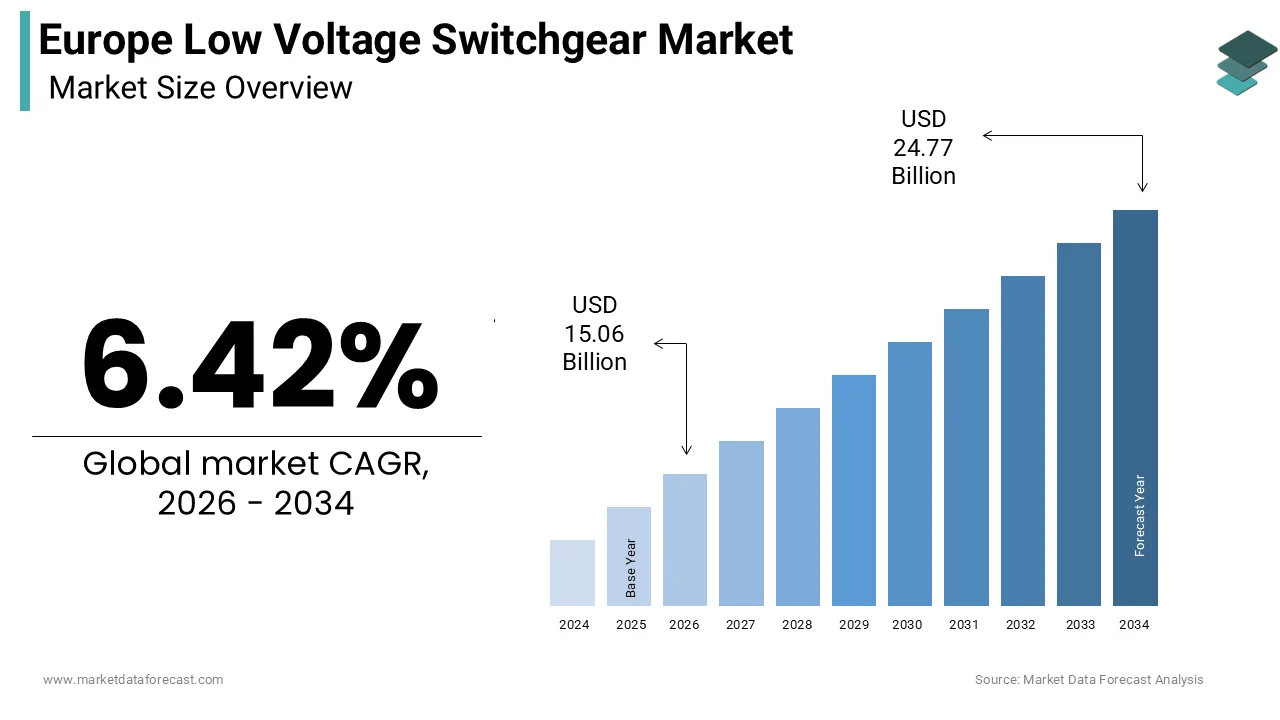
The Europe low voltage switchgear market size was calculated at USD 14.15 billion in 2025, is anticipated to reach USD 15.06 billion in 2026, and is projected to scale up to USD 24.77 billion by 2034, registering a compound annual growth rate (CAGR) of 6.42% during the forecast period from 2026 to 2034. Driven by the European Green Deal, building renovation mandates, and the widespread electrification of heating and transport, the industry continues to evolve from a commodity hardware segment into a vital component of intelligent energy management systems.
Key Executive Metrics (At-a-Glance)
- 2025 Base Valuation: USD 14.15 Billion
- 2026 Current Valuation: USD 15.06 Billion
- 2034 Forecast Valuation: USD 24.77 Billion
- Compound Annual Growth Rate (CAGR): 6.42% (2026–2034)
- Dominant Application Segment: Distribution (holding a substantial share due to the vast network of residential and commercial endpoint facilities requiring safe power delivery)
- Dominant Installation Segment: Indoor Installation (capturing the largest share backed by urban spatial efficiency and protection from harsh environmental elements)
- Dominant Voltage Rating Segment: 250 V to 750 V Range (holding the majority share due to standard nominal supply voltage levels in regional residential and commercial grids)
- Fastest-Growing Application Segment: Substation Segment (projected to register a CAGR of 6.5%, driven by grid modernization for renewable energy integration and EV charging hubs)
- Fastest-Growing Installation Segment: Outdoor Installation (expanding rapidly due to rural network resilience and remote renewable energy and utility infrastructure deployments)
- Fastest-Growing Voltage Rating Segment: 750 V to 1000 V Range (fueled by high-power industrial automation and utility-scale solar/wind collection demands)
Core Market Drivers
- Accelerated Building Renovation Mandates: European Green Deal policies requiring extensive electrical upgrades to address energy-inefficient legacy building stocks.
- Electrification of Heating and Transport: Rapid uptake of heat pumps and EV charging infrastructure creating high load requirements that necessitate robust circuit breakers and panels.
- Decentralized Renewable Integration: Massive rooftop solar and wind generation driving the need for reverse power protection and smart grid compatibility.
Primary Market Restraints & Challenges
- Supply Chain Volatility for Raw Materials: Significant price instability and import dependency for copper, which directly affects switchgear manufacturing costs and profit margins.
- Skilled Labour Shortages: Deficits in qualified electricians and engineers slowing down the physical deployment, commissioning, and integration of sophisticated smart switchgear.
- Technical Complexity & Fragmentation: Operational hurdles of managing bidirectional power flows alongside divergent national electrical codes across member states.
Europe Low Voltage Switchgear Market Segmentation Breakdown
| Segment Category | Leading Sub-Segment (2025 Base) | Fastest-Growing Sub-Segment (2026–2034) |
|---|---|---|
| By Application | Distribution (dominant share due to widespread use across millions of residential and commercial end-user endpoints) | Substation (fastest-growing category registered at a 6.5% CAGR driven by grid modernization and EV charging hubs) |
| By Installation | Indoor Installation (largest share supported by urban architectural density and component protection from weather) | Outdoor Installation (fastest-growing segment propelled by remote rural grids, solar parks, and wind farms) |
| By Voltage Rating | 250 V to 750 V Range (dominant share aligning with standard 230V/400V regional residential and commercial grid setups) | 750 V to 1000 V Range (fastest-growing segment driven by high-power industrial applications and green energy collection) |
| By Region | Germany & Western Europe (dominant market backed by robust industrial manufacturing and rigorous energy standards) | Southern & Eastern Europe (fastest-growing regional markets driven by grid expansion and renewable investments) |
Major Industry Players Profiled
Key enterprises shaping the competitive European low voltage switchgear market include Siemens AG, Schneider Electric SE, ABB Ltd., Eaton Corporation plc, Legrand SA, Mitsubishi Electric Corporation, Rockwell Automation Inc., General Electric Company, Hitachi Energy Ltd., and Fuji Electric Co., Ltd..
Europe Low Voltage Switchgear Market Size
The Europe low voltage switchgear market size was calculated at USD 14.15 billion in 2025 and is anticipated to reach USD 24.77 billion by 2034, from USD 15.06 billion in 2026, growing at a CAGR of 6.42% during the forecast period.
Low voltage switchgear is a centralized assembly of switches, fuses, and circuit breakers rated for systems up to 1,000 volts AC or 1,500 volts DC that controls, protects, and isolates electrical equipment. This field is fundamentally linked to broader energy transition goals rather than simple construction metrics. According to the European Commission, the Renovation Wave Strategy targets doubling the annual energy renovation rate of buildings by 2030, a goal designed to improve energy performance and help decarbonise the region's overall building stock. As per the European Commission, the building sector accounts for approximately 40% of total energy consumption and 36% of energy-related greenhouse gas emissions in the European Union. According to the World Economic Forum, digital solutions can reduce greenhouse gas emissions by up to 20 per cent in hard-to-abate industrial sectors. These statistics illustrate that demand is driven by regulatory mandates for decarbonization and safety rather than organic growth alone. The market functions as the operational interface between renewable generation sources and end users, ensuring grid stability amidst decentralized energy production. Consequently, the European low-voltage switchgear market is evolving from a commodity hardware segment into a vital component of intelligent energy management systems designed to meet stringent environmental targets.
MARKET DRIVERS
Accelerated Building Renovation Mandates Drive Replacement Demand
Regulatory Pressure for Energy Efficiency Retrofits. The European Green Deal is the primary driver of the European low-voltage switchgear market. This policy mandates extensive renovations of existing building stock to improve energy performance. According to the European Commission, approximately 75% of the current building stock in the European Union is energy inefficient, requiring comprehensive electrical upgrades to meet new sustainability standards. This statistic directly correlates to switchgear demand because older distribution panels often lack the capacity or safety features necessary to support modern heat pumps, solar inverters, and electric vehicle chargers. As per the Buildings Performance Institute Europe, deep renovation rates need to reach at least 3% annually in order to meet the European Union's 2030 climate and energy goals. According to the Buildings Performance Institute Europe, the current annual deep renovation rate in the European Union is only 0.2% on average. The regulatory framework transforms switchgear from an optional maintenance item into a mandatory compliance investment. Also, the sheer volume of non-compliant buildings ensures that retrofit activities will dominate procurement volumes for decades, decoupling market growth from new construction cycles and anchoring it firmly in policy-driven modernization efforts.
Electrification of Heating and Transport Systems
Electrification of Heating and Transport Creates New Load Requirements. The rapid shift toward electrified heating and transportation creates substantial new load requirements that existing low-voltage infrastructure cannot accommodate without significant upgrades and ultimately fuels the growth of the Europe low-voltage switchgear market. According to the International Energy Agency, heat pump sales in Europe enjoyed a record year, with sales growing by nearly 40% in 2022, led by a near 50% jump in air-to-water models. This surge in high-power appliances directly drives demand for higher-rated breakers and expanded panel configurations. As per the European Environment Agency, accelerating the electrification of heating, transport, and industry is required to support Europe's clean and competitive future. A single fast charger can draw more power than an entire household, requiring specialized switchgear solutions to manage peak loads and prevent grid instability. The correlation between electrification policies and switchgear specifications is direct, as national bans on gas boilers and fossil fuel vehicles translate immediately into electrical engineering requirements. Utilities and building operators must proactively reinforce their low-voltage networks to avoid overloading legacy systems. This structural shift in energy consumption patterns guarantees long-term demand for advanced switching and protection devices capable of handling bidirectional flows and higher amperages associated with the clean energy transition.
MARKET RESTRAINTS
Supply Chain Volatility for Critical Raw Materials
Copper Price Instability Impacts Manufacturing Costs. Fluctuations in copper prices are a significant restraint for the Europe low voltage switchgear market. This is due to the metal's central role in busbars, contacts, and wiring components. According to the World Bank, the base metals index gained 29 percent between early 2025 and early 2026, marking a spell of extraordinary market volatility driven by shifting trade policies and global demand expectations. Since copper constitutes a substantial portion of the bill of materials for switchgear, even minor price spikes erode profit margins or force project delays as buyers await stabilization. As per the European Commission, the European Union relies heavily on international markets for copper, with its import dependency rate for copper ores and concentrates exceeding 80 percent to feed local refining operations. The relationship between commodity markets and switchgear affordability is inverse; when raw material costs rise, capital expenditure budgets for electrical upgrades are often deferred or scaled back. Smaller contractors and distributors face particular difficulty in hedging against these fluctuations compared to multinational corporations. Consequently, the financial unpredictability associated with copper sourcing acts as a brake on market expansion, particularly for standard low-margin products where cost competitiveness is paramount.
Skilled Labour Shortages Delay Installation Projects
Workforce Deficits Hinder Deployment Speeds. A severe shortage of qualified electricians and electrical engineers restricts the actual deployment rate of low-voltage switchgear regardless of product availability or demand signals, which impedes the expansion of the European market. According to the European Commission, meeting climate, economic, and energy-efficiency investment targets requires adding around 3.6 million additional workers to the construction ecosystem by 2030. This relates directly to the switchgear market because sophisticated modern panels require specialised knowledge for proper installation, commissioning, and integration with building management systems. As per the European Commission, graduates from upper secondary architecture and construction programs across member states fell by 9.2 percent as vocational paths face widening labor shortages. Complex smart switchgear installations are particularly vulnerable to these shortages, as they demand digital literacy alongside traditional electrical skills. When skilled labour is scarce, projects stall in the planning phase or experience costly rework due to improper installation, discouraging end users from upgrading. The bottleneck is not manufacturing capacity but human capital. This structural constraint limits the market’s ability to absorb demand generated by renovation mandates and electrification trends, effectively capping growth potential until workforce development initiatives yield tangible results.
MARKET OPPORTUNITIES
Integration of Digital Monitoring and Predictive Maintenance
Smart Grid Compatibility Requirements Create Value-Added Services. The transition toward intelligent distribution networks opens significant opportunities for the European low-voltage switchgear market. This equipment is now increasingly designed with embedded sensors and communication capabilities. According to Eurelectric, distribution grid investments across Europe must increase from an average of €33 billion to €67 billion per year from 2025 to 2050 to support the massive electrification of transport, heating, and industry. Utilities and facility managers are actively seeking equipment that transcends basic protection functions to enable proactive grid management. As per the European Commission, AI-based operation and maintenance optimization is projected to save up to €94 billion annually in the energy ecosystem by 2035. The relation between digitalisation trends and market opportunity lies in the shift from selling hardware to selling reliability and efficiency outcomes. Manufacturers offering integrated monitoring solutions can differentiate themselves from commodity suppliers and capture higher-value contracts. The growing complexity of distributed energy resources necessitates granular visibility at the low-voltage level, which only intelligent switchgear can provide. This convergence of IT and OT creates a blue ocean for vendors who successfully bridge the gap between traditional electrical engineering and data analytics, transforming passive distribution assets into active network nodes.
Decentralised Renewable Energy Integration Needs
Distributed Generation Proliferation Drives Specialised Equipment Demand. The exponential growth of rooftop solar and small-scale wind installations generates unique technical requirements, which unlocks potential for the Europe low voltage switchgear market. Standard low voltage switchgear cannot adequately address these needs. According to SolarPower Europe, the European Union connected a record 55.9 gigawatts of solar photovoltaic systems to the grid in 2023, bringing the region's cumulative installed solar fleet to 263 gigawatts. This highlights a fundamental change in grid topology where consumers become producers, requiring switchgear with enhanced safety features like arc fault detection and reverse power protection. As per the Joint Research Centre, flexibility requirements in the European Union electricity system are projected to more than double by 2030 and expand sevenfold by 2050 to successfully accommodate variable renewable energy sources. The correlation between renewable penetration rates and specialized equipment demand is linear; every additional gigawatt of distributed generation translates to thousands of connection points requiring upgraded infrastructure. Traditional unidirectional designs are becoming obsolete in areas with high solar density. This technical evolution creates opportunities for manufacturers to develop next-generation products tailored specifically for prosumer applications. The regulatory push for self-consumption further amplifies this trend, ensuring sustained demand for innovative low-voltage solutions that facilitate safe and efficient renewable integration.
MARKET CHALLENGES
Technical Complexity of Bidirectional Power Flow Management
Legacy Infrastructure Incompatibility with Modern Loads. The widespread adoption of bidirectional energy flows from electric vehicles and solar PV creates technical challenges, which in turn inhibit the growth of the Europe low-voltage switchgear market. Existing low-voltage switchgear was never designed to handle these issues. According to the European Network of Transmission System Operators for Electricity, the shift toward a decentralized power system moves generation into the distribution level, causing highly volatile load flow patterns and increased reverse flows across transmission-distribution network nodes. This underscores the mismatch between legacy infrastructure capabilities and contemporary operational realities. As per the Fraunhofer Institute for Solar Energy Systems, large-scale PV power plant operations are raising system voltages up to low- to medium-voltage ranges to minimize electricity production costs and optimize asset resource efficiency. The relation between this technical challenge and market dynamics is that it forces premature obsolescence of functional but inadequate equipment. Operators cannot simply add new breakers to old panels; they must often replace entire assemblies with units rated for bidirectional operation and equipped with advanced monitoring. This compatibility gap slows down renewable integration projects as stakeholders navigate complex retrofitting requirements. It also increases liability risks for installers and manufacturers if equipment fails under conditions outside original design parameters. Resolving these technical incompatibilities requires significant R&D investment and careful system engineering, acting as a friction point in the otherwise accelerating energy transition.
Standardisation Fragmentation Across National Markets
Divergent National Regulations Hinder Scalability. Significant variations in national electrical codes and certification requirements continue to fragment the European low-voltage switchgear market. This fragmentation persists despite the region’s harmonisation efforts. According to CENELEC, over 75 percent of the active European electrical standards portfolio is identical to international IEC work, establishing a shared technical baseline across all 34 member countries. This reflects the persistent regulatory heterogeneity that complicates pan-European business strategies. As per the European Committee for Standardization, every national standardization body within the network is legally obliged to adopt each approved European Standard identically and immediately withdraw any conflicting national standards. The relation between regulatory fragmentation and market challenges is direct; manufacturers must maintain multiple product variants and inventory pools to serve different jurisdictions, negating economies of scale. Small and medium-sized enterprises are disproportionately affected as they lack the resources to navigate complex multi-country certification processes. This barrier to entry protects incumbent national champions but stifles innovation and competition. Even when products technically comply with EU directives, local inspectors may reject them based on customary practices or outdated interpretations. Until true regulatory alignment is achieved, the Europe low voltage switchgear market will remain a collection of distinct national markets rather than a unified single market. This fragmentation limits efficiency gains and slows the diffusion of best available technologies.
REPORT COVERAGE
| REPORT METRIC | DETAILS |
| Market Size Available | 2025 to 2034 |
| Base Year | 2025 |
| Forecast Period | 2026 to 2034 |
| CAGR | 6.4% |
| Segments Covered | By Application, Installation, Voltage Rating, and Region |
| Various Analyses Covered | Global, Regional, & Country-Level Analysis; Segment-Level Analysis; DROC; PESTLE Analysis; Porter’s Five Forces Analysis; Competitive Landscape; Analyst Overview of Investment Opportunities |
| Regions Covered | UK, France, Spain, Germany, Italy, Russia, Sweden, Denmark, Switzerland, Netherlands, Turkey, Czech Republic, Rest of Europe |
| Market Leaders Profiled | Siemens AG, Schneider Electric SE, ABB Ltd., Eaton Corporation plc, Legrand SA, Mitsubishi Electric Corporation, Rockwell Automation Inc., General Electric Company, Hitachi Energy Ltd., Fuji Electric Co., Ltd. |
SEGMENTAL ANALYSIS
By Application Insights
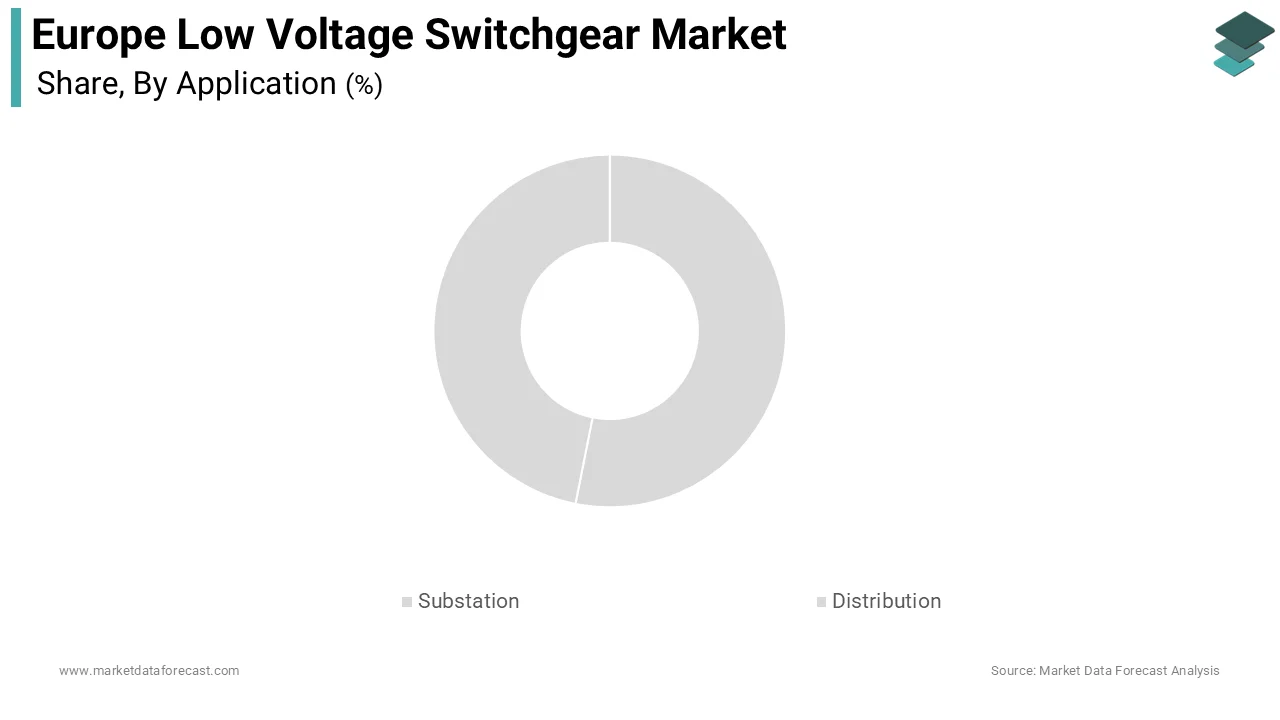
The distribution segment dominated the Europe low voltage switchgear market and accounted for a substantial share in 2025. This dominance of the segment was driven by the vast network of end-user facilities requiring safe power delivery at the point of consumption. According to Eurostat, the European Union housing landscape records that just over half of the regional population lives in houses while 48 percent live in flats, dictating structural configurations for low-voltage electrical installations. The massive installed base creates a continuous demand for replacement and upgrade cycles as buildings age and electrical codes evolve. As per Eurostat, electricity accounts for approximately 26.9 percent of final energy consumption in European Union households, impacting the baseline configuration of residential electrical distribution equipment. The direct correlation between housing stock volume and switchgear units ensures that the distribution segment remains the primary revenue generator. Unlike substation applications, which are centralised, distribution switchgear is deployed in millions of discrete locations, amplifying volume requirements. Renovation activities in older housing stocks further boost demand as outdated fuse boxes are replaced with modern miniature circuit breakers and residual current devices. The ubiquity of electrical power in daily life makes this segment resilient to economic fluctuations, as safety compliance is non-negotiable. Consequently, the sheer scale of residential and commercial endpoints secures the leading position of the distribution application in the market.
Strict adherence to electrical safety regulations drives the dominance of the distribution segment by mandating regular upgrades and installations of certified low-voltage switchgear in all occupied buildings. According to the International Electrotechnical Commission, the IEC 60364 series establishes the international rules for the design, erection, and selection of compliant devices to ensure proper protection and control inside low-voltage switchgear assemblies. As per the European Committee for Electrotechnical Standardization, the regional electrical architecture enforces that national technical standard deviations are reduced because over 75 percent of active CENELEC standards are identical to the international IEC text. The relation between regulation and market size is direct; every code update triggers a wave of retrofits across millions of buildings. Non-compliance can result in insurance invalidation or legal liability, making adherence a priority for stakeholders. This regulatory pressure ensures that distribution switchgear is not viewed as optional but as a critical legal requirement. The consistent enforcement of these standards across member states provides a stable and predictable demand environment for manufacturers focusing on the distribution segment.
The substation segment is estimated to register the fastest CAGR of 6.5% from 2026 to 2034 due to urgent needs to modernize grid infrastructure for renewable energy integration. According to the European Network of Transmission System Operators for Electricity, the transmission grid operators face soaring funding needs as the supporting offshore grid alone requires between €70 billion and €90 billion of capital investment by 2030 to link regional electricity markets. As per the International Energy Agency, the share of variable renewable energy in the European Union electricity supply mix will rise to 46 percent by 2030, transforming the demand patterns for local network nodes and switchgear equipment. The transition from traditional radial networks to active meshed configurations necessitates switchgear with enhanced communication and control capabilities. Utilities are replacing ageing electromechanical devices with digital solutions that offer real-time monitoring and remote operation. This technological shift accelerates procurement cycles and increases the value per unit sold. The strategic importance of grid resilience against climate-induced disruptions further prioritizes substation upgrades. Consequently, the substation segment experiences accelerated growth as it becomes the focal point of the energy transition infrastructure.
The rapid deployment of high-power electric vehicle charging hubs is propelling the substation segment to become the fastest-growing application area for low-voltage switchgear. According to the European Alternative Fuels Observatory, expanding the public charging infrastructure network to reach the 3.5 million public charging point goal by 2030 requires setting up roughly 410,000 new units every year, creating extensive connection points for distribution panels. These high-capacity charging stations draw substantial power, necessitating robust low-voltage switchgear at the substation level to manage peak loads and prevent local grid congestion. As per the Joint Research Centre, the structural volatility of decentralized renewable inputs causes flexibility requirements in the European Union power network to expand sevenfold by 2050, accelerating the modern upgrading of secondary substation equipment. The correlation between charging infrastructure rollout and substation equipment demand is strong, as each major hub represents a significant new load center requiring specialized distribution infrastructure. Utilities are proactively upgrading substations in urban areas to accommodate the anticipated surge in electric vehicle adoption. This proactive infrastructure development drives higher growth rates in the substation segment compared to traditional residential distribution. The focus on supporting sustainable mobility ensures sustained investment in substation modernisation, cementing its status as the fastest-growing application segment.
By Installation Insights
The indoor installation segment led the Europe low voltage switchgear market and captured a significant share in 2025. These setups are highly favoured because they offer superior protection for sensitive electronic components against harsh weather conditions and physical damage. According to the European Committee for Electrotechnical Standardization, technical committees develop uniform standards for low-voltage electrical installations to shield users from operational hazards and guarantee component functionality inside indoor infrastructure environments. The reliability factor makes indoor installation the preferred choice for commercial buildings, industrial facilities, and residential complexes where uptime is essential. As per the Fraunhofer Institute for Solar Energy Systems, accelerating the deployment of smart energy technologies helps stabilise the regional distribution grid against volatile load patterns. The relation between environmental protection and market dominance is clear; stakeholders prioritize longevity and reliability, which indoor installations inherently provide. Climate variability in Europe, including heavy rainfall and temperature extremes, further discourages outdoor exposure for standard low-voltage equipment. Indoor settings also facilitate easier access for routine inspections and upgrades, enhancing operational efficiency. The prevalence of multi-story buildings in urban European centres naturally dictates indoor placement for vertical distribution. These practical advantages ensure that indoor installation remains the dominant configuration in the market.
The density of urban infrastructure in the region is one of the major factors behind the leading position of indoor low-voltage switchgear installations, as they maximize space efficiency in confined building environments. According to Eurostat, approximately 48 percent of the European Union population lives in flats while just over half lives in houses, dictating layout plans for residential power boards. Indoor switchgear panels can be integrated into dedicated electrical rooms or wall-mounted in corridors, optimizing usable floor space while ensuring safety compliance. As per the European Construction Industry Federation, regional construction firms face expanding engineering backlogs because building electrification upgrades and infrastructure installations outpace the recruitment of qualified personnel. The correlation between urban density and indoor installation preference is direct; limited outdoor space in cities makes external mounting impractical for most residential and commercial applications. Indoor installations also reduce noise pollution and visual clutter, aligning with urban aesthetic standards. The ability to cluster multiple distribution boards in a single secure location simplifies management and enhances security against tampering. These spatial and aesthetic benefits make indoor installation the default choice for the majority of European construction projects, securing its leading market position.
The outdoor installation segment is rapidly expanding in the European low-voltage switchgear market, owing to the need to extend electrical infrastructure to rural and remote areas where indoor housing for equipment is not feasible. According to the European Rural Development Network, public funding strategies focus heavily on improving the overall structural resilience and deployment rates of local utility networks across outer territories. These installations must withstand extreme weather conditions, driving innovation in weatherproof and corrosion-resistant materials. As per the International Energy Agency, global grid infrastructure bottlenecks are intensifying because expanding load requests and renewable energy queues cause capacity constraints across outdoor grid nodes. The relation between rural development and outdoor switchgear growth is direct; every new connection in a remote location typically involves an outdoor pole-mounted or ground-level enclosure. The expansion of renewable energy sites, such as wind farms and solar parks, also necessitates outdoor switchgear for collection and distribution points. These applications require equipment that can operate reliably without shelter, fostering demand for specialized outdoor-rated products. The push for energy independence in rural communities accelerates this trend, making outdoor installation the fastest-growing segment despite its smaller overall share.
The expansion of industrial facilities and utility infrastructure in open spaces is accelerating the growth of the outdoor low voltage switchgear segment. According to the European Chemical Industry Council, member chemical enterprises are ramping up targeted investment allocations toward lower-carbon production hardware to update aging electrical operations. Outdoor units allow for larger capacities and easier integration with overhead lines, which are common in industrial zones. As per the European Association of Electrical Contractors, installation businesses struggle to complete grid infrastructure expansions because a severe shortage of technicians impacts the commissioning of low-voltage network devices. The correlation between industrial growth and outdoor switchgear demand is strong, as these sectors prioritize functional efficiency over aesthetic considerations. Outdoor installations facilitate quicker deployment and lower civil engineering costs compared to building dedicated indoor electrical rooms. The trend toward modular and prefabricated outdoor substations further boosts this segment by offering rapid installation solutions for temporary or expanding operations. These operational advantages drive the rapid adoption of outdoor switchgear in industrial and utility applications.
By Voltage Rating Insights
In 2025, the 250 V to 750 V range segment held the majority share in the Europe low voltage switchgear market. This segment remained prominent due to its alignment with the standard nominal voltage levels used in most residential and commercial electrical systems in the region. According to the European Committee for Electrotechnical Standardization, standard EN 60038 formally establishes the nominal supply voltage inside the region at 230 V for single-phase networks and 400 V for three-phase configurations. According to the International Electrotechnical Commission, technical standard IEC 60038 breaks down standard AC equipment application parameters by setting nominal electrical values across a designated range between 100 V and 1000 V. As per Eurostat, the European transport sector accounts for the largest share of final regional energy consumption at 32.0 per cent, followed by residential households at 26.3 per cent. The relation between voltage standards and market leadership is absolute; nearly every building connection requires equipment rated for this range. Manufacturers optimise production for this segment to achieve economies of scale, further reinforcing its dominance. The compatibility with existing wiring infrastructure and appliances makes this voltage rating the default choice for general-purpose applications. Any deviation from this standard would require costly adapters or specialized equipment, which is impractical for mass market use. Consequently, the 250 V to 750 V segment remains the undisputed leader in terms of volume and revenue.
The entrenched nature of the European power grid infrastructure supports the dominance of the 250 V to 750 V switchgear segment by ensuring seamless integration with legacy systems. According to the European Network of Transmission System Operators for Electricity, regional investment strategies emphasize adding extensive cross-border transmission capacities to lower aggregate power system costs and boost socio-economic integration. As per the International Electrotechnical Commission, standard guidelines define the formal low voltage installation band as operating up to 1000 V root-mean-square for alternating current supplies. The correlation between grid design and switchgear selection is direct; utilities and contractors prefer equipment that matches the established grid parameters to avoid compatibility issues. The widespread availability of spare parts and technical expertise for this voltage range further reduces operational risks. New constructions adhere to these standards to ensure interoperability with the wider network. This systemic alignment ensures that the 250 V to 750 V segment continues to hold the largest market share, driven by the inertia of established infrastructure and standardised practices.
The 750 V to 1000 V segment is growing quickly in the Europe low voltage switchgear market. This swift expansion of the segment is propelled by its increasing adoption in high-power industrial applications and electric vehicle charging infrastructure. According to the International Electrotechnical Commission, standard IEC 61140 explicitly defines low voltage thresholds as spanning from 0 up to 1000 V AC root-mean-square and up to 1500 V for direct current systems. Higher voltage allows for thinner cables and reduced energy losses, making it attractive for heavy industry. Industrial automation and robotics also benefit from higher voltage supplies for improved performance. This technical shift is creating a new niche of high-performance switchgear that is expanding faster than the traditional lower voltage segments. The focus on industrial decarbonization and electrification further accelerates this trend.
The integration of large-scale renewable energy systems is fueling the growth of the 750 V to 1000 V switchgear segment by requiring efficient power collection and conversion. According to SolarPower Europe, regional solar hardware operations are heavily concentrated in string inverter manufacturing, which accounted for 86 percent of the continent's overall inverter production base. As per WindEurope, specialized offshore engineering projects require design reviews of medium-voltage and low-voltage switchgear, transformers, and electrical auxiliary systems to manage deep-sea power grid connections. The correlation between renewable capacity additions and high voltage low voltage switchgear demand is strengthening as projects scale up. Higher voltage ratings reduce the number of parallel strings and simplify system architecture, lowering installation costs. This efficiency gain drives preferential selection of 750 V to 1000 V equipment in new renewable projects. The strategic push for clean energy thus directly contributes to the rapid growth of this specific voltage segment.
REGIONAL ANALYSIS
Germany Low-Voltage Switchgear Market Analysis
Germany was the top performer in the European low-voltage switchgear market and occupied a commanding share in 2025. This market dominance was driven by the country's robust industrial base and aggressive energy transition policies. According to the Federal Ministry for Economic Affairs and Climate Action, Germany is adjusting its future renewable power additions to align explicitly with the slower physical expansion progress of its electricity grid infrastructure to preserve industrial cost competitiveness. The country is home to major global manufacturers who innovate locally before exporting, creating a strong domestic supply chain. As per the German Electrical and Electronic Manufacturers’ Association, regional industry deployment programs prioritise building-level and transport electrification solutions to systematically drive the comprehensive digitalization of low-voltage hardware configurations. Germany’s strict safety regulations and high labor costs favor premium, reliable switchgear solutions, supporting value over volume. The renovation of old industrial facilities to meet new efficiency standards further boosts replacement demand. Government incentives for smart grid technologies encourage the adoption of digital switchgear. This combination of industrial strength, regulatory rigour, and technological leadership cements Germany’s dominant role in the regional market.
France Low-Voltage Switchgear Market Analysis
France was positioned second in the European low-voltage switchgear market, with a large share in 2025. This position of the French market was supported by strong state involvement in energy infrastructure and nuclear-powered grid stability. According to the French Government Strategy and Planning Office, approximately 64 percent of the estimated regional energy transition investments are tied directly to updating and adapting local distribution and transmission network assets. The country hosts major global players who leverage France as a hub for European operations. As per the French Union of Electricity Industries, structural modernization policies must exclude standard component repair and spare parts activities to safeguard operators from overly complex low-voltage grid alignment expenses. France’s focus on digital sovereignty encourages the development of smart switchgear solutions that integrate with national grid management systems. Public investment in charging infrastructure for electric vehicles further stimulates market growth. The regulatory framework emphasises safety and energy efficiency, guiding procurement decisions. This supportive policy environment ensures France remains a key market for both standard and advanced switchgear technologies.
United Kingdom Low-Voltage Switchgear Market Analysis
The United Kingdom maintains a strong presence in the European low-voltage switchgear market due to a mature construction sector and ambitious net zero targets. According to the UK Department for Business, Energy and Industrial Strategy, strategic demonstration projects are evaluating real-world housing archetypes and manufacturing supply chains to resolve installation cost barriers for residential heat applications. The country has a strong presence of international switchgear manufacturers and a well-established distribution network. As per the National Energy System Operator, regional net zero targets demand massive scaling of demand-side response and battery storage capacity to handle structural volatility across the distribution network. The UK’s building regulations strictly enforce electrical safety standards, ensuring consistent demand for certified products. Post-Brexit adjustments have led to some supply chain restructuring, but domestic manufacturing capabilities remain strong. The focus on retrofitting older housing stock provides a long-term pipeline for replacement projects. This regulatory and market dynamic sustains the UK’s significant contribution to the regional market.
Italy Low-Voltage Switchgear Market Analysis
Italy is a crucial player in the European low-voltage switchgear market because of extensive building renovation programs and growing renewable energy capacity. According to the Revenue Agency, the Superbonus 110% green subsidy scheme directed over 120 billion euros toward deep energy building retrofits, including residential photovoltaic systems and heat pump integrations. The country has a strong manufacturing base for electrical components, serving both domestic and export markets. As per the International Energy Agency Photovoltaic Power Systems Programme, approximately 98 percent of all installed photovoltaic power plants across Italy are connected directly to the low-voltage distribution grid. Italy’s aging infrastructure requires continuous maintenance and modernization, supporting steady replacement demand. The government’s focus on energy efficiency and digitalisation encourages the adoption of smart metering and connected switchgear. Local distributors play a key role in reaching small and medium-sized enterprises. These factors collectively strengthen Italy’s position in the European market.
Spain Low-Voltage Switchgear Market Analysis
Spain contributes significantly to the European low-voltage switchgear market owing to rapid solar energy expansion and tourism-related construction. According to the Ministry for the Ecological Transition and the Demographic Challenge, Spain's deployed solar self-consumption and distributed generation power footprint expanded dramatically to surpass 7 gigawatts of total capacity. The country’s construction sector is rebounding, with new hotels and residential complexes driving demand for modern electrical installations. As per the Spanish Association of Electrical Equipment Manufacturers, the consolidated domestic manufacturing network spans 137 individual member companies that represent over 90 percent of the total sector market turnover for low and medium voltage hardware. The government’s recovery funds are directed toward digitalising the grid and improving energy efficiency in buildings. This investment supports the adoption of advanced switchgear solutions. The warm climate also drives demand for air conditioning, increasing electrical loads and necessitating robust distribution systems. These dynamics position Spain as a key growth market in Southern Europe.
COMPETITION OVERVIEW
The competition in the Europe low voltage switchgear market is intense and characterized by the presence of several multinational corporations alongside numerous regional specialists who compete on technology quality and service. Major players leverage their brand reputation and extensive distribution networks to maintain strong relationships with contractors and electrical wholesalers. Innovation in digital features such as remote monitoring and automated control serves as a key differentiator in this otherwise standardized product category. Price competition remains relevant for basic components but shifts toward value-added services for complex industrial applications. Regulatory compliance with European safety and environmental standards acts as a significant barrier to entry for new competitors, ensuring high-quality benchmarks. Companies are increasingly focusing on sustainability credentials to appeal to environmentally conscious buyers and meet green building certification requirements. The market sees frequent collaborations between hardware manufacturers and software providers to offer integrated smart grid solutions. Customer loyalty is driven by reliability, after-sales support, and technical expertise rather than just initial cost. This dynamic environment encourages continuous improvement and adaptation to emerging energy trends.
KEY MARKET PLAYERS
A few major players in the European low-voltage switchgear market include
- Siemens AG
- Schneider Electric SE
- ABB Ltd
- Eaton Corporation plc
- Legrand SA
- Mitsubishi Electric Corporation
- Rockwell Automation Inc
- General Electric Company
- Hitachi Energy Ltd
- Fuji Electric Co., Ltd
Top Strategies Used by Key Market Participants
Key players in the Europe low voltage switchgear market primarily focus on digitalization and product innovation to differentiate their offerings in a mature industry. Companies are integrating Internet of Things sensors and cloud connectivity into switchgear to enable predictive maintenance and real-time energy monitoring for customers. Strategic acquisitions of software firms and niche technology startups allow established manufacturers to enhance their digital capabilities rapidly. Sustainability is another core strategy, with vendors developing eco-friendly materials and energy-efficient designs to comply with strict European environmental regulations. Partnerships with utility companies and construction firms help secure large-scale projects and ensure early specification of products in building designs. Expanding local manufacturing facilities reduces supply chain risks and improves delivery times for regional clients. Investment in research and development remains high to create compact and modular solutions that save space and installation time. These combined strategies aim to transform traditional hardware into intelligent energy management assets.
Leading Players in the Europe Low Voltage Switchgear Market
- Schneider Electric stands as a global leader in energy management and automation with a profound impact on the Europe low voltage switchgear market. The company provides comprehensive solutions ranging from residential circuit breakers to industrial control panels that ensure safety and efficiency. Recent actions include the launch of advanced digital switchgear lines integrated with IoT capabilities for real-time monitoring and predictive maintenance. Schneider Electric actively collaborates with utilities and building managers to deploy smart grid technologies that enhance energy resilience. The company invests heavily in research and development to create eco-friendly products that align with European sustainability regulations. Its strong distribution network ensures wide availability across the continent. By focusing on software-defined power systems, Schneider Electric differentiates itself from traditional hardware providers. These strategic initiatives reinforce its reputation for innovation and reliability in the European market.
- Siemens AG is a technological powerhouse contributing significantly to the European low-voltage switchgear market through its extensive portfolio of electrical distribution products. The company offers robust switchgear solutions designed for high-performance industrial applications and critical infrastructure projects. Recent actions involve expanding its digital twin technology to optimize switchgear design and operation throughout the lifecycle. Siemens AG partners with engineering firms to integrate its low-voltage components into smart building ecosystems. The company emphasizes modular designs that facilitate easy installation and scalability for diverse customer needs. Its commitment to decarbonization drives the development of energy-efficient devices that reduce operational costs. Siemens AG also strengthens its position by providing comprehensive training and support services to installers and engineers. This holistic approach ensures long-term customer loyalty and technical superiority in the competitive European landscape.
- ABB Ltd plays a pivotal role in the European low-voltage switchgear market by delivering innovative electrification products that prioritize safety and connectivity. The company manufactures a wide array of low voltage devices, including molded case circuit breakers and residual current devices used in various sectors. Recent actions include the introduction of AI-enabled protection relays that enhance grid stability and fault detection accuracy. ABB Ltd focuses on sustainable manufacturing processes to minimize the environmental footprint of its switchgear production. The company collaborates with renewable energy developers to provide specialized solutions for solar and wind integration. Its global expertise is leveraged to address specific regional regulatory requirements in Europe. ABB Ltd continues to invest in digital platforms that allow users to monitor electrical health remotely. These efforts solidify its standing as a trusted partner for modern electrical infrastructure development.
MARKET SEGMENTATION
This research report on the Europe low voltage switchgear market is segmented and sub-segmentedbyn application, installation, voltage rating, and region.
By Application
- Substation
- Distribution
By Installation
- Indoor
- Outdoor
By Voltage Rating
- Below 250 V
- 250 V - 750V
- 750V - 1000 V
By Region
- UK
- France
- Spain
- Germany
- Italy
- Russia
- Sweden
- Denmark
- Switzerland
- Netherlands
- Turkey
- Czech Republic
- Rest of Europe