- Product Description Description
- Table of Contents TOC
- List of Table & Figure LOT
- Get Free Sample PDF Sample PDF
Market Size, 2025
$24.56 BnMarket Estimate, 2026
$25.42 BnMarket Forecast, 2034
$33.53 BnCAGR, 2026–2034
3.52%Executive Summary: Europe Luxury Apparel Market
- Market Scope: European market analysis covering product types, distribution channels, end-user categories, and country-level landscapes.
- Market Valuation: Valued at USD 24.56 billion (2025), estimated at USD 25.42 billion (2026), and projected to reach USD 33.53 billion by 2034, growing at a CAGR of 3.52% (2026–2034).
- Primary Growth Drivers: Artisanal heritage, luxury tourism, premium craftsmanship, digital innovation, a wider fashion value chain employing ~5 million people, and strong tourism expenditure (€555 billion by EU residents in 2023) boosting retail demand.
Key Market Segment Metrics (2026–2034)
| Category | Leading Segment (2025 Position) | Fastest-Growing Segment |
|---|---|---|
| By Product Type | Upper Wear (62% share) | Innerwear (8.7% CAGR) |
| By Distribution Channel | Specialist Retailers (58.5% share) | Online Retail (11.3% CAGR) |
| By End User | Women’s Segment (67.7% share) | Men’s Segment (9.8% CAGR) |
| By Country | France (28.5% share, with Golden Triangle generating €5B+ and households spending €1,850 annually) | — |
Major Market Players
Valentino, Burberry, The Coach, Gucci, Calvin Klein, Kate Spade, Dolce & Gabbana, and Prada SpA.
 Download Free Sample Report
Europe Luxury Apparel Market Size
The Europe luxury apparel market size was valued at USD 24.56 billion in 2025 and is projected to reach USD 33.53 billion by 2034 from USD 25.42 billion in 2026, growing at a CAGR of 3.52%.
Luxury apparel includes high-end ready-to-wear and made-to-measure garments from heritage and contemporary fashion houses that emphasise craftsmanship, rarity, and brand storytelling. Defined not by price alone but by adherence to artisanal techniques, limited production runs, and material provenance, this segment caters to discerning consumers for whom clothing functions as cultural capital and self-expression. Europe remains the birthplace and stronghold of global luxury fashion, with Paris, Milan, London, and Florence hosting the industry’s most influential design ateliers and trade events. Europe remains the global epicentre of luxury fashion, with most internationally recognised houses maintaining their creative and manufacturing bases on the continent. According to the European Commission’s Craft and Creative Industries Strategy, haute couture tailoring and hand embroidery as forms of intangible cultural heritage requiring preservation. According to Eurostat, a majority of luxury apparel consumed in the EU is domestically produced, with Italy and France together accounting for the lion’s share of output. This deep integration of cultural identity, artisanal legacy, and regulatory protection underpins Europe’s enduring leadership in defining global luxury aesthetics and standards.
MARKET DRIVERS
Cultural Heritage and Artisanal Craftsmanship as Brand Equity
The escalating incidence of cultural heritage and artisanal craftsmanship across Europe is one of the key factors propelling the growth of the European luxury apparel market. According to the European Commission, the wider fashion and high-end ecosystem represents a key cultural and economic asset, employing around 5 million people in the fashion value chain and over 1 million high-end industries, underscoring the scale of skilled craft embedded in European production. As per the Fédération de la Haute Couture et de la Mode, haute couture houses must meet strict criteria set in Paris to retain the designation, including maintaining workshops and presenting collections that exemplify artisanal excellence. Italy’s longstanding guild and atelier tradition continues to certify workshops in Florence and Milan that supply finished components to global brands. For instance, certified provenanced documented craftsmanship supports price premiums and loyalty among affluent clientele, reinforcing brand equity through tangible artisanal value. This fusion of protected cultural practice and commercial exclusivity transforms garments into wearable heritage, resisting commodification and reinforcing Europe’s role as the guardian of luxury’s material soul.
Rising Affluence of the Global Tourist Consumer in European Capitals
The rapidly rising affluence of global tourist consumers is another key driver propelling the growth of the European luxury apparel market. According to UN Tourism (UNWTO), international tourism in 2023 recovered to around 87–90% pre-pandemic levels, with Europe welcoming the largest share of global arrivals and major hubs such as Paris, Milan, and London regaining strong footfall. As per the European Travel Commission, tourism retail continues to rebound across leading city destinations, with fashion capitals benefiting from sustained international shopper demand and premium retail experiences. According to Eurostat, EU residents’ tourism expenditure in 2023 reached approximately €555 billion, supporting luxury retail corridors and flagship districts that attract high-spending visitors. Luxury brands leverage this by timing launches during fashion weeks and offering exclusive in-store services such as monogramming and private fittings to convert tourist flows into high-margin sales. tourism-driven demand provides a resilient revenue base less susceptible to local economic fluctuations and reinforces Europe’s status as the physical epicentre of luxury consumption.
MARKET RESTRAINTS
Stringent EU Sustainability and Transparency Regulations
One of the primary restraints facing the European luxury apparel market is the stringent sustainability and transparency regulations imposed by the EU. According to the European Commission, the Corporate Sustainability Reporting Directive (CSRD) entered into force in 2025, expanding detailed environmental and social disclosures across value chains and extending the scope beyond the previous NFRD. As per the EU Strategy for Sustainable and Circular Textiles, brands face increasing expectations on durability, recyclability, and traceability, with preparatory work toward Digital Product Passports advancing across the textiles ecosystem. For instance, new EU requirements, including due diligence and product-level data collection, are raising operational costs for apparel firms as they implement traceability systems, Scope 3 accounting, and audit programs. These measures, while aligned with ethical goals, disproportionately impact luxury firms reliant on multitier craft networks, increasing reporting complexity and potentially stressing artisanal workflows.
Geopolitical and Economic Volatility Affecting Discretionary Spending
The supply chain disruptions and macroeconomic volatility are hampering the European luxury apparel market's growth. According to Eurostat, household real consumption and disposable income indicators showed only modest improvements through 2025, while inflationary pressures persisted unevenly across categories that include premium goods. As per the European Central Bank, the transmission of tighter monetary policy has affected household spending expectations, particularly among asset-rich segments exposed to real estate and equity cycles. According to sector and national reports, UK luxury retail has faced demand normalisation alongside broader consumer caution, consistent with lower growth in apparel outlays across 2023–2025. As per consumer research and market trackers, during uncertainty, luxury apparel is among the categories where clients trade down or postpone purchases, shifting toward accessories or curated entry-level items. This sensitivity to macro shocks reveals the fragility beneath the sector’s aspirational veneer.
MARKET OPPORTUNITIES
Integration of Digital Innovation with Heritage Craft
The growing adoption of digital innovation alongside heritage craft is a significant opportunity for the European luxury apparel market. According to academic and industry case studies, European maisons increasingly employ 3D design and virtual sampling to reduce fabric waste and accelerate prototyping, enabling iterative craftsmanship without compromising hand finishing. As per the European Commission’s Creative Europe program, funding continues to support cultural and creative sector digitisation, including projects that enhance provenance tracking and digital skills in ateliers. According to the European Fashion Alliance’s 2025 report, digitisation initiatives correlate with improved consumer experience metrics among digital-native luxury buyers, reinforcing authenticity through traceable narratives. This fusion enables limited-edition drops with verifiable origins and reduces time to market, positioning Europe to lead inext-generationon luxury that is traceable, experiential, and sustainable.
Expansion of Pre-Owned and Resale Luxury Platforms
The development of authenticated pre-owned luxury apparel platforms offers another promising avenue for the European luxury apparel market expansion. According to market studies and resale industry reports, Europe’s secondhand and luxury resale segments have expanded strongly post-pandemic, driven by sustainability awareness and affordability for younger consumers. As per the European Commission’s Circular Economy Action Plan, policy momentum supports circular models, including repair, takeback, and product life extension, that align with authenticated resale ecosystems. According to consumer surveys, a growing share of European luxury buyers aged 25–40 view preowned purchases as responsible and aspirational, broadening brand touchpoints beyond primary retail. Heritage houses are piloting official resale collaborations to protect brand equity and capture secondary market value, strengthening long-term loyalty through curated authentication and refurbishment.
MARKET CHALLENGES
Counterfeit Proliferation Undermining Brand Integrity
The absence harmonised enforcement against counterfeit goods is primarily challenging the European luxury apparel market. According to the European Union Intellectual Property Office, detentions of counterfeit items across the EU reached record levels in 2023, with clothing among the categories incurring the largest revenue losses. As per EUIPO analyses, counterfeit goods cost the EU clothing, cosmetics, and toy industries an estimated €16 billion annually and reduce employment by nearly 200,000 jobs, illustrating systemic harm to legitimate brands. According to OLAF, coordinated crackdowns in 2025–2026 seized large volumes of counterfeit fashion items, evidencing sophisticated supply chains that exploit cross-border enforcement gaps. This persistent illicit trade challenges exclusivity and consumer trust, which requires coordinated legal and technological responses, including product-level identifiers and robust marketplace governance.
Talent Shortage Specialised Artisanal Professions
The growing instability due to talent shortages is also challenging the expansion of the European luxury apparel market. According to CEDEFOP, apprenticeship systems across EU member states face capacity constraints in specialist crafts, limiting the pipeline for haute couture tailoring, hand embroidery, and leatherwork. As per national craft confederations and sector bodies, master artisans in heritage hubs such as Florence exhibit high average ages with insufficient apprentice intake, raising succession risks for cornerstone skills. According to the European Commission’s Pact for Skills, initiatives aim to mobilise public-private partnerships to upskill and reskill craftspeople, but uptake and alignment with atelier needs remain uneven. Without accelerated training pathways and prestige restoration for craft careers and living heritage risks attrition, which is undermining the artisanal foundation upon which European luxury’s global distinction is built.
REPORT COVERAGE
| REPORT METRIC | DETAILS |
| Market Size Available | 2025 to 2034 |
| Base Year | 2025 |
| Forecast Period | 2026 to 2034 |
| CAGR | 3.52% |
| Segments Covered | By Product Type, Distribution Channel, End User, Material, and Region |
| Various Analyses Covered | Global, Regional, & Country Level Analysis; Segment-Level Analysis; DROC, PESTLE Analysis; Porter’s Five Forces Analysis; Competitive Landscape; Analyst Overview of Investment Opportunities |
| Regions Covered | UK, France, Spain, Germany, Italy, Russia, Sweden, Denmark, Switzerland, Netherlands, Turkey, and the Czech Republic |
| Market Leaders Profiled | Valentino, Burberry, The Coach, Gucci, Calvin Klein, Kate Spade, Dolce & Gabbana, and Prada SpA |
SEGMENTAL ANALYSIS
By Product Type Insights
The upper wear segment led the market and accounted for 62% of the European luxury apparel market share in 2025, owing to the cultural and aesthetic primacy of outer garments in luxury expression. According to the Fédération de la Haute Couture et de la Mode, Paris Fashion Week showcases a strong emphasis on upper-body silhouettes that convey brand identity and craftsmanship. As per leading department store disclosures, upper wear delivers a substantial share of luxury apparel revenue due to its statement value and gifting appeal. This segment is expected to maintain dominance over the forecast period as visibility, artisanal detailing, and heritage pieces continue to anchor purchase decisions.
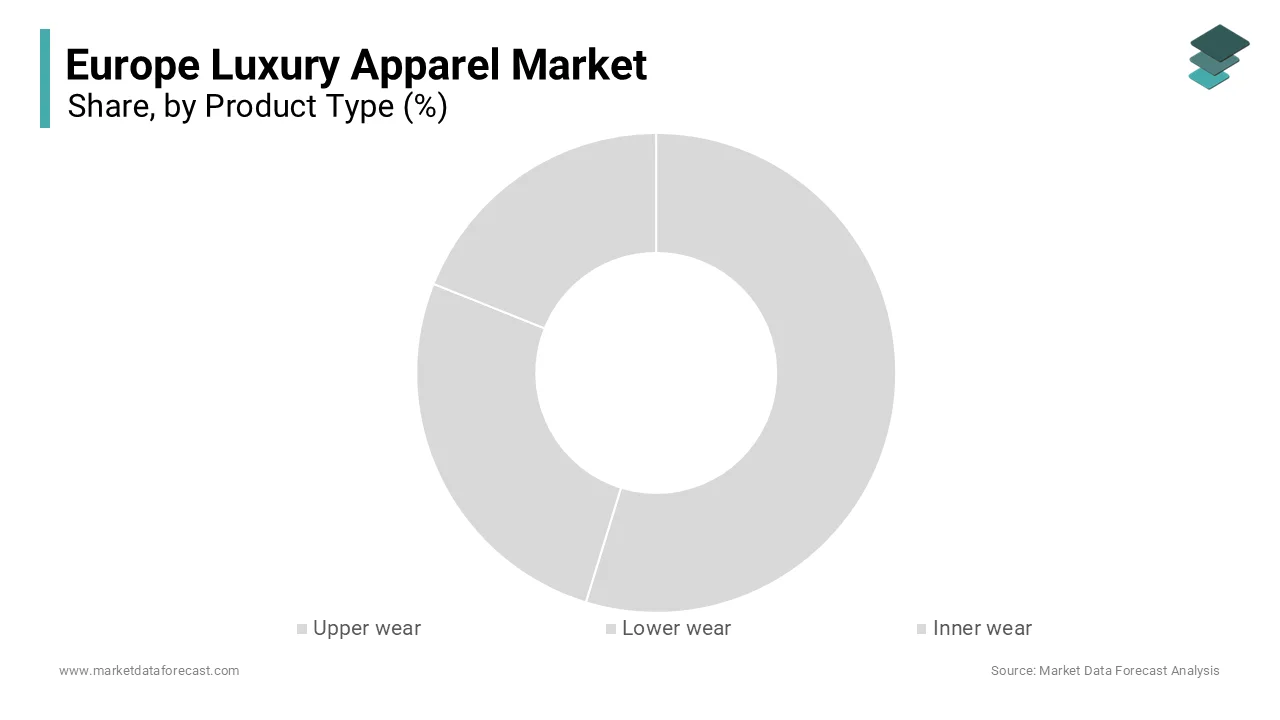
The innerwear segment is anticipated to grow at a promising CAGR of 8.7% over the forecast period in the European market. According to consumer surveys, affluent buyers increasingly prioritise premium materials, traceability, and skin health, signalling willingness to pay for silk and certified organic cotton undergarments. As per the EU Strategy for Sustainable and Circular Textiles, stricter chemical and durability requirements are guiding product reformulation and compliance in intimate apparel. This segment is expected to expand steadily over the forecast period as “quiet luxury” wellness-driven preferences reinforce demand for high-quality inner wear.
By Distribution Channel Insights
The specialist retailers segment occupied 58.5% of the European luxury apparel market share in 2025. The leading position of the specialist retailers segment in this European market is attributed to experiential retail, personalised fitting, and exclusive services that are difficult to replicate digitally. According to industry analyses by Cushman & Wakefield and RetailX, physical luxury stores remain the primary sales channel, supported by curated assortments and in-store services that strengthen trust and authenticity. This segment is expected to remain dominant over the forecast period as tactile evaluation and bespoke services continue to underpin luxury purchase behaviour.
The online retail segment is expected to register the fastest CAGR of 11.3% over the forecast period in the European market. According to the European Commission’s Digital Services Act, enhanced authentication and consumer protection measures are reinforcing confidence in online luxury transactions. As per European luxury retail reports, brands are scaling proprietary ecommerce with ARtry-onn, digital concierge, and 24/7 clienteling to preserve exclusivity while broadening access. This segment is expected to grow rapidly over the forecast period as immersive digital experiences and mobile commerce deepen engagement among technative luxury consumers.
By End User Insights
The women’s segment captured 67.7% of the European luxury apparel market share in 2025. The dominance of the women’s segment in this European market is driven by broader product diversity, richer seasonal narratives, and sustained creative investment in women’s lines. According to fashion industry reporting, women’s categories receive the majority of runway programming and marketing spend across leading maisons, reinforcing visibility and repeat purchasing. This segment is expected to sustain dominance over the forecast period as cultural design focus and female economic empowerment continue to amplify luxury demand.
The men’s segment is anticipated to exhibit a CAGR of 9.8% over the forecast period in the European market. According to European luxury market insights, elevated casualwear and refined tailoring are gaining traction, with brands emphasising natural fibres, artisanal finishes, and versatile silhouettes aligned to relaxed dress codes. As per retailer and consultancy reports, men’s luxury consumers demonstrate growing engagement with premium essentials and repeat purchasing within preferred maisons. This segment is expected to expand significantly over the forecast period as “new masculinity” and smartcasual wardrobes elevate men’s luxury apparel penetration.
REGIONAL ANALYSIS
France Market Analysis
France held the leading position in the European luxury apparel market in 2025 by accounting for 28.5% of the regional market share 2025. The dominance of France in the European market is driven by its haute couture heritage, strong retail hubs, and global tourism appeal. According to the Paris City Hall Economic Observatory, the Golden Triangle generates over €5 billion in annual luxury apparel sales, primarily from international tourists. France enforces strict couture regulations requiring ateliers to employ at least 20 full-time artisans and present 50 original designs per season. As per INSEE, French households spend an average of €1,850 annually on luxury apparel, reflecting robust domestic demand. France is expected to sustain unrivalled leadership in the luxury apparel market in the coming years.
Italy Market Analysis
Italy is a promising regional segment in the European luxury apparel market in 2025. According to the Italian National Institute of Statistics, Italy remains one of Europe’s largest apparel producers, with luxury garments leveraging centuries-old techniques in embroidery, leather finishing, and textile weaving. As per the Milan Chamber of Commerce, Milan generated €2.3 billion in luxury apparel sales in 2025, reinforcing its role as a secondary fashion capital. Italy is expected to remain indispensable as both a creative collaborator and production backbone in Europe’s luxury ecosystem in the coming years.
United Kingdom Market Analysis
The United Kingdom is anticipated to capture a substantial share of the European luxury apparel market over the forecast period. According to the UK Fashion and Textile Association, British luxury houses increasingly adopt sustainable practices, with a majority now using certified regenerative wool and traceable cotton. As per the Office for National Statistics, luxury apparel sales in Mayfair and Knightsbridge rebounded to 92% of prepandemic levels in 2025, underscoring London’s resilience as a tourist shopping destination. The UK is expected to sustain its influential market position in the coming years.
Germany Market Analysis
Germany is expected to exhibit a prominent CAGR in the European luxury apparel market during the forecast period. According to Statista, the German luxury goods market generated €6.2 billion in fashion revenue in 2025, which reflects strong domestic demand. As per the Federal Statistical Office, German households spend significantly on luxury apparel, prioritising durability and material authenticity. According to the German Consumer Organisation, 44% of consumers purchase pre-owned high-end apparel and resulting in the leadership of Germany in circular luxury adoption. Germany is expected to remain a stablehigh-valueue market less prone to trend volatility in the coming years.
Spain Market Analysis
Spain is predicted to account for a prominent share of the European luxury apparel market during the forecast period. According to the Spanish National Statistics Institute, Spain welcomed 138 million international visitors in 2025, a record high, with luxury shopping accounting for a significant share of retail expenditure. As per the Bank of Spain, the high-net-worth population grew by 8.3% in 2025, boosting domestic demand. The government’s “Spain Luxury” initiative has invested €120 million since 2022 to promote craft districts and support young designers. Spain is expected to strengthen its role as Southern Europe’s luxury fashion nexus in the coming years.
COMPETITIVE LANDSCAPE
KEY MARKET PLAYERS
Some of the notable key players in the European luxury apparel market are
- Valentino
- Burberry
- The Coach
- Gucci
- Calvin Klein
- Kate Spade
- Dolce & Gabbana
- Prada SpA
TOP STRATEGIES USED BY THE KEY MARKET PLAYERS
Key players in the European luxury apparel market prioritise vertical integration to maintain control over artisanal production and brand narrative. They invest heavily in sustainable material innovation, including regenerative fibres and bio-based dyes, to align with EU environmental mandates. Flagship stores are reimagined as cultural spaces offering personalised services and made-to-order experiences that reinforce exclusivity. Brands deploy digital product passports using blockchain to ensure traceability and comply with the EU Digital Product Passport regulation. Additionally, they foster direct consumer relationships througproprietary e-commerceee platforms featuring virtual styling and AR try on while avoiding third-party marketplaces to safeguard brand integrity and pricing discipline.
COMPETITION OVERVIEW
The European luxury apparel market is defined by a concentrated yet fiercely differentiated competitive environment where heritage craftsmanship, brandstorytelling,g and regulatory compliance outweigh price as decisive factors. Dominated by conglomerates like LVMH, Kerin,, and independent houses such as Chan, el competition revolves around creative direction, artisanal authenticity, and sustainability credibility rather than volume. New entrants face insurmountable barrierss including decades-long client relationships, protected design techniques, and stringent EU regulations on material traceability and labour practices. Incumbents leverage vertical integration to control everything from fabric mills to retail eexperience ensuring consistency and exclusivity. Digital transformation is embraced not to democratize access but to enhance personalisation and provenance verification. In this high-trust trust high-scrutiny arena, success depends on balancing innovation with tradition while navigating Europe’s evolving sustainability and consumer protection framework.
TOP PLAYERS IN THE MARKET
- LVMH is a cornerstone of the European luxury apparel landscape through its ownership of iconic fashion houses including Louis Vuitton Dior Celine and Loewe. The group champions vertical iintegration controlling design craftsmanship and retail to preserve brand exclusivity and quality. In 20,24 LVMH expanded its artisanal ateliers in France and Spain to address growing demand for fmade-to-orderder tailoring and hand-finished outerwear. It also launched a blockchain-based product passport across all apparel lines to comply with the EU’s Digital Product Passport mandate, enhancing traceability and consumer trust. Through strategic investments in sustainable materials such as regenerative wool and bio-based dyes, LVMH reinforces its leadership in responsible luxury while maintaining global influence across North America,a Asa and the Middle East.
- Kering SA stands as a pivotal force in European luxury apparel via its portfolio of Gucci, Saint Lauren,t Balenciaga,ga and Alexander McQueen. The groemphasises creative boldness coupled with rigorous environmental accountability. In 2023, Kering implemented its “Crafting Tomorrow’s Luxury” roadmap across all brands standardisingg GOTS-certified cotton and traceable leather sourcing throughout Europe. It also opened a new haute couture workshop in Florence dedicated to zero-waste pattern cutting and artisanal embroidery. Kering’s Environmental Profit and Loss account—pioneered over a decade ago—continues to guide material innovation and supply chain transparency, setting benchmarks for the global industry. Its focus on disruptive design and measurable sustainability solidifies its role as a progressive luxury leader worldwide.
- Chanel SA remains a paragon of timeless European luxuryy renowned for its haute couture tailoring, iconic tweed suits, and minimal ready-to-wear. The company maintains full ownership of key artisanal suppliers, including Lesage for embroidery and Massaro for footwearr ensuring unparalleled control over quality and heritage integrity. In 20,24 Chanel inaugurated a new sustainable textile laboratory in AAubervilliers France, focused on developing bio-based silk alternatives and low-impact dyeing techniques compliant with EU chemical regulations. It also enhanced its private client services in London, Mila, and Munich, offering digital lookbooks wiwith in-personittings to bridge digital convenience and tactile luxury. Chanel’s unwavering commitment to craftsmanship, exclusivity, and discreet innovation cements its global prestige and emotional resonance.
MARKET SEGMENTATION
This research report on the European luxury apparel market has been segmented and sub-segmented based on categories.
By Product Type
- Upper wear
- Lower wear
- Inner wear
By Distribution Channel
- Supermarkets and Hypermarkets
- Convenience Stores
- Specialist Retailers
- Online Retail
- Others
By End User
- Men
- Women
- Children
By Material
- Cotton
- Silk
- Leather
- Denim
By Country
- UK
- France
- Spain
- Germany
- Italy
- Russia
- Sweden
- Denmark
- Switzerland
- Netherlands
- Turkey
- Czech Republic
- Rest of Europe