- Product Description Description
- Table of Contents TOC
- List of Table & Figure LOT
- Get Free Sample PDF Sample PDF
Market Size, 2025
$1.43 BnMarket Estimate, 2026
$1.55 BnMarket Forecast, 2034
$2.98 BnCAGR, 2026–2034
8.5%Executive Summary: Global Online Clothing Rental Market
- Market Scope: Global market analysis covering end-user demographics, clothing styles, and regional landscapes.
- Market Valuation: Valued at USD 1.43 billion (2025), estimated at USD 1.55 billion (2026), and projected to reach USD 2.98 billion by 2034, growing at a CAGR of 8.50% (2026–2034).
- Primary Growth Drivers: Heightened sustainability demands (global fashion generating >92 million tons of annual waste, 85% of textiles ending in landfills/incinerators, and the industry accounting for ~10% of global carbon emissions), alongside social campaigns like #SlowFashion and #RentNotBuy surpassing 1.2 billion views.
Key Market Segment Metrics (2026–2034)
| Category | Leading Segment (2025 Position) | Fastest-Growing Segment |
|---|---|---|
| By End User | Women (67.4% global market share) | Children’s Segment (24.6% CAGR) |
| By Clothing Style | Formal Wear (52.5% market share for weddings, galas, and corporate events) | Casual Wear (19.3% CAGR) |
| By Region | North America (44.6% share; supported by mature e-commerce and subscription adoption) | Asia-Pacific (identified as the most dynamically growing regional market) |
Major Market Players & Market Structure
Market Structure: Competitive landscape shaped by subscription rental models, AI-driven personalization, virtual try-on tools, logistics efficiency, cleaning standards, fit accuracy, and inventory diversity.
Key Companies: Linen Rental, Flyrobe.com, Rent the Runway, Style Lend, Catwalk Rental, Liberent, Secoo Holding Limited, Share Wardrobe, Gwynnie Bee, Le Tote, Dress Hire, and Swapdom.
 Download Free Sample Report
Global Online Clothing Rental Market Size
The Global Online Clothing Rental Market is projected to grow from USD 1.43 billion in 2025 to USD 1.55 billion in 2026 and reach USD 2.98 billion by 2034, registering a CAGR of 8.5% during the forecast period from 2026 to 2034.

Online Clothing Rental refers to a digital-first, subscription and transaction-based model enabling consumers to lease garments for temporary use rather than purchasing them outright, facilitated through e-commerce platforms and logistics networks. This paradigm shift redefines ownership in fashion by emphasizing access over possession, aligning with evolving consumer values centered on sustainability, variety, and cost efficiency. Unlike traditional retail, the model operates on a circular economy framework, where garments are cleaned, maintained, and recirculated across multiple users, thereby extending product lifecycles and reducing textile waste.
As per the United Nations Environment Programme, the global fashion industry produces over 92 million tons of waste annually, with 85% of textiles ending up in landfills or incinerators. The online rental model directly counters this linear consumption pattern by promoting reuse. In urban centers across Europe and North America, younger demographics are increasingly adopting rental platforms for special occasions, workwear, and seasonal fashion experimentation. Besides, institutions such as the Sustainable Apparel Coalition have recognized clothing rental as a key strategy in reducing the environmental footprint of apparel, particularly in categories like formalwear and fast fashion, where utilization rates are traditionally low. This reconfiguration of consumer behavior reflects a broader cultural pivot toward experiential consumption and responsible resource use.
MARKET DRIVERS
Rising Environmental Consciousness Among Millennials and Gen Z Consumers
The growing environmental awareness among younger consumer cohorts, particularly millennials and Generation Z, who are redefining fashion consumption through ethical and ecological considerations, is a pivotal driver of the online clothing rental market. This demographic shift is particularly evident in urban markets such as London, Los Angeles, and Sydney, where climate activism and digital advocacy have heightened awareness of fashion’s carbon footprint. The Intergovernmental Panel on Climate Change highlights that the textile industry accounts for approximately 10% of global carbon emissions, more than international aviation and maritime shipping combined, making it a focal point for behavioral change.
Platforms like Rent the Runway and Hurr Collective have capitalized on this sentiment by transparently communicating the environmental savings of each rental cycle, such as water conservation and CO₂ reduction. In response, educational institutions like the London College of Fashion have integrated circular economy principles into curricula, fostering a new generation of designers and consumers who prioritize access over ownership. Furthermore, social media influencers and sustainability advocates have amplified the message, with campaigns on Instagram and TikTok generating over 1.2 billion views under hashtags like #SlowFashion and #RentNotBuy. This cultural realignment, rooted in planetary responsibility and informed consumption, has transformed clothing rental from a niche convenience into a symbol of modern ethical living, fueling its rapid adoption across digitally connected populations.
Urbanization and the Demand for Fashion Flexibility in Metropolitan Lifestyles
The accelerating pace of urbanization and the corresponding need for dynamic, adaptable wardrobes among city-dwelling professionals and creatives, is another significant demand driver. As per the United Nations Department of Economic and Social Affairs, over half of the global population now resides in urban areas, a share projected to rise to 60%by 2030, with density concentrated in fashion-forward metropolises such as Tokyo, Paris, and New York. In these environments, social and professional expectations demand frequent wardrobe rotation, yet spatial constraints and economic pressures limit the feasibility of extensive personal collections.
The online clothing rental market addresses this dissonance by offering curated access to high-end and designer apparel without the burden of ownership. In cities like Berlin and Seoul, where apartment sizes average under 70 square meters, consumers are increasingly adopting minimalist lifestyles that prioritize utility and versatility. Besides, the gig economy and hybrid work models have blurred dress codes, increasing demand for context-specific attire. Platforms such as ByRotation and Flyrobe have responded by introducing flexible subscription tiers and same-week delivery in key urban hubs. This synergy between urban living conditions and digital convenience has positioned clothing rental as an essential utility for modern city life, where style, space, and sustainability intersect.
MARKET RESTRAINTS
Hygiene and Sanitization Concerns Affecting Consumer Trust
Consumer skepticism regarding garment hygiene and post-use sanitization processes is one of the most persistent restraints in the online clothing rental market. Despite advancements in industrial cleaning technologies, potential users in North America and Western Europe expressed discomfort with wearing clothing previously used by others, citing risks of allergens, bacteria, and residual odors. This psychological barrier is particularly pronounced in intimate apparel and activewear categories, where skin contact is extensive. While companies employ methods such as ozone treatment, ultrasonic cleaning, and antimicrobial steaming, transparency about these procedures remains inconsistent. Like, there is currently no harmonized EU-wide certification for garment hygiene in rental services, leading to variable quality control across providers. In Japan, where cleanliness standards are exceptionally high, only a limited portion of surveyed consumers trusted third-party cleaning claims made by rental platforms. Moreover, the lack of visible, real-time verification, such as blockchain-tracked cleaning logs, further erodes confidence. During the post-pandemic period, heightened sensitivity to public health amplified these concerns.
High Operational Complexity and Logistical Inefficiencies in Garment Circulation
The logistical demands of managing a scalable online clothing rental platform present a formidable barrier to market expansion, particularly in regions with fragmented infrastructure and low population density. Each rental cycle involves multiple touchpoints, collection, transportation, sorting, cleaning, quality inspection, repackaging, and redistribution, requiring a tightly coordinated supply chain to maintain garment integrity and service reliability. In countries like Australia and Canada, where urban centers are geographically dispersed, maintaining rapid turnaround times becomes economically unviable without significant investment in regional hubs. Additionally, garment damage and loss rates remain elevated; in UK, some of rented items returned to major platforms required repair or were retired due to wear, directly impacting profitability. The absence of standardized packaging and tracking systems further complicates inventory management, especially when integrating third-party dry cleaners or courier services. These operational bottlenecks not only inflate costs but also compromise customer experience, undermining the promise of convenience that underpins the rental value proposition.
MARKET OPPORTUNITIES
Expansion into Corporate and Professional Wear Segments
The growing corporate demand for sustainable professional attire, driven by evolving workplace norms and employer-led sustainability initiatives, is a significant opportunity. Multinational corporations such as Deloitte, PwC, and Unilever have launched internal sustainability pledges, including commitments to reduce employee carbon footprints, prompting interest in rental solutions for workwear. Platforms like Armoire in the U.S. and Style Lend in the UK have reported a year-on-year increase in corporate subscriptions, with companies covering rental fees as part of employee benefits. Furthermore, the rise of hybrid work models has reduced the need for daily office attire, making ownership less practical. By partnering with HR departments and offering bulk leasing, analytics dashboards, and branded wardrobe programs, rental platforms can transition from individual transactions to institutional contracts, unlocking a high-value, low-churn market segment.
Integration with Digital Fashion and Virtual Try-On Technologies
The convergence of online clothing rental with digital fashion innovations presents a transformative opportunity to enhance user engagement and reduce return rates. Platforms such as H&M and Zalando have already integrated 3D avatar-based try-ons, reducing size-related returns. For rental services, where fit accuracy is critical to customer satisfaction and garment longevity, these tools offer a strategic advantage. Companies like Virtusize and Zeekit (acquired by Walmart) enable users to visualize how garments drape on body types similar to their own, minimizing mismatches. Additionally, the emergence of digital-only fashion for social media use creates a hybrid model where consumers rent physical garments for real-world events and pair them with digital ensembles for online presence. This dual-access model enhances perceived value and encourages repeat usage. By embedding AR try-ons, AI-driven recommendations, and gamified styling interfaces, rental platforms can elevate the user journey from transactional to experiential, fostering loyalty and reducing operational friction.
MARKET CHALLENGES
Scaling Sustainable Practices Amid Greenwashing Allegations
The intensifying scrutiny over genuine sustainability claims, with growing accusations of greenwashing undermining consumer trust, is a major challenge confronting the online clothing rental market. Regulators are responding. The complexity arises because while rental models reduce textile waste, their environmental benefits can be offset by high transportation emissions and energy-intensive cleaning processes. Furthermore, the durability of garments is often overstated. To maintain credibility, companies must adopt transparent reporting, invest in low-impact logistics, and align with international sustainability standards, or risk regulatory penalties and reputational damage.
Balancing Inventory Diversity with Economic Viability
Maintaining a broad, trend-responsive inventory while ensuring economic sustainability remains a critical operational challenge for online clothing rental platforms. Consumers expect access to a wide range of styles, sizes, and designer labels, yet acquiring and maintaining high-fashion inventory involves substantial capital outlay and risk. Fast-changing fashion cycles exacerbate the issue. Additionally, size inclusivity demands further strain inventory efficiency. Platforms like Nuuly and Le Tote have struggled with overstocking, resulting in financial losses and eventual restructuring. Moreover, exclusive partnerships with luxury brands often come with restrictive terms, limiting resale or redistribution rights. Without predictive analytics and demand forecasting tools tailored to rental behavior, companies face a perpetual trade-off between customer satisfaction and unit economics. This imbalance threatens scalability, especially in markets where consumer acquisition costs are rising and profit margins remain thin.
REPORT COVERAGE
| REPORT METRIC | DETAILS |
| Market Size Available | 2025 to 2034 |
| Base Year | 2025 |
| Forecast Period | 2026 to 2034 |
| CAGR | 8.5% |
| Segments Covered | By End-User, Clothing Style and Region |
| Various Analyses Covered | Global, Regional & Country Level Analysis, Segment-Level Analysis, DROC, PESTLE Analysis, Porter’s Five Forces Analysis, Competitive Landscape, Analyst Overview of Investment Opportunities |
| Regions Covered | North America, Europe, Asia Pacific, Latin America, Middle East & Africa |
| Key Market Players | Linen rental, Flyrobe.com, Rent the Runway, Style Lend, Catwalk rental, Liberent, Secoo Holding Limited, Share Wardrobe, Gwynnie Bee, Le Tote, Dress Hire and Swapdom |
SEGMENTAL ANALYSIS
By End-Users Insights
The women’s segment dominated the online clothing rental market by capturing 67.4% of the global market share in 2025. This overwhelming dominance is primarily driven by deeply embedded consumer behavior patterns and the expansive diversity of occasions that necessitate wardrobe variation among female consumers. A crucial factor underpinning this leadership is the frequency and variety of social and professional events that demand distinct sartorial expressions. This professional pressure, combined with the cultural emphasis on fashion experimentation, fuels demand for rotating wardrobes. Platforms like Rent the Runway and My Wardrobe HQ report that a notable share of their active subscribers are women, primarily for work events, weddings, and holidays. The psychological aspect of fashion as self-expression is also more pronounced among women. Additionally, the fast fashion cycle disproportionately affects women’s wear, with Zara and H&M introducing many new women’s collections annually, incentivizing rental access over ownership. This confluence of professional expectations, social dynamics, and rapid trend turnover establishes the women’s segment as the cornerstone of the online clothing rental economy. A further pivotal driver reinforcing the dominance of the women’s segment is the maturity and depth of product offerings tailored specifically to female consumers. Several designer collaborations in the rental space—such as those with Reformation, Self-Portrait, and Victoria Beckham—are focused on women’s apparel, ensuring access to high-demand, occasion-specific garments. The availability of extended sizing has further broadened appeal. Moreover, the integration of styling services and AI-driven recommendations has enhanced personalization. The presence of influential female-led digital communities on platforms like Instagram and TikTok has amplified visibility. This ecosystem of curated inventory, inclusive sizing, and social validation creates a self-reinforcing cycle of engagement, making the women’s segment not only the largest but also the most commercially sustainable within the rental landscape.
The children’s segment is emerging as the fastest-growing category in the online clothing rental market and is projected to expand at a CAGR of 24.6% from 2025 to 2033. This accelerated growth is primarily fueled by the exceptionally rapid growth cycles of infants and toddlers, which render ownership of clothing economically inefficient and environmentally wasteful. Parents are increasingly recognizing this inefficiency. Platforms such as Petit Praise in the UK and Hela in France have reported an increase in subscription sign-ups since 2022, driven by eco-conscious millennial parents. The economic incentive is substantial, making rental models an attractive alternative. With circularity principles gaining traction in family consumption habits, the children’s segment is rapidly transitioning from novelty to necessity. An additional major factor propelling the growth of the children’s rental segment is the rising institutional and policy-level support for sustainable parenting practices. As per the European Commission’s Circular Economy Action Plan for Textiles, member states are incentivizing reusable childcare products, including clothing, through tax breaks and public awareness campaigns. The durability and safety standards of rental garments also align with parental concerns; garments in certified rental pools undergo rigorous testing for fabric integrity, flame resistance, and allergen content, often exceeding retail benchmarks. Furthermore, the emotional appeal of passing on high-quality baby clothes, such as organic cotton gowns and hand-knitted sets, resonates with values of legacy and care. This convergence of practical necessity, regulatory encouragement, and ethical parenting is positioning children’s clothing rental as one of the most dynamic and socially resonant segments in the broader fashion ecosystem.
By Clothing Style Insights
The Formal wear segment led within the online clothing rental market by accounting for 52.5% of the global market share in 2025. This dominance is due to the episodic and high-cost nature of formal attire, which makes ownership impractical for most consumers. Weddings, galas, award ceremonies, and corporate events require garments that are often worn only once or twice, yet carry premium price tags. This inefficiency has created a fertile ground for rental platforms to offer access to designer formalwear at a fraction of retail cost. In the UK, as per the Office for National Statistics, a high number of weddings occur annually, generating sustained demand for cocktail dresses, tuxedos, and evening gowns. Platforms like Hurr Collective and ByRotation have capitalized on this, pointing out that a significant portion of their bookings are for formal occasions. The psychological barrier to wearing pre-used clothing is also lower in this context, as consumers perceive formal garments as less intimate and more transactional in use. Apart from these, the prestige associated with designer labels, such as Oscar de la Renta, Ralph & Russo, and Tom Ford, enhances the appeal of temporary access, allowing users to project status without long-term investment. This alignment of economic rationality, social expectation, and aspirational branding solidifies formal wear as the most lucrative and established segment in the rental market. An additional critical factor reinforcing the dominance of formal wear is the strong partnership ecosystem between rental platforms and luxury fashion houses. Brands like Dior and Gucci have permitted limited rental distribution to maintain exclusivity while expanding reach. The Italian National Fashion Chamber has endorsed this model, noting that rental exposure has led to an increase in full-price purchases among users who first experience garments through leasing. Furthermore, formal wear is inherently more durable and less prone to fit-related returns; the European Apparel and Textile Confederation points out that formal garments undergo more rental cycles on average before retirement, compared to those for casual wear, improving unit economics. The standardization of sizing in formal attire, particularly in suits and evening gowns, also reduces logistical complexity. With formal events showing no sign of decline and consumer aversion to single-use fashion growing, the segment remains the financial backbone of the online clothing rental industry.
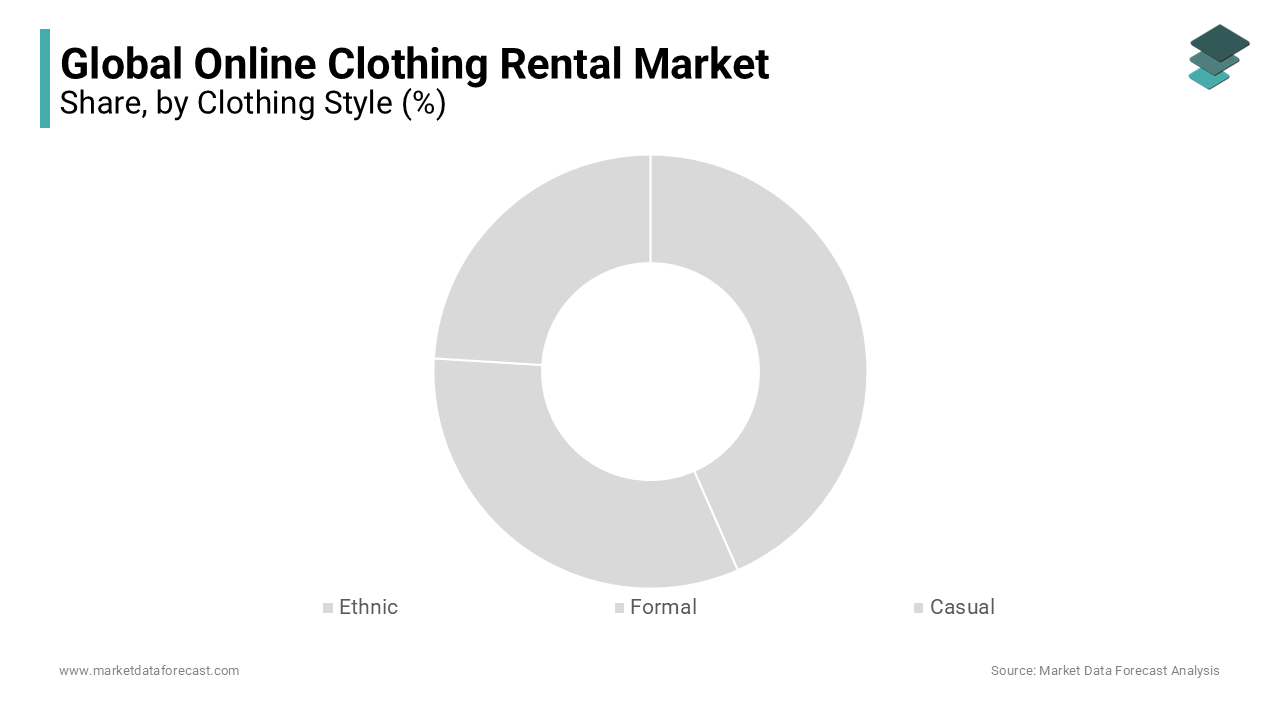
The casual wear segment is the fastest-growing in the online clothing rental market and is projected to grow at a CAGR of 19.3% from 2025 to 2033. This surge is driven by the normalization of hybrid lifestyles and the erosion of rigid dress codes in both professional and social environments. The rise of remote and hybrid work models has diminished the need for formal office attire, shifting consumer focus toward versatile, comfortable clothing suitable for video calls, errands, and informal gatherings. Platforms such as Armoire and Tulerie have reported an increase in rentals of elevated casualwear—such as linen shirts, tailored joggers, and minimalist knits since 2022. The appeal lies in the ability to refresh everyday looks without the clutter of ownership. Rental models allow consumers to experiment with trends like “quiet luxury” and “gorpcore” without long-term commitment, aligning with the values of minimalism and experiential consumption. A further key driver of casual wear’s rapid growth is the integration of sustainability into daily lifestyle choices, particularly among younger demographics. Casual wear, being the most frequently replaced category, contributes disproportionately to textile waste. Rental platforms address this by promoting extended garment use. Additionally, brands are embedding circularity into their casual lines; Levi’s SecondHand program and Eileen Fisher’s Renew initiative have inspired rental collaborations that emphasize durability and timeless design. The social normalization of repeat wearing, amplified by influencers advocating “capsule wardrobes,” further supports this shift. With casual wear becoming the new fashion frontier for personal expression and environmental responsibility, its rental adoption is accelerating across global markets.
REGIONAL ANALYSIS
North America Online Clothing Rental Market Analysis
North America led the global online clothing rental market by accounting for 44.6% in 2025. The region’s top position is anchored in a mature e-commerce infrastructure, high consumer disposable income, and early adoption of subscription-based services. The United States, in particular, has been the birthplace of major rental platforms such as Rent the Runway and Nuuly, which have normalized the concept of temporary fashion access. Urban centers like New York, Los Angeles, and Chicago exhibit high penetration rates, with a potion of women aged 25–40 engaging in clothing rental. The presence of a robust venture capital ecosystem has enabled rapid scaling, while consumer familiarity with digital transactions and same-day delivery networks enhances usability. Additionally, corporate sustainability mandates in tech and finance sectors have driven demand for professional wear rental. With strong brand partnerships, regulatory clarity, and a culture of innovation, North America continues to set the pace for global market development.
Europe Online Clothing Rental Market Analysis
Europe captures a significant position in the global online clothing rental market, with the UK, Germany, and France leading in adoption. The region’s growth is propelled by stringent environmental regulations and a deeply rooted culture of sustainability. The European Union’s Circular Economy Action Plan has classified textiles as a priority sector, prompting national initiatives such as France’s anti-waste law and Sweden’s tax incentives for repair and reuse services. The UK’s rental market is particularly advanced, with platforms like Hurr and ByRotation gaining traction among urban professionals. Germany’s emphasis on quality and durability aligns well with rental models, while Scandinavian countries are pioneering public-private collaborations in circular fashion. With strong policy support, high digital literacy, and consumer trust in shared economies, Europe remains a critical hub for innovation and ethical fashion transformation.
Asia Pacific Online Clothing Rental Market Analysis
The Asia Pacific region in the global market is witnessing the most dynamic growth trajectory. Countries like Japan, South Korea, and Australia are driving adoption through technological sophistication and urban density. Japan’s YCloset and Korea’s StyleShare have introduced seamless mobile-first rental experiences, supported by efficient logistics networks. Australia’s My Wardrobe HQ has gained traction in major cities, leveraging eco-conscious consumer sentiment. However, cultural preferences for ownership and limited awareness in Southeast Asia constrain expansion. With rising middle-class affluence and government-backed sustainability programs in cities like Singapore, the region is poised for accelerated growth, especially in formal and occasion wear segments.
Latin America Online Clothing Rental Market Analysis
Latin America accounts for notable share of the global market, with Brazil and Mexico showing early signs of adoption. The region’s market is characterized by vibrant social cultures where weddings, quinceañeras, and festivals generate demand for special occasion wear. Brazilian platforms like Alugaê have gained traction in São Paulo and Rio de Janeiro, offering access to designer dresses at affordable rates. However, logistical challenges, limited cold chain infrastructure for garment care, and low credit card penetration hinder scalability. Despite these barriers, rising environmental awareness and youth-driven digital innovation suggest long-term potential, particularly in urban centers embracing circular economy principles.
Middle East and Africa Online Clothing Rental Market Analysis
The Middle East and Africa collectively represent small share of the global market, with the Gulf Cooperation Council (GCC) nations leading in adoption. The UAE, particularly Dubai and Abu Dhabi, has emerged as a regional hub due to high disposable income, luxury consumption, and government support for smart city initiatives. Platforms like The Style Circle offer curated designer rentals for weddings and social events, catering to a fashion-conscious elite. In contrast, Sub-Saharan Africa faces significant barriers, including underdeveloped logistics and low internet penetration. However, Nairobi and Cape Town are witnessing grassroots circular fashion movements, supported by local designers and NGOs. With strategic investments in digital infrastructure and sustainability, the region may unlock niche opportunities in high-end and cultural wear rental.
KEY MARKET PLAYERS AND COMPETITIVE LANDSCAPE
Linen rental, Flyrobe.com, Rent the Runway, Style Lend, Catwalk rental, Liberent, Secoo Holding Limited, Share Wardrobe, Gwynnie Bee, Le Tote, Dress Hire and Swapdom are some of the noteworthy companies in the global online clothing rental market.
The competitive dynamics of the online clothing rental market are shaped by a convergence of innovation, brand identity, and consumer trust. While early entrants have established strong footholds through scale and recognition, the sector remains highly fragmented, with niche players differentiating themselves through specialization in demographics, occasions, or sustainability practices. The absence of dominant monopolies has fostered a landscape where agility and customer experience often outweigh sheer size. Incumbents face pressure from both tech-savvy startups leveraging AI-driven personalization and traditional retailers launching their own rental arms, blurring industry boundaries. Differentiation is increasingly achieved not just through inventory breadth but through operational excellence—particularly in logistics, cleaning standards, and fit accuracy. Trust remains a critical battleground, with companies investing heavily in transparency, hygiene certification, and user reviews to overcome psychological barriers to shared clothing. The integration of digital fashion and virtual try-ons is further redefining engagement, allowing platforms to merge physical and digital experiences. As sustainability becomes a non-negotiable expectation rather than a unique selling point, competition is shifting toward authenticity, service depth, and cultural relevance. The market’s future will likely be determined by those who can seamlessly align ethical values with convenience, style, and technological sophistication.
TOP PLAYERS IN THE MARKET
Rent the Runway
Rent the Runway has redefined the fashion landscape by pioneering the concept of designer wardrobe access through a scalable subscription and rental model. The company has played a transformative role in normalizing the idea of temporary ownership, particularly in North America, where it has influenced consumer perceptions of value, sustainability, and versatility in fashion. By forging partnerships with hundreds of high-end designers, it offers an expansive catalog that spans occasion wear, workwear, and casual styles, enabling users to experiment with trends without long-term commitment. Its seamless digital platform, integrated logistics, and emphasis on customer experience have set industry benchmarks. Beyond commerce, Rent the Runway has contributed to broader conversations about circular fashion, influencing both consumer behavior and brand strategies. Its early-mover advantage and consistent innovation have established it as a foundational force in the evolution of the online clothing rental ecosystem.
Hurr Collective
Hurr Collective has emerged as a trailblazer in the peer-to-peer segment of the online clothing rental market, introducing a decentralized model that empowers individuals to rent out their personal designer wardrobes. By leveraging trust-based verification, secure packaging, and professional cleaning partnerships, the platform has successfully addressed concerns around hygiene and reliability in shared fashion. Its community-driven approach fosters a sense of ownership and participation, transforming users from passive consumers into active contributors to a circular economy. The company has also championed sustainability through transparency, showcasing the environmental impact of each rental to reinforce ethical consumption. Hurr’s model has inspired similar platforms across Europe and demonstrated the viability of asset-light, scalable rental networks. By democratizing access to luxury fashion and promoting collaborative consumption, Hurr Collective has reimagined the social dynamics of clothing use.
My Wardrobe HQ
My Wardrobe HQ has positioned itself as a premium player in the online clothing rental space by combining curated luxury inventory with a strong commitment to sustainability and inclusivity. Operating primarily in the UK and expanding into Europe, the platform offers high-quality garments from renowned designers, emphasizing durability, timeless style, and responsible production. Its focus on elevated occasion wear and professional attire caters to a discerning clientele seeking both aesthetic and ethical value. The company has strengthened its brand through strategic collaborations with fashion houses and sustainability advocates, reinforcing its identity as a steward of circular fashion. My Wardrobe HQ also prioritizes user experience, offering personalized styling support and seamless logistics to enhance retention. By aligning luxury consumption with environmental responsibility, it has carved a distinct niche in a competitive market, setting a precedent for how premium fashion can evolve in a post-ownership era.
TOP STRATEGIES USED BY KEY PLAYERS
One major strategy employed by leading players is brand differentiation through sustainability storytelling. Companies are investing in transparent supply chains, carbon footprint labeling, and lifecycle tracking to position themselves as environmentally responsible alternatives to fast fashion. This narrative is reinforced through partnerships with eco-certification bodies and environmental NGOs, enhancing credibility and resonating with ethically conscious consumers.
Another key approach is the development of hybrid business models that blend rental subscriptions with resale, repair, and product care services. By offering a full spectrum of circular fashion solutions, companies increase customer lifetime value and deepen engagement. This strategy not only diversifies revenue streams but also reinforces brand loyalty by embedding the platform into the user’s long-term wardrobe management.
A third critical strategy is the cultivation of community and social engagement through digital platforms. Companies are leveraging user-generated content, influencer collaborations, and membership tiers to create a sense of belonging and exclusivity. These communities serve as both marketing channels and feedback loops, enabling rapid iteration and fostering emotional connections that transcend transactional relationships.
RECENT HAPPENINGS IN THE MARKET
- In February 2024, Rent the Runway partnered with a major luxury fashion house to launch an exclusive capsule collection available only through its rental platform, enhancing brand differentiation and attracting high-value subscribers.
- In March 2024, Hurr Collective introduced a blockchain-based garment tracking system to provide users with verified cleaning and usage history, significantly improving transparency and consumer confidence in peer-to-peer rentals.
- In January 2024, My Wardrobe HQ expanded its operations into France and Germany, establishing local logistics partnerships to ensure rapid delivery and efficient garment maintenance across Western Europe.
- In May 2024, Nuuly launched a resale marketplace integrated within its app, allowing members to buy and sell pre-loved rental items, thereby extending garment lifecycles and diversifying revenue streams.
- In June 2024, Armoire collaborated with a leading corporate wellness provider to offer clothing rental as an employee benefit, targeting hybrid work professionals and expanding into the B2B segment.
MARKET SEGMENTATION
This research report on the global online clothing rental market has been segmented and sub-segmented based on clothing style, end-user and region.
By Clothing Style
- Ethnic
- Formal
- Casual
By End-User
- Women
- Men
- Children
By Region
- North America
- Europe
- Asia Pacific
- Latin America
- The Middle East and Africa